Introduction
The African rice gall midge (AfRGM) Orseolia oryzivora Harris and Gagné (Diptera: Cecidomyiidae) is an important insect pest of rainfed and irrigated lowland rice in Africa (Williams et al., Reference Williams, Okhidievbie, Harris and Ukwungwu1999; Nwilene et al., Reference Nwilene, Nwanze and Okhidievbie2006). It has also been reported in the rainfed upland ecology in Burkina Faso (Dakouo et al., Reference Dakouo, Nacro and Sie1988). It was first identified as a distinct species by Harris and Gagné (Reference Harris and Gagné1982), having previously been confused with the Asian rice gall midge Orseolia oryzae (Wood-Mason), which does not occur in Africa. Its pest status has been increasing over the last few decades in Nigeria (Taylor et al., Reference Taylor, Fomba, Fanah and Bernard1995; Nacro et al., Reference Nacro, Heinrichs and Dakouo1996). Crop damage is caused by the larvae of AfRGM, which infest rice tillers at the vegetative growth stage, inducing the formation of tubular galls called silver shoots or onion leaves. The infested tillers are irreversibly damaged and are unable to initiate growth of more leaves or a panicle (Ukwungwu and Misari, Reference Ukwungwu and Misari1997; Ogah et al., Reference Ogah, Echezona and Umeh2005). Infested plants normally respond by the production of extra tillers, but these tillers often also become infested and result in stunting of the plant.
Severe outbreaks of AfRGM in many parts of Nigeria and elsewhere in Africa have resulted in almost total yield loss in the worst affected areas (Ukwungwu and Joshi, Reference Ukwungwu and Joshi1992a; Heinrichs and Barrion, Reference Heinrichs, Barrion and Hettel2004). In West Africa, Nigeria is reported to be the ‘hot spot’ for gall midge infestation. Severe gall midge incidence in Nigeria was reported in the Federal States of Plateau and Niger (Ukwungwu et al., Reference Ukwungwu, Alam and Kaung Zan1984). In 1988, there was a severe outbreak in the Guinea savanna zone of Nigeria (Ukwungwu et al., Reference Ukwungwu, Winslow and John1989). The most severe damage was in Abakaliki, Anambra State, where up to 80% tiller infestation was observed, about 50,000 ha of rice were damaged and total grain losses were recorded in severely infested fields.
Several studies have been undertaken to identify appropriate control measures against this pest. Chemical control has several drawbacks such as the financial costs, risks to human health and the possible destruction of natural enemies (Nacro, Reference Nacro1984), which could result in new pest outbreaks. Despite intensive screening, so far no Oryza sativa L. (Poaceae) lines with very strong resistance under high AfRGM pressure have been found. However, a number of lines with moderate AfRGM resistance when compared with currently released varieties have been identified (Ukwungwu and Alam, Reference Ukwungwu and Alam1991; Ukwungwu and Joshi, Reference Ukwungwu and Joshi1992b). Most of these lines are traditional varieties, which, although potentially useful as sources of resistance in a breeding programme, are unsuitable for direct release to farmers because of their low yield (Williams et al., Reference Williams, Okhidievbie, Harris and Ukwungwu1999).
Biological control seems to be the most promising option of controlling AfRGM. Diverse complexes of natural enemies of AfRGM have been identified in Nigeria and other West African countries that can reduce AfRGM to tolerable levels (Umeh et al., Reference Umeh, Joshi and Ukwungwu1991; Ukwungwu and Misari, Reference Ukwungwu and Misari1997). Some egg predators have been reported (Williams et al., Reference Williams, Harris, Ukwungwu, Nacro, Dakouo, Nwilene, Singh and Okhidievbie2002), which include tiny predatory mites, Neoseiulus spp. (Acari: Phytoseiidae), Cyrtorhinus viridis Linnavuori (Heteroptera: Miridae), Conocephalus longipennis de Haan (Orthoptera: Tettigoniidae), Anaxipha longipennis Serville (Orthoptera: Gryllidae) and ladybird beetles (Coleoptera: Coccinellidae). Two common parasitoids of the AfRGM include Platygaster diplosisae Risbec (Hymenoptera: Platygastridae), a gregarious egg/larval endoparasitoid, and Aprostocetus procerae ( = Tetrastichus pachydiplosisae) Risbec (Hymenoptera: Eulophidae), a solitary pupal ectoparasitoid (Dakouo et al., Reference Dakouo, Nacro and Sie1988). Parasitism caused by these two parasitoids can reach as high as 77% of the immature populations of the pest (Marshall, Reference Marshall1906; Hidaka, Reference Hidaka1988; Williams et al., Reference Williams, Okhidievbie, Harris and Ukwungwu1999; Ba, Reference Ba2003).
The lack of knowledge of the population dynamics of AfRGM and its parasitoids can hinder control measures against it. Understanding the factors that influence the distribution and abundance of an insect is a fundamental issue in insect ecology and is a practical concern with insects that cause economic damage (Baskauf, Reference Baskauf2003; Murua et al., Reference Murua, Molina-Ochoa and Coviella2006). Because AfRGM is widely distributed, it is subjected to much climatic diversity and other ecological factors, namely relative humidity, temperature, rainfall and soil type. There is limited information on the population dynamics of AfRGM and how environmental factors affect it in Nigeria. There is also a lack of information on the natural distribution and abundance of the parasitoids associated with AfRGM in Nigeria. Identifying AfRGM parasitoids and determining their temporal occurrence will advance AfRGM biological control efforts.
Materials and methods
Sampling sites
Ogidiga and Edozhigi are hot-spot locations for AfRGM in Nigeria. Both sites have had regular gall midge outbreaks since the late 1980s. Ogidiga (near Abakaliki in southeast Nigeria) falls within the forest zone with latitude 06°17′N, longitude 08°04′E and altitude 104 m above sea level (masl). Edozhigi (near Bida in north central Nigeria) falls within the Guinea savanna zone with latitude 09°45′N, longitude 06°07′E and altitude 51 masl. Their rainfall patterns are bimodal with an average annual rainfall of about 1800–2200 and 900–1050 mm per annum for Ogidiga and Edozhigi, respectively, distributed between May and October. Their average daily temperature fluctuates between 20 and 35 °C with an annual mean of 26.5 and 27.4 °C, respectively. Mean relative humidity is in the range of 64–83% and 52–73% for Ogidiga and Edozhigi, respectively. The soils are ultisol and alfisol and slightly acidic with pH values of 4.5–4.9 and 5.5–6.3 for Ogidiga and Edozhigi, respectively. Both sites are rainfed lowland rice-growing areas.
Field sampling
The study was conducted in farmers' fields at Ogidiga and Edozhigi – also used for experimental work on AfRGM by both the Africa Rice Center (WARDA) and the National Cereal Research Institute. The area planted to lowland rice at each location measured 0.5 ha and planting was done in May. The rice variety grown at Ogidiga was Cisadane – released as FARO 51 in Nigeria. At Edozhigi, ITA 306 (also known as FARO 37) was used. Both varieties are susceptible to the AfRGM. Insecticides were not applied on any of the fields sampled.
The light trap was installed in each rice field as follows: a wooden framework with a tripod stand was anchored firmly to the ground. A light source, consisting of a kerosene lamp, was mounted on the frame in five locations within each experimental site. A shallow bowl of water was placed directly underneath (about 5 cm below) the lamp. Liquid soap was added to the water, so that any insect that was attracted by the light and landing on the water would sink. The light was mounted at the height of the rice plants. The whole construction was quite robust, so that it could not be blown down by wind or knocked over by animals. The light was operated from dusk to dawn, once per week. Light-trap catches of gall midge adults were collected, rinsed with clean water, counted and preserved in 70% alcohol. An average gall midge adult density per site was based on the total number of samples collected for the period (Umeh and Joshi, Reference Umeh and Joshi1993; Umeh and Dakouo, Reference Umeh and Dakouo1998; Ba et al., Reference Ba, Dakouo, Nacro and Ouédraogo2005).
Sampling for adult AfRGM using the light trap was conducted at weekly and sometimes at monthly intervals at both locations from June to December of 2006 and 2007. For each field sampled, 50 plants were randomly selected to assess the intensity of damage due to AfRGM (% tiller infestation) and dissected for % parasitism (parasitized larvae and pupae and parasitoid species present). Data on temperature, relative humidity and rainfall were collected from the weather stations in the zones.
Statistical analysis
An arcsine transformation was used on adult AfRGM populations from the light-trap catches, % tiller infestation and % parasitism data prior to ANOVA (SAS, 2002–2003). The mean separation was carried out by Tukey's studentized range test. Pearson correlation coefficient (r) was used to determine the relationship between adult populations from light-trap catches and % tiller infestation, and between % tiller infestation and parasitism by P. diplosisae and A. procerae.
Results
Light-trap catches of adult AfRGM populations
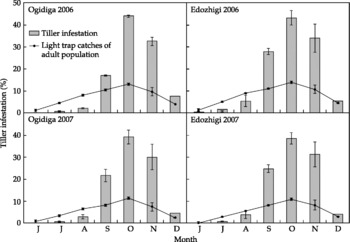
Adult AfRGM populations were very low in July and August – beginning of the rainy season, followed by a period of rapid increase in October, and a decline starting from November to December (Fig. 1). There were consistencies in the peak period of light-trap catches of adult AfRGM populations in October of both years. At both locations, the overall mean number of adult populations was greater in the rainy season of 2006 than in 2007 (Fig. 1). Although Edozhigi recorded higher adult populations compared with Ogidiga, there was no significant difference between the gall midge populations at both locations.
Mean % tiller infestation ( ± SE) and mean adult AfRGM population ( ± SE) from light-trap catches at Ogidiga and Edozhigi during the 2006 and 2007 rainy seasons.

The 2006 cropping season recorded more rainfall, reduced relative humidity and temperature than the 2007 cropping season, which caused greater tiller infestation. At the location level, Edozhigi recorded less rainfall and relative humidity, but slightly higher temperatures than Ogidiga. Rainfall and temperature but not relative humidity differed significantly between both locations. At Edozhigi, there was a positive correlation between adult gall midge populations and relative humidity (r = 0.68, P < 0.0001), and between adult gall midge populations and rainfall (r = 0.73, P < 0.0001). At Ogidiga, there was a strong positive correlation between adult gall midge populations and rainfall (r = 0.57, P < 0.0001).
Plant damage due to the AfRGM (% tiller infestation)
During the rainy seasons of 2006 and 2007 at Edozhigi, gall midge damage to rice was generally very low in July and August. In both years, there was a peak in October followed by a decrease in November. The trend was similar at Ogidiga where infestation increased rapidly from August to October and decreased in November. At both locations, % tiller infestation was greater in the rainy season of 2006 than in 2007 (Fig. 1). However, there was no significant difference between the levels of tiller infestations at both locations, even though Edozhigi recorded a higher % tiller infestation than Ogidiga.
There was a strong positive correlation between adult populations from the light-trap catches and % tiller infestation (r = 0.86, P ≤ 0.0001).
Parasitism
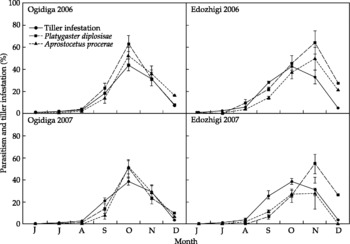
Dissection of tillers made during the first 6 weeks of galls' appearance showed that at both locations, P. diplosisae was the first parasitoid species recorded in the fields sampled, followed by A. procerae that appeared 2 weeks later. In the Guinea savanna zone, P. diplosisae was the most abundant parasitoid parasitizing AfRGM larvae during the 2006 and 2007 rainy seasons. The % parasitism by P. diplosisae was delayed by 2 months after which parasitism increased from late August to October across the years (Fig. 2). In October, when the AfRGM populations peaked, the % parasitism by P. diplosisae also peaked and dominated the field throughout the 2006 and 2007 rainy seasons. The number of P. diplosisae adults recovered from each rice gall dissected varied greatly with a range of 40–67 adults and an average of 53 individuals per rice gall. In the forest zone, percentage parasitism by A. procerae was much lower than in the Guinea savanna zone. There were no significant differences in % parasitism between the two locations. However, Edozhigi had higher % parasitism during the 2-year study. Beginning from November, populations of AfRGM and both parasitoids were observed to decline slowly.
Mean % tiller infestation ( ± SE) and mean parasitism ( ± SE) by Platygaster diplosisae and Aprostocetus procerae at Ogidiga and Edozhigi, Nigeria, during the 2006 and 2007 rainy seasons.

There was a positive correlation between adult gall midge populations and % parasitism by P. diplosisae (r = 0.75, P ≤ 0.0001) and A. procerae (r = 0.76, P ≤ 0.0001). There was also a strong positive correlation between tiller infestation and % parasitism by P. diplosisae (r = 0.86, P ≤ 0.0001) and A. procerae (r = 0.89, P ≤ 0.0001).
Discussion
Generally, insect pests are most severe in the humid tropical and Guinea savanna zones (Heinrichs and Barrion, Reference Heinrichs, Barrion and Hettel2004), and in Nigeria, where AfRGM occurs in both the savanna and forest zones, it is more common in the southern portion of the Guinea savanna region of the country (Ukwungwu and Joshi, Reference Ukwungwu and Joshi1992a). This is consistent with the results obtained in the present study where gall midge populations were higher in the southern Guinea savanna zone (Edozhigi) than in the forest zone (Ogidiga). Studies conducted in Côte d'Ivoire in 1995 also confirmed that AfRGM populations were higher in the Guinea savanna than in the humid forest region (Heinrichs et al., Reference Heinrichs, Williams, Oyediran, Kassoum, Ndongidila, Harris, Camara and Dias1995).
One of the major reasons that attributed to the major gall midge outbreaks that occurred in 1989 in Cross River and Akwa Ibom states of Nigeria was favourable weather with high rainfall, extensive cloud cover and high humidity (Ukwungwu et al., Reference Ukwungwu, Winslow and John1989). Hidaka (Reference Hidaka1974) reported that humidity and rainfall are major factors affecting populations of the Asian rice gall midge, O. oryzae. The rapid increase in adult populations of AfRGM between August and October recorded in this study can be attributed to climatic factors, especially rainfall. During these months, the mean relative humidity and temperature averaged 75% and 25 °C, respectively, and this has been reported as favourable for AfRGM development and reproduction (Umeh and Joshi, Reference Umeh and Joshi1993). Rainfall readings during the study at both locations and years averaged 200 mm. Umeh and Joshi (Reference Umeh and Joshi1993) observed that the peaks in AfRGM populations were positively correlated with increase in relative humidity and regular rainfall. Previous studies have established a link between the weather, especially rainfall during the wet season, and AfRGM rate of infestation and development (Umeh and Joshi, Reference Umeh and Joshi1993; Williams et al., Reference Williams, Okhidievbie, Harris and Ukwungwu1999).
Parasitism is very important in the biological control of AfRGM (Nacro et al., Reference Nacro, Dakouo and Heinrichs1995). Generally, P. diplosisae was observed to be more abundant than A. procerae in the present study, especially at Edozhigi. A. procerae appeared later than P. diplosisae. Ukwungwu and Joshi (Reference Ukwungwu and Joshi1992a) reported that P. diplosisae is the dominant parasitoid species attacking AfRGM in Nigeria. In another study also conducted at Ogidiga, one of our study sites, Umeh and Joshi (Reference Umeh and Joshi1993) similarly recorded P. diplosisae as the dominant parasitoid of AfRGM. The dominance of P. oryzae has also been reported in India by Joshi and Venugopal (Reference Joshi and Venugopal1985), and in other Asian countries where O. oryzae is a pest (Hidaka et al., Reference Hidaka, Budiyanto, Klai and Joshi1988). In the present study, P. diplosisae was the first parasitoid species to establish in the field, and it maintained a higher rate of parasitism than A. procerae throughout the season and across both years of the study. The decline in gall density observed in November as parasitism increased could be attributed to the parasitoids as previously reported by Umeh and Joshi (Reference Umeh and Joshi1993). The gregariousness of P. diplosisae and the exploitation of the host early in the season may be advantageous to this species as an effective biological control agent of AfRGM. These findings and those of earlier studies by Dakouo et al. (Reference Dakouo, Nacro and Sie1988) and Ukwungwu and Misari (Reference Ukwungwu and Misari1997) suggest that P. diplosisae and A. procerae are the only indigenous parasitoids with high potential for biological control of AfRGM.
Conclusion
The highest gall midge populations and the highest levels of parasitism occurred in October – towards the end of the rainy season, suggesting that the parasitoids play an important role in regulating AfRGM populations. We thus hypothesize that enhancement and conservation of the parasitoids early in the planting season to improve their synchronization with that of the host population may positively contribute towards biological control of AfRGM in lowland rice-based ecosystems in West Africa.
Acknowledgements
The authors are thankful to Ogidiga and Edozhigi farmers for providing the rice fields used for the study and to Mr Adebayo Kehinde and Mr Idowu Olowookere for their technical assistance.