Introduction
The treatments for cancer of the larynx and hypopharynx vary with disease stage and tumour location. Surgery followed by radiation therapy with or without chemotherapy remains the standard treatment for advanced tumours, and total pharyngolaryngectomy and total laryngectomy are the only surgical options in many cases.Reference Forastiere, Koch, Trotti and Sidransky1 Pharyngocutaneous salivary fistula is the most common complication of total pharyngolaryngectomy or total laryngectomy, occurring in 2.6 to 65.5 per cent of laryngectomised patients.Reference Saki, Nikakhlagh and Kazemi2–Reference Saydam, Kalcioglu and Kizilay9 These fistulas primarily develop on post-operative days 5 or 6, prior to the reintroduction of oral feeding.Reference Qureshi, Chatuverdi, Pai, Chaukar, Deshpande and Pathak7, Reference Saydam, Kalcioglu and Kizilay9–Reference Prasad, Sreedharan, Dannana, Prasad and Chandra14
The primary causes of fistula formation include poor surgical technique, the use of inappropriate suture, pre-operative malnutrition, previous radiation therapy, low haemoglobin levels, haematoma, surgical margin compromised by the tumour and pharyngeal stenosis.Reference Assis, Negri, Oliveira, Filho and Pires6–Reference Prasad, Sreedharan, Dannana, Prasad and Chandra14
Total laryngectomised patients undergo the reintroduction of oral feeding on post-operative day 7 in an attempt to prevent the development of pharyngocutaneous fistulas.Reference Saydam, Kalcioglu and Kizilay9, Reference Medina and Khafif11–Reference Akyol, Ozdem and Celikkanat13 Head and neck surgeons (84.5 per cent) have typically followed this practice for over half a century, apparently without evidence-based proof.Reference Boyce and Meyers15 Therefore, the appropriate time to reintroduce oral feeding remains controversial.
The few authors who have attempted to break with this paradigm have demonstrated that the early reintroduction of oral feeding does not increase the incidence of salivary fistula; the incidence is similar to cases in which feeding is reintroduced after post-operative day 7.Reference Saydam, Kalcioglu and Kizilay9–Reference Prasad, Sreedharan, Dannana, Prasad and Chandra14
The present study compared the incidence of salivary fistula between groups with an early or late reintroduction of oral feeding, and identified the predictive factors for salivary fistula.
Materials and methods
A randomised trial was performed using 165 patients with larynx or hypopharynx cancer at 3 treatment centres. The patients underwent total laryngectomy or total pharyngolaryngectomy at the General Hospital of the Federal University of Minas Gerais, the Hospital da Baleia and the Hospital São João de Deus, Minas Gerais, Brazil from January 2010 to January 2012. Diagnosis, staging, surgical indication, surgical technique and tactics, and the equipment used in the surgical procedures were standardised to keep the surgical procedures as similar as possible, regardless of the hospital service or surgeon responsible for the patient.
The ethics and research committees of the three hospitals approved this study. All patients agreed to participate in the study and signed an informed consent form.
Patients were evaluated at out-patient clinics, and the tumours were staged according to the tumour–node–metastasis (TNM) classification of malignant tumours.Reference Edge, Byrd, Compton, Fritz, Greene and Trotti16
Patients were excluded from the study if: they did not agree to participate in the study; they had undergone pre-operative radiation therapy; they required pharyngeal reconstruction using the myocutaneous flap, or pre- and/or post-operative procedures were incomplete; they had diabetes mellitus or used corticosteroids long term; or they had any systemic complication during the post-operative period that precluded the reintroduction of oral feeding.
Patients were randomly assigned to two groups: early (n = 44) or late (n = 45). Oral feeding was started 24 hours after the operation in the early group. Oral feeding was started from post-operative day 7 onward in the late group.
All patient haemoglobin levels were measured in the pre-operative period and within 48 hours after surgery.
Nutritional assessment
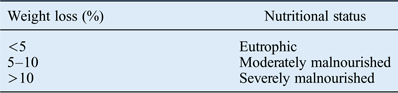
Patients’ nutritional status was classified according to percentage of weight loss (Table I). Patients’ albumin levels and lymphocyte counts were considered in the assessment of their nutritional status.
Nutritional status classification

Classification made according to the percentage of weight loss between patients’ normal weight and immediate pre-operative weight.
Surgical technique
A nasoenteric tube was introduced in all patients immediately before the surgery.
Tissue samples were excised from the top, bottom, right and left of the surgical site to test for possible tumour penetration in the surgical margins after total pharyngolaryngectomy or total laryngectomy followed by neck dissection. The remnant pharyngeal wall was measured as follows: longitudinally from the base of the tongue to the hypopharynx; and crosswise, at rest and with traction of its flaps.
The pharynx was repaired in a T-shaped fashion, by continuous suture using polyglactin (size 000) thread in the submucosa plane with inversion of the mucosa. Subsequently, the pharyngeal constrictor muscle was closed with simple interrupted stitches using polyglactin (size 000) thread, and this muscle was fixed to the suprahyoid muscles with simple interrupted stitches using polyglactin (size 000) thread.
Saline (0.9 per cent, 40 ml) with methylene blue was administered into the oropharynx through a number 14 Levine catheter to evaluate the patency of pharyngeal anastomosis. The suture was reapplied or reinforced in cases of extravasation along the pharyngeal suture line. The duration of surgery was measured as the time from skin incision to the time of closure.
Patient feeding
The reintroduction of oral feeding was standardised in the following manner in the early group. Initially, 100 ml reverse osmosis filtered water stained with methylene blue was administered 24 hours after surgery. This was followed by observation for 30 minutes to assess whether the ingested content was externalised through the surgical wound, tracheotomy or drains. Strictly liquid diets were offered orally for 24 hours if externalisation was not observed. If no signs of salivary fistula were observed, feeding progressed every 24 hours in the following manner: full liquid diet, homogeneous paste and free diet, depending on patient acceptance.
The progression for reintroduction of oral feeding in the late group followed the same order as in the early group, from post-operative day 7 onward.
All patients received an industrialised and polymeric enteral diet as follows: 150 ml every 3 hours on post-operative day 1; 200 ml every 3 hours on day 2; and 250 ml every 3 hours on day 3 onwards, until the patient's total energy expenditure, as calculated pre-operatively, was reached. The nasoenteric tube was removed from all patients on post-operative day 10 if no signs of salivary fistula were observed.
Oral feeding was immediately suspended if a salivary fistula was observed at any time post-operatively. Affected patients received enteral nutrition only until fistula closure, and were treated with antibiotics for 10 days. The surgical wound was dressed daily to avoid the accumulation of secretions.
The occurrence of salivary fistula was evaluated in relation to the following variables: early or late oral feeding, nutritional status, haemoglobin level, requirement of blood transfusion, age, gender, related comorbidities, cancer stage according to the (TNM) classification of malignant tumours,Reference Edge, Byrd, Compton, Fritz, Greene and Trotti16 type of surgery performed, duration of surgery, type of neck dissection, and extravasation following the anastomotic patency test.
A 5 per cent level of significance was used in all statistical tests (chi-square test, Student's t-test and Fisher's exact test), and analyses were performed using the statistical software routines of IBM® SPSS® Statistics version 19.
Results
Of the 165 patients with larynx or hypopharynx squamous cell carcinoma, 10 underwent partial laryngectomy, 17 received radiation therapy exclusively, 20 were treated using a radiation and chemotherapy protocol, 10 did not return for definitive treatment, and 3 died while waiting for the biopsy results or definitive treatment. Sixteen patients who underwent total laryngectomy or total pharyngolaryngectomy were excluded for failing to meet the inclusion criteria, or for satisfying one or more of the exclusion criteria. Therefore, 89 patients who underwent total laryngectomy or total pharyngolaryngectomy were included in the study.
Eighty-two (92.1 per cent) of the 89 patients were male, and 7 (7.9 per cent) were female. Patient ages ranged between 21 and 88 years, with a mean of 62.9 ± 11.7 years and a median of 62 years. The mean age of the early group was 64.9 ± 10.7 years, and the median age was 62.5 years. The mean age of the late group was 61.0 ± 12.5 years, and the median age was 61.0 years. No significant difference between groups was observed in terms of age (p = 0.88).
The 89 patients exhibited the following comorbidities: systemic arterial hypertension in 35 patients (39.3 per cent) (20 (57.1 per cent) in the early group and 15 (42.9 per cent) in the late group (p = 0.24)) and gout in 1 patient (1.1 per cent) in the late group.
Forty-two (47.2 per cent) of the 89 patients underwent tracheotomy pre-operatively (50.0 per cent for each group).
Patients in the early group presented with 6.8 per cent glottic tumours, 11.4 per cent supraglottic, 59.1 per cent transglottic and 22.7 per cent hypopharyngeal. Patients in the late group exhibited 8.9 per cent glottic tumours, 20.0 per cent supraglottic, 46.7 per cent transglottic and 24.4 per cent hypopharyngeal.
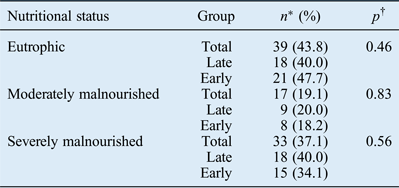
Nutritional status classifications and group comparison data are presented in Table II.
Nutritional status results
*Total n = 89 patients. †Calculated using Student's t-test for means comparison.
The duration of surgery was 220.34 ± 50.19 minutes for the early group and 226.89 ± 61.05 minutes for the late group. No significant difference between groups was observed (p = 0.58).
Fifty-three (59.6 per cent) of the 89 patients underwent total laryngectomy (26 patients (49.1 per cent) in the early group and 27 (50.9 per cent) in the late group), and 36 patients (40.4 per cent) underwent total pharyngolaryngectomy (18 patients (50.0 per cent) in the early group and 18 (50.0 per cent) in the late group). All patients underwent neck dissection. No significant differences between the types of neck dissection were observed (bilateral jugular in 26 early group and 21 late group patients; radical and jugular, or bilateral radical in 18 early group and 24 late group patients; and extended in 4 early group and 4 late group patients). Jugular vein ligature was observed in 9 patients in the early group and 15 patients in the late group. No significant difference between groups was observed. One patient in each group exhibited bilateral ligature.
The following pharyngeal wall measurements were observed for the early and late groups respectively: longitudinal, 5.58 ± 1.58 cm and 5.84 ± 1.36 cm; cross-sectional at rest, 2.89 ± 0.92 cm and 2.89 ± 1.05 cm; and cross-sectional with traction, 7.69 ± 1.35 cm and 7.33 ± 1.92 cm. No significant differences between the two groups were observed in any pharyngeal measurement (p > 0.34).
A total of 44 patients (49.4 per cent) were fed on post-operative day 1, and 45 patients (50.6 per cent) were fed after post-operative day 7.
Eighty-two patients (92.1 per cent) did not require blood transfusion at any time during treatment. One (1.1 per cent) of the remaining seven patients received blood in the immediate pre-operative period, four patients (4.5 per cent) received blood pre-operatively and two patients (2.2 per cent) received blood post-operatively. Four patients (8.9 per cent) were in the late group and three (6.8 per cent) were in the early group.
No patient exhibited peri-operative complications.
Most patients (64.0 per cent) progressed without post-operative complications. However, the following post-operative complications were observed: haematoma (one patient in the late group), wound dehiscence (one patient in each group), abscess (one patient in the early group), pneumonia (one patient in the early group), lymphatic fistula (one patient in the early group and two in the late group), wound infection (two patients in each group), facial oedema (two patients in the early group) and bleeding in the oropharynx (one patient in the late group). Salivary fistulas were observed in 10 patients from the early group and 6 from the late group.
No difference was observed between groups in terms of the pathological staging of patients according to the TNM classification.Reference Edge, Byrd, Compton, Fritz, Greene and Trotti16 Three of the patients in the early group (6.8 per cent) were classified as stage III, and 41 (93.2 per cent) were classified as stage IV. All 45 patients in the late group were classified as stage IV.
The surgical margins were free of tumour in 71 patients (79.8 per cent), including 37 (84.1 per cent) in the early group and 34 (66.7 per cent) in the late group (p = 0.42). Positive surgical margins for carcinoma in situ were detected in 12 patients (13.5 per cent) (4 patients (9.1 per cent) in the early group and 8 (17.8 per cent) in the late group), and invasive carcinoma was detected in 6 patients (6.7 per cent) (3 patients (6.8 per cent) in the early group and 3 (6.7 per cent) in the late group).
Tumour extension beyond the larynx and hypopharynx borders was detected on anatomopathological examination in 34 patients (38.2 per cent), including 14 (31.8 per cent) in the early group and 20 (44.4 per cent) in the late group (p = 0.27). Extranodal extension in lymph nodes was pathologically detected in 21 patients (23.6 per cent), including 11 (25.0 per cent) in the early group and 10 (22.2 per cent) in the late group (p = 0.80).
Salivary fistula incidence and feeding
The incidence of salivary fistula according to the time of post-operative oral feeding reintroduction was 27.3 per cent (n = 12) in the early group and 13.3 per cent (n = 6) in the late group. No significant difference between the groups was observed (p = 0.10).
Salivary fistula non-predictors
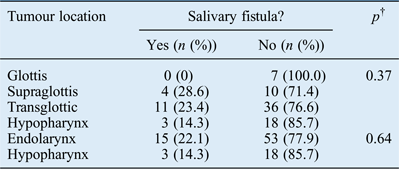
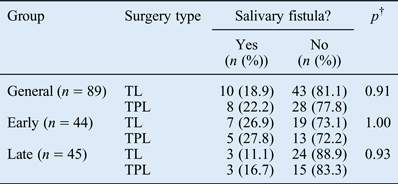
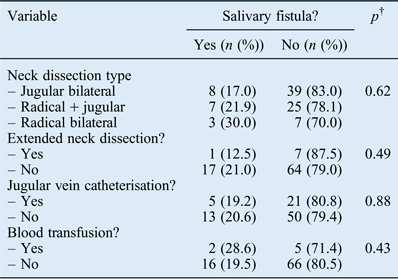
The following variables were not statistically significant: age (p = 0.65); gender (p = 0.19); pre-operative tracheotomy (p = 0.19); presence of chronic comorbidities (p = 0.20); pre- and post-operative haemoglobin levels (p = 0.38); nutritional status (eutrophic, or with moderate or severe malnutrition) (p = 0.45); tumour location (glottic, supraglottic, transglottic or hypopharyngeal (p = 0.37), or endolaryngeal or hypopharyngeal (p = 0.64) (Table III)); primary tumour surgery type (total laryngectomy or total pharyngolaryngectomy) (p = 0.91) in the early (p = 1.00) and late (p = 0.93) groups (Table IV); duration of surgery and size of the remnant pharynx (p = 0.53); type of neck dissection (bilateral jugular, radical and jugular, or bilateral radical neck (p = 0.62), or extended radical (p = 0.49) (Table V)); jugular vein ligature (p = 0.88) (Table V); and blood transfusion requirement (p = 0.43) (Table V).
Tumour location and salivary fistula incidence*
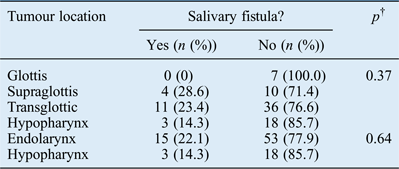
* Total n = 89 patients. †Calculated using the chi-square test for independence.
Type of surgery and salivary fistula incidence*
* Total n = 89 patients. †Calculated using the chi-square test for independence. TL = total laryngectomy; TPL = total pharyngolaryngectomy
Surgery-related variables and salivary fistula incidence*
* Total n = 89 patients. †Calculated using the chi-square test for independence.
Anatomopathological variables
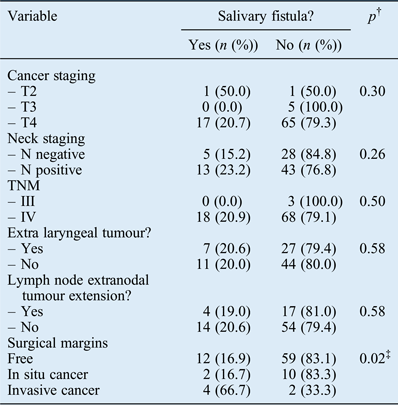
The only variable associated with the incidence of salivary fistula was the involvement of surgical margins on anatomopathological examination. No statistically significant difference (p = 0.98) was observed between free surgical margins and in situ carcinoma. However, a significant difference (p = 0.02) was observed between the free margins and invasive carcinoma. The surgical margins of three patients in each group revealed invasive carcinoma, and four patients (two per group) developed salivary fistula (Table VI).
Anatomopathological examination variables and salivary fistula incidence*
* Total n = 89 patients. †Calculated using the chi-square test for independence. ‡Comparison between tumour-free margins and margins with invasive cancer. T = tumour; N = node; TNM = tumour–node–metastasis classification
Patient nutritional status was examined according to albumin levels, lymphocyte counts and percentage of weight loss, and these values were compared with the incidence of salivary fistula. No differences were observed in terms of the incidence of salivary fistula and the period of reintroduction of an oral diet (p > 0.45).
Time of salivary fistula occurrence
Salivary fistulas were detected between the 3rd and 16th post-operative day; 50 per cent of the fistulas occurred before the 7th post-operative day, and 50 per cent occurred after 7 days. The median period of onset of salivary fistula was 7.8 and 12.9 days in the early and late groups, respectively. A significant difference between the groups was observed (p = 0.05).
The closure of salivary fistula occurred between the 16th and 36th post-operative days, and all affected patients were treated conservatively. No difference in feeding reintroduction was observed between the groups (p = 0.88).
Discussion
Salivary fistula in the post-surgery upper aerodigestive tract is associated with high surgical morbidity and mortality, prolonged hospital stay, high hospital costs, and increased emotional distress in patients. These fistulas may also prevent or delay the onset of adjuvant therapy and patient rehabilitation.
Concern regarding the possibility of salivary fistula delays the initiation of oral feeding, the latter of which promotes pharynx healing. The rationale for this practice is not clear. The current global paradigm for the reintroduction of oral feeding is 7 to 10 days post-surgery. Prospective and controlled studies of the early and late reintroduction of oral feeding include methodological inaccuracies, and these studies have failed to fully answer the question of whether late reintroduction of oral feeding is necessary to avoid salivary fistula.Reference Soylu, Kiroglu and Aydogan3, Reference Saydam, Kalcioglu and Kizilay9–Reference Prasad, Sreedharan, Dannana, Prasad and Chandra14, Reference Aswani, Thandar, Otiti and Fagan17–Reference Eustaquio, Medina, Krempl and Hales21
A patient's swallowing of 1.5 litres of saliva in 24 hours during the immediate post-operative period supports the safety of early oral feeding, and oral feeding may improve oral hygiene and reduce bacterial flora.Reference Prasad, Sreedharan, Dannana, Prasad and Chandra14
A wide variety of risk factors have been described, with discrepant incidences for salivary fistula following total laryngectomy. This variation may be explained by: the use of small samples, variability in the type of surgery or technique used, tumour location and stage, the type of reconstruction performed, pre-operative radiation therapy, and vague definitions of the term ‘complication’.Reference Soylu, Kiroglu and Aydogan3, Reference Paydarfar and Birkmeyer22
The primary goals of oral feeding reintroduced soon after total laryngectomy are: faster patient psychosocial rehabilitation, improvements in patient comfort by dispensing with the nasoenteric tube, reduced nursing care and shortened hospital stay (which reduces treatment costs).Reference Aswani, Thandar, Otiti and Fagan17
Only 12 studies have demonstrated that the early reintroduction of oral feeding does not increase the incidence of salivary fistula.Reference Soylu, Kiroglu and Aydogan3, Reference Saydam, Kalcioglu and Kizilay9–Reference Prasad, Sreedharan, Dannana, Prasad and Chandra14, Reference Aswani, Thandar, Otiti and Fagan17–Reference Eustaquio, Medina, Krempl and Hales21 Several of these studies suggest that a nasoenteric tube for enteral nutrition is not required after total laryngectomy because an increased rate of salivary fistula was not observed.Reference Soylu, Kiroglu and Aydogan3, Reference Saydam, Kalcioglu and Kizilay9–Reference Medina and Khafif11, Reference Aswani, Thandar, Otiti and Fagan17, Reference Aprigliano18
Patients in the present study were randomly distributed into two groups: early and late oral feeding. This randomisation formed homogeneous groups of patients in terms of nutritional status, haemoglobin level, tumour stage, age, gender and surgical variables (e.g. type of surgery performed, duration of surgery, pharyngeal wall measurements and blood transfusion requirement).
With regard to weight loss, most patients were eutrophic in both groups, and similar malnutrition was observed across the groups. No significant difference in nutritional status was observed between groups.
The present study demonstrated that early oral feeding did not increase the incidence of salivary fistula (p = 0.10). This is consistent with previous studies on the early reintroduction of oral feeding in laryngectomised patients.Reference Soylu, Kiroglu and Aydogan3, Reference Saydam, Kalcioglu and Kizilay9, Reference Aswani, Thandar, Otiti and Fagan17–Reference Eustaquio, Medina, Krempl and Hales21 The incidence observed in the historical cases at our hospital was similar to that reported in the international literature.Reference Sousa, Castro, Porcaro-Salles, Soares, de Moraes and Carvalho23 However, in the current study, patients in the early group developed fistula in a significantly shorter period than patients in the late group (p = 0.05).
Gender and age were not predictive factors for the onset of salivary fistula.
Pre-operative tracheotomy generally indicates further advanced tumours and a higher probability of surgical wound contamination, which may be linked to a higher incidence of salivary fistula.Reference Qureshi, Chatuverdi, Pai, Chaukar, Deshpande and Pathak7 However, no difference was observed in the present study in terms of pre-operative tracheotomy requirement and the incidence of salivary fistula. This result is consistent with previous studies.Reference Soylu, Kiroglu and Aydogan3, Reference Qureshi, Chatuverdi, Pai, Chaukar, Deshpande and Pathak7, Reference Seven, Calis and Turgut12, Reference Sousa, Castro, Porcaro-Salles, Soares, de Moraes and Carvalho23, Reference Markou, Vlachtsis, Nikolaou, Petridis, Kouloulas and Daniilidis24
The identified comorbidities, systemic arterial hypertension and gout, were not linked to an increase in salivary fistula in the present sample.
Malignant tumours of the hypopharynx or supraglottis have been associated with an increased incidence of salivary fistula,Reference Redaelli de Zinis, Ferrari, Tormenzoli, Premoli, Parrinello and Nicolai4, Reference Prasad, Sreedharan, Dannana, Prasad and Chandra14, Reference Galli, De Corso, Volante, Almadori and Paludetti25, Reference Lorenz, Grieser, Ehrhart and Maier26 possibly because a portion of the pharyngeal wall is resected with the larynx during surgery. The diameter of the remnant pharynx may be smaller than usual when the flaps are not used for closing, which causes stenosis and increases the risk of fistula.Reference Queija Ddos, Portas, Dedivitis, Lehn and Barros27 The number of patients with endolaryngeal and transglottic tumours was significantly higher than the number of those with hypopharyngeal tumours in the present sample. However, no difference in the incidence of salivary fistula was observed between the various tumour subsites, or between endolaryngeal and hypopharyngeal tumours (p > 0.05). This result is consistent with previous studies.Reference Seven, Calis and Turgut12, Reference Markou, Vlachtsis, Nikolaou, Petridis, Kouloulas and Daniilidis24, Reference Galli, De Corso, Volante, Almadori and Paludetti25, Reference Schwartz, Yueh, Maynard, Daley, Henderson and Khuri28
Surgery duration (p = 0.60) and pharyngeal wall measurements were similar between groups (p > 0.27), and no significant difference in the occurrence of salivary fistula was observed in relation to these variables.
Neck dissection may increase the incidence of salivary fistula after total pharyngolaryngectomy or total laryngectomy.Reference Galli, De Corso, Volante, Almadori and Paludetti25, Reference Lorenz, Grieser, Ehrhart and Maier26 However, tumour stage and the consequences of advanced malignancy, including malnutrition and neck metastasis, are most likely the predictive factors for salivary fistula in cases of more extensive lymphadenectomy and not the dissection itself. Neck dissection, regardless of extent, was not a predictive factor for salivary fistula in the present study. This supports the meta-analysis findings of Paydarfar et al.Reference Paydarfar and Birkmeyer22
The incidence of salivary fistula was not higher when the jugular veins were not ligated, compared with unilateral or bilateral ligatures of the internal jugular (p = 0.88). This association had not been investigated previously.
Blood transfusion was not a predictor of salivary fistula. This finding contradicts previous studies.Reference Redaelli de Zinis, Ferrari, Tormenzoli, Premoli, Parrinello and Nicolai4, Reference Boscolo-Rizzo, De Cillis, Marchiori, Carpenè and Da Mosto29–Reference Cavalot, Gervasio, Nazionale, Albera, Bussi and Staffieri31 Patients with haemoglobin levels below 12.5 mg/dl, 11.2 mg/dl and 9.5 mg/dl during the pre- and post-operative periods did not exhibit an increased incidence of salivary fistula. These cut-off values were similar to those reported in previous studies.Reference Redaelli de Zinis, Ferrari, Tormenzoli, Premoli, Parrinello and Nicolai4, Reference Boscolo-Rizzo, De Cillis, Marchiori, Carpenè and Da Mosto29–Reference Cavalot, Gervasio, Nazionale, Albera, Bussi and Staffieri31
The presence of surgical margins with tumour involvement, as identified microscopically or via an in situ tumour, may increase the incidence of salivary fistula.Reference Markou, Vlachtsis, Nikolaou, Petridis, Kouloulas and Daniilidis24 This association may be explained by a delay or failure in the healing process that is produced by the tumour along the suture line. Markou et al. observed a 35.7 per cent incidence of salivary fistula in patients with affected surgical margins, in contrast to 11.2 per cent in those with free margins.Reference Markou, Vlachtsis, Nikolaou, Petridis, Kouloulas and Daniilidis24 Other authors did not consider affected surgical margin as a risk factor for salivary fistula.Reference Redaelli de Zinis, Ferrari, Tormenzoli, Premoli, Parrinello and Nicolai4, Reference Sousa, Castro, Porcaro-Salles, Soares, de Moraes and Carvalho23, Reference Galli, De Corso, Volante, Almadori and Paludetti25, Reference Ikiz, Uça, Güneri, Erdağ and Sütay32 In the present study, patients with invasive carcinoma in the surgical margin had a higher incidence of salivary fistula than the group with free margins (p = 0.02).
Schwartz et al. showed a significant correlation between pre-operative hypoalbuminaemia and increased complication after total laryngectomy.Reference Schwartz, Yueh, Maynard, Daley, Henderson and Khuri28 However, the present study found no significant association between the albumin cut-off levels (≥3.5 g/dl or <3.5 g/dl) and the incidence of salivary fistula. These values were used according to criteria established in previous studies.Reference Redaelli de Zinis, Ferrari, Tormenzoli, Premoli, Parrinello and Nicolai4, Reference Boscolo-Rizzo, De Cillis, Marchiori, Carpenè and Da Mosto29
• Most centres still delay oral feeding following total laryngectomy
• Only 12 studies have demonstrated that early oral feeding does not increase salivary fistula incidence
• This prospective, randomised trial compared early and late oral feeding groups and examined predictors of salivary fistula
• Early oral feeding in total laryngectomy patients did not increase salivary fistula incidence
• Surgical margin involvement by invasive carcinoma was an independent risk factor for salivary fistula
• Early oral feeding is recommended
In the present study, lymphocyte counts (≥1200 per ml or <1200 per ml) were also compared with the incidence of salivary fistula, but there was no significant relationship.
The relationship between nutritional status and the incidence of salivary fistula is well defined in the international literature. Several authors have shown that a 10 per cent or greater loss of body weight is linked to increased morbidity and mortality.Reference Correia and Waitzberg33, Reference Campos, Chen and Meguid34 In the present sample, patients classified as moderately malnourished exhibited a higher incidence of salivary fistula compared with eutrophic patients, representing a marginally significant difference (p = 0.07). A higher incidence of salivary fistula was not found in the comparisons among severely malnourished versus eutrophic or versus moderately malnourished patients. There was no obvious explanation for this finding.
In summary, the early reintroduction of oral feeding in total pharyngolaryngectomy or total laryngectomy patients does not appear to increase the likelihood of salivary fistula. The results suggest that surgical margin involvement by invasive carcinoma is an independent risk factor for salivary fistula.