Introduction
To aid our understanding of ecological niches, we must investigate habitat use and preferences of both native and exotic species (Castro & Huber Reference Castro and Huber2003; Kuprijanov Reference Kuprijanov2017). Exotic species are organisms introduced outside their natural range and natural dispersal potential (Olenin et al. Reference Olenin, Alemany, Cardoso, Gollasch, Goulletquer, Lehtiniemi, McCollin, Minchin, Miossec, Occhipinti Ambrogi, Ojaveer, Rose Jensen, Stankiewicz, Wallentinus and Aleksandrov2010). Exotic species, especially, can assume the role of competitors and predators of native species, potentially limiting food resources and spreading diseases within habitats (Primack & Rodrigues Reference Primack and Rodrigues2001; Moura-Brito & Patrocínio Reference Moura-Britto, Patrocínio, Campos, Tossulino and Müller2006; Camarotti et al. Reference Camarotti, Silva and Oliveira2015). Moreover, such species can also increase fruit production by pollination processes (Pavé et al. Reference Pavé, Peker, Raño, Orjuela, Zunino and Kowalewski2009), thereby attracting animals to consume and disperse their seeds, increasing the potential risk to local biodiversity (Hendges et al. Reference Hendges, Fortes and de Sá Dechoum2012; Canale et al. Reference Canale, Suscke, Rocha-Santos, São Bernardo, Kierulff and Chivers2016). Additionally, the establishment of a given exotic organism can be facilitated for another exotic one. This relationship between exotic species is commonly known as an invasional meltdown (Simberloof & Von Holle Reference Simberloff and Von Holle1999). If a species is invasive, it will quickly expand its population in the new territory, potentially becoming dominant (Valéry et al. Reference Valéry, Fritz, Lefeuvre and Simberloff2008). Thus, studying behavioural and ecological aspects of exotic organisms with a high potential to become invasive is crucial in helping habitat management and the conservation of areas.
The relationship between animals and their habitats constitutes a central component in wildlife ecology (Morrison et al. Reference Morrison, Marcot and Mannan2006). To increase their chances of survival and reproduction, animals can select and preferentially use specific areas and avoid others (Gaillard et al. Reference Gaillard, Hebblewithe, Loison, Fuller, Powell, Basille and Moorter2010). Several factors are responsible for animal habitat preferences, including canopy height, vegetation coverage, availability and distribution of food resources, and the presence of other organisms (Manly et al. Reference Manly, McDonald, Thomas, McDonald and Erickson2007; Herfindal et al. Reference Herfindal, Tremblay, Hansen, Solberg and Saeter2009).
The habitat use by mammals is strongly associated with food availability and distribution in their habitat (Hanya et al. Reference Hanya, Kanamori, Kuze, Wong and Bernard2020; Kinap et al. Reference Kinap, Nagy-Reis, Bobrowiec, Gordo and Spironello2021). Neotropical primates, for example, inhabiting predictable environments in terms of food production, such as tropical rainforests, tend to choose their habitat type according to the presence/absence of specific food belonging to their diet (Heiduck Reference Heiduck2002). For instance, during periods of high fruit production, black-fronted titi monkeys (Callicebus nigrifrons Spix, 1823) use central areas of their home range (Nagy-Reis & Setz Reference Nagy-Reis and Setz2017), and masked titi monkeys (Callicebus melanochir Wied-Neuwied 1820) often exploit undisturbed areas due to the high availability of food (Heiduck Reference Heiduck2002). In these habitats, both species appeared to search for food resources highly nutritious (i.e., fruits) to maintain their daily energy. The type of food available – that is, native or exotic – may also influence habitat use. The consumption of exotic Artocarpus heterophyllus Lam. fruits by golden-headed lion tamarins (Leontopithecus chrysomelas Kuhl, 1820), for instance, affects the use of cacao plantations by this primate species (Oliveira et al. Reference Oliveira, Neves, Raboy and Dietz2011).
Mixed-species groups include associations between at least two groups of different species or between an individual of a species and a group of another species (Terborgh Reference Terborgh1983). Such associations increase the group’s overall size, which may lead to increased direct resource competition. Still, they can improve predator detection or defence or have other foraging-related benefits (Terborgh Reference Terborgh1983; Cords Reference Cords, Boinski and Garber2000; Rehg Reference Rehg2006). The benefits of foraging during mixed-species association may include a greater chance of detecting and obtaining food (Terborgh Reference Terborgh1983; Peres Reference Peres1996). Time spent foraging can also increase because of cooperative anti-predator surveillance behaviour. Callitrichids, for example, scan for potential predators visually, compromising much of the daily activity time (Ferrari & Lopes Ferrari Reference Ferrari and Lopes Ferrari1989). Thus, a decrease in vigilance can lead to an increase in time spent foraging and feeding. For example, when small groups of L. chrysomelas are associated with Wield’s marmoset (Callithrix kuhlii Coimbra-Filho 1985) groups, they use areas of lower forest canopy levels (Almeida-Rocha et al. Reference Almeida-Rocha, De Vleeschouwer, Reis, Grele and Oliveira2015). Considering the complex alarm calling system often observed in primates (e.g., Cäsar & Zuberbuehler Reference Cäsar and Zuberbuehler2012), other advantages related to predation include the increased probability of detecting a predator (Norconk Reference Norconk1990) and a lower probability of being captured (Roberts Reference Roberts1996).
The squirrel monkeys (genus Saimiri) have been illegally introduced outside their natural distribution – Amazonian Forest – in several parts of Brazil (Rosa et al. Reference Rosa, Curi, Puertas and Passamani2017). In North-eastern Brazil, the species can be found inhabiting Atlantic Forest fragments in Salvador, Alagoas and two municipalities in Pernambuco: Tamandaré (Mendes-Pontes et al. Reference Mendes-Pontes, Jordani, Ribeiro, Normande, Fernandes, Soares, Ramalho and Bicca-Marques2007) and Recife (PAN PriNE 2013). In Recife Forest fragments, the exotic squirrel monkeys have been reported as a potential seed disperser of native trees (Oliveira-Silva et al. Reference Oliveira-Silva, Campêlo, Lima, Araújo, Bezerra and Souza-Alves2018). They seem to possess flexible ecological and behavioural patterns to adapt to the Atlantic Forest (Campêlo et al. Reference Campêlo, Souza-Alves, Lima, Araújo, Oliveira-Silva and Bezerra2019). In Atlantic Forest fragments in Tamandaré, the presence of the species has been reported to negatively influence the behavioural pattern of a local primate, the common marmoset, Callithrix jacchus Linnaeus, 1758 (Camarotti et al. Reference Camarotti, Silva and Oliveira2015).
The present study aimed to investigate the use of an urban fragment of Atlantic Forest in North-eastern Brazil by the exotic squirrel monkey, Saimiri spp. We investigated if habitat use by exotic squirrel monkeys was associated with the consumption of exotic and native plant species, the presence of native common marmosets, and monthly fruit production. In this sense, we predicted that (i) exotic squirrel monkeys would preferentially use areas where exotic plants were prevalent, due to their preference for this food source in the study site (Campêlo et al. Reference Campêlo, Souza-Alves, Lima, Araújo, Oliveira-Silva and Bezerra2019); (ii) the presence of common marmosets (Callithrix jacchus Linnaeus, 1958) does not affect habitat choice of exotic squirrel monkeys due to the lack of agonistic interactions previously observed between the species in the study area (Campêlo et al. Reference Campêlo, Souza-Alves, Lima, Araújo, Oliveira-Silva and Bezerra2019); furthermore, due to different feeding habits between common marmoset and exotic squirrel monkeys (e.g., Castro & Araújo Reference Castro and Araújo2006; Paim et al. Reference Paim, Chapman, de Queiroz and Paglia2017; Schiel & Souto Reference Schiel and Souto2017; Oliveira-Silva et al. Reference Oliveira-Silva, Campêlo, Lima, Araújo, Bezerra and Souza-Alves2018), the species would not share the same habitat, and (iii) exotic squirrel monkeys would preferentially use habitat where the fruit production is increased (Boinski Reference Boinski1987; Silva et al. Reference Silva2003; Veiga Reference Veiga2006; Mercês and de Paula Reference Mercês and de Paula2018).
Study site
We carried out the study in a 106-ha urban Atlantic Forest fragment at Mata do Curado Wildlife Refuge (8º04'50''S, 34º58'21''W), located in Recife, Pernambuco, North-eastern Brazil. The area has many plant species from the families Monimiaceae and Melastomataceae (Lins-e-Silva & Rodal Reference Lins-e-Silva, Rodal and Thomas2008). The tree density is 780 individuals/ha, basal area of 24.7 m2 ha-1, and the mean height of the tree canopies is 11.3 m (Lins-e-Silva & Rodal Reference Lins-e-Silva, Rodal and Thomas2008). Over the ten years before our study (2006–2016), the mean monthly rainfall from December to March was 188.6 ± 110 mm (range: 67.7 mm–335.2 mm). During the study period (December 2016 to May 2017), the monthly rainfall ranged between 67.8 mm (December) and 397.7 mm (May) with an average of 157.7 ± 154.5 mm (APAC 2017). Because the study area is inserted in the urban area, many exotic plant species exist, such as Artocarpus heterophyllus Lam., Mangifera indica L., Musa sp., and Elaeis guineensis Jacq. Furthermore, such plants are uniformly distributed under high densities in the home range of the study squirrel monkey group (6.83 individuals/ha) (Campêlo et al. Reference Campêlo, Souza-Alves, Lima, Araújo, Oliveira-Silva and Bezerra2019).
Material and methods
Data collection
From December 2016 to May 2017, we collected behavioural and ecological data from a population of exotic squirrel monkeys. We observed the apparent fission–fusion division of the population during the systematic monitoring, resulting in at least five subgroups averaging 59 individuals (± SD 45: 25–139 individuals). Expeditions lasted ten continuous days per month. The fieldwork activities occurred from 05:00 to 17:00, using the scan sampling method (Altmann Reference Altmann1974) at 10 minutes intervals, totalling 147 hours of observations (mean number of records/scans: 11 ± SD 2). We have used the pattern procedure to collect behavioural data for primates (see Zuberbühler & Wittig Reference Zuberbühler, Wittig, Setchell and Curtis2011). This procedure consisted in recording the behavioural activity separately of each individual in the view. Thus, if there were four individuals during the scan, and, two individuals could be feeding, one resting, and the last moving on the trees each behaviour was separately recorded. When the monitored individuals of the subgroup were visually lost, the scan sampling was stopped and resumed when the observer reencountered the animals, and when a given monitored subgroup was lost, the first subgroup or even the previously monitored was found, the scan was returned. We recorded several behavioural categories during the scans, including rest, feed, move, and social interaction (adapted from Campêlo et al. Reference Campêlo, Souza-Alves, Lima, Araújo, Oliveira-Silva and Bezerra2019). In this study, we only used data from feeding on native and exotic plants in the present study. When the animals were consuming any plant parts (i.e., fruit, leaf, flower, seed), the plant source was marked with vinyl tape and numbered; when it was not possible to identify the plant in the field, a fertile branch was collected for identification at Geraldo Mariz herbarium at the Universidade Federal de Pernambuco.
Habitat characterization
Before characterizing the habitat, we established the home range limits of the exotic squirrel monkey group over the study period. These limits were based on the minimum convex polygon, with 100% of the points georeferenced in each scan. We used this estimator as the kernel density estimators often overestimate home range size when the sample size is small (Boyle et al. Reference Boyle, Lourenço, Silva and Smith2009). We used the software ArcGis 9.3 with the Home Range Extension (Rodgers & Carr Reference Rodgers and Carr1998). We overlapped a raster of the forest structure over the exotic squirrel monkeys’ home range limits, aiming to characterize its structure. The raster was provided by the Woods Hole Research Center (http://whrc.org/publications-data/datasets/detailed-vegetation-height-estimates-across-the-tropics/) obtained from LiDAR (light detection and ranging). This system provided information on vegetation height at a pixel resolution of 30 × 30 m, allowing for the classification of the exotic squirrel monkeys’ home range into three categories: (i) Disturbed Forest (trees between 0–5 m); (ii) Secondary Initial Forest (6–12 m); and (iii) Secondary Old Forest (>12 m) (adapted from Oliveira-Silva et al. Reference Oliveira-Silva, Campêlo, Lima, Araújo, Bezerra and Souza-Alves2018).
Food availability
To quantify the food availability within the home range of the exotic squirrel monkeys and thus verify a possible association with the used habitat (Freitas et al. Reference Freitas, Astúa, Santori and Cerqueira1997; Pinotti Reference Pinotti2010; Camaratta et al. Reference Camaratta, Chaves and Bicca-Marques2017), we installed 50 fruit traps in five transects. These transects were randomly distributed within the limits of the home range of the study group. Each transect was set up at least 100 m apart and received ten fruit traps (1 m × 1 m) 2 m apart from one another (Oliveira-Silva et al. Reference Oliveira-Silva, Campêlo, Lima, Araújo, Bezerra and Souza-Alves2018). Thus, the total trapped area was 50 m2. We fortnightly revised the traps from December 2016 to May 2017, when all fruits and seeds were collected and taken to the laboratory for analysis. The trapped fruits and seeds were identified to their highest taxonomic level possible. Still, when it was impossible to identify the seed/fruit, we classified them as morphotypes based on their general morphological characteristics (e. g., size, form, colour).
Presence of common marmosets
During the scan sampling, we registered the native common marmosets (Callithrix jacchus) using the same area as the exotic squirrel monkeys if they were within a 50-m radius (Oates & Whitesides Reference Oates and Whitesides1990). We recorded the estimated distance between the common marmosets and the exotic squirrel monkeys. Also, when the exotic squirrel monkeys were engaged in feeding behaviour, we recorded whenever the common marmoset was in the same tree. We recorded whether the common marmosets were eating the same food item, a different item, or not eating at all.
Data analysis
To determine the different types of habitats used by exotic squirrel monkeys during each scan sampling, we georeferenced the central location of the observed group using a handheld Garmin 60CSx GPS. Furthermore, whenever a plant source – native or exotic plant – was consumed, we identified, marked, and georeferenced the source. We then mapped the location of native and exotic plant species that were part of the exotic squirrel monkey diet within their home range. Therefore, at the end of this procedure, we had the geographical location of (i) native and exotic consumed plants; (ii) feeding behaviour; and (iii) the presence of common marmosets.
Although there is a fission–fusion dynamic in exotic squirrel monkeys, we treated all the population as a unit sampling. Thus, all the behavioural and ecological events within each month were summed. Firstly, we used the abundance of resources in the traps to classify the months with low and high food availability extremes. We considered the period of low availability when abundance was lower than the lower limit of the 95% confidence interval (CI). In contrast, abundance was higher than its upper limit in high availability month. We have used such extreme values because there is a strong association among these periods on the behaviour and ecology of Neotropical primates (Chaves & Bicca-Marques Reference Chaves and Bicca-Marques2016; Nagy-Reis & Setz Reference Nagy-Reis and Setz2017; Souza-Alves et al. Reference Souza-Alves, Chagas, Santana, Boyle and Bezerra2021a, Reference Souza-Alves, Chagas Alves, Hilário, Barnett and Bezerra2021b). Thus, following the 95% confidence interval (range = 176–597), the month with the lowest availability was December, and the month with the highest availability was May. Therefore, such months were chosen to verify the potential influence of low and high availability periods on the habitat use of exotic squirrel monkeys.
For the frequency of consumption of native and exotic plants across months, we have quantified the total frequency for both and calculated the relative frequency (%) using the formula: p i = n i /N x 100, where p i = percentage of the total number of records for fruits, n i = number of records of fruits, and N = total number of records collected during the study period (Cullen & Valladares-Pádua Reference Cullen, Valadares-Pádua, Valladares Pádua, Bodmer and Cullen1997).
To verify if exotic squirrel monkeys engaged in true associations, remaining in contact more often than it would be expected by chance, we used the ideal gas model proposed by Waser (Reference Waser1982) and Hutchinson & Waser (Reference Hutchinson and Waser2007). First, we calculated the expected values of frequency of association using the following equation to generate expected values of the encounter due to chance:
 $${{\rm{S}}_{ij}} = {\rm{\;}}2rhoDv$$
where S is the frequency that group i will form an association with group j given the density of each group (rho), the distance used to define the association between groups (D), and the mean relative velocity (v). We assumed the Maxwell-Boltzmann distributions of velocity in both groups; therefore, v was calculated following Hutchinson & Waser’s (Reference Hutchinson and Waser2007) equation:
 $${\rm{\upsilon }} = {\rm{\;}}\sqrt {{{\overline u}^2} + {{\overline v}^2}} $$
where v is the mean relative velocity,
 $\overline u$
is the mean velocity for the group i and,
 $\overline v$
is the mean velocity for the group j. Velocities for exotic squirrel monkeys and common marmosets represent the mean distances travelled per full-day follow (0.81 km/d–0.90 km/d) were obtained from Campêlo et al. (Reference Campêlo, Souza-Alves, Lima, Araújo, Oliveira-Silva and Bezerra2019) and Digby et al. (Reference Digby, Ferrari, Saltzmann, Campbell, Fuentes, Mackinnon, Bearder and Stumpf2011), respectively. We tested whether observed results differed significantly from predictions by comparing the variance in mean monthly observations of encounter rate to the expected encounter rate with a t-test procedure (Hutchinson & Waser Reference Hutchinson and Waser2007). We produced 95% confidence intervals by multiplying the standard error of the mean for monthly encounter rates by the 95% confidence interval for the T distribution and adding and subtracting from the mean (Hutchinson & Waser Reference Hutchinson and Waser2007). If the predicted encounter rate fell outside the confidence intervals, the observed encounter rate was significantly different from chance. We used a square-root transformation to normalize the data.
To obtain the proportion of the different types of habitats within the home range, we used the total pixel count within the limits of the home range of the study group (N = 880 pixels). The observed proportion of each type of habitat and the variables used (food availability, presence of common marmosets, presence of exotic and native trees) was determined by the presence of at least one scan within a defined habitat.
The observed frequencies were obtained through of quantification of each pixel based on (i) the presence of native and exotic plants consumed (prediction #1); (ii) the presence of exotic squirrel monkeys during the periods with low and high food availability (prediction #2); and (iii) presence of common marmosets (prediction #3).
To determine the expected frequency of habitat used by exotic squirrel monkeys, we considered the percentage of each type of habitat within the home range calculated from the number of pixels. We then considered the observed frequency of the habitats used in association with the predictive variable, that is, the presence of exotic and native plant species consumed by exotic squirrel monkeys. Thus, it was possible to calculate the expected frequency for the consumption of exotic and native plant species by exotic squirrel monkeys in the different habitats using the following equation:
 $${\rm{Fre}}{{\rm{q}}_{exp\;}} = \;{{{{\rm{\sum Fre}}{{\rm{q}}_{obs}}\; \times \;\% {\rm{Hbd}}}} \over {{100}}}$$
where Freq exp is the expected frequency of the records, Freq obs is the observed frequency of records for each predictive variable in each habitat, and Hbd is the percentage of the type of habitat available.
For the other predictive variables (i.e., common marmoset presence, food availability), we first calculated the percentage of each type of habitat used by the exotic squirrel monkeys. Then, we calculated the observed frequency referring to the habitats for each predictor variable aforementioned. From these results, it was possible to calculate the expected frequency of the habitat used with the variables using the equation:
 $${\rm{Fre}}{{\rm{q}}_{exp\;}} = \;{{{{\rm{\sum Fre}}{{\rm{q}}_{obs}}\; \times \;\% {\rm{Hbu}}}} \over {{100}}}$$
where Freq exp is the expected frequency of the records, Freq obs is the observed frequency of records for each predictive variable in each habitat, and Hbu is the percentage of habitat type used.
To verify if habitat type used by exotic squirrel monkeys was associated with the predictor variables (difference between expected and observed frequency), we used Fisher’s tests of independence based on 999 randomizations through the DescTools package (Signorell et al. Reference Signorell, Aho, Alfons, Anderegg, Aragon and Arppe2019) in the RStudio version 1.1.463 (RStudio Team 2019). Statistical significance was set at p < 0.05.
Results
Habitat characterization
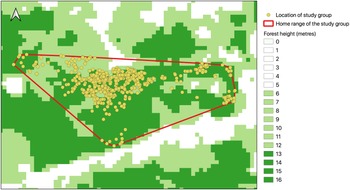
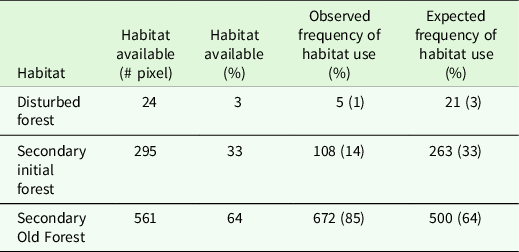
A total of 880 pixels were registered in the exotic squirrel monkey home range. Sixty-three per cent (N = 561 pixels) of the study area was characterized as Secondary Old Forest, with the other two categories of forest occupying less than 40% of the area, Secondary Initial Forest = 295 (33%)/Disturbed Forest = 24 (3%) (Figure 1, Table 1). In general, the exotic squirrel monkey preferred Secondary Old Forest habitats when considering the observed and expected frequency (Table 1 – Fisher’s test: p = 0.001).
Home range extracted through minimum polygon convex using 100% (red line) of the collected points of the exotic squirrel monkeys and three different types of habitats (0–5 m: Disturbed Forest; 6–12: Secondary Initial Forest; <12 m: Secondary Old Forest).

Habitat available in the study area observed and expected frequencies of the habitat type used by exotic squirrel monkeys in the study urban Atlantic Forest fragment in North-eastern Brazil

Fruit availability
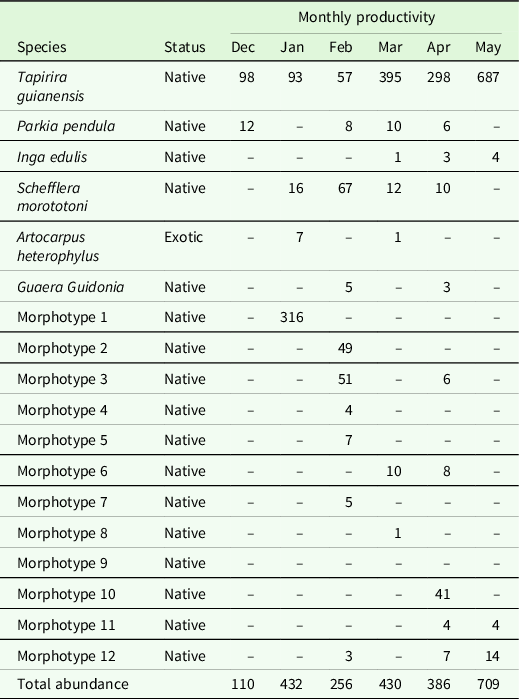
A total of 2,323 fruits and seeds (monthly mean = 387 ± 201 SD) were collected in the traps while monitoring the exotic squirrel monkeys’ behaviours. December (N = 110) presented the lowest number of food available, while May (N = 709) showed the highest values (Table 2). Of the 18 fruit species collected, it was possible to identify five native plants (Tapirira guianensis Aubl., Schefflera morototoni Aubl., Parkia pendula (Willd.) Benth. ex Walp., Inga edulis Mart., Guaera Guidonia (L.) Sleumer) and one exotic species (Artocarpus heterophyllus) (Table 2). Tapirira guianensis, morphotype 1, and S. morototoni were the most abundant species (Table 2).
Estimative of fruit productivity across the study period. We measured monthly productivity from 50 fruit traps installed in the home range of the exotic squirrel monkeys

Distribution of food sources and food item consumption
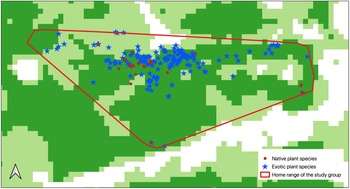
Exotic squirrel monkeys consumed 194 plant food sources during the study period. One hundred seventy food sources (88%) consisted of exotic plants, while 24 (12%) were native plants. Within the exotic plants, we found A. heterophyllus (Moraceae), M. indica (Anacardiacae), E. guineensis (Arecaceae), Syzygium jambos (L.) Alston (Myrtaceae), Anarcadium ocidentale (L.) (Anacardiaceae), Musa sp. (Musaceae), Spondias mombin L. (Anacardiaceae), and Syzygium cumini (L.) Skeels (Myrtaceae). The native species were I. edulis (Fabaceae), Bowdichia sp. (Fabaceae), Talisia sp. (Sapindaceae), and four morphotypes. We found 22 native plant food sources inserted in the Secondary Old Forest and two native plant sources in the Secondary Initial Forest (Figure 2). Only 22 exotic plant food sources were found in the Secondary Initial Forest, while 148 exotic plant food sources were recorded in the Secondary Old Forest (Figure 2).
Distribution of native and exotic plant species consumed by exotic squirrel monkeys in their home range during the study period. The red line represents the limits of the home range.

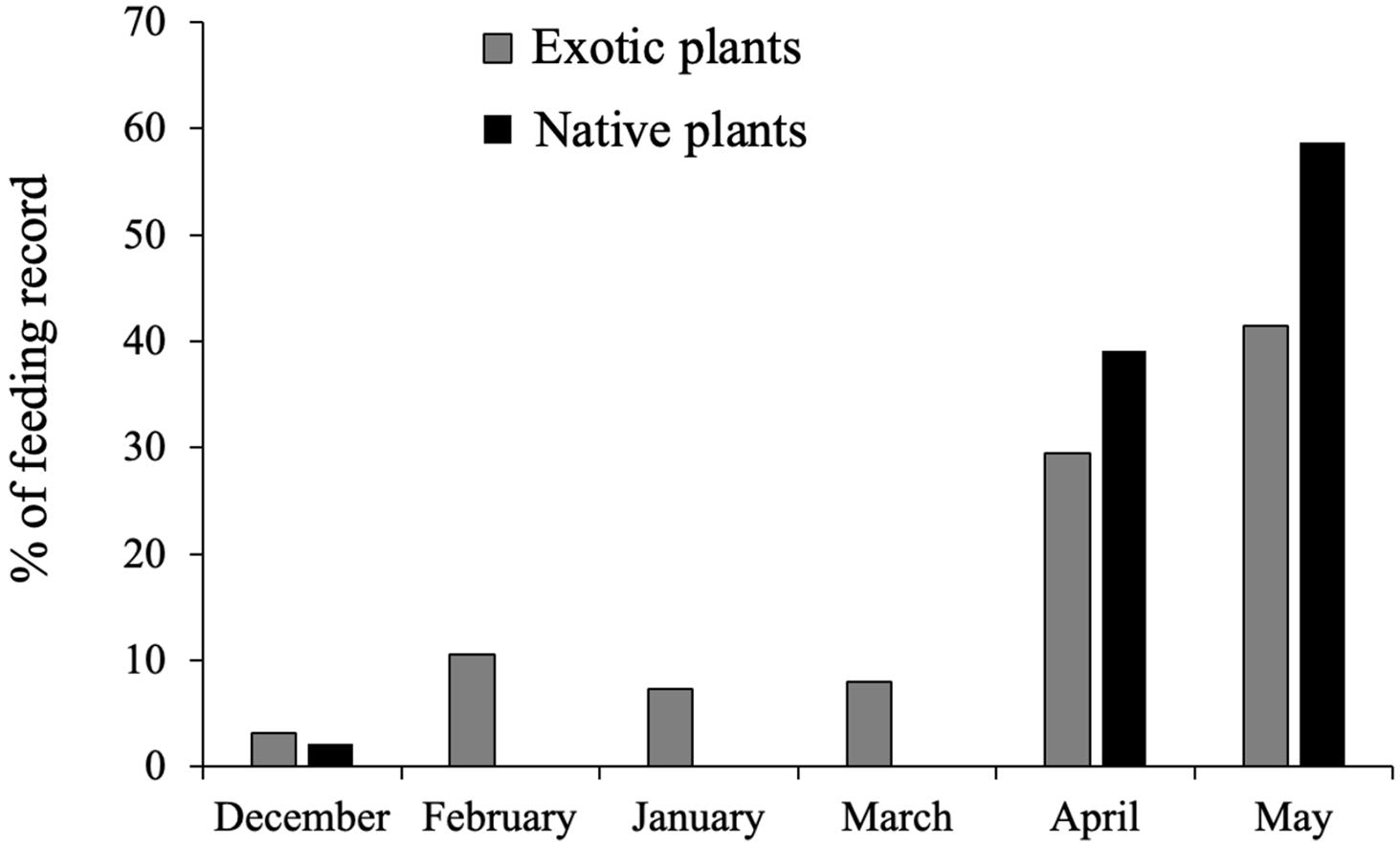
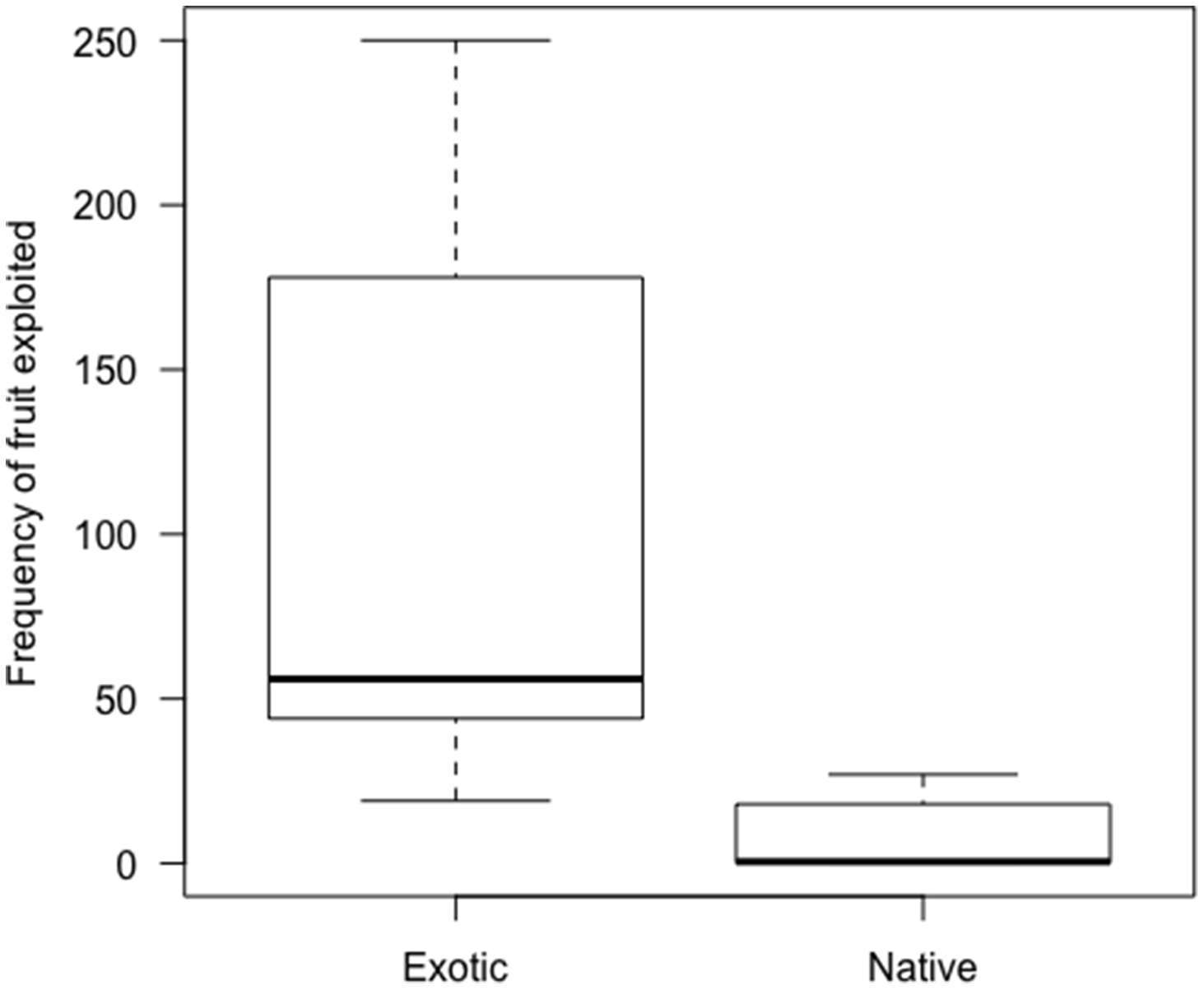
Exotic squirrel monkeys consumed the native plant species only three out of six months of the study period (Figure 3). In contrast, exotic plant species were consumed across the study period (Figure 3). The lowest frequencies of feeding records on both native and exotic plant species were recorded in the month with the lowest food availability (i.e., December). On the other hand, the highest native and exotic plant consumption frequencies occurred in May, that is, the month with the highest food availability (Figure 3). Although the monthly percentages demonstrate an increase in the consumption of native plants in the last 2 months, when we consider the absolute values, the exotic plants were most frequently consumed (Figure 4).
Relative frequency (%) of the feeding records for native and exotic plant species exploited by exotic squirrel monkeys.

Consumption of exotic and native plant species by exotic squirrel monkeys living in an Atlantic Forest fragment in Northeast Brazil. The boxplot shows the absolute values of consumption. The dark line inside the box represents the median, and the top and bottom edges of the box mark the 1st and 3rd quartile, respectively. The error bars are the standard deviation.

Presence of common marmosets
We observed exotic squirrel monkeys interacting with common marmosets throughout the study period in 220 events (3% of total de records). The mean number of individual common marmosets in contact with the exotic squirrel monkeys ranged from 1.5 (± 0.8 individuals) in March to 3.1 individuals in February (± 2.0 individuals) and April (± 2.6 individuals). We observed 35 events of interaction (16%) occurring in the Secondary Initial Forest and 185 events (84%) in the Secondary Old Forest; no event was recorded in the Disturbed Forest (Table 3). The expected encounter rate was 0.74 and 0.54 events for the duration of the study period (147 hours) in the Secondary Initial Forest and the Secondary Old Forest, respectively.
Observed/expected frequencies of potential correlate as habitat use of exotic squirrel monkeys in the present study

Potential correlates of habitat use by exotic squirrel monkeys
From the scans, we obtained 7,069 records of exotic squirrel monkey habitat use. The total number of feeding records represented 11% (N = 795 records). The consumption of exotic plants by the exotic squirrel monkeys represented 76% (N = 603 records), while the consumption of native plants represented 6% (N = 46 feeding records). The other feeding records (18%) were for different food items such as invertebrates. We found that 84% of the consumption records of exotic plants occurred in Secondary Old Forest (84%) (Table 3). Similarly, native plants were primarily consumed in the Secondary Old Forest (96%) (Table 3). There was a preference for Secondary Old Forest habitats to consume exotic and native plants by the exotic squirrel monkeys (Fisher’s test: p = 0.001), thus supporting prediction #1.
There was no variation concerning the expected and observed frequencies of associations between exotic squirrel monkeys and common marmoset in the different habitats (Fisher’s test: p = 0.781). Nevertheless, the frequency of interaction did not appear to be by chance in one type of habitat. According to the 95% confidence interval for Secondary Initial Forest (0.20–2.70 events), the values for expected encounters between exotic squirrel monkeys and common marmosets demonstrated that such interaction was by chance. On the other hand, the interaction between species in the Secondary Old Forest habitat (95% CI: 5.14–13.5 events) was not by chance (prediction #2 was supported).
During the study period, 785 scan samples were performed. We obtained 28% of the scan records (N = 218 scans) during the months of low food availability and 19% (N = 148) during the months of high food availability. For both periods, most of the records took place in the Secondary Old Forest (80% of records – low food availability/89% of records – high food availability) (Table 3). There were no differences between the observed and the expected frequencies for the period of low availability (Fisher’s test: p = 0.139) and high availability (Fisher’s test: p = 0.195) of fruits. Thus, exotic squirrel monkeys did not prefer any habitat during the months with low and high food availability (prediction #3 was not supported).
Discussion
Our findings demonstrated that the use of the habitat by the exotic squirrel monkeys appears to be highly flexible and related to the consumption of native and exotic food sources. The consumption of exotic and native plant species contributed to the exotic squirrel monkey preferences for non-disturbed habitats. The presence of the native common marmosets did not prevent the use of the habitat. We found that the association between common marmosets and exotic squirrel monkeys in the Secondary Old Forest habitat was not by chance. The use of the habitat by exotic squirrel monkeys was not related to food availability. Nevertheless, the high availability of food in Secondary Old Forest appeared to be related to the increased use of native and exotic food sources and the high frequency of food consumption. Previous studies have demonstrated that exotic plants are essential for the maintenance of exotic animal populations, including deer (Relva et al. Reference Relva, Nuñez and Simberloff2010), carnivores (Hardesty-Moore et al. Reference Hardesty-Moore, Orr and McCauley2020), snails (Meza-Lopez & Siemann Reference Meza-Lopez and Siemann2015), and primates (Cunha et al. Reference Cunha, Vieira and Grelle2006).
Primate responses to the availability of both native and exotic food sources will vary by species and the context in which they are placed (McLennan & Hockings Reference McLennan and Hockings2014). Some primates tend to use areas with more native resources (Riley Reference Riley2008; Terada et al. Reference Terada, Nackoney, Sakamaki, Mulavwa, Yumoto and Furuichi2015; Bryson-Morrison et al. Reference Bryson-Morrison, Tzanopoulos, Matsuzawa and Humle2017), while others use areas with high densities of exotic plants (Eppley et al. Reference Eppley, Donati, Ramanamanjato, Randriatafika, Andriamandimbiarisoa, Rabehevitra, Ravelomanantsoa and Ganzhorn2015). However, highly aggregated and predictable food resources, such as exotic and cultivated vegetation, can also be attractive to species (Hill Reference Hill, Paterson and Wallis2005; Hockings et al. Reference Hockings, Anderson and Matsuzawa2009; Hoffman & O’Riain Reference Hoffman and O’Riain2011). In the Mata do Curado Wildlife Refuge, there is a high density of exotic plant species (A. heterophyllus, S. cumin, E. guineenses, M. indica) that dominate the diet of this exotic squirrel monkey population (Oliveira-Silva et al. Reference Oliveira-Silva, Campêlo, Lima, Araújo, Bezerra and Souza-Alves2018; Campêlo et al. Reference Campêlo, Souza-Alves, Lima, Araújo, Oliveira-Silva and Bezerra2019). Such plant species are widely distributed in Secondary Old Forest habitats. Moreover, exotic plant species produce year-round large fleshy fruits that attract frugivorous species (Piedade-Kill & Ranga Reference Piedade-Kill and Ranga2000; Ziller Reference Ziller2001; Kueffer et al. Reference Kueffer, Kronauer and Edwards2009; Traveset & Richardson Reference Traveset and Richardson2014). In our study, the use of the Secondary Old Forest areas by the exotic squirrel monkeys was associated with native and exotic plant consumption and the high availability of food sources. The use of primary forest and the late-successional forest was also reported for Saimiri orsterdii (Reinhardt, 1872) when low food availability (Boinsky Reference Boinski1987). Undisturbed habitats favour the high availability of food resources due to an increase in plant species richness, tree basal (López et al. Reference López, Terborgh and Ceballos2005; Arroyo-Rodríguez & Mandujano Reference Arroyo-Rodríguez and Mandujano2006), which can positively influence the habitat choice of a primate species (Heiduck Reference Heiduck2002; Tinsman et al. Reference Tinsman, Volampeno, Ganas-Swaray, Gann, Andrianirina, Chamizo, Ralazampirenena, Ranaivoarisoa, Ravaoarisoa, Rivero, Zamora and Gomes2022; Trapanese et al. Reference Trapanese, Meunier and Masi2022; Yazezew et al. Reference Yazezew, Bekele, Fashing, Nguyen, Moges, Ibrahim, Burke, Epplet and Mekonnen2022). The fact that the exotic squirrel monkeys use these areas at a higher frequency seems to be an essential adaptation for maintaining the population in this habitat and consuming foods presenting higher availability and most likely high energetic content.
Few studies have demonstrated interspecific associations between native and exotic primates (Ruiz-Miranda et al. Reference Ruiz-Miranda, Affonso, Martins and Beck2000). As a result of these associations, an increase in competition for food resources can occur (Ruiz-Miranda et al. Reference Ruiz-Miranda, Affonso, Martins and Beck2000; Morais Reference Morais2005; Morais et al. Reference Morais, Ruiz Miranda, Gravitol, Andrade, Lima, Martins, Beck, Oliveira, Gravitol and Miranda2008). In our study, the presence of common marmosets did not contribute to the exotic squirrel monkeys’ preference for a given habitat. Likewise, variability in food availability is often highlighted as a key factor for habitat use in primates (Peres Reference Peres1994; Clutton-Brock & Harvey Reference Clutton-Brock and Harvey1997; Camaratta et al. Reference Camaratta, Chaves and Bicca-Marques2017). Even though we worked with only one month of low and high fruit production – which are months of extreme productivity – the difference between them is evident, and the formation of mixed groups in a habitat with increased food availability was demonstrated. Therefore, our findings suggest that the interspecific associations formed by exotic squirrel monkeys and common marmosets were not by chance. It is likely to be associated with increased fruit abundance in the habitat. Constant and abundant fruit production over the year by exotic plants may have increased the likelihood of both primates consuming fruits in Secondary Old Forest habitats at any time.
The population of exotic squirrel monkeys appears to be well-adapted to the ecological conditions found and offered in this urban forest fragment, preferring to use habitats with the presence of exotic plants (and native), and where they were frequently observed to eat and rest (see Campêlo et al. Reference Campêlo, Souza-Alves, Lima, Araújo, Oliveira-Silva and Bezerra2019). Contrary to our predictions, the variation of food availability did not affect the exotic squirrel monkeys’ preference for some type of habitat. Meanwhile, the resource consumption and their location of food sources likely favoured the high frequency of exotic squirrel monkeys in Secondary Old Forest during the low availability month. Although they are miles away from their natural habitat (i.e., Amazonian Forest), suitable feeding strategies (e.g., consuming exotic plants) increase the chances of this species becoming well-established (high number of infants were reported during the study period: A. Campêlo, pers. comm.). Furthermore, our study also introduced the possibility that an invasional meltdown effect positively affects the exotic squirrel monkey population. This study made it possible to broaden our knowledge on the ecological and behavioural flexibility of an exotic population in a habitat out of their native range.
Acknowledgements
We are grateful to the personnel of the Comando Militar do Nordeste and 10º Pelotão de Polícia Militar do Exército for allowing us to carry out this study. Our thanks extend to all the people that directly or indirectly participated in this project. We are grateful to Robério Freire-Filho for the comments/suggestions performed in the first draft of the manuscript. We are thankful to Dr. Vojtech Novotny and three anonymous reviewers for their valuable comments on our manuscript.
Financial support
ACC was funded by CNPq (Grant number 132854/2016-3) and Capes (Financial Code 001). IMS was funded by PIBIC/UFPE/CNPq (Grant number 17027382PO). JPS-A is supported by FACEPE (BFP-0149-2.05/19). BMB is a CNPq productivity grant holder.
Conflicts of interest
The authors declare no competing interests and no conflicts of interest.
Ethical statement
All research complied with Brazilian legal requirements. It also adhered to the ASAB/ABS Guidelines for the Use of Animals in Research and American Society of Primatologists Principles for the Ethical Treatment of Non-Human Primates.