During natural disasters, Deaf and hard of hearing individuals and older adults who are also Deaf and hard of hearing have repeatedly experienced disproportionate morbidity and mortality compared to other populations.Reference Wood and Weisman 1 , Reference Cahalan and Renne 2 There are accounts of Deaf individuals driving into severe thunderstorms because they did not hear warning messages being transmitted on television and narrowly missing tornadoes because they could not hear the warning sirens and only recognized the risk when they saw neighbors fleeing their homes.Reference Wood and Weisman 1
According to the National Institute on Deafness and Other Communication Disorders (NIDCD), 1 in 8 individuals (13%, or 30 million) aged 12 years or older living in the United States in 2014 experienced hearing loss in both ears. In addition, 2% of adults aged 45 to 54 years, 8% of those aged 55 to 64, 25% of those aged 65 to 74, and 50% of those 75 years or older have disabling hearing loss. 3 The NIDCD findings agree with other studies showing that 43% of the older adult population also experiences Deafness or difficulty hearing.Reference Zelaya, Lucas and Hoffman 4 Therefore, hearing loss is a common thread that impacts communication strategies and preparedness for both Deaf and hard of hearing and older adult populations.
Findings from the nationwide Health and Retirement Study, a preparedness survey of 1304 adults aged 50 years and older,Reference Al-Rousan, Rubenstein and Wallace 5 suggest a link between poor communication during disasters and poor outcomes for Deaf and hard of hearing persons and older adults. In the survey, 6.7% of respondents had a hearing impairment that prevented them from hearing warning signals.
Other studies have highlighted emergency-response-related needs identified by emergency response personnel such as health care workers, members of affected communities, law enforcement, and public health professionals. These needs include training in basic American Sign Language as well as being better equipped during an emergency response to sensitively, compassionately, and physically assist those who may have a chronic illness, those who cannot move around without a wheelchair, or those confined to a bed.Reference Anderson 6 , Reference Fernandez, Byard, Lin, Benson and Barbera 7 These needs can be addressed by quality training programs for emergency response personnel who will interact with Deaf and hard of hearingReference Engelman, Ivey and Tseng 8 and older adultsReference Fernandez, Byard, Lin, Benson and Barbera 7 during disasters.
Despite the need for ongoing work, there have been a few successful interventions that have aided communication with Deaf and hard of hearing and older adults in some communities. Televised communications during Super Storm Sandy included a sign language interpreter whose professionalism and dedication were warmly received by the public, as evidenced by her following on Twitter and Tumblr.Reference Peters 9 In addition, the Chesapeake Health Education Program, Inc, a nonprofit organization that is based in Maryland, has been organizing an annual Preparedness, Emergency Response, and Recovery Consortium since 2013. This 4-day conference has created a forum for health care professionals, law enforcement officers, volunteers, and public health professionals to share best practices for preparedness communication and coordination among partner agencies at all levels of disaster response and recovery operations. 10 , 11
The aims of this study were to (1) identify available training programs for emergency response personnel and public health professionals on addressing the needs of Deaf and hard of hearing and older adult individuals, (2) identify strategies to improve these training programs, and (3) identify gaps in available training and make recommendations for addressing these gaps.
Methods
Literature Review
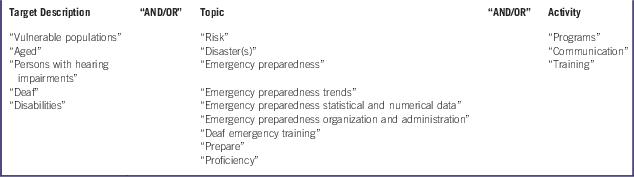
Data on training programs for emergency response personnel and public health professionals working with Deaf and hard of hearing and older adults were obtained from a review of the literature. Key word searches were conducted in the PubMed (National Library of Medicine), Web of Science (Thomson Reuters), Cumulative Index to Nursing and Allied Health Literature (CINAHL; EBSCO), Google Scholar (Google Inc), and Google (Google Inc) databases. Search terms included a target population (eg, “persons with hearing impairments”) and/or a topic (eg, “emergency preparedness”) and/or an activity (eg, “training”) to identify the most relevant publications (Table 1). Abstracts and full texts were screened for the following inclusion criteria: (1a) a structured training program that included elements such as title, duration, target audience, curriculum, and aims OR (1b) an evaluation of a structured training program that focused on (2) training of professionals to address the emergency preparedness needs of Deaf and hard of hearing persons or older adults or (3) did not describe a training program but rather addressed emergency preparedness needs for Deaf and hard of hearing populations or older adults.
Summary of Search Terms Used in the Literature ReviewFootnote a

a Literature searches were conducted in PubMed, Web of Science, CINAHL, Google, and Google Scholar. Articles pertaining to responders serving older adults were retrieved from PubMed, and the other databases were used primarily to retrieve articles related to individuals who were Deaf or hard of hearing. Google was used primarily to identify training programs with search terms previously used by Engelman et al.Reference Engelman, Ivey and Tseng 8
Key Informant Survey
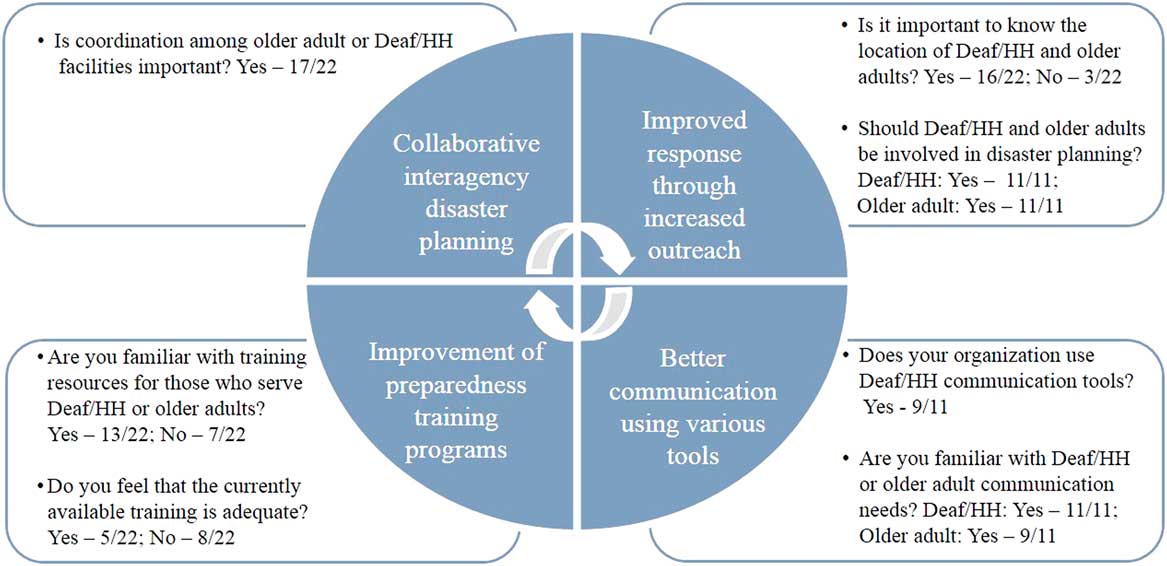
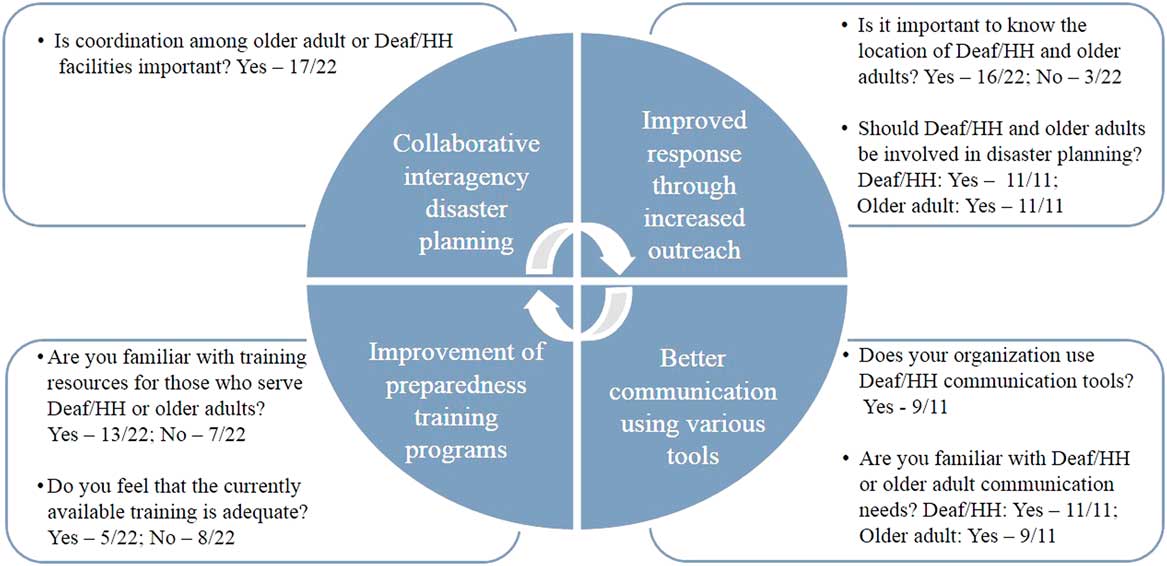
Key informants were identified mainly on the basis of their research area of expertise or field experience with Deaf and hard of hearing or older adult communities. We used purposive sampling from organizations of different types. Requests were sent via email to 66 subject matter experts (SMEs) from the US government, academia, health departments, nonprofit public health organizations, and Deaf and hard of hearing or older adult advocacy organizations. Twenty-two of the 66 SMEs responded and were interviewed for the survey. Those who consented to participate answered survey questions during a 45- to 60-minute phone interview or by completing a survey that was sent to them via email. Phone and email survey questionnaires were based on a previous designReference Engelman, Ivey and Tseng 8 and included both quantitative and qualitative questions. Survey questions were reviewed by collaborators and piloted with public health professionals (different from the respondents). The survey questions were organized into domains focusing on different aspects of emergency preparedness (see Supplementary Table 1 in the online data supplement). The older adult SME survey included 43 questions, and the Deaf and hard of hearing SME survey included 42 questions. Sample questions and overall themes are summarized in Figure 1.
Sample Survey Questions (Clear Boxes) and Qualitative Themes (Blue Core) Identified by Key Informants. Abbreviation: Deaf/HH, Deaf and hard of hearing. Twenty-two experts (11 for people who were Deaf and hard of hearing and 11 for older adults) answered questions during a 45- to 60-min phone session with a live person or completed an emailed survey. Those not accounted for in the “yes” or “no” categories of the questions either were not asked the question because of time limitations or chose not to answer the question.
Data Analyses
Individual responses from phone and emailed surveys were summarized by domain. Frequencies were calculated for quantitative questions. Qualitative questions were analyzed for common themes pertaining to preparedness training programs. Themes identified in the key informant surveys were then compared to findings from the literature review; commonalities and differences were summarized.
Results
Literature Review
Of the original pull of citations (3766) from PubMed, CINAHL, Web of Science, and Google Scholar, there was overlap across databases. After eliminating duplicates and reviewing abstracts, we identified approximately 400 articles for full-text review. After full-text review, 15 publications met the inclusion criteria. Four publications were evaluations of training programs for professionals working with older adults (Supplementary Table 2 in the online data supplement). The remaining 11 publications discussed recommendations for preparedness training for public health, health care professionals, and first responders (n=2) who worked with communities of either older adult (n=6), Deaf and hard of hearing (n=1), or both (n=2). The publications identified several key elements that contribute to successful training programs for emergency responders and public health when working with Deaf and hard of hearing and older adult communities. Results are presented by population.
Deaf and Hard of Hearing Persons
Community-based organizations (CBOs) have an important role to play in readying Deaf and hard of hearing communities for a disaster. Results from 2 studies revealed the need for more widely availableReference Cahalan and Renne 2 , Reference Anderson 6 preparedness training for CBOs, emergency responders (medical personnel, law enforcement, and firefighters), and members of the Deaf and hard of hearing community. In addition, one study found that local health departments could use their resources and staff more efficiently by forming strategic and meaningful partnerships with CBOs and faith-based organizations.Reference Stajura, Glik and Eisenman 12
Communication is an essential component of assisting the Deaf and hard of hearing in a disaster. One study highlighted the need for mass emergency messages to be more accessible and written at the fourth-grade reading level.Reference Neuhauser, Ivey and Huang 13 An evaluation in Ohio suggested that police officers, firefighters, and emergency management technicians need to know basic American Sign Language, have more knowledge of Deaf culture, and be trained in effective emergency communication with a person who is Deaf.Reference Anderson 6
Older Adults
Advanced preparedness was a key finding among literature focused on older adults. Three reports included activities that public health and medical practitioners could use to better prepare older adults living in the community for disaster situations.Reference Cahalan and Renne 2 , Reference Al-Rousan, Rubenstein and Wallace 5 , Reference Klaiman, Knorr and Fitzgerald 14 Emphasis was placed on involving older adults in disaster plan development and execution.Reference Al-Rousan, Rubenstein and Wallace 5 Furthermore, plans should be tailored toward older adults who live independently, lack transportation, have restricted mobility, or have hearing loss or other impairments.Reference Cahalan and Renne 2
General Preparedness
Four reports focused on training programs for practitioners working with one or both target populations.Reference Peters 9 , Reference Klaiman, Knorr and Fitzgerald 14 - 16 These reports emphasized that curricula need to be developed in consultation with people who are Deaf and hard of hearing and older adultsReference Klaiman, Knorr and Fitzgerald 14 as well as with relevant organizations that serve groups from diverse cultural and linguistic backgrounds.Reference Laditka, Laditka and Cornman 15
Key Informant Survey
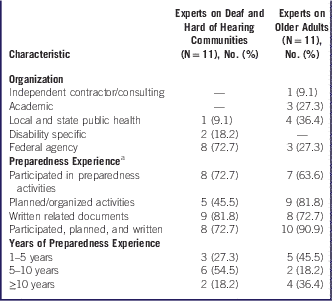
Information on training needs for the Deaf and hard of hearing and older adults was obtained from surveys completed by 22 public health practitioners identified as SMEs in the field of emergency preparedness (Table 2). Eleven SMEs had experience in the administrative and/or field execution of emergency preparedness related to Deaf and hard of hearing persons and 11 had similar experience working with older adults. At the time of the interview, the SMEs were working in their respective organizations as consultants, outreach coordinators, physicians, analysts, university professors, program directors, health educators, health scientists, health advisors, and health education specialists. Over half of the SMEs had experienced a disaster response where there were concerns about older adults or individuals who were Deaf or hard of hearing.
Characteristics of Key Informants

a All participants were able to respond to all categories that applied to this particular question, thereby demonstrating their experience in the preparedness field.
SMEs were queried about training curricula and training needs. Their responses indicated that curricula need to be widely advertised and accessible, be updated regularly to keep up with changing communication technology, include refresher courses, be tailored toward different emergency situations, and be designed as a collaborative effort among federal and state agencies.
Content analysis identified 4 major themes that occurred most frequently in the experts’ responses. Each theme has specific emergency preparedness success factors applicable to programs geared toward those working with Deaf and hard of hearing persons and/or older adults (Figure 1).
Theme 1: Coordination Among Organizations and Affected Communities Is Crucial for Effective Disaster Planning
SMEs from both groups (8 of 11 for Deaf and hard of hearing and 9 of 11 for older adults) felt that interagency collaboration was important. Coordinated efforts would enable response organizations to better address emergency preparedness and response needs of Deaf and hard of hearing and older adult community members. These coordinated efforts among agencies could include exchanging unique knowledge and experiences and clearly outlining specific capabilities. Agencies working together could also distribute resources more efficiently during emergency response situations, such as involving sign language interpreters in all aspects of response efforts and better targeting socially isolated older adults with access and functional needs.
An example of successful agency collaboration is Philadelphia’s Vulnerable Populations Outreach Model,Reference Klaiman, Knorr and Fitzgerald 14 where collaborating agencies have complementary roles to ensure that populations at risk for adverse outcomes are better prepared for disaster situations. In addition, local government provides preparedness training opportunities, government partners from other agencies provide staff and communicate directly with the communities, and community members are included in emergency planning.
Theme 2: Disaster Response Efforts Could Be Improved by Increasing Outreach to Affected Communities
All SMEs felt that better outreach was an important component of improved disaster efforts. Six of the 11 SMEs for Deaf and hard of hearing persons and 10 of 11 SMEs for older adults felt that it was important to establish community registries containing locations of Deaf and hard of hearing persons and older adults. They thought that knowing the locations of these individuals would be particularly important for building mutual trust and respect as well as for reaching those who are confined to beds or wheelchairs. A small number of SMEs, 2 of 11 for Deaf and hard of hearing persons and 1 of 11 for older adults, were opposed to the idea. They felt that more useful information could be collected such as individuals’ phone numbers and phone types (for text messages or relay systems), ages, income levels, and medical conditions. This information would allow for better allocation of resources and more efficient outreach.
All SMEs agreed that disaster response could be improved by involving older adults and Deaf and hard of hearing individuals in emergency planning. For example, Deaf and hard of hearing and older adult community members could be appointed as representatives whose roles could include relaying feedback from the community to response organizations, serving as preparedness mentors within their communities and disseminating emergency information from response personnel to those affected. Furthermore, community representatives could also be utilized to register phone numbers into a secure emergency message database (reverse 911).
Theme 3: A Variety of Tools and Procedures Are Needed to Communicate With Deaf and Hard of Hearing and Older Adult Communities
Our experts stressed the importance of using a variety of channels (for example, radio, email, and social media) to disseminate emergency messages. Relying on a single mode of communication, such as social media, could exclude those persons who do not feel comfortable using a computer. Sign language and written notes could be used when communicating directly with an older individual with hearing loss who may not use social media or even have a cell phone. When composing emergency messages, various factors such as age and literacy level would need to be taken into account.
Currently available tools for Deaf and hard of hearing persons include alert and early warning systems, which utilize email and text messaging and are only available in some areas. SMEs felt that Text-to-911, a wireless service restricted to certain parts of the country, should be made available nationwide.
More commonly, Deaf and hard of hearing individuals can converse with first responders via relay calls. Relay calls utilize an operator service that allows Deaf and hard of hearing individuals to converse on a standard phone as an operator types messages so that the conversation can be relayed back and forth. Teletypewriters (TTYs) are an older technology that can also be used for phone conversations. Other modalities include smartphone communication applications or signing and using open and closed-captioning on television.
Emergency messages for Deaf and hard of hearing individuals might also be conveyed by using visual cues (signs at shelters, flashing lights) or use of communication access real-time translation (CART) services (also known as real-time captioning), where speeches or other talks are recorded as they are happening by using a stenography machine and computer software and displayed on a screen for the audience.Reference Wood and Weisman 1 Tools that could be implemented in advance between emergency responders and these at-risk individuals include one-on-one communication via home visits or video relay services.
Theme 4: Need for Improving Preparedness Training Programs
Five of the 11 SMEs working with Deaf and hard of hearing persons and 8 of 11 SMEs working with older adults (Figure 1) knew of resources for training public health professionals to assist people who are Deaf and hard of hearing and older adults in disaster situations. These resources include (1) online training sponsored by the Federal Emergency Management Agency (FEMA) and Centers for Disease Control and Prevention (CDC), 16 , 17 (2) practice centers and toolkits developed by the National Association of County and City Health Officials (NAACHO), 18 (3) training by private consultants,Reference Kailes 19 and (4) online American Sign Language Videos provided by the Massachusetts Commission for the Deaf and Hard of Hearing. 20 However, 3 of 11 SMEs for Deaf and hard of hearing persons and 5 of 11 SMEs working for older adults felt that available training for public health professionals was inadequate for serving these populations.
Experts felt training needed to be more structured and accessible to response personnel, organizations serving Deaf and hard of hearing persons and older adults, and the affected communities. They also felt that organizing training programs for communities with older adults and people who are Deaf and hard of hearing needed to be a high priority for allocation of funds.
Discussion
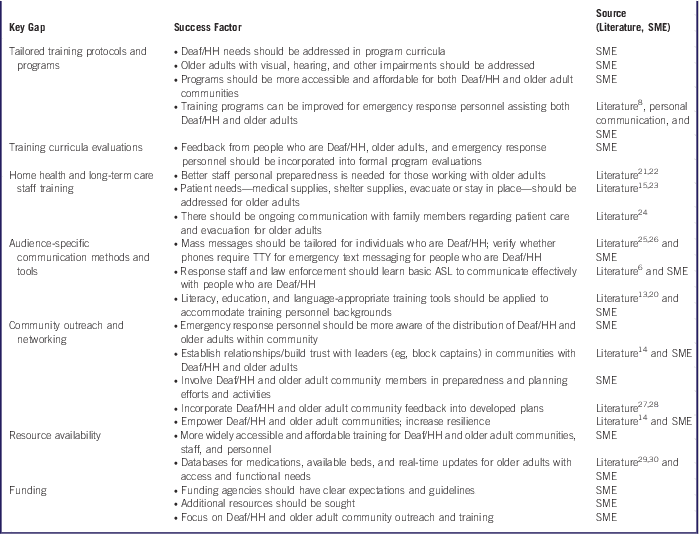
This study identified a number of similarities between the key gaps in preparedness training noted in the published literature and those identified by our key informants. The 4 themes identified by key informant interviews combined with the results of the literature review can be crystallized into 7 specific gaps in preparedness training for Deaf and hard of hearing individuals and older adults (Table 3).
1. Tailored training protocols and programs. Improved training protocols that teach public health professionals and emergency response personnel how to address the communication needs of Deaf and hard of hearing individuals as well as older adults with visual and hearing impairments are critical.
2. Tailored curricula evaluations. Feedback on existing training curricula should be obtained directly from members of Deaf and hard of hearing and older adult communities.
3. Home health and long-term care staff training. Staff need to be personally prepared for disasters, stay in communication with the family members of their older adult patients, and develop tailored plans that address their patient’s needs, including medication availability, mobility, and whether to evacuate or shelter in place.
4. Audience-specific communication methods and tools. Response personnel need to learn sign language, mass messages should be tailored to Deaf and hard of hearing individuals who use TTY or text messaging, and training tools need to be in the appropriate language and at the appropriate literacy and education level of the trainees.
5. Community outreach and networking. Emergency response personnel need to develop relationships with the community (both the leaders and members at large) and should involve them in preparedness activities, obtain their feedback, and empower community members by ensuring they have personal preparedness plans and supplies in place.
6. Resource availability. More widely accessible training resources are needed, along with databases that provide information on pharmacy access and bed availability, both in advance and in real time as disaster response efforts progress.
7. Funding. Funding agencies need to have clear expectations and guidelines for the inclusion of Deaf and hard of hearing individuals and older adults in all preparedness and response efforts, and more funds should be channeled toward community outreach and training.
Key Gaps and Success Factors in Preparedness Training ProgramsFootnote a

a Abbreviations: ASL, American Sign Language; Deaf/HH, Deaf and hard of hearing; SME, subject matter experts; TTY, teletypewriter.
Key informants emphasized the importance of increased funding for training evaluations (Table 3). This was supported by a recent publication that describes the importance of evaluating the effectiveness of health care worker disaster training programs.Reference Williams, Nocera and Casteel 31 A recent white paper from the Institute of MedicineReference Pines, Pilkington and Seabury 32 suggests that, while funding has declined over the years, there has not been enough evidence showing the effectiveness of current trainings. These collective findings suggest a clear need for peer-reviewed evaluations of available training programs. Furthermore, organizations should focus on emergency preparedness plans that are cost-effective and sustainable in order to accommodate limited resources.Reference Thomas, Roggiero and Silva 33
The elements of coordinated preparedness and response activities that successfully support Deaf and hard of hearing persons and older adults were highlighted by key informant interviews and the literature review. These include (1) understandable emergency mass messages targeting Deaf and hard of hearing communities,Reference Neuhauser, Ivey and Huang 13 (2) teaching response personnel basic American Sign Language,Reference Anderson 6 and (3) developing training tools in appropriate languages and at low literacy levels.Reference Neuhauser, Ivey and Huang 13 , Reference Ivey, Tseng and Dahrouge 34 Key informants further suggested that registered phone numbers need to be evaluated for text-enabled messaging or TTY compatibility prior to disseminating emergency messages.
Both groups highlighted the importance of emergency preparedness collaboration among nursing homes, home health agencies, law enforcement, emergency management, CBOs, nongovernmental organizations, state and local officials, and sign language interpreters.Reference Stajura, Glik and Eisenman 12 , Reference Klaiman, Knorr and Fitzgerald 14 , Reference Laditka, Laditka and Cornman 15 , Reference Rosselli, Davis and Simeonsson 35 Agencies can improve their partnerships through cross-training activities and by coordinating emergency response efforts to avoid redundancy, share resources, and distribute the response burden.Reference Klaiman, Knorr and Fitzgerald 14 , Reference Estrada, Fraser and Cioffi 27 The key informants highlighted the importance of knowing the geographic distribution of at-risk populations. Both groups acknowledged the need for increased community outreach and empowering communities to be more proactive by improving their personal preparedness and looking out for their neighbors.Reference Klaiman, Knorr and Fitzgerald 14 , Reference Wells, Tang and Lizaola 36 Improved personal and community resiliency will positively impact the ability of responders to help people who are Deaf and hard of hearing and older adults by having quick access to important information, such as the location of available hospital beds, pharmacies, and an individual’s medical history.Reference Troy, Carson and Vanderbeek 29 , Reference Irmiter, Subbarao and Shah 30
This study was strengthened by containing perspectives of key informants who have worked in the preparedness field specifically with Deaf and hard of hearing or older adult populations and by discussing important communication preparedness training needs for people who are Deaf and hard of hearing, both within and outside of older adult communities. Study findings can be used to inform development or enhancement of preparedness training programs and emergency messaging for Deaf and hard of hearing persons and older adults, especially given the relative lack of published literature on this topic.
A limitation of this study was that additional training programs and evaluations of training curricula may be available from sources other than those published in the peer-reviewed literature. Nevertheless, the study findings serve to give public health practitioners examples of training programs to model and the key elements necessary to effectively reach Deaf and hard of hearing and older adult populations. Another limitation was that the key informant group did not represent all types of stakeholders who are important in working with Deaf and hard of hearing and older adult populations. However, the surveys captured gaps and recommendations that are mirrored in the small body of published literature, and follow-up studies involving stakeholders that represent a wider range of the public health system and partner organizations could address the issues in more depth.
Conclusions
This study (1) characterizes training programs intended for public health and emergency response personnel who serve Deaf and hard of hearing individuals, some of whom are older adults; (2) highlights published assessments of emergency preparedness needs that could inform or enhance training; and (3) discusses recommendations from key informants for improving preparedness training. The primary findings suggest that development and implementation of training programs for personnel serving Deaf and hard of hearing and older communities should (1) involve collaboration across different emergency, state, federal, and advocacy agencies; (2) involve members from affected communities; (3) be more widely accessible and affordable; and (4) teach response personnel varied communication techniques relevant to these communities of interest.
Acknowledgments
The authors thank the participants for completing the survey and Elena Savoia (Harvard University T.H. Chan School of Public Health), Winston Tseng (University of California Berkeley, School of Public Health), and Angie Fuoco, Vincent Campbell, and Sam Groseclose (Centers for Disease Control and Prevention) for guidance while conducting the study and critical review of the manuscript.
Disclaimer
The contents, findings, and views contained in this article are those of the authors and do not necessarily represent the official programs and policies of Centers for Disease Control and Prevention (CDC), Agency for Toxic Substances and Disease Registry (ATSDR), or the US Department of Health and Human Services. Use of trade names and commercial sources is for identification only and does not imply endorsement by the Centers for Disease Control and Prevention, the Public Health Service, or the US Department of Health and Human Services.
Supplementary materials
To view supplementary material for this article, please visit https://doi.org/10.1017/dmp.2017.117