Introduction
Antarctic toothfish in McMurdo Sound have been studied since 1969, and prior to 2000, much of what we knew about the species was derived from the samples collected there for biological studies, resulting in a good understanding of their biology (e.g. Calhaem & Christoffel Reference Calhaem and Christoffel1969, Burchett et al. Reference Burchett, DeVries and Briggs1984, Eastman Reference Eastman, Siegfried, Condy and Laws1985a, Reference Eastman1993, DeVries & Eastman Reference DeVries and Eastman1998, Eastman & DeVries Reference Eastman and DeVries2000, Horn et al. Reference Horn, Sutton and DeVries2003).
A fishery for Antarctic toothfish began in the Ross Sea in 1997 under the authority of the Commission for the Conservation of Antarctic Marine Living Resources (CCAMLR), which set data collection requirements and implemented a widespread mark and recapture programme that has operated since 2003. Data collected by vessels and observers expanded the areas sampled for biological information from McMurdo Sound to more than 1 million km2 covering the entire Ross Sea region and encompassing other components of the population (juveniles and spawning adults; Hanchet et al. Reference Hanchet, Mormede and Dunn2010, Reference Hanchet, Dunn, Parker, Horn, Stevens and Mormede2015a).
As data from these two sources accumulated, some differences have been noted. These include observed size distribution, diet, condition (length versus weight relationship) and reproductive status (Eastman Reference Eastman1985b, Eastman & DeVries Reference Eastman and DeVries2000, Hanchet et al. Reference Hanchet, Mormede and Dunn2010, Ainley et al. Reference Ainley, Nur, Eastman, Ballard, Parkinson, Evans and DeVries2013, Parker et al. Reference Parker, Mormede, DeVries, Hanchet and Eisert2016), including some differences between toothfish caught on opposite sides of Ross Island. Therefore, some conclusions about life history have differed amongst studies (e.g. Ainley et al. Reference Ainley, Nur, Eastman, Ballard, Parkinson, Evans and DeVries2013, Reference Ainley, Ballard, Eastman, Evans, Nur and Parkinson2017, Hanchet et al. Reference Hanchet, Dunn, Parker, Horn, Stevens and Mormede2015a, Reference Hanchet, Dunn, Parker, Horn, Stevens and Mormede2016, Parker et al. Reference Parker, Mormede, DeVries, Hanchet and Eisert2016, Ashford et al. Reference Ashford, Dinniman and Brooks2017). However, because the sampling methods, magnitude and timing of sampling effort, data collected and data analysis from the two data sources have differed, it has been difficult to resolve these differences without new comparable data.
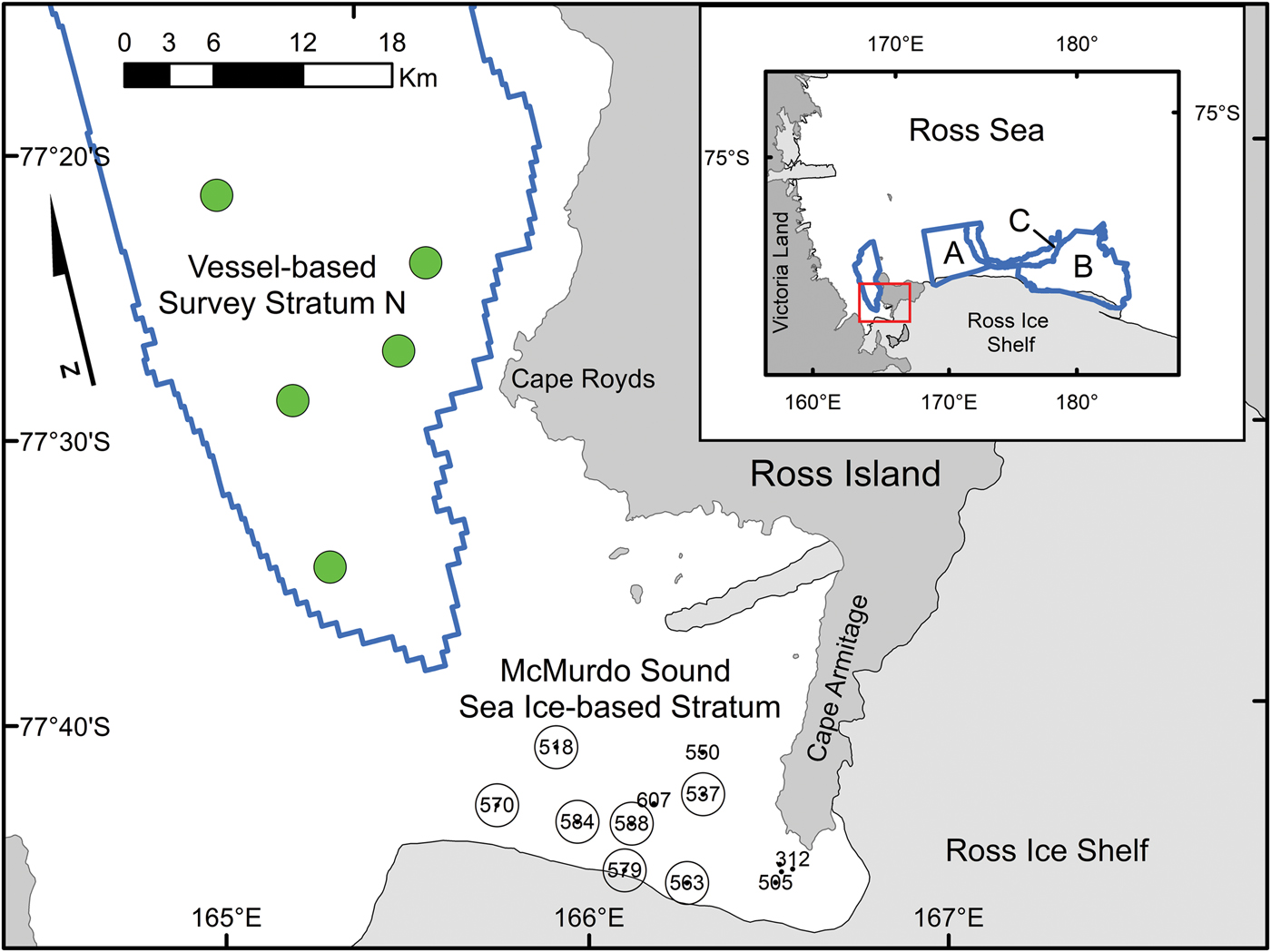
To generate more comparable data, we conducted surveys from the sea ice in McMurdo Sound in 2014 and 2015. We incorporate the results of an annual toothfish survey series across the southern Ross Sea shelf based from a vessel since 2012 (Hanchet et al. Reference Hanchet, Mormede, Parker, Large, Dunn and Sharp2017) with standardized gear and protocols that were integrated with the sea ice-based survey protocols. The standardized approach in both sea ice- and vessel-based surveys with some overlapping geographic area (Fig. 1) results in the ability to compare the population characteristics of the toothfish sampled from each platform, as well as to establish a mechanism to allow relative abundance throughout the southern Ross Sea to be monitored.
Study area in McMurdo Sound, Antarctica. Blue polygon indicates the Ross Sea shelf survey strata (A, B and C) and stratum N in McMurdo Sound, where it identifies the 550 m isobath. Numbers indicate depths measured using sonar as part of the sea ice-based survey as no reliable bathymetry is available. The red rectangle in the inset indicates the location of McMurdo Sound. Green circles show the locations of 5 of the 15 stations surveyed in stratum N. Numbered circles show the seven sea ice survey locations.

We compare the information collected on size distribution, age distribution, length at age, diet and reproduction with that collected during the Ross Sea shelf vessel-based survey (survey reviewed by Hanchet et al. Reference Hanchet, Mormede, Parker, Large, Dunn and Sharp2017) with an aim towards documenting any spatial heterogeneity in the population and bringing together a consistent and testable biological view of the Ross Sea population. We also document here the standardized sea ice-based survey methodology to inform future surveys for comparability.
Methods
Survey design
In developing a randomized station sea ice-based survey within McMurdo Sound, we considered water depth, survey timing, average sea ice coverage and spatial overlap with the vessel-based survey. Toothfish have been collected for biological samples in McMurdo Sound mainly from the steep slope off Cape Armitage mostly at depths between 415 and 495 m (Ainley et al. Reference Ainley, Nur, Eastman, Ballard, Parkinson, Evans and DeVries2013). The vessel-based survey, as a depth-stratified random station survey, identified that the relative abundance of toothfish decreased strongly at shallower than 500 m (Hanchet et al. Reference Hanchet, Dunn, Parker, Horn, Stevens and Mormede2015a), and therefore the minimum depth sampled from the sea ice was 500 m to maximize efficiency. A survey stratum for the vessel-based survey was developed in McMurdo Sound based on the 500 m depth contour (www.gebco.net) and extending north to a latitude of 76°42'S to encompass almost all of the bathymetric area estimated to be deeper than 500 m, enclosing an area of 2930 km2 (stratum N, Fig. 1). The vessel-based survey also includes three depth-based strata (A, B and C) located across the southern Ross Sea shelf (Fig. 1 inset) and has taken place annually in January since 2012.
For the sea ice-based survey, the actual bathymetry in McMurdo Sound outside of the shipping channel is not well documented, but much of the area south of stratum N is deeper than 500 m, extending even to under the ice shelf (Fig. 1). The exact area deeper than 500 m is not yet known, but this information is now collected routinely as part of the sea ice-based survey. Previous biological sampling focused on November and we therefore chose the region south of Cape Royds (77°30'S latitude) where sea ice conditions were on average accessible during November, but where depth was expected to be greater than 500 m (Fig. 1).
Within the sea ice survey area, stations were generated at random locations more than 12 km apart (Doonan & Rasmussen Reference Doonan and Rasmussen2015). These potential stations were then constrained to those on accessible sea ice during the survey period and were sampled within the time available given sea ice conditions. Two fish huts were used to provide shelter. After one week, each hut was moved to a second location to allow four sites to be sampled spanning two weeks. Additional sites were sampled during the same period without shelter when weather permitted. Depth at each station was measured with a Furuno FCV-295 38 kHz echo sounder set to local hydrographic conditions.
Sampling protocols
Sampling was conducted by deploying vertical lines configured with 28 hooks (15/O EZ-baiter, Mustad), baited with Humbolt squid (Dosidicus gigas) spaced at 1.4 m intervals beginning at 2.4 m from the sea floor (spanning the bottom 40 m of the water column) and suspended with a clump weight placed on the sea floor. The bottom hook was kept at least 2 m from the sea floor to minimize the effects of scavenging amphipods on moribund fish. The line was left to fish for a target period of 18 hours (which also minimized the effects of any amphipods) and then slowly hauled to the surface using an electric winch. The status of each hook was recorded (baited, no bait, fish, hook missing), allowing individual fish to be linked to their position on the line. At the surface, each fish was slid onto a measuring board, measured for total length and weighed. For comparison, on the vessel-based survey, bottom longlines (horizontal configurations of sinking mainline with the same bait, 4600 hooks and snoods spaced at 1.4 m) were deployed and fished for a target of 18 hours (Hanchet et al. Reference Hanchet, Mormede, Parker, Large, Dunn and Sharp2017).
Biological sampling
Depending on the need for biological samples, each fish was then either tagged and released following CCAMLR tagging procedures (www.ccamlr.org) or euthanized for biological samples. Biological sampling comprised determining sex and maturity status, liver weight and gonad weight, retaining the stomach for subsequent contents analysis, a gonad tissue sample for histological analysis for each sex, a muscle tissue sample for genetics and stable isotope analysis and otoliths for age determination.
Analysis
The relative abundance of Antarctic toothfish for the sea ice-based survey was calculated as the number of fish per hook retrieved summarized across all sea ice-based samples for comparisons with historical data. As additional effort variables were not available for historical data, no additional effort standardization was conducted.
Stomach contents were determined in the laboratory by visual analysis to the finest taxonomic resolution possible, but then aggregated to coarse taxonomic groupings for summary. These are reported elsewhere (Stevens et al. Reference Stevens, Dunn, Pinkerton and Forman2014, Denechaud Reference Denechaud2017). Unidentifiable prey, completely digested prey and parasites were excluded from detailed diet analyses. Small scavenging cirolanid isopods (Natatolana spp.) and lysianassid amphipods (Orchomenella spp.) were considered to be incidental prey ingested during capture and were also excluded from diet analyses.
Gonad tissue samples were fixed in formalin, then histological sections were prepared with haematoxylin and eosin staining and classified following Parker & Grimes (Reference Parker and Grimes2010). A sex-specific Fulton condition factor (Anderson & Neumann Reference Anderson, Neumann, Murphy and Willis1996) was calculated using the overall sex-specific length–weight relationship exponents for the Ross Sea (Mormede et al. Reference Mormede, Dunn and Hanchet2014, Hanchet et al. Reference Hanchet, Dunn, Parker, Horn, Stevens and Mormede2016). Otoliths were prepared using a bake and embed method and ages were determined following Horn et al. (Reference Horn, Sutton and DeVries2003). Data from the Ross Sea shelf vessel-based survey were developed using these same sampling methods for comparability (Hanchet et al. Reference Hanchet, Mormede, Parker, Large, Dunn and Sharp2017). Comparisons of condition factors were made using ANOVA (www.R-project.org) and growth function comparisons were made using maximum likelihood and randomization tests (Kimura et al. Reference Kimura1980).
Results
Sea ice-based survey implementation
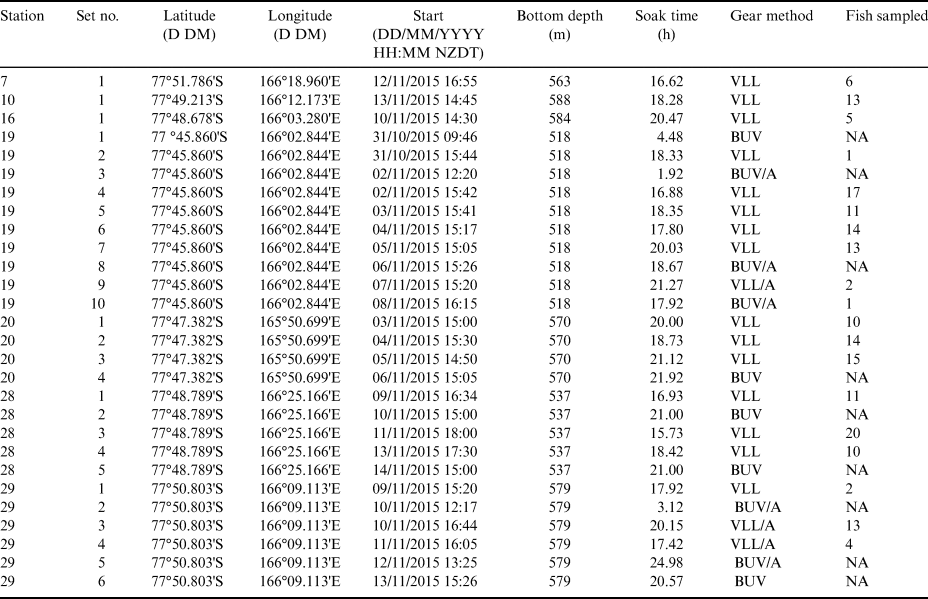
The 2015 survey comprised 7 locations and 18 sets with 182 fish captured (Table I). Results from the 2014 survey are reported in Parker et al. (Reference Parker, Mormede, DeVries, Hanchet and Eisert2016) and comprised 12 sets with 23 fish captured. Sets included some baited underwater video and quantitative acoustics gear deployments not included in abundance estimates. Although the vessel-based and sea ice-based survey areas have a small spatial overlap by design (Fig. 1), sea ice conditions have not permitted sampling in the overlapping area, with vessel-based stations occurring in the northern part of the sound, while sea ice-based stations have occurred in the southern part, with the closest stations between surveys c. 30 km apart.
Details of vertical longlines set in McMurdo Sound in 2015. D DM = degrees decimal minutes; NZDT = New Zealand daylight time. Gear abbreviations are VLL = vertical longline; BUV = baited underwater video; A = acoustics.

Only Antarctic toothfish were captured on the lines. Catch rates in 2014 and 2015 were similar to those observed before 2002 and greater than those observed between 2002 and 2012 (mean ± SD fish per hook: before 2002 = 0.20 ± 0.17, 2002–2012 = 0.034 ± 0.05, 2014–2015 = 0.38 ± 0.22; Parker et al. Reference Parker, Mormede, DeVries, Hanchet and Eisert2016). Survey stations sampled were spread throughout the sound but limited by the time available and the sea ice accessibility in the northern part of the stratum. Three non-sheltered sites were sampled in which toothfish were measured, tagged and released.
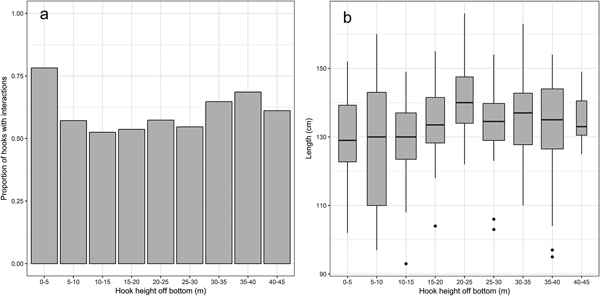
Recording the hook position associated with each fish allowed the height off the sea floor to be calculated, including the height off the sea floor of hooks. Missing hooks or missing baits indicated likely interactions with a toothfish, as no other fish species capable of consuming the large bait and hook are present in the area. A higher proportion of hooks showed interactions with toothfish within 5 m of the sea floor, with a near constant proportion of hook interactions at all other distances (Fig. 2a). There was a significant trend between the size of fish captured and the height of hooks from the sea floor (F(3.96) = 2.504, P = 0.0376; Fig. 2b). The fish caught at less than 15 m from the sea floor tended to be a few centimetres smaller than those caught between 15 and 40 m, but large fish (likely to be neutrally buoyant; Near et al. Reference Near, Russo, Jones and DeVries2003) were routinely captured on the bottom hooks (and anecdotally observed with underwater video) and small fish (likely not neutrally buoyant) were captured 35–40 m off the sea floor (Fig. 2b).
a. Proportion of hooks that either had captured a fish or were removed versus those showing undisturbed baits in relation to the hook height from the sea floor. b. Boxplot of the distribution of fish lengths caught at different heights from the sea floor from pooled data from 2014 and 2015. Horizontal lines indicate the median, shaded rectangles indicate the interquartile range, whiskers indicate the largest or smallest values within 1.5 times the interquartile range and points indicate values outside that range.

Size
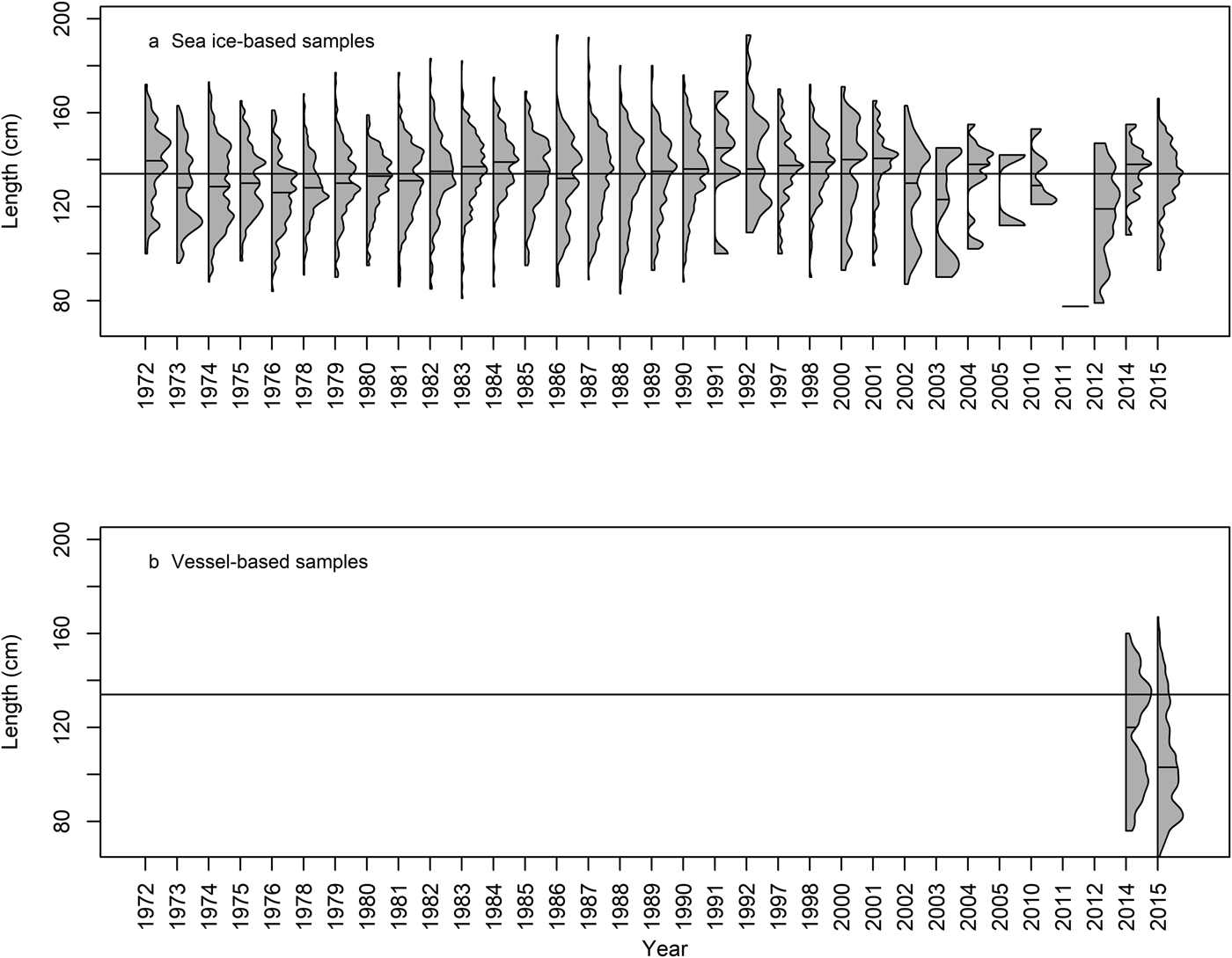
The size distributions of Antarctic toothfish captured from the sea ice prior to 2002 typically showed a single mode near 130 cm with a range from 90 to 170 cm (Fig. 3). In 2002, a more bimodal distribution was observed, with a smaller mode at 95 cm (Fig. 3a), similar to the size distribution observed in the vessel-based survey in the McMurdo Sound stratum N (Fig. 3b). In the 2014 and 2015 sea ice-based surveys, the size distribution showed a single mode near 130 cm and low numbers of fish of 80–100 cm, a distribution similar to historical data, noting that only 23 fish were sampled in 2014 (Fig. 3b). The size distribution observed in the vessel-based survey was smaller than that observed in the sea ice-based survey, with the main differences being that the vessel-based survey occurred in January in open water versus November through the sea ice, the vessel samples were distributed c. 100 km to the north and the gear orientation in the vessel survey was horizontal.
a. Length frequency distributions of Antarctic toothfish from McMurdo Sound for sampled years since 1972 (1972–2012 from Ainley et al. (Reference Ainley, Nur, Eastman, Ballard, Parkinson, Evans and DeVries2013) and from present study in 2014 and 2015). Note that fewer than 10 fish were sampled from vertical lines in 1991, 2005, 2010, 2011 and 2012. The horizontal lines are the medians for each year or the overall median lengths for the data set of sea ice-based samples. b. Length frequency distributions from the 2014 and 2015 vessel-based surveys from stratum N in McMurdo Sound. Horizontal lines indicate the same median values from the upper panel.

Age
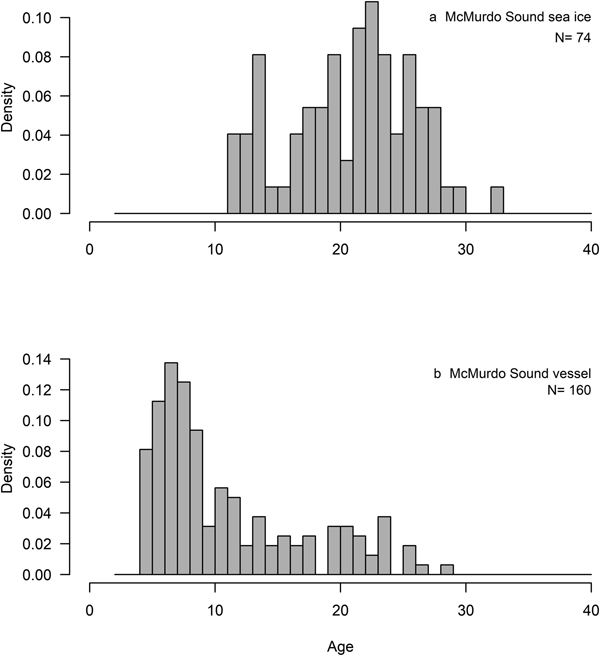
The age distributions of fish sampled in 2014 and 2015 through the sea ice in McMurdo Sound ranged from 12 to 33 years (mean = 21.3 years, SD = 4.98; Fig. 4a) and mirrored the shape of the length distribution with a mode at 23 years and a tail of younger fish at c. 14 years. This distribution was older than the fish sampled in the McMurdo stratum N of the vessel-based Ross Sea shelf survey (Fig. 4b), which was bimodal, with an upper mode similar to the sea ice-based survey data, but dominated by a younger mode of 5–10-year-old fish. This dominant younger mode is also observed annually across the Ross Sea shelf (Hanchet et al. Reference Hanchet, Mormede, Parker, Large, Dunn and Sharp2017). Historical and comparable age data were not available for McMurdo Sound.
a. Age distributions from Antarctic toothfish sampled from the sea ice-based survey, and b. the Ross Sea shelf survey McMurdo Sound stratum N.

Growth
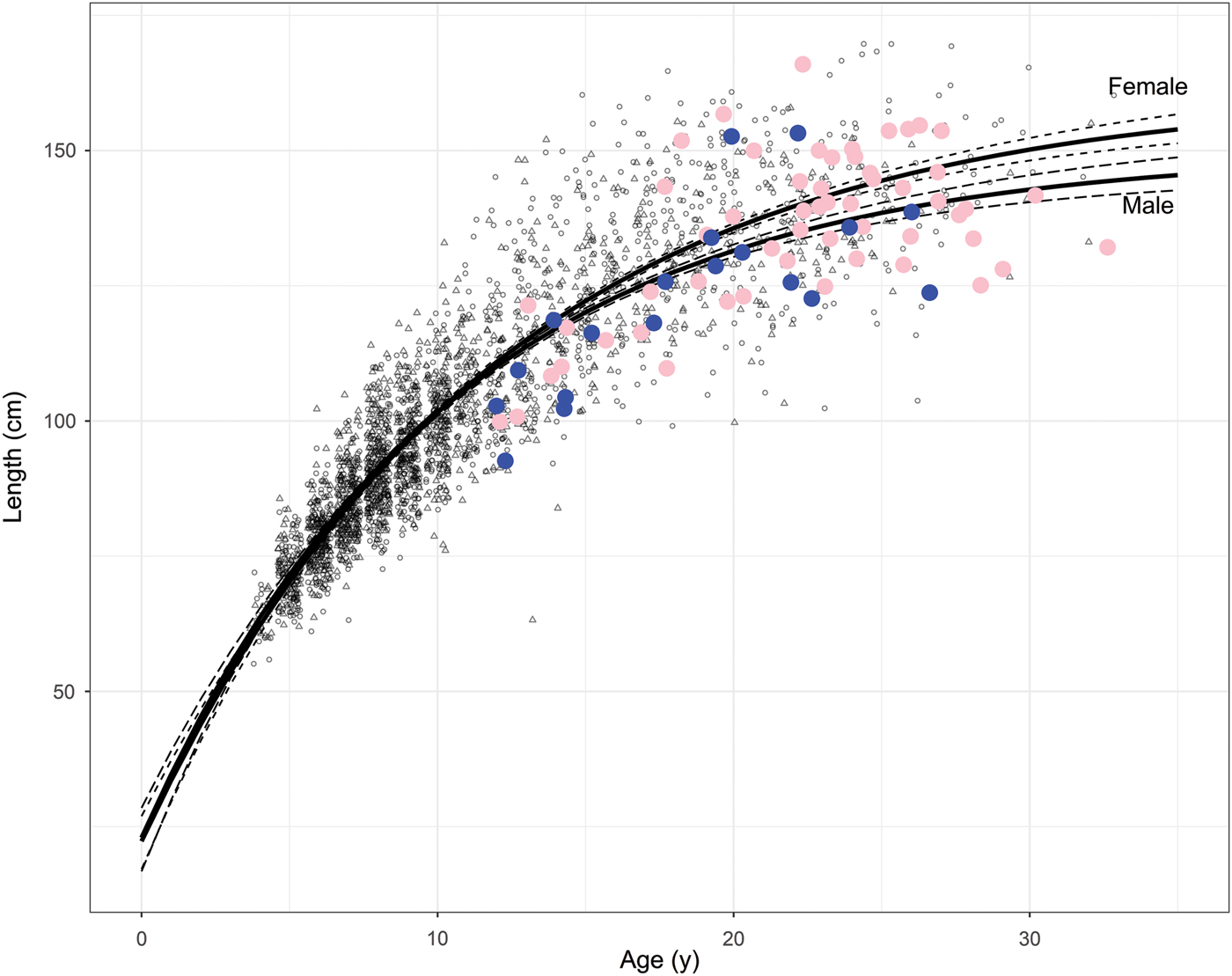
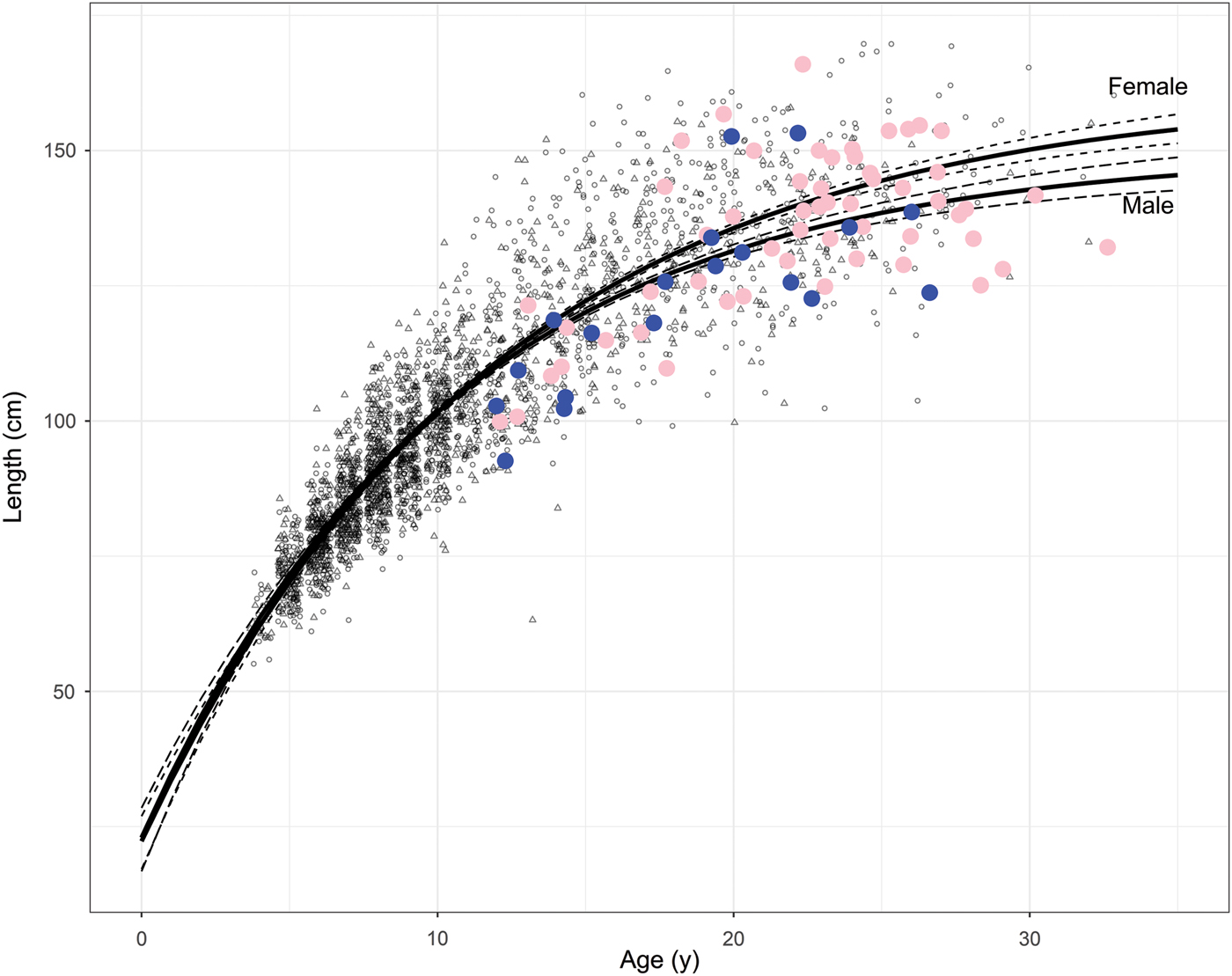
The length at age by sex for toothfish sampled in McMurdo Sound on the sea ice-based survey compared with those sampled on the vessel-based survey on the Ross Sea shelf (strata A, B and C) suggests that the toothfish inhabiting McMurdo Sound may be shorter at age (i.e. grow slower) than those on the southern Ross Sea continental shelf for both sexes (Fig. 5). A length at age relationship for fish from the McMurdo stratum N has not yet been determined due to the low sample size. However, the effect is more pronounced in fish less than 17 years of age, whereas older fish show greater variation in their length at age. There was only weak statistical support for a different growth curve for McMurdo Sound fish (age-stratified randomization test, P = 0.27), suggesting that a larger sample size from southern McMurdo Sound is needed.
Length at age observations for male (black-outlined triangles) and female (black-outlined circles) Antarctic toothfish from the vessel-based survey across the Ross Sea shelf and the von Bertalanffy fits and 95% confidence intervals (black solid and dashed lines for each sex). Pink symbols show the observed length at age for female and blue symbols for male Antarctic toothfish sampled through the sea ice in McMurdo Sound in 2014 and 2015 (n = 74).
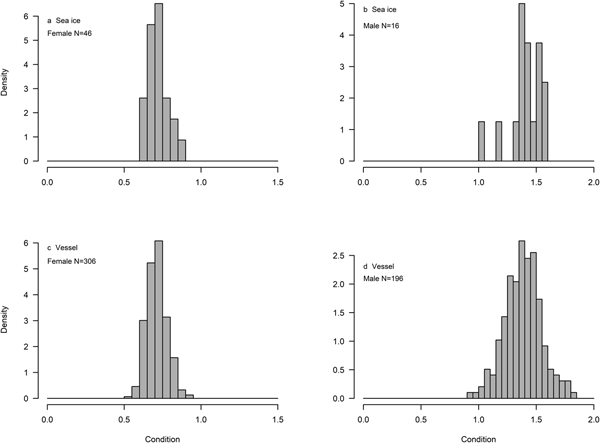
The sex-specific condition factors of fish from the sea ice-based survey were not significantly different from those sampled each year in the vessel-based Ross Sea shelf survey in stratum N (females: F(1) = 1.849, P = 0.174; males: F(1) = 2.323, P = 0.128), indicating that McMurdo Sound toothfish are not thinner or fatter than those observed across the continental shelf (Fig. 6).
Distribution of the sex-specific condition factor (length–weight relationship) for (a. and c.) female and (b. and d.) male Antarctic toothfish sampled in McMurdo Sound from the sea ice- and from vessel-based surveys in stratum N.

Sex ratio
The sex ratio of toothfish in McMurdo Sound from the sea ice-based survey was skewed towards females, with observations of 71% and 85% female in 2014 and 2015 (and similar to historical data), while the vessel-based survey shows female percentages of 53–57% (mean 55%, SD = 2). This difference is due to the differences in size distribution between the two surveys, with rates of female smaller fish (< 120 cm) of 54% in the vessel-based survey and 45% in the 2015 sea ice-based survey (out of the 23 fish captured, only one female was < 120 cm in 2014). All of the female and male fish sampled showed resting or early developmental stages of ovaries and testes (n = 10 stage 1, n = 54 stage 2, n = 7 stage 3). Of the 11 histologically evaluated females, ten were early vitellogenic, one was peri-nucleolus and one was vitellogenic. Early vitellogenic-stage fish are expected to be at least 18 months from spawning (Parker & Grimes Reference Parker and Grimes2010).
Diet
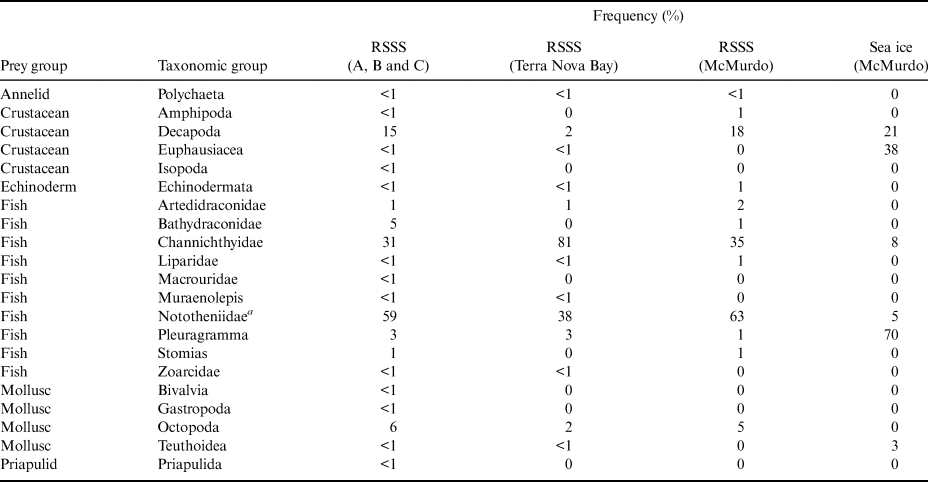
Diet based on stomach contents from fish sampled under ice in McMurdo Sound showed mainly fish and crustaceans, with 11% of individuals with empty stomachs (n = 71; Table II). The fish component of the diet was dominated by Pleuragramma antarctica in the sea ice-based survey, as in previous McMurdo samples obtained during spring (Eastman Reference Eastman1985b). However, the diet observed in the vessel-based survey in northern McMurdo Sound in January (n = 7152) showed few P. antarctica, with the fish component of the diet dominated by channichthyids or Trematomus spp., regardless of fish size. There were also notable differences in the fish prey composition amongst Ross Sea shelf strata in the vessel-based survey (Table II, Fig. 1), with channichthyids being much more common in Terra Nova Bay samples than in the core survey area off the Ross Ice Shelf (strata A, B and C) or in McMurdo Sound. In northern McMurdo Sound, Trematomus spp. were more frequently observed as prey items than in other areas (Denechaud Reference Denechaud2017).
Observed stomach contents of Antarctic toothfish expressed as percentage frequency of occurrence in stomachs containing prey in the southern Ross Sea from the Ross Sea shelf survey (RSSS) core strata (A, B and C), Terra Nova Bay, McMurdo Sound strata, and sea ice survey series.

a Note that Nototheniidae excludes Pleuragramma antarctica as these could be identified separately.
The prevalence of P. antarctica in McMurdo Sound sea ice-based samples taken in November compared with the vessel-based samples taken in January suggests that P. antarctica may not be abundant seasonally, especially during summer months or when sea ice is not present. The Index of Relative Importance (Pinkas et al. Reference Pinkas, Oliphant and Iverson1971) was calculated from a subset of stomachs from the vessel (n = 678) that were returned to the laboratory, where prey items were weighed and showed the same pattern as the frequency of occurrence data (not presented).
Residence
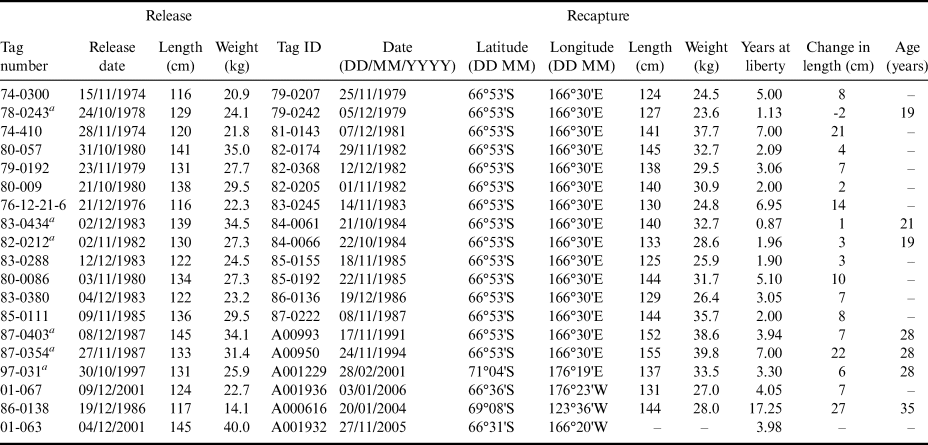
During sampling between 1978 and 2001, 4752 toothfish were tagged and released in McMurdo Sound (Ainley et al. Reference Ainley, Nur, Eastman, Ballard, Parkinson, Evans and DeVries2013). Of these, 19 have been recaptured (Table III): 15 in McMurdo Sound between 1979 and 1994 and 4 in the commercial bottom longline fishery between 2001 and 2006 that began in 1997. The McMurdo Sound recaptures show evidence of residence, or site fidelity, with recaptures spanning 7 years (2, 5, 3, 0, 2, 0 and 3 fish recaptured after 1–7 years at liberty, respectively). Despite four tagged fish being recaptured hundreds of kilometres away in the fishery after up to 17 years at liberty, the recapture of multiple fish 5 and 7 years after release indicates that the fish in McMurdo Sound likely remain in the same area (or display site fidelity after any spawning migration). This is consistent with observations from the tagging programme in the commercial fishery, where toothfish are typically recaptured within 20 km of their release location regardless of maturity stage or years at liberty (Hanchet et al. Reference Hanchet, Dunn, Parker, Horn, Stevens and Mormede2015a).
Details of Antarctic toothfish tagged and released in McMurdo Sound and subsequently recaptured either at the same location or in the commercial bottom longline fishery. DD DM = degrees minutes.

a Otoliths aged and included in Horn et al. (Reference Horn, Sutton and DeVries2003).
Discussion
The sea ice-based survey design in McMurdo Sound has provided data using similar methods to the vessel-based Ross Sea shelf survey. These data indicate that some of the biological characteristics of toothfish observed in McMurdo Sound were different between the surveys, even between northern and southern McMurdo Sound. The vessel-based survey has been shown to be representative of the data from the fishery with similar gears used, size compositions, catch rates and biological data collected, and the survey has been incorporated into the Ross Sea stock assessment model as an index of year class strength (Mormede et al. Reference Mormede, Dunn and Hanchet2014, CCAMLR 2017).
The vertical lines in the sea ice-based survey used the same gear, configuration and procedures as the vessel-based survey with the exception that the sea ice-based survey gear is arranged vertically with the lowest hook 2.4 m from the bottom. The uniform distribution of fish size relative to the hook height from the bottom suggests no large size selectivity difference in orientation of the line with other factors held constant. Despite the observation that fish greater than 100 cm in length in McMurdo Sound were neutrally buoyant (Near et al. Reference Near, Russo, Jones and DeVries2003) or several observations of toothfish in the upper 200 m of the water column (Fuiman et al. Reference Fuiman, Davis and Williams2002), there is very little empirical evidence that smaller toothfish are confined to a demersal habitat or that larger toothfish are always neutrally buoyant (Fenaughty et al. Reference Fenaughty, Eastman and Sidell2008) or that they spend a significant proportion of time in a pelagic environment (e.g. vertical line fishing trials on the continental slope or northern seamounts have captured few pelagic toothfish compared to the high densities of large toothfish caught on bottom longlines in the commercial fishery). A neutrally buoyant physical state does not necessarily indicate the behaviour of a pelagic distribution. In addition, neutral buoyancy or the lack of neutral buoyancy should have no impact on the ability of toothfish to effectively feed within a short distance from the sea floor. In an environment 500–1000 m deep in McMurdo Sound, moving 10, 30 or 50 m off the sea floor, especially if sensing food, is hardly a large movement. However, the trend of larger fish caught on hooks more than 20 m from the bottom supports the idea that larger fish may be more willing to move pelagically (Ainley et al. Reference Ainley, Nur, Eastman, Ballard, Parkinson, Evans and DeVries2013, Ashford et al. Reference Ashford, Dinniman and Brooks2017), but empirical information is required regarding the actual vertical movement patterns of toothfish in those conditions.
The spatial differences in size distribution, age distribution and diet between the two surveys raise two main issues. First, the differences in length (and age) distributions between the vessel- and sea ice-based surveys could be caused by small fish entering the McMurdo Sound area after November (when the sea ice-based survey was completed) and January (when the vessel-based survey was conducted). This would be consistent with the dominant size classes of toothfish observed across the Ross Sea shelf moving into the sound to occupy new areas as the ice disperses to take advantage of the seasonal high productivity (Smith et al. Reference Smith, Ainley and Cattaneo-Vietti2007). DeVries et al. (Reference DeVries, Ainley and Ballard1998) also noted that smaller fish were caught through the sea ice later in the spring (December) than in October or November. Alternatively, the large fish present under the sea ice in November could leave the area during summer, with the small fish remaining behind to dominate the sampled distribution. It is also possible that southern McMurdo Sound simply attracts fewer young fish than the area immediately to the north, regardless of season. Toothfish may move around Ross Island to the south, as McMurdo Sound continues with deep water all around Ross Island under the Ross Ice Shelf (see Fig. 1).
The combination of differences in size distribution, age distribution and diet of toothfish in the two surveys is most consistent with southern McMurdo Sound acting as a local sink for toothfish that arrive as juveniles (as observed across the Ross Sea shelf; Hanchet et al. Reference Hanchet, Mormede, Parker, Large, Dunn and Sharp2017), but then generally remain in the sound, growing by preying on P. antarctica, which may be seasonally abundant (Eastman Reference Eastman1985b), and trying to avoid predation by Weddell seals and killer whales (Ainley & Siniff Reference Ainley and Siniff2009, Ainley et al. Reference Ainley, Ballard and Olmastroni2009). Ecologically, it is arguably a strange place for a toothfish population sink. Adult toothfish, as with all species, distribute themselves to a large degree based on biotic factors such as needs for successful reproduction, food availability and competition and avoiding predators (Wisz et al. Reference Wisz, Pottier, Kissling, Pellissier, Lenoir and Damgaard2013). McMurdo Sound is more than 1000–1500 km from the presumed main spawning grounds (Hanchet et al. Reference Hanchet, Dunn, Parker, Horn, Stevens and Mormede2015a), it has the highest densities of predators in the region (Stirling Reference Stirling1969, Ainley & Siniff Reference Ainley and Siniff2009, Pitman et al. Reference Pitman, Fearnbach and Durban2018) and although P. antarctica have been observed as abundant prey at times, there is little evidence that P. antarctica is a dominant and pervasive food source. Few acoustic recordings exist, and although stomach contents of 70% of toothfish sampled through the ice comprised typically one or two silverfish with 20% of the stomachs empty, silverfish were even less frequent in vessel-based observations in January, with 20–30% showing empty stomachs (Eastman Reference Eastman, Siegfried, Condy and Laws1985a, Denechaud Reference Denechaud2017).
The consistent presence of large fish in McMurdo Sound in both surveys suggests that smaller fish may inhabit the area seasonally, especially the southern sound. It is unknown whether the adult-sized toothfish in McMurdo Sound migrate to the toothfish spawning areas in the northern Ross Sea periodically to spawn, spawn in McMurdo Sound or do not develop gonads on an annual cycle while in McMurdo Sound. Samples collected in spring and summer have all shown fish in an early vitellogenic stage (i.e. resting; Eastman & DeVries Reference Eastman and DeVries2000, present study) and Antarctic toothfish in the Ross Sea region are thought to spawn in July (Parker & Grimes Reference Parker and Grimes2010, Stevens et al. Reference Stevens, DiBlasi and Parker2016). Larger fish are present in southern McMurdo Sound in spring, though their presence in the winter is uncertain. There is, however, movement of large fish within the wider Ross Sea region, evidenced by observations of four toothfish tagged in McMurdo Sound and recaptured in the fishery (three on the Ross Sea slope (c. 500 km north) and one on a seamount in the Amundsen Sea (c. 2000 km north-east after 17 years at liberty)). There is as yet no evidence that adult toothfish leave northern spawning grounds to migrate or return to McMurdo Sound.
The relatively high proportion of large toothfish in McMurdo Sound could have implications for the potential effects of fishing on the population, and for the effectiveness of the Ross Sea region Marine Protected Area (RSRMPA) depending on the mechanism by which the large fish recruit to McMurdo Sound and their residence time. If those large fish arrive as juveniles recruiting to the Ross Sea shelf region and simply remain in the area as residents and grow, then the only effect of fishing on McMurdo Sound toothfish would be through reduced recruitment to the overall Ross Sea population. Recruitment to the shelf area is monitored using the Ross Sea shelf survey (Hanchet et al. Reference Hanchet, Mormede, Parker, Large, Dunn and Sharp2017). However, if large fish migrate to McMurdo Sound as adults from areas where fishing occurs, such as the slope and northern regions, then their abundance should be reduced, with fishing targeting to reduce spawning biomass by half (Hanchet et al. Reference Hanchet, Sainsbury, Butterworth, Darby, Bizikova, Godøa and Ichiia2015b), which could then reduce the numbers of large toothfish moving into McMurdo Sound. Lastly, if adult toothfish in McMurdo Sound do migrate to northern spawning grounds periodically, a reduction in the density of toothfish in the slope or northern areas could result in McMurdo fish choosing to become residents in preferred slope habitats, and the abundance of large toothfish in McMurdo Sound could be reduced. Therefore, the status of the toothfish stock in McMurdo Sound may not be representative of the status of toothfish in the Ross Sea, as evaluated by the stock assessment (Mormede et al. Reference Mormede, Dunn and Hanchet2014). Because toothfish predators aggregate (Ainley & Siniff Reference Ainley and Siniff2009, Pitman et al. Reference Pitman, Fearnbach and Durban2018) in the south and west margins of the Ross Sea shelf, this important area requires directed monitoring to detect and manage any effects of fishing on the stock on the continental slope and northern areas.
The data to index relative abundance are now being collected through a random, spatially stratified survey with standardized procedures from both vessel- and sea ice-based surveys. The developing data series provides a relative abundance index for the southern Ross Sea, which will be an important variable for trophic modelling, and also as a key component of the RSRMPA research and monitoring plan (Kennicutt et al. Reference Kennicutt, Chown, Cassano, Liggett, Peck, Massom and Rintoul2015, SC-CAMLR 2017). Although not directly comparable with historical data, the sea ice-based survey can form the beginning of a time series to monitor relative abundance under the sea ice in southern McMurdo Sound. A similar survey to monitor abundance under the sea ice in Terra Nova Bay can also link those data with a vessel-based survey in the same area (Parker & Ghigliotti, unpublished data). Generating time series of toothfish abundance (as well as data on predators such as Weddell seals or killer whales, and prey such as P. antarctica and Trematomus spp.) through sea ice-based surveys such as these will be critical to evaluating the effectiveness of the RSRMPA.
In addition to monitoring relative abundance, studies are needed to understand the residence time and growth rates of toothfish in McMurdo Sound, their mechanism of recruitment to the area, reproductive status, importance as a food source to top predators and the seasonal distribution and abundance of P. antarctica in the south-western Ross Sea.
These data support the conclusions of Ashford et al. (Reference Ashford, Dinniman and Brooks2017) that understanding the ecological dynamics in McMurdo Sound is an important component to understanding the potential impacts of fishing in the Ross Sea, the potential impacts of climate change or other environmental effects in McMurdo Sound and that standardized surveys are needed to collect this type of information. The ecological interactions of Antarctic toothfish may be different in McMurdo Sound than in the rest of the Ross Sea because the few known predators of Antarctic toothfish are especially abundant in the sea ice-dominated margins. Changes in the local toothfish population may affect both predator and prey species dynamics. Understanding these dynamics is a high-priority element required under the research and monitoring plan for the RSRMPA (SC-CAMLR 2017).
Acknowledgements
We thank the Italian National Programme of Antarctic Research (PNRA) for providing L.G. and S.C. with the opportunity to participate in the survey under the project DISMAS (PNRA Project 2015/B1.02). We thank E. Carlig for diet data from McMurdo Sound and C. Denechaud for diet analysis of the Ross Sea shelf survey samples. We thank Antarctica New Zealand for excellent logistic support. Funding for the sea ice-based survey was provided by MPI project ANT2015/01. We thank the members of the New Zealand Ministry for Primary Industries Antarctic Working Group and the reviewers for their constructive comments on this paper.
Author contributions
All authors actively contributed to developing the concepts, conducting the fieldwork, analysing the data and preparing and editing the manuscript.