As many as 25% of inpatients have indwelling urinary catheters placed at some point during their hospitalization;Reference Gokula, Hickner and Smith 1 many of these are placed in the emergency department (ED) setting. An estimated 3 million urinary catheters are placed during an ED encounter in the United States each year. 2 Unfortunately, up to 65% of catheters placed in the ED may not be appropriate.Reference Gokula, Hickner and Smith 1 , Reference Gardam, Amihod, Orenstein, Consolacion and Miller 3 – Reference Schuur, Chambers and Hou 6 Catheter-associated urinary tract infection (CAUTI) is one of the most common healthcare-associated infections in the United States,Reference Klevens, Edwards and Richards 7 leading to excess morbidity, mortality, and costs.Reference Foxman 8 , Reference Saint 9 Urinary catheters also cause other patient safety problems such as increased patient discomfort,Reference Saint, Lipsky, Baker, McDonald and Ossenkop 10 patient immobility,Reference Saint, Lipsky and Goold 11 and accidental removal.Reference Hollingsworth, Rogers and Krein 12 Among the most effective approaches for reducing both infectious and noninfectious complications of urinary catheters is limiting indwelling urinary catheter use to cases in which an appropriate indication is present.Reference Gould, Umscheid, Agarwal, Kuntz and Pegues 13 Considering that 18 million patients are admitted through the ED annually in the United States, appropriate catheter utilization in the ED is needed to reduce the clinical and economic burdens of urinary catheter-related harm. 2
Collaborative approaches to infection prevention, which facilitate the sharing of best practices between participants, permit networking, provide content expertise, and allow for quantitative quality improvement comparisons, have become more common in recent years. Recent national surveys of acute-care hospitals in the United States have shown that the percentage of hospitals participating in a collaborative effort to reduce healthcare-associated infection increased from 42% to 83% between 2005 and 2013.Reference Krein, Kowalski, Hofer and Saint 14 , Reference Krein, Greene and Apisarnthanarak 15 Specific to CAUTI prevention, national survey data from 2013 indicated that urinary catheter reminders and stop orders were used more regularly in hospitals participating in healthcare-associated infection collaboratives.Reference Krein, Greene and Apisarnthanarak 15 Successful collaborative approaches to reducing urinary catheter use and preventing CAUTI have been organized and implemented at the health system,Reference Fakih, Heavens, Grotemeyer, Szpunar, Groves and Hendrich 16 , Reference Fakih, Heavens, Ratcliffe and Hendrich 17 state,Reference Fakih, Watson and Greene 18 , Reference Saint, Greene, Kowalski, Watson, Hofer and Krein 19 and nationalReference Fakih, George, Edson, Goeschel and Saint 20 , Reference Saint, Greene and Krein 21 levels.
Starting in 2012, interventions focused on improving urinary catheter appropriateness in EDs were implemented as part of 2 distinct collaboratives. The first collaborative involved multiple hospitals within Ascension, a large non-for-profit health system with hospitals in 22 states and the District of Columbia. The second collaborative was led by the Michigan Health and Hospital Association (MHA), the organizing center for several previous successful collaborative efforts focused on device-related infectionsReference Saint, Greene, Kowalski, Watson, Hofer and Krein 19 , Reference Pronovost, Needham and Berenholtz 22 ; it consists of multiple hospitals in Michigan. To date, comparisons between collaborative approaches to urinary catheter reduction that have been implemented under different collaborative frameworks have not been conducted. Therefore, we compared the effectiveness of 2 distinct multisite, collaborative interventions, 1 system-based and 1 state-based. Both focused on reducing urinary catheter use in the ED.
METHODS
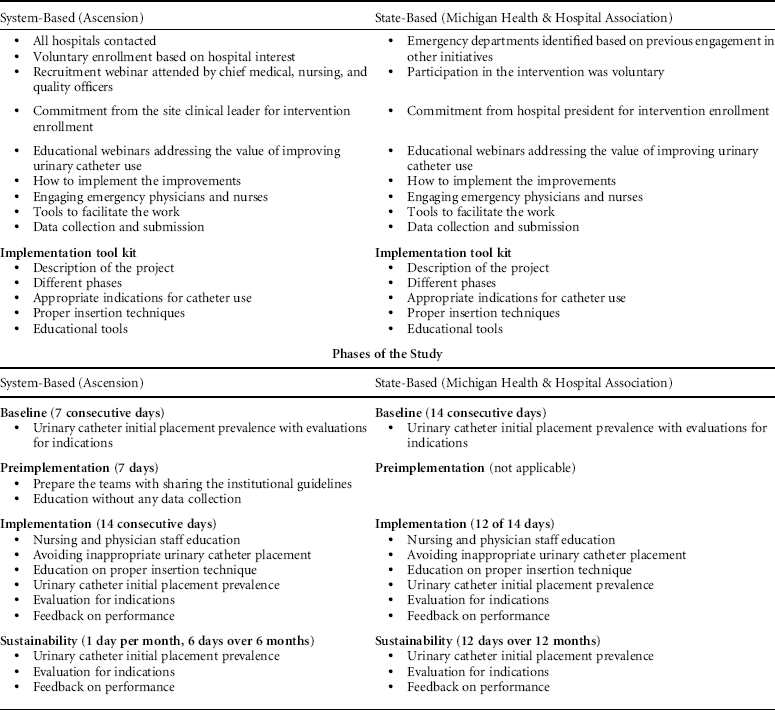
In 2012, a total of 18 Ascension hospitals participated in a system-based, collaborative ED intervention to reduce the use of urinary catheters, while 16 hospitals in the state of Michigan participated in a state-based ED collaborative with the same goal. Participation in both intervention settings was voluntary. Details of the interventions have been described previously.Reference Fakih, Heavens, Grotemeyer, Szpunar, Groves and Hendrich 16 Briefly, hospitals in both collaborative efforts were required to obtain leadership support, to identify both nurse and physician champions, and to establish institutional guidelines for appropriately indicated catheter placement based on Centers for Disease Control and Prevention (CDC) guidelines.Reference Gould, Umscheid, Agarwal, Kuntz and Pegues 13 Both efforts implemented interventions to avoid inappropriate urinary catheter use, and one of the authors (M.G.F.) presented identical webinars on the technical aspects from indications to methods that help avoid catheter exposure. Table 1 illustrates the setting and the 3 study phases that occurred for both collaboratives.
Setting and Study Phases of Emergency Department Intervention to Reduce Inappropriate Use of Urinary Catheters

Data Collection
Data were collected at the individual facilities and were then reported to the lead organizations (Ascension or MHA). Trained nurses at each facility collected the number of patients admitted through the ED, the number of patients admitted from the ED with a urinary catheter present, the indication for placement of catheters in the ED, and the number of catheters placed in the ED with a physician order. The primary outcome measure was rate of the newly placed urinary catheters in the ED (defined as the number of new catheters placed in the ED divided by the number of patients admitted during the same period and multiplied by 100). Appropriateness of urinary catheters placed in the ED (defined as the number of newly placed urinary catheters with an appropriate indication divided by the number of newly placed urinary catheters during the same period and multiplied by 100) and presence of physician order for the placement of a urinary catheter in the ED (defined as the number of physician orders for newly placed urinary catheters divided by the number of newly placed urinary catheters during the same period and multiplied by 100) were also tracked and compared as secondary outcomes.
Hospital EDs participating in the system-based intervention collected baseline data for 7 days (from June 4 to June 10, 2012), implementation data for 14 days (from June 18 to July 1, 2012), and sustainability data 1 day per month for 6 months (from July 2 to December 31, 2012). Among hospital EDs participating in the state-based intervention, baseline data were collected for 14 days (during April 2012), implementation data were collected for 12 days (in May 2012), and sustainability data were collected 1 day per month for 12 months (from June 2012 to May 2013). To be comparable to the Ascension cohort, we used the first 6 months of sustainability data reported for the MHA cohort in our analyses. For our analyses, all data from participating EDs were aggregated at the collaborative framework level (ie, system-based vs state-based) and at 3 distinct study phase levels: baseline, implementation, and sustainability.
Statistical Analysis
Descriptive statistics are given for comparisons of raw data by collaborative framework. Multilevel negative binomial regression with a random facility-level intercept was utilized to compare system-based versus state-based facilities regarding their performance in minimizing catheter use during the interventions. An interaction of group and time was used to test the hypothesis that system-based hospitals would perform better than state-based hospitals. Similarly, multilevel logistic regression models with random facility-level intercepts were used to compare system-based versus state-based facilities regarding the appropriateness of urinary catheter use and presence of a physician order accompanying urinary catheter placement. The interaction of group and time was again the coefficient of interest. Stata/MP software version 13.1 (StataCorp, College Station, TX) was used for all analyses.
RESULTS
The system-based cohort consisted of 13,215 patients with 889 urinary catheters placed in the ED. The state-based cohort consisted of 12,104 patients with 718 urinary catheters placed in the ED. Changes in urinary catheter placement, appropriateness, and presence of physician orders for both interventions can be found in Table 2. Multilevel regression results showed that the participating system-based EDs had higher catheter placement rates at baseline (incidence rate ratio [IRR], 1.34; 95% confidence interval [CI], 0.96–1.88; P=.09), but experienced greater declines over the course of the intervention (IRR, 0.79; 95% CI, 0.64–0.97; P=.02), compared to the EDs participating in the state-based intervention. We detected no differences in the appropriateness of catheters placed between the system-based and state-based cohorts at baseline (odds ratio [OR], 1.04; 95% CI, 0.47–2.32; P=.93). However, there was an overall increase in appropriateness (all EDs combined regardless of collaborative framework) throughout the interventions (OR, 1.42; 95% CI, 1.08–1.87; P=.01) and system-based EDs made greater improvements in appropriateness over the course of the intervention (OR, 1.86; 95% CI, 1.22–2.84; P=.004). We detected no statistically significant overall changes over time (OR, 1.06; 95% CI, 0.74–1.53; P=.74) or differences between the system-based and state-based cohorts over time (OR, 1.14; 95% CI, 0.71–1.83; P =.60) in terms of catheter placement with accompanying physician orders.
Urinary Catheter Utilization, Appropriateness, and Presence of Physician Orders in Emergency Department (ED) by Collaborative Structure and Intervention Period

a P values from stratified multilevel regression model with baseline as reference group.
b Ascension.
c Michigan Health & Hospital Association.
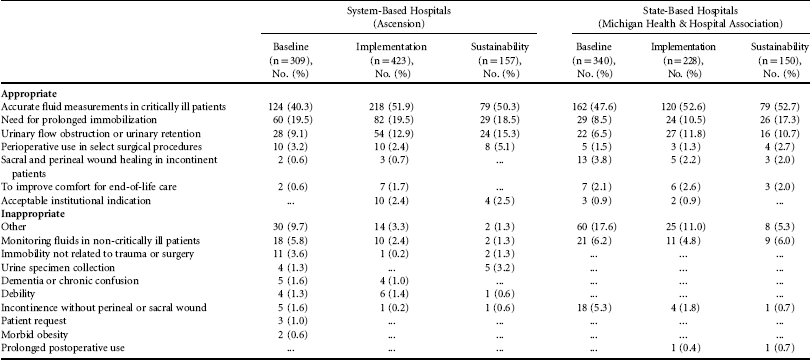
The appropriateness of urinary catheter use increased from baseline to implementation for both the system-based and state-based cohorts from baseline to implementation, and appropriateness continued to increase for the state-based cohort during the sustainability phase. Changes in the indications noted for catheter placement for both interventions are illustrated in Table 3. Notable reductions for inappropriate indications among the system-based EDs were observed for the indications “other” (9.7% baseline; 1.3% sustainability) and “monitoring fluids in non-critically ill patients” (5.8% baseline; 1.3% sustainability). In the state-based cohort, reductions in inappropriate indications were observed for the “incontinence without sacral or perineal wounds” (5.3% baseline; 0.7% sustainability) and “other” (17.6% baseline; 5.3% sustainability).
Reasons Noted for Urinary Catheter Placement by Collaborative Structure and Intervention Period

DISCUSSION
We present the results of a large multisite evaluation of interventions aimed at reducing inappropriate urinary catheter use in the ED under 2 different collaborative frameworks. Several important findings emerged from our study of urinary catheter use and appropriateness in the ED. First, we observed statistically significant greater reductions in urinary catheter placement among EDs in the system-based intervention compared to the EDs participating in the state-based intervention. Second, although we observed reductions in urinary catheter placement between baseline and implementation phases under both collaborative frameworks, decreases in urinary catheter placement rates were sustainable only under the system-based framework. Third, we detected statistically significant overall improvements in placing urinary catheters based on an appropriate indication, regardless of the collaborative framework that the intervention was implemented in. This finding is encouraging because education around and institutional support for appropriateness criteria for urinary catheter use were central to both interventions.
Several prior studies demonstrated successful reductions in urinary catheter placement in the ED and concurrent improvements in appropriateness of urinary catheters placed. Based on the findings from the 18 hospitals participating in the system-based ED intervention, Fakih et alReference Fakih, Heavens, Grotemeyer, Szpunar, Groves and Hendrich 16 showed that establishing institutional guidelines for urinary catheter placement and identifying physician and nurse champions led to a 4% absolute reduction in newly placed catheters and a 24% increase in the appropriateness of newly placed catheters in the ED. Gokula et alReference Gokula, Smith and Hickner 23 demonstrated increases in both appropriateness of urinary catheter use and presence of a physician order for catheter placement, as well as sustained decreases in the total number of catheters placed in the ED, following an intervention involving staff education and attaching an indication sheet to each catheter kit for staff to complete prior to placement. We did not detect overall improvements or differences by collaborative framework with respect to the presence of physician order for urinary catheter placement. The majority of urinary catheters placed in all participating EDs had a physician order present at baseline and this rate remained high throughout the interventions, in contrast to some earlier studies reporting that close to half of catheter placements did not have an accompanying physician order.Reference Gokula, Smith and Hickner 23 , Reference Fakih, Pena and Shemes 24 Prior studies have shown the impact of nurse-driven initiatives in reducing the number of patients leaving the ED with newly placed urinary cathetersReference Patrizzi, Fasnacht and Manno 25 and the number of CAUTIs associated with catheter insertion in the ED.Reference Burnett, Erickson, Hunt, Beaulieu, Bobo and Shute 26
The presentation of the technical components of the interventions were virtually identical in both collaborative frameworks. Which factors may have contributed to the greater reductions in urinary catheter placement in the EDs participating in the system-based intervention? First, the presence of ED physician and nurse champions were very well established at Ascension (the system-based cohort). Champions for the intervention at the Ascension EDs were actively engaged in establishing institutional guidelines promoting appropriate urinary catheter indications and ensuring completeness of data reporting throughout the intervention. Second, the organizational structure of Ascension may have contributed to greater accountability by directly engaging the teams and their local leaders through calls to discuss any barriers to implementation. Third, general CAUTI prevention has been a key focus area for Ascension hospitals since 2010. A survey of infection prevention practices at Ascension hospitals in 2012 showed that 79% of their hospitals had policies that include appropriate indications for catheterization, and 76% of their hospitals used bladder scanners to avoid inappropriate placement.Reference Fakih, Heavens, Ratcliffe and Hendrich 17 A repeat survey in 2014 revealed that up to 90% of their facilities have policies including the CDC appropriate indications and 90% use annual competency assessments for nurses regarding placement and care of urinary catheters.Reference Fakih, Grotemeyer and Hendrich 27 On one hand, Ascension’s ongoing organizational commitment to CAUTI prevention efforts, which include reducing catheter use, may have facilitated the uptake and sustainability of efforts to reduce inappropriate catheter use within the ED environment specifically. On the other hand, the state-based cohort started with a lower baseline, which may reflect more engaged staff in best practices and, thus, a narrower opportunity for improvement.
In this study, roughly 80% of urinary catheters placed in the ED were accompanied by an appropriate indication. It is encouraging that we observed significant improvements in the appropriate use of urinary catheters among all 34 EDs participating in this study. These facilities implemented interventions that focused on establishing institutional guidelines for urinary catheter appropriateness, on providing staff education on appropriateness criteria, and on identifying physicians and nurses to champion and promote the adoption of and adherence to the developed guidelines. While the present and previous studies demonstrate that focused interventions can successfully reduce inappropriate urinary catheter use in the ED, room for further improvement remains. A recent study of 129 ED providers found that despite self-reported knowledge of appropriate urinary catheter indications, when presented with clinical vignettes, the appropriate approach for urinary catheter placement was only correctly identified in 40% of cases among nurses and in 37% of cases among mid-level providers and physicians.Reference Viswanathan, Rosen and Mulcare 28 Additionally, this same study also found that ED providers very infrequently reassessed their patients for urinary catheter necessity during shift changes or at admission.Reference Viswanathan, Rosen and Mulcare 28
Our findings need to be considered in the context of the following limitations. Participation in both the system-based and state-based interventions was voluntary, and our findings may not be generalizable to other EDs. Additionally, although we compared the effectiveness of similar ED interventions across multiple hospitals by different collaborative frameworks, we did not have external control groups to evaluate secular trends in EDs generally. Although similar, the data collection schedules differed modestly between EDs in the system-based and state-based hospitals, which may have impacted overall comparisons between the groups. Still, the data collected from multiple hospitals in each group provided robust aggregate numbers of patient and device days with which to compare each intervention phase.
Additionally, EDs in the system-based intervention had a 1-week preimplementation period, which may have provided better preparedness and additional opportunities for education. However, no data were collected during this period, so we were unable to quantitatively examine its impact on our metrics of interest. Emergency departments participating in the state-based intervention had, on average, lower catheter placement rates at baseline, which may have impacted their ability to achieve and sustain further significant reductions in urinary catheter placement rates. However, we did not observe statistically significant changes in catheter placement by collaborative framework over time, when stratifying baseline catheter placement rates by a cutoff point of 8% (results not shown).
Although the overall increase in documentation of appropriate indications across the interventions is a positive finding, we cannot rule out the possibility of biased documentation given the intervention focus on appropriate urinary catheter use (ie, limiting selection of indications to those appropriate). Notably, there was a systematic decrease in the overall use of the “other” inappropriate indication across the interventions, potentially suggesting that the interventions were successful in drawing increased attention and scrutiny toward indication selection. Finally, we were unable to evaluate the impact of the intervention on CAUTI rates or other noninfectious complications directly.
Limitations notwithstanding, our study shows that focused interventions can effectively reduce inappropriate urinary catheter use in the ED setting. Emergency departments participating in the intervention in the system-based hospitals demonstrated statistically significant greater reductions in urinary catheter placement over the course of the intervention than those in the state-based hospitals, and system-based hospitals were able to sustain reductions, suggesting that sustained improvements may be partially dependent upon the collaborative framework under which the interventions are implemented. Given the paucity of studies on urinary catheter placement in the ED, an achievable target number for urinary catheter utilization in this clinical setting is unclear. Fakih et alReference Fakih, Heavens, Grotemeyer, Szpunar, Groves and Hendrich 16 previously demonstrated that EDs with baseline placement rates of <5% were unable to achieve further reductions in catheter placement, despite participating in focused interventions. Given this finding, coupled with our findings that EDs in the state-based intervention were able to achieve placement rates <5% during implementation and those in the system-based intervention approached 5% during the sustainability phase, interventions focused on reducing urinary catheter utilization in the ED setting may best benefit EDs with utilization rates >5%. Regardless, we continue to encourage all EDs to establish and adhere to institutional guidelines regarding appropriate catheter placement, to identify clinical championsReference Damschroder, Banaszak-Holl, Kowalski, Forman, Saint and Krein 29 to encourage and reinforce appropriate catheter use, and to monitor device utilization ratiosReference Fakih, Gould and Trautner 30 in the ED setting as a means of tracking performance related to potential overall urinary catheter harm. Because the ED is usually a patient’s first point of entry into the hospital, reducing inappropriate urinary catheter use in this setting is crucial for improving patient safety by reducing both infectious and noninfectious complications associated with urinary catheter use.
ACKNOWLEDGMENTS
Financial support: This work was supported by a grant from the National Institute of Diabetes and Digestive and Kidney Diseases (grant no. 1R21DK101654-01A1). The findings and conclusions in this report are those of the authors and do not necessarily represent the official position of the Department of Veterans Affairs.
Potential conflicts of interest: Dr Saint reports receiving fees for serving on advisory boards from Doximity and Jvion. All authors report no conflicts of interest relevant to this article.