Introduction
Clinical experience and prior research suggest that borderline personality disorder (BPD) incorporates four sectors of psychopathology that need to be present concurrently: aspects of dysphoric affect, cognitive disturbances ranging from overvalued ideas to quasi-psychotic thought, difficulties with impulsivity, and troubled relationships (Zanarini et al. Reference Zanarini, Gunderson, Frankenburg and Chauncey1989). Furthermore, repeated suicide threats, gestures and attempts currently comprise a defining diagnostic criterion for BPD. Research suggests that as many as 70% of those with BPD have attempted suicide in their lifetime and 5–10% successfully complete suicide (Black et al. Reference Black, Blum, Pfohl and Hale2004; Zanarini et al. 2005a; McGirr et al. Reference McGirr, Paris, Lesage, Renaud and Turecki2007); this rate is much higher than that found in the general population (Gunderson, Reference Gunderson2001). Such behaviors involve suicidal intent and typically involve at least some intent to die. This is differentiated from non-suicidal self-injury in which there is no intent to die (Nock & Favazza, Reference Nock, Favazza and Nock2009). Given the high rate and potential lethality of suicide attempts among borderline patients, it is important to understand which factors might increase the likelihood of attempting suicide in this population so as to improve our methods of intervention and prevention.
Prior cross-sectional studies have examined a wide range of predictors of suicide attempts in BPD. These studies have found diagnostic predictors of suicide attempts in BPD: co-morbid major depressive disorder (MDD; Soloff et al. Reference Soloff, Lynch, Kelly, Malone and Mann2000; Brodsky et al. Reference Brodsky, Groves, Oquendo, Mann and Stanley2006), substance use disorder (SUD; Fyer et al. Reference Fyer, Frances, Sullivan, Hurt and Clarkin1988; van den Bosch et al. Reference van den Bosch, Verheul and van den Brink2001; Wilson et al. Reference Wilson, Fertuck, Kwitel, Stanley and Stanley2006) and post-traumatic stress disorder (PTSD; Pagura et al. Reference Pagura, Stein, Bolton, Cox, Grant and Sareen2010). Younger age has also been associated with increased suicide attempts in BPD (Stepp & Pilkonis, Reference Stepp and Pilkonis2008). The co-occurring symptom of impulsivity (Brodsky et al. Reference Brodsky, Malone, Ellis, Dulit and Mann1997; Chesin et al. Reference Chesin, Jeglic and Stanley2010) has also been associated with suicide attempts in this population. Furthermore, in studies of patients with BPD, childhood adversity, including both childhood physical and sexual abuse, has been implicated as a predictor of suicide attempts in cross-sectional studies (Brodsky et al. Reference Brodsky, Malone, Ellis, Dulit and Mann1997).
Some longitudinal studies have also identified predictors of suicide attempts in BPD. One study by Soloff & Fabio (Reference Soloff and Fabio2008) found that, in addition to co-morbid major depression, hospitalization prior to any suicide attempt, a lower Global Assessment of Functioning (GAF) score at baseline and poor social adjustment predicted suicide attempts at future follow-up points. However, the longest follow-up in that study was 5 years. The Collaborative Longitudinal Personality Disorders Study has also identified some predictors of suicide attempts in BPD. Using data from 8 years of follow-up, this study identified specific symptoms of BPD as predictors of suicide attempts in borderline patients: self-harm (Yen et al. Reference Yen, Shea, Walsh, Edelen, Hopwood, Markowitz, Ansell, Morey, Grilo, Sanislow, Skodol, Gunderson, Zanarini and McGlashan2011), affective instability (Yen et al. Reference Yen, Shea, Sanislow, Grilo, Skodol, Gunderson, McGlashan, Zanarini and Morey2004), and general negative temperament (Yen et al. Reference Yen, Shea, Sanislow, Skodol, Grilo, Edelen, Stout, Morey, Zanarini, Markowitz, McGlashan, Daversa and Gunderson2009). Using data from this study, Yen et al. (Reference Yen, Shea, Sanislow, Skodol, Grilo, Edelen, Stout, Morey, Zanarini, Markowitz, McGlashan, Daversa and Gunderson2009) also examined several facets of impulsivity, another symptom of BPD, and found that only the facet of lack of planning and premeditation was significantly associated with suicide attempt status.
Thus, a wide range of predictors of suicide attempts have been examined in those with BPD. Although some longitudinal data have been published on predictors of suicide attempts in BPD, none have examined follow-up beyond 8 years. The current study used data from the McLean Study of Adult Development (MSAD) and a large, carefully diagnosed and socio-economically diverse sample of individuals with BPD. From this rich data set we selected a series of prospective predictors of suicide attempts over 16 years of follow-up data, examining most of the predictors identified by others in prior studies, and additional predictors thought to be clinically relevant. We examined predictors examined previously, including: age, co-morbid MDD, SUD and PTSD, baseline number of hospitalizations, baseline number of suicide attempts, the presence of self-harm, baseline GAF, childhood physical and sexual abuse, impulsivity, temperament, affective instability, and measures of social adjustment (i.e. on social security disability insurance, SSDI). In addition, we tested variables thought to be clinically related to suicide attempts in those with BPD including: sex, race, caretaker suicide attempts, completion, and self-harm, adult physical and sexual assault, and dissociation. We tested these variables in both bivariate and multivariate models to examine how these baseline and time-varying predictors function over time.
Method
Procedures
The methodology of this study, which was reviewed and approved by the McLean Hospital Institutional Review Board, has been described in detail elsewhere (Zanarini et al. Reference Zanarini, Frankenburg, Hennen and Silk2003). In brief, all subjects were initially in-patients at McLean Hospital in Belmont, Massachusetts. All patients were first screened to determine that they: (1) were between the ages of 18 and 35 years; (2) had a known or estimated IQ of ⩾71; (3) had no history or current symptoms of schizophrenia, schizo-affective disorder, bipolar I disorder, or an organic condition that could cause psychiatric symptoms; and (4) were fluent in English.
After the study procedures were explained, written informed consent was obtained. Each patient then met with a masters-level interviewer blind to the patient's clinical diagnoses for a thorough diagnostic assessment. Three semistructured diagnostic interviews were administered. These diagnostic interviews were: (1) the Structured Clinical Interview for DSM-III-R Axis I Disorders (SCID-I; Spitzer et al. Reference Spitzer, Williams, Gibbon and First1992) to assess for the presence of Axis I psychiatric disorders, (2) the Revised Diagnostic Interview for Borderlines (DIB-R; Zanarini et al. Reference Zanarini, Gunderson, Frankenburg and Chauncey1989) to assess the presence and severity of symptoms of BPD, and (3) the Diagnostic Interview for DSM-III-R Personality Disorders (DIPD-R; Zanarini et al. Reference Zanarini, Frankenburg, Chauncey and Gundersun1987) to assess for the presence and severity of BPD and other Axis II disorders. The inter-rater and test–retest reliability of all three of these measures has been found to be good–excellent [SCID: median Κ=0.80, DIPD-R: median Κ=0.85 (Zanarini & Frankenburg, Reference Zanarini and Frankenburg2001); DIB-R: median Κ=0.80 (Zanarini et al. Reference Zanarini, Frankenburg and Vujanovic2002)].
In the current study the presence of affective instability was derived from the DIPD-R as it is not included in the DIB-R, and the presence of impulsivity was derived from the DIB-R and the DIPD-R as they have identical items assessing impulsivity. To avoid overlap between the separate variables of substance abuse and self-harm (see below), these items were removed from the impulsivity subscale of the DIB-R and the remaining impulsive behaviors were counted to create a continuous measure of impulsivity. Thus, only items regarding promiscuity, paraphilias, eating binges, spending sprees, gambling sprees, verbal outbursts, physical fights, physical threats, physical assaults, property damage, reckless driving, and antisocial behavior were counted in this impulsivity variable.
Three other semistructured interviews were also administered at baseline. These interviews were: (1) the Lifetime Self-Destructiveness Scale (LSDS; Zanarini et al. Reference Zanarini, Frankenburg, Ridolfi, Jager-Hyman, Hennen and Gunderson2006) providing information about the presence and severity of suicidal and non-suicidal self-injurious behaviors, (2) the Abuse History Interview (AHI; Zanarini et al. 2005b) assessing for the presence of emotional, verbal, physical and sexual abuse, and (3) the Revised Childhood Experiences Questionnaire (CEQ-R; Zanarini et al. Reference Zanarini, Williams, Lewis, Reich, Vera, Marino, Levin, Yong and Frankenburg1997) probing for the presence of childhood adversity. The inter-rater and test–retest reliability of these interviews has also been found to be good–excellent [LSDS: median Κ=1.0 (Zanarini et al. 2008b); AHI: median Κ=0.78 (Zanarini et al. 2005b); CEQ-R: median Κ=0.88 (Skodol et al. Reference Skodol, Bender, Pagano, Shea, Yen, Sanislow, Grilo, Daversa, Stout, Zanarini, McGlashan and Gunderson2007)]. From the LSDS we obtained information regarding the presence or absence of a suicide attempt and the presence or absence of self-harm during each follow-up. From the AHI we obtained information regarding adult physical and sexual abuse. From the CEQ-R we obtained data regarding childhood abuse and neglect, including the presence of childhood sexual abuse. A continuous measure of childhood abuse was calculated by adding up the number of age periods (early childhood, latency and adolescence) that a male or female caretaker was reported to have verbally, emotionally or physically abused the subject, resulting in a summary score of 0 to 18. Similarly, a continuous measure of the severity of childhood neglect was calculated by adding up the number of age periods that a male or female caretaker was reported to have engaged in seven forms of neglect (caretaker's physical neglect, emotional withdrawal, inconsistent treatment, denial of subject's thoughts and feelings, failure to establish a real relationship with subject, placing subject in a parent role, and failure to provide needed protection), resulting in a summary score that ranged from 0 to 42. From the CEQ-R we also determined the presence of having had a caretaker attempt or successfully complete suicide or engage in self-harm.
At each of eight follow-up waves, separated by 24 months, Axis I and II psychopathology was reassessed by interview methods similar to the baseline procedures by staff members blind to baseline diagnoses. After informed consent was obtained, our diagnostic battery was readministered (with the SCID-I focusing on the past 2 years and not lifetime Axis I psychopathology as at baseline). The follow-up inter-rater reliability (within one generation of follow-up raters) and the follow-up longitudinal reliability (from one generation of raters to the next) of these three measures have been found to be good–excellent [SCID: median Κ=0.93, DIPD-R: median Κ=0.86 (Zanarini & Frankenburg, Reference Zanarini and Frankenburg2001); DIB-R: median Κ=0.92 (Zanarini et al. Reference Zanarini, Frankenburg and Vujanovic2002)].
The follow-up versions of the LSDS and the AHI were also administered at each of the study's eight follow-up periods. The follow-up inter-rater reliability and the follow-up longitudinal reliability of these two measures have also been found to be good–excellent [LSDS: median Κ=0.92 (Zanarini et al. Reference Zanarini, Frankenburg, Ridolfi, Jager-Hyman, Hennen and Gunderson2006; AHI: median Κ=0.87 (Zanarini et al. 2005b)].
In addition, the Dissociative Experiences Scale (DES), a 28-item self-report questionnaire measuring the severity of dissociative experiences, was administered at baseline and each of the eight waves of follow-up (Zanarini et al. 2008b). The DES has been found to have good test–retest (r=0.84) and split-half reliability (r=0.71–0.96) (Bernstein & Putnam, Reference Bernstein and Putnam1986). It has also been found to have construct and criterion validity. In this measure, subjects are asked to rate the percentage of the time that each inner state is experienced, with a range of 0–100%. We also used data from the NEO-Five Factor Inventory (NEO-FFI) collected at baseline and at 6- to 16-year follow-ups. Because the NEO-FFI was not collected at the 2- and 4-year follow-ups, a multiple imputation procedure, using a series of chained equations (as implemented in Stata Version 9.2; StataCorp, 2005), was used to conduct analyses including data from 2- and 4-year follow-up time points. The imputation procedure used 10 imputations and incorporated both baseline and 6- to 16-year follow-up NEO-FFI data as predictors of the missing 2- and 4-year follow-up NEO-FFI data. To assess the sensitivity of the results to this imputations procedure, all analyses were rerun without imputed baseline data and the results were similar. The NEO-FFI is a 60-item measure designed to assess five aspects of normal temperament with 12 items comprising each factor, rated on a scale from 0 to 4: neuroticism, extraversion, openness, agreeableness, and conscientiousness (Costa & McCrae, Reference Costa and McCrae1992). This is a commonly used measure of normal temperament and shows correlations of 0.75–0.89 with the longer 240-item NEO Personality Inventory Revised (NEO-PI-R; Costa & McCrae, Reference Costa and McCrae1992). Furthermore, the NEO-FFI reports α values between 0.76 and 0.90 for the five factors (Costa & McCrae, Reference Costa and McCrae1992).
Our binary outcome was the presence/absence of a suicide attempt during the baseline period and each of the study's eight follow-up periods as gathered from the LSDS. A suicide attempt was defined as engagement in self-injurious behavior with at least some intent to die.
Participants
Two hundred and ninety patients met both DIB-R and DSM-III-R criteria for BPD. In terms of baseline demographic data, 80.3% (n=233) of the subjects were female and 87.2% (n=253) were white. The average age of the borderline subjects was 26.9 years (s.d.=5.8), their mean socio-economic status was 3.4 (s.d.=1.5), where 1=highest and 5=lowest (Hollingshead Reference Hollingshead1957), and their mean GAF score was 38.9 (s.d.=7.5), indicating major impairment in several areas, such as work or school, family relationships, judgment, thinking or mood. In terms of continuing participation, 87.5% (n=231/264) of surviving borderline patients (13 committed suicide and 13 died of other causes) were reinterviewed at all eight follow-up waves.
Statistical analyses
Descriptive statistics were used to report the frequencies, means, standard deviations (s.d.) and range of the predictor and outcome variables. Categorical variables are reported as % (n) and continuous data are presented as means (s.d., range). Statistical significance was determined by two-tailed p<0.05.
The generalized estimating equations (GEE) approach was used in longitudinal analyses of the predictors of the presence of suicide attempts using Stata 11.2 (StataCorp, 2009). These analyses modeled the log odds (or logit of the prevalence) of suicide attempts at each occasion, yielding an odds ratio (OR) and 95% confidence interval (CI) for the association with a given predictor. Analyses also appropriately accounted for the correlation among the repeated measures of suicide attempts. In all analyses we controlled for assessment period by the inclusion of a quadric time trend to allow for the discernible non-linear decline in prevalence over time. We first assessed the relationship between each baseline and time-varying predictor variable and the presence of a suicide attempt in a bivariate fashion, while controlling for assessment period. Next, to select the subset of predictors to be retained in the most parsimonious multivariate model, we entered all the significant variables from the bivariate analyses simultaneously and followed a backward deletion procedure, singularly deleting one variable at a time based on which variable was least significant until all variables remaining were statistically significant at p<0.05. In this analysis, assessment period was always included as a covariate to allow for temporal variation in the prevalence of suicide attempts.
Results
The following prevalence rates for suicide attempts were found at the study's nine measurement periods: 79.3% (n=230) at baseline, 34.2% (n=94) at the 2-year follow-up, 20.1% (n=54) at the 4-year follow-up, 16.7% (n=44) at the 6-year follow-up, 14.1% (n=36) at the 8-year follow-up, 12.9% (n=32) at the 10-year follow-up, 12.3% (n=30) at the 12-year follow-up, 8.0% (n=19) at the 14-year follow-up, and 8.2% (n=19) at the 16-year follow-up.
We first selected 12 predictor variables measured at baseline based on our review of the previous literature to serve as bivariate predictors of suicide attempts. We used age at baseline, sex and race as bivariate demographic predictors. We also selected the number of prior suicide attempts and number of hospitalizations at baseline rather than across time to avoid problems with circularity. Participants had a mean number of 6.08 prior suicide attempts at baseline (s.d.=14.14, range=0–180) and a mean number of 5.62 prior hospitalizations (s.d.=6.99, range=0–35). Sixty-two percent (n=181) of participants reported a childhood history of sexual abuse and the severity of other childhood abuse was found to have a mean of 7.28 (s.d.=5.34, range=0–18). The severity of childhood neglect had a mean of 14.68 (s.d.=10.66, range=0–42). Finally, we assessed whether participants had a caretaker who had attempted or successfully completed suicide, or engaged in self-injury. The results suggested that 15.5% (n=45) of participants had a caretaker who had attempted suicide, 2.8% (n=8) had a caretaker who had completed suicide, and 9.0% (n=26) had a caretaker who had engaged in self-harm.
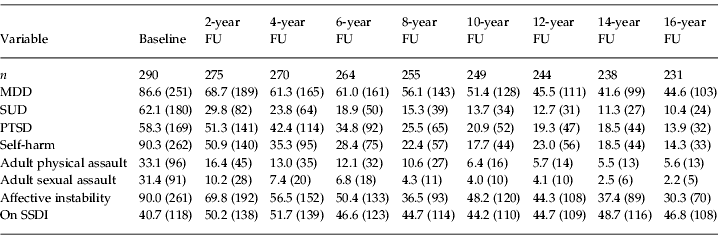
Fifteen time-varying variables were also selected based on prior research. Table 1 presents the prevalence of MDD, SUD, PTSD, self-harm, adult physical and sexual assault, affective instability, and those on SSDI across the follow-up periods. With the exception of SSDI, which remained relatively stable over follow-up, the rates of the remaining nine variables in Table 1 generally declined from baseline to the 16-year follow-up.
Prevalence of major depressive disorder (MDD), any substance use disorder (SUD), post-traumatic stress disorder (PTSD), self-harm, adult physical and sexual assault, affective instability, and those on SSDI in sample

SSDI, Social security disability insurance; FU, follow-up.
Data presented as percentage prevalence (n).
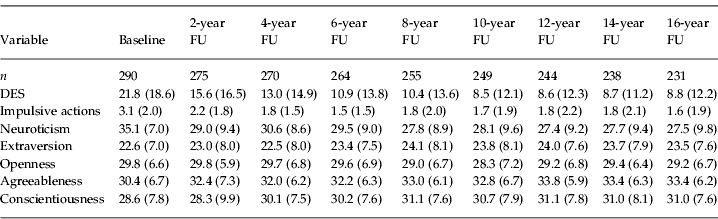
Table 2 depicts the mean scores and standard deviations for the Dissociative Experiences Scale (DES), the number of impulsive actions across all follow-up periods, and the five factors of the NEO-FFI. This table shows that DES scores decrease until the 10-year follow-up and then level off, whereas the number of impulsive actions drops off sharply early on and then stays relatively constant. All the factors from the NEO remain relatively constant across all the time periods.
Mean (standard deviation) of Dissociative Experiences Scale (DES), number of impulsive actions, and NEO-Five Factor Inventory (NEO-FFI) scores in sample

FU, Follow-up.
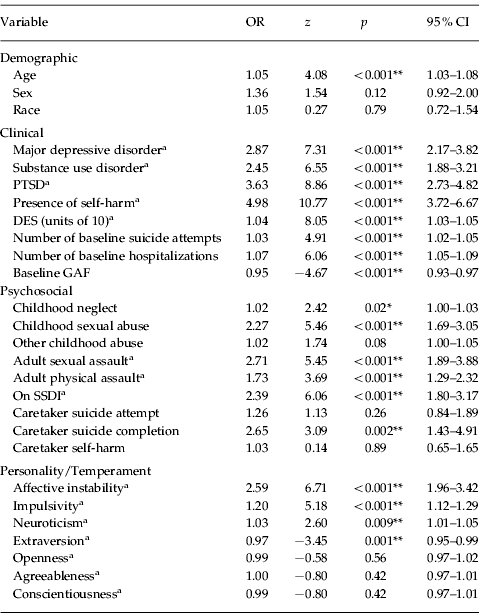
Table 3 presents the bivariate predictors of suicide attempts across each of the measurement periods. As mentioned earlier, each analysis was conducted controlling for assessment period using quadratic time trends. Nineteen of the 27 variables tested were significant at the p<0.05 level. One demographic variable, age, was statistically significant, in that older age increased the risk of future suicide attempts, and all the clinical variables tested were statistically significant predictors of suicide attempts. These were: MDD, SUD, PTSD, self-harm, higher score on the DES, higher number of suicide attempts assessed at baseline, higher baseline number of hospitalizations, and lower baseline GAF score. Significant psychosocial predictors were: severity of childhood neglect, childhood sexual abuse, adult physical and sexual assault, being on SSDI, and having had a caretaker complete suicide. Finally, four personality/temperament variables significantly predicted suicide attempts in the bivariate analyses, namely the presence of affective instability, increased impulsivity, and high neuroticism and lower extraversion scores on the NEO-FFI.
Bivariate predictors of suicide attempts over 16 years of prospective follow-up

OR, Odds ratio; CI, confidence interval; GAF, Global Assessment of Functioning; PTSD, post-traumatic stress disorder; DES, Dissociative Experiences Scale; SSDI, social security disability insurance.
a Time-varying variable, * p⩽0.05, ** p⩽0.01.
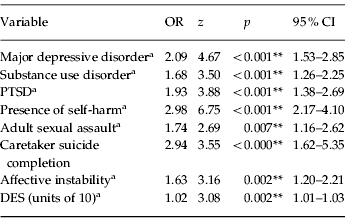
Table 4 depicts the multivariate model obtained after the backwards deletion procedure, having used the significant bivariate predictors in the initial model. In this model, eight of the original predictors remain statistically significant: having a diagnosis of MDD, SUD or PTSD, the presence of self-harm, adult sexual assault, having had a caretaker complete suicide, affective instability, and a higher score on the DES. The ORs reported in Table 4 indicate that a diagnosis of MDD, SUD or PTSD is associated with an approximately twofold increase in the odds of a suicide attempt. Similarly, experiencing a sexual assault as an adult was also associated with a comparable increase in the odds of a suicide attempt. The presence of self-harm and having had a caretaker complete suicide were associated with an almost threefold increase in the odds of a suicide attempt, whereas affective instability and 10-point increases on the DES were associated with smaller (approximately 1.5-fold and 1-fold respectively) increases in the odds of making an attempt.
Multivariate model of significant predictors of suicide attempts over 16 years of prospective follow-up

OR, Odds ratio; CI, confidence interval; PTSD, post-traumatic stress disorder; DES, Dissociative Experiences Scale.
a Time-varying variable, * p⩽0.05, ** p⩽0.01.
Discussion
The results from the current study suggest that a wide range of demographic, clinical, psychosocial and personality/temperament variables predict future suicide attempts in those with BPD when examined over 16 years of prospective follow-up. Specifically, when examined in a bivariate manner, previously examined variables of older age, diagnoses of MDD, SUD and PTSD, the presence of self-harm, increased number of baseline suicide attempts, higher number of hospitalizations at baseline, lower baseline GAF score, severity of childhood neglect, childhood sexual abuse, being on SSDI as a measure of social adjustment, the presence of affective instability, greater impulsivity, high neuroticism and low extraversion all predicted future suicide attempts. Additionally, new variables tested in this study, including adult physical and sexual assault, having had a caretaker complete suicide and more severe dissociation, also predict future suicide attempts. However, when examined in a multivariate fashion, eight of these variables remained in the model. These were: MDD, SUD, PTSD, self-harm, adult sexual assault, having a caretaker who has completed suicide, affective instability, and more severe dissociative experiences, incorporating both previously examined variables and those new to this study.
The majority of those variables tested in the current study that have been examined previously remained significant predictors in our bivariate analyses. The variables that were not found to be significant are of interest because of their presumed clinical relevance (i.e. sex, race, caretaker self-injury, aspects of personality) and the fact that some of them have been found to be significant predictors of suicide attempts in prior studies of those with BPD (i.e. other childhood abuse; Brodsky et al. Reference Brodsky, Malone, Ellis, Dulit and Mann1997) and in the population more generally (i.e. sex; Weissman et al. Reference Weissman, Bland, Canino, Greenwald, Hwu, Joyce, Karam, Lee, Lellouch, Lepine, Newman, Rubio-Stipec, Wells, Wickramaratne, Wittchen and Yeh1999; Nojomi et al. Reference Nojomi, Malakouti, Bolhari and Poshtmashhadi2007; Nock et al. Reference Nock, Borges, Bromet, Alonso, Angermeyer, Beautrais, Bruffaerts, Chiu, de Girolamo, Gluzman, de Graaf, Gureje, Haro, Huang, Karam, Kessler, Lepine, Levinson, Medina-Mora, Ono, Posada-Villa and Williams2008; Borges et al. Reference Borges, Nock, Haro Abad, Hwang, Sampson, Alonso, Andrade, Angermeyer, Beautrais, Bromet, Bruffaerts, de Girolamo, Florescu, Gureje, Hu, Karam, Kovess-Masfety, Lee, Levinson, Medina-Mora, Ormel, Posada-Villa, Sagar, Tomov, Uda, Williams and Kessler2010).
Three of the variables that remained significant in the multivariate analysis are clinical diagnoses. Given the considerable role of MDD in predicting suicide attempts more generally (Borges et al. Reference Borges, Angst, Nock, Ruscio and Kessler2008; Wilcox et al. Reference Wilcox, Arria, Caldeira, Vincent, Pinchevsky and O'Grady2010) and the large role that dysphoric mood plays in BPD (Zanarini et al. Reference Zanarini, Frankenburg, DeLuca, Hennen, Khera and Gunderson1998), this predictor makes clinical sense. Similarly, the impulsivity and decreased inhibition associated with SUD may be strong contributors to suicide attempts, especially in those with BPD, where ongoing impulsivity is a defining feature. PTSD has also previously been found to be a predictor of suicide attempts in those with BPD (Pagura et al. Reference Pagura, Stein, Bolton, Cox, Grant and Sareen2010) and it may be that the additional re-experiencing, emotional avoidance and arousal symptoms of this disorder might be especially taxing on those with BPD who already are struggling with an underlying affective lability.
This effect of PTSD may be particularly salient in those in ongoing assaultive situations. It is noteworthy that only adult sexual assault remained significant and none of the childhood abuse or neglect variables remained significant in the multivariate model. This, in conjunction with ongoing PTSD as a significant predictor, might suggest that ongoing assault and current symptoms of PTSD have a greater impact on suicide attempts than difficult events that occurred in the more distant past.
Our finding that having had a caregiver complete suicide predicts future suicide attempts is a new one for BPD. Fear of, and frantic efforts to avoid, abandonment is a diagnostic criterion for BPD. Having a caretaker commit suicide is a traumatic abandonment that might lead to the desire to join the parent, follow their model, or to attachment problems or other disorders such as PTSD, which themselves may increase suicide risk. Thus, having a caretaker commit suicide might be a particularly salient trauma for borderline patients. Having a caretaker merely attempt suicide or engage in self-injury does not provide the same kind of traumatic loss, and subsequently may, understandably, not be a significant predictor. Furthermore, adoption, twin and family studies support the view that the transmission of suicide attempts is at least in part genetic (Brent & Mann, Reference Brent and Mann2005; Brent & Melhem, Reference Brent and Melhem2008). Thus, the pattern of caretaker suicides predicting future suicide attempts in offspring may be in part environmental but also in part transmitted genetically.
Several co-occurring symptoms of BPD were also found to be significant predictors of suicide attempts. The presence of affective instability makes it difficult to cope with situations such as the symptoms that come with a co-morbid psychiatric diagnosis, sexual assault, and having a loved one complete suicide. Suicide has been cited as a method of ending emotional pain (Kraft et al. Reference Kraft, Jobes, Lineberry, Conrad and Kung2010). Thus, it may make sense that difficult and unstable affect might contribute to individuals using suicide attempts as a solution. This may be particularly true for those with BPD, where affective instability is a hallmark criterion of the disorder. Like suicide, dissociation has also often been cited as a method of disengaging from strong emotions (Stiglmayr et al. Reference Stiglmayr, Ebner-Priemer, Bretz, Behm, Mohse, Lammers, Anghelescu, Schmahl, Schlotz, Kleindienst and Bohus2008; van Dijke et al. Reference van Dijke, van der Hart, Ford, van Son, van der Heijden and Bühring2010). Thus, it may not be surprising that the two are related. Dissociation has also been seen as a way of coping with the stress of both childhood sexual abuse and adult sexual assault (Lipschitz et al. Reference Lipschitz, Kaplan, Sorkenn, Chorney and Asnis1996), and in this way it is related to other predictors. However, it remains in the model after accounting for these other variables, suggesting that dissociation is an important predictor of suicide in its own right.
Finally, self-harm, a common co-occurring symptom in BPD (Gunderson, Reference Gunderson2001) and fellow traveler with suicide attempts (Nock et al. Reference Nock, Joiner, Gordon, Lloyd-Richardson and Prinstein2006), was also found to predict suicide attempts in BPD. Thus, this symptom, too, significantly increases the odds of making a suicide attempt over time. Self-harm might perhaps be seen as a ‘gateway’ to more life-threatening suicide attempts; however, it might also simply be a somewhat similar and co-occurring behavior. Future research is needed to further understand the nature of this relationship.
It should also be noted that impulsivity did not remain a significant predictor of suicide attempts in the multivariate analysis. This is of particular interest because impulsivity specifically has been found previously to be a predictor of suicide attempts in BPD (Brodsky et al. Reference Brodsky, Malone, Ellis, Dulit and Mann1997; Yen et al. Reference Yen, Shea, Sanislow, Skodol, Grilo, Edelen, Stout, Morey, Zanarini, Markowitz, McGlashan, Daversa and Gunderson2009). This may be because these prior studies included substance abuse and self-harm in their measures of impulsivity. The current study, by removing these aspects and testing them separately, demonstrates that these components of impulsivity more specifically predict suicide attempts across time.
Limitations and future directions
One limitation of this study is that all participants were initially in-patients in a private psychiatric hospital and were thus seriously ill at the start of the study. In addition, the majority of participants were in treatment during each study period (Hörz et al. Reference Hörz, Zanarini, Frankenburg, Reich and Fitzmaurice2010). Thus, it is difficult to know whether the results generalize to a less severely ill sample. Furthermore, all data were obtained by self-report from the participants. Thus, it is difficult to know if the information obtained was exaggerated, minimized, or both at different times. Future research might use community samples along with record review and informant interviews in an attempt to address some of these limitations. Moreover, because the data were collected as the presence of each variable within a 2-year time frame, we could not determine whether the predictors and outcome variable co-occurred. Thus, this may have markedly underestimated the true effect size in the study. Future research might attempt to ascertain the exact timing of the predictors and outcome variables to avoid this. Similarly, because the selection of the sample is to some extent selected for the outcome variable, the effects are likely to be attenuated because the selection of the sample is constricted. Future research might examine a wider selection of sample. Finally, it is the case that many of the predictors and the outcome measure are criteria for BPD. However, we used many predictors from the DIB-R, a more complex measure than the specific items outlined in the DSM, limiting the overlap and direct manifestation of liability for BPD.
Conclusions
Taken together, the results of this study suggest that the prediction of suicide attempts among borderline patients is complex, involving co-occurring disorders and co-occurring symptoms of BPD in addition to aspects of adult adversity and a family history of completed suicide. Prediction of suicide attempts is a particular challenge (Paris, Reference Paris2006). Thus, the more accurate the predictors we can identify among a given group, the better our chances of predicting and preventing this lethal outcome. The current study identifies several predictors of suicide attempts in BPD, many of which are above and beyond those found in other disorders (i.e. MDD, bipolar disorder, schizophrenia). Although age and sex have been associated with suicide attempts in schizophrenia (Hor & Taylor, Reference Hor and Taylor2010) and past history of suicide attempts (Oquendo et al. Reference Oquendo, Currier and Mann2006), and impulsivity has been associated with suicide attempts in both unipolar and bipolar disorders (Perroud et al. Reference Perroud, Baud, Mouthon, Courtet and Malafosse2011), other predictors found in this study do not generally overlap with previous work in the prediction of suicide attempts in other disorders. This suggests that clinicians should pay particular attention to these non-overlapping predictors when conducting suicide assessments in those with BPD.
Acknowledgements
This research was supported by National Institute of Mental Health (NIMH) grants MH47588 and MH62169.
Declaration of Interest
None.