




Introduction
Twin birth rates have increased worldwide in the last decades, largely due to the increased use of assisted reproduction technology (ART). Parents of twins have to deal repeatedly with several stressful situations. Twins have higher risk of prematurity, low birth weight, and perinatal mortality compared with singletons (Blondel et al., Reference Blondel, Kogan, Alexander, Dettani, Kramer and Macfarlane2002). Twins also show poorer neurodevelopmental outcomes than singletons (Lorenz, Reference Lorenz2012). To meet the needs of two or more children, parents may experience financial, childcare, and physical and psychological issues (Ellison and Hall, Reference Ellison and Hall2003; Choi et al., Reference Choi, Bishai and Minkovitz2009). The first three months after delivery are a particularly vulnerable period for mothers due to the overload of caregiving tasks and different sleeping and feeding patterns of the twins (Beck, Reference Beck2002).
Given that infertility-related distress has been observed during pregnancy and postpartum among parents of ART singletons (Hjelmstedt et al., Reference Hjelmstedt, Widström, Wramsby and Collins2004), it would be expected that twin parenthood after ART would have a cumulative negative effect on parents’ psychological adjustment. However, some studies suggest that ART parents of twins have similar or even fewer psychological symptoms than parents of spontaneously conceived (SC) twins (Munro et al., Reference Munro, Ironside and Smith1990; Vilska et al., Reference Vilska, Unkila-Kallio, Punamäki, Poikkeus, Repokari, Sinkkonen, Tiitinen and Tulppala2009). One of the few longitudinal studies that examined the impact of mode of conception on the psychological adjustment of twins’ parents found that ART mothers exhibited fewer depressive symptoms at mid-pregnancy and similar levels of depressive and anxiety symptoms compared with SC mothers at three months and one year postpartum; however, no differences were found between ART and SC fathers of twins at pregnancy or postpartum (Vilska et al., Reference Vilska, Unkila-Kallio, Punamäki, Poikkeus, Repokari, Sinkkonen, Tiitinen and Tulppala2009). Other studies revealed that first-time mothers of ART twins reported more psychological symptoms and poorer coping resources than first-time mothers of SC twins (Colpin et al., Reference Colpin, Munter, Nys and Vandemeulebroecke1999; Baor et al., Reference Baor, Bar-David and Blickstein2004; Baor and Soskolne, Reference Baor and Soskolne2010). Although some studies found that primiparous ART women had more psychological symptoms and lower psychosocial well-being than multiparous ART mothers (Colpin et al., Reference Colpin, Munter, Nys and Vandemeulebroecke1999; Baor et al., Reference Baor, Bar-David and Blickstein2004; Baor and Soskolne, Reference Baor and Soskolne2010), others found no evidence for negative effects of parity on parental mental health (Vilska et al., Reference Vilska, Unkila-Kallio, Punamäki, Poikkeus, Repokari, Sinkkonen, Tiitinen and Tulppala2009).
With regard to the marital relationship, the few studies that have compared ART and SC parents of twins have found lower self-reported marital quality in ART mothers at late pregnancy compared with mothers of SC twins (Baor and Soskolne, Reference Baor and Soskolne2010), but similar marital relationship quality nine months (Baor et al., Reference Baor, Bar-David and Blickstein2004) and one year postpartum (Colpin et al., Reference Colpin, Munter, Nys and Vandemeulebroecke1999).
Differences in pregnancy and child-related attitudes between parents of ART and SC twins are largely unknown. Research with singletons suggests that ART mothers seem to have more idealized attitudes to pregnancy than SC mothers (McMahon et al., Reference McMahon, Tennant, Ungerer and Saunders1999). It is unclear whether the prenatal maternal expectations of ART mothers of twins are unrealistic as well (Baor and Soskolne, Reference Baor and Soskolne2010).
There is also a very limited body of research on gender differences in psychological adjustment to twin parenthood among ART and SC parents. Munro et al. (Reference Munro, Ironside and Smith1990) found no gender differences in psychiatric morbidity in a sample of parents of twins conceived spontaneously, by hormonal treatment or IVF. In contrast, mothers of twins showed lower psychological well-being than fathers, regardless of mode of conception (Baor et al., Reference Baor, Bar-David and Blickstein2004).
The inconclusive evidence regarding parents’ psychological adjustment to twin parenthood after ART may be at least in part explained by differences in studied samples. Some studies have included only primiparous women (McMahon et al., Reference McMahon, Tennant, Ungerer and Saunders1999; Baor and Soskolne, Reference Baor and Soskolne2010), whereas in others multiparous women were also included (Munro et al., Reference Munro, Ironside and Smith1990; Colpin et al., Reference Colpin, Munter, Nys and Vandemeulebroecke1999; Baor et al., Reference Baor, Bar-David and Blickstein2004; Vilska et al., Reference Vilska, Unkila-Kallio, Punamäki, Poikkeus, Repokari, Sinkkonen, Tiitinen and Tulppala2009). ART couples appear to be a heterogeneous group in terms of their socio-demographic characteristics and fertility difficulties (Hammarberg et al., Reference Hammarberg, Fisher and Wynter2008).
The purpose of this study was to examine whether mode of conception and gender are associated with parents’ psychological adjustment (anxiety and depressive symptoms, marital relationship quality, attitudes to pregnancy and the baby and attitudes to sex) across the transition to twin parenthood, taking into account the interdependence of data within couples. Based on previous research, we hypothesized that ART parents (and ART mothers in particular) would have poorer psychological adjustment than SC parents during the transition to twin parenthood.
Method
Procedures and participants
After receiving ethical approval from the Ethics Committee, consecutive couples expecting twins were recruited at the antenatal Obstetrical Units of three public hospitals in Northern Portugal. Inclusion criteria included twin pregnancy, less than 15 weeks gestational age and knowing how to read and write in Portuguese. Participants provided written informed consent. Information on couples’ psychological adjustment was collected three times during pregnancy (T1–T3) and three times after childbirth (T4–T6). The measures were completed separately by women and men, on average, at 13, 21 and 30 weeks of pregnancy and 1, 4 and 8 weeks after birth.
The sample included 41 couples, 25 of whom with twins conceived spontaneously (SC) and 16 conceived by assisted reproduction techniques (ART). Of the 50 eligible couples approached, 45 agreed to participate in the study (80%). Four couples were excluded due to death of one or both twins. Two couples dropped out the study after childbirth for personal reasons. Within the ART group, seven couples conceived through in vitro fertilization, eight by intracytoplasmic sperm injection and one by ovarian stimulation medication.
Measures
Couples’ information was collected using a socio-demographic questionnaire.
The state subscale of the State-Trait Anxiety Inventory Form Y (STAI; Spielberger et al., Reference Spielberger, Gorsuch and Lushene1983) was used to measure anxiety symptoms. It comprises 20 items that are scored on a four-point Likert scale. The scores range from 20 to 80, with higher scores indicating higher anxiety. The Portuguese version of the STAI has been validated for use during pregnancy and the postpartum period (Tendais et al, Reference Tendais, Costa, Conde and Figueiredo2014). In this study, the Cronbach’s α was 0.93 for both men and women.
The Edinburgh Postnatal Depression Scale (EPDS; Cox et al., Reference Cox, Holden and Sagovsky1987) was used to measure depressive symptoms. The EPDS is a self-report questionnaire composed of 10 items scored on a four-point Likert scale addressing depressive symptoms within the previous seven days. The scores range from zero to 30, with higher scores indicating more severe depressive symptoms. The Portuguese version of the EPDS has been validated both for pregnancy and the postpartum period (Tendais et al, Reference Tendais, Costa, Conde and Figueiredo2014). In this study, the Cronbach’s α was 0.82 for women and 0.76 for men.
Marital relationship, attitudes to sex and to pregnancy and the baby were assessed with the subscales of the maternal and the paternal attitudes and adjustment scale (MAMA, PAPA) (Kumar et al., Reference Kumar, Robson and Smith1984). The attitudes to sex subscale comprises 12 items (range 12–48). The marital relationship and the attitudes to pregnancy and the baby subscales comprise 11 items each (range 11–44). Sample questions include ‘Has there been tension between you and your partner?’ (marital relationship), ‘Have you found your partner sexually desirable?’ (attitudes to sex), ‘Have you been worrying that you might not be a good mother/father?’ (attitudes to pregnancy and the baby). Each item is scored on a four-point Likert scale (1=never to 4=very often). The Portuguese version of the MAMA (Figueiredo et al., Reference Figueiredo, Mendonça and Sousa2004) and PAPA (Pinto et al., Reference Pinto, Figueiredo, Samorinha, Tendais and Nunes-Costa2017) have been validated both for pregnancy and the postpartum. In this study, the Cronbach’s α was 0.84 for MAMA and 0.81 for PAPA.
All of these measures have been used in previous studies with ART and SC parents (Pinto et al., Reference Pinto, Figueiredo, Samorinha, Tendais and Nunes-Costa2017; Reference Pinto, Samorinha, Tendais, Silva and Figueiredo2018; Tendais and Figueiredo, Reference Tendais and Figueiredo2016).
Data analysis strategy
Pearson’s correlations were used to assess couples’ interdependence at baseline. In addition, unconditional multilevel models with gender and time as fixed effects were run for all outcome measures to estimate couples’ interdependence over time.
Dyadic linear growth curve models were estimated using multilevel modeling (Kenny et al., Reference Kenny, Kashy and Cook2006), a method for studying hierarchically nested data structure such as repeated measures from dyads. Growth curve models were used to evaluate the degree of change in an outcome variable using time as the predictor variable and the influence of other variables in the moderation of change over time (Kashy et al., Reference Kashy, Donnellan, Burt and McGue2008). The data consist of 492 potential observations: 41 couples by six time points by two people (husband and wife). Two-level models were estimated for each psychological adjustment variable (dependent variables) in which observation is level one and couple is level two.
Based on the examination of mean scores over time for the sample for depression, anxiety and attitudes to sex, there was a large change at the first assessment postpartum. Thus, for these variables, we used piecewise models with two different slopes: the first, from three (T1) to nine months (T4) and the second, from nine months to the last assessment (T6). In addition, the model contains two intercepts. The first ‘intercept’ represented where a person started at T1, and a second intercept named ‘pre-postnatal transition’ reflects change from pregnancy to the postpartum period. For the remaining outcome variables (marital relationship and attitudes to pregnancy and the baby), a single linear trend was sufficient to model changes from the first assessment during pregnancy to the last assessment postpartum. The models included main effects for time, mode of conception and gender. All interactions were examined, resulting in a possible three-way interaction between time, mode of conception and gender. Three multivariate outliers for anxiety and two for depression were detected and excluded from the analysis.
The time variable was defined in months and Time 0 was the beginning of the study (T1, M=3.05, SD=0.17) and so the intercept or baseline score represents the estimated mean level of each outcome variable at three months of pregnancy and the slope corresponds to the average linear change for each one month.
Results
In the ART group, couples had been infertile for 3.8 years (SD=2.2) and received an average of 1.8 (SD=0.9) fertility treatments. On average, participants were 30.7 years old (SD=4.7, range 20–43 years), had been in the relationship for 8.3 years (SD=4.7, range 1–21 years), and the majority were Caucasian (97.6%), primiparous (78%), married (75.6%), employed (84.5%), did not complete high school or equivalent (51.2%), and had medium and medium-low socioeconomic level (29.3% and 41.5%, respectively). More than half of the women had complications during pregnancy (53.7%) and delivered by cesarean section (63.4%). The mean gestational age was 36.1 weeks (SD=2.7, range 27.7–38.7).
Most of the twins were born full-term (51.2%) and had low and very low birth weight (50% and 11%, respectively). In more than a third of cases, at least one of the twins was admitted to a neonatal intensive care unit (NICU) (34.1%) with an average stay of 21.3 days (SD=24.9).
ART twins had a significantly longer stay at NICU than SC twins (U=102.0, P=0.02). A significant association was found between mode of conception and parity (χ 2(1)=–7.38, P<0.01). All women in the ART group were primiparous, whereas in the SC group more than a third was multiparous (36.0%). No statistically significant differences were found for age, education, socioeconomic level, relationship length, pregnancy complications, delivery mode, gestational age or NICU admittance between SC and ART groups (32% versus 37.5%, respectively).
Means and standard deviations for the outcome variables are presented for women and men and for spontaneous and ART groups in Table 1.
Mean and standard deviation of outcome variables for women and men and for spontaneous and assisted reproduction technique (ART) groups at all time points

STAI-T=State-Trait Anxiety Inventory – Trait; STAI-S=State-Trait Anxiety Inventory – State; EPDS=Edinburgh Postnatal Depression Scale; M=mean; SD=standard deviation.
Data were collected at 13 (T1), 21 (T2) and 30 (T3) weeks of pregnancy and one (T4), four (T5) and eight (T6) weeks after birth.
Positive and significant correlations within couples were found at baseline and over time indicating within-couple similarity in psychological adaptation, that is, interdependence. At baseline, Pearson’s correlation between couples’ scores were significant for anxiety (r=0.29, P=0.01), depression (r=0.46, P<0.001), marital relationship (r=0.26, P=0.03), attitudes to sex, (r=0.31, P=0.01), and marginally significant for attitudes to pregnancy and the baby (r=0.23, P=0.49). Time-specific correlations of the residuals indicated that couples’ anxiety (r=0.28, P<0.001), depression (r=0.23, P<0.01), marital relationship (r=0.18, P=0.02), attitudes to sex (r=0.28, P<0.001), and attitudes to pregnancy and the baby (r=0.24, P=0.01), scores were significantly correlated over time.
Tables 2 and 3 include detailed information on estimates, standard errors and effect sizes of variables for the piecewise growth curve models adjusted for twins’ length of stay at NICU and mothers’ parity. The statistical information of additional analyses and random effects is presented in the text.
Piecewise growth models for depressive and anxiety symptoms, attitudes to pregnancy and the baby and attitudes to sex from pregnancy to postpartum
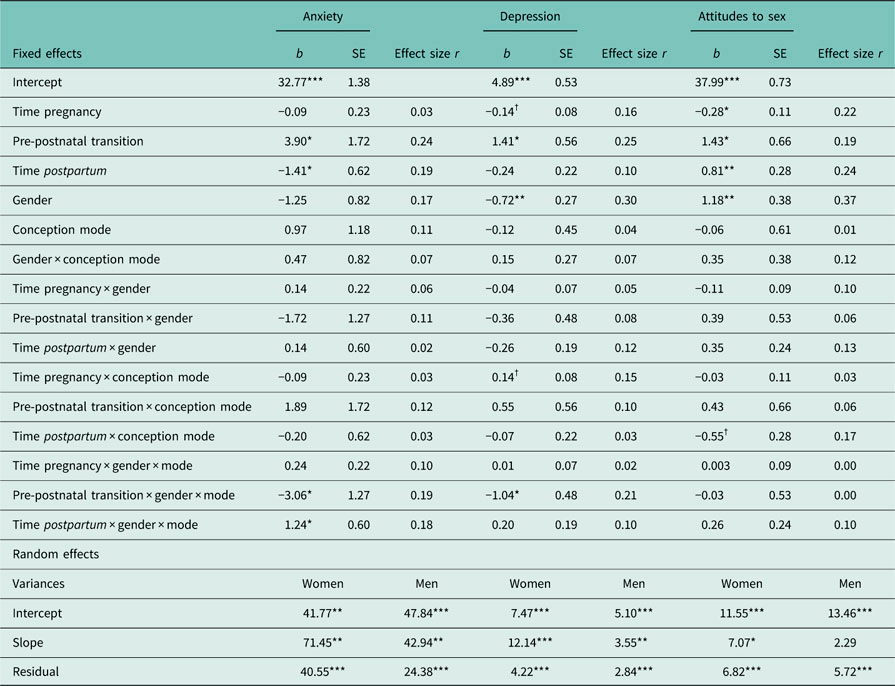
Gender was coded as men=1, women=−1; conception mode was coded as ART=1, spontaneous=−1; effect size r=√(t 2/[t 2+df]). Models are adjusted for twins’ length of stay at NICU and mothers’ parity.
† P<0.10, *P<0.05, **P<0.01, ***P<0.001.
Growth models for attitudes to pregnancy and the baby and marital relationship from pregnancy to postpartum

Gender was coded as men=1, women=−1; conception mode was coded as ART=1, spontaneous=−1; effect size r=√(t 2/[t 2+df]). Models are adjusted for twins’ length of stay at NICU and mothers’ parity.
† P<0.10, *P<0.05, **P<0.01, ***P<0.001.
A significant main effect of gender was found for depression, marital relationship and attitudes to sex. Women had higher depression scores, less positive attitudes to sex, and a more positive perception of their marital relationship than men at baseline.
Marginally significant two-way interactions were found between mode of conception and time for marital relationship, attitudes to pregnancy and the baby and attitudes to sex. Tests of simple slopes revealed that ART parents reported a decline in marital relationship over time (b=–0.25, P=0.02, r=0.36), no changes in attitudes to pregnancy and the baby over time (P=0.53), and a slow improvement in attitudes to sex over postpartum (b=0.65, P=0.09, r=0.13). In contrast, SC parents reported no changes in marital relationship over time (P=0.62), more positive attitudes to pregnancy and the baby over time (b=0.27, P<0.001, r=0.58), and more positive attitudes to sex over postpartum (b=1.40, P<0.001, r=0.35). A marginally significant two-way interaction (P=0.098) was also found between gender and time for marital relationship indicating that women reported a decline in marital relationship over time (b=–0.24, P=0.03, r=0.34), while men showed no changes in marital relationship over time (P=0.51).
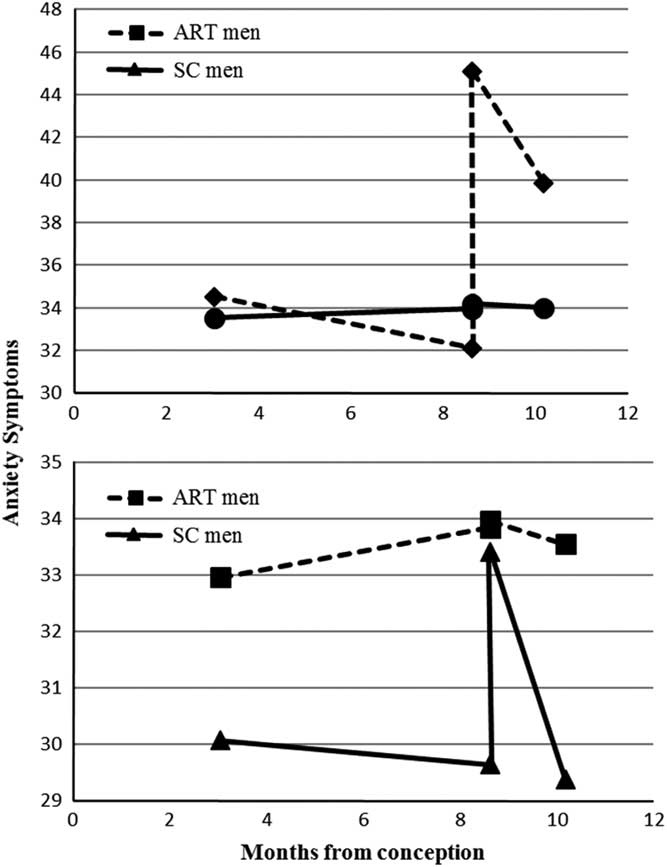
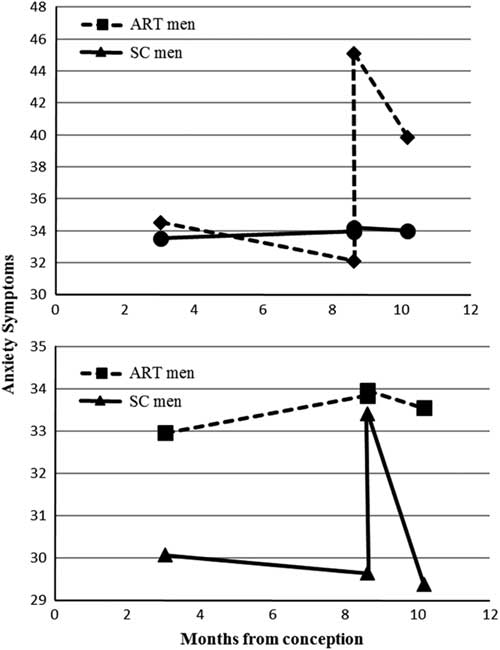
Significant three-way interactions were found between mode of conception, gender and time for anxiety (see Figure 1) and depression. Tests of simple slopes revealed that ART women showed a significant increase in both anxiety (b=10.57, P=0.01, r=0.16), and depression (b=3.35, P=0.02, r=0.16), scores from pregnancy to the postpartum period. Smaller but significant increases in anxiety scores (b=1.55, P=0.04, r=0.13) were also noted for SC men from pregnancy to the postpartum period. During the postpartum period, ART women showed a decline trend in anxiety scores (b=−2.99, P=0.09, r=0.12) and no changes in depression scores (P=0.61), whereas a significant decrease in anxiety (b=–2.30, P=0.02, r=0.13) and a decline trend in depression scores (b=–0.63, P=0.06, r=0.12, was observed among SC men. Anxiety and depression scores remained unchanged for ART men and SC women from pregnancy to the postpartum period (anxiety: ART men P=0.77, SC women P=0.79; depression: ART men P=0.58, SC women P=0.86) and during the postpartum period (anxiety: ART men P=0.86, SC women P=0.93; depression: ART men P=0.36, SC women P=0.45). Compared with the other groups (SC mothers and fathers, ART fathers), ART women had a higher increase in anxiety (P=0.03), and depression scores (P=0.07) from pregnancy to the postpartum period.
Mean predicted anxiety scores from pregnancy to the postpartum period for parents of twins by mode of conception and parents’ gender. ART=assisted reproduction technology; SC=spontaneous conception.
Discussion
The results of this study show that both mode of conception and parents’ gender are associated with parents’ psychological adjustment across the transition to twin parenthood. Consistent with our hypothesis, ART parents in general and ART mothers in particular showed poor psychological adjustment over the transition to twin parenthood.
ART parents reported a decline in marital relationship quality, no changes in attitudes to pregnancy and the baby and no changes in attitudes to sex over the postpartum. In contrast, SC parents did not change their perception of the marital relationship, reported more positive attitudes toward pregnancy and the baby and more positive attitudes to sex over the postpartum. These results suggest that ART couples experience interpersonal difficulties during the transition to twin parenthood that could result from several factors, including accumulating stress. Baor and Soskolne (Reference Baor and Soskolne2010) also found that ART mothers of twins report lower marital quality, as well as lower self-efficacy and social support than mothers of SC twins at late pregnancy.
Given that a large proportion of couples undergoing fertility treatments desire having twins (Child et al., Reference Child, Henderson and Tan2004), it is surprising that ART parents’ attitudes to pregnancy and the baby remained stable, whereas SC parents reported more positive attitudes to pregnancy and the baby over time. However, research with singletons showed that formerly infertile patients tend to experience increased anxiety about the security of the pregnancy and fetal survival (Hammarberg et al., Reference Hammarberg, Fisher and Wynter2008). We can speculate that these anxieties are higher in case of ART twin pregnancy, which can ultimately influence the attitudes to pregnancy and the baby. Because the literature on the psychological adjustment in ART and non-ART parents of twins is scarce, the obtained results still need further exploration.
Compared with the other groups (SC mothers and fathers, ART fathers), ART mothers exhibited a significantly higher increase in anxiety and depressive symptoms from pregnancy to the postpartum period and only anxiety levels exhibited a decline trend over the postpartum. Similar results were obtained even when multiparous SC parents were excluded from the analyses. Our results are consistent with previous studies with mothers of twins showing that ART mothers have lower psychosocial well-being than SC mothers (Colpin et al., Reference Colpin, Munter, Nys and Vandemeulebroecke1999; Baor et al., Reference Baor, Bar-David and Blickstein2004; Baor and Soskolne, Reference Baor and Soskolne2010). These adjustment difficulties may be due to a cumulative negative consequence of the prior experience of infertility and fertility treatment (Hammarberg et al., Reference Hammarberg, Fisher and Wynter2008). As previously noted, ART parents are a heterogeneous group regarding socio-demographic characteristics (Hammarberg et al., Reference Hammarberg, Fisher and Wynter2008), namely because funding policies for fertility treatments vary significantly across countries. In Portugal, ART procedures provided in public clinics/hospitals are fully reimbursed, whereas medications are only partially reimbursed (40%). In the present study, most parents had medium socioeconomic level and medium educational level and no differences in these variables were found between ART and SC groups.
At the couple level, women and men showed similar results at each time period as demonstrated by the correlations at baseline and over time. These results show that couples’ psychological adjustment tends to covary over the transition to twin parenthood. A previous study with singletons has shown that couples’ psychological adjustment is significantly correlated across the transition to parenthood (Tendais and Figueiredo, Reference Tendais and Figueiredo2016).
This study brings several clinical and developmental contributions. The longitudinal design starting at early pregnancy and comprising multiple time points covering pregnancy and the early postpartum period provided detailed information on changes over time. This information can be helpful for tailoring interventions to the specific needs of parents during the transition to parenthood. In addition, a broad understanding of the psychological adjustment process was gained by the inclusion of measures (marital relationship and pregnancy and child-related attitudes) other than psychological symptoms. Our results also showed that women’s and men’s psychological adjustments are interdependent. Therefore, couple-based interventions (eg, Kalland et al., Reference Kalland, Fagerlund, von Koskull and Pajulo2016) may be more beneficial for both women and men than those directed at the individual level. These interventions may be helpful for preventing and treating depression and anxiety, especially for ART mothers. Considering that parents’ depressive and anxiety symptoms have been consistently associated with adverse outcomes on the fetus, neonate, and child (Stein et al., Reference Stein, Pearson, Goodman, Rapa, Rahman, McCallum, Howard and Pariante2014), self-report measures might be used as a screening measure among parents attending primary care services. Prenatal and postnatal routine care appointments may provide valuable opportunities for early detection and referral for maternal or paternal depression and anxiety, so that psychological support and intervention may begin as early as possible.
The current study has also limitations. First, the small sample size, especially of the ART group, warrants cautious interpretation and generalization of the results. Nevertheless, effect sizes indicate that the identified differences are small to moderate. Second, the SC group included first- and second-time parents, whereas the ART group included only first-time parents, necessitating adjustments for parity. Third, self-report measures may have increased the reporting bias.
Further research is needed to investigate whether the identified early postpartum adjustment difficulties are transient or persist over time. In addition, future studies should examine the contribution of declining marital relationship reported by ART couples to the increased anxiety and depressive symptoms during postpartum noted in ART women.
In conclusion, the findings of the current study suggest that ART couples may experience greater adjustment difficulties during the transition to twin parenthood than SC couples, especially ART mothers. Although the sample size for the ART group was small, poorer psychological adjustment than the SC group was consistently observed.
Acknowledgments
The authors thank Dr Dulcina Ramada and Prof. Nuno Montenegro for their institutional support for this study. They also thank Ana Conde for her contributions to this manuscript and to the families who collaborated in this study.
Financial Support
This study was supported by an FCT doctoral grant (SFRH/BD/40146/2007) to the first author.
Conflicts of Interest
None.
Ethical Standards
Ethical approval was obtained from the three participating hospitals (Centro Hospitalar de Entre o Douro e Vouga, E.P.E., Hospital São João, Hospital Pedro Hispano).



 Open access

