

A stressful event can place a couple's marital relationship into crisis; in other words, stressful events do not just affect the individual in a relationship. Stressful situations have negative effects not only on individuals, but also their partners. For example, a previous study on infertile couples found that both spouses’ depressive symptoms increased significantly after one spouse received information of a negative pregnancy result (Berghuis & Stanton, Reference Berghuis and Stanton2002). Another study found that both patient and partner were affected by the impact of the diagnosis and treatment of cancer (Manne et al., Reference Manne, Norton, Ostroff, Winkel, Fox and Grana2007). Our study aimed to simplify the complexity of coping in a marital context by data reduction technique.
Coping in a Marital Context
The systemic transactional model (STM) assumes that daily distresses experienced by one spouse can be expressed verbally or non-verbally in a couple relationship and need to be coped with daily by the other partner, regardless of whether the partner shares the distresses or not (Bodenmann, Reference Bodenmann, Revenson, Kayser and Bodenmann2005). The STM indicates that the stress coping process needs a dyadic perspective. In this study, we aimed to identify the coping patterns of couples experiencing a shared stressor. As a theoretical framework, we predicted that coping behaviour does not stop at an individual level, but extends to the couple level (Bodenmann, Reference Bodenmann1997; Coyne & Smith, Reference Coyne and Smith1991, Reference Coyne and Smith1994).
Under a stressor in a marital context, both the patient and their partner manage not only their own stress but also their partner's stress (Coyne & Smith, Reference Coyne and Smith1991, Reference Coyne and Smith1994). The literature on stress and coping, and particularly that on couples coping with chronic illness (Revenson, Kayser, & Bodenmann, Reference Bodenmann, Revenson, Kayser and Bodenmann2005), refers to this process as ‘relationship-focused coping’ (Coyne & Smith, Reference Coyne and Smith1991, Reference Coyne and Smith1994), ‘ways of giving support’ (Kuijer et al., Reference Kuijer, Ybema, Buunk, DeJong, Thijs-Boer and Sanderman2000) and ‘dyadic coping’ (Bodenmann, Reference Bodenmann1997).
When focusing on interpersonal processes that involve managing stress, relationship-focused coping is a useful concept. Relationship-focused coping is defined as cognitive and behavioural efforts to manage and sustain intimate relationships during stressful events (O’Brien, DeLongis, Pomaki, Puterman, & Zwicker, Reference O’Brien, DeLongis, Pomaki, Puterman and Zwicker2009). Previous studies of relationship-focused coping have shown two widely used notions: protective buffering, which involves hiding negative emotions and yielding to one's partner to avoid distress or disagreement (Coyne & Smith, Reference Coyne and Smith1991; Kuijer et al., Reference Kuijer, Ybema, Buunk, DeJong, Thijs-Boer and Sanderman2000); and active engagement, which includes open discussion and problem solving, as well as talking about feelings (Coyne & Smith, Reference Coyne and Smith1991, Reference Coyne and Smith1994).
Relationship-focused coping mechanisms have two types of outcomes. One is the actor effect, which is a person's own response to stress. The other is the partner effect, where a person's response to stress impacts on their partner's response to stress.
Regarding the actor effect, wives’ protective buffering was found to be associated with their own greater distress in couples where the husband experienced a myocardial infarction (Coyne & Smith, Reference Coyne and Smith1991). Furthermore, patient protective buffering has been shown to be associated with higher levels of patients’ distress (Manne et al., Reference Manne, Norton, Ostroff, Winkel, Fox and Grana2007; Suls, Green, Rose, Lounsbury, & Gordon, Reference Suls, Green, Rose, Lounsbury and Gordon1997). Active engagement has been found to be positively associated with an actor's marital satisfaction and wellbeing (Kurosawa & Kato, Reference Kurosawa and Kato2013). Generally, protective buffering is considered maladaptive behaviour for their mental health. In contrast, several studies have found active engagement to be adaptive behaviour for spouses’ marital satisfaction and mental health.
Regarding the partner effect, the frequency of active engagement by the partner of a patient was positively associated with the patient's marital satisfaction (Hagedoorn et al., Reference Hagedoorn, Kuijer, Buunk, DeJong, Wobbes and Sanderman2000). The frequency of protective buffering of wives was associated with patients’ higher self-esteem (Coyne & Smith, Reference Coyne and Smith1994). The previous studies found that negative outcome of actor effect of protective buffering is the total opposite to positive outcome of the partner effect of protective buffering (Coyne & Smith, Reference Coyne and Smith1991, Reference Coyne and Smith1994). In other words, there is a complexity.
A previous study of couples’ communication showed that each spouse in couples engages in different types of behaviour, such as demand/withdraw communication. The Communication Pattern Questionnaire (CPQ) showed that couples’ communication patterns did not stop at an individual level; that is, couples’ communication has a ‘mutual’ aspect.
System theorists emphasise patterns of communication within couples because these patterns have an effect on the outcome of individuals within couples (Christensen & Shenk, Reference Christensen and Shenk1991). The CPQ is widely used to assess communication within couples. The CPQ has three subscales: mutual constructive communication, demand–withdraw communication, and mutual avoidance (Christensen & Shenk, Reference Christensen and Shenk1991; Manne et al., Reference Manne, Ostroff, Norton, Fox, Goldstein and Grana2006). Mutual constructive communication consists of five items that assess the mutual discussion of the issue, the expression of feelings, the understanding of views, and feelings that the issue has been resolved. Mutual avoidance consists of three items that assess the mutual avoidance of discussion and mutual withdrawal after a discussion. The results of the CPQ found significant associations between the frequency of husbands’ mutual constructive communication and that of their wives (Christensen & Shenk, Reference Christensen and Shenk1991).
A study simplifies the complexity of individual coping. Previous studies of coping found that coping itself has multidimensional aspects. In other words, individuals deal with their stress with various coping methods and specific patterns. For example, Shapiro's research team conducted cluster analysis to identify coping categories (Shapiro, Rodrigue, Boggs, & Robinson, Reference Shapiro, Rodrigue, Boggs and Robinson1994). Their study found four coping categories: confrontive, avoidant, resigned, and other (Shapiro et al., Reference Shapiro, Rodrigue, Boggs and Robinson1994).
Previous studies of relationship-focused coping and coping patterns have several limitations. First, the samples used in previous studies, with the exception of Kurosawa and Kato (Reference Kurosawa and Kato2013), involved couples in which one spouse had a serious medical problem. Severe illnesses such as cancer have a negative effect on both the lives of patients and the lives of those close to them (Hagedoorn et al., Reference Hagedoorn, Kuijer, Buunk, DeJong, Wobbes and Sanderman2000). Our study expands the concept of relationship-focused coping to couples who are not suffering from any serious medical problem, because stressful situations are not limited to couples experiencing illness. For example, a previous study showed that dual-career couples typically encounter seven major conflict situations in daily life: domestic chores, maintaining social relations, role cycling, job relocations, sex-role socialisation, social pressure, and direct competition between spouses (Wiersma, Reference Wiersma1994).
Second, a previous study of relationship-focused coping examined the actor effect and partner effect but did not focus on the multidimensional aspects of relationship-focused coping, that is, the patterns of coping in couples. As Shapiro et al. (Reference Shapiro, Rodrigue, Boggs and Robinson1994) suggested in their research, coping has multidimensional aspects. We hypothesised that relationship-focused coping takes on specific patterns in couples, because relationship-focused coping is just one way that couples cope with stress (Bodenmann, Reference Bodenmann, Revenson, Kayser and Bodenmann2005).
Aim of the Present Study
We aimed to to simplify the complexity of relationship-focused coping by data reduction technique because couples’ coping (Coyne & Smith, Reference Coyne and Smith1991, Reference Coyne and Smith1994) and communication (Christensen & Shenk, Reference Christensen and Shenk1991) needs a dyadic perspective.
A qualitative study simplified how couples cope with their daily stresses. An interview study sampled dual-career couples and found that couples’ coping patterns were either flexible or rigid (Stanfield, Reference Stanfield1998). The study found that couples had coping patterns and this indicated that coping patterns were constructed by both husbands and wives.
Our study aimed to simplify the patterns of relationship-focused coping in Japanese couples. We sampled child-rearing couples. After the birth of the first child, couples need to adjust to the changes that a new baby brings (Belsky & Kelly, Reference Belsky and Kelly1994). In addition, we chose child-rearing couples because these couples experience many daily hassles, such as disciplinary issues, returning to work and illness (e.g., their child suddenly develops a fever). To deal with these issues, the couple may face marital conflict. Therefore, selecting this life stage was appropriate for our research question.
Based on a previous study (Badr, Reference Badr2004) and the earlier CPQ study, we hypothesised at least two couple types: ‘mutual active relationship maintenance couples’, where both spouses engage in active engagement to deal with marital conflict, and ‘mutual avoidant relationship maintenance couples’, where both spouses engage in escape–avoidance in dealing with marital conflict. After identifying the couples’ relationship-focused coping patterns, we examined the characteristics of the patterns from the perspective of marital satisfaction and wellbeing. To identify interpersonal and intrapersonal aspects, marital satisfaction and wellbeing are appropriate outcome variables in our study. Furthermore, in previous studies on relationship-focused coping, these two variables are frequently used (Hagedoorn et al., Reference Hagedoorn, Kuijer, Buunk, DeJong, Wobbes and Sanderman2000; Kuijer et al., Reference Kuijer, Ybema, Buunk, DeJong, Thijs-Boer and Sanderman2000; Suls et al., Reference Suls, Green, Rose, Lounsbury and Gordon1997).
Method
Procedures
We distributed 258 pairs of questionnaires from 2010 to 2011 and a further 221 pairs of questionnaries from 2011 to 2012. Questionnaires were delivered in envelopes to all parents whose children attended four day-care centres. About 60% of child-rearing couple use the day-care centres and kindergartens in Japan (Ministry of Health, Labour and Welfare, 2011), in other words, it is a typical support system for parents. To regulate the effect of area difference, we surveyed day-care centres in four different areas. There was no overlap of participants between the two surveys. Husbands and wives answered separately and returned the questionnaires in sealed opaque envelopes. We collected 130 pairs of data. The correction rate was 25.1%. The research design was approved by the Ethics Committee of our university.
Participants
We excluded questionnaires that had missing data on the questionnaire (n = 29). In the end, 101 child-rearing couples out of 130 couples who had at least one pre-school child participated in the study. All participants were Japanese. The mean age of the husbands and wives was 36.64 years (SD = 5.34) and 35.14 years (SD = 4.65) respectively. Of the husbands, 98 were employed full time (97.0%), 2 were part time (1.98%), and 1 did not provide an answer to that question (0.99%). In addition, 13 (12.9%) husbands reported their job status as the owner of an independent business, 9 were specialists (8.9%), 18 were civil servants (17.8%), 60 were company employees (59.4%), and 1 answered as ‘other’ (0.99%). Among the wives, 45 were full-time workers (44.6%), 26 were part-time (25.7%), 27 were full-time homemakers (26.7%), 2 were students (1.98%), and 1 answered as ‘other’ (0.99%). Furthermore, 7 wives reported their job status as the owner of an independent business (6.9%), 20 were specialists (19.8%), 13 were civil servants (12.9%), 21 were company employees (20.8%), 2 were freelance workers (1.98%), and 7 replied they were ‘other’ (6.9%). Ninety-seven couples were living together and four couples were separated. We included the four separated couples for analysis, because working away from one's spouse, called Tanshin-Funin, is common in Japan. Among the married couples, the average length of their marital relationship was 8.17 years (SD = 3.21 years) and the average number of their children was 1.79 (SD = 0.68). The average age of their first child was 67.69 months (SD = 38.04, the average age of the second child was 43.56 months (SD = 26.31, n = 64), and the average age of their third child was 35.73 months (SD = 24.42, n = 15).
Measures
Relationship-focused coping
To measure relationship-maintaining behaviour in couples, we used a Japanese version of relationship-focused coping (Kurosawa & Kato, Reference Kurosawa and Kato2013). The scale is a 17-item instrument. This scale was created using previous studies on relationship-focused coping (Kuijer et al., Reference Kuijer, Ybema, Buunk, DeJong, Thijs-Boer and Sanderman2000; Langer, Brown, & Syrjala, Reference Langer, Brown and Syrjala2009). It includes items about the avoidant aspect of relationship maintenance, based upon Kato's Interpersonal Stress-Coping Inventory (Kato, Reference Kato2000), and includes questions concerning coping with stressful situation in participants’ daily lives. Escape avoidance has six items, measured by items such as ‘I try to avoid talking with my spouse to cool us down’ and ‘I stay by myself until both feel calm’. Active engagement has five items, measured by items such as ‘I am full of understanding towards my partner’ and ‘I try to discuss it with my partner openly’. Protective buffering has six items, measured by items such as ‘I deny or hide my worry’ and ‘I do not disagree with my spouse’. Items are scored on a Likert type scale ranging from 1 (never) to 5 (very often).
Marital satisfaction
Participants answered a Japanese version (Sugawara & Takuma, Reference Sugawara and Takuma1997) of the Kansas Marital Satisfaction Scale (KMS; Schumn et al., Reference Schumm, Paff-Bergen, Hatch, Obiorah, Copeland, Meens and Bugaighis1986). The KMS consists of three items (e.g., How satisfied are you with your relationship with your partner?). The original KMS scale used a fully anchored 7-point Likert scale, but in this study the mid-point (4) was removed. The mid-point of the original version of KMS is mixed; however, the mid-point of Japanese version of KMS is neither agree nor disagree. The meaning is different, so we removed the mid-point. Thus, the items had a range from 1 (extremely dissatisfied) to 6 (extremely satisfied). Three items were averaged to produce a scale that also had a range from 1 to 6.
Wellbeing
We used the WHO-Five Well-Being Index (WHO-5) as a measure of wellbeing. The scale is a five-item instrument. WHO-5 items concern positive wellbeing, thus making it a popular tool among community mental health professionals (Awata et al., Reference Awata, Bech, Koizumi, Seki, Kuriyama, Hozawa and Tsuji2007). The Japanese version of the WHO-5, translated by Awata et al. (Reference Awata, Bech, Koizumi, Seki, Kuriyama, Hozawa and Tsuji2007), has been confirmed to have sufficient internal consistency (the Cronbach alpha was 0.87), as well as external validity, being significantly correlated with a number of indices, including major diabetic complications, depression, anxiety and subjective quality of life. The score of the WHO-5 was negatively correlated with the number of illnesses (r = −.17) and positively correlated with physical functioning (r = .37). In addition, the scale was used for married couples (Kurosawa & Kato, Reference Kurosawa and Kato2013). The WHO-5 includes items such as ‘I have felt cheerful and in good spirits’ and ‘I have felt active and vigorous’. Respondents rated how often they felt the feeling described in the items on a scale from 0 (at no time) to 5 (all of the time). Higher scores represent a higher level of wellbeing.
Design and Analyses
To simplify the complexity of couples’ coping, a data reduction technique that reduces a large number of observations into a smaller number of groups was required. The term ‘cluster analysis’ is generally used to describe a set of numerical techniques for classifying objects into groups, based on their values on a set of variables. The intent is to classify objects into groups such that objects within the same group have similar values on the set of variables and objects in different groups have dissimilar values (Pastor, Reference Pastor, Hancock and Mueller2010).
As an analytic plan, we used the cluster analysis method. Cluster analysis identifies and describes groups of individual cases defined by similarities among multiple dimensions of interest. This method is useful in the field of family psychology (Henry, Tolan, & Gorman-Smith, Reference Henry, Tolan and Gorman-Smith2005). To conduct cluster analysis, Euclidian distance and Ward's method are recommended in the family psychology field (Henry et al., Reference Henry, Tolan and Gorman-Smith2005). The most common distance metric in family psychology is the Euclidian distance, which is calculated by summing the squared differences between cases on each variable and using the square root of the sum. Ward's method of linkage links clusters together on the basis of the degree of similarity between observations in the same clusters. We determined that couples’ coping patterns could be best described by clustering the three categories of relationship-focused coping (active engagement, protective buffering and escape-avoidance).
Results
SPSS, version 18.0J for Windows (SPSS Japan Inc., Tokyo, Japan) was used for data analyses.
Relationship-Focused Coping Pattern
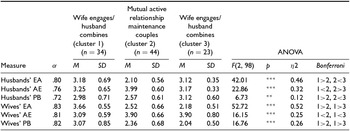
Cluster analysis was used to test for the coping patterns. We used Euclidian distances and Ward's method for analysis because these methods are one of the standard methods and frequently used in family studies, as noted by Henry et al. (Reference Henry, Tolan and Gorman-Smith2005). Data analysis was conducted in several steps. First, the scores of relationship-focused coping were standardised. Second, a squared Euclidean distance measure was calculated using SPSS. Third, the Ward method was used to place the data into hierarchical clusters. The dendrogram showed two or three clusters were appropriate. To introduce the characteristics of the couples’ relationship-focused patterns, we chose three clusters. In the fourth step, we calculated the mean of the relationship-focused coping to label each cluster. Table 1 shows the means and standard deviations of each cluster and the results of the analysis of variance (ANOVA). The p value of Box's test was under 0.01; therefore, an ANOVA was appropriate (Field, Reference Field2009).
Between-Group Differences for Relationship-Focused Coping Measures

Note: EA = escape-avoidance; AE = active engagement; PB = protective buffering.
*p < .05, **p < .01, ***p < .001
In this research, a mean score above 3.50 was the criteria by which the characteristics of the clusters were labelled. In cluster 1 (n = 34), the wives’ escape avoidance (M = 3.66, SD = 0.55) was significantly higher than for the other two clusters. Furthermore, the wives’ protective buffering was higher than in cluster 2 and cluster 3. In addition to this, the husbands’ relationship-focused coping had two characteristics: (1) in cluster 1, the husbands’ escape avoidance and protective buffering were significantly higher than in cluster 2 and cluster 3; (2) mean scores of escape-avoidance (M = 3.18), active engagement (M = 3.25) and protective buffering (M = 2.98) were about 3.0. To summarise, wives engage escape-avoidance after marital conflict and husbands combine three kinds of relationship-focused coping. Thus, we labelled this cluster as ‘wife escapes/husband combines’.
In cluster 2 (n = 44), both the husbands’ (M = 3.99, SD = 0.60) and wives’ scores (M = 3.90, SD = 0.66) for active engagement were highest. The wives’ escape avoidance and protective buffering was significantly lower than in cluster 1. In cluster 2, the husbands’ escape avoidance and protective buffering were significantly lower than in clusters 1 and 3. The results showed that both wife and husband engage active engagement in this cluster. Thus, we labelled this cluster as ‘mutual active relationship maintenance couples’.
In cluster 3 (n = 23), the wives’ active engagement score was high (M = 3.90, SD = 0.80). In addition, there was no significant difference between the wives’ escape–avoidance and protective buffering in clusters 2 and 3. Husbands’ relationship-focused coping had two characteristics: (1) the husbands’ escape–avoidance and protective buffering in cluster 3 was higher than for cluster 2; (2) mean scores of escape-avoidance (M = 3.12), active engagement(M = 3.17) and protective buffering (M = 3.12) were about 3.0. To summarise, wives engage active engagement after marital conflict and husbands combine three kinds of relationship-focused coping. Thus, we labelled this cluster as ‘wife engages/husband combines’.
Overall, these results indicate that in terms of passive relationship maintenance (escapa-avoidance, protective buffering), the pattern of relationship-focused coping of husbands in cluster 1 was similar to the patterns of husbands in cluster 3. In contrast, in terms of active relationship maintenance (active engagement), the pattern of relationship-focused coping of wives in cluster 2 was similar to the patterns of wives in cluster 3.
The Characteristics of Each Cluster
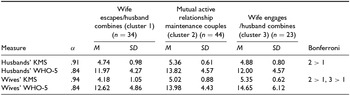
To clarify the characteristics of the clusters, we compared the scores of marital satisfaction and wellbeing among the clusters. A multivariate analysis of variance (MANOVA) was conducted. The Box's test p value was .025, and therefore a MANOVA was appropriate (Field, Reference Field2009). Using Pillai's trace, the clusters were found to have a significant effect on the wives’ marital satisfaction, F(2, 98) = 6.60, p < .01, and marital satisfaction of the husbands, F(2, 98) = 13.92, p < .01. In contrast, the wives’ wellbeing, F(2, 98) = 2.09, ns, and wellbeing of husbands, F(2, 98) = 1.28, ns, did not vary significantly as a function of these three clusters. Table 2 shows the means and standard deviations of the outcome variables, and Table 3 shows the MANOVA results.
Mean Scores and Standard Deviations for Measures of Marital Satisfaction and Wellbeing

Note: KMS = Kansas Marital Satisfaction Scale; WHO-5 = WHO-Five Well-Being Index.
Multivariate and Univariate Analyses of Variance for Outcome Variables

Note: KMS = Kansas Marital Satisfaction Scale; WHO-5 = WHO-Five Well-Being Index. Multivariate F ratios were generated using Pillai's statistics.
*p < .05, **p < .01, ***p < .001.
Multiple comparison using the Bonferroni method shows that the fathers’ marital satisfaction in cluster 2, mutual active relationship maintenance couples (M = 5.36, SD = 0.98), was significantly higher than those husbands in cluster 1, wife escapes/husband combines (M = 4.74, SD = 0.98). Husbands’ marital satisfaction in cluster 2, mutual active relationship maintenance couples, was higher than those husbands in cluster 3, wife engages/husband combines, with a significant tendency level (p = .06). Wives’ marital satisfaction in cluster 2, mutual active relationship maintenance couples (M = 5.02, SD = 0.88), and cluster 3 (M = 5.35, SD = 0.62), was significantly higher than those wives in cluster 1, wife escapes/husband combines (M = 4.18, SD = 1.05).
Discussion
To our knowledge, this is the first study to clarify the relationship-focused coping patterns in child-rearing couples using the cluster analysis method. Shapiro et al. (Reference Shapiro, Rodrigue, Boggs and Robinson1994) sampled cancer patients and explored the multidimensional aspects of coping; by doing so, they shed light on the specific patterns of coping at an individual level. The main findings of our study showed that couples have their own relationship-focused coping patterns, as individuals have multidimensional aspects of coping; that is, the way that both spouses deal with their daily stresses has specific patterns, as Stanfield (Reference Stanfield1998) found using an interview method.
Our study showed that ‘mutual active relationship maintenance couples’ (i.e., where both husbands and wives participate in active engagement after marital conflict) are the most functional couples from the perspective of marital satisfaction. When both spouses engage in active engagement, they both achieve higher rates of marital satisfaction. Christensen and Shenk (Reference Christensen and Shenk1991) and Manne et al. (Reference Manne, Ostroff, Norton, Fox, Goldstein and Grana2006) found that functional couples engaged in more open communication compared with couples with problems. Open communication has mutual aspects such as sharing emotions or constructive problem solving. Active engagement also has the aspect of open communication. Therefore, both husbands and wives are affected by frequent active engagement. Langer et al. (Reference Langer, Brown and Syrjala2009) concluded that emotional expression might be helpful for both patients and caregivers. Engaging in active engagement enables couples to exchange and share their feelings and thoughts, which can lead to higher levels of marital satisfaction.
In contrast, findings regarding cluster 1 (wife escapes/husband combines) and cluster 3 (wife engages/husband combines) suggested that one's marital satisfaction was predicted by individuals’ relationship-focused coping, with the exception of mutual active relationship-maintenance couples. The couples with serious stress used avoidant style of coping and protective buffering (Berghuis & Stanton, Reference Berghuis and Stanton2002; Coyne & Smith, Reference Coyne and Smith1991, Reference Coyne and Smith1994). We sampled couples with lesser stress compared with the couples that the previous studies sampled. Therefore, husbands used not only escape-avoidance and protective buffering but also active engagement, active style of relationship-maintenance, for their marital conflict.
In addition to the importance of the actor effect in marital satisfaction, couples’ coping patterns are also of value. In cluster 1, the frequency of husbands’ escape–avoidance was significantly higher than the frequency of husbands in cluster 2. In cluster 1, the frequency of wives’ escape–avoidance was significantly higher than that of wives in cluster 2 and cluster 3. Badr (Reference Badr2004) showed that both husbands and wives engage in avoidant behaviour as a ‘common negative dyadic coping’ behaviour (Badr, Carmack, Kashy, Cristofanilli, & Revenson, Reference Badr, Carmack, Kashy, Cristofanilli and Revenson2010). Badr et al. (Reference Badr, Carmack, Kashy, Cristofanilli and Revenson2010) examined the mutual avoidant behaviour in couples with one item. Our study, which simplifies the complexity of relationship-focused coping patterns regarding the characteristics of cluster 1, may support that finding.
In our study, the frequency of protective buffering had no effect on marital satisfaction and wellbeing. Previous studies of protective buffering targeted couples experiencing health problems (Coyne & Smith, Reference Coyne and Smith1991; Suls et al., Reference Suls, Green, Rose, Lounsbury and Gordon1997), while our study sampled child-rearing couples. An earlier study showed that the intention to engage in protective buffering is to protect patients (Langer et al., Reference Langer, Brown and Syrjala2009). Our study sampled healthier couples than those used in previous studies; therefore, the harmful impact of protective buffering might be decreased.
We found two theoretical implications. First, we showed three coping patterns of couples and their characteristics. Previous studies showed the actor and partner effects of relationship-focused coping (Coyne & Smith, Reference Coyne and Smith1991, Reference Coyne and Smith1994). Our study showed the couples’ characteristics are also important for relationship-focused coping. When a wife and her husband both exercise active engagement they can maintain a mutual active relationship. On the other hand, if a wife exercises active engagement, but her husband exercises protective buffering and escape–avoidance, their relationship follows the coping pattern of wife engages/husband combines.
Second, our study expands the concept of relationship-focused coping to a lesser form of stress. Some married couples face illnesses such as heart failure or cancer. Other married couples face child-care issues, family-financial issues and differences of philosophy in raising children. Our study showed that the concept of relationship-focused coping could adapt to a lesser form of stress, and relationship-focused coping has patterns in these couples. This perspective is also supported by a recent study of relationship-focused coping that expanded the target to couples in which one or both partners were smokers (Butler, Hollenstein, Shoham, & Rohrbaugh, Reference Butler, Hollenstein, Shoham and Rohrbaugh2013).
Clinical Implications
Couple counsellors and family therapists may also benefit from our findings. If a husband combines relationship-focused coping, whether wives actively maintain the relationship or engage in an avoidant style of relationship maintenance determines whether they are functional couples. In other words, from the perspective of relationship-focused coping patterns, wives’ relationship-focused coping is the key.
Limitations
One of the limitations of our study was the use of a cluster analysis for individual data to examine relationship-focused coping patterns at a couple level. We asked participants to describe their marital conflict and what methods they used in relationship-focused coping. Because of the characteristics of individual data, each spouse might recall events of marital conflict differently. For example, a husband might recall conflicts about their domestic accounts and his wife may instead recall childcare issues. Our study focused on general stress, so relationship-focused coping patterns for specific type of stress such as difference of philosophy in raising children needs to be investigated. Furthermore, a previous study that focused on housework found men and women have very different perceptions about what each person contributes in terms of household work (Lee & Waite, Reference Lee and Waite2005). Therefore, when asking a husband and wife about shared marital conflict, a joint interview method (Arksey & Knight, Reference Arksey and Knight1999) may be a more effective research technique.
The other limitation is the sampled couples used in this study. We only sampled heterosexual couples; however, homosexual couples would also experience relationship conflict and engage in relationship-focused coping. A future study that examines the patterns of relationship-focused coping sampled from homosexual couples is thus required.
Acknowledgement
This article is based on Tai Kurosawa's dissertation, which was submitted in partial fulfillment of the requirements for a doctoral degree in clinical psychology at Tohoku University, Japan. We thank the professors at Tohoku University (Prof. Keizo Hasegawa, Associate Prof. Hideo Ambo) for their helpful feedback. We thank Dr. Kenji Yokotani, associate professor at Niigata Seiryo University, for his comments on the manuscripts. Lastly, we appreciate the participation of the parents.
Financial Support
The present study was funded by the Japan Society for the Promotion of Science (Grant-in-Aid for JSPS Fellows [248092], Grant-in-Aid for Scientific Research (B) [24330191]).
Conclusion
Our study expanded the concept of relationship-focused coping for healthy couples and found patterns of relationship-focused coping based on a previous study of individual coping patterns. Our study showed that each couple has a particular coping pattern, as each individual in a couple has their own specific coping pattern.