


1. Introduction
The prey–predator model is one of the most widely studied models in population dynamics. One typical problem for such a model is to consider the propagation process of predators as they enter the habitat of their prey. Usually, such a process can be effectively characterized by the spreading speed and traveling wave solutions. In this article, we study the spreading speed and traveling wave solutions of the following prey–predator system:
 \begin{align}
\left\{\begin{aligned}
\frac{\text{d}u_j(t)}{\text{d}t}=&\;d_{1,j}\left(\sum_{k\in\mathbb{Z}}J_1(j-k)u_k(t)-u_j(t)\right)\\ &
+g_j(u_j(t))-f_{1,j}\big(u_j(t),v_j(t)\big),\quad (t,j)\in\mathbb{R}\times\mathbb{Z},\\
\frac{\text{d}v_j(t)}{\text{d}t}=&\;d_{2,j}\left(\sum_{k\in\mathbb{Z}}J_2(j-k)v_k(t)-v_j(t)\right)\\
&+f_{2,j}\big(u_j(t),v_j(t)\big)- \alpha_jv_j(t),\quad (t,j)\in\mathbb{R}\times\mathbb{Z},
\end{aligned}
\right.
\end{align}
where  $u_{j}(t)$ and
 $v_{j}(t)$ denote the density of prey and predator individuals at time t and point j, respectively; gj represents the growth rate of the prey at point j;
 $f_{1,j}(u,v)$ is viewed as the general predator functional response to the prey at point j; the biomass gain rate of the predator at point j can be expressed by
 $f_{2,j}(u,v)$; αj describes the per capita mortality rate of the predator at point j;
 $d_{i,j},i=1,2$ are the dispersal rates of uj and vj, respectively. For the dispersal kernels and reaction term, we always assume that
(K0) For any
 $i=1,2$,
$J_i(k)$ is non-negative,
$J_i(-k)=J_i(k), \sum_{k\in\mathbb{Z}}J_i(k)=1$, and
$J_i(\pm 1) \gt 0$.
(F0)
$d_1,d_2,g(\cdot), f_1(\cdot,\cdot),f_2(\cdot,\cdot),\alpha$ are L-periodic in
$\mathbb{Z}$ in the sense that
$\omega_{j}=\omega_{j+L}$ for all
$j\in \mathbb{Z}$, where
$\omega=d_1,d_2,g,f_1,f_2,\alpha$ and L is a positive integer. Moreover,
$d_1,d_2$, and α are positive.(F1)
$g_j(0)=0, \partial_ug_j(0) \gt 0, g_j(u)/u$ is a decreasing function in u > 0 and there exists K > 0 such that
$g_j(K) \lt 0$ for any
$j\in\mathbb{Z}$;(F2) For any
$j\in\mathbb{Z}$,
$f_{1,j},f_{2,j}\in C(\mathbb{R}^+\times\mathbb{R}^+,\mathbb{R}^+)$;
$f_{1,j}(u,v)=0$ if uv = 0;
$\partial_uf_{2,j}(u,v) \gt 0$ for all
$u\geqslant 0,v \gt 0$;
$\partial_vf_{2,j}(u,v) \gt 0$ for all
$u \gt 0,v\geqslant 0$;
$\partial_{vv}f_{2,j}(u,v)\leqslant 0$ for all
$u,v\geqslant 0$;
$f_{2,j}(u,v)/v$ is uniformly bounded in
$u\in[0,K]$ and v > 0;
$f_{2,j}(u,v)\leqslant f_{1,j}(u,v)$ for all
$u,v\geqslant 0$.


In model (1.1), the dynamics of prey and predator individuals are characterized by the lattice systems, which are viewed as a discretized version of non-local dispersal systems with continuous spatial variables. Such models are studied in various fields, including chemical reactions, neural networks, population ecology, and other fields. In real life, a discrete point can be seen as a city, an isolated island, etc. It should be pointed out that the varied areas (including rivers, mountains, and rice fields) may lead to a heterogeneous environment. Periodic environments can accurately represent this spatial heterogeneity, garnering significant attention in the process (see, e.g., Dewhirst and Lutscher [Reference Dewhirst and Lutscher6], Hudson and Zinner [Reference Hudson and Zinner18], and Lutscher et al. [Reference Lutscher, Lewis and McCauley23]). Recently, there has been a growing interest among in studying the spreading speed and traveling wave solutions of periodic lattice systems. For example, Guo and Hamel [Reference Guo and Hamel15] established the existence of traveling wave solutions for the monostable equation; Wu et al. [Reference Wu, Chen and Hsu30] considered the uniqueness and the exact asymptotic behaviour of the traveling wave solutions for the monostable equation; Jin and Zhao [Reference Jin and Zhao19] investigated the spatio-temporal dynamics of a class of integro-difference equations in a periodic discrete habitat; Fan and Zhao [Reference Fan and Zhao11] studied the propagation dynamics of a Lotka–Volterra two-species competition system with non-local diffusion in a periodic lattice habitat. For the study of various dynamic aspects of lattice systems, we refer to Aye et al. [Reference Aye, Fang and Pan1, Reference Aye, Fang and Pan2], Chen and Shen [Reference Cao and Shen4], Shen [Reference Shen26], and Zhang et al. [Reference Zhang, Wang and Liu34], and references therein.
The spreading speeds and traveling waves for prey–predator systems have been investigated extensively. Regarding traveling waves, we refer to Chen et al. [Reference Chen, Giletti and Guo5], Huang et al. [Reference Huang, Lu and Ruan17], Zhang [Reference Zhang36], and Zhang et al. [Reference Zhang, Wang and Wang35] about the reaction–diffusion systems; Hao et al. [Reference Hao, Li and Yang16], Yang et al. [Reference Yang, Li and Wang33] about the non-local dispersal systems; Li and Wang [Reference Li and Wang20] about the lattice diffusion systems. For the spreading speed, we refer to Ducrot et al. [Reference Ducrot, Giletti and Matano8] and Ducrot and Jin [Reference Ducrot and Jin9] about the reaction–diffusion systems; Wang et al. [Reference Wang, Li, Wang and Yang27], Wu et al. [Reference Wu, Pang and Ruan31], and Zhao et al.[Reference Zhao, Yuan, Ma and Zhao37] about the non-local dispersal systems; Ducrot and Jin [Reference Ducrot and Jin10] about the lattice diffusion systems. It should be emphasized that there is a strong correlation between epidemic models and prey–predator models. Let
 \begin{align*}f_{1,j}(u_{j},v_{j})=f_{2,j}(u_{j},v_{j})=\beta_{j}u_{j}v_{j},~g_{j}(u_j)=r_j(1-u_j),\end{align*}
and
 \begin{align*}
J_{i}(k)=\bigg\{\begin{array}{c}
a_{\pm 1} \gt 0, \quad ~~ k=\pm 1, \\
0, \quad \text{otherwise},
\end{array},~i=1
\end{align*}
where βj and rj are positive and L-periodic in j, the model (1.1) can be considered as an epidemic system with bilinear incidence. In this model, the zero solution is no longer a steady state, and hence, the dynamic analysis of this model is simpler than that of the prey–predator model. San et al. [Reference San, Wang and Feng25] considered the existence and non-existence of traveling waves for such a model. Recently, Xu et al. [Reference Xu, Li and Lin32] investigated the accelerated propagation for a cooperative system with non-local dispersal. However, there have been no results on propagation dynamics and accelerated spreading for prey–predator systems in a periodic lattice habitat.
The purpose of this article is to study the spreading properties and traveling waves for system (1.1). The first difficulty is the lack of the comparison principle, and hence, the abstract theory for monotone semiflow (see, e.g., [Reference Liang and Zhao22] and [Reference Weinberger29]) cannot be applied to study the propagation dynamics for system (1.1). Inspired by [Reference Ducrot and Jin10], we first give some uniform estimates between u and v, then we compare solutions of system (1.1) with those of an associated scalar lattice equation. The second difficulty arises in the study of accelerated propagation. More specifically, due to the discretization and heterogeneity of system (1.1), the method in [Reference Xu, Li and Lin32] cannot be directly employed. By using some ideas in [Reference Finkelshtein and Tkachov12, Reference Finkelshtein and Tkachov13] and the exact series estimates, we are able to use the upper and lower solutions to get a precise estimate of the acceleration. The third difficulty is to overcome the boundedness of the second component in proving the existence of traveling waves. With an idea in [Reference San, Wang and Feng25] and the Harnack-type inequality, we first establish the existence and boundedness of traveling wave solutions, and then we obtain the asymptotic behaviour of traveling waves at  $\infty$ via the spreading properties of solutions.
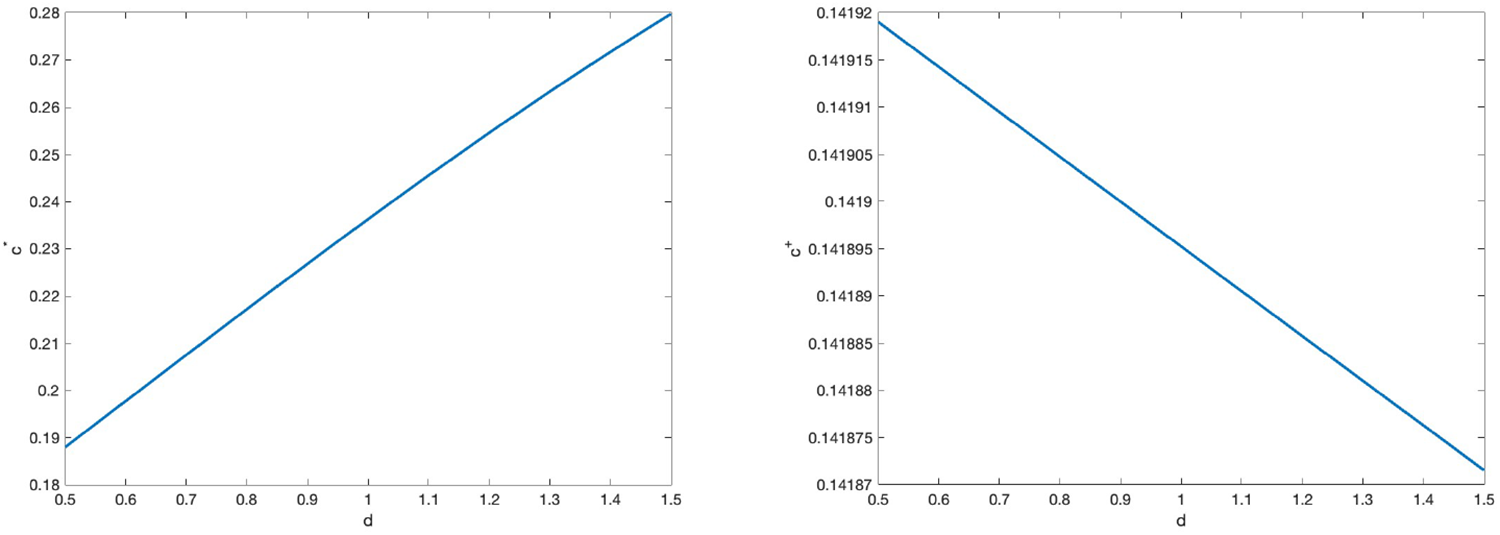
The rest of this article is organized as follows. In §2, we introduce some notations, present assumptions, and state the main results of this article. In §3, we give some estimate of the solution  $\{(u_j(t),v_j(t))\}_{j\in\mathbb{Z}}$. Then the (linear or superlinear) invasion speed of the predator is established via comparison arguments. In §4, the existence and non-existence of traveling waves are proved. In §5, we conduct some numerical simulations to illustrate our analytic results.
2. Main results
Before presenting our main results about system (1.1), we first give some notations and definitions. Let  $\mathcal{C}:=\{\varphi|\varphi=\{\varphi_j\}_{j\in\mathbb{Z}}~\text{is a bounded sequence} \}$ and
 $\mathcal{C}^+=\{\varphi\in\mathcal{C}|\varphi_j\geqslant 0, \forall j\in\mathbb{Z}\}$ be a positive cone of
 $\mathcal{C}$. We define the norm on
 $\mathcal{C}$ by
 \begin{align*}\|\varphi\|_{\mathcal{C}}=\sum_{m=1}^{\infty}\frac{\max_{|j|\leqslant m}|\varphi_j|}{2^m}.\end{align*}
For any  $\varphi\in\mathcal{C}$, we write
 $\varphi=\{\varphi_j\}_{j\in\mathbb{Z}}$. Let
 $\mathcal{C}^L:=\{\varphi\in\mathcal{C}| \varphi_j~\text{is}~L\text{-periodic in}~j\}$ with the maximum norm and
 $\mathcal{C}^L_+=\{\varphi\in \mathcal{C}^L| \varphi_j\geqslant 0, \forall j\in \mathbb{Z}\}$ be a positive cone of
 $\mathcal{C}^L$. Clearly,
 $\mathcal{C}^L_+$ has non-empty interior Int
 $(\mathcal{C}^L_+)=\{\varphi\in \mathcal{C}^L| \varphi_j \gt 0, \forall j\in \mathbb{Z}\}.$ For any
 $\beta\in \text{Int}(\mathcal{C}^L_+)$, we define
 $ \mathcal{C}_{\beta}:=\{\varphi\in \mathcal{C}| 0\leqslant \varphi_j\leqslant \beta_j, \forall j\in\mathbb{Z}\}$. Set
 $\mathbb{L}:=\{1,\ldots,L\}$. For any
 $a,b\in\mathbb{Z}$ with a < b, let
 $[a,b]_{\mathbb{N}}=\{a,a+1,\ldots,b-1,b\}$.
Letting  $v\equiv0$ in (1.1), we then have
 \begin{align}
\frac{\text{d}u_j(t)}{\text{d}t}=d_{1,j}\left(\sum_{k\in\mathbb{Z}}J_1(j-k)u_k(t)-u_j(t)\right)+g_j(u_j(t)), ~ (t,j)\in\mathbb{R}\times\mathbb{Z}.
\end{align}
Fix h with  $0 \lt h\leqslant \infty$. Let
 $u(t)=\{u_j(t)\}_{j\in\mathbb{Z}}$ with
 $u_j:[0,h)\to\mathbb{R}$ being C 1 in
 $t\in(0,h)$. We call u(t) a super-solution
 $($sub-solution
 $)$ of system (2.1) on
 $[0,h)$ if u(t) satisfies
 \begin{align*}
\frac{\text{d}u_j(t)}{\text{d}t}\geqslant (\leqslant)d_{1,j}\left(\sum_{k\in\mathbb{Z}}J_1(j-k)u_k(t)-u_j(t)\right)+g_j(u_j(t)),~ (t,j)\in(0,h)\times\mathbb{Z}.
\end{align*}
It follows from [Reference Zhao39, lemma 4.3] and [Reference Wang, Wang and Bao28, remark 3.2] that the following comparison principle holds true.
Lemma 2.1. Suppose that  $(K0)$ holds and
 $(\overline{u},\underline{u})$ is a pair of super- and sub-solutions of system (2.1) on
 $[0,h)$ with
 $\underline{u}(t),\overline{u}(t)\in \mathcal{C}_{K}$ for all
 $t\geqslant 0$. If
 $\overline{u}(0)\geqslant \underline {u}(0)$, then
 $\overline {u}_j(t)\geqslant \underline {u}_j(t)$ for all
 $(t,j)\in[0,h)\times\mathbb{Z}$. Moreover, if
 $\overline u(0) \gt \underline u(0)$, then
 ${\overline u}_j(t) \gt {\underline u}_j(t)$ for all
 $(t,j)\in(0,h)\times\mathbb{Z}$.
Since  $\partial_ug_{j}(0) \gt 0$, it follows from the arguments in [Reference Zhao38, theorem 2.3.4] that (2.1) admits a positive periodic solution
 $u^*$ in
 $\text{Int}(\mathcal{C}^L_+)$. If
 $u=u^*$, then v satisfies
 \begin{align}
\frac{\text{d}v_j(t)}{\text{d}t}=d_{2,j}\left(\sum_{k\in\mathbb{Z}}J_2(j-k)v_k(t)-v_j(t)\right)+ f_{2,j}\big(u_j^*,v_j(t)\big)-\alpha_jv_j(t),~(t,j)\in\mathbb{R}\times\mathbb{Z}.
\end{align}
Define  $\mathcal{I}=\{\mu\in\mathbb{R}|\sum_{k\in\mathbb{Z}}J_2(k)e^{\mu k} \lt +\infty\}$. For any
 $\mu\in\mathcal{I}$, consider the following eigenvalue problem in
 $\mathcal{C}^L$:
 \begin{align}
d_{2,j}\left(\sum_{k\in\mathbb{Z}}J_2(j-k)e^{-\mu (j-k)}\phi_k-\phi_j\right)+p_j\phi_j=\lambda(\mu)\phi_j,~(t,j)\in\mathbb{R}\times\mathbb{Z}
\end{align}
where  $p=\{p_j=\partial_vf_{2,j}(u_j^*,0)-\alpha_j\}_{j\in\mathbb{Z}}$.
It follows from the Perron–Frobenius theorem that (2.3) admits an eigenvalue
 $\lambda^*(d_2,p,\mu)$ with eigenfunction
 $\phi^*(d_2,p,\mu)\in \text{Int}({\mathcal{C}}^L_+)$. If
 $\lambda^*(d_2, p,0) \gt 0$, then (2.2) admits a spreading speed
 $c^*$. Moreover,
 $c^*=\min_{\mu \gt 0}\frac{\lambda^*(d_2,p,\mu)}{\mu} \gt 0$ with
 $\mathcal{I}\neq\{0\}$ and
 $c^*=+\infty$ with
 $\mathcal{I}=\{0\}$. We assume that
(F3)
$ \lambda^*(d_2, p,0) \gt 0$.

In this article, we mainly consider the following initial value:
(U0)
$u_0\in \mathcal{C}_{u^*}~\text{with}~ \min_{j\in\mathbb{Z}}u_{0,j} \gt 0$,
$v_0\in\mathcal{C}_{+}\setminus\{0\}$ has compact support, and
$ v_0\in\mathcal{C}_{\kappa}$ for some κ > 0.


Biologically, system (1.1) with initial values satisfying (U0) may describe that the predator population invades an environment where the prey is distributed in the entire space. Let  $\{(u_j(t),v_j(t))\}_{j\in\mathbb{Z}}$ be the solution of system (1.1) with
 $\{(u_j(0),v_j(0)\}_{j\in\mathbb{Z}}=\{(u_{0,j},v_{0,j})\}_{j\in\mathbb{Z}}$ satisfying (U0). By the arguments similar to those for [Reference Zhao38, theorem 9.1.1], there exists a constant
 $M(\kappa) \gt 0$ such that
 $\{u_j(t)\}_{j\in\mathbb{Z}}\in\mathcal{C}_{u^*}$ and
 $\{v_j(t)\}_{j\in\mathbb{Z}}\in\mathcal{C}_{M(\kappa)}$ for any
 $t\geqslant 0$.
We first consider the case where J 2 is exponentially bounded.
(K1) There exists
$\mu_0 \gt 0$ such that
$\sum_{k\in\mathbb{Z}}J_2(k)e^{\mu |k|} \lt +\infty$ for any
$0\leqslant \mu \lt \mu_0$.


Theorem 2.2. Assume that conditions (K0), (K1), (F0)–(F3), (U0) hold. Then the solution  $\{(u_j(t),v_j(t)\}_{j\in\mathbb{Z}}$ of (1.1) admits the following spreading properties:
(i) For all
$c \gt c^*$, there holds
\begin{align*}
\lim _{t \rightarrow \infty} \inf _{|j| \geqslant c t}|u_j(t)-u^*_j|=0\ \text {and } \lim _{t \rightarrow \infty} \sup _{|j| \geqslant c t} v_j(t)=0 ;
\end{align*}(ii) For all
$c \in\left[0, c^*\right)$, there exists
$\varepsilon(\kappa,c) \gt 0$ such that
\begin{align*}
\begin{gathered}
\liminf _{t \rightarrow \infty} \inf _{|j| \leqslant c t} v_j(t) \gt \varepsilon, \\
\liminf _{t \rightarrow \infty} \inf _{|j| \leqslant c t} u_j(t) \gt \varepsilon\ \text {and } \limsup _{t \rightarrow \infty} \sup _{|j| \leqslant c t} (u^*_j-u_j(t)) \gt \varepsilon.
\end{gathered}
\end{align*}


We conjecture that the first statement also holds when  $|j|=c^* t$ since there may exist the logarithmic Bramson correction for Fisher-Kolmogorov-Petrovsky-Piscounov (Fisher-KPP) equations. This conjecture has been confirmed for lattice equations [Reference Besse, Faye, Roquejoffre and Zhang3] and non-local dispersal equations [Reference Roquejoffre24] with constant coefficients. There seem no results about the periodic non-local dispersal equations with a continuous (or discrete) spatial variable.
Note that when the predator’s diffusion kernel function is exponentially unbounded, the propagation speed is infinite, that is, accelerated propagation occurs. Next, we give an exact characterization of the propagation rate when J 2 is algebraically decaying.
(K2)
$J_2(j)=\frac{C_{\alpha}}{1+|j|^{\alpha}}$ with α > 1 and
$C_{\alpha}=1/\sum_{k\in\mathbb{Z}}\frac{1}{1+|j|^{\alpha}}$.


Theorem 2.3. Let  $\lambda^*=\lambda^*(d_2,p,0)$, and assume that conditions (K0), (K2), (F0)–(F3), (U0) hold. Then the solution
 $\{(u_j(t),v_j(t)\}_{j\in\mathbb{Z}}$ of (1.1) has the following accelerating propagation properties:
(i) For all
$\lambda \gt \lambda^*$, there holds
\begin{align*}
\lim _{t \rightarrow \infty} \inf _{|j| \geqslant e^{\frac{\lambda}{\alpha}} t}|u_j(t)-u^*_j|=0\ \text {and } \lim _{t \rightarrow \infty} \sup _{|j| \geqslant e^{\frac{\lambda}{\alpha}} t} v_j(t)=0 ;
\end{align*}(ii) For all
$\lambda \in\left[0, \lambda^*\right)$, there exists
$\varepsilon(\kappa,\lambda) \gt 0$ such that
\begin{align*}
\begin{gathered}
\liminf _{t \rightarrow \infty} \inf _{|j| \leqslant e^{\frac{\lambda}{\alpha} t} } v_j(t) \gt \varepsilon, \\
\liminf _{t \rightarrow \infty} \inf _{|j| \leqslant e^{\frac{\lambda}{\alpha} t} } u_j(t) \gt \varepsilon\ \text {and } \limsup _{t \rightarrow \infty} \sup _{|j| \leqslant e^{\frac{\lambda}{\alpha}t} } (u^*_j-u_j(t)) \gt \varepsilon.
\end{gathered}
\end{align*}


The second part of this article is about traveling waves of (1.1). We say that the positive and bounded solution (u, v) with  $u_j(t)=U_j(j+ct)$ and
 $v_j(t)=V_j(j+ct)$ is the traveling wave of (1.1) with speed c if
 $\{(U_j(s),V_j(s))\}_{j\in\mathbb{Z}}(s=j+ct)$ satisfies
 \begin{align}
\left\{\begin{aligned}
&c \frac{\text{d}U_j( s)}{\text{d} s}=d_{1,j}\left(\sum_{k\in\mathbb{Z}}J_1(j-k) U_k( s-j+k)-U_j( s)\right)+g_j( {U}_j( s))-f_{1,j}\big(U_j( s),V_j( s)\big),\\
&c \frac{\text{d}V_j( s)}{\text{d} s}=d_{2,j}\left(\sum_{k\in\mathbb{Z}}J_2(j-k)V_k( s-j+k)-V_j( s)\right)+f_{2,j}\big(U_j( s),V_j( s)\big)-\alpha_jV_j( s),\\
&(U_{j+N}( s), V_{j+N}( s)=\left(U_j( s), V_j( s)\right),
\end{aligned}
\right.
\end{align}
with the boundary condition
 \begin{align*}
\left(U_j(-\infty), V_j(-\infty)\right)=\left(u^*_j, 0\right),\left(U_j(\infty), V_j(\infty)\right) \gt \left(0, 0\right),~j\in\mathbb{Z}.
\end{align*}
In order to obtain the existence of traveling wave solutions, we need the following additional conditions.
(K3) There exists
$\mu_1 \gt 0$ and
$N\geqslant 2$ such that
$\sum_{k\in\mathbb{Z}}J_1(k)e^{\mu |k|} \lt +\infty$ for any
$0\leqslant \mu \lt \mu_1$, and
$J_2(k)=0$ for
$|k|\geqslant N$.


The following result shows that the minimum wave speed coincides with the invasion speed of the predator for system (1.1).
Theorem 2.4. Assume that conditions (K0), (K3) (F0)–(F3) hold. Then system (1.1) admits a traveling wave  $\{(u_j(t),v_j(t))=(U_j(j+ct),V_j(j+ct))\}_{j\in\mathbb{Z}}$ if and only if
 $c\geqslant c^*$.
Note that (K3) implies that the diffusion kernel function of the prey J 1 is exponentially bounded, which seems to be a technical condition. According to the spreading properties, we conjecture that when this kernel is exponentially unbounded, there is still a traveling wave solution (see the numerical simulation in §5). Moreover, according to the property of accelerated propagation, there is no traveling wave solution for system (1.1) when the diffusion kernel function of the predator J 2 is exponentially unbounded.
3. Spreading speeds
In this section, we consider the spreading speed of system (1.1). We start with some properties of the solution  $\{(u_j(t),v_j(t))\}_{j\in\mathbb{Z}}$.
Lemma 3.1. Let κ > 0 be given. For any σ > 0, one can find constants  $M_{\sigma} \gt 0$ and
 $T_{\sigma} \gt 0$ such that
 \begin{align*}v_j(t)\leqslant \sigma+M_{\sigma}u_j(t),~~\forall t\geqslant T_{\sigma}, j\in\mathbb{Z}.\end{align*}
Proof. Assume, on the contrary, that there exist  $\sigma_0 \gt 0$ and sequences
 \begin{align*}\{(u_{0}^n,v_{0}^n)\}_{n\in\mathbb{N}}~\text{satisfies}~ (U0),\end{align*}
 \begin{align*}\{t_n\}_{n\in\mathbb{N}}~\text{with}~t_n\to+\infty, \text{and}~ \{j_n\}_{n\in\mathbb{N}}~\text{with}~j_n\in\mathbb{Z} \end{align*}
such that
 \begin{align}
v^n_{j_n}\left(t_n\right) \gt \sigma_0+n u^n_{j_n}\left(t_n\right), \text {for all } n \geqslant 0,
\end{align}
where  $(u^n,v^n)$ is the solution of system (1.1) with the initial value
 $(u^n_{0},v^n_{0})$. Let
 $
u_{n,j}(t):=u^n_{j+j_n}\left(t+t_n\right)\ \text {and } v_{n,j}(t):=v^n_{j+j_n}\left(t+t_n\right)
$ for
 $(t,j) \in\left[-t_n,+\infty\right) \times \mathbb{Z}$. For any jn, one can find nj which is the maximum integer no bigger than
 $\frac{j_n}{L}$ such that
 $j_n=n_j L+\tilde j_n$ and
 $\tilde j_n\in \mathbb{L}$. Up to a subsequence, one has
 \begin{align*}\left(u_{n,j}(t), v_{n,j}(t)\right) \rightarrow\left(u_{\infty,j}(t), v_{\infty,j}(t)\right), \tilde j_n \rightarrow \tilde j_{\infty}\end{align*}
and
 \begin{align*}\omega_{j+j_n} \rightarrow \omega_{j+\tilde j_{\infty}}=:\tilde \omega_j, \text{with}~\omega=g(\cdot),f_i(\cdot,\cdot), \alpha,d_i, i=1,2\end{align*}
as  $n \rightarrow \infty$ locally uniformly for
 $(t,j) \in \mathbb{R}\times\mathbb{Z}$. Since v is bounded, it follows from (3.1) that
 $\lim_{n\to +\infty }u^n_{j_n}\left(t_n\right) =0$, and hence,
 $u_{\infty,0}(0)=0$. Thus,
 $v_{\infty,0}(0) \geqslant \sigma_0$. Meanwhile,
 $\left(u_{\infty}, v_{\infty}\right)$ satisfies
 \begin{align*}
\left\{\begin{aligned}
\frac{\text{d}u_j(t)}{\text{d}t}=&\;\tilde d_{1,j}\left(\sum_{k\in\mathbb{Z}}J_1(j-k)u_k(t)-u_j(t)\right)+\tilde g(u_j(t))\\
&-\tilde f_{1,j}\big(u_{n,j}(t),v_{n,j}(t)\big),~(t,j)\in\mathbb{R}\times\mathbb{Z},\\
\frac{\text{d}v_j(t)}{\text{d}t}=&\;\tilde d_{2,j}\left(\sum_{k\in\mathbb{Z}}J_2(j-k)v_k(t)-v_j(t)\right)+\tilde f_{2,j}\big(u_{n,j}(t),v_{n,j}(t)\big)\\
&-\tilde \alpha_j v_j(t), ~(t,j)\in\mathbb{R}\times\mathbb{Z}.
\end{aligned}
\right.
\end{align*}
Lemma 2.1 indicates that  $u_{\infty} \equiv 0$. Since
 $f_{2,j}\in C(\mathbb{R}^+\times\mathbb{R}^+,\mathbb{R}^+)$,
 $f_{2,j}(u,v)\leqslant f_{1,j}(u,v)$ and
 $f_{1,j}(0,v)=0$ for any
 $u\geqslant 0$ and
 $v\geqslant 0$, it follows that
 $f_{2,j}(0,v)=0$ for any
 $v\geqslant 0$, and hence,
 $\tilde f_{2,j}(0,v)=0$ for any
 $v\geqslant 0$. Thus,
 $v_{\infty}$ satisfies
 \begin{align}
\frac{\text{d}v_{\infty,j}(t)}{\text{d}t}=\tilde d_{2,j}\left(\sum_{k\in\mathbb{Z}}J_2(j-k)v_{\infty,k}(t)-v_{\infty,j}(t)\right)-\tilde \alpha_j v_{\infty,j}(t).
\end{align}
In view of the fact  $\alpha_j \gt 0$, the zero solution of (3.2) is globally asymptotically stable in
 $\mathcal{C}_+$. It then follows that any bounded entire solution of (3.2) is zero, this contradicts
 $v_{\infty,0}(0) \geqslant \sigma_0$.
Proposition 3.2. Let κ > 0 be given, there exists  $\varepsilon(\kappa) \gt 0$ such that
 \begin{align*}
\liminf _{t \rightarrow \infty} \inf _{j\in\mathbb{Z}} u_j(t) \gt \varepsilon(\kappa).
\end{align*}
Proof. By the assumption of f 1, there exists a constant  $\mathcal{K}_1$ such that
 $f_{1,j}(u,v)\leqslant \mathcal{K}_1uv$ when
 $u,v\geqslant 0$. With lemma 3.1, the solution
 $\{u_j(t)\}_{j\in\mathbb{Z}}$ can be considered as a super-solution of following equation on
 $[T_{\sigma},\infty)$,
 \begin{align}
\frac{\text{d}u_j(t)}{\text{d}t} & = d_{1,j}\left(\sum_{k\in\mathbb{Z}}J_1(j-k)u_k(t)-u_j(t)\right)+ g_j(u_j(t))\nonumber\\
& \quad -\mathcal{K}_1u_j(t)\big(\sigma+M_\sigma u_j(t)\big), ~ j \in \mathbb{Z}.
\end{align}
Choose σ small enough such that  $\partial_u g_j(0)-\sigma\mathcal{K}_1 \gt 0$. Let
 $\{{u}_j^{\sigma}(t)\}_{j\in\mathbb{Z}}$ be the solution of (3.3) with initial value
 $\{{u}_j^{\sigma}(0)\}_{j\in\mathbb{Z}}$ which satisfies
 $(U0)$, one has
 \begin{align*}
\lim _{t \rightarrow \infty} \sup _{j\in\mathbb{Z}} \big|u^{\sigma}_j(t)-u_j^{\sigma,*}\big|=0,
\end{align*}
where  $\{u_j^{\sigma,*}\}_{j\in\mathbb{Z}}$ is the unique positive periodic solution of (3.3). Choose the initial value
 ${u}_j^{\sigma}(0) \leqslant u_j\left(T_\sigma\right)$. It follows from the comparison principle that
 \begin{align*}
\liminf _{t \rightarrow \infty} \inf _{j\in\mathbb{Z}} u_j(t+T_{\sigma})\geqslant \liminf _{t \rightarrow \infty} \inf _{j\in\mathbb{Z}} u^{\sigma}_j(t) \gt \min_{j\in\mathbb{Z}}\{u_j^{\sigma,*}\}/2 .
\end{align*}
Let  $\varepsilon(\kappa)=\min_{j\in\mathbb{Z}}\{u_j^{\sigma,*}\}/2 \gt 0$, we can end the proof.
Remark 3.3. We give some propagation properties of u when the initial value of u has compact support. Given κ > 0. Let the non-trivial initial value  $\{(u_j(0),v_j(0)\}_{j\in\mathbb{Z}}$ satisfies
 $\{(u_j(0),v_j(0))\}_{j\in\mathbb{Z}}\in\mathcal{C}_{u^*}\times \mathcal{C}_{\kappa}$ and has compact support. And we assume (K3) holds. Define
 $\mathcal{I}_1=\{\mu\in\mathbb{R}|\sum_{k\in\mathbb{Z}}J_1(k)e^{\mu k} \lt +\infty\}$. For any
 $\mu\in\mathcal{I}_1$, we establish the following eigenvalue problem in
 $\mathcal{C}^L$:
 \begin{align}
d_{1,j}\left(\sum_{k\in\mathbb{Z}}J_1(j-k)e^{-\mu (j-k)}\phi_k-\phi_j\right)+q_j(0)\phi_j=\lambda(\mu)\phi_j,~(t,j)\in\mathbb{R}\times\mathbb{Z},
\end{align}
where  $q_j=\partial_ug_j(0)$. It follows from Perron–Frobenius theorem that (3.4) admits an eigenvalue
 $\lambda^*(d_1,q,\mu)$ with eigenfunction
 $\phi^*(d_1,q,\mu)\in \text{Int}({\mathcal{C}}^L_+)$. Then (2.1) admits a spreading speed
 $c_u^*$. Moreover,
 $c_u^*=\min_{\mu \gt 0}\frac{\lambda^*(d_1,q,\mu)}{\mu} \gt 0$.
Let
 $c_u^*(\sigma)$ be the spreading speed of (3.3). Moreover,
 \begin{align*}
c_u^*(\sigma):=\min_{\mu \gt 0}\frac{\lambda^*(d_1,q-\sigma \mathcal{K}_1,\mu)}{\mu}.
\end{align*}
Since  $\lim\limits_{\sigma \to 0} c_u^*(\sigma)\to c_u^*$, then for
 $0 \leqslant {c} \lt c_u^*$, there exists σ > 0 small enough such that
 ${c} \lt c_u^*\left(\sigma\right) \lt c_u^*$. Let
 ${u}_j^{\sigma}(t)$ be the solution of (3.3) with initial value
 $u_j^{\sigma}(0)$ being non-trivial and having compact support, then
 \begin{align*}
\lim _{t \rightarrow \infty} \sup _{|j| \leqslant \tilde c t} \big |u^{\sigma}_j(t)-u_j^{\sigma,*}\big |=0, \quad \forall \tilde c \in\left[0, c_u^*(\sigma)\right).
\end{align*}
For any  $k\in\mathbb{N}$, let
 ${u}^{\sigma}(0, \cdot) \leqslant u\left(T_\sigma\right)$. The comparison principle implies that
 \begin{align*}
\liminf _{t \rightarrow \infty} \inf _{|j| \leqslant c t} u_j\left(t+T_\sigma\right) \geqslant \lim _{t \rightarrow \infty} \inf _{|j| \leqslant c t} u^{\sigma}_j(t) \gt \min_{j\in\mathbb{Z}}u_j^{\sigma,*}/2.
\end{align*}
Thus, for any  $c \in\left[0, c_u^*\right)$, there exists ɛ > 0 such that
 $\liminf _{t \rightarrow \infty} \inf _{|j| \leqslant c t} u_j(t) \gt \varepsilon$.
Lemma 3.4. Let κ > 0 be given. For each ς > 0, there exist constants  $M_\varsigma \gt 0$ and
 $T_\varsigma \gt 0$ such that
 \begin{align*}
u^*_j-u_j(t) \leqslant \varsigma+M_\varsigma v_j(t), \quad \forall t \geqslant T_\varsigma, j\in\mathbb{Z}.
\end{align*}
Proof. By contradiction, we assume that there exist  $\varsigma_0 \gt 0$ and sequences
 \begin{align*}\{(u_{0}^n,v_{0}^n)\}_{n\in\mathbb{N}}~\text{satisfies}~ (U0),\end{align*}
 \begin{align*}\{t_n\}_{n\in\mathbb{N}}~\text{with}~t_n\to+\infty, \text{and}~ \{j_n\}_{n\in\mathbb{N}}~\text{with}~j_n\in\mathbb{Z} \end{align*}
such that
 \begin{align*}
\begin{aligned}
u_{j_n}^*-u^n_{j_n}\left(t_n\right) \gt \varsigma_0+n v^n_{j_n}\left(t_n\right), \forall n \geqslant 1,
\end{aligned}
\end{align*}
where  $(u^n,v^n)$ is the solution of system (1.1) with the initial value
 $(u^n_{0},v^n_{0})$. Set
 \begin{align*}
u_{n,j}(t):=u^n_{j+j_n}\left(t+t_n\right)\ \text {and } v_{n,j}(t):=v^n_{j+j_n}\left(t+t_n\right),
\end{align*}
for any  $(j,t)\in\mathbb{Z}\times[-t_n,+\infty)$. For any jn, one can find nj which is the maximum integer no bigger than
 $\frac{j_n}{L}$ such that
 $j_n=n^j L+\tilde j_n$ and
 $\tilde j_n\in\mathbb{L}$. Up to the extraction of a subsequence, one has
 \begin{align*}\left(u_{n,j}(t), v_{n,j}(t)\right) \rightarrow\left(u_{\infty,j}(t), v_{\infty,j}(t)\right), \tilde j_n \rightarrow \tilde j_{\infty}\end{align*}
and
 \begin{align*}\omega_{j+j_n} \rightarrow \omega_{j+\tilde j_n} =:\hat \omega_j, \text{with}~\omega=g(\cdot),f_i(\cdot,\cdot), \alpha,d_i, i=1,2\end{align*}
as  $n \rightarrow \infty$ locally uniformly for
 $(t,j) \in \mathbb{R}\times\mathbb{Z}$. In view of the fact
 $\{u_j(t)\}_{j\in\mathbb{Z}}$ is bounded, we have
 \begin{align*}
v_{j_n}\left(t_n\right) \rightarrow v_{\infty,0}(0)= 0, \text {as } n \rightarrow \infty, \text{and}~~u^*_{j_{\infty}}-u_{\infty,0}(0) \geqslant \varsigma_0 \gt 0.
\end{align*}
Moreover,  $\left(u_{\infty}, v_{\infty}\right)$ satisfies
 \begin{align*}
\left\{\begin{aligned}
\frac{\text{d}u_j(t)}{\text{d}t}=&\;\hat d_{1,j}\left(\sum_{k\in\mathbb{Z}}J_1(j-k)u_k(t)-u_j(t)\right)+\hat g_j(u_j(t))-\hat f_{1,j}\big(u_j(t),v_j(t)\big),\\
\frac{\text{d}v_j(t)}{\text{d}t}=&\;\hat d_{2,j}\left(\sum_{k\in\mathbb{Z}}J_2(j-k)v_k(t)-v_j(t)\right)+\hat f_{2,j}\big(u_j(t),v_j(t)\big)-\hat \alpha_j v_j(t).
\end{aligned}
\right.
\end{align*}
Since  $v_{\infty,0}(0)=0$, lemma 2.1 indicates that
 $v_{\infty} \equiv 0$. Thus,
 $u_{\infty}(t)=\{u_{\infty,j}(t)\}_{j\in\mathbb{Z}}$ satisfies following Fisher–KPP equation
 \begin{align}
\frac{\text{d}u_j(t)}{\text{d}t}=\hat d_{1,j}\left(\sum_{k\in\mathbb{Z}}J_1(j-k)u_k(t)-u_j(t)\right)+\hat g_j(u_j(t)), \quad (t,j) \in \mathbb{R}\times\mathbb{Z} .
\end{align}
Let  $\{\hat u_j(t)\}_{j\in\mathbb{Z}}$ be the solution of (3.5) with
 $\{\hat u_j(0)=\varepsilon(\kappa)\}_{j\in\mathbb{Z}}$. It follows from the comparison principle that
 \begin{align*}
u_{j+j_{\infty}}^* \geqslant u_{\infty,j}(t+s) \geqslant \hat u_j(t), \quad \forall t \geqslant 0, s \in \mathbb{R}, j \in \mathbb{Z} .
\end{align*}
Since  $\hat u_j(t) \rightarrow u_{j+j_{\infty}}^*$ as
 $t \rightarrow \infty$, one has
 $u_{\infty,j}(0)=u_{j+j_{\infty}}^*$, which contradicts
 $u^*_{j_{\infty}}-u_{\infty,0} \geqslant \varsigma_0 \gt 0$. This completes the proof.
Proof of theorem 2.2
(i) For all  $c \gt \tilde{c} \gt c^*$, let
 $\mu_{\tilde c}$ satisfies
 $\tilde c=\frac{\lambda^*(d_2,p,\mu)}{\mu}$. One can prove that for any B > 0, the function
 \begin{align*}
\overline{v}_j(t):=B e^{\mu_{\tilde c}\left(j+\tilde c t\right)}\phi_j^*(d_2,p,\mu_{\tilde c})
\end{align*}
satisfies
 \begin{align}
\frac{\text{d}\overline{v}_j(t)}{\text{d}t}-d_{2,j}\left(\sum_{k\in\mathbb{Z}}J_2(j-k)\overline v_k(t)-\overline v_j(t)\right)-p_j\overline{v}_j(t)+\alpha_j\overline v_j(t) =0,~~(j,t)\in\mathbb{Z}\times\mathbb{R}.
\end{align}
Let B > 0 be large enough such that  $\overline{v}_j(0) \geqslant v_{0,j}$ for all
 $j \in \mathbb{Z}$. By assumption (F2), one has
 $f_{2,j}(u,v)\leqslant \partial_{v} f_{2,j}(u,0)v$ for all
 $u_j^*\geqslant u\geqslant 0,v\geqslant 0$. Thus,
 $\{\overline v_j(t)\}_{j\in\mathbb{Z}}$ can be considered as a super-solution of the second equation of (1.1). It follows from the comparison principle that for any
 $c \gt c^*$, one has
 \begin{align*}
\lim _{t \rightarrow \infty} \sup _{-j \geqslant c t} v_j(t) \leqslant \lim _{t \rightarrow \infty} \sup _{-j \geqslant c t} \overline{v}_j(t) \leqslant \lim _{t \rightarrow \infty}B e^{\mu_{\tilde c}\left(\tilde ct- c t\right)}\phi_j^*(d_2,p,\mu_{\tilde c})=0 .
\end{align*}
Similarly, for any  $c \gt c^*$, one has
 \begin{align*}
\lim _{t \rightarrow \infty} \sup _{j \geqslant c t} v_j(t) =0 .
\end{align*}
Hence, for any  $c \gt c^*$, one has
 \begin{align*}
\lim _{t \rightarrow \infty} \sup _{|j| \geqslant c t} v_j(t) =0 .
\end{align*}
For the first limit, by contradiction, we assume that there exist constants  $c_1 \gt c^*$,
 $\iota_0 \gt 0$ and sequences
 \begin{align*}\{t^n\}_{n\in\mathbb{N}}~\text{with}~t^n\to+\infty, \text{and}~ \{j^n\}_{n\in\mathbb{N}}~\text{with}~j^n\in\mathbb{Z} \end{align*}
such that
 \begin{align*}
\begin{aligned}
c_1|t^n|\leqslant j^n,~\text{and}~ u_{j^n}^*-u_{j^n}\left(t^n\right) \gt \iota_0, \forall n \geqslant 1 .
\end{aligned}
\end{align*}
Set
 \begin{align*}
u_j^n(t):=u_{j+j^n}\left(t+t^n\right)\ \text {and } v_j^n(t):=v_{j+j^n}\left(t+t^n\right),
\end{align*}
for any  $(j,t)\in\mathbb{Z}\times[-t^n,+\infty)$. For any jn, one can find nj which is the maximum integer no bigger than
 $\frac{j^n}{L}$ such that
 $j^n=n^j L+\bar j^n$ and
 $ \bar j^n\in\mathbb{L}$. Up to the extraction of a subsequence, one has
 \begin{align*}\left(u_j^n(t), v_j^n(t)\right) \rightarrow\left(u_j^{\infty}(t), v_j^{\infty}(t)\right), \bar j^n \rightarrow \bar j^{\infty}\end{align*}
and
 \begin{align*}\omega_{j+j^n} \rightarrow \omega_{j+j^{\infty}} =:\bar \omega_j, \text{with}~\omega=f_1(\cdot,\cdot),f_2(\cdot,\cdot), \alpha,g,d_1,d_2\end{align*}
as  $n \rightarrow \infty$ locally uniformly for
 $(t,j) \in \mathbb{R}\times\mathbb{Z}$. The boundedness of
 $ \{u_j(t)\}_{j\in\mathbb{Z}} $ yields that
 \begin{align*}
~u^*_{j^{\infty}}-u_0^{\infty}(0) \geqslant \iota_0 \gt 0.
\end{align*}
Recall that
 \begin{align*}\lim_{t\to+\infty,|j|\geqslant c_1t}v_j(t)=0,\end{align*}
then
 \begin{align*}
v_j^{\infty}(t)=0,~~~(j,t)\in\mathbb{Z}\times\mathbb{R}.
\end{align*}
Moreover,  $\left(u^{\infty}, v^{\infty}\right)$ satisfies
 \begin{align*}
\left\{\begin{aligned}
\frac{\text{d}u_j(t)}{\text{d}t}=&\;\hat d_{1,j}\left(\sum_{k\in\mathbb{Z}}J_1(j-k)u_k(t)-u_j(t)\right)+\hat g_j(u_j(t))-\hat f_{1,j}\big(u_j(t),v_j(t)\big),\\
\frac{\text{d}v_j(t)}{\text{d}t}=&\;\hat d_{2,j}\left(\sum_{k\in\mathbb{Z}}J_2(j-k)v_k(t)-v_j(t)\right)+\hat f_{2,j}\big(u_j(t),v_j(t)\big)-\hat \alpha_j v_j(t).
\end{aligned}
\right.
\end{align*}
Since  $v^{\infty} \equiv 0$, then
 $u^{\infty}=\{u_j^{\infty}(t)\}_{j\in\mathbb{Z}}$ satisfies the following Fisher–KPP equation
 \begin{align}
\frac{\text{d}u_j(t)}{\text{d}t}=\hat d_{1,j}\left(\sum_{k\in\mathbb{Z}}J_1(j-k)u_k(t)-u_j(t)\right)+\hat g_j(u_j(t)), \quad (t,j) \in \mathbb{R}\times\mathbb{Z} .
\end{align}
Let  $\{\hat u_j(t)\}_{j\in\mathbb{Z}}$ be the solution of (3.7) with
 $\hat u_j(0)=\varepsilon(\kappa)$ for all
 $j\in\mathbb{Z}$. It follows from the fact
 $
\inf _{(t,j) \in \mathbb{R}\times\mathbb{Z}} u_{\infty,j}(t) \gt \varepsilon(\kappa)
$ and lemma 2.1 that
 \begin{align*}
u_{j+j_{\infty}}^* \geqslant u_j^{\infty}(t+s) \geqslant \hat u_j(t), \quad \forall t \geqslant 0, s \in \mathbb{R}, j \in \mathbb{Z} .
\end{align*}
Since  $\hat u_j(t) \rightarrow u_{j+j^{\infty}}^*$ as
 $t \rightarrow \infty$, one has
 $u_j^{\infty}(0)=u_{j+j^{\infty}}^*$, which contradicts
 $u^*_{j^{\infty}}-u_0^{\infty}(0) \geqslant \sigma_0 \gt 0$. Thus, for any
 $c \gt c^*$, one has
 \begin{align*}\lim _{t \rightarrow \infty} \inf _{|j| \geqslant c t}|u_j(t)-u^*_j|=0.\end{align*}
(ii) Lemma 3.4 implies that, for any ς > 0, there exist  $M_\varsigma \gt 0$ and
 $T_\varsigma \gt 0$ such that
 \begin{align*}
u^*_j-u_j(t) \leqslant \varsigma+M_\varsigma v_j(t), \forall t \geqslant T_\varsigma, j\in\mathbb{Z} .
\end{align*}
By the assumption of f 2, there exists a constant  $\mathcal{K}_2$ such that
 $f_{2,j}(u,v)-\alpha_j v\geqslant p_jv-\mathcal{K}_2v\big((u_j^*-u)+v\big)$ when
 $u,v\geqslant 0$. It follows that
 $\{v_j(t)\}_{j\in\mathbb{Z}}$ can be considered as a super-solution of the following equation on
 $[ T_{\varsigma},\infty)$,
 \begin{align}
\frac{\text{d}v_j(t)}{\text{d}t}=d_{2,j}\left(\sum_{k\in\mathbb{Z}}J_2(j-k)v_k(t)-v_j(t)\right)+ p_jv_j(t)-\mathcal{K}_2v_j(t)\big((\varsigma+M_\varsigma v_j(t))+v_j(t)\big).
\end{align}
For any ς > 0, we define  $c^*(\varsigma)$ given by
 \begin{align*}
c^*(\varsigma):=\min_{\mu \gt 0}\frac{\lambda^*(d_2,p^{\varsigma},\mu)}{\mu},
\end{align*}
where  $p_j^{\varsigma}=p_j-\varsigma\mathcal{K}_2$. Since
 $\lim\limits_{\varsigma \to 0} c^*(\varsigma)\to c^*$, then for
 $0 \leqslant {c} \lt c^*$, there exists ς > 0 small enough such that
 ${c} \lt c^*\left(\varsigma\right) \lt c^*$. Let
 $\{v_j^{\varsigma}(t)\}_{j\in\mathbb{Z}}$ be the solution of (3.8) with the initial value
 $\{v_j^{\varsigma}(0)\}_{j\in\mathbb{Z}}$ being non-trivial and having compact support, then one has
 \begin{align*}
\lim _{t \rightarrow \infty} \sup _{|j| \leqslant \tilde c t} \big|v^{\varsigma}_j(t)-v_j^{\varsigma,*}\big|=0, \quad \forall \tilde c \in\left[0, c^*(\varsigma)\right)
\end{align*}
where  $\{v_j^{\varsigma,*}\}_{j\in\mathbb{Z}}$ is the unique positive periodic solution of (3.8). Choose
 ${v}_j^{\sigma}(0) \leqslant v_j\left(T_\varsigma\right)$ and apply the comparison principle, one has
 \begin{align*}
\liminf _{t \rightarrow \infty} \inf _{|j| \leqslant \tilde c t} v_j\left(t+T_\sigma\right) \geqslant \lim _{t \rightarrow \infty} \inf _{|j| \leqslant \tilde c t} v^{\varsigma}_j(t)\geqslant \min_{j\in\mathbb{Z}}v_j^{\varsigma,*}/2,~\forall \tilde c \in[0, c^*(\varsigma)).
\end{align*}
By the arbitrariness of  $\tilde c \in\left[0, c^*(\varsigma)\right)$, one has
 \begin{align*}
\liminf _{t \rightarrow \infty} \inf _{|j| \leqslant c t} v_j(t) \gt \min_{j\in\mathbb{Z}}v_j^{\varsigma,*}/2 \gt 0.
\end{align*}
Let  $\varepsilon_1=\min_{j\in\mathbb{Z}}v_j^{\varsigma,*}/2$, we can get the first inequality. The second inequality is follows from proposition 3.2. Now we only need to prove the last inequality. Assume, on the contrary, that there exist sequences
 \begin{align*}\{(u_{0}^n,v_{0}^n)\}_{n\in\mathbb{N}}~\text{satisfies}~ (U0),\end{align*}
 \begin{align*}~\{t_n\}_{n\in\mathbb{N}}~\text{with}~t_n\to+\infty, \text{and}~ \{j_n\}_{n\in\mathbb{N}}~\text{with}~j_n\in\mathbb{Z} \end{align*}
such that
 \begin{align*}
\begin{aligned}
|j_n|\leqslant c t_n, u^n_{j_n}\left(t_n\right)-u_{j_n}^* \rightarrow 0, \text {as } n \rightarrow \infty,
\end{aligned}
\end{align*}
where  $\{(u_j^n(t),v_j^n(t))\}_{j\in\mathbb{Z}}$ is the solution of system (1.1) with the initial value
 $\{(u_j^n(0),v_j^n(0))\}_{j\in\mathbb{Z}}$.
Set
 \begin{align*}
\tilde u_{n,j}(t):=u^n_{j+j_n}\left(t+t_n\right)\ \text {and } \tilde v_{n,j}(t):=v^n_{j+j_n}\left(t+t_n\right),
\end{align*}
for any  $(j,t)\in\mathbb{Z}\times[-t_n,+\infty)$. For any jn, one can find nj which is the maximum integer no bigger than
 $\frac{j_n}{L}$ such that
 $j_n=n_j L+\tilde j_n$ and
 $\tilde j_n\in\mathbb{L}$. Up to the extraction of a subsequence, one has
 \begin{align*}\left(\tilde u_{n,j}, \tilde v_{n,j}\right)(t) \rightarrow\left(\tilde u_{\infty,j}, \tilde v_{\infty,j}\right)(t), ~\tilde j_n \rightarrow \tilde j_{\infty}\end{align*}
and
 \begin{align*}\omega_{j+j_n} \rightarrow \omega_{j+\tilde j_{\infty}}=:\hat {\tilde \omega}_j, \text{with}~\omega=d_1,d_2,f_1,f_2,\alpha,g\end{align*}
as  $n \rightarrow \infty$ locally uniformly for
 $(t,j) \in \mathbb{R}\times\mathbb{Z}$, the function pair
 $\{\left(\tilde u_{\infty,j}, \tilde v_{\infty,j}\right)\}_{j\in\mathbb{Z}}$ satisfies
 \begin{align}
\left\{\begin{aligned}
\frac{\text{d}u_j(t)}{\text{d}t}=&\;
\hat{\tilde d}_{1,j}\left(\sum_{k\in\mathbb{Z}}J_1(j-k)u_k(t)-u_j(t)\right)+
\hat{\tilde g}_j(u_j(t))-\hat{\tilde f}_{1,j}\big(u_j(t),v_j(t)\big),\\
\frac{\text{d}v_j(t)}{\text{d}t}=&\;
\hat{\tilde d}_{2,j}\left(\sum_{k\in\mathbb{Z}}J_2(j-k)v_k(t)-v_j(t)\right)+\hat{\tilde f}_{2,j}\big(u_j(t),v_j(t)\big)-\hat{\tilde \alpha}_j v_j(t).
\end{aligned}
\right.
\end{align}
Since  $u_{\infty,0}(0)=u_{\tilde j_{\infty}}^*$ and
 $0 \leqslant u_{\infty,\tilde j_{\infty}} \leqslant u_{\tilde j_{\infty}}^*$, then lemma 2.1 implies that
 $u_{\infty,j}(t) \equiv u_{j+\tilde j_{\infty}}^*$ for all
 $j\in\mathbb{Z}$. Hence the second equation in (3.9) yields
 $v_{\infty,j}(t)\equiv 0$ for all
 $j\in\mathbb{Z}$. By the similar arguments as those for lemma 3.4, one has
 \begin{align*}
\inf _{(t,j) \in \mathbb{R}\times\mathbb{Z}} v_{\infty,j}(t) \gt 0 .
\end{align*}
This is a contraction. Thus, there exists  $\varepsilon_2 \gt 0$ such that
 \begin{align*}\limsup _{t \rightarrow \infty} \sup _{|j| \leqslant c t} (u^*_j-u_j(t)) \gt \varepsilon_2.\end{align*}
Letting  $\varepsilon=\min\{\varepsilon_1,\varepsilon(\kappa),\varepsilon_2\}$, we then finish the proof.
The following arguments about the accelerating propagation are inspired by [Reference Finkelshtein and Tkachov12, Reference Finkelshtein and Tkachov13, Reference Li, Xin and Zhao21]. Recall that  $\big(\lambda^*(d_2,p,0), \phi^{*}(d_2,p,0)\big)$ is the eigenpair of problem (2.3) with µ = 0. For simplicity, we let
 $\lambda^*=\lambda^*(d_2,p,0)$ and
 $\phi^*=\phi^{*}(d_2,p,0)$. Since
 $\phi^{*}$ is unique up to multiplication by a positive constant, we can assume that
 $\|\phi^*\|_{\mathcal{C}^L}=1$. For any
 $\epsilon\in(0,\lambda^*)$, let
 $
\lambda_1=\lambda^*-\frac{\epsilon}{2}$. For any
 $\theta,C \gt 0$ with
 $\theta=CJ_2(1)$, define a function
 $\xi(t):[0,\infty)\to \mathbb{N}^*$ by
 $CJ_2(\xi(t))e^{\lambda_1t}\leqslant \theta $ and
 $CJ_2(\xi(t)+1)e^{\lambda_1t} \gt \theta $. It follows that
 $\xi(t)$ is non-decreasing in t. Define
 \begin{align*}
b_j(t):=\Bigg\{\begin{array}{ccc}
Ce^{\lambda_1t}J_2(j), & & \text{for all}\ |j| \gt \xi(t), \\
\theta, & &\text{for all}\ |j|\leqslant \xi(t),
\end{array}
\end{align*}
 \begin{align*}
\underline v_j(t):=b_j(t)\phi_j^*~\text{and}~g_j(t):=\int_t^{t+1}\underline v_j(s)\text{d}s.
\end{align*}
Consider the following equation,
 \begin{align}
\frac{\text{d}v_j(t)}{\text{d}t}=d_{2,j}\left(\sum_{k\in\mathbb{Z}}J_2(j-k)v_k(t)-v_j(t)\right)+ (p_j-\frac{\epsilon}{2})v_j(t),~j\in\mathbb{Z}.
\end{align}
Lemma 3.5. There exist constants  $\theta_0,t_0 \gt 0$ such that
 $g_j(t)$ is a sub-solution of system (3.10) on
 $[t_0,\infty)$ with
 $\theta \lt \theta_0$.
Proof. Note that
 \begin{align*}
\begin{aligned}
g'_j(t) & =\underline v_j( t+1)-\underline v_j(t)= \int_t^{t+1} \underline v'_j(s) \text{d}s,
\end{aligned}
\end{align*}
and
 \begin{align*}
\begin{aligned}
\sum_{k\in\mathbb{Z}}J_2(j-k)g_k(t)
& = \int_t^{t+1}\sum_{k\in\mathbb{Z}}J_2(j-k)\underline v_k(t)\text{d}s,
\end{aligned}
\end{align*}
for all  $(t,j)\in\mathbb{R}\times\mathbb{Z}$. Note that
 $g_j(t)$ is continuously differentiable for
 $t\in\mathbb{R}$. In order to prove that g is a sub-solution to system (2.1) on
 $[t_0,\infty)$, it is suffices to show that
 \begin{align}
\frac{\text{d}\underline v_j(t)}{\text{d}t}\leqslant d_{2,j}\left(\sum_{k\in\mathbb{Z}}J_2(j-k)\underline v_k(t)-\underline v_j(t)\right)+ (p_j-\frac{\epsilon}{2})\underline v_j(t), \quad \text{a.e.}~ t \gt t_0, j\in\mathbb{Z}.
\end{align}
Set  $h(j)=[\ln j]$ for all
 $j\geqslant 1$, where
 $[a]$ is the maximum integer no bigger than a. It is not hard to prove that
 \begin{align*}
\lim _{j \rightarrow \infty} \sup _{|k| \leqslant h(j)}\left|\frac{J_2(j+k)}{J_2(j)}-1\right|=0.
\end{align*}
Fix  $\delta_1 \gt 0$ such that
 \begin{align*}\delta_1\sum_{k\in\mathbb{Z}}J(k)\phi^*_{j-k} \lt \frac{\epsilon}{4} \phi^*_j,\quad \forall j\in\mathbb{Z}.\end{align*}
Then one can find  $j_0\in\mathbb{Z}$ such that
 \begin{align}
\sup _{|k| \leqslant h(j)} \frac{J_2(j+k)}{J_2(j)} \geqslant 1-\delta_1, \quad \forall j \geqslant j_0 .
\end{align}
In the following, we first prove that there exists 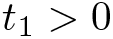 $t_1 \gt 0$ such that
 \begin{align}
\sum_{k\in\mathbb{Z}}J_2(j-k)\underline v_k(t) \geqslant \left(1-\delta_1\right)b_j(t)\sum_{k=-h(\xi(t))}^{\xi(t)} J_2(k)\phi^*_{j-k},\quad \forall t\geqslant t_1,j\in\mathbb{N}^*.
\end{align}
Obviously,
 \begin{align}
\sum_{k\in\mathbb{Z}}J_2(j-k)\underline v_k(t) \geqslant \sum_{k=-h(\xi(t))}^{\xi(t)} J_2(k)\underline v_{j-k}, \quad \forall t \gt 0, j\in\mathbb{Z}.
\end{align}
Case 1. When  $0\leqslant j \lt \xi(t)-h\left(\xi(t)\right), t \gt 0$, then
 $b_j(t)=\theta$. If
 $-h\left(\xi(t)\right) \leqslant j \leqslant \xi(t)$, then one has
 $-\xi(t) \leqslant j-k \lt \xi(t)$. For these j and k,
 $\underline u_{j-k}(t)=\theta \phi_{j-k}^*$. It follows from (3.14) that
 \begin{align*}
\sum_{k\in\mathbb{Z}}J_2(j-k)\underline v_k(t) \geqslant \theta\sum_{k=-h(\xi(t))}^{\xi(t)} J_2(k)\phi^*_{j-k}.
\end{align*}
Case 2. When  $\xi(t)-h\left(\xi(t)\right)\leqslant j \lt \xi(t), t \gt 0$, then
 $b_j(t)=\theta$. By (3.14) again, one has
 \begin{align*}
\sum_{k\in\mathbb{Z}}J_2(j-k)\underline v_k(t) \geqslant \theta\sum_{k=j-\xi(t)}^{\xi(t)} J_2(k)\phi^*_{j-k} +\theta\sum_{k=-h(\xi(t))}^{j-\xi(t)-1} J(k)\frac{J_2(j-k)}{J_2(\xi(t))}\phi^*_{j-k}.
\end{align*}
It follows from  $-h\left(\xi(t)\right) \leqslant k \leqslant j-\xi(t)$ that
 $0 \leqslant j-k-\xi(t) \lt h\left(\xi(t)\right)$. By (3.12), one can find a constant
 $t_2 \gt 0$ such that
 \begin{align*}
\frac{J_2(j-k)}{J_2\left(\xi(t)\right)}=\frac{J_2\left(\xi(t)+\left(j-k-\xi(t)\right)\right)}{J_2\left(\xi(t)\right)} \geqslant 1-\delta_1,~~\forall t\geqslant t_2.
\end{align*}
This result yields that (3.13) with  $t_1\geqslant t_2$.
Case 3. When  $j \geqslant \xi (t), t \gt 0$, then
 $b_j(t)=e^{\lambda_1 t}J_2(j)$. By (3.14) again, one has
 \begin{align*}
\sum_{k\in\mathbb{Z}}J_2(j-k)\underline v_k(t) \geqslant &\,\,Ce^{\lambda_1 t} J_2(\xi(t))\sum_{k=j-\xi(t)}^{\xi(t)} J_2(k)\phi^*_{j-k}\\
&+Ce^{\lambda_1 t}\sum_{k=-h(\xi(t))}^{j-\xi(t)-1} J_2(k)J_2(j-k)\phi^*_{j-k}.
\end{align*}
By the property of J 2, one has  $J_2(\xi(t)) \geqslant J_2(j)$ for t > 0 and
 $J_2(j-k) \geqslant J_2(j)$ for
 $0 \leqslant k \leqslant j-\xi(t)$. It follows from (3.12) that there exists a constant
 $t_3 \gt t_2$, such that
 $J_2(j-k) \geqslant \left(1-\delta_1\right) J_2(j)$, when
 $-h\left(\xi(t)\right) \leqslant k \lt 0, j \geqslant \xi(t), t \geqslant t_3$. This result yields that (3.13) holds. The inequality (3.13) implies that one can find a constant
 $t_4\geqslant t_3$ such that
 \begin{align*} & -\left(1-\delta_1\right) \sum_{k=-h(\xi(t))}^{\xi(t)} J_2(k)\phi^*_{j-k}+\sum_{k\in\mathbb{Z}} J_2(k)\phi^*_{j-k} \lt \min\{\frac{\epsilon}{2},\lambda^*-\frac{\epsilon}{2}\}\phi^*_j,\\
&\forall t\geqslant t_4,j\in\mathbb{Z}.\end{align*}
Furthermore, there exists  $\theta_0 \gt 0$ such that for any
 $0 \lt \theta \lt \theta_0$, one has
 \begin{align*}f_{2,j}\big(u_j^*,\underline v_j\big)-\alpha_j \underline v_j \geqslant
(p_j -\frac{\epsilon}{2}) \underline v_j, \quad \forall j\in \mathbb{Z}, 0 \lt \theta \lt \theta_0. \end{align*}
Since for any  $j\in\mathbb{Z}$,
 $\underline{v}_j$ is differentiable in t except at finitely many points. We only need to show that (3.11) holds for any t where
 $\underline{v}$ is differentiable.
Case 1.  $\underline v_j(t)=b_j(t)\phi_j^*=Ce^{\lambda_1t}J_2(j)\phi_j^*$. It then follows that
 \begin{align*}
& \frac{\text{d}\underline v_j(t)}{\text{d}t}-d_{2,j}\left(\sum_{k\in\mathbb{Z}}J_2(j-k)\underline v_k(t)-\underline v_j(t)\right)-(p_j -\frac{\epsilon}{2})\underline v_j(t)
\\
= & \,\,\big(\lambda_1Ce^{\lambda_1t}J_2(j)\big)\phi_j^*-d_{2,j}\left(\sum_{k\in\mathbb{Z}}J_2(j-k)\underline v_k(t)-\underline v_j(t)\right)-(p_j -\frac{\epsilon}{2})\underline v_j(t)\\
\leqslant& \,\,b_j(t)\left((\lambda^*-\epsilon)\phi_j^*-d_{2,j}\left(\sum_{k\in\mathbb{Z}}J_2(j-k) \phi^*_k-\phi^*_j\right)\right)-(p_j -\frac{\epsilon}{2})\underline v_j(t)\\ &+d_{2,j}\sum_{k\in\mathbb{Z}}J_2(j-k)\phi^*_k(b_j(t)-b_k(t))\\
\leqslant & \,\,b_j(t) \left(-\left(1-\delta_1\right) \sum_{k=-h(\xi(t))}^{\xi(t)} J_2(k)\phi^*_{j-k}+\sum_{k\in\mathbb{Z}} J_2(k)\phi^*_{j-k}-\frac{\epsilon}{2} \phi_j^*\right)\\
\leqslant & \,\,0,\quad t \gt t_4, j\in\mathbb{Z}.
\end{align*}
Case 2.  $\underline v_j=b_j(t)\phi_j^*=\theta \phi_j^*$. We then have
 \begin{align*}
&\frac{\text{d}\underline v_j(t)}{\text{d}t}-d_{2,j}\left(\sum_{k\in\mathbb{Z}}J_2(j-k)\underline v_k(t)-\underline v_j(t)\right)-(p_j -\frac{\epsilon}{2})\underline v_j(t)\\
= &-d_{2,j}\left(\sum_{k\in\mathbb{Z}}J_2(j-k)\underline v_k(t)-\underline v_j(t)\right)-(p_j -\frac{\epsilon}{2})\underline v_j(t)\\
\leqslant& \,\,\theta\left(-d_{2,j}\left(\sum_{k\in\mathbb{Z}}J_2(j-k) \phi^*_k-\phi^*_j\right)\right)-(p_j -\frac{\epsilon}{2})\underline v_j(t)\\
&+d_{2,j}\sum_{k\in\mathbb{Z}}J_2(j-k)\phi^*_k(b_j(t)-b_k(t))\\
\leqslant & \,\,\theta \left(-\left(1-\delta_1\right) \sum_{k=-h(\xi(t))}^{\xi(t)} J_2(k)\phi^*_{j-k}+\sum_{k\in\mathbb{Z}} J_2(k)\phi^*_{j-k}-(\lambda^*-\frac{\epsilon}{2}) \phi_j^*\right)\\
\leqslant & \,\,0,\quad t \gt t_4, j\in\mathbb{Z}.
\end{align*}
This completes the proof with  $t_0\geqslant t_4$.
Fix  $0 \lt \varsigma \lt 1$, one can always find a constant M > 0 and a positive kernel
 $\hat J(j)$ with
 \begin{align*}\hat J(j)= J_2(j), ~~|j| \gt M,\end{align*}
and
 \begin{align}
\sum_{k\in\mathbb{Z}}\hat J(k)\phi^*_k \leqslant \frac{\varsigma}{2} \sum_{k\in\mathbb{Z}} J_2(j-k)\phi^*_k, ~j\in\mathbb{Z}.
\end{align}
Then there exists a constant  $\rho_1 \gt 0$ such that for all
 $j \geqslant h(\rho_1) \gt M$, there holds
 \begin{align}
\sup _{|k| \leqslant h(j)}|\hat J(j+k)-\hat J(j)| \leqslant \varsigma \hat J(j),
\end{align}
 \begin{align}
\sum_{k=-\infty}^{-h(j)}J_2(k)\phi^*_k \leqslant & \varsigma \sum_{k\in\mathbb{Z}} J_2(j-k)\phi^*_k,
\end{align}
and
 \begin{align}
\sum_{k=-\infty}^{-h(j)}J_2(k)\phi^*_{j-k}+\sum^{\infty}_{k=h(j)}J_2(k)\phi^*_{j-k} \leqslant \varsigma \sum_{k\in\mathbb{Z}} J_2(j-k)\phi^*_k.
\end{align}
By (3.17), (3.18) and the fact  $\hat J(j)$ is decreasing in
 $|j|$, for any
 $j\geqslant \rho_1 \gt h(\rho_1)$, there holds
 \begin{align*}
\sum_{k=-\infty}^{-h(j)}J_2(j-k)\hat J(k)\phi^*_{k}+\sum_{k=-\infty}^{-h(j)}J_2(k)\hat J_2(j-k)\phi^*_{j-k} \leqslant \varsigma \hat J(j) \sum_{k\in\mathbb{Z}} J_2(j-k)\phi^*_k.
\end{align*}
For any  $(j,k)\in\mathbb{Z}\times\mathbb{Z}$ satisfies
 $j\geqslant \rho_1 \gt h(\rho_1)$ and
 $-h(j)\leqslant k\leqslant h(j)$, one has
 $ J_2(j-k)=\hat J(j-k)$. It then follows from (3.15) and (3.16) that
 \begin{align*}
\sum_{k=-h(j)}^{h(j)}J_2(j-k)\hat J(k)\phi^*_{k} \leqslant (1+\varsigma)\hat J(j) \sum_{k\in\mathbb{Z}} \hat J(k)\phi^*_k \leqslant \varsigma \hat J(j) \sum_{k\in\mathbb{Z}} J_2(k)\phi^*_k ,
\end{align*}
and
 \begin{align*}
&\sum_{k=-h(j)}^{h(j)}J_2(j-k)\hat J(k)\phi^*_{k}- \hat J(j)\sum_{k=-h(j)}^{h(j)}J_2(k)\phi^*_{j-k} \\
\leqslant &\sup _{|k| \leqslant h(j)}|\hat J(j+k)-\hat J(j)|\sum_{k=-h(j)}^{h(j)}J_2(k)\phi^*_{j-k}\\
\leqslant & \,\,\varsigma \hat J(j) \sum_{k=-h(j)}^{h(j)}J_2(k)\phi^*_{j-k}.
\end{align*}
By the argument similar to those for [Reference Foss, Korshunov and Zachary14, theorem 4.7], we have
 \begin{align*}
\sum_{k=h(j)}^{j-h(j)}\hat J(j-k)\hat J(k)=o\left(\hat J(j)\right), \quad j \rightarrow \infty.
\end{align*}
Based on this property, one can find a constant  $\rho_2 \gt 0$ such that for all
 $j \geqslant \rho_2 \gt h(\rho_2) \gt M$, there holds
 \begin{align*}
&\sum_{k=h(j)}^{j-h(j)}\hat J(j-k) J_2(k)\phi^*_{j-k} = \sum_{k=h(j)}^{j-h(j)}\hat J(j-k) \hat J(k)\phi^*_{j-k} \leqslant \varsigma \hat J(j)\sum_{k\in\mathbb{Z}}J_2(j-k)\phi^*_k.
\end{align*}
Let  $\rho=\max\{\rho_1,\rho_2\}$, then for any
 $j\geqslant \rho \gt h(\rho)$, one has
 \begin{align*}
&\sum_{k\in\mathbb{Z}}J_2(j-k)\hat J(k)\phi^*_k\\=&\;\sum_{k=-\infty}^{h(j)-1}J_2(j-k)\hat J(k)\phi^*_{k}+\sum_{k=-\infty}^{h(j)-1}\hat J(j-k) J_2(k)\phi^*_{j-k}+\sum_{k=h(j)}^{j-h(j)}\hat J(j-k) J_2(k)\phi^*_{j-k}\\=
&\sum_{k=-\infty}^{-h(j)}J_2(j-k)\hat J(k)\phi^*_{k}+\sum_{k=-h(j)+1}^{h(j)-1}J_2(j-k)\hat J(k)\phi^*_{k} +\sum_{k=-\infty}^{-h(j)}\hat J(j-k) J_2(k)\phi^*_{j-k} \\
&+\sum_{k=-h(j)+1}^{h(j)-1}\hat J(j-k) J_2(k)\phi^*_{j-k}+\sum_{k=h(j)}^{j-h(j)}\hat J(j-k) J_2(k)\phi^*_{j-k}\\
\leqslant& \,\,5\varsigma \hat J(j)\sum_{k\in\mathbb{Z}}J_2(j-k)\phi^*_k+\hat J(j)\sum_{k=-h(j)+1}^{h(j)-1}J_2(k)\phi^*_{j-k}+\hat J(j)\sum_{k\in\mathbb{Z}}J_2(k)\phi^*_{j-k}\\ &-\hat J(j)\sum_{k=-\infty}^{-h(j)}J_2(j-k)\phi^*_{j-k}-\hat J(j)\sum_{k=-h(j)+1}^{h(j)-1}J_2(k)\phi^*_{j-k}-\hat J(j)\sum^{\infty}_{k=h(j)}J_2(k)\phi^*_{j-k}
\\ \leqslant & \,\,(1+6\varsigma) \hat J(j)\sum_{k\in\mathbb{Z}}J(j-k)\phi^*_k.
\end{align*}
For any  $j\leqslant -\rho$, the above inequality can be proved by a similar way.
Let  $\Theta=\min\limits_{j\in[-\rho,\rho]_{\mathbb{Z}}} \hat J(j) \gt 0$ and
 $\tilde J(j)=\min\{\frac{\Theta}{2} ,\hat J(j)\}$. Then one can easily prove that
 \begin{align}
\sum_{k\in\mathbb{Z}}J_2(j-k)\tilde J(k)\phi^*_k \leqslant (1+6\varsigma) \tilde J(j)\sum_{k\in\mathbb{Z}}J_2(j-k)\phi^*_k, \quad j\in\mathbb{Z}.
\end{align}
Proof of theorem 2.3
(i) The first limit can be proved by the arguments similar to those for theorem 2.2 with ct being replaced by  $e^{\frac{\lambda}{\alpha}t}$. Let
 \begin{align*}
\overline v_j(t)=e^{\lambda_0 t}\tilde J(j)\phi_j^{*}, \quad t\geqslant 0, j\in\mathbb{Z},
\end{align*}
where
 \begin{align*}\lambda_0=\lambda^*+\varsigma \max_{j\in\mathbb{Z}}\frac{6d_{2,j}\sum_{k\in\mathbb{Z}}J_2(j-k)\phi^*_k}{\phi^*_j}.\end{align*}
Since  $\phi^*$ is unique up to multiplication by a positive constant, we assume that
 $v_j(0)\leqslant \tilde J(j) \phi^*_j$ for all
 $j\in\mathbb{Z}$. By calculation and (3.19), one has
 \begin{align*}
&\frac{\text{d}\overline v_j(t)}{\text{d}t}-d_{2,j}\left(\sum_{k\in\mathbb{Z}}J_2(j-k)\overline v_k(t)-\overline v_j(t)\right)+ f_{2,j}\big(u_j^*,\overline v_j(t)\big)-\alpha_j\overline v_j(t)\\
\geqslant & \,\,\lambda_0e^{\lambda_0 t}\tilde J(j)\phi^*_j-\lambda^*e^{\lambda_0 t}\tilde J(j)\phi^*_j-6\varsigma d_{2,j}e^{\lambda_0 t}\tilde J(j)\sum_{k\in\mathbb{Z}}J_2(j-k)\phi^*_k\\
\geqslant & \,\,0,\quad t \gt 0,j\in\mathbb{Z}.
\end{align*}
Then the comparison principle for lattice equations implies that
 \begin{align*}v_{j}(t)\leqslant e^{\lambda_0 t}\tilde J(j)\phi_j^*, \quad\forall t\geqslant 0,j\in\mathbb{Z}.\end{align*}
By the definition of  $\tilde J$, one can see that for any ϵ > 0 and
 $ \lambda \gt {\lambda_0}$, there exists T > 0 such that
 \begin{align*}v_j(t)\leqslant e^{\lambda_0 t} J_2(j)\phi_j^*\leqslant \epsilon, \quad\forall t \gt T, J_2(j)\leqslant e^{-\lambda t}.\end{align*}
Due to the arbitrariness of ϵ and ς, we can get the second limit.
(ii) For any a > 0, we define
 \begin{align*}\tilde v_j(t)=a\left(v_{0,j}+d_{2,j}\sum_{k\in\mathbb{Z}}J_2(j-k)v_{0,k}t\right)e^{-Mt},\end{align*}
where  $M \gt \max_{j\in\mathbb{Z}}\{d_{2,j}+\alpha_j\}$. Then we have
 \begin{align*}
\frac{\text{d}\tilde v_j(t)}{\text{d}t}\leqslant d_{2,j}\left(\sum_{k\in\mathbb{Z}}J_2(j-k)\tilde v_k(t)-\tilde v_j(t)\right)-\alpha_j\tilde v_j(t), ~t \gt 0, j\in\mathbb{Z}.
\end{align*}
By the arguments similar to those for [Reference Li, Xin and Zhao21, lemma 3.9] that one can find a constant a > 0 such that for any t > 0, there exists a constant  $C(t) \gt 0$ such that
 \begin{align*}v_j(t) \gt C(t)J_2(j),~~\quad t \gt 0, j\in\mathbb{Z}.\end{align*}
Choose ς and θ 2 satisfy  $\varsigma \mathcal{K}_2 \lt \frac{\epsilon}{4}$ and
 \begin{align*}p_jv-\mathcal{K}_2v\big((\varsigma+M_\varsigma v)+v\big) \gt (p_j-\frac{\epsilon}{2})v,~~\forall j\in\mathbb{Z}, v\in[0,\theta_2].\end{align*}
Then we can choose suitable θ and C such that  $\{g_j(t)\}_{j\in\mathbb{Z}}$ is a sub-solution of (3.8) and
 $v_j(T_{\varsigma}) \gt g_j(t_0)$ for all
 $j\in\mathbb{Z}$. By the comparison principle, one has
 \begin{align*}v_j(t+T_{\varsigma})\geqslant v_j^{\varsigma}(t)\geqslant g_j(t),~~\quad t\geqslant t_0, j\in\mathbb{Z}\end{align*}
where  $\{v_j^{\varsigma}(t)\}_{j\in\mathbb{Z}}$ is the solution of (3.8) with initial value
 $\{v_j^{\varsigma}(t_0)\}_{j\in\mathbb{Z}}=\{g_j(t_0)\}_{j\in\mathbb{Z}}$. By employing a dynamical systems approach which is mentioned in [Reference Ding and Liang7, theorem 2.1] (see also [Reference Li, Xin and Zhao21, theorem 3.6]), we can get
 \begin{align*}
\lim_{t \rightarrow \infty} \inf _{|j| \leqslant e^{\frac{1}{\alpha}(\lambda^*-\epsilon)t}} |v^{\varsigma}_j(t)-v_j^{\varsigma,*}|=0,
\end{align*}
where  $\{v_j^{\varsigma,*}\}_{j\in\mathbb{Z}}$ is the unique positive periodic solution of (3.8). Thus, the first limit follows from the arbitrariness of ϵ and the comparison principle. The second limit follows from proposition 3.2, and the third limit can be proved by the argument similar to those for theorem 2.2.
4. Traveling waves
In this section, we address the existence and non-existence of traveling waves of system (1.1). We start with the construction of supper-and sub-solutions of (2.4).
Recall that  $\mathcal{I}_1=\{\mu\in\mathbb{R}|\sum_{k\in\mathbb{Z}}J_1(k)e^{\mu k} \lt +\infty\}$. For any
 $\mu\in\mathcal{I}_1$, consider the following eigenvalue problem on
 $\mathcal{C}^L$:
 \begin{align}
d_{1,j}\big(\sum_{k\in\mathbb{Z}}J_1(j-k)e^{-\mu(j-k)}\phi_k-\phi_j\big)+b_j\phi_j=\lambda \phi_j,~j\in\mathbb{Z},
\end{align}
where  $b=\{b_j=g_j(u^*_j)/u^*_j\}_{j\in\mathbb{Z}}$. Thus, the Perron–Frobenius theorem implies that (4.1) admits the principle eigenvalue
 $\lambda^*(d_1,b,\mu)$ and eigenvector
 $\phi^*(d_1,b,\mu)\in \text{Int}({\mathcal{C}}^L_+)$.
Proposition 4.1. For any  $\mu\geqslant 0, $ one has
 $ \lambda^*(d_1,b,\mu)=\lambda^*(d_1,b,-\mu)$.
Proof. For convenience, we set  $\phi(\mu)=\phi^*(d_1,b,\mu)$ for any
 $\mu\in\mathcal{I}_1$. Note that
 \begin{align*}
&\big(\lambda^*(d_1,b,\mu)-\lambda^*(d_1,b,-\mu)\big)\sum_{j=1}^L\phi_j(\mu)\phi_j(-\mu)\frac{1}{d_{1,j}}\\
=&\;\sum_{j=1}^L\phi_j(-\mu)\left(\sum_{k\in\mathbb{Z}}J_1(j-k) e^{-\mu (j-k)} \phi_k(\mu)- \phi_j(\mu)+\frac{b_j}{d_{1,j}}\phi_j(\mu)\right)\\
&-\sum_{j=1}^L\phi_j(\mu)\left(\sum_{k\in\mathbb{Z}}J_1(j-k) e^{\mu (j-k)} \phi_k(-\mu)- \phi_j(-\mu)+\frac{b_j}{d_{1,j}}\phi_j(-\mu)\right)\\
=&\;\sum_{j=1}^L\phi_j(-\mu)\sum_{k\in\mathbb{Z}}J_1(j-k) e^{-\mu (j-k)} \phi_k(\mu)-\phi_j(\mu)\sum_{k\in\mathbb{Z}}J_1(j-k) e^{\mu (j-k)} \phi_k(-\mu)\\
=&\;\sum_{j=1}^L\phi_j(-\mu)\sum_{k\in\mathbb{Z}}J_1(j-k) e^{-\mu (j-k)} \phi_k(\mu)-\phi_k(\mu)\sum_{k\in\mathbb{Z}}J_1(k-j) e^{-\mu (j-k)} \phi_j(-\mu)\\
=&\;0.
\end{align*}
It then follows that  $\lambda^*(d_1,b,\mu)=\lambda^*(d_1,b,-\mu)$.
By proposition 4.1, one has  $\partial_{\mu}\lambda^*(d_1,b,0)=0$. Since
 $\{u_j^*\}_{j\in\mathbb{Z}}\in \text{Int}({\mathcal{C}}^L_+) $ satisfies (4.1) with λ = 0, then
 $\lambda^*(d_1,b,0)=0$. Fix
 $c \gt c^*$, there exists
 $\tilde \mu \gt 0$ small enough such that
 $-c\tilde \mu+\lambda^*(d_1,b,\tilde u) \lt 0$. Note that there is a unique
 $\mu^* \gt 0$ such that
 $c^*=\frac{\lambda^*(d_2,p,\mu^*)}{\mu^*}$. One can find µc such that
 $c=\frac{\lambda^*(d_2,p,\mu_c)}{\mu_c}$ and
 $0 \lt \mu_c \lt \mu^*$. Choose ɛ > 0 such that
 $\mu_{\varepsilon}=\mu+\varepsilon \lt \{\mu^*,2\mu_c\}$. In this section, for convenience, we set
 $\lambda_1^{*}(\mu)=\lambda^*(d_1,b,\mu)$,
 $\phi_1^{*}(\mu)=\phi^*(d_1,b,\mu)$,
 $\lambda_2^{*}(\mu)=\lambda^*(d_2,p,\mu)$,
 $\phi_2^{*}(\mu)=\phi^*(d_2,p,\mu)$. Set
 $\overline g_j(u_j,v_j)=f_{2,j}(u_j,v_j)/v_j$ and
 $B=\max_{j\in\mathbb{Z}, u\in[0,u_j^*]}\partial_u\overline g_{j}(u,0)$. Choose R 1 and R 2 satisfy
 \begin{align*}-c\tilde \mu R_1\phi_{1,j}^*(\tilde \mu)+\lambda_1^*(\tilde \mu)R_1\phi_{1,j}^*(\tilde \mu)+\partial_vf_{1,j}(u^*_j,0)\phi_{2,j}^{*}(\mu_c) \lt 0,\end{align*}
 \begin{align*}\frac{\tilde \mu}{\mu}\ln\frac{v^*(j)}{\phi_{2,j}^{*}(\mu)} \gt \ln\frac{u^*_j}{R_1\phi_{1,j}^*(\tilde \mu)}, \frac{1}{\varepsilon}\ln\frac{R_2\phi_2^*(\mu_{\varepsilon},j)}{\phi_{2,j}^{*}(\mu)} \gt \frac{1}{\tilde \mu}\ln\frac{R_1\phi_{1,j}^*(\tilde \mu)}{u^*_j},\end{align*}
 \begin{align*}-(c\mu_{\varepsilon}-\lambda_2^*(\mu_{\varepsilon}))R_2\phi_{2,j}^*(\mu_{\varepsilon})+B R_1 \phi_{1,j}^*(\tilde \mu) \phi_{2,j}^{*}(\mu_c) \lt 0.\end{align*}
Next, we define two sequences  $\{\left(\overline{U}_j( s), \overline{V}_j( s)\right)\}_{j\in\mathbb{Z}}$ and
 $\{\left(\underline{U}_j( s), \underline{V}_j(s)\right)\}_{j\in\mathbb{Z}}$ as follows
 \begin{align*}
\overline{U}_j( s)=u^*_j, \quad \underline{U}_j( s)=\max \left\{0, u^*_j-R_1 e^{\tilde{\mu} s}\phi_{1,j}^*(\tilde \mu)\right\},
\end{align*}
 \begin{align*}
\overline{V}_j( s)=e^{\mu_c s} \phi_{2,j}^{*}(\mu_c), ~~\underline{V}_j( s)=\max \left\{0, e^{\mu_c s} \phi_{2,j}^{*}(\mu_c)-R_2e^{\mu_{\varepsilon} s}\phi_{2,j}^{*}(\mu_{\varepsilon})\right\} .
\end{align*}
Lemma 4.2. The sequence  $\{\overline{V}_j( s)\}_{j\in\mathbb{Z}}$ satisfies
 \begin{align*}
c\overline{V}'_j( s) & \geqslant d_{2,j}\left(\sum_{k\in\mathbb{Z}}J_2(j-k)\overline V_k( s-j+k)-\overline V_j( s)\right)\\
& \quad +f_{2,j}\big(u^*_j,\overline V_j( s)\big)-\alpha_j \overline{V}_j( s),~(j,s)\in\mathbb{Z}\times\mathbb{R}.
\end{align*}
Proof. According to direct calculation, for any  $(j,z)\in\mathbb{Z}\times\mathbb{R}$, one has
 \begin{align*} & c\overline V'_j(s)-d_{2,j}\left(\sum_{k\in\mathbb{Z}}J_2(j-k){\overline V}_k(s-j+k)-{\overline V}_j(s)\right)-f_{2,j}\left(u_j^\ast,{\overline V}_j(s)\right)+\alpha_j{\overline V}_j(s)\\&\!\!\!\geqslant c\mu_ce^{\mu_cs}\phi_{2,j}^\ast(\mu_c)-e^{\mu_cs}\left(d_{2,j}\left(\sum_{k\in\mathbb{Z}}J_2(j-k)e^{-\mu_c(j-k)}\phi_{2,k}^\ast(\mu_c)-\phi_{2,j}^\ast(\mu_c)\right)+p_j\phi_{2,j}^\ast(\mu_c)\right)\\&\!\!\!=c\mu_c\phi_{2,j}^\ast(\mu_c)-\lambda^\ast(\mu_c)\phi_{2,j}^\ast(\mu_c)\\&\!\!\!=0.\end{align*}
This completes the proof.
Lemma 4.3. The sequence  $\{\underline{U}_j( s)\}_{j\in\mathbb{Z}}$ satisfies
 \begin{align*}c\underline{U}_j'(s)\leqslant & d_{1,j}{\left(\sum_{k\in\mathbb{Z}}J_1(j-k)\underline{U}_k(s-j+k)-\underline{U}_j(s)\right)}+g_j(\underline{U}_j(s))\\ & -f_{1,j}(\underline{U}_j(s),{\overline V}_j(s)), \qquad a.e. \quad (j,s)\in\mathbb{Z}\times\mathbb{R}.\end{align*}
Proof. For any fixed  $j\in\mathbb{Z}$, there is only one point that is not differentiable with respect to s, so here we only need to consider the point that is differentiable with respect to s. When
 $\underline{U}_j( s)=0$, one can prove that
 \begin{align*}
c\underline {U}'_j( s)=0&\leqslant d_{1,j}\left(\sum_{k\in\mathbb{Z}}J_1(j-k)\underline U_k( s-j+k)-\underline U_j( s)\right)\\
& \quad +g_j\big(\underline{U}_j(
s)\big)-f_{1,j}\big(\underline U_j( s),\overline V_j( s)\big) .
\end{align*}
When  $\underline{U}_j( s)=u^*_j-R_1 e^{\tilde \mu s}\phi_{1,j}^*(\tilde \mu)$, by the choice of R 1, one can easily prove that
 \begin{align*}
&c\underline {U}'_j( s)-d_{1,j}\left(\sum_{k\in\mathbb{Z}}J_1(j-k)\underline U_k( s-j+k)-\underline U_j( s)\right)-g_j\big(\underline{U}_j(
s)\big)\\ &+f_{1,j}\big(\underline U_j( s),\overline V_j( s)\big) \\
\leqslant & -c\tilde \mu R_1 e^{\tilde \mu s}\phi_{1,j}^*(\tilde \mu)-d_{1,j}\left(\sum_{k\in\mathbb{Z}}J_1(j-k)u^*_k-u^*_j\right)\\ &+d_{1,j} R_1 e^{\tilde \mu s} \left(\sum_{k\in\mathbb{Z}}J_1(j-k) e^{-\tilde \mu (j-k)}\phi_{1,k}^*(\tilde \mu) -\phi_{1,j}^*(\tilde \mu)\right) \\
& -g_j\big(u^*_j-R_1 e^{\tilde \mu s}\phi_{1,j}^*(\tilde \mu)\big)+\partial_vf_{1,j}\big(u^*_j-R_1 e^{\tilde \mu s}\phi_{1,j}^*(\tilde \mu),0\big)e^{\mu_c s} \phi_{2,j}^{*}(\mu_c)\\
=&\;-c\tilde \mu R_1 e^{\tilde \mu s}\phi_{1,j}^*(\tilde \mu)+\lambda_1^*(\tilde \mu)R_1e^{\tilde \mu s}\phi_{1,j}^*(\tilde \mu)+ g_j(u^*_j)-R_1e^{\tilde \mu s}\frac{g_j(u^*_j)}{u^*_j}\phi_{1,j}^*(\tilde \mu)\\
& -g_j\big(u^*_j-R_1 e^{\tilde \mu s}\phi_{1,j}^*(\tilde \mu)\big)+\partial_vf_{1,j}\big(u^*_j-R_1 e^{\tilde \mu s}\phi_{1,j}^*(\tilde \mu),0\big)e^{\mu_c s} \phi_{2,j}^{*}(\mu_c)\\
\leqslant & \,\,e^{\tilde \mu s}\Big(-c\tilde \mu R_1\phi_{1,j}^*(\tilde \mu)+\lambda_1^*(\tilde \mu)R_1\phi_{1,j}^*(\tilde \mu)+\partial_vf_{1,j}\big(u^*_j,0\big)\phi_{2,j}^{*}(\mu_c)\Big)\\ &+\Big(\frac{g_j(u^*_j)}{u^*_j}-\frac{g_j(\underline U_j( s))}{\underline U_j( s)}\Big)(u^*_j-R_1 e^{\tilde \mu s}\phi_{1,j}^*(\tilde \mu))\\
\leqslant & \,\,0.
\end{align*}
This completes the proof.
Lemma 4.4. The sequence  $\{\underline{V}_j(t)\}_{j\in\mathbb{Z}}$ satisfies
 \begin{align*}c\underline {V}'_j( s)& \leqslant d_{2,j}\big(\sum_{k\in\mathbb{Z}}J_2(j-k)\underline V_k(s-j+k)-\underline V_j(s)\big)\\&+f_{2,j}\big(\underline{U}_j(s),\underline{V}_j(s)\big)-\alpha_j \underline{V}_j(s), \quad a.e.\quad (j,s)\in\mathbb{Z}\times\mathbb{R}.
\end{align*}
Proof. By the arguments as those for lemma 4.3, we only need to consider the point that is differentiable with respect to s. When  $\underline{V}_j(s)=0$, one can easily prove that
 \begin{align*}c\underline {V}'_j( s)=0&\leqslant d_{2,j}\left(\sum_{k\in\mathbb{Z}}J_2(j-k)\underline V_k(s-j+k)-\underline V_j(s)\right)\\& -f_{2,j}\big(\underline{U}_j(s),\underline{V}_j(s)\big)+\alpha_j \underline{V}_j(s), \quad a.e.\quad (j,s)\in\mathbb{Z}\times\mathbb{R}.
\end{align*}
When  $\underline{V}_j( s)=e^{\mu_c s} \phi_{2,j}^{*}(\mu_c)-R_2e^{\mu_{\varepsilon} s}\phi_{2,j}^*(\mu_{\varepsilon})$, by the choose of R 2, we have
 $\underline{U}_j( s)=u^*_j-R_1 e^{\tilde \mu s}\phi_{1,j}^*(\tilde \mu)$. Recall that
 $\overline g_j(u_j,v_j)=f_{2,j}(u_j,v_j)/v_j$, it follows from the mean value theorem that
 \begin{align*}
\begin{aligned}
\overline g_{j}\big(\underline{U}_j,\underline{V}_j\big)-\overline g_{j}\big(u^*_j,0\big) =&\;-\partial_{u}\overline g_{j}\big(\gamma_j\big) R_1 e^{\tilde \mu s}\phi_{1,j}^*(\tilde \mu)\\
& -\partial_{v}\overline g_{j}(\gamma_j)\big(e^{\mu_c s} \phi_{2,j}^{*}(\mu_c)-R_2e^{\mu_{\varepsilon} s}\phi_{2,j}^*(\mu_{\varepsilon})\big),
\end{aligned}
\end{align*}
where  $\gamma_j=(u_j^*+\sigma(\underline{U}_j-u_j^*(t),\sigma \underline{V}_j)$ and
 $0 \lt \sigma \lt 1$. Note that
 $\underline{U}_j \gt 0$ and
 $0 \lt \underline{V}_j( s) \leqslant e^{\mu_c s} \phi_{2,j}^{*}(\mu_c)$. According to direct calculation, one has
 \begin{align*}
&c\frac{\text{d}\underline {V}_j( s)}{\text{d} s}-d_{2,j}\left(\sum_{k\in\mathbb{Z}}J_2(j-k)\underline V_{k}( s-j+k)-\underline V_j( s)\right)-f_{2,j}(\underline{U}_j( s),\underline{V}_j( s))+\alpha_j \underline{V}_j( s) \\
\leqslant& \,\,c\mu_c e^{\mu_c s} \phi_{2,j}^{*}(\mu_c)-c\mu_{\varepsilon}R_2e^{\mu_{\varepsilon} s}\phi_{2,j}^*(\mu_{\varepsilon})-d_{2,j}e^{\mu_c s}\sum_{k\in\mathbb{Z}}J_2(j-k)e^{\mu_c (j-k)}\phi_{2,k}^*(\mu_c)\\ &
-d_{2,j}R_2e^{\mu_{\varepsilon} s}\sum_{k\in\mathbb{Z}}J_2(j-k)e^{\mu_{\varepsilon} (j-k)}\phi_{2,k}^*(\mu_{\varepsilon})
+d_{2,j}e^{\mu s}\phi_{2,j}^{*}(\mu)
-d_{2,j}R_2e^{\mu_{\varepsilon} s}\phi_{2,j}^*(\mu_{\varepsilon})\\ &
+\partial_{u}\overline g_{j}\big(\gamma_j\big) R_1 e^{\tilde \mu s}\phi_{1,j}^*(\tilde \mu)(e^{\mu_c s} \phi_{2,j}^{*}(\mu_c)-R_2e^{\mu_{\varepsilon} s}\phi_{2,j}^*(\mu_{\varepsilon})\big)
\\ &+\partial_{v}\overline g_{j}(\gamma_j)\big(e^{\mu_c s} \phi_{2,j}^{*}(\mu_c)-R_2e^{\mu_{\varepsilon} s}\phi_{2,j}^*(\mu_{\varepsilon})\big)^2\\
&+ ( \partial_vf_{2,j}(u^*_j,0)-\alpha_j)(e^{\mu_c s} \phi_{2,j}^{*}(\mu_c)-R_2e^{\mu_{\varepsilon} s}\phi_{2,j}^*(\mu_{\varepsilon}))\\
=&\; -(c\mu_{\varepsilon}-\lambda_2^*(\mu_c))R_2e^{\mu_{\varepsilon} s}\phi_{2,j}^*(\mu_{\varepsilon})+\partial_{u}\overline g_{j}\big(\gamma_j\big) R_1 e^{\tilde \mu s}\phi_{1,j}^*(\tilde \mu) e^{\mu_c s} \phi_{2,j}^{*}(\mu_c)\\ &+\partial_{v}\overline g_{j}(\gamma_j)\big(e^{\mu_c s} \phi_{2,j}^{*}(\mu_c)-R_2e^{\mu_{\varepsilon} s}\phi_{2,j}^*(\mu_{\varepsilon})\big)^2\\
\leqslant & \,\,e^{\mu_{\varepsilon} s}\big(-(c\mu_{\varepsilon}-\lambda^*(\mu_{\varepsilon}))R_2\phi_{2,j}^*(\mu_{\varepsilon})+|\partial_{u}\overline g_{j}(\gamma_j) |R_1 e^{\tilde \mu s}\phi_{1,j}^*(\tilde \mu) e^{-\varepsilon s} \phi_{2,j}^{*}(\mu_c)\big)\\
\leqslant & \,\,e^{\mu_{\varepsilon} s}\Bigg(-(c\mu_{\varepsilon}-\lambda_2^*(\mu_{\varepsilon}))R_2\phi_{2,j}^*(\mu_{\varepsilon})+B R_1 \phi_{1,j}^*(\tilde \mu) \phi_{2,j}^{*}(\mu_c)\Bigg)\\
\leqslant & \,\,0.
\end{align*}
This completes the proof.
For any M > 0, denote  $\mathcal{I}_M=(-M, M), \overline{\mathcal{I}}_M=[-M, M], C_M=C\left([-M, M], \mathbb{R}^{2 L}\right)$ and
 \begin{align*}
\mathcal{D}_M:=\Bigg\{(U,V)\in C_M:\begin{array}{c}
\underline U_j( s)\leqslant
U_j( s)\leqslant \overline U_j( s),
\underline V_j( s)\leqslant
V_j( s)\leqslant \overline V_j( s) \\
U_j(-M)=\underline U_j(-M), V_j(- M)=\underline V_j(- M)
\end{array} s\in \mathcal{I}_M, j\in \mathbb{L}
\Bigg\} .\end{align*}
For any  $(\mathbb{U}, \mathbb{V})\in C_M$, we define
 \begin{align*}
\widehat{\mathbb{U}}_j( s)=\left\{\begin{array}{ll}
\mathbb{U}_j(M), & s \gt M, \\
\mathbb{U}_j( s), & | s| \leqslant M, \\
\underline U_j( s), & s \lt -M,
\end{array} \quad \widehat{\mathbb{V}}_j( s)= \begin{cases}\mathbb{V}_j(M), & s \gt M, \\
\mathbb{V}_j( s), & | s| \leqslant M, \\
\underline{V}_j( s), & s \lt -M .\end{cases}\quad j\in\mathbb{L}.\right.
\end{align*}
Let  $\tilde J_1(j)=\sum_{i\in\mathbb{Z}}J_1(j-iL)$ and
 $\tilde J_2(j)=\sum_{i\in\mathbb{Z}}J_2(j-iL)$. Consider the initial value problem
 \begin{align}
\left\{\begin{aligned}
&c \frac{\text{d}U_j( s)}{\text{d} s}+\left(-\frac{g_j(\mathbb{U}_j( s))}{\mathbb{U}_j( s)}+\frac{f_{1,j}\big(\mathbb{U}_j( s),\mathbb{V}_j( s)\big)}{\mathbb{U}_j( s)}+d_{1,j}\right) U_j( s)\\ &=d_{1,j}\sum_{k\in\mathbb{L}}\tilde J_1(j-k)\widehat{\mathbb{U}}_k( s-j+k)\\
&
c \frac{\text{d}V_j( s)}{\text{d} s}+\left(\frac{f_{2,j}(\mathbb{U}_j( s),\mathbb{V}_j( s))}{\mathbb{V}_j( s)}-\alpha_j-d_{2,j}\right) V_j( s)\\ &=d_{2,j}\sum_{k\in\mathbb{L}}\tilde J_2(j-k)\widehat{\mathbb{V}}_k( s-j+k)\\
&
\left(U_j(-M), V_j(-M)\right)=\left(\underline{U}_j(-M), \underline{V}_j(-M)\right),
\end{aligned}
\right. \quad j\in\mathbb{L}.
\end{align}
Obviously, (4.2) admits a unique solution  $(\tilde U, \tilde V) \in C_M$. Then, we define
 \begin{align*}\mathcal{F}^M=\left(F_1^M, \ldots, F_L^M, Q_1^M, \ldots, Q_L^M\right): \mathcal{D}_M \mapsto C_M\end{align*}
by
 \begin{align*}U_j( s)=F_j^M(\tilde U, \tilde V)( s)~\text{and}~V_j( s)=Q_j^M(\tilde U, \tilde V)( s),~j\in\mathbb{L}, s \in[-M, M],\end{align*}
where
 \begin{align*}
\begin{aligned}
U_j( s)= & \,\,\tilde{U}_j(-M) \exp \left\{-\frac{1}{c} \int_{-M}^{s}\left(-\frac{g_j(\tilde{U}_j(r))}{\tilde{U}_j(r)}+\frac{f_{1,j}\big(\tilde{U}_j(r),\tilde{V}_j(r)\big)}{\tilde{U}_j(r)}+d_{1,j}\right) \text{d} r\right\} \\
& +\frac{1}{c} \int_{-M}^{s} \exp \left\{-\frac{1}{c} \int_\eta^{s}\left(-\frac{g_j(\tilde{U}_j(s))}{\tilde{U}_j(s)}+\frac{f_{1,j}\big(\tilde{U}_j(r),\tilde{V}_j(r)\big)}{\tilde{U}_j(r)}+d_{1,j}\right) \text{d} r\right\} H_j^M(\tilde U, \tilde V)(\eta) \text{d} \eta, \\
V_j( s)= & \,\,\tilde{V}_j(-M) \exp \left\{\frac{1}{c} \int_{-M}^{s}\left(\frac{f_{2,j}(\tilde{U}_j(r),\tilde{V}_j(r))}{\tilde{V}_j(r)}-\alpha_j-d_{2,j}\right) \text{d} r\right\} \\
& +\frac{1}{c} \int_{-M}^{s} \exp \left\{\frac{1}{c} \int_\eta^{s}\left(\frac{f_{2,j}(\tilde{U}_j(r),\tilde{V}_j(r))}{\tilde{V}_j(r)}-\alpha_j-d_{2,j}\right) \text{d} r\right\} P_j^M(\tilde U, \tilde V)(\eta) \text{d} \eta
\end{aligned}
\end{align*}
and
 \begin{align*}
\left\{\begin{array}{l}
H_j^M(\tilde U, \tilde V)(\eta)=d_{1,j}\sum_{k\in\mathbb{L}}\tilde J_1(j-k)\widehat{\tilde U}_k( s-j+k), \\
P_j^M(\tilde U, \tilde V)(\eta)=d_{2,j}\sum_{k\in\mathbb{L}}\tilde J_2(j-k)\widehat{\tilde V}_k( s-j+k) .
\end{array}\right.
\end{align*}
It follows from lemmas 4.2–4.4 that  $\mathcal{F}^M:C_M\to C_M$. Moreover, the operator
 $\mathcal{F}^M: C_M \rightarrow C_M$ is completely continuous. Because of the fact CM is closed and convex, Schauder’s fixed point theorem implies that there exists
 $\left(U^M, V^M\right) \in C_M$ such that
 \begin{align*}
\left(U^M, V^M\right)=\mathcal{F}^M\left(U^M, V^M\right) .
\end{align*}
Obviously, for any given S > 0, there exists a constant C(S) such that
 \begin{align*}
\left\|U^M\right\|_{C^1([-S, S])} \lt C(S) \text {and }\left\|V^M\right\|_{C^1([-S, S])} \lt C(S)
\end{align*}
for any M > S.
Theorem 4.5. For any  $c \gt c^*$, there exists a solution
 $\left\{\left(U_j, V_j\right)\right\}_{j \in \mathbb{Z}}$ of system (2.4) such that
 \begin{align*}
0 \lt U_j( s) \lt u^*_j, \quad V_j( s) \gt 0, \quad (j,s) \in \mathbb{R}\times \mathbb{Z} .
\end{align*}
Proof. Let  $\{M_n\}_{n\in\mathbb{N}}$ be an increasing sequence such that
 $M_n\to +\infty $ as
 $n\to+\infty$. By the above discussion, one has that
 $\{(U^{M_n},V^{M_n})\}_{n\in\mathbb{N}}$, up to subsequence, converges to a function
 $(U,V)=\{(U_j,V_j)\}_{j\in\mathbb{L}}$ locally uniformly in
 $\mathbb{R}$. Let
 $U_{j+N}=U_{j}$ and
 $V_{j+N}=V_j$, one can find a solution
 $\{(U_j,V_j)\}_{j\in\mathbb{Z}}$ of system (2.4). Moreover,
 \begin{align*}
\underline U_j(s)\leqslant U_j( s)\leqslant \overline U_j(s), \quad \underline V_j(s) \leqslant V_j( s)\leqslant \overline V_j(s), \quad (j,s) \in \mathbb{R}\times \mathbb{Z} .
\end{align*}
From this inequality, one can find  $(j_0,s_0)\in\mathbb{Z}\times\mathbb{R}$ such that
 $V_{j_0}(s) \gt 0$ for all
 $s \lt s_0$. We first prove that
 $V_j(s) \gt 0$ for all
 $(j,s)\in\mathbb{Z}\times\mathbb{R}$. Assume that there exists
 $(j_1,s_1)\in\mathbb{Z}\times\mathbb{R}$ such that
 $V_{j_1}(s_1)=0$, then
 $V'_{j_1}(s_1)=0$. By the second equation of (2.4), we have
 $V_{j_1 \pm 1}\left( s_1 \pm 1\right)=0$. Repeat this process, one has
 $V_{j_1 \pm \mathbb{Z}}\left( s_1 \pm \mathbb{Z}\right)=0$. In particular, we get
 $V_{j_0+n_0L}\left( s_1 +j_0+n_0L-j_1\right)=0$, where n 0 is a constant such that
 $ s_1 +j_0+n_0L-j_1 \lt s_0$. This is a contradiction. Thus,
 $V_j(s) \gt 0$ for all
 $(j,s)\in\mathbb{Z}\times\mathbb{R}$.
Let  $\tilde U_j(s)=U_j(s)/u^*_j$ for any
 $(j,s)\in\mathbb{Z}\times\mathbb{R}$. Obviously,
 $\{\tilde U_j\}_{j\in\mathbb{Z}}$ satisfies
 \begin{align*}
c\tilde U'_j(s) & =d_{1,j}\left(\sum_{k\in\mathbb{Z}}J_1(j-k)u_k^*/u_j^*\tilde U_k(s-j+k)-\tilde U_j(s)\right)\\
& \quad +g_j(\tilde U_j(s)u^*_j)/u_j^*-f_{1,j}(\tilde U_j(s)u^*_j,V_j(s))/u_j^*.
\end{align*}
Next, we prove that  $U_j(s) \lt u_j^*$ for all
 $(j,s)\in\mathbb{Z}\times\mathbb{R}$. Assume that there exists
 $(j_2,s_2)\in\mathbb{Z}\times\mathbb{R}$ such that
 $U_{j_2}(s_2)=u_{j_2}^*$, then
 $\tilde U_{j_2}(s_2)=1$,
 $\tilde U'_{j_2}(s_2)=0$ and
 \begin{align*}
0=&\;d_{1,j_2}\left(\sum_{k\in\mathbb{Z}}J_1(j_2-k)u_k^*\tilde U_k(s_2-j_2+k)-\tilde U_{j_2}(s_2)\right)+g_{j_2}(\tilde U_{j_2}(s_2)u^*_{j_2})/u_{j_2}^*\\ &\quad-f_{1,j_2}(\tilde U_{j_2}(s_2)u^*_{j_2},V_{j_2}(s_2))/u_{j_2}^*\\ \lt & \,\,d_{1,j_2}\left(\sum_{k\in\mathbb{Z}}J_1(j_2-k)u_k^*/u_{j_2}^*\tilde U_k(s_2-j_2+k)-\tilde U_{j_2}(s_2)\right)+g_{j_2}(\tilde U_{j_2}(s_2)u^*_{j_2})/u_{j_2}^*\\
\leqslant & \,\,0,
\end{align*}
which is a contradiction. Hence,  $U_j(s) \lt u_j^*$ for all
 $(j,s)\in\mathbb{Z}\times\mathbb{R}$.
Lemma 4.6. Let  $\left\{\left(U_j, V_j\right)\right\}_{j \in \mathbb{Z}}$ be the solution of (2.4) given by theorem 4.5. Then for any
 $i\in\mathbb{N}^*$ and τ > 0, there holds
 \begin{align*}
\sup _{(j, s) \in \mathbb{Z} \times \mathbb{R}, \tilde j\in[j,i+j]_{\mathbb{N}},\tilde{s} \in [ s, s+\tau]} \frac{V_j( s)}{V_{\tilde j}(\tilde{s})} \lt +\infty .
\end{align*}
Proof. Let  $u_j(t)=U_j(j+ct)$ and
 $v_j(t)=V_j(j+ct)$ for any
 $(j,t)\in\mathbb{Z}\times\mathbb{R}$. Then
 $u_j(t)=u_{j-L}(t+L / c)$ and
 $v_j(t)=v_{j-L}(t+L / c)$ for all
 $(j,t)\in\mathbb{Z}\times\mathbb{R}$. Moreover,
 $\{v_j(t)\}_{j\in\mathbb{Z}}$ satisfies
 \begin{align}
\frac{v'_j(t)}{v_j(t)}=d_{2,j}\left(\sum_{k\in\mathbb{Z}} J_2(j-k)\frac{v_k(t)}{v_j(t)}-1\right)+\frac{f_{2,j}(u_j(t),v_j(t))}{v_j(t)}-\alpha_j,~\quad j\in\mathbb{Z}.
\end{align}
In the following, we hope to show that the quantities  $v_{j+l}(t) / v_{j}(t)=v_{j+l}(t) / v_{j-L}(t+L / c)$ are uniformly globally bounded for all integer
 $|l|\leqslant N$. Fix
 $(j_0,t_0) \in\mathbb{Z}\times\mathbb{R}$ and
 $l_0\in[-N,N]_{\mathbb{Z}}$. Let
 $\{i_j(t)\}_{j\in\mathbb{Z}}$ be the solution of the following equation with the initial value
 $\{i_j\left(t_0\right)\}_{j\in\mathbb{Z}}=\{v_j\left(t_0\right)\}_{j\in\mathbb{Z}}$,
 \begin{align}
\frac{\text{d}i_j(t)}{\text{d}t}=d_{2,j}\left(\sum_{k\in\mathbb{Z}}J_2(j-k)i_k(t)-i_j(t)\right)-\alpha_ji_j(t), ~j \in \mathbb{Z}.
\end{align}
It follows from the comparison principle that
 \begin{align*}
v_{j-L}\left(t_0+L / c\right) \geqslant i_{j-L}\left(t_0+L / c\right), ~j \in \mathbb{Z} .
\end{align*}
Let  $\{w_j(t)\}_{j\in\mathbb{Z}}$ be the solution of (4.4) with the initial value
 $w_{j_0+l}\left(t_0\right)=v_{j_0+l}\left(t_0\right)\ \text {and } w_{j}\left(t_0\right)=0 \text {for all } j \neq j_0+l.$ One can prove that
 \begin{align*}
v_{j-L}\left(t_0+L / c\right) \geqslant i_{j-L}\left(t_0+L / c\right) \geqslant w_{j-L}\left(t_0+L / c\right), \quad j \in \mathbb{Z} .
\end{align*}
For any  $i\in\mathbb{Z}$, let
 $\{z_j^i(t)\}_{j\in\mathbb{Z}}$ be the solution of (4.4) with the initial value
 $ z_{i+l}^i(0)=1$ and
 $z_j^i(0)=0$ for all
 $j \neq i+l$. Define
 $\varrho_i:=z_{i-L}^i(L / c)$ for all
 $i\in\mathbb{Z}$. It follows from maximum principle that
 $\varrho_i \gt 0$ for all
 $i\in\mathbb{Z}$. Moreover,
 $\varrho_i=\varrho_{i-L}$ for all
 $i \in$
 $\mathbb{Z}$. Thus,
 $\varrho^*:=\min _{i \in \mathbb{Z}} \varrho_i \gt 0$. Furthermore,
 $
w_{j_0-L}\left(t_0+L / c\right)=\varrho_{j_0} v_{j_0+1}\left(t_0\right).
$ This implies
 $
v_{j-L}\left(t_0+L / c\right) \geqslant \varrho^* v_{j_0+1}\left(t_0\right).
$ Note that
 $\varrho^*$ is only depend on l and l is finite. Thus, there exists a constant ρ > 0 such that
 \begin{align*}
v_{j+l}(t) / v_{j-L}(t+L / c) \leqslant \rho,~(j, t) \in \mathbb{Z} \times \mathbb{R}, l\in[-N,N]_{\mathbb{Z}} .
\end{align*}
Recall that  $f_{2,j}(u_j(t),v_j(t))/v_j(t)$ is uniformly bounded. Combing (4.3), one has
 \begin{align*}\sup_{(j,t)\in\mathbb{Z}\times\mathbb{R}}\frac{|v'_j(t)|}{v_j(t)} \lt +\infty.\end{align*}
By the arguments similar to those for [Reference San, Wang and Feng25, lemma 2.10 and remark 2.11], we can prove the desired statement.
The assumption of function  $f_{1,j}$ implies that for any
 $j\in\mathbb{Z}$ and u > 0, there exist two possibilities about
 $f_{1,j}$: (i)
 $\lim_{v\to+\infty}f_{1,j}(u,v)$ exists and (ii)
 $\lim_{v\to+\infty}f_{1,j}(u,v)=+\infty$. Thus, we only need to consider two cases of f 1.
Case 1  $\max_{j\in\mathbb{Z},u\in[0,u_j^*],v \gt 0}f_{1,j}(u,v) \lt +\infty$.
The assumption (F2) indicates that  $\max_{j\in\mathbb{Z},u\in[0,u_i^*],v \gt 0}f_{2,j}(u,v) \lt +\infty$. Then one can find a constant
 $K_1 \gt 0$ such that
 $f_{2,j}(u,K_1)-\alpha_j K_1 \lt 0$ for any
 $j\in\mathbb{Z}$ and
 $u\in[0,u^*_j]$. Define
 $\overline{V}_j( s)=\min\{e^{\mu_c s} \phi_{2,j}^{*}(\mu_c),K_1\}$. One can easily prove that lemmas 4.2 and 4.3 still hold. Thus, the boundedness of
 $\{V_j\}$ is obvious.
Case 2 There exists  $j_0\in\mathbb{Z}$ such that
 $\lim_{v\to+\infty}f_{1,j_0}(u,v)=\infty$ for any fixed
 $u\in(0,u_{j_0}^*]$. Let
 $\mathbb{L}^+$ be the set containing such element
 $j_0\in\mathbb{Z}$. Then
 $\mathbb{L}^+$ is not empty. In the following, we consider the boundedness of
 $\{v_j(t)\}_{j\in\mathbb{Z}}$ in this case.
Lemma 4.7. Let  $\{c_m\}_{m\in\mathbb{N}}$ be a bounded sequence with
 $c_m\geqslant c^*$ for all
 $m\geqslant 0$ and
 $\{(U^m_j,V_j^m)\}_{j\in\mathbb{Z}}$ be solutions of system (2.4) given by theorem 4.5 with speeds cm. If there exist
 $j_0\in \mathbb{L}^+$ and sequence
 $\{s_m\}_{m\in\mathbb{N}}$ such that
 $V^m_{j_0}(s_m)\to+\infty$ as
 $m\to+\infty$, then
 $\lim_{m\to\infty}U_{j_0}^m(s_m)=0$.
Proof. Assume, by contradiction, that there exist a constant ɛ > 0 and a subsequence  $\{s_m\}_{m\in\mathbb{N}}$ such that
 $V_{j_0}^m\left(s_m\right) \rightarrow+\infty$ as
 $m \rightarrow+\infty$ and
 $U_{j_0}^m\left(s_m\right) \geqslant \varepsilon$ for all
 $m \in \mathbb{N}$. Since
 $U_j( s)$ is bounded and
 $U_j'( s)$ is bounded from above, one can find a constant δ > 0 such that
 \begin{align*}
U_{j_0}^m(s) \geqslant \frac{\varepsilon}{2} \text {for all } s \in\left[s_m-\delta, s_m\right]\ \text {and } m \in \mathbb{N}.
\end{align*}
Moreover, lemma 4.6 implies that
 \begin{align*}0 \lt M_m:=\min _{\left[s_m-\delta, s_m\right]} V_{j_0}^m(s) \rightarrow+\infty, \text{as}~m \rightarrow+\infty.\end{align*}
Thus,
 \begin{align*}
\max _{\left[s_m-\delta, s_m\right]}(U_{j_0}^m)'(s)\leqslant \frac{\tilde {C}_0}{c^*}-\frac{1}{c^*}f_{1,j_0}(\frac{\varepsilon}{2},M_m)\rightarrow-\infty, \text {as } m \rightarrow+\infty,
\end{align*}
where  $\tilde{C}_0=\max _{j \in \mathbb{L}} (d_{1,j}+\partial_u g_i(0)) u^*_j$. This is impossible due to the boundedness of
 $U_{j_0}^m(s)$.
Lemma 4.8. Let  $\left\{\left(U_j, V_j\right)\right\}_{j \in \mathbb{Z}}$ be given as in theorem 4.5. If
 $\limsup\limits_{s \rightarrow+\infty} \max_{j\in\mathbb{Z}}V_{j}( s)=+\infty$, then
 $\liminf\limits_{s \rightarrow+\infty}\min_{j\in\mathbb{Z}} V_{j}( s)=+\infty$.
Proof. Assume, by contradiction, that there exists  $j_0\in\mathbb{Z}$ and
 $\mathcal{M} \gt 0$ such that
 $\limsup\limits_{s \rightarrow+\infty} V_{j_0}( s)=+\infty$ and
 $\liminf\limits_{s \rightarrow+\infty} V_{j_0}( s) \lt \mathcal{M}$. One can find two sequences
 $\left\{\sigma_m\right\}_{m\in\mathbb{N}}$ and
 $\left\{s_m\right\}_{m\in\mathbb{N}}$ with
 $\sigma_m, s_m \rightarrow+\infty$ as
 $m \rightarrow+\infty$ such that
 $
\sigma_m \lt s_m-N \lt s_m \lt s_m+N \lt \sigma_{m+1}
$ for all
 $m \in \mathbb{N}$ and
 $V_{j_0}\left(\sigma_m\right) \leqslant \mathcal{M}, \lim _{m \rightarrow+\infty} V_{j_0}\left( s_m\right)=+\infty$. Thus, lemma 4.6 indicates that
 \begin{align*}
V_j( s) \rightarrow+\infty \,\text {as } m \rightarrow+\infty \,\text {for all } s \in\left[ s_m-N, s_m+N\right], j \in \mathbb{Z},
\end{align*}
and
 \begin{align*}
V_j( s) \lt \mathcal{M}_0 \,\text {for all } j, m \in \mathbb{Z}\ \text {and } s \in\left[\sigma_m-N, \sigma_m+N\right]
\end{align*}
for some  $\mathcal{M}_0 \gt \mathcal{M}$. Set
 $
V^0( s)=\max _{j \in \mathbb{L}} V_j( s) .
$ There exist
 $ s_0^m \in\left[\sigma_m, \sigma_{m+1}\right]$ and
 $j_0^m \in \mathbb{L}$ such that
 $
V_{j_0^m}\left( s_0^m\right)=\max _{s \in\left[\sigma_m, \sigma_{m+1}\right]} V^0( s).
$ Obviously,
 $V_{j_0^m}'\left( s_0^m\right)=0$ and
 $s_0^m\in[\sigma_m+N,\sigma_{m+1}-N]$. Thus,
 \begin{align*}d_{2,j_0^m}\left(\sum_{k\in\mathbb{Z}}J_2(j-k)V_{j_0^m+k}( s_0^m+k)-V_{j_0^m}( s_0^m)\right)\leqslant 0.\end{align*}
By the second equation of (2.4), one has
 \begin{align*}
{ f_{2,j_0^m}\big( U_{j_0^m}\left( s_0^m\right),V_{j_0^m}\left( s_0^m\right)\big)-\alpha_{j_0^m} V_{j_0^m}\left( s_0^m\right) \geqslant 0 \,\text {for all } m \in \mathbb{N}.}
\end{align*}
If there is a subsequence of  $\{j_0^m\}_{m\in\mathbb{N}}$ (still denoted by
 $\{j_0^m\}_{m\in\mathbb{N}}$) such that
 $j_0^m\in\mathbb{L}^+$ for all
 $m\geqslant 1$, then
 $V_{j_0^m}\left( s_0^m\right) \rightarrow+\infty$ and
 $U_{j_0^m}\left( s_0^m\right)\to 0$ as
 $m \rightarrow+\infty$ by lemma 4.7. Otherwise, there exists a subsequence of
 $\{j_0^m\}_{m\in\mathbb{N}}$ (still denoted by
 $\{j_0^m\}_{m\in\mathbb{N}}$) such that
 $f_{2,j_0^m}\big( U_{j_0^m}\left( s_0^m\right),V_{j_0^m}\left( s_0^m\right)\big)$ is bounded. Both of these cases are impossible for sufficiently large m. Thus,
 $\lim\limits_{s \rightarrow+\infty} V_j( s)=+\infty$ for all
 $j \in \mathbb{Z}$.
Lemma 4.9. Let  $\left\{\left(U_j, V_j\right)\right\}_{j \in \mathbb{Z}}$ be given as in theorem 4.5. If
 $\min_{j\in\mathbb{Z}}\lim\limits_{s \rightarrow+\infty} V_{j}( s)=+\infty$, then
 $\sup\limits_{j \in \mathbb{Z}} \limsup\limits_{s \rightarrow+\infty}\left|U_j^{\prime}( s)\right| \lt +\infty$.
Proof. Assume, by contradiction, that there exist  $j_0 \in \mathbb{L}$ and sequence
 $\left\{s_n^0\right\}_{n \in \mathbb{N}}$ with
 $ s_n^0 \to\infty$ as
 $n\to+\infty$ such that
 $
|U_{j_0}^{\prime}\left( s_n^0\right) |\rightarrow \infty \text {as } n \rightarrow+\infty .
$ Meanwhile,
 $U_j'( s)$ is bounded from above. Thus,
 $
U_{j_0}^{\prime}\left( s_n^0\right) \rightarrow-\infty \text {as } n \rightarrow+\infty .
$ In view of the boundedness of
 $U_{j_0}( s)$, one has
 $
\limsup\limits_{n \rightarrow+\infty} \max\limits_{s \in\left[ s_n^0-1, s_n^0\right)}U_{j_0}^{\prime}( s) \gt -\infty .
$ There exist a positive constant
 $\tilde{\mathcal{M}}$ and sequence
 $\left\{\zeta_n\right\}_{n \in \mathbb{N}}$ with
 $\zeta_n \in\left[ s_n^0-1, s_n^0\right]$ such that
 \begin{align*}
{-\tilde{\mathcal{M}} \lt U_{j_0}^{\prime}\left(\zeta_n\right) \lt 0\ \text {and } U_{j_0}^{\prime}( s) \lt 0 \text {for } s \in\left(\zeta_n, s_n^0\right),~n\in\mathbb{N}.}
\end{align*}
It follows that
 \begin{align*}
\begin{aligned}
-f_{1,j_0}\big(U_{j_0}(\zeta_n), V_{j_0}\left(\zeta_n\right)\big) \gt & -c \tilde{\mathcal{M}}-d_{1,j_0}\sum_{k\in\mathbb{Z}}J_1(j_0-k)U_{j_0+k}(\zeta_n-j_0+k)+d_{1,j_0} U_{j_0}(\zeta_n) \\
& -g_{j_0}(U_{j_0}(\zeta_n)) \\ \gt & -c \tilde{\mathcal{M}}-d_{1,j_0}u^*_{j_0}-q_{j_0}u^*_{j_0} .
\end{aligned}
\end{align*}
Lemma 4.6 implies that one can find a constant  $\mathcal{N}_0 \gt 0$ such that
 \begin{align*}
{\max _{s \in\left[ s_n^0-1, s_n^0\right]} V_{j_0}( s) \lt \mathcal{N}_0 V_{j_0}\left(\zeta_n\right) \text {for all } n \in \mathbb{N}.}
\end{align*}
Since  $U_{j_0}^{\prime}( s) \lt 0$ for any
 $ s \in\left(\zeta_n, s_n^0\right)$, one has
 \begin{align*}
\begin{aligned}
c U_{j_0}^{\prime}( s^0_n)= &\; d_{1,j_0}\sum_{k\in\mathbb{Z}}J_1(j_0-k)U_{j_0+k}( s^0_n-j_0+k)-d_{1,j_0} U_{j_0}( s^0_n) \\
& +g_{j_0}(U_{j_0}( s^0_n))-f_{1,j_0}\big(U_{j_0}( s^0_n),V_{j_0}( s^0_n)\big) \\ \gt & -d_{1,j_0}u^*_{j_0}-f_{1,j_0}\big(U_{j_0}(\zeta_n), \mathcal{N}_0 V_{j_0}\left(\zeta_n\right)\big)\\
\geqslant &-d_{1,j_0}u^*_{j_0}-\mathcal{N}_0f_{1,j_0}\big(U_{j_0}(\zeta_n), V_{j_0}\left(\zeta_n\right)\big)\\
\geqslant & -d_{1,j_0}u^*_{j_0}-\mathcal{N}_0(c \tilde{\mathcal{M}}+d_{1,j_0}u^*_{j_0}+q_{j_0}u^*_{j_0} ).
\end{aligned}
\end{align*}
This contradicts the fact that  $U_{j_0}^{\prime}\left( s_n^0\right) \rightarrow-\infty \text {as } n \rightarrow+\infty$.
Let  $\lambda^*(d_2,-\alpha,\mu)$ be the principal eigenvalue of (2.3) with pj being replaced by −αj. Then we have the following statement.
Lemma 4.10. Let  $\left\{\left(U_j, V_j\right)\right\}_{j \in \mathbb{Z}}$ be given as in theorem 4.5 with the speed c. If
 $\lim\limits_{s \rightarrow+\infty} V_{j}( s)=+\infty,~~j \in \mathbb{Z}$, then
 $\lim_{s\to+\infty}\frac{V_j^{\prime}( s)}{V_j( s)}=\mu_0,~~j\in\mathbb{Z}$, where µ 0 satisfies
 $\lambda^*(d_2,-\alpha,\mu_0)=c\mu_0$.
Proof. Since  $V_j(s)$ is periodic in j, one can conclude that there exist a constant
 $j_0\in \mathbb{L}$ and a sequence
 $\{s_n\}_{n\in\mathbb{N}}$ with
 $ s_n \rightarrow+\infty$ as
 $n \rightarrow+\infty$ such that
 \begin{align*}
\frac{V_{j_0}^{\prime}\left( s_n\right)}{V_{j_0}\left( s_n\right)} \rightarrow \mu_-=\min_{j\in \mathbb{L}}\liminf _{s \rightarrow+\infty} \frac{V_j^{\prime}( s)}{V_j( s)} \text {as } n \rightarrow+\infty .
\end{align*}
Let
 \begin{align*}
V_j^n( s)=\frac{V_j\left( s+ s_n\right)}{V_{j_0}\left( s_n\right)}, ~j \in \mathbb{Z}, n \in \mathbb{N}, s \in \mathbb{R},
\end{align*}
then  $V_j^n$ satisfies
 \begin{align*}
c\left(V_j^n\right)^{\prime}( s)= & \,\,d_{2,j}\left(\sum_{k\in\mathbb{Z}}J_2(j-k)V_k^n( s-j+k)-V_j^n( s)\right)-\alpha_jV_j^n( s) \\
&\quad+ f_{2,j}\big(U_j\left( s+ s_n\right), V_j( s+ s_n)\big)V_j^n( s)/V_j( s+ s_n).
\end{align*}
Lemma 4.6 indicates that the sequence  $\{\{V_j^n( s)\}_{j\in\mathbb{Z}}\}_{n\in\mathbb{N}}$ is bounded in
 $C_{l o c}^1(\mathbb{R})$. Moreover, it satisfies
 \begin{align*}
c\left(V_j^n\right)^{\prime\prime}( s)= & \,\,d_{2,j}\big(\sum_{k\in\mathbb{Z}}J_2(j-k)(V_k^n)^{\prime}( s-j+k)-\left(V_j^n\right)^{\prime}(s)\big)-\alpha_j\left(V_j^n\right)^{\prime}( s) \\ &\quad+
\partial_uf_{2,j}\big(U_j\left( s+ s_n\right), V_j( s+ s_n)\big)V_j^n( s)U'_j\left( s+ s_n\right)/V_j( s+ s_n)\\ &\quad+
\partial_vf_{2,j}\big(U_j\left( s+ s_n\right), V_j( s+ s_n)\big)(V_j^n)^{\prime}( s).
\end{align*}
For any  $j\in\mathbb{Z}$, it follows from lemma 4.10 that
 $U_j^{\prime}\left( s+ s_n\right)$ is locally bounded. Thus, the sequence
 $\{V_j^n( s)\}_{n\in\mathbb{N}}$ is bounded in
 $C_{l o c}^2(\mathbb{R})$. One can find a function
 $v_j( s) \in C^1(\mathbb{R})$ such that
 $V_j^n( s) $, up to a subsequence, converges to
 $ v_j( s)$ in
 $C_{l o c}^1(\mathbb{R})$. Moreover, the function
 $v_j( s)$ is L-periodic in j. Since
 $V_j( s+s_n) \rightarrow 0$ as
 $ n \rightarrow+\infty$, then
 $f_{2,j}\big(U_j\left( s+ s_n\right), V_j( s+ s_n)\big)/V_j( s+ s_n) \rightarrow 0$ as
 $n \rightarrow+\infty$. Thus,
 $\{v_j( s)\}_{j\in\mathbb{Z}}$ satisfy
 \begin{align}
c v_j^{\prime}( s)=d_{2,j}\big(\sum_{k\in\mathbb{Z}}J_2(j-k)v_k( s-j+k)-v_j( s)\big)-\alpha_j v_j( s), ~j\in\mathbb{Z}, s\in\mathbb{R}.
\end{align}
Claim.  $v_j( s) \gt 0, ~(j,s)\in\mathbb{Z}\times\mathbb{R}$.
If not, there exist  $ s^*\in\mathbb{R}$ and
 $j_0\in\mathbb{Z}$ such that
 $v_{j_1}\left( s^*\right)=0$ and
 $v'_{j_1}\left( s^*\right)=0$. By (4.5), we have
 $v_{j_1 \pm 1}\left( s^* \pm 1\right)=0$. Repeat this process, we get
 $v_{j_0+n_0L}\left( s^* +j_0+n_0L-j_1\right)=0$, where n 0 is a constant such that
 $ s^* +j_0+n_0L-j_1 \gt 0$. Meanwhile, since
 \begin{align*}cv'_{j_0+n_0L}( s) \geqslant-\left( d_{2,j_0+n_0L}+\alpha_{j_0+n_0L}\right) v_{j_0+n_0L}( s),\end{align*}
we have
 \begin{align*}
v_{j_0+n_0L}( s^*+j_0+n_0L-j_1) \geqslant v_{j_0+n_0L}(0)e^{-\left(d_{2,j_0+n_0L}+\alpha_{j_0+n_0L}\right)( s^*+j_0+n_0L-j_1) / c} \gt 0,
\end{align*}
here  $ v_{j_0+n_0L}(0) \gt 0$ can be obtained from the definition of
 $V_j^n$. This contradiction proves the claim.
Thus,  $
w_j( s):=v_j^{\prime}( s)/v_j( s) \geqslant \mu_-$ and
 $w_{j_0}(0)=\mu_-$. Moreover, wj is L-periodic in j and wj satisfies
 \begin{align*}
c w_j^{\prime}( s)=d_{2,j}\sum_{k\in\mathbb{Z}}\tilde J_2(j,k)\big(w_k( s-j+k)-w_j( s)\big),
\end{align*}
where
 \begin{align*}
\tilde J_2(j,k)= J_2(j-k)v_k( s-j+k) / v_j( s) \gt 0.
\end{align*}
By the arguments similar those for above claim, it follows that  $w_j( s)=\mu_-$ for all
 $(j, s) \in \mathbb{Z} \times \mathbb{R}$. Hence,
 $v_j^{\prime}( s)=\mu_- v_j( s),$ for any
 $(j, s) \in \mathbb{Z} \times \mathbb{R}$. Thus,
 $
v_j( s)=e^{\mu_- s} v^*_j,
$ where
 $v^*_{j}=v^*_{j-L}=v_j(0) \gt 0$ for all
 $j \in \mathbb{Z}$. Moreover, one can see that
 $v^*_j$ satisfies
 \begin{align*}
c \mu_- v^*_j=d_{2,j}\left(\sum_{k\in\mathbb{Z}}J_2(j-k)e^{-\mu_- (j-k)}v^*_k-v^*_j\right)-\alpha_j v^*_j,~~j\in\mathbb{Z}.
\end{align*}
Thus,  $
\lambda^*(d_2,-\alpha,\mu_-)=c \mu_- .
$ It follows from the definition of
 $v_j( s)$ that
 \begin{align}
\frac{V_j^{\prime}\left( s_n+ s\right)}{V_j\left( s_n+ s\right)} \rightarrow \mu_- \text {local uniformly in } s \text {as } n \rightarrow+\infty, \text {for all } j \in \mathbb{Z} .
\end{align}
That is,
 \begin{align*}
\mu_-=\liminf _{s \rightarrow+\infty} \frac{V_j^{\prime}( s)}{V_j( s)}, \quad \text {for all } j \in \mathbb{Z} .
\end{align*}
Since  $V_j(s)$ is periodic in j, then there exists
 $j_2\in\mathbb{L}$ and sequence
 $\{\widehat s_n\}_{n\in\mathbb{N}}$ with
 $ s_n \lt \widehat s_n \lt s_{n+1}$ such that
 \begin{align*}
\frac{V_{j_2}^{\prime}\left( \widehat s_n\right)}{V_{j_2}\left( \widehat s_n\right)} \rightarrow \mu_+=\max_{j\in \mathbb{L}}\limsup _{s \rightarrow+\infty} \frac{V_j^{\prime}( s)}{V_j( s)} \text {as } n \rightarrow+\infty . \end{align*}
Similarly, we can prove
 \begin{align*}
\mu_+=\limsup _{s \rightarrow+\infty} \frac{V_j^{\prime}( s)}{V_j( s)}, j \in \mathbb{Z}, ~\text {with}~\mu_+ \text {satisfies } \lambda^*(d_2,-\alpha,\mu_+)=c \mu_+,
\end{align*}
and
 \begin{align}
\frac{V_j^{\prime}\left(\widehat s_n+ s\right)}{V_j\left(\widehat s_n+ s\right)} \rightarrow \mu_+ \,\text {local uniformly in } s \text {as } n \rightarrow+\infty \,\text {for all } j \in \mathbb{Z} .
\end{align}
If  $\mu_-=\mu_+$, then we can end the proof. If not, then
 $\mu_- \lt \mu_+$. Since
 $\alpha_j \gt 0$, one can see that
 $
\lambda^*(d_2,-\alpha,\mu)=c \mu
$ has two solutions
 $\mu_-$ and
 $\mu_+$ with
 $\mu_- \lt 0 \lt \mu_+$. It then follows from (4.6) and (4.7) that
 $
s_n \lt \widehat{s}_n-2N \lt \widehat{s}_n \lt \widehat{s}_n+2N \lt s_{n+1} .
$ Let
 $
V^0( s)=\max _{j \in \mathbb{L}} V_j( s) .
$ There exist
 $j_0^n \in \mathbb{L}$ and a sequence
 $\left\{s_1^n\right\}_{n\in\mathbb{N}}$ with
 $ s_1^n \in\left(\widehat{s}_n, s_{n+1}\right)$ such that
 $V_{j_0^n}\left( s_1^n\right)=$
 $V^0\left( s_1^n\right),\left(V_{j_1^n}\right)^{\prime}\left( s_1^n\right)=0$ and
 $V^0\left( s_1^n\right)=\max _{s \in\left[ \widehat s_n, s_{n+1}\right]} V^0( s)$. Thus,
 \begin{align*}d_{2,j}\left(\sum_{k\in\mathbb{Z}}J_2(j_0^n-k)V_k(j_0^n+k)-V_{j_0^n}( s_1^n)\right) \leqslant 0.\end{align*}
It follows from the second equation of (2.4) that
 \begin{align*}f_{2,j_0^n}\big(U_{j_0^n}\left( s_1^n\right), V_{j_0^n}\left( s_1^n\right)\big)-\alpha_{j_0^n} V_{j_0^n}\left( s_1^n\right) \geqslant 0,~n\in\mathbb{N}.\end{align*}
By the similar arguments as those for lemma 4.8, one can reach a contradiction. Thus,  $\mu_-=\mu_+=\mu_0$. It is clear that
 $\mu_0 \gt 0$ due to the fact that
 $V_j( s) \rightarrow+\infty$ as
 $ s \rightarrow+\infty$. Hence, we have
 $\lambda^*\left(d_2,-\alpha,\mu_0\right)=c \mu_0$.
Lemma 4.11. Let  $\left\{\left(U_j, V_j\right)\right\}_{j \in \mathbb{Z}}$ be the solution of (2.4) given by theorem 4.5. Then
 $\{V_j( s)\}_{j\in\mathbb{Z}}$ is bounded.
Proof. Assume, on the contrary, that  $\{V_j( s)\}_{j\in\mathbb{Z}}$ is not bounded. Since
 $V_j( s)$ is continuous and
 $V_{j}(-\infty)=0$, then one can find
 $j_0 \in\mathbb{L}$ such that
 $\lim \sup _{s \rightarrow+\infty} V_{j_0}( s) \rightarrow+\infty$. The lemmas 4.8 and 4.10 imply that
 \begin{align*}
\lim _{s \rightarrow+\infty} \frac{\ln V_j( s)}{s}=\mu_0,~j\in\mathbb{Z}.
\end{align*}
In view of the fact  $\lambda^*(d_2,p,\mu) \gt \lambda^*(d_2,-\alpha,\mu)$, one has
 $\mu_c \lt \mu_0$. Thus,
 \begin{align*}
\limsup _{s \rightarrow+\infty} \frac{\ln V_j( s)}{s} \leqslant \mu_c \lt \mu_0,~~j\in\mathbb{Z} .
\end{align*}
This is a contradiction. Hence,  $\{V_j( s)\}_{j\in\mathbb{Z}}$ is bounded.
Lemma 4.12. Let  $\{c_m\}_{m\in\mathbb{N}}$ be a bounded sequence satisfies
 $c_m\geqslant c^*$ for all
 $m\geqslant 0$ and
 $\{(U^m,V^m)\}_{m\in\mathbb{N}}$ be the solutions of (2.4) with
 $c=c_m$. Then
 $\{V^m\}_{m\in\mathbb{N}}$ is bounded uniformly in m.
Proof. Assume, on the contrary, that there exist  $j_0 \in \mathbb{L}$ (up to a subsequence) such that
 $\sup_{s\in\mathbb{R}}|V_{j_0}^m(s)|\rightarrow+\infty$ as
 $m \rightarrow+\infty$. It follows from lemma 4.6 that
 \begin{align*}
{\sup_{s\in\mathbb{R}}|V_{j}^m(s)| \rightarrow+\infty \,\text {as } m \rightarrow+\infty, \text {for all } j \in \mathbb{Z}.}
\end{align*}
Then one can find  $j_0^m \in \mathbb{L}$ and
 $ s_m \in \mathbb{R}$ satisfying
 $V_{j_0^m}^m\left( s_m\right) \rightarrow+\infty$ as
 $m \rightarrow+\infty$ and
 \begin{align}
V_{j_0^m}^m\left( s_m\right) \geqslant \left(1-\frac{1}{m+1}\right) \max _{j \in \mathbb{Z}}\sup_{s\in\mathbb{R}}|V_{j}^m(s)| .
\end{align}
It follows from lemma 4.6 that
 \begin{align*}
{V_j^m\left( s+ s_m\right) {\longrightarrow}+\infty \,\text {local uniformly in } s \in \mathbb{R}, j \in \mathbb{Z} \,\text {as } m \rightarrow+\infty.}
\end{align*}
Let
 \begin{align*}
\Phi_j^m( s):=U_j^m\left( s+ s_m\right), \Psi_j^m(s):=\frac{V_j^m\left( s+ s_m\right)}{V_{j^m_0}^m\left( s_m\right)} .
\end{align*}
The inequality (4.8) implies that  $\Psi_j^m( s) \leqslant 1+1 / m$ for any
 $ s \in \mathbb{R}$ and
 $m \in \mathbb{N}^*$. Let
 $c_m \rightarrow c^{\infty} \geqslant c^*$ as
 $m \rightarrow+\infty$. By a similar discussion as those in lemma 4.10, one can see that
 $\Psi_j^m( s)$ converges to
 $\Psi_j^{\infty}( s)$ locally uniformly in s with
 \begin{align*}
c^{\infty}\left(\Psi_j^{\infty}\right)^{\prime}( s)=d_{2,j}\left(\sum_{k\in\mathbb{Z}}J_2(j-k)\Psi_k^{\infty}( s-j+k)-\Psi_j^{\infty}(s)\right)-\alpha_j \Psi_j^{\infty}( s)
\end{align*}
and
 \begin{align*}
0 \lt \Psi_j^{\infty}( s)\leqslant 1,~ \text {for~any } s \in \mathbb{R}\ \text {and } j \in \mathbb{Z} .
\end{align*}
Let  $j_0^m \rightarrow j_0^{\infty}$ as
 $m \rightarrow+\infty$. Note that
 $\Psi_{j_0^{\infty}}^{\infty}(0)=1$, then
 $\left(\Psi_{j_0^{\infty}}^{\infty}\right)^{\prime}(0)=0$ and
 \begin{align*}\left(\sum_{k\in\mathbb{Z}}J_2(j_0^{\infty}-k)\Psi_k^{\infty}( -j_0^{\infty}+k)-\Psi_{j_0^{\infty}}^{\infty}( 0)\right) \leqslant 0.\end{align*}
Thus,
 \begin{align*}0 & =c^{\infty}\left(\Psi_{j_0^{\infty}}^{\infty}\right)^{\prime}( 0)=d_{2,{j_0^{\infty}}}\left(\sum_{k\in\mathbb{Z}}J_2({j_0^{\infty}}-k)\Psi_k^{\infty}( -{j_0^{\infty}}+k)-\Psi_{j_0^{\infty}}^{\infty}(0)\right)\\
& \quad -\alpha_{j_0^{\infty}} \Psi_{j_0^{\infty}}^{\infty}( 0) \lt 0.\end{align*}
This contradiction completes the proof.
Lemma 4.13. Let  $\left\{\left(U_j, V_j\right)\right\}_{j \in \mathbb{Z}}$ be given as in theorem 4.5. Then we have
 $\inf _{\mathbb{R}} U_j( s) \gt 0, j \in \mathbb{Z}$.
Proof. Set  $u_j(t):=U_{j}(j+ct)$ for any
 $(t,j) \in \mathbb{R}\times\mathbb{Z}$, then we have
 $U_j( s)=u_j(( s-j)/c) $ for any
 $(t,j) \in \mathbb{R}\times\mathbb{Z}$. We assume, by contradiction, that there exist
 $\left\{j_n\right\}_{n \in\mathbb{N}}$ with
 $j_n\in\mathbb{L}$ and
 $\left\{s_n\right\}_{n\in\mathbb{N}}$ with
 $\lim _{n \rightarrow \infty} s_n=\infty$ such that
 $U_{j_n}\left( s_n\right) \lt \frac{1}{n}$. Fix a
 $\check{c}\in\left(0, c^*\right)$. We can choose a subsequence of
 $\left\{s_n\right\}_{n\in\mathbb{N}}$ (still denoted by
 $\left\{s_n\right\}_{n\in\mathbb{N}}$) which is strictly increasing. Set
 \begin{align*}
k_n:=\max \left\{k \in \mathbb{N}: ( s_n \frac{\check c}{c+\check c}-j_n)/L\geqslant k\right\}~\text{for sufficiently large}\ n.
\end{align*}
It is easy to see that  $\left\{k_n\right\}_{n\in\mathbb{N}}$ is strictly increasing,
 $\lim _{n \rightarrow \infty} k_n=\infty$ and
 \begin{align*}( s_n \frac{\check c}{c+\check c}-j_n)/L\geqslant k_n.\end{align*}
For all sufficiently large n, one has
 \begin{align*}|j_n+k_nL|\leqslant \check c ( s_n-j_n-k_nL)/c.\end{align*}
By the periodicity of  $U_{j}(\cdot)$ in j, we have
 \begin{align*}
U_{j_n}\left( s_n\right)=U_{j_n+k_nL}\left( s_n\right)=u_{j_n+k_nL}\big(( s_n-j_n-k_nL)/c\big).
\end{align*}
It follows from remark 3.3 that there exists ɛ > 0 such that
 \begin{align*}
\lim _{n \rightarrow \infty} U_{j_n}\left( s_n\right)=\lim _{n \rightarrow \infty}u_{j_n+k_nL}\left(( s_n-j_n-k_nL)/c\right) \gt \varepsilon \gt 0.
\end{align*}
This gives a contradiction.
Lemma 4.14. Let  $c^* \leqslant \underline{c} \lt \overline{c}$. There exists ɛ > 0 such that for any solution
 $\left\{\left(U_j( s), V_j( s)\right)\right\}_{j \in \mathbb{Z}}$ of system (2.4) with
 $c\in[\underline{c}, \overline{c}]$, there holds
 \begin{align*}
\inf_{s\in\mathbb{R}}U_j(s) \gt \varepsilon,~\liminf _{s \rightarrow+\infty} V_j( s) \gt \varepsilon, ~j \in \mathbb{Z}.
\end{align*}
Proof. Let  $u_j(t):=U_{j}(j+ct)$ and
 $v_j(t)=V_j(j+ct)$ for all
 $(j,t)\in\mathbb{Z}\times\mathbb{R}$. By lemmas 4.12, 4.13 and proposition 3.2, there exists
 $\varepsilon_1 \gt 0$ which is not depend on c that
 \begin{align*}\liminf_{t\to\infty} u_{j}(t) \gt \varepsilon_1,\quad j\in\mathbb{Z}.\end{align*}
Thus, one can find a constant  $t_0 \gt 0$ such that
 \begin{align*}u_j(t)\geqslant \varepsilon_1/2,~ t\geqslant t_0,j\in\mathbb{Z}.\end{align*}
By the definition of  $u_j(t)$, one has
 \begin{align*}U_j(j+ct)\geqslant \varepsilon_1/2,~ t\geqslant t_0,j\in\mathbb{Z}.\end{align*}
For any  $(j,s)\in\mathbb{Z}\times\mathbb{R}$ and
 $c\in[\underline c, \overline c]$, one can find integer n 1 and
 $t_1 \gt t_0$ such that
 $s=j+n_1N+ct_1$. Thus,
 $U_j(s)=U_{j+n_1N}(j+n_1N+ct_1)\geqslant \varepsilon_1/2$. Hence,
 \begin{align*}U_j(s)\geqslant \varepsilon_1/2,~(j,s)\in\mathbb{Z}\times\mathbb{R}.\end{align*}
Moreover, it follows from the arguments in theorem 2.2 that there exists  $0 \lt c_2 \lt c^*$ and
 $\varepsilon_2 \gt 0$ (which not depend on c) such that
 \begin{align*}\liminf_{t\to\infty}\inf_{|j|\leqslant c_2t}v_j(t) \gt \varepsilon_2.\end{align*}
By the definition of  $v_j(t)$, one has
 \begin{align*}\liminf_{t\to\infty}\inf_{|j|\leqslant c_2t}V_j(j+ct) \gt \varepsilon_2.\end{align*}
Therefore,
 \begin{align*}\liminf_{s\to\infty}V_j(s) \gt \varepsilon_2,~j\in\mathbb{Z}.\end{align*}
Then we obtain the desired result by taking  $\varepsilon=\min\{\varepsilon_1/2,\varepsilon_2\}$.
The proof of theorem 2.4
The existence of traveling waves of system (1.1) with speed  $c \gt c^*$ has been established by lemmas 4.11 and 4.14. In the following, we consider the existence of the critical traveling wave. Choose a sequence
 $\{c_m\}_{m\in\mathbb{N}}$ with
 $c_m \in\left(c^*, c^*+1\right]$ and
 $c_m \rightarrow c^*$ as
 $m \rightarrow$
 $+\infty$. Let
 $\{(U^m( s), V^m( s))\}_{m\in\mathbb{N}}$ be the solution of (2.4) with the speed cm and ɛ be given in lemma 4.14. Assume that
 \begin{align*}
V^m_1(0)=\frac{\varepsilon}{2}~\text{and}~
V_1^m(s) \lt \frac{\varepsilon}{2} ~\text{for all}\ s \lt 0, m\in\mathbb{N}^*.
\end{align*}
Arzela–Ascoli theorem implies  $\{(U^m,V^m)\}_{m\in\mathbb{N}}$, up to a subsequence, converges to
 $(U^*,V^*)=\{(U_j^*,V_j^*)\}_{j\in\mathbb{Z}}$ locally uniformly in s. By the similar arguments as those for lemma 4.14 that
 \begin{align*}\inf_{s\in\mathbb{R}}U_j(s) \gt \varepsilon,~\liminf _{s \rightarrow+\infty} V_j( s) \gt \varepsilon, ~j \in \mathbb{Z}.\end{align*}
We first prove that  $V^*_1(-\infty)=0$. Otherwise,
 $\limsup\limits_{s\to-\infty} V_1^*(s)=\varepsilon_0\leqslant \frac{\varepsilon}{2}$. Then there exists subsequence
 $\{s_k\}_{k\in\mathbb{N}}$ with
 $s_k\to-\infty$ as
 $k\to+\infty$ such that
 $\lim_{k\to+\infty}V_1^*(s_k)=\varepsilon_0$. Set
 $U_j^k(s)=U_j^*(s+s_k)$ and
 $V^k_j(s)=V^*_j(s+s_k)$ for all
 $(j,s)\in\mathbb{Z}\times\mathbb{R}$. Up to subsequence,
 $\{(U^k,V^k)\}_{k\in\mathbb{N}}$ converges to
 $(\tilde U, \tilde V)=\{(\tilde U_j,\tilde V_j)\}_{j\in\mathbb{Z}}$ locally uniformly in s. Moreover,
 $0 \lt \tilde V_1(s)\leqslant \tilde V_1(0)=\varepsilon_0$. Set
 $u_j(t)=\tilde U_j(j+c^*t)$ and
 $v_j(t)=\tilde V_j(j+ct)$ for all
 $(j,t)\in\mathbb{Z}\times\mathbb{R}$. It follows from theorem 2.2 and lemma 4.14 that there exists
 $0 \lt \tilde c \lt c^*$ such that
 \begin{align*}\liminf_{t\to+\infty}\inf_{|j|\leqslant \tilde ct}v_j(t) \gt {\varepsilon}.\end{align*}
The above result indicates that for any sufficiently large t, one has
 \begin{align*}\tilde V_1(1+ct)\geqslant v_1(t) \gt \varepsilon \gt \varepsilon_0.\end{align*}
This contradicts the fact  $\tilde V_1(s) \lt \varepsilon$. Thus,
 $\lim_{s\to-\infty}V^*_1(s)=0$. In view of the fact
 $(V_1^*)^{\prime\prime}$ is bounded, the Barbalat lemma implies that
 $\lim_{s\to-\infty} (V^*_1)'(s)=0$. It follows from the second equation of (2.4) that
 $\lim_{s\to-\infty}V^*_2(s)=\lim_{s\to-\infty}V_{0}^*(s)=0$. Repeat this argument, one has
 $\lim_{s\to-\infty} V^*_j(s)=0$ for any
 $j\in\mathbb{Z}$. Now we only need to prove
 $\lim_{s\to-\infty}U^*_j(s)=u_j^*$ for all
 $j\in\mathbb{Z}$. Otherwise, there exists
 $j_0\in\mathbb{Z}$ and sequence
 $\{s_k\}_{k\in\mathbb{N}}$ with
 $s_k\to-\infty$ as
 $k\to+\infty$ such that
 $0 \lt U^*_{j_0}(s_k)\to a_{j_0} \lt u_{j_0}^*$ and
 $V_j^*(s_k)\to 0$. Moreover,
 $\lim_{k\to+\infty}(U^*_{j_0})'(s_k)=0$, but it contradicts the fact that
 $\{u_j^*\}_{j\in\mathbb{Z}}$ is the unique positive periodic equilibrium solution of (2.1). Then
 $\lim_{s\to-\infty}U^*_j(s)=u_j^*$ for all
 $j\in\mathbb{Z}$.
To end this proof, we show the non-existence of traveling waves of system (1.1). Otherwise, there exists a traveling wave  $\{(U_j(s), V_j(s))\}_{j\in\mathbb{Z}}$ of system (2.4) with
 $c \lt c^*$. Let
 $u_j(t):=U_{j}(j+ct)$ and
 $v_j(t)=V_j(j+ct)$ for all
 $(j,t)\in\mathbb{Z}\times\mathbb{R}$. Choose ϵ satisfies
 $c \lt c+\epsilon \lt c^*$. In view of
 $\min_{(j,t)\in\mathbb{Z}\times\mathbb{R}}u_j(t) \gt 0$ and
 $v_j(t)$ is bounded, it follows from theorem 2.2 that
 \begin{align*}
\liminf _{t \rightarrow \infty}v_{j}(t) \gt 0, ~\text{with}~|j|\leqslant (c+\epsilon)t.
\end{align*}
Let  $[a]$ denote the maximum integer no bigger than a. Then
 \begin{align*}
\liminf _{t \rightarrow \infty} V_{[-(c+\epsilon)t]}\big([-(c+\epsilon)t]+ct\big) \gt 0.
\end{align*}
This contradicts the definition of the traveling wave.
5. Numerical simulations
In this section, we present some numerical results about the following system to illustrate the obtained analytic results.
We consider the following lattice system:
 \begin{align}
\left\{\begin{aligned}
\frac{\text{d}u_j(t)}{\text{d}t}=&\;d_{1,j}\left(\sum_{k\in\mathbb{Z}}J_1(j-k)u_k(t)-u_j(t)\right)\\
&+u_j(t)(1-u_j(t))-\beta_{1,j}u_j(t)v_j(t),\quad (t,j)\in\mathbb{R}\times\mathbb{Z},\\
\frac{\text{d}v_j(t)}{\text{d}t}=&\;d_{2,j}\left(\sum_{k\in\mathbb{Z}}J_2(j-k)v_k(t)-v_j(t)\right)\\
&+\beta_{2,j}u_j(t)v_j(t)- \alpha_jv_j(t),\quad (t,j)\in\mathbb{R}\times\mathbb{Z}.
\end{aligned}
\right.
\end{align}
Here we select the functional response as Holling Type I. Next, we use numerical simulation to explore the speed of the invasion of predators, the existence of traveling wave solutions, and the effects of parameters on propagation.
5.1. Spreading speeds
We first select the parameters as follows:
 \begin{align*}d_{1,j}=d_{2,j}=1,\beta_{1,j}=0.1\cos(j\pi/20)+2,\beta_{2,j}=0.8*\beta_{1,j},\alpha_j=1, ~j\in\mathbb{Z}\end{align*}
and
 \begin{align*}
J_1(j)=\left \{
\begin{array}{rcl}
1/3 & & j=-1,0,1\\
0 & & \text{otherwise}
\end{array} \right.,
J_1(j)=\left \{
\begin{array}{rcl}
0.2 & & j=-2,-1,0,1,2\\
0 & & \text{otherwise}
\end{array} \right..
\end{align*}
Take the following initial conditions
 \begin{align*}
u_j(0)=1, ~j\in\{1,\ldots, 300\},
\end{align*}
and
 \begin{align*}
v_j(0)=\left \{
\begin{array}{rcl}
0.2 & & 125\leqslant j\leqslant175\\
0 & & \text{otherwise}
\end{array} \right..
\end{align*}
System (5.1) with this initial value may describe that the predator population invades an environment where the native prey population exists at its carrying capacity. Figure 1 shows the evolution of the prey and predator. We show the distributions of the prey and the predator at  $t=100,t=150$, and t = 200 in figure 2. From the figure, we can see that the predator expands outward at a constant speed, while the prey decreases at a constant speed. In addition, it can be seen that predators and prey will eventually coexist.
The spread of u and v.

The spread of u and v at  $t=100,t=150$, and t = 200.

Now we select the kernel function with logarithmic decay for the predator. That is, we choose  $d_2J_2(j)=1/(1+|j|^4)$ and keep the other parameters the same as in figure 1. Figure 3 shows the evolution of the prey and predator. We show the distributions of the prey and the predator at
 $t=10,t=25$, and t = 40 in figure 4. From the figure, we can see that the predator expands outward at a superlinear speed, while the prey decreases at a superlinear speed.
The spread of u and v.

The spread of u and v at  $t=10,t=25$, and t = 40.

5.2. Traveling waves
Now we choose the initial value to show the existence of the traveling wave solution of system (5.1)
 \begin{align}
u_j=\left \{
\begin{array}{rcl}
0.2 & & 0 \leqslant j\leqslant 300\\
1 & & 301 \leqslant j\leqslant 600
\end{array} \right.,
v_j=\left \{
\begin{array}{rcl}
0.2 & & 125\leqslant j\leqslant175\\
0 & & \text{otherwise}
\end{array} \right..
\end{align}
We choose the same parameters as figure 1. Through the initial value (5.2), we give a numerical simulation of the initial value problem (5.1), and we can find that the numerical solution in figure 5 of system (5.1) behaves like the traveling wave solution. In our previous theory, we only proved the persistent properties of the traveling wave solution at infinity but did not obtain its exact behaviour. We can see from figure 5 that the traveling wave solution connects exactly to the periodic solution at infinity.
The spread of u and v.

Now we select the kernel function with logarithmic decay for the prey. More precisely, the parameters are shown as below:
 \begin{align*}d_{1,j}=d, d_{2,j}=1,\beta_{1,j}=0.1\cos(j\pi/20)+2,\beta_{2,j}=0.8\beta_{1,j},\alpha_j=1, ~j\in\mathbb{Z}\end{align*}
and
 \begin{align*}
dJ_1(j)=
\frac{1}{1+j^4},~j\in\mathbb{Z},~~
J_2(j)=\left \{
\begin{array}{rcl}
0.2 & & j=-2,-1,0,1,2\\
0 & & \text{otherwise}
\end{array} \right..
\end{align*}
By using the initial value (5.2), we can see that the numerical solution of system (5.1) still looks like a traveling wave solution (see figure 6). Therefore, we guess that when the prey reaches saturation, the spread of prey does not affect the invasion rate of predators.
The spread of u and v.

5.3. Dependence of propagation speed and diffusion rate
Let’s consider the effect of the predator’s diffusion rate on its linear invasion speed. Change the parameter  $d=d_2$ from 0.5 to 1.5 and keep the other parameters the same as in figure 1. By calculating the principal eigenvalue of the corresponding matrix, we can obtain the relationship between
 $c^*$ and d. As can be seen from figure 7, the greater the diffusion rate, the greater the speed.
The relationships between  $c^*$,
 $c^+$, and d.

In order to consider the effect of the predator’s diffusion rate on its exponential invasion speed, we change the parameter  $d=d_2$ from 0.5 to 1.5 and keep the other parameters the same as in figure 3. In this case, the exponential speed is
 $c^+=\frac{\lambda^*}{4}$, where
 $\lambda^*$ is the principle eigenvalue of (2.3) with µ = 0. By calculating the principal eigenvalue of the corresponding matrix, we can obtain the relationship between
 $c^+$ and d. As can be seen from figure 7, the greater the diffusion rate, the smaller the exponential speed. This is different from the result of linear speed.
Acknowledgements
W.-T. Li was partially supported by NSF of China (12271226), NSF of Gansu Province of China (21JR7RA537), and the Fundamental Research Funds for the Central Universities (lzujbky-2021-kb15), M.-Z. Xin was partially supported by the China Scholarship Council under a joint-training program (No. 202206180022), and X.-Q. Zhao was partially supported by the NSERC of Canada (RGPIN-2019-05648).