Healthcare depends increasingly on advanced medical technology. In addition, other forms of technology contribute to determine how our lives are influenced by disease and disability. The extent to which persons with impaired bodily functions are forced to live their lives differently than other people depends to a large part on a variety of technologies, from wheelchairs to computer interfaces, from hearing aids to garage doors. This wide-ranging influence of technology has important ethical aspects, but has seldom been discussed in bioethics, the ethics of technology, or other branches of applied ethics.1
Related issues that have also received relatively little attention in the ethical literature are physical disability and medical rehabilitation. See Amundson R. Disability, handicap, and the environment. Journal of Social Philosophy 1992;23:105–19; Caplan AL, Callahan D, Haas J. Ethical and policy issues in rehabilitation medicine. Hastings Center Report 1987;17(Suppl.):S1–9.
Handicap activists have probably contributed more than ethicists or healthcare professionals to bringing attention to the importance for social equality of these aspects of technology. Since the 1970s, activists have urged us to see handicap less as a medical problem than as a consequence of social exclusion that is often mediated by technology. Disabled persons have identified themselves as an oppressed minority. This standpoint was well expressed by Alison Davis, a handicap activist who herself has spina bifida:
[I]f I lived in a society where being in a wheelchair was no more remarkable than wearing glasses and if the community was completely accepting and accessible, my disability would be an inconvenience and not much more than that. It is society which handicaps me, far more seriously and completely than the fact that I have spina bifida.2
Newell C. The social nature of disability, disease and genetics: A response to Gillam, Persson, Holtug, Draper and Chadwick. Journal of Medical Ethics 1999;25:172–175 at p. 172.
It is important to distinguish between a medical condition (such as being blind) and a social condition that it gives rise to (such as being unable to read the newspaper). I follow a common terminological convention and distinguish between disability and handicap. Disability is an impairment of a bodily or mental function. Handicap is the presence of obstacles that persons with disabilities are subject to in society. Hence disability is inherent in the person, whereas handicap is a relation between a person and her environment.3
See note 1, Amundson 1992. Admittedly, the distinction is not knife sharp. We have a strong tendency to call only those functional impairments “disabilities” that tend to give rise to a handicap in the society in which we live. Hence, errors of refraction that can be corrected with eyeglasses are not counted as disabilities, whereas ophthalmological conditions that give rise to a comparable but incorrigible impairment of vision may be classified as disabilities.
Although curing or palliating the causes of a disability is a medical matter, handicaps can also be eliminated or reduced through changes in the social and technological environment. Therefore, issues of handicap belong both to the healthcare sector and to other sectors in society. The ethical values and principles that dominate in healthcare have much less influence in these other sectors. These differences give rise to obvious risks of inconsistency and incoordination in social decisionmaking that should be carefully analyzed not least from an ethical point of view.
It is the purpose of the present paper to contribute to developing an ethical discourse on how technology influences the effects of disease and disability. In the next section, I propose a typology of technologies. In the third section, a normative grading, or ethical prioritization, of the proposed types is put forward. After that, an overview of ethical problems related to these technologies is given. I have divided these problems into two major categories, distribution problems (in the fourth section) and autonomy problems (in the fifth section). The conclusions of the paper are briefly summarized in the last section.
Four Types of Enabling Technology
The typology to be presented here has its focus on how enabling a technology is, or in other words on its capacity to reduce the negative impact of having a disease or disability. This excludes many other aspects of technology. In particular, technologies that prevent accidents or reduce their impact are not included in this typology. I use the term enabling technology as a general designation of technology that alleviates the impact of disease or disability. Such technologies can be divided into four categories according to how their impact is distributed between the individual and the surrounding society: therapeutic, compensatory, assistive, and universal technology.
Therapeutic technology has its focus entirely on the individual.4
Therapeutic technology is a type of medical technology. The latter term is much wider in meaning. It includes diagnostic and monitoring devices and is also often used to cover what is here called compensatory technology.
By compensatory technology I mean technology that replaces (fully or in part) a lost biological function by a new function of a general nature. Hence, whereas therapeutic technology reduces handicap by reducing disability, compensatory technology reduces handicap by providing new abilities that compensate for the disability. Some examples of compensatory technology are eyeglasses, hearing aids, speech synthesis systems, walking sticks, crutches, wheelchairs, orthotic appliances, ventilators, and equipment for total parental nutrition. Rehabilitation medicine, which aims at replacing lost functions by new compensating ones, makes much use of compensatory technology.
Assistive technology makes it possible for the individual to perform a task or activity despite an (uncompensated) disability or lack of function. Assistive technology provides abilities of a more specialized nature than what compensatory technology does. Typical examples are devices with which disabled persons can perform tasks or activities that most persons can perform without these devices: knives that require less strength than standard kitchen knives, plates and dishes that do not slide on the table, appliances for dressing, toileting, and bathing, remote control for doors, windows, and light switches, textphones and videophones for the speech and hearing impaired, reading machines for the blind, and so forth. Adaptive interfaces of software products have become an increasingly important form of assistive technology, both for private life and for workplaces.5
Software technology has often lagged behind. Hence, as was noted by Grodzinsky, colleges and universities have usually seen to it that handicapped persons have access to their buildings, but have often failed to give them full access to the computers. Grodzinsky FS. Equity of access: Adaptive technology. Science and Engineering Ethics 2000;6:221–34.
Erlen JA. Technology. Possibilities and pitfall. Orthopaedic Nursing 2003;22:310–3.
Universal technology, the fourth and final category, is technology that is intended for general use, not only for persons with a specific disease or disability. Without being restricted to persons with a disability, technology can be adjusted so that it includes them among its potential users. The difference between assistive and (adjusted) universal technology is often social rather than (in a restricted sense of the word) technological. Hence, a ramp that is used to enter a building both walking and in wheelchairs is universal technology; a wheelchair ramp at the back of the building intended only for those who cannot use the stairs at the front is assistive technology.
In the development of new technologies, accessibility for disabled persons is seldom treated as more than a side issue. Therefore, improvements or worsenings in terms of accessibility are often unintended side effects of developments that have been driven by other aims. It is not easy to determine if the general trends in technological development are, in general, positive or negative for accessibility. There seem to be contradictory trends. One positive trend is mechanization, which gradually decreases the need for physical strength in most occupations. Another positive trend is digitalization, which makes information more easily convertible to formats that are accessible to blind and deaf people.7
Cornes P. Impairment, disability, handicap and new technology. In: Oliver M, ed. Social Work. Disabled People and Disabling Environments. London: Jessica Kingsley Publishers; 1993:98–114; Coombs N. Liberation Technology. Equal Access via Computer Communication; 2003. Available at http://ittimes.ucdavis.edu/spring2003/stories/past_fall92_liberation.htm.
A Normative Grading of the Four Types
Given the four types of enabling technology, which of them is to be preferred? To compare them, we should assume equal levels of regained abilities and ask questions such as: “Which is best, to achieve a certain level of functional improvement through therapeutic or compensatory technology?” Of course, such comparisons are difficult to make, because they rely on problematic ceteris paribus conditions, but they are meaningful enough and highly relevant for policy discussions.
Therapeutic technology differs from the other three types in being capable of eliminating or diminishing both the disability and (thereby) the handicap. I therefore propose that therapeutic technology should have the normative status of being the first priority, that is, the first-hand solution.8
Note that this refers to situations where reduced function is already a fact. Preventive technology has an obvious advantage over therapeutic technology.
Harris J. Is there a coherent social conception of disability? Journal of Medical Ethics 2000;26:95–100.
For discussion and references on cochlear implants, see Hansson SO. Implant ethics. Journal of Medical Ethics 2005;31:519–25. On growth hormone treatment, see Berreby D. Up with people: Dwarves meet identity politics. New Republic 1996;214(18):14–19.
When a disability cannot be eliminated, then at least the handicap that it gives rise to in the social context should be eliminated as far as possible. This can be done with universal technology and arguably also with compensatory technology, but not with assistive technology, which instead provides means to perform tasks and activities in spite of the handicap. Appropriately adapted universal technology has the advantage over compensatory and assistive technology that it makes it possible for disadvantaged people to interact with the technological environment in the same way as others. As one example of this, if a machine—such as an elevator—has both visual and auditory signals, then both blind and deaf people can use it in the same way as people who both see and hear. Similarly, if a heavy door is operated from a panel that is accessible from a wheelchair, then both walking and wheelchair-bound persons can open it in the same way. Therefore, universal technology is, as a general principle, superior to compensatory or assistive technology. A problem that cannot be solved with therapeutic technology should if possible be solved with universal technology, even if alternative solutions with compensatory or assistive technology are available.
The remaining priority, that between compensatory and assistive technology, should also be rather obvious. Compensatory technology provides the person with general-purpose functions that can be used also in unforeseen situations, whereas assistive technology only provides solutions for more limited tasks. Therefore compensatory technology is more enabling than assistive technology. Hence, having a prosthesis that replaces a lost arm in a number of different tasks appears to be preferable to having a series of assistive appliances with which each of these tasks can be performed with only one arm. A problem that cannot be solved with therapeutic or universal technology should, if possible, be solved with compensatory technology, even if alternative solutions with assistive technology are available.
It must again be emphasized that this normative grading of enabling technologies is very general in nature and depends on ceteris paribus conditions that may not always apply. Still, the normative grading provides a useful general framework for discussions on the choice of solutions to handicap-related problems.
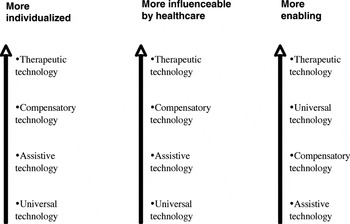
In the preceding section, the four types of enabling technology were introduced in an order corresponding to how individualized they are. We have now seen that an ordering according to how enabling they are will be a different ordering. The two orderings are summarized in Figure 1. The diagram also contains a third ordering of the four types, namely, according to how accessible they are to decisionmaking in the healthcare sector. Therapeutic technology is fully within the purview of healthcare. The degree to which access to compensatory and assistive technology can be influenced by healthcare professionals differs between countries and healthcare systems. Generally speaking, access to compensatory technology is, to a large extent, subject to decisions in the healthcare sector, whereas assistive technology often belongs to the welfare sector or to the private sector(s). Of the four types of enabling technology, universal technology is least accessible to influence from the healthcare sector.

Three gradings of the four types of enabling technology.
Problems of Resource Distribution
Resource limits and problems of resource distribution (prioritization) are central in medical ethics. When we widen the discourse to also cover nonmedical technology, these problems will be further accentuated. Unfortunately, full adaptation of all technologies to people with all kinds of disabilities would not be economically realistic in practice. This was brought out by Ron Amundson with the drastic example of a hypothetical blind person who wants to become an airline pilot.11
See note 1, Amundson 1992.
Some issues of equal access, such as access to public buildings and public documents, concern civil rights. This is a reason to give them very high priority. However, enabling technologies are also used for purposes that are not covered by (common conceptions of) civil rights.12
See note 1, Amundson 1992.
Regarding the latter example it should be noted that it is not self-evident that the notion of civil rights covers adjustments of the natural environment. See note 1, Amundson 1992:116.
There has not been much ethical discussion on how enabling technologies should be weighed against other social objectives. However, some recent discussions in political philosophy have high relevance for this issue. In the debates that have centered around the question “Equality of what?”, discussants have ventilated a sizable number of proposals for what should be distributed equally or equitably.14
Hansson SO. Equity, equality, and egalitarianism. Archiv für Rechts- und Sozialphilosophie (ARSP) 2001;87:529–41.
The major starting point of the “Equality of what?” discussion was John Rawls's theory of justice. According to Rawls, a just social distribution consists of a fair distribution of primary social goods. These are “things which it is supposed a rational man wants whatever else he wants” (p. 92), such as rights and liberties, opportunities and powers, income and wealth.15
Rawls J. A Theory of Justice. Oxford: Oxford University Press; 1972.
See note 15, Rawls 1972:93–4.
Critics have pointed out that Rawls's proposal fails to take into account that different people have different needs. Economist Kenneth Arrow, who was one of the first to criticize this feature of Rawls's theory, used the example of a hemophiliac who needs expensive medication to survive. This example puts in doubt that equal access to primary social goods leads to social equality.17
Arrow K. Some Ordinalist-Utilitarian notes on Rawls's theory of justice. Journal of Philosophy 1973;70:245–63.
Replying to this criticism, Rawls confirmed that his theory of justice is based on the assumption that everyone has physical needs and psychological capacities “within the normal range” so that “the problems of special health care and how to treat the mentally defective” need not be considered. This was, in his view, a justified exclusion because he wanted to avoid “prematurely introducing difficult questions that may take us beyond the theory of justice” and “distract our moral perception by leading us to think of people distant from us whose fate arouses pity and anxiety” (p. 96).18
Rawls J. A Kantian conception of equality. Cambridge Review 1975;96:94–99.
According to Amartya Sen, the failure of Rawls's theory of justice to assign compensatory resources to disabled persons is only a sign of a more fundamental deficiency in this theory:
If people were basically very similar, then an index of primary goods might be quite a good way of judging advantage. But, in fact, people seem to have very different needs varying with health, longevity, climatic conditions, location, work conditions, temperament, and even body size (affecting food and clothing requirements). So what is involved is not merely ignoring a few hard cases, but overlooking very widespread and real differences. (p. 366)19
Sen A. Equality of what. In: Sen A. Choice, Welfare and Measurement. Oxford: Blackwell; 1982:353–69.
Sen has proposed an alternative to Rawls's account, namely, that what should be distributed equally is capabilities, such as the ability to move about, the ability to meet one's nutritional requirements, the power to participate in the social life of one's community, and so forth. Because there are many different capabilities, they have to be weighed with an index, just as the primary social goods. According to Sen, such an index should be focused on “basic capabilities,” but the details of this have not been worked out.20
See note 19, Sen 1982.
Norman Daniels has criticized this approach, claiming that equality in capabilities is not a tenable goal for society. “What is of urgent moral concern to us is not assuring equality of capability in some global way, in all its dimensions, but the more modest goal of protecting individuals from certain impairments of their capabilities.” Only what falls below “a normal range of functioning” requires compensation.21
Daniels N. Equality of what: Welfare, resources, or capabilities? Philosophy and Phenomenological Research 1990;50:S273–98 at p. S283.
Sen A. Rights and capabilities. In: Honderich T, ed. Morality and Objectivity. London: Routledge; 1985:130–48.
Ronald Dworkin, another major participant in these debates, follows Rawls in favoring fair distribution of resources, but uses a wider concept of resources. The resources that an individual has access to can be divided into two categories: external resources, such as money and physical objects, and internal resources, such as physical and mental capacities. According to Dworkin, when comparing people's access to resources, we should take both their internal and their external resources into account. If two persons have the same amount of external resources, but one of them is paraplegic, then the distribution of resources between them is not equal.23
Dworkin R. What is equality? Part 1: Equality of welfare. Philosophy and Public Affairs 1981a;10:185–246; Dworkin R. What is equality? Part 2: Equality of resources. Philosophy and Public Affairs 1981b;10:283–345.
An obvious approach would be to require that the external resources be redistributed in such a way that equality is achieved in terms of total (external plus internal) resources. Dworkin rejects this solution as unrealistic. No compensation, however large, can compensate for a severe disability.24
See note 23, Dworkin 1981b:300.
The totality of a person's external and internal resources determines her capabilities. Therefore, there is a close similarity between Sen's proposed equality of capabilities and the equal distribution of total resources that Dworkin rejects. Dworkin's main argument, that severe disabilities can never be fully compensated for, applies equally to Sen's equality in capabilities. Commenting on this, Sen answers essentially that although equal opportunities may not be a realistic model for immediate implementation it is an excellent guidepost telling us in which direction to go.25
See note 22, Sen 1985.
These discussions are clearly highly relevant for the distribution of resources for compensatory and assistive technology. In the present author's opinion, there is no doubt that Amartya Sen's capability approach is the one that corresponds most closely to current priority-setting standards in healthcare. The application of this proposal to compensatory and assistive technology would therefore lead to priority-setting practices that are continuous with well-established ethical criteria for the distribution of resources for therapeutic technologies.
However, if we try to apply this proposal, or any other of the proposals from the “equality of what” discussion, to universal technology, then an important limitation will be revealed: This discussion has only been concerned with the distribution of resources between persons. Resources for therapeutic, compensatory, and assistive technology can be redistributed in this way, but universal technology has to be treated differently. Although adjustments of universal technology are essential for equality between persons, such adjustments do not take the form of redistribution between persons. Instead, they take the form of assigning resources to public goods that will reduce the need for redistribution between persons. This is an important aspect of equality that does not seem to have received philosophical attention. The intermediate position of universal technology on the normative scale introduced in the section “A Normative Grading of the Four Types” contributes to complicating the picture. To develop a political theory that can deal adequately with differences between humans (instead of abstracting from them as Rawls does), tools need to be developed that can be used to analyze the choice between certain types of public goods and redistributions between individuals as means to reduce inequality.
Another complication is that decisions on enabling technologies have to be made in social sectors other than the healthcare sector. In particular, decisions on universal technology (e.g., the adaptation of buildings, communication systems, and household appliances to variations in the population) are largely made in contexts where ideas of social justice and equal treatment have less influence than in healthcare. All this gives rise to coordination problems that are in need of careful ethical and decision-theoretical analysis.
Problems of Autonomy
One of the major positive effects of enabling technology is to increase personal autonomy. However, there are at least four complications that make the relationship between autonomy and enabling technologies less than straightforward.
Patient reluctance to use compensatory and assistive technology is a well-known phenomenon in rehabilitation medicine.26
See note 1, Caplan et al. 1987; Purtilo R. Rehabilitation and technology: Ethical considerations. International Journal of Technology and Aging 1991;4:162–70.
Strand EA. Clinical and professional ethics in the management of motor speech disorders. Seminars in Speech and Language 2003;24:301–11.
See note 1, Caplan et al. 1987.
See note 26, Purtilo 1991.
Lidz CW, Appelbaum PS, Meisel A. Two models of implementing informed consent. Archives of Internal Medicine 1988;148:1385–9.
Self-inflicted risks. The healthcare sector has a strong tradition of risk avoidance. Patients expect healthcare personnel to take far-reaching precautions to avoid all avoidable iatrogenic damages. However, as soon as the patient leaves the clinic, the criteria internal to healthcare do not apply any more. Outside of the hospital, the patient makes her own decisions on what risks to take or accept.31
Bach JR, Barnett V. Ethical considerations in the management of individuals with severe neuromuscular disorders. American Journal of Physical Medicine and Rehabilitation 1994;73:134–40.
Lantos JD, Kohrmann AF. Ethical aspects of pediatric home care. Pediatrics 1992;89:920–4, at 921.
Subordination to technology will probably become an increasingly serious problem as enabling technology is developed that exhibits more and more intelligent behavior. This problem has already been discussed in relation to such comparatively simple devices as “salt pencils” that indicate the contents and the dietary value of food.33
Dittmar A, Axisa F, Delhomme G, Gehin C. New concepts and technologies in home care and ambulatory monitoring. In: Lymberis A, de Rossi D, eds. Wearable eHealth Systems for Personalised Health Management. State of the Art and Future Challenges. Amsterdam: IOS Press; 2004:9–35.
Reduced human contact. One of the most important effects of enabling technologies is to facilitate human communication. Hearing aids, textphones, appliances for reading and writing, speech reading programs, and various technologies for physical mobility are all examples of this. However, enabling technology can also replace human contacts or reduce the need for them. It can, for instance, reduce the need for human support services. This is, in principle, always desirable, but it can, in practice, lead to social isolation that is ethically problematic. As was noted by Frances Grodzinsky, disabled persons who have become dependent on human support services often find independence frightening.34
See note 5, Grodzinsky 2000.
Recently, technology specifically intended to replace human contact has become available in the form of companion robots. These products have been developed in Japan, where there is less resistance to robots with human features than in Europe or North America. Elderly patients are invited to interact with robots such as the robot baby seal Paro, which reacts when one speaks to it or pets its fur, and the “healing partner” Yumel, which looks like a baby boy, has a vocabulary of 1200 phrases, and sings lullabies. Patients tend to appreciate these robots, cuddle with them, and talk to them. Some patients with age-related dementia do not realize that they are interacting with a machine.35
Sullins JP. Building the perfect companions: The humane design of personal robotics technologies. Manuscript, 2005.
Conclusion
The quality of life of people with disease or disability depends to a large extent on the availability of enabling technology. Decisions on such technologies are partly made in the healthcare sector, partly in other sectors of society. Furthermore, ethical issues pertaining to the use of enabling technologies extend far beyond the traditional area of medical ethics. Therefore, enabling technologies provide an excellent testing ground for determining the relations between ethical principles in healthcare and in the surrounding society.