Introduction
Weed control is second only to labor supply as the most serious concern of organic growersReference Walz1. Weeds remain a serious issue even in small organic research plotsReference Posner, Baldock and Hedtcke2. Although the benefits of crop rotation, sanitation, etc. for long-term weed management systems are recognized widely by growers, a demand still exists for new and improved tactics for short-term weed control. Despite the existence of several organically compatible forms of weed control, such as flaming, steaming, inhibitory natural products and so forth, most organic growers still rely heavily on repeated soil tillage for weed control. Because soil tillage may diminish soil health, new weed control techniques that do not involve soil disturbance would be welcomed by growers.
Previous work has demonstrated that innocuous grits derived from agricultural residues could be used for post-emergence control of small seedlings of broadleaf weedsReference Forcella3. Weed seedlings were controlled by abrasion if grits were propelled from nozzles at air pressures of about 500 kPa. The apical meristems or growing points of most broadleaf weeds are above the soil surface and, consequently, their abrasion and shredding by grits resulted in nearly complete death of small seedlings.
Meristems of grasses typically remain below the soil surface during seedling development for a much longer period of time than those of broadleaf plants. Consequently, air-propelled abrasive grit may not control grass seedlings as effectively as those of broadleaf weed seedlings. In other words, even though the exposed leaves of grass seedlings may be abraded completely by grit, the shredded portions of leaves could be replaced by continual leaf elongation and development from the buried meristems.
Another important issue for organic farmers, besides weed control, is soil fertility, especially soil nitrogen. Most nitrogen in organic systems is supplied through legume-based crop rotations and green and animal manure. Additional sources of nitrogen are desirable, particularly those that can be applied in a flexible and as-needed manner. Rhizobially fixed nitrogen and manures require time and long-term scheduling (e.g., rotations) that may not allow farmers to capitalize on short-term market opportunities. For this and other reasons, protein-rich products have been used by organic farmers for fulfilling nitrogen requirements of their crops. These products have included seed meals, i.e., products that remain after oil or starch extraction from seeds of canola, corn, cotton, etc. Traditionally these meals are used as livestock feeds, but some can be used also as organic fertilizersReference Kücke4, Reference Müller and von Fragstein und Niemsdorff5.
Agricultural residues previously used as grits for weed control included corn (maize) cobs and walnut shells. These materials are comprised mostly of carbohydrates and would be expected to have little effect on soil chemistry other than contributing small amounts of carbon and other elements to soil organic matter. In contrast, corn gluten meal (CGM) is of particular interest as both a grit and a labile organic fertilizer. CGM is a by-product of the wet milling process of maize grain. It contains 9–10% N, and when added to soil it releases this N over 1–4 monthsReference Müller and von Fragstein und Niemsdorff5–Reference Card, Whiting, Wilson and Reeder7. CGM could provide N fertilizer, while simultaneously controlling small weed seedlings. Moreover, CGM also may inhibit radical growth of seeds of late-emerging species, such as Digitaria sanguinalis L.Reference Liu, Christians and Garbutt8, thereby providing three potential benefits from one application: post-emergence weed control, crop fertility and pre-emergence weed control of late-emerging weeds.
Grit can be derived from maize cobs or CGM. Worldwide 27 countries each produce at least 1 million hectares of maize, with the USA alone harvesting over 30 million ha9, and even small nations such as New Zealand may produce over 100,000 haReference Booker10. Consequently, the raw material for grit production is widely available.
Our objectives for the project described here were twofold. The first was to determine if seedlings of a common summer annual grass weed, known as yellow foxtail or yellow bristlegrass (Setaria pumila [Poir.] Roem. & Schult.=S. glauca [L.] P. Beauv.) could be controlled by timely applications of air-propelled grit. The second goal was to examine CGM for its efficacy as a (soft) grit compared to a traditional hard grit such as fine quartz sand.
Materials and Methods
A series of experiments were performed, each twice, in the outdoor Plant Protection nursery of AgResearch, Ruakura Research Centre, Hamilton, New Zealand. All experimental work was carried out between December 10, 2009 and February 5, 2010. Daily growing conditions during this period were as follows: minimum and maximum air temperatures (±SE), 12.3±0.51°C and 23.2±0.31°C; solar radiation, 23.6±0.87 MJ m−2; and rainfall, 2.9±1.12 mm. In addition, the nursery was irrigated with 6 mm of water by an overhead sprinkler system each morning and afternoon.
Experimental methods common to all experiments are described in this and the following paragraph, whereas specific details for individual experiments are explained separately. All plants were grown in 1.5-litre plastic pots (15 cm diameter) which were filled with ‘Daltons GB Potting Mix’. This mix contained a complete source of macro, micro and trace elements needed for the growth of plant seedlings over the course of 4–6 weeks; consequently, no supplemental fertilizer was added. After seeds were sown (see below) on the soil surface, additional potting mix was placed in the pots, resulting in the final soil surface being 1 to 2 cm above the seeds. Pots were thoroughly watered immediately after seeds were sown. Seeds of S. pumila were collected from the Waikato District of New Zealand's North Island during the growing season of 2007/2008.
The abrasion of seedlings was performed via a trigger-operated sandblasting nozzle as pictured elsewhereReference Forcella3. The nozzle was connected to a 5.6 kW (7.5 horse power) air compressor (LT270, ABAC Co.) with air delivery regulated at 500 kPa. A 250 ml funnel served as the grit reservoir, which was placed above the nozzle and connected to it with a clear nylon hose. Thus, both gravity and suction fed grit into the nozzle when the trigger was squeezed, and the presence of grit or air pockets could be seen through the clear hose and corrected if necessary. The tip of the nozzle typically was positioned 60 cm from the centre of the treated seedlings and at a 30° angle from the horizontal. The nozzle was secured in place with clamps on a burette stand. Grit used for abrasion was the granular formulation of AvonGold CGM (New Zealand Starch, Penford New Zealand Ltd), and fine quartz sand (source unknown). Grit diameters (mm) were approximately 0.3±0.07 for CGM and 0.6±0.07 for sand.
Repetitious abrasion and recovery
In this experiment, we queried whether S. pumila (i) can recover from abrasion and (ii) whether abrasion effects differ between CGM (soft grit) and fine quartz sand (hard grit).
Approximately 10 seeds of S. pumila were sown in each of 30 pots on December 10, 2009. Treatments were applied on December 21 when each pot had, on average, five seedlings; 40% at the spike stage (0-leaf, 8 mm tall) and 60% at the 1-leaf stage of growth (13 mm tall). At that time 15 pots were selected randomly for the following five treatments, each with three replications: (i) 1 s of abrasion with fine quartz sand, (ii) 2 s abrasion with fine quartz sand, (iii) 1 s of abrasion with CGM, (iv) 2 s abrasion with CGM and (v) the control treatment with 2 s of abrasion with air (no grit) at 500 kPa pressure. The experiment was repeated on December 26 when there were, on average, six seedlings per pot, with 25% at the spike stage (9 mm), 50% at the 1-leaf stage (15 mm) and 25% at the 2-leaf stage (20 mm).
Injury due to abrasion was rated visually 7 days after treatment on a score of 0 to 10, with 0 indicating no effect compared to control plants and 10 indicating complete death. All plants in each pot also were measured at that time for maximum height above the soil level of living green tissue. Subsequently, each pot was treated again, and this sequence was repeated at weekly intervals for two additional weeks. One week after the third abrasion, the plants were scored and measured as above and then harvested. Plants were cut at the crown, dead leaf tissues carefully excised, dried at 60–80° C for 2 days and weighed to the nearest 0.1 mg.
Abrasion duration and distance
The purpose of this experiment was to explore the effects of (i) the duration of grit abrasion and (ii) the proximity of the weed to the 28 grit source.
Approximately ten seeds of S. pumila were sown in each of the 54 pots on December 10, 2009 and, subsequently, seedlings were thinned to four per pot. On December 30, when seedlings were at the 2- to 3-leaf stage of growth, they were subjected to the following treatments, each with three replications: (i–v) 1, 2, 3, 4 or 5 s abrasion by CGM at 60 cm distance between nozzle and seedlings; (vi–x) as above but at 30 cm distance between nozzle and seedlings; (xi) 5 s of air (no grit) at 30 cm; and (xii) control (i.e., no grit or air). Visual injury was rated 1 week after treatment (January 6, 2010), as was the maximum height of the living green tissue of each plant. Plants were harvested and processed as described earlier. The experiment was repeated, with seed sowing on January 6, 2010, treatments occurring on January 19, and measuring and harvesting on January 28.
Air pressure effects
In this experiment, we explored the effects of differing (i) air pressures and (ii) distances of the weed from the grit source.
Twenty seeds of S. pumila were sown in pots on January 6, 2010, thinned to four seedlings per pot, and treated on January 29, 2010 when the plants were at the 4- to 5-leaf stages of growth and were 67±3.7 mm tall. Main treatments involved air pressure at 250, 500 and 750 kPa for propelling CGM grit. Sub-treatments were 30 and 60 cm distances between the nozzle and the potted seedlings. There were three replications per sub-treatment. Grit was applied for 5 s duration to each pot. Control pots received 5 s of air only at 500 kPa pressure at 30 cm distance. Injury was evaluated 1 week after treatment, at which time heights of all surviving plants were measured. At this same time, green tissues were cut at the soil surface, dried and weighed as above. The experiment was repeated with a different set of pots the same day.
Selective control in maize
In this experiment, maize was tested as a ‘model’ crop to document whether a weed could be selectively controlled without adversely affecting crop growth.
Twenty seeds of S. pumila and five seeds of maize (Pioneer ‘36H36’) were sown into each of 16 pots on December 10, 2009. (Maize did not emerge adequately in a repeated experiment, which was abandoned.) Subsequently, pots were thinned to four S. pumila seedlings and one maize seedling per pot. All weed seedlings were rooted within 5 cm distance of the maize seedling. The four treatments were as follows: (i) at the 2-leaf, (ii) 3-leaf and (iii) 4-leaf stages of maize, the weed seedlings of four pots were subjected to 5 s of abrasion by CGM grit; and (iv) weed seedlings in four other pots were exposed to 5 s of compressed air, but not grit, which represented the control treatment. The nozzle was spaced 60 cm from the seedlings and at a 30° angle from the horizontal, which created an oval spray pattern of about 10×13 cm (data not shown), which means that the bases of the maize plants as well as the weeds were affected by the grit. Leaf stages and heights of all seedlings were recorded immediately prior to treatments. Visual injury to maize and weeds was rated 1 week after each treatment, as was the height of living green tissue of each plant. Maize and weeds were cut at the soil level 1 week after the 4-leaf treatment, dried at 70°C for 1 week and weighed.
Grit delivery rate
This experiment was necessary to determine the amount of grit propelled per second at 500 kPa by the applicator in the above experiments.
The rate of grit delivery was measured by placing the burette stand and all attached items, including the funnel full of grit, onto a balance and weighing the entire apparatus before and after 5 s of abrasion each of four times for both sand and CGM grits. Means and standard errors were calculated for grit deliveries per second for each grit type.
Effects of CGM without air pressure
Because evidence exists for CGM to behave as a pre-emergence herbicideReference Liu, Christians and Garbutt8, Reference Bingaman and Christians11, its effects on S. pumila seedling emergence and growth were examined.
The experiment began on December 10, 2009, wherein about ten seeds of S. pumila were sown in each pot. The six treatments were as follows, each with three replications: 0, 1.8, 4.4, 8.8, 17.7 and 44.2 g pot−1 of CGM spread evenly on the surface of the pots 1 day after the seeds were sown. These rates were equivalent to 0, 100, 250, 500, 1000 and 2500 kg ha−1 of CGM. The experiment was repeated on December 30 with exactly 20 seeds of S. pumila in each pot. The number, leaf stage and heights of all seedlings were recorded on December 29 for Experiment 1 and January 19 for Experiment 2.
Statistical analyses
In each experiment, pots were arranged in a randomized complete block design after treatment. Statistical analysis of categorical data involved analysis of variance (ANOVA)12. Each experiment was repeated in time, and in the absence of significant (P<0.05) experiment×treatment interactions, the data for both experiments were combined. Non-linear regression was used to examine and summarize continuous data. If regression parameters did not differ (P>0.05) between experiments, data were aggregated and parameters compared only between treatments. Otherwise, experiments were analyzed separately.
Injury ratings were divided by 10 and then the arcsine-square root transformed prior to statistical analyses, but back-transformed for presentation. Because standard errors are difficult to report for back-transformed means, Tukey's honest significant difference (HSD) was used for grouping back-transformed injury values.
Results
Repetitious abrasion and recovery
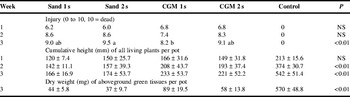
Although injury levels differed between experiments, no interactions occurred between experiments and treatments. Consequently, data for the two experiments were combined (Table 1). Visual injuries to S. pumila seedlings 1 week after abrasion treatments ranged from 6.0 to 6.8 at week 1, 7.4 to 8.6 at week 2 and 8.2 to 9.5 at week 3. Differences in the duration of grit application were not apparent. The only significant difference occurred at week 3 when 1 s of CGM was found to injure seedlings less than 2 s of sand. However, a trend of increasing intensity of injury over time was apparent for each grit treatment.
Average effects (±SE) of 1 or 2 s of air-propelled sand or CGM grit on injury and heights of S. pumila seedlings 1 week after each of three successive weekly treatments, as well as final shoot dry weights. For visual injury, ratings are back-transformed means followed by Tukey's HSD groupings across treatments; invariant ratings for control plants were not included in ANOVA.

Means not followed by letters in common differ significantly.
In all grit treatments, cumulative maximum heights of green tissue of all living plants within each pot were shorter than those in the control treatment in weeks 2 and 3. However, heights were equivalent in all grit-treated pots. Cumulative height of all living plants was a non-destructive measurable variable and was less subjective than visual injury ratings. Both variables allowed comparisons of the same plants over time.
At the final harvest, dry weights of plants closely reflected both measured plant heights and estimated injury levels. Grit treatments did not differ among themselves, but each differed from the control treatment. Relative to control plants, treatments reduced dry weights by 84–94%. Consequently, the results of all three variables signified that (i) a soft grit-like CGM is as effective as a hard grit in terms of severity of damage inflicted on seedlings, (ii) 1 s of grit delivery works as well as 2 s and (iii) good control of grass seedlings may require more than one grit application.
Abrasion duration and distance
Visual injury, seedling height and dry weight of seedlings were highly correlated to one another in terms of the effects of the duration of abrasion by grit and the distance of the nozzle from the plants (data not shown). Consequently, only results for plant dry weights are described below.
Plants attained different weights in response to abrasion in the two experiments. These differences were detected readily through best-fit non-linear asymptotic regressions (P<0.05, F distributions >20). Therefore, data for each experiment were analyzed and presented separately. Differences were likely due to daily air-temperature and time-span disparities: i.e., 16.4±0.43°C over 18 days in Experiment 1 (smaller plants) and 18.0±0.53°C over 23 days in Experiment 2 (larger plants).
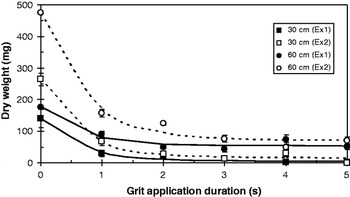
Despite the differences between experiments, similar trends were apparent in response to abrasion duration and distance (Fig. 1). A single abrasion event for one or more seconds of CGM grit injured seedlings of S. pumila, but for each experiment the level of injury was much greater (P<0.05) when the nozzle was placed at 30 cm distance from the seedlings than at 60 cm distance. When plants were exposed to more than 1 s of abrasion by grit, slight additional loss in dry weight occurred.
Dry weights of S. pumila seedlings 1 week after abrasion by CGM grit for 1–5 s at 500 kPa when the applicator nozzle were either 30 cm or 60 cm from the target plants. Results from two experiments (Expts) are shown. Vertical bars represent±SE.

Dry weight reductions were related to the duration of grit application in a non-linear manner. Best-fit asymptotic equations for each distance in each experiment (Ex) were as follows: (Ex 1, 30 cm) mg=6.3209+133.64×0.2063 kPa, r 2=0.99; (Ex 2, 30 cm) mg=15.847+248.67×0.212 kPa, r 2=0.98; (Ex 1, 60 cm) mg=53.765+123.85×0.2045 kPa, r 2=0.98; (Ex 2, 60 cm) mg=70.894+402.77×0.2479 kPa, r 2=0.94. Each equation differed significantly (P<0.05) from the others.
Compared to plants treated with neither grit nor air, dry weights of plants treated with 5 s of air only at 500 kPa were reduced significantly (P<0.05) by 64±3.2% at 30 cm distance and 52±9.1% at 60 cm distance. We speculate that the reduction in dry weight of plants exposed to 5 s of air only was due to abrasion by dislodged and airborne potting soil rather than the air itself. Abrasion by 1 or 2 s of air only was not obvious in any of our experiments. The difference between the two distance treatments in the absence of grit was marginal (P=0.09).
These results indicate that nozzles placed 30 cm from weed seedlings are more effective than those placed at 60 cm. Moreover, increasing the duration of abrasion by grit beyond 1 or 2 s had little additional effect on injury, height reduction or dry weight decrease. Additionally, although abrasion by air alone for 5 s reduced plant dry weights, the addition of grit to the air stream for just 1 s substantially reduced dry weights even more.
Air pressure effects
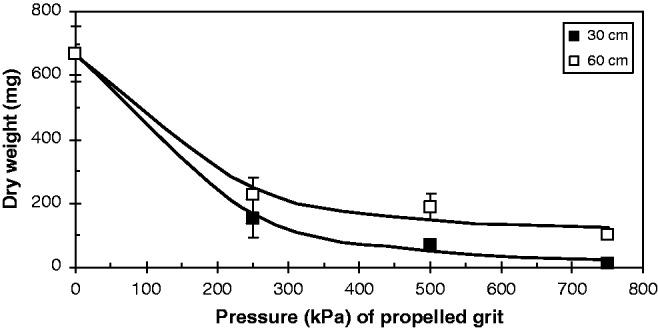
Visual injury and cumulative plant height were closely related to the dry weight of S. pumila seedlings, thus only results for dry weights are shown in Fig. 2. Because results from each experiment did not differ (P>0.05), data were combined. Dry weights (mg) of plants at each nozzle distance fit separate non-linear asymptotic relationships with respect to differing air pressures. The associated equations were (30 cm) mg=16.161+649.55×0.9942kPa (r 2=0.86) and (60 cm) mg=116.26+548.65×0.9944kPa (r 2=0.91). The two equations differed (P=0.05) significantly with a calculated F distribution value of 3.2.
Dry weights of S. pumila seedlings after treatment with CGM grit propelled at different air pressures when the applicator nozzle was spaced at 30 or 60 cm from the target plants. Vertical bars represent ±SE.
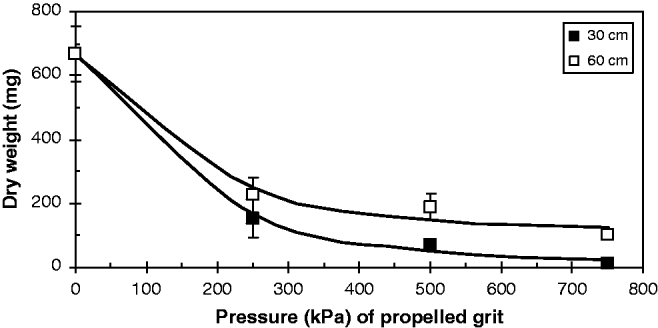
Dry weight reductions were greater when the nozzle was spaced 30 cm from the plants than 60 cm under each pressure regime. Dry weight reductions also increased with air pressure, but at decreasing rates once 250 kPa was exceeded. At the highest pressure and closest distance (750 kPa and 30 cm), injury was sufficient to cause nearly complete plant death.
Selective control in maize
Maize height at harvest averaged 36±1.2 cm and did not differ among treatments (P>0.1). Maize leaf developmental stage did differ among treatments (P<0.05), but only slightly, with the control, 2-leaf, 3-leaf and 4-leaf treatments attaining 5.6±0.05, 5.8±0.05, 5.9±0.03 and 5.9±0.03 leaves per plant, respectively. The control plants were smaller than the plants in the 3- and 4-leaf treatments, but were equivalent to plants in the 2-leaf treatments. The 2-, 3- and 4-leaf treated plants had equivalent stages of leaf development. Maize dry weights also differed (P=0.01) among treatments. The average maize seedling dry weights at harvest were 1.4±0.10, 2.5±0.24, 2.1±0.24 and 2.3±0.15 g for the control, 2-leaf, 3-leaf and 4-leaf treatments, respectively. The control plants weighed less than the 2- and 4-leaf plants, but were equivalent to the 3-leaf plants. Weights of the 2-, 3- and 4-leaf plants did not differ.
At the final harvest, weights of S. pumila differed significantly (P<0.01). S. pumila plants in the control, 2-leaf, 3-leaf and 4-leaf treatments weighed 1.3±0.14, 0.4±0.09, 0.6±0.02 and 0.8±0.03 g, respectively. The control plants were heavier than the other treatments, which had equivalent weights. These results are based on a single experiment and should be viewed cautiously. Nevertheless, they suggest that grit applications when maize is in the 2-leaf through 4-leaf stages of growth will curtail growth of S. pumila and allow maize to grow better than when weeds are not controlled.
Grit delivery rate
The grit delivery rate was 7.2±0.38 g s−1 for fine quartz sand and 4.7±0.21 g s−1 for CGM at an air pressure of 500 kPa. To estimate how much grit would be needed to control weeds within and alongside crop rows, several assumptions were made, which included: crop rows were spaced at 75 cm, the applicator had twin nozzles to affect control on either side of the row and the applicator traveled at 1 km h−1. Given these assumptions, 445 kg ha−1 of CGM or 682 kg ha−1 of fine quartz sand would have been applied.
For comparison, when used as an organic fertilizer, rates of approximately 1000–2000 kg CGM ha−1 are recommended (100–200 kg N ha−1)7. Thus, even if the speculative calculated rate of 445 kg CGM ha−1 for weed control is two to four times too low, it still is within the range of recommended rates for use as an organic fertilizer.
Effects of CGM without air pressure
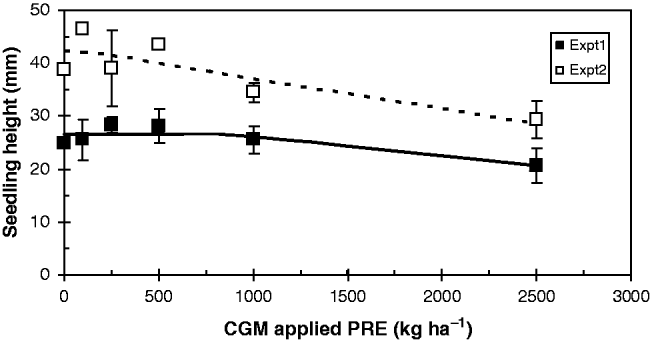
The rate of CGM applied pre-emergence did not affect S. pumila emergence (data not shown). However, seedling heights (mm) decreased slightly when fit to a Farazdaghi–Harris equation12 (pseudo r 2>0.99, P<0.01). Equation parameters differed significantly for each experiment (Fig. 3), perhaps because of a seemingly minor difference in average daily air temperatures during the experimental periods: 16.4±0.52°C over 19 days in Experiment 1 and 16.9±0.51°C over 20 days in Experiment 2. Parameters for the equations were as follows: Expt 1, mm=1/(0.0375+0.00000000001185×rate2.635) and Expt 2, mm=1/(0.0236+0.0000003201×rate1.3378), where rate is in kg of CGM ha−1.
Effect of CGM applied as a pre-emergence herbicide on average seedling height in two experiments. Vertical bars represent±SE.
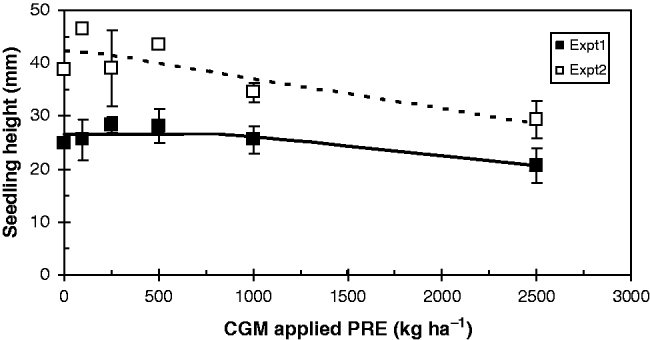
These best-fit equations indicated that seedling heights decreased by 10% from maximum estimated values between 850 and 1750 kg CGM ha−1 in the two experiments. This suggests that even high CGM rates affect seedling height growth very little. Whatever the case, CGM did not influence density or growth of S. pumila as extensively as it may affect some other weedy grassesReference Müller and von Fragstein und Niemsdorff5. Consequently, the effects on S. pumila by abrasive CGM grit observed in the prior experiments are likely due entirely to abrasion rather than chemical inhibition of decomposing CGM.
Conclusions
Our experiments represent ‘proof-of-concept’ only. They showed that the control of a summer annual grass, such as S. pumila, is amenable to abrasion during early seedling development. Furthermore, abrasion can be performed by post-emergence application of CGM, a substance already approved as an organically appropriate form of nitrogen fertilizer and pre-emergence herbicideReference Card, Whiting, Wilson and Reeder7. Although efficacy as a pre-emergence herbicide may be questionable, simultaneous post-emergence weed control and fertilizer application could be beneficial for organic growers. Lastly, even though maize was used successfully as a model crop in our experiments, we emphasize that weed abrasion by air-propelled grit may be more appropriate in higher value row crops, such as organically managed vineyards, orchards and soft fruit and vegetable production fields, or in non-crop areas such as urban sidewalksReference Rask and Kristoffersen13. Much additional research will be needed before air-propelled grit can be recommended as a form of organic weed management. For instance, slight but unavoidable damage to adjacent crops may provide entry points for plant pathogens and thereby compromise abrasion by grit as a useful tool for weed control. Nevertheless, the results reported here reveal an encouraging trend for the successful application of the technique.
Acknowledgement
This research was supported through a 12-week fellowship from the Organization of Economic Cooperation and Development to promote ‘Sustainability in Practice’ and cooperation between USDA-ARS and AgResearch.