Introduction
The red palm weevil, Rhynchophorus ferrugineus (Olivier) (Coleoptera: Dryophthoridae), is still the primary pest of palm trees (Arecaceae) worldwide (EPPO/OEPP, 2008). This weevil is native to Southeast Asia and Melanesia, where it is the key pest of coconut palms, Cocos nucifera (Linnaeus) (Arecales: Arecaceae) (Viado & Bigornia, Reference Viado and Bigornia1949). Although R. ferrugineus has a broad host range, it favours certain Phoenix species, such as Phoenix canariensis (H. Wildpret) and Phoenix dactylifera (Linnaeus) (Arecales: Arecaceae) (Murphy & Briscoe, Reference Murphy and Briscoe1999; Faleiro, Reference Faleiro2006). This pest invaded the Middle East in the mid-1980s, being present in over half of the date palm-growing countries, and causing major economic losses (Faleiro, Reference Faleiro2006). R. ferrugineus spread around the Mediterranean basin during the last two decades, but it has also reached Australia (EPPO/OEPP, 2008), and the American continent (EPPO/OEPP, 2009). Recently, it has been detected in countries such as Yemen (Assggaf, Reference Assggaf2013) and Russia (Karpun et al., Reference Karpun, Zhuraleva and Ignatova2014).
As a general rule, insects can be dispersed through their own movements (mainly through flight) or transported by humans. The former is necessary to perform vital roles such as feeding, mating, oviposition or migration (Goldsworthy & Wheeler, Reference Goldsworthy, Wheeler, Goldsworthy and Wheeler1989). In the case of R. ferrugineus, the trade of palm trees between territories (Abraham et al., Reference Abraham, Al-Shuaibi, Faleiro, Abozuhairah and Vidyasagar1998; Rugman-Jones et al., Reference Rugman-Jones, Hoddle, Hoddle and Stouthamer2013), and the high flight potential of this weevil (Ávalos et al., Reference Ávalos, Martí-Campoy and Soto2014), have facilitated its spread.
There are several techniques used to evaluate, under laboratory and field conditions, the flight potential and behaviour of insects and to determine the influence of biotic and abiotic factors. In laboratory, the flight mill technique allows the aforementioned aspects to be studied; however, flight data obtained from tethered insects should not be interpreted as an exact reflection of their flight potential in field (Cooter, Reference Cooter1993). Therefore it is essential to complement these data with field trials. Several methods and devices can be used outdoors to track insect movements: radio telemetry, harmonic radars, vertical-looking entomological radars, and radio frequency identification, among others (Chapman et al., Reference Chapman, Drake and Reynolds2011; Kissling et al., Reference Kissling, Pattemore and Hagen2013). Other less complex and less expensive methods can also be used to study the insect's flight range and its dispersal capabilities under field conditions. One of these is the mark-release-recapture (MRR) method, which has been used successfully to study numerous agricultural pests, including Ceratitis capitata (Wiedemann) (Diptera: Tephritidae) (Gavriel et al., Reference Gavriel, Gazit, Leach, Mumford and Yuval2012), Cydia pomonella (Linnaeus) (Lepidoptera: Tortricidae) (Margaritopoulos et al., Reference Margaritopoulos, Voudouris, Olivares, Sauphanor, Mamuris, Tsitsipis and Franck2012), Homalodisca coagulata (Say) (Hemiptera: Cicadellidae) (Coviella et al., Reference Coviella, Garcia, Jeske, Redak and Luck2006), and Leptinotarsa decemlineata (Say) (Coleoptera: Chrysomelidae) (Szendrei et al., Reference Szendrei, Kramer and Weber2009).
The prevention and control of infestations produced by R. ferrugineus require an integrated pest management program based on olfactory trapping with pheromones and kairomones, the application of chemical or biological insecticides, early detection of infestations, destruction of infested plant material, and mechanical sanitation (Hallett et al., Reference Hallett, Oehlschlager and Borden1999; Abbas et al., Reference Abbas, Saleh and Akil2001; Faleiro, Reference Faleiro2006; EPPO/OEPP, 2008; La Mantia et al., Reference La Mantia, Lo Verde and Ferry2008). Knowing and understanding the flight capability and behaviour of R. ferrugineus adults could help to improve the techniques to control this pest, such as olfactory trapping or the demarcation and management of pest outbreaks. The flying ability of R. ferrugineus adults under laboratory conditions has been analyzed by Ávalos et al. (Reference Ávalos, Martí-Campoy and Soto2014) and Hoddle et al. (Reference Hoddle, Hoddle, Faleiro, El-Shafie, Jeske and Salla2015), who studied different flight parameters and the influence of some biotic and abiotic factors in the flight potential of this insect. On the other hand, Abbas et al. (Reference Abbas, Hanounik, Shahdad and Al-Bagham2006) evaluated under field conditions the distances covered by weevil adults in P. dactylifera plantations using the MRR method. Finally, Oehlschlager et al. (Reference Oehlschlager, Chinchilla and González1992) studied the migration of another Rhynchophorus species, Rhynchophorus palmarum (Linnaeus) (Coleoptera: Curculionidae), and estimated its populations in oil palm plantations, Elaeis guineensis (Jacquin) (Arecales: Arecaceae). Despite the data gathered in these studies, there is still a lack of information regarding the flight behaviour and dispersal patterns of R. ferrugineus adults under field conditions.
The present study focuses on the flight behaviour and dispersal of R. ferrugineus adults, in order to analyze the influence of biotic and abiotic factors and to improve the strategies used to control this weevil. To this end, two MRR experiments were conducted in areas with infestation of the pest. The influence of R. ferrugineus sex, temperature, relative humidity, and solar radiation, was analyzed in terms of take-off and flight mobility. Moreover, their dispersal distances and times were calculated.
Materials and methods
Experimental insects
The unmated R. ferrugineus adults used in the experiments were obtained from cocoons collected from infested P. canariensis palm trees in the town of Algemesí, in Eastern Spain (latitude 39°11′N; longitude 00°26′W; altitude 17 m), between March 2009 and January 2012. Experimental insects were collected, kept, and fed, following the methodology described in Ávalos et al. (Reference Ávalos, Martí-Campoy and Soto2014). Weevil adults used in the MRR experiments were less than 30 days old.
Because R. ferrugineus is considered as a quarantine pest in some regions of the world, including Spain, and to avoid infestation of palm trees by oviposition of adult weevils, insects used in the MRR experiments were subjected to a process of manual sealing. The procedure consisted in sealing with cyanoacrylate glue (Super Glue-3, Henkel Ibérica, Barcelona, Spain) the aperture of the reproductive system, located in the insect's pygidium. In order to determine the lifespan of sealed insects, to ensure the sealing fixation, and to confirm the absence of oviposition, 11 couples of R. ferrugineus adults (males and females less than 7 days old) were manually sealed. Each pair of insects was placed in an individual box with food and was kept in a climatic chamber at 25 ± 2°C and 65 ± 5% relative humidity. Moreover, in order to determine if sealing affected the flying ability of R. ferrugineus adults, the number of flights, total distance flown, longest single flight, and total flight duration, of 231 (118 males and 113 females) sealed and 206 (115 males and 91 females) non-sealed adults, aged between 1 and 23 days old, were compared using the flight mill technique and the experimental procedure, as described by Ávalos et al. (Reference Ávalos, Martí-Campoy and Soto2014).
Marking technique
Released R. ferrugineus adults were marked by painting their pronotum with a white dot using correction fluid (Tipp-Ex, Societé BIC, Île-de-France, France), and covering it with a thin coat of transparent cyanoacrylate glue (Super Glue-3, Henkel Ibérica, Barcelona, Spain). In order to avoid confusing released insects between successive releases with time overlap, the mark was changed for each release, using either one or two white dots. Twenty adults were marked and placed during 30 days in a box containing pieces of palm tree stems and fibres, and kept in a climatic chamber at 25 ± 2°C and 65 ± 5% relative humidity, proving that this marking technique was distinctive and durable in all the tested insects.
MRR experiment 1
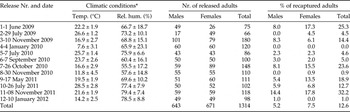
The first MRR experiment was conducted in the maritime area of the town of Castellón, in Eastern Spain (latitude 39°59′N; longitude 00°01′W; altitude 10 m), an area with a high infestation level of R. ferrugineus. The release point, as well as 37 white bucket traps, scattered according to the possibilities so as to fit a uniform distribution around the spot at distances between 220 and 1390 m (362 ha), were placed in the study area. Bucket traps (10 litre capacity) were baited with a R. ferrugineus male aggregation pheromone (Ferrolure+, composed of 4-methyl-5-nonanol and 4-methyl-5-nonanone [9:1], and containing 700 mg of 95% pure active ingredients), kairomone (composed of ethyl acetate, and containing 40 ml of 95% pure active ingredient) (Econex Ltd., Murcia, Spain), water and a piece of infested P. canariensis petiole (8 × 5 cm2). The recommended lifespan of the pheromone and kairomone dispensers was 3 months (Econex, 2013a , b ), being replaced after this time, together with the palm tree petioles. On twelve dates between 66 and 180 adults of both sexes were released in a wide range of climatic conditions, from June 2009 to January 2012 (table 1). Traps were inspected 1, 3, 7, 15, and 21 days after each release date, recording the number and sex of recaptured marked weevils. In addition, the effects of temperature (°C) and relative humidity (%) on the flight mobility of R. ferrugineus adults were recorded for later analysis.
Summary of the Rhynchophorus ferrugineus adult releases in MRR experiment 1: release dates, average (±SD) values of climatic conditions, number of released adults, and percentage of recaptured adults.
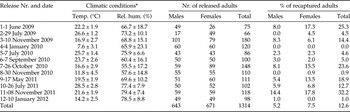
* Climatic conditions for each release period corresponds to the mean values of the 7 days after each release.
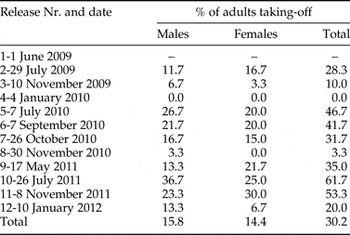
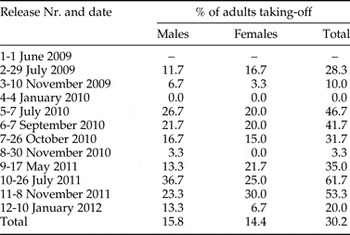
Moreover, the take-off of 60 of the released weevils (30 males and 30 females) was analyzed by direct observation (table 2) during 30 min, four times a day: 7:00a.m., 10:00a.m., 1:00p.m., and 4:00p.m. (15 adults each time), in order to determine if the weevil sex, temperature, relative humidity, or solar radiation influenced their take-off. The weevil take-off was analyzed from the second release date onwards.
Summary of take-off observation of the Rhynchophorus ferrugineus adults in MRR experiment 1: release dates and percentage of adults taking-off.
In order to analyze their effect on the take-off and flight mobility of the R. ferrugineus adults, the climatic data were recorded at the moment of the weevil release, and every 10 min during the 21 days following each release. These data were obtained from a weather station in the experimental area (latitude 39°90′N; longitude 00°01′W; altitude 16 m).
MRR experiment 2
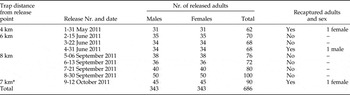
In order to measure the maximum flight distance travelled by R. ferrugineus adults in field, a second MRR experiment was carried out from June to October 2011 around the Albufera Natural Park, in Eastern Spain (latitude 39°24′N; longitude 00°31′W; altitude 7 m). This area was chosen because of its very low density of palm trees, and its topography (a large extension of completely flat rice fields with no geographical barriers), which facilitated weevil flight. The release point was surrounded by a ring of eight bucket traps, placed equidistant between them (same model and bait as in MRR experiment 1). Initially traps were placed at 4 km from the release point. Between 62 and 100 marked R. ferrugineus adults of both sexes were released each time, depending on the availability of cocoons in field (table 3). Traps were inspected 1, 3, 7, 15, and 21 days after each release date, and if at least one weevil adult was recaptured, the distance between the traps and the release point was increased by 2 km and a new set of weevils were released. If after four releases for the same tested distance no adult was recaptured, the trap distance from the release point was reduced by 1 km. The maximum flight distance was considered as the farthest, in which a weevil adult was recaptured.
Summary of the Rhynchophorus ferrugineus adult releases in MRR experiment 2: trap distance from release point, release dates, number of released adults, number of recaptured weevils and their sex, and maximum flight distance travelled by adults in field.
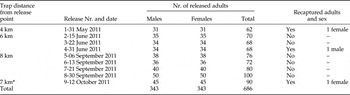
* Maximum flight distance at which a Rhynchophorus ferrugineus adult was recaptured.
Statistical analysis
A multifactor analysis of variance (ANOVA) was performed to determine the effect of pygidium sealing, sex, and age of weevil adults and their interactions on the parameters established to measure their flight potential in flight mill tests. Means were separated using Tukey's Honest Significant Difference test with a 5% significance level. Due to the periodicity of counting after each release, the flight potential parameters were analyzed grouping the ages in three ranges: from 1 to 6, from 7 to 14, and from 15 to 23 days old. Insects that did not fly were excluded from the data analysis. Given the positive asymmetry characteristic of this type of data, these were transformed by ln(x) before the analysis. A two-sample t-test was used to compare the effect of sex on the longevity of the sealed adults.
A binary logistic regression model was used to determine the significance of the weevil sex, temperature, relative humidity, and solar radiation on the insect take-off during MRR experiment 1. Due to the distribution of the recaptures, the mean values of the climatic factors during the 7 days after each release were used for the subsequent analyses. In order to detect any effect of weevil sex, temperature, and relative humidity on insect recaptures in MRR experiment 1, a binary logistic regression model was carried out. To study the influence of weevil sex, temperature, and relative humidity on the dispersal distances in MRR experiment 1, a multiple regression model was used. A χ2 test was used to compare the differences in recaptures between three tested trap distance ranges from the release point in MRR experiment 1: less than 500 m (9 traps), between 500 and 1000 m (19 traps), and between 1000 and 1390 m (9 traps) from the release point. A regression model with interval-censored data, assuming a lognormal distribution for time variable, was used to examine the influence of weevil sex, temperature, and relative humidity on the insect's recapture time in MRR experiment 1. Finally, to detect the differences in recaptures between surveyed time ranges after the release in MRR experiment 1, a χ2 test was used. All the analyses were performed using Statgraphics Centurion XVI (Statgraphics, 2010) and Minitab 14 (Minitab, 2004).
Results
Features of experimental insects
The mean (±SE) longevity of R. ferrugineus sealed adults was 16.7 ± 1.9 days (19.55 ± 2.8 days for males and 13.8 ± 2.5 days for females), with no significant differences between sexes (t-test: t = 1.54; df = 20; P = 0.1381). Esteban-Durán et al. (Reference Esteban-Durán, Yela, Beitia-Crespo and Jiménez-Álvarez1998) and Shahina et al. (Reference Shahina, Salma, Mehreen, Bhatti and Tabassum2009) reported that the mean adult longevity of R. ferrugineus under laboratory conditions ranged between 43 and 80 days. In addition, the seal remained intact until the end of their lives and no eggs were laid.
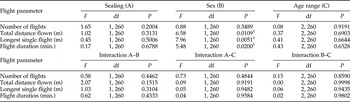
With regard to the influence of sealing on the flight potential of the R. ferrugineus adults, 138 (82 males and 56 females) sealed and 132 (72 males and 60 females) non-sealed weevils flew in the flight mill (59.7 and 64.1% of the tested insects, respectively). The mean (±SE) number of flights per insect recorded in the flight mill study was 14.3 ± 1.9 flights for the sealed insects, and 14.9 ± 2.3 flights for non-sealed ones. Likewise, the mean (±SE) values of total distance flown for both kinds of insect were 2344.6 ± 337.5 and 2615.4 ± 381.9 m, respectively. In their longest single flight, the sealed insects covered an average (±SE) of 1240.2 ± 194.3 m, and the non-sealed ones, 1312.5 ± 213.1 m. Finally, the average (±SE) flight duration for sealed and non-sealed insects was 27.6 ± 3.9 and 30.7 ± 4.5 min, respectively. Statistical analysis showed no differences in the flight potential of sealed and non-sealed R. ferrugineus adults (table 4).
Effect of sealing, sex, age range, and their interactions by pairs on flight parameters of Rhynchophorus ferrugineus adults tested, by multifactor analysis of variance (ANOVA).
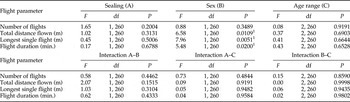
1 This value shows statistical significant differences (multifactor ANOVA).
Additionally, the R. ferrugineus age range did not influence the flight potential of the sealed or non-sealed insects (table 4). On the other hand, the sex of sealed and non-sealed weevils significantly affected their flight potential, being greater in males, except for the number of flights (table 4). The interactions by pairs between the pygidium sealing method, age range, and weevil sex had no significant influence on the flight potential parameters studied (table 4).
Overall, the flight potential of experimental insects was not influenced by the pygidium sealing, being their longevity the only analyzed factor affected. Because of the weevil longevity reduction, the evaluation period in subsequent MRR experiments was restricted to 21 days after each release.
Weevil take-off
Of 660 R. ferrugineus adults, the percentage of weevils that took-off was 30.2%, being 15.8 and 14.4% in males and females, respectively, and reaching a maximum value of 61.7% during one of the releases (table 2).
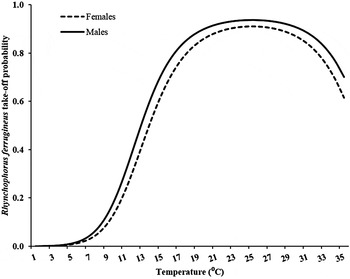
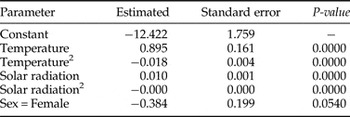
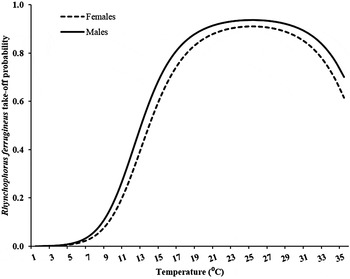
Concerning weevil's sex, statistical analysis showed that according to the generated binary logistic regression model with forward selection for take-off, the take-off probability was significantly higher in males compared with females (table 5). Regarding the abiotic factors analyzed, temperatures during the experiment reached minimum and maximum values of 8.8 and 32.3°C, respectively. Solar radiation varied between 0 and 883.5 W m−2, and relative humidity between 21 and 95%. Temperature and solar radiation, highly correlated, had a significant influence on take-off (table 5). With solar radiation at 400 W m−2, and a temperature of 10°C, the probability of take-off for males was 0.2189 (fig. 1). With the same solar radiation, but at 17°C, an intermediate temperature, this probability increased to 0.8308. Under the aforementioned solar radiation, and with a higher temperature (25°C), this probability rose to 0.9372, the maximum according to the model prediction. Therefore, a rise in temperature and solar radiation significantly increased the probability of take-off in the R. ferrugineus adults. This increase was less pronounced for high values of these climatic parameters, even a reduction could be seen in its take-off. On the other hand, relative humidity did not influence the weevil take-off.
Rhynchophorus ferrugineus take-off probability for males and females at different temperatures (°C) (solar radiation = 400 W m−2) in MRR experiment 1, according to the generated binary logistic regression model (forward selection).
Summary of the stepwise binary logistic regression model (forward selection) for the take-off of Rhynchophorus ferrugineus adults in MRR experiment 1.
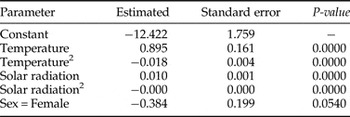
Hosmer–Lemeshow Goodness-of-fit test: χ2 = 5.009, df = 3, P = 0.1711.
Weevil flight mobility
A total of 1314 insects were released, and the mean percentage of recaptured weevils was 12.6%, reaching a maximum value of 32.2% during the 11th release (table 1). Concerning the total number of recaptured adults per sex, 5.2 and 7.5% of the males and females were recaptured respectively, with a ratio (±SE) of 1.4 ± 0.2 recaptured females per male.
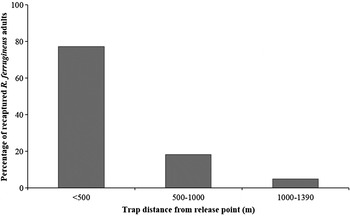
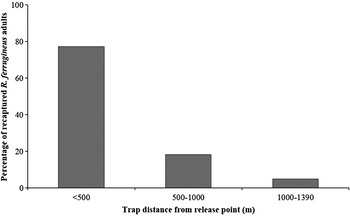
The analysis of dispersal distances of R. ferrugineus adults indicated that the highest percentage of recaptured insects (77.1%) was recovered from traps placed under 500 m from the release point (fig. 2), and significant differences were observed for the three range distances established (less than 500 m, between 500 and 1000 m, and between 1000 and 1390 m from the release point) (χ2 test: χ2 = 147.52; df = 2; P = 0.0000). On the other hand, in MRR experiment 2, 7 km was the maximum flight distance at which a marked R. ferrugineus adult was trapped, and although weevils were recaptured at closer distances (4 and 6 km), none were recaptured when traps were placed at 8 km from the release point (table 3).
Percentage of marked Rhynchophorus ferrugineus adults, recaptured in three established distance intervals in MRR experiment 1.
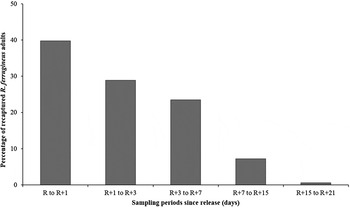
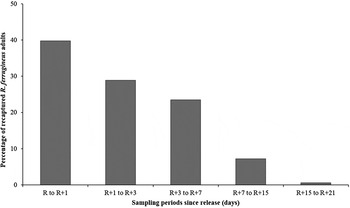
For the distances analyzed in MRR experiment 1, more than 90% of the recaptured R. ferrugineus adults were recovered during the first 7 days after their release (fig. 3), showing significant differences among surveyed times (χ2 test: χ2 = 84.78; df = 4, P = 0.0000). Likewise, it is important to note that in MRR experiment 2, the marked adult trapped at 7 km from the release point was recaptured in less than 5 h after its release.
Percentage of marked Rhynchophorus ferrugineus adults, recaptured in each sampling period after the release date (R) in MRR experiment 1.
The influence of weevil sex on the dispersal distances and times was analyzed and no significant effect was found (tables 6 and 7). Regarding the influence of climatic factors, the dispersal distances were significantly increased by rising temperatures (table 6). On the other hand, the dispersal time of the weevils was significantly influenced only by relative humidity, thus being reduced when humidity was higher (table 7). In accordance with the model generated, for relative humidity values between 80 and 100%, the probability of increasing the dispersal time was reduced between 40 and 60%, respectively.
Summary of the stepwise multiple regression model (forward selection) for dispersal distances of Rhynchophorus ferrugineus adults in MRR experiment 1.

Coefficient of determination R 2 = 4.7%.
Summary of the regression model with interval-censored data for dispersal times of Rhynchophorus ferrugineus adults in MRR experiment 1.
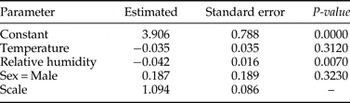
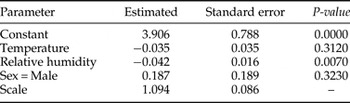
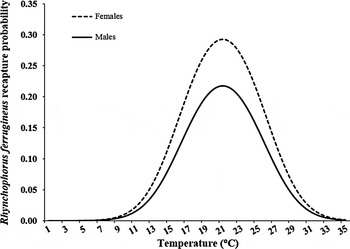
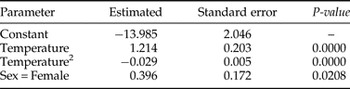
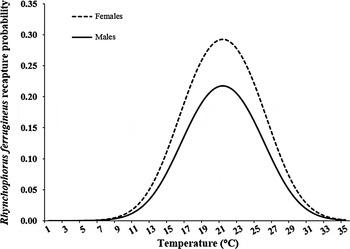
According to the generated binary logistic regression model with forward selection for recaptures, the weevil sex had a significant influence on the probability of recapture, being the recaptures female-biased (table 8). Regarding abiotic factors, and according to the predictions of the model generated (fig. 4), the probability of being recaptured increased significantly with a rise in temperature, reaching a maximum at 21°C (30%). This probability increase was less pronounced with high temperature values, and diminished with low temperatures, being above 10% for females, for temperatures between 15 and 27°C. On the other hand, relative humidity did not significantly influence the weevil recaptures.
Rhynchophorus ferrugineus recapture probability for males and females at different temperatures (°C) in MRR experiment 1, according to the generated binary logistic regression model (forward selection).
Summary of the stepwise binary logistic regression model (forward selection) for the recapture of Rhynchophorus ferrugineus adults in MRR experiment 1.
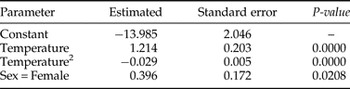
Hosmer–Lemeshow Goodness-of-fit test: χ2 = 4.126, df = 3, P = 0.2481.
Discussion
Influence of sex
The R. ferrugineus sex had different effects depending on the analyzed flight phase. The take-off probability of the R. ferrugineus adults was greater in males, in accordance with the analysis of their flight potential under laboratory conditions; however, in terms of flight mobility, more females were recaptured. As observed in the present study, Abraham et al. (Reference Abraham, Faleiro, Kumar and Al-Shuaibi1999); Faleiro & Rangnekar (Reference Faleiro and Rangnekar2000), and Al-Saoud (Reference Al-Saoud2011), among others, found that sex ratio captures in pheromone traps range from 1.94 to 2.7 females per male. Moreover, tests performed under controlled conditions using olfactometers also showed that females were more attracted to pheromones than males (Giblin-Davis et al., Reference Giblin-Davis, Faleiro, Jacas, Peña, Vidyasagar and Peña2013). This could be due to their requirement for mating places, new food sources and oviposition sites (Soroker et al., Reference Soroker, Blumberg, Haberman, Hamburger-Rishard, Reneh, Talebaev, Anshelevich and Harari2005). On the other hand, Ávalos & Soto (Reference Ávalos and Soto2015) observed that when traps were not baited with olfactory lures, the sex ratio of captures was not always female-biased. Therefore, the differences observed between sexes in the two analyzed flight phases could be an indication of the different dispersal behaviour depending on the weevil sex. A possible hypothesis is that R. ferrugineus males, which have a higher flight potential and take-off rate, are responsible for the first step to colonize a new host. When a R. ferrugineus male arrives to a new palm tree, it releases the aggregation pheromone that attracts both weevil sexes, but mainly females, increasing the likelihood of a successful colonization.
Weevil take-off
Generally, insect dispersal begins with take-off and requires some external stimuli and specific climatic conditions to induce flight (Johnson, Reference Johnson1969). In the present study the take-off of R. ferrugineus adults increased significantly as the ambient temperature increased, being optimal with temperatures between 17 and 25°C. In other Rhynchophorus species, such as Rhynchophorus cruentatus (Fab.), temperatures above 15°C also increase take-off probability (Weissling et al., Reference Weissling, Giblin-Davis, Center and Hiyakawa1994). Moreover, solar radiation, highly correlated with temperature, significantly influenced take-off of the R. ferrugineus adults, which increased with higher rates of solar radiation. With regard to this aspect, Johnson (Reference Johnson1969) pointed out that some coleopteran species have an asynchronous fibrillar type of flight muscles, preparing for flight by heating their thorax before unfolding their wings. Therefore, and despite R. ferrugineus being a tropical insect, intense solar radiation seems to be decisive in their take-off.
Weevil flight mobility
As occurred in the MRR studies performed by Abbas et al. (Reference Abbas, Hanounik, Shahdad and Al-Bagham2006) and Oehlschlager et al. (Reference Oehlschlager, Chinchilla and González1992), with R. ferrugineus and R. palmarum, respectively, in the present study very few recaptures of R. ferrugineus adults were obtained (12.6%). Kalshoven (Reference Kalshoven1981) and Abbas et al. (Reference Abbas, Hanounik, Shahdad and Al-Bagham2006) pointed out that high infestation levels cause higher pheromone and kairomone emission rates, attracting more weevils than compounds used to bait traps, thus explaining the low percentage of recaptures observed. In other MRR experiments with insect borer species such as Anoplophora glabripennis Motschulsky and Monochamus galloprovincialis Oliv. (Coleoptera: Cerambycidae), low rates of recapture (1.13 and 6.76%, respectively) were also reported (Smith et al., Reference Smith, Bancroft, Li, Gao and Teale2001; Hernández et al., Reference Hernández, Ortiz and Pérez2011).
The dispersal distances of R. ferrugineus adults tend to be short, since most weevils were recaptured at less than 500 m from the release point. Besides, as shown in MRR experiment 2, despite this tendency to fly short distances, R. ferrugineus was able to travel up to 7 km from the release point. In previous studies under laboratory conditions, without friction that hinders insect flight, the tendency of weevils to fly short distances and their ability to cover up to 20 km was observed (Ávalos et al., Reference Ávalos, Martí-Campoy and Soto2014). However, as the findings from the present study suggest, the percentage of weevils that can travel these long distances seems to be very low. Only Abbas et al. (Reference Abbas, Hanounik, Shahdad and Al-Bagham2006) managed to capture R. ferrugineus adults, which migrated up to 7 km. Likewise, the study by Oehlschlager et al. (Reference Oehlschlager, Chinchilla and González1992) provided information about the distances travelled by R. palmarum, concluding that most adults, as well as R. ferrugineus ones, were recaptured in traps placed at 500 m from the release point.
Regarding dispersal times for the distances analyzed in MRR experiment 1, the R. ferrugineus adults were quickly dispersed after their release, decreasing their recaptures to very low values from the seventh day onwards. Moreover, the results obtained in this study indicate that the flight potential of R. ferrugineus was not influenced by age. Therefore, this quick dispersal may be a consequence of the dispersal behaviour of the insect, which seeks and finds new hosts immediately after leaving a palm tree. Other MRR studies conducted by Abbas et al. (Reference Abbas, Hanounik, Shahdad and Al-Bagham2006) and Oehlschlager et al. (Reference Oehlschlager, Chinchilla and González1992) indicated that most of the released weevil adults are recaptured between the second and fifth day after their release.
Climatic factors are directly associated with R. ferrugineus mobility, mating season, and efficacy in searching for food sources; therefore, they play an important role in determining its activity (Faleiro, Reference Faleiro2006; Haris et al., Reference Haris, Nang, Chuah and Wahizatul2014). In the present study, temperature significantly influenced the dispersal distance of R. ferrugineus adults, as occurred with take-off and recaptures, increasing when temperatures rose. Similarly, Ávalos et al. (Reference Ávalos, Borrás and Soto2011) reported that in the Valencia region, R. ferrugineus adults’ activity is higher during autumn, with temperatures around 20°C, and decreases during winter months with colder temperatures. Moreover, Faleiro (Reference Faleiro2006) pointed out that in general, moderated temperature values increase the flight of tropical weevils. On the other hand, temperatures around 15°C may be considered a threshold, below which R. ferrugineus adults’ flight is limited. With regard to this aspect, El-Garhy (Reference El-Garhy1996) analyzed the number of R. ferrugineus adults captured in pheromone traps on a monthly basis, reporting that insect captures were very low during months with an average daily temperature below 14°C.
Further, high levels of atmospheric humidity significantly reduced the dispersal time of the R. ferrugineus adults, requiring less time to cover the same distance when this parameter increased. Aldryhim & Al-Bukiri (Reference Aldryhim and Al-Bukiri2003) suggested that irrigation management and soil moisture are key factors in the dispersion of this weevil. Therefore, dry conditions do not favour the dispersal of R. ferrugineus adults. Weissling & Giblin-Davis (Reference Weissling and Giblin-Davis1993) indicated that other weevil species, such as R. cruentatus, have high cuticular permeability and are susceptible to significant water loss in dry environments. Besides, in laboratory tests the insect chooses high over low relative humidity. In this sense, and as occurs with temperatures, Faleiro (Reference Faleiro2006) indicated in his work that high values of relative humidity enhance the flight of tropical weevils.
In conclusion, the results obtained in the present study show that R. ferrugineus adults tend to fly short distances, are able to fly up to several kilometres, and disperse rapidly. Moreover, the R. ferrugineus flight behaviours and dispersal are influenced by biotic and abiotic factors, and differences were found between the flight mobility of males and females. The analysis of the flight behaviour and dispersal will permit a more effective implementation of trapping grids, both to monitor and reduce populations of the weevil. Further, the detection of newly infested areas, and the demarcation of regions around R. ferrugineus outbreaks could be established and adjusted, permitting better intensive surveillance, and therefore applications of adequate phytosanitary treatment strategies. Finally, this information allows us to identify the possible causes for their rapid spread over the last two decades, highlighting the high dispersal potential of R. ferrugineus adults through flight, together with their effortless adaptability to new hosts and different climatic conditions compared with their areas of origin, the high abundance of their main hosts, and the continuous movement of plant material.
Acknowledgements
The authors wish to thank José Juan López Calatayud (TRAGSA Valencia) for his help in locating suitable areas to conduct the mark-release-recapture experiments. For reviewing previous versions of this manuscript, we wish to thank María Camañes. Debra Westall proofread the manuscript and was funded by the Universitat Politècnica de València, Spain. This research was partially funded by the Instituto Nacional de Investigación y Tecnología Agraria y Alimentaria (INIA) (Project TRT2006-00016-C07-03) and by the Foundation of the Comunidad Valenciana for Agroalimentary Research, Agroalimed, within the project: Study of the flight behaviour and chromatic attraction in Rhynchophorus ferrugineus adults (Coleoptera: Curculionidae).