Introduction
Recent field work in Sulawesi has resulted in many new discoveries. Here, we describe a new species in Diplycosia Blume (Ericaceae, Gaultherieae) which brings the number of known species in Sulawesi to 22. This may still be only a fraction of the true number in Sulawesi since the plants are so often overlooked when growing epiphytically high in large trees and with small, often green flowers which are difficult to see at a distance.
Species Description
Diplycosia mekonggaensis Argent & Widjaja, sp. nov.
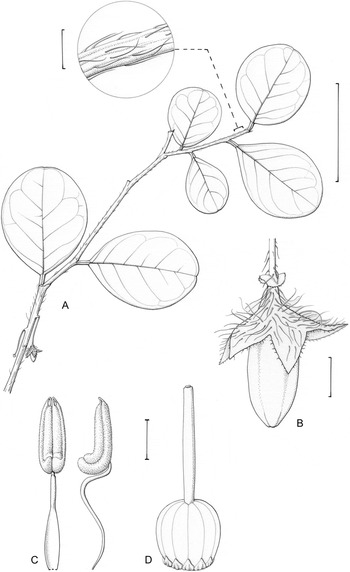
Similar to Diplycosia undata J.J.Sm. in its bristly stems, broadly elliptic to subcircular leaves and long pedicels but the stems lacking conspicuous lateral buds and with shorter, appressed, not subpatent bristles, the calyx with long, dense bristles, not muriculate, lacking the thick glands of D. undata. – Type: SE Sulawesi, Gunung Mekongga, North Kolaka district, Rante Angin subdistrict, Tinukari village, 03°65′02.7″S, 121°23′69.2″E, 1900–2600 m, 11 vii 2011, E.A. Widjaja, A. Suyadi, U. Hapid & W. Santoso EAW 9806 (holo BO; iso E). Fig. 1.
Diplycosia mekonggaensis Argent & Widjaja. A, habit with inset to show stem indumentum; B, flower bud; C, stamens, front and side views; D, pistil. Scale bars: A = 4 cm; B = 2 mm; C & D = 1 mm.

Epiphytic shrub. Twigs with a sparse covering of appressed multicellular, brown, eglandular bristles to 2 mm long, these sometimes becoming sub-spreading on older stems, without fine under-indumentum of simple hairs. Lateral buds small and inconspicuous. Leaf blade leathery, 35–50 × 20–38 mm, broadly elliptic to subcircular, or obovate, glabrous above and below although punctate abaxially which could demonstrate the remains of early caducous bristles, the base broadly obtuse to rounded, apex rounded, the terminal gland small and, although protruding, turned downwards so inconspicuous when viewed from above, margin entire, with appressed bristles when young, narrowly revolute, without a distinct cartilaginous border, mid-vein slender, slightly impressed above, prominent beneath throughout its length, lateral veins pinnate, 2–4 per side, ascending and disappearing before the leaf margin adaxially, displaying looped connections abaxially, reticulation obscure. Petiole 2–5 × 1–2 mm, at first with appressed bristles. Flowers solitary. Pedicels 11–12 × c.0.2 mm, slender, at anthesis with sparse, semi-appressed bristles; basal bracts small and inconspicuous; bracteoles c.1 mm long, semi-circular, fringed with irregular hair bases, otherwise glabrous. Calyx tube c.2 mm long, densely bristly, the lobes broadly triangular, c.4 × 2.5 mm, densely bristly outside, glabrous inside, the margins paler and fimbriate. Corolla (in bud) 6 × 3.5 mm, red, glabrous inside and out, lobes 5, c.1 × 1 mm, ovate-triangular. Stamens c.4.5 mm long; filaments sigmoid, glabrous, c.3.5 mm long; anthers c.2 mm long, echinulate, the tubules c.0.2 mm long. Disc of 10 lobes appressed to the ovary. Ovary glabrous; style c.3 mm long, cylindrical, glabrous. Fruit not seen.
Distribution. Known only from the type locality.
Ecology. Montane ridge forest. Flowering July.
Conservation status. Data Deficient.
Etymology. Named after Gunung Mekongga, the mountain on which it was collected.
Diplycosia mekonggaensis keys out in Argent (Reference Argent2014) to D. undata J.J.Sm. but this species has longer, subpatent bristles on the stems, conspicuous lateral buds and a calyx with only ‘a few thick glands externally’ not the long dense bristles of D. mekonggaensis. The corolla of this species is likely to be much smaller than that of Diplycosia undata. Although Widjaja et al. EAW 9806 (BO) has only a flower bud, this appears to be close to opening as the lobes are quite distinct. Given what is known of the development of the flowers in other species, it would be unlikely to grow to 8–11 mm, the length of the corolla in Diplycosia undata. Only Diplycosia hirsuta Sleumer and D. kjellbergii J.J.Sm. amongst the Sulawesi species of Diplycosia have the coarse bristles on the calyx exhibited by D. mekonggaensis. In Diplycosia hirsuta the calyx is only sparsely bristly, the leaves have an acute or acuminate apex and the flowers are much larger. Diplycosia kjellbergii has spreading bristles on the stems, an acuminate leaf apex and the pedicels are less than half the length of those in D. mekonggaensis.
Acknowledgements
The authors thank Claire Banks for her very competent drawing. The project under which this plant was collected was supported by Grant Number U01TW008160 from the Fogarty International Center, the Office of Dietary Supplements, the National Science Foundation and the Department of Energy. This project was supported by the USDA Agricultural Food Research Initiative of the National Institute of Food and Agriculture, USDA, Grant #35621-04750. The content is solely the responsibility of the authors and does not necessarily represent the official views of the Fogarty International Center or the National Institutes of Health, the Office of Dietary Supplements, the National Science Foundation, the Department of Energy, or the Department of Agriculture. The authors also thank the local people who helped to collect this plant, especially Mrs Wahyudi Santoso, Agus Suyadi and Ujang Hapid.