I. INTRODUCTION
Graphene and its derivatives have attracted considerable attention owing to their remarkable electrical, optical, thermal, chemical, and mechanical properties. Graphene oxide (GO) is a strongly oxidized form of graphene, retaining the basic framework of graphene and containing abundant oxygen-containing functional groups (Li and Richard, Reference Li and Richard2008; Liu et al., Reference Liu, Liu, Wang, Yan and Sun2011; Wang et al., Reference Wang, Wang, Wang, Yu, Yu, Lei and Wang2013a, Reference Wang, Wang, Ming, Wang, Yu, Yu, Wang and Lei2013b). The interesting structure of GO confirms highly hydrophilia and manipuility to construct a series of nanocomposites for many applications (Chen et al., Reference Chen, Zheng, Wang and Zheng2011).
As a noble metal, Ag has been the focus of scientific research, possessing excellent optical property and outstanding catalytic performance. Interaction between graphene and Ag can improve the surface-enhanced Raman scattering (SERS) activity of Ag–graphene oxide composites (Ag/GO). Considerable attention has been focused on the composites. However, most of the methods still involved multi-steps such as preparation of functional GO (Kumar et al., Reference Kumar, Huang, Lim, Marlinda, Harrison and Chia2013) and required strong reducing agents, including ethylene glycol, hydrazine, sodium borohydride, and methanol. These synthesis methods were complicated and risky for the environment (Xu et al., Reference Xu and Wang2009; He et al., Reference He, Cui and Mater2012). In this study, the Ag–reduced graphene oxide (Ag/rGO) composites with uniform size and good dispersity were obtained through an environmental friendly one-step hydrothermal route using GO and silver carbonate (Ag2CO3) as the raw materials exclusively. The structure, mechanism, and Raman properties of the composites were investigated in detail.
II. EXPERIMENTAL
The crucial raw materials GO and Ag2CO3 were prepared according to the literature (Huang et al., Reference Huang, Lei, Wang, Liang, Ye, Zhao, Li, Zhang, Fan and Wang2014a, Reference Huang, Li, Lin, Liang, Wang, Ye, Wang, Zhang, Fan, Yang, Wang and Lei2014b) and Dong et al. (Reference Dong, Chen, Sun, Li, Yu and Chen2013), respectively. The Ag/rGO composites were fabricated via a one-step hydrothermal method. In a typical procedure, 10 mg Ag2CO3 powder was added into the calculated amount of GO solution in a 15 ml teflon-sealed autoclave and corresponding amount of deionized water was added to reach 80% of autoclave capacity. The mixture should be dispersed by the ultrasonic processing for 1 h and vigorous stirring for 4 h. Then the autoclaves would be transferred into oven at 80 °C for 8 h and cooled down to room temperature naturally. The products were rinsed with deionized water and ethanol for several times, and finally dried in vacuum at 40 °C for 12 h.
The silver colloid was prepared through a simple reaction reported by Qian et al. (Reference Qian, Cheng, Zhou, Wu and Xu2013). For the detection of SERS activity, a certain amount of various concentrations of solution R6G were mixed with the suspension of Ag/rGO and were allowed to stay for 4 h after the ultrasonic dispersion process. Finally, the mixture was dropped on the silicon slide and dried for the SERS detection.
The structure properties were observed by the X-ray diffraction (XRD, PANalytical) and field emission scanning electron microscope (FESEM, S-4800, Hitachi). The atomic compositions and SERS activity were detected by Raman spectroscopy (Horiba Jobin Yvon, France), Fourier-transformed infrared spectra (FTIR, Thermo Nicolet), and X-ray photoelectron spectroscopy (XPS, Perkin-Elmer, AlKα radiation).
III. RESULTS AND DISCUSSION
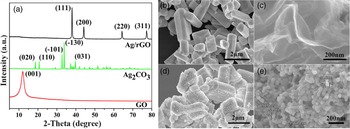
The phase structure of the product was first confirmed by the XRD. As shown in Figure 1(a), GO displays a diffraction peak at 11.9°, corresponding to the (001)-plane of the hexagonal graphite structure (Xu et al., Reference Xu and Wang2009; Qian et al., Reference Qian, Cheng, Zhou, Wu and Xu2013), and the diffraction peaks of prepared Ag2CO3 agree well with those of the standard monoclinic Ag2CO3 (JCPDS No. 26-0339). Four main peaks at 2θ = 37.9°, 44.1°, 64.3°, and 77.2° emerge, which correspond to the (111), (200), (220), and (311) planes of the cubic Ag (JCPDS no. 99-0094), respectively, indicating that the metallic Ag is formed after the hydrothermal process. However, no obvious diffraction peaks of rGO are observed, which may be because of the relatively low content of rGO or the exfoliation of rGO (Xu et al., Reference Xu and Wang2009).
(Color online) (a) XRD patterns of GO, Ag2CO3, and Ag/rGO; (b–e) SEM images of pure Ag2CO3, GO sheets, hydrothermal treated pure Ag2CO3, and Ag/rGO composites, respectively.

The morphology of the product was examined by FESEM. The rod-like Ag2CO3 particles [Figure 1(b)] display a relatively smooth surface and uniform size, and GO sheets [Figure 1(c)] exhibit the typical crumpled structure. As shown in Figure 1(d), no Ag nanospheres emerge in the absence of GO sheets. Inspiringly, the rod-like particles disappear, whereas the new sphere-like particles with average size of 50 nm covered with rGO sheets [Figure 1(e)] generate after the GO-assisted hydrothermal reaction. It is believed that the anisotropic growth is inhibited with the wrapping GO, leading to the formation of Ag spheres.
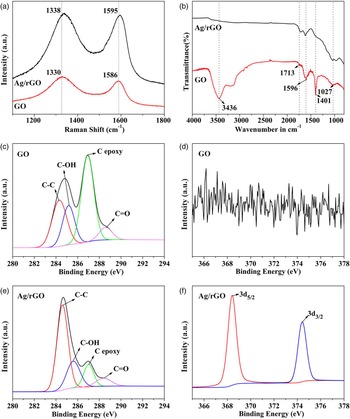
To further investigate the formation process, corresponding Raman, FTIR, and XPS spectra were measured. Two prominent peaks [Figure 2(a)] correspond to D band about 1330 cm−1 and G band about 1590 cm−1 for GO sheets are observed, which is assigned to the disorder originating from functional groups and E 2g mode of C sp2 atoms, respectively. The intensity ratio I D/I G of GO is 1.13. However, the I D/I G of Ag/rGO composites decreases to 1.02 after the hydrothermal treatment. It is suggested that the oxygen-containing functional groups decrease and the GO is partially reduced into rGO (Kumar et al., Reference Kumar, Huang, Lim, Marlinda, Harrison and Chia2013; Liu et al., Reference Liu, Huang and Wang2013). In addition, the intensities of the D and G bands of Ag/rGO composites obviously increase in comparison with those of GO, which is because of the SERS activity (Ma et al., Reference Ma, Zhang, Xiong, Yong and Zhao2011; Huang et al., Reference Huang, Lei, Wang, Liang, Ye, Zhao, Li, Zhang, Fan and Wang2014a, Reference Huang, Li, Lin, Liang, Wang, Ye, Wang, Zhang, Fan, Yang, Wang and Lei2014b).
(Color online) (a) Raman, (b) FTIR spectra of GO and Ag/rGO, (c, e) XPS spectra of C1s peaks, and (d, f) Ag3d peaks for GO and Ag/rGO, respectively.

The FTIR spectrum of GO and Ag/rGO composites is shown in Figure 2(b). The characteristic absorption peaks of GO appear at 3436, 1713, 1596, 1401, and 1027 cm−1, corresponding to the –OH stretching vibrations, C=O stretching of COOH groups, sp2 C–C bonds, O–H deformations of the C–OH groups, and C–O stretching vibrations, respectively (Yuan et al., Reference Yuan, Gu and Li2012). The most obvious difference between the two spectrums is the intensity weakening of the vibration of C–OH groups, which reveals that C–OH groups play an important role for the reduction process of silver cations to metallic silver.
To investigate the inner structure and the formation mechanism, XPS spectra of GO and Ag/rGO composites are exhibited in Figures 2(c)–2(f). The deconvoluted peaks of C1s XPS spectrum of GO [Figure 2(c)] arising from 284.7, 286.9, and 288.6 eV indicate the components of C–C/C=C (graphene bonding), C–O (hydroxyl and epoxy), and C=O (carboxyl), respectively (Yuan et al., Reference Yuan, Gu and Li2012). As to Ag/rGO composites [Figure 2(e)], the intensity of oxygen-containing functional groups decreases significantly. The elimination of hydroxyl, epoxyl, and carboxyl confirms the reduced process of GO to rGO and the important role of these functional groups. Meanwhile, two new peaks at 368.4 and 374.4 eV can be detected corresponding to the binding energies of Ag3d3/2 and Ag3d5/2 in the Ag3d XPS spectrum of Ag/rGO composites [Figure 2(f)]. The separation of spin-energy is measured to be 6 eV, further confirming the formation of metallic silver (Ma et al., Reference Ma, Zhang, Xiong, Yong and Zhao2011).
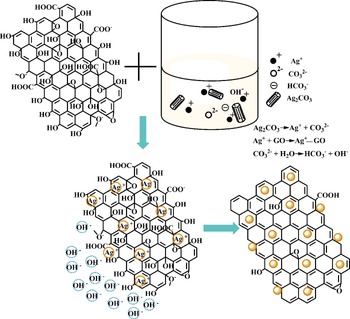
The consistent results illustrate that GO have played an important role during the hydrothermal formation process of Ag/rGO composites. First, GO promotes the dispersion of Ag2CO3 in aqueous solution. The large number of functional groups can adsorb the particles in solution, making sure the Ag2CO3 sufficient decentralize. Another point, GO can be treated as a consumer of silver cations via combination by electrostatic adsorption and π–π orbitals interaction. The decreasing concentration of silver cation coupling with high temperature of 80 °C, promotes hydrolysis of Ag2CO3 to generate Ag+, HCO3 −, and OH−, resulting in the alkaline condition. Besides, the functional groups, acting as anchor sites of silver cations, enable the subsequent in situ formation of Ag nanoparticles (Pasricha et al., Reference Pasricha, Gupta and Srivastava2009). Furthermore, the functional groups play the role of reducing agent. During the hydrothermal process, the hydroxyl groups based on the hexagonal basal plane are equivalent to phenolic entity in alkaline condition, with a protonation to generate strongly activated phenolate anions and achieve the electrophilic aromatic substitution reaction to generate elemental silver by transferring electrons to silver cations (Manuel et al., Reference Manuel, Paul and Michael2005). In addition, GO is reduced to rGO, forming Ag/rGO composites. As Figure 3 shows, with the interaction of oxygen-containing functional groups, the silver ions are adsorbed on the rGO sheets and form Ag nanoparticles to achieve one-step synthesis in the absence of additional reductant.
(Color online) Schematic illustration of the mechanism for Ag/rGO composites.

The SERS activity of as-prepared samples was further tested by R6G as the probing molecules. As Figure 4(a) shows, the strong characteristic Raman peaks of R6G on the Ag/rGO substrate at 614, 777, 921, 1132, 1186, 1312, 1364, 1510, 1579, and 1650 cm−1 observed in the spectra A are in good agreement with the previous reports. By contrast, the SERS signals of R6G on the silver colloid are significantly reduced. Moreover, we cannot find any characteristic peaks of R6G on the GO substrate. Combined with the above analysis, we consider that the better SERS activity of Ag/rGO results from the aggregated structures of Ag nanoparticles coupling with rGO. SERS spectra of R6G with different concentrations on Ag/rGO are displayed in Figure 4(b). It is obvious that the SERS signals decrease with decreasing the concentration of R6G, and the spectrum 3 becomes similar to rGO with further decrease. However, the bands at 614, 777, and 921 cm−1 are still sensitive to detect the concentration of R6G.
(Color online) (a) SERS spectra of R6G (10−6 M) solution on the substrate of Ag/rGO (A), Ag colloids (B), and rGO (C). (b) SERS spectra of R6G of various concentrations on the Ag/rGO substrate.

IV. CONCLUSIONS
In summary, Ag/rGO composites have been successfully fabricated through a facile one-step hydrothermal method using GO and Ag2CO3 as starting reactants. The GO sheets are identified to serve as the dispersant, stabilizer, and reducing agent, whereas the Ag2CO3 provides silver cations and alkaline condition. Silver cations are reduced into metallic Ag by hydroxyl groups mainly in the alkaline condition, and then causing the generation of rGO because of the decrease of oxygen-containing functional groups. The as-prepared Ag/rGO composites are testified to be an excellent substrate to probe molecules. The Ag/rGO composites exhibit better SERS activity than Ag colloid owing to the strong interaction of Ag and rGO.
ACKNOWLEDGEMENTS
This work was financially supported by the Program for New Century Excellent Talents in the University (grant no. NCET-13-0684), Fund of State Key Laboratory of Information Photonics and Optical Communications (Beijing University of Posts and Tele-Communications, People's Republic of China), National Natural Science Foundation of China (Grant numbers 61376018, 51102019, 61177085, 61377097, 61274012, and 51272031).