I. INTRODUCTION
Organic rare earth complexes, which display unique luminescent properties such as long luminescence lifetimes, large Stokes shifts, and sharp emission peaks, are of high interest. Thereinto, optical materials containing rare earth ions like Nd, Er, and Yb with near-infrared (NIR) emission have frequently been studied recently because of their potential applications in the following fields: (i) probes in bioanalysis and bioimaging,Reference Werts, Woudenberg, Emmerink, Gassel, Hofstraat and Verhoeven1 (ii) active dopants for laser materials or waveguide amplifiers,Reference Liang, Zheng, Chen, Zhang and Ming2, Reference Yang, Diemeer, Geskus, Sengo, Pollnau and Driessen3 (iii) light conversion molecular devices, for example, luminescent solar concentrators.Reference Rowan, Wilson and Richards4
It is known that the extinction coefficients of rare earth ions are quite low for the intra-4f transitions that are forbidden. But, in rare earth complexes, chromophores are introduced as “antennae,” which act as energy donors with large absorption cross-sections. In terms of NIR emitting complexes, energy transfer efficiencies are usually dissatisfactory because of the large energy gap between the high excited state levels of chromophores and relatively low emitting levels of rare earth ions. So the ligands with low exited state levels are required to sensitize the NIR emitting ions. Shifting the absorption band of chromophores to visible light is an effective way to lower the energy level. At the same time, by introducing visible light absorbing ligand, the complexes will have some advantages in practical application. For example, different from ultraviolet (UV) light, the visible light is harmless to organism, which can avoid photo damage and photo degradation. In addition, semiconductor diode lasers with visible light are cheap and convenient when used as a pump light source of lasers or optical amplifiers. Up to date, NIR emitting complexes with various chromophores such as fluorescein, lissamine, porphyrins, ferrocene, and metal complexes have been reported.Reference Werts, Hofstraat, Geurts and Verhoeven5–Reference Imbert, Cantuel, Bunzli, Bernardinelli and Piguet9
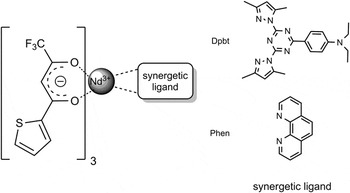
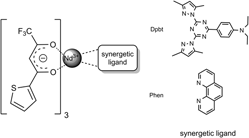
In addition, as dopants in polymer waveguide for laser and optical amplifiers, rare earth β-diketonate complexes exhibit good stability and compatibility, and the doping concentration can be up to a magnitude of 3% by weight without aggregate.Reference Chen, Xu, Dong, Liang, Zhang and Yin10 So, based on these considerations, in this work, a new visible-light-sensitized Nd complex was synthesized by using 2-(N,N-diethylanilin-4-yl)-4,6-bis(3,5-dimethylpyrazol-1-yl)-1,3,5-triazine (Dpbt) as synergetic ligand and thenoyltrifluoroacetonate (TTA) as the first ligand, as shown in Fig. 1. Spectroscopic properties of Nd(TTA)3Dpbt in poly(methyl methacrylate) PMMA was measured and compared with Nd(TTA)3Phen. Judd–Ofelt theory was used, and the intensity parameters were calculated. Radiative properties such as transition probabilities, emission cross-sections, fluorescence branching ratios, and radiative lifetime were calculated and analyzed according to Judd–Ofelt theory.
Chemical structure of neodymium complexes containing different synergetic ligands.

II. EXPERIMENTAL PROCEDURE
A. Apparatus
Fourier transform infrared spectroscopy (FTIR) spectra were measured by Bruker EQUINOX55 spectrometer.
Elemental analysis was performed on VARIO ELIII elemental analyzer (Elementar Analysensysteme GmbH, Germany). Thermogravimetric (TG) curves were obtained by TA Instruments Thermogravimetric Analyzer Q5000 (TA Instruments, USA). UV–vis absorption spectra were recorded on Shimadzu DUV-3700 (Shimadzu, Japan). NIR fluorescence spectra and fluorescence decay curves were obtained on FLUOROLOG-3-TAU (Jobin Yvon, France) at room temperature (298 K).
B. Synthesis and characterization of neodymium complexes
The precursor complex Nd(TTA)3·2H2O was prepared according to the literature.Reference Charles and Ohlmann11 The visible light absorbed ligand Dpbt and corresponding complex Nd(TTA)3Dpbt were synthesized according to the procedure in the literature.Reference Yang, Fu, Wang, Zhang, Wong, Ai, Qiao, Zou and Gui12 The resulting complex is yellow powder with good solubility in methyl methacrylate (MMA). Infrared (IR) spectra (KBr pellets, ν in cm−1) ν: 2979, 2927 (C–H), 1610, 1590, 1556(C=N), 1536, 1501, 1470, 1413(C=N), 1392, 1352, 1301, 1185, 1139, 1070, 934, 857, 809(C=N), 782, 753, 713, 641, 579, 455 (O=Nd). Elemental analysis: calcd for NdC47H40N8F9O6S3 (1224.29): C, 46.11; H, 2.29; N, 9.15. Found: C, 46.78; H, 2.41; N, 8.97%. The complex Nd(TTA)3Phen was synthesized by the procedure described in our previous work.Reference Guan, Chen, Sun, Liang and Zhang13
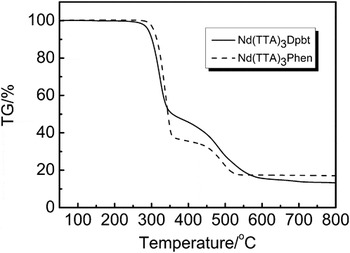
TG analysis was performed to ascertain the Nd3+ ion content for each complex. TG curves are shown in Fig. 2, and the metal containing is calculated from the weight of oxide Nd2O3. The theory contents are 13.4% and 17.0%, and the measured values are 13.3% and 17.2% for complexes with ligands Dpbt and Phen, respectively. Moreover, TG curves indicate that the complexes have good thermal stability below 220 °C.
Thermogravimetric curves of Nd complexes with different synergetic ligands. Data are recorded with heating rate 10 °C/min in atmosphere of nitrogen.

C. Preparation of PMMA containing neodymium complexes
To prepare Nd(TTA)3Lx-doped PMMA, 6 mg 2,2-azoisobutyronitrile as an initiator was added to 5 ml Nd-MMA solution and pre-polymerized at 85 °C for 30 min, and the pre-polymerized solution was then poured into a mould. The polymerization of the model was carried out at 50 °C for 24 h and additionally heated at 90 °C until solidification was fulfilled. The sample was cut and polished for optical measurements. Nd3+ ion concentrations for all samples are 3000 ppm wt, i.e., the content of Nd(TTA)3Dpbt in PMMA is 2.6 wt%.
III. RESULTS AND DISCUSSION
A. Absorption spectra of ligands in Nd complexes
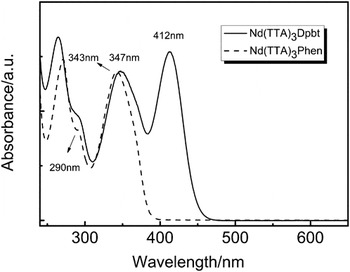
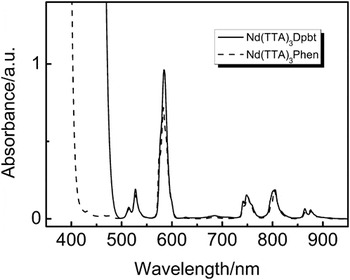
The normalized absorption spectra of Nd(TTA)3Dpbt and Nd(TTA)3Phen in PMMA film are shown in Fig. 3. The absorption bands with their centers at 343 and 347 nm are due to the π-π* transition of ligand TTA.Reference Liu, Wang, Lia, Yan, Wei and Du14 Common synergetic ligands like 1,10-phenanthroline are always introduced to substitute H2O molecule to avoid the fluorescence quenching by high frequency O–H vibrating. Their absorption bands are in short wavelength UV region (280–300 nm), as they have higher excited state energy level, for example, for Phen the first singlet level S1 = 34,500 cm−1, for Bipy S1 = 35,800 cm−1, and Tppo S1 = 36,400 cm−1.Reference Luo, Yan, Wu, Wu and Zhang15–Reference Xin, Shi, Gao, Huang, Gong, Nie, Cao, Bian, Li and Huang17 However, considering the emission level of NIR-emitting Nd3+ ion is low (11,500 cm−1), the ligand chelated with Nd3+ ion need to have low lying energy level to acquire higher energy transfer efficiency. Therefore, when π-conjugated system and electron-donating group (diethylamine) are introduced to the ligand molecular structure, the excited state level can be lower. The absorption peak of the lowest level for ligand Dpbt is at 412 nm,Reference Yang, Fu, Wang, Zhang, Wong, Ai, Qiao, Zou and Gui12 and a low lying triplet state (T1) of Dpbt is expected by decreasing the S1 energy. In addition, there is no Nd3+ ion’s characteristic absorption band observed in the spectra,Reference Carnall, Fields and Rajnak18 which is because of Laporte forbidden f-f transition and the large absorption cross-section of organic molecule. The absorption bands of Nd3+ ion will be detected (as shown in Fig. 4) using PMMA bulks about 1 cm thick, which have long optical path.
Normalized absorption spectra of Nd complexes–doped PMMA thin film.

Absorption spectra of Nd(TTA)3Phen- and Nd(TTA)3Dpbt-doped PMMA bulks at wavelength ranging from 350 to 950 nm. The concentrations of Nd3+ ion are 3000 ppm wt.

B. Nephelauxetic effect, oscillator strengths, and Judd–Ofelt theory analysis
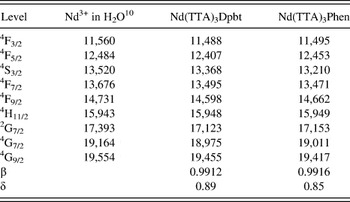
Nephelauxetic effect of Nd3+ is studied by comparing the nephelauxetic parameter (β) and degree of covalency (δ) in different complexes as shown in Table I. Relatively lower β and higher δ for Nd(TTA)3Dpbt indicates that covalency of the bonds around Nd3+ is stronger in this complex. The reason for this may be from the conjugation effect and the electron-donating effect of diethylamine group of ligand Dpbt.
Energy levels (cm−1), nephelauxetic parameter (β), and degree of covalency (δ) of Nd3+ in H2O solution and poly(methyl methacrylate) (PMMA).

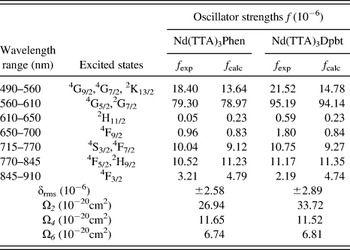
Judd–Ofelt theory is a useful tool for estimating the intensities of the forced electric–dipole transition of rare earth ions and for giving information about the chemical environment surrounding the ions. The radiative properties of rare earth ions in various host matrixes can be predicted by using the spectral intensities of electric–dipole transitions. To obtain the intensity parameters of transitions based on Judd–Ofelt theory, the optical absorption spectra of Nd3+ in the complexes are measured. Figure 4 shows the characteristic absorption spectra of Nd3+ ion in PMMA matrix, and the absorption bands are attributed to the transition of ground state 4F3/2 to various excited states, which are listed in Table II.
The oscillator strengths and Judd–Ofelt parameters of Nd(TTA)3Phen and Nd(TTA)3Dpbt in PMMA.

Dpbt, 2-(N,N-diethylanilin-4-yl)-4,6-bis(3,5-dimethylpyrazol-1-yl)-1,3,5-triazine.
Experiment and calculated oscillator strengths for the two complexes are displayed in Table II. The root mean square deviation (δ rms) between the experimental and calculated line strengths is defined as:

where N is the number of experimental bands involved in the above calculation. As shown in Table II, δ rms of two complexes listed here are 2.58 × 10⁻⁶ and 2.89 × 10⁻⁶. These magnitudes of the δ rms are comparable with previous studies of the other Nd3+-doped systems and reflect the accuracy of the Judd–Ofelt parameters fitting.Reference Kumar, Martinez and De La Rosa19, Reference Koeppen, Yamada, Jiang and Garito20
The value of Ω 2 is usually concerned with the symmetry and the degree of covalency in the lanthanide-first coordination shell interaction.
The Nd complex with Dpbt has a larger Ω 2 value than that with Phen, which indicates higher covalent nature of Nd3+-ligand bonds in complex Nd(TTA)3Dpbt. This is in agreement with the results by nephelauxetic effect analysis. Ω 6 is related to the stiffness of the host matrix.Reference Jorgensen and Reisfeld21 Ω 4 and Ω 6 in two complexes are nearly the same, which indicates that different synergetic ligands do not influence parameters Ω 4 and Ω 6.
C. Near-infrared luminescence of Nd complexes–doped PMMA
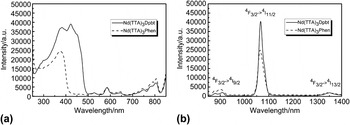
Figure 5 shows the fluorescence spectra of Nd(TTA)3Dpbt- and Nd(TTA)3Phen-doped PMMA matrixes from 850 to 1400 nm. The excited spectra are monitored at the emission peak of the transition 4F3/2→4I11/2 of Nd3+. Both the excited spectra for Nd3+-doped polymer are composed of a broad band and some narrow peaks. The presence of broad bands suggests that energy transfer from ligand to Nd3+ ion occurs in these two complexes. Normally, the ligand of complex absorbs the light and migrates to its singlet state and then transfer to its triplet state by intersystem crossing, and the triplet molecule passes the energy to center ion.Reference Bassett, Magennis, Glover, Lewis, Spencer, Parsons, Williams, Cola and Pikramenou22, Reference Hebbink, Grave, Woldering, Reinhoudt and van Vegge23 The wide exciting band of the complex Nd(TTA)3Dpbt is attributed to π-π* transitions of ligands TTA and Dpbt. Because Dpbt has absorption in long wavelength, this band is extended to nearly 500 nm; thus, the excited band is wider than that of Nd(TTA)3Phen. The other excited peaks respond to intra 4f transitions of Nd3+ ion. The bands of ligands are much stronger than Nd3+ ion, which indicates that the ligands are more efficient when sensitizing Nd3+ because of their large absorption cross-sections.
Excited (a) and emission (b) spectra of Nd(TTA)3Dpbt- and Nd(TTA)3Phen-doped PMMA. Excited spectra are obtained by monitoring the emission of transition in nearly 1060 nm, and emission spectra are obtained by excitation at 380 nm.

The NIR emitting spectra were obtained by excitation at 380 nm light from a 450 W xenon lamp. There are three NIR emission peaks centered at 894, 1066, and 1351 nm, which are assigned to the transition of 4F3/2→4I9/2, 4F3/2→4I11/2, and 4F3/2→4I13/2, respectively. The emission of the 4F3/2→4I11/2 is the strongest among the three bands, and relative area of the transition 4F3/2→4I11/2 is different among the three emission bands by changing ligand. The emission peak position is related to the degree of covalence of the Nd3+-ligand bonds in host matrix. The higher the covalence of these bonds, the weaker the electron–electron interaction in the 4f shell leading to lower transition energies.Reference Ajroud, Haouari, Ben Ouada, Maaref, Brenier and Garapon24 The peak for transition 4F3/2→4I11/2 is at 1064 nm for Nd(TTA)3Phen, which is 2 nm shorter than that of Nd(TTA)3Dpbt, which reveals that the covalence degree in the latter is higher. This is in agreement with the analysis based on Judd–Ofelt theory and nephelauxetic effect mentioned earlier. The emission intensity of Nd(TTA)3Dpbt is nearly 1.5 times the value of Nd(TTA)3Phen frequently used in optical research, and this can also be detected in the excited spectra.
D. Radiative properties of Nd(TTA)3Dpbt-doped PMMA
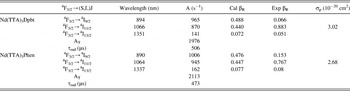
The radiative properties of Nd(TTA)3Dpbt-doped PMMA are listed in Table III by using the Judd–Oflet parameters in Sec. III. B. The radiative lifetime and emission cross-sections of the transition involved are important parameters in consideration of the pumping requirement for the threshold of laser action. The calculated radiative lifetime and emission cross-sections are 506 μs and 3.02 × 10⁻²⁰ cm2, respectively. They are comparable with properties of neodymium laser glasses.Reference Mehta, Aka, Dawar and Mansingh25–Reference Rolli, Gatterer, Wachtler, Bettinelli, Speghini and Ajo27
Radiative properties of Nd(TTA)3Dpbt and Nd(TTA)3Phen in PMMA.

The fluorescence branching ratio is a critical parameter to the laser system designer because it characterizes the possibility of attaining stimulated emission from any specific transition.Reference Jiang, Wang, Zhang, Hu and Liu28 In Table III, calculated values of β R for Nd(TTA)3Dpbt are obtained from Eq. (8). From the triangle rule |J − J′| < λ < |J + J′|, the values of ‖U 2‖2 are zero for all these transitions; thus, the theoretical β R of 4F3/2 is not concerned with parameter Ω 2.Reference Kaminskii, Boulon, Buoncristiani, Di Bartolo, Kornienko and Mironov29 The β R is dependent on the value Ω 4/Ω 6, which is defined as spectroscopic quality factor χ. For Nd(TTA)3Dpbt, χ is 1.69, and for Nd(TTA)3Phen, χ is 1.73. The larger the χ value, the weaker is the intensity of transition 4F3/2→4I11/2. The values of χ are all larger than 1, which implies that relative intensity of the transition 4F3/2→4I11/2 will not be very strong.
However, analyzing the integrated areas of the emission bands in the experimental emission spectra, the transition 4F3/2→4I11/2 has the highest branching ratio value among various transitions as shown in Fig. 5. Experimental β Rs of the transition 4F3/2→4I11/2 for both Nd complexes are higher than 70%, larger than the calculated values. It has already been established that an emission level with β R value near 50% becomes a potential laser emission transition.Reference Ravikumar, Veeraiah, Apparao and Bhuddudu30 Nd(TTA)3Dpbt has larger β R value for transition 4F3/2→4I11/2 than Nd(TTA)3Phen, indicating that the energy is more concentrated.
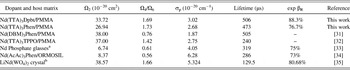
Optical properties of some Nd complexes in PMMA and inorganic optical materials are listed in Table IV. Judd–Ofelt parameter Ω 2 for the complex Nd(TTA)3Dpbt is relatively high. Radiative lifetime and emission cross-sections of 4F3/2→4I11/2 are comparable with other systems. The experimental β R is the largest and do not depend on the spectroscopic quality factor χ exactly. The largest β R value of 88.3% for Nd(TTA)3Dpbt is rare and beneficent for the generation of laser at 1066 nm. The reason for this large value may rise from the photo-induced intermolecular charge transfer character of Dpbt. It has been proved that the transition dipole moment of this ligand is considerably large.Reference Fu, Wen, Ai, Sun, Wu, Zhang and Wang36
Judd–Ofelt parameter Ω 2, spectroscopic quality factor χ, emission cross-section σ p lifetime, experimental fluorescence branching ratios βR of 4F3/2→4I11/2 in different Nd-doped matrix studies in recent year.

a PKSAN10.
b Data for the π-polarization.
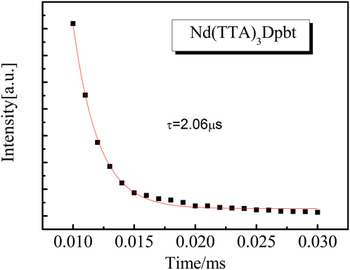
The luminescence decay curve of Nd(TTA)3Dpbt in PMMA monitored at 1066 nm, which is shown in Fig. 6, is fitted to a single exponential form. The lifetime for Nd(TTA)3Dpbt is 2.06 μs, which is comparable with other Nd complex in organic systems.Reference Bassett, Magennis, Glover, Lewis, Spencer, Parsons, Williams, Cola and Pikramenou22, Reference Qiu, Yu, Gao, Hou, He, Zhou, Wei and Peng37 Using the lifetime from the experimental and the radiative lifetime stimulated above, the quantum efficiency can be obtained as 0.407%, which is considerably high.Reference Zhang, Badger, Geib and Petoud38 As the population inversion P = 0.5, the gain cross-section of the potential laser at 1066 nm is 1.51 × 10⁻²⁰ cm2, where σ e = 3.02 × 10⁻²⁰ cm2 (emission cross-section) and σ a = 4.03 × 10⁻²³ cm2 (absorption cross-section). The gain bandwidth σ g is 67.35 nm × 10−20 cm2, which can be estimated from the product of the effective bandwidth Δλ eff and σ e, and this value is comparable with that of Nd-doped fluorophosphate glasses and some commercial phosphate laser glasses like LHG-8 and LG-770.Reference Kumar, Babu, Jang, Seo, Jayasankar and Joshi33, Reference Campbell and Suratwala39 Δλ eff is 23.3 nm in this system, and this value is comparable with some fluorophosphate glasses.Reference Kumar, Babu, Jang, Seo, Jayasankar and Joshi33 In summary, Nd(TTA)3Dpbt-doped PMMA, which has a long fluorescence lifetime and large emission section as a polymer system, is desirable as a laser material.
The decay curve of Nd(TTA)3Dpbt in PMMA monitored the emission at 1066 nm. (color online)

IV. CONCLUSIONS
In this work, spectroscopic properties of a visible-light-sensitized Nd complex–doped PMMA are studied. As a result, this complex has relatively wide excited band and high luminescent intensity in PMMA. This indicated that more light sources can be utilized when Nd(TTA)3Dpbt is used as optical probe or laser medium.
Through Judd–Ofelt analysis, larger value of Ω 2 is obtained, which indicates Nd3+-ligand bond of Nd(TTA)3Dpbt is more covalent. The stimulate emission cross-section and lifetime are found comparable with other Nd3+-doped optical host matrix. The differences between calculated and experimental fluorescent branching ratio has been demonstrated. Such a high experimental fluorescent branching ratio for Nd(TTA)3Dpbt has seldom been seen before to the author’s knowledge, showing that Nd(TTA)3Dpbt in PMMA is a promising potential laser medium.
ACKNOWLEDGMENTS
This work is supported by National Natural Science Foundation of China (Nos. 21074123, 91027024, and 50973101), the Chinese Academy of Sciences (kjcx3.sywH02 and kjcx2-yw-m11), and China Postdoctoral Science Foundation (No. 20100470038).