


“Revolution, like Saturn, devours its own children.”Footnote 1 Many leaders of successful revolutions and political protests later experience far worse outcomes than they could reasonably have expected under the status quo. Nonetheless, many individuals in different times and countries have endangered their lives trying to overthrow authoritarian regimes. These observations suggest great uncertainty about the outcome of the tremendous changes that come with successful revolutions. So, too, there can be extensive uncertainty in citizens' assessments of the status quo because of propaganda and state censorship that limit reliable information dissemination to citizens.
The literature on collective action has focused on the uncertainties about the regime's ability to repress collective action (Boix and Svolik Reference Boix and Svolik2009; Edmond Reference Edmond2008), the costs of collective action (Lohmann Reference Lohmann1994; Persson and Tabellini Reference Persson and Tabellini2009), and the number of dissidents willing to revolt (Bueno de Mesquita Reference Bueno de Mesquita2010b; Egorov, Guriev, and Sonin Reference Egorov, Guriev and Sonin2009; Egorov and Sonin Reference Egorov and Sonin2011; Lohmann Reference Lohmann1994). In particular, the literature has largely overlooked uncertainties about the status quo and the alternative (revolution), which are the focus of our analysis. These uncertainties may matter little for staunch revolutionaries whose sole focus is on overthrowing a regime. However, often most ordinary citizens are uncertain even about whether the status quo is “bad” enough, and the alternative “good” enough, to make successful revolution desirable. The contribution of this article is to integrate uncertainty about payoffs into a model of collective action, and investigate the implications of the strategic interactions that emerge.
We model the “calculus of protest” of citizens who must decide whether to submit to the status quo or mount a revolution based on their personal assessments of the value of revolution. The model features two representative citizens, A and B, who can challenge the status quo by mounting a revolution. Each citizen receives a private signal about the uncertain expected payoff from a successful revolution.Footnote 2 They then decide whether to revolt. The revolution succeeds if and only if both citizens revolt, in which case citizens receive the revolution payoff. Otherwise, the status quo prevails, and a citizen who participates in a failed revolution is punished.
This strategic environment gives rise to a complicated strategic calculus for citizens. Citizen A realizes that his assessment of the value of successful revolution is imperfect, and might “accidentally” be much better or much worse than what that value really is. However, citizen A understands that citizen B will revolt only after receiving good signals about the value of successful revolution. Because revolution will not succeed without citizen B's participation, this helps citizen A avoid overturning the status quo as a result of making a wrong assessment, which would result in a state of revolution worse than the status quo. Similarly, if citizen A has a moderate assessment of the value of successful revolution, he might still revolt to allow the revolution to succeed when citizen B assesses the value of revolution more favorably and revolts.
These strategic calculations have two distinct consequences: (1) If citizen B is too willing to revolt—if he revolts even after receiving very bad signals about the value of successful revolution—this deprives citizen A of the ability to effectively condition the overturn of the status quo on the aggregate information contained in both citizens' assessments. That is, if citizen A's assessment of the value of successful revolution is good and he revolts, revolution succeeds even when citizen B's assessment of that value is so bad that conditional on their joint information, the value of the status quo exceeds the expected value of successful revolution. Hence, when one citizen is too willing to revolt, this reduces other citizens' incentive to revolt. (2) A citizen may revolt even when his personal assessment based solely on his private signal of the value of successful revolution is bad enough that were the other citizen's assessment as bad, the first citizen would actually prefer that the revolution fail (and he be punished)—rather than being joined by the other citizen and proceeding to a successful revolution. As a result, sometimes revolution succeeds when their joint information would indicate that citizens would be worse off under a state of revolution. By revolting even when he thinks the value of successful revolution is not that good, a citizen “buys” the option to have the other citizen's information determine whether the status quo is replaced—at the costs of (i) sometimes being the sole revolter and being punished, and (ii) sometimes experiencing “interim regret.” The possibility of such interim regret is an intrinsic characteristic of collective action when actors receive private signals about uncertain common payoffs and cannot fully communicate their information.
Several counterintuitive results emerge:
(1) One might think that limiting citizens' information would reduce their incentives to revolt: Such limitations (a) reduce citizens' abilities to assess “good” news about the value of revolution, and (b) reduce their information about each other's information, which decreases their ability to coordinate and avoid punishment. We show that this intuition is not always true. In particular, we identify sufficient conditions under which more accurate information decreases incentives to revolt. Related to Magaloni's (Reference Magaloni2010) assessment in the context of election fraud that “limited information about fraud might actually end up working against the autocrats (Magaloni Reference Magaloni2010, 761),” we establish that keeping the citizens behind “the veil of ignorance” is a double-edged sword. In fact, less information can increase citizens' incentives to revolt because (a) their less informative signals about the value of revolution reduce the weight placed on “bad” signals about that value, and (b) when citizens have more accurate assessments of each other's information, they do not need to “buy” access to each other's information by revolting more, as described above.
(2) A common theme in the literature is that public signals, which generate common knowledge, increase citizens' incentives to revolt and raise the likelihood of collective action (e.g., Chwe Reference Chwe2000, Reference Chwe2001; Egorov, Guriev, and Sonin Reference Egorov, Guriev and Sonin2009). However, we establish that, as long as failed revolution is not punished too harshly, citizens revolt more when they receive private signals than when they receive public signals. The intuition reflects the netting of two conflicting effects: (a) With public signals, citizens coordinate perfectly, avoiding the risk of punishment for participation in a failed (uncoordinated) collective action, whereas with private signals, there is always fear of miscoordination and punishment. (b) With private signals, citizens do not know each others’ assessments, so that a citizen has an incentive to revolt in order to facilitate conditioning outcomes on the other citizen's assessment. A citizen recognizes that even though revolution may not be worthwhile based solely on his own assessment, it might still be optimal to revolt to let the revolution succeed when the other citizen's assessment of revolution is far better. This incentive to revolt does not exist with public signals because citizens know each others’ information. When the punishment for failed revolution is small, the second effect dominates: Each citizen revolts more with private signals because he can gain more from conditioning the outcome on their joint information than he risks in punishment.
(3) One might conjecture that because harsher punishments deter collective action, they must reduce the probability that the state actually has to suppress a revolt. Surprisingly, this is not always so. In fact, harsher punishment can increase the incidence of punishment. We call this Punishment Dilemma 1. The reasoning reflects two conflicting mechanisms. When the state punishes failed revolt more harshly, this reduces the likelihood that a given citizen revolts. However, it also raises the probability that following any given signal that induces one citizen to revolt, the other citizen does not join in, allowing the state to suppress the revolt. In particular, when failed revolters are not punished too harshly, slightly harsher punishments raise the probability of observing repression because harsher punishment impairs coordination in revolt. In contrast, when the punishment is already harsh, further increases in the severity of punishment make revolt so unlikely that the probability of failure/repression also falls. We present the empirical and normative implications of these findings.
Punishment Dilemma 1 has implications for a state's choices of how harshly to punish dissent. Consider a state that does not punish dissent harshly, because of the high costs. Were the state to increase its punishment, the dilemma indicates that the state would also have to repress dissenters more frequently. This indirect frequency effect magnifies repression costs, making repression less attractive. This suggests an explanation for why states that do not punish dissent harshly tend subsequently not to increase punishment. This finding is consistent with the robust empirical finding that past repression is the key to explaining variations in repression after controlling for other relevant variables (Davenport Reference Davenport1996, Reference Davenport2007; Poe and Tate Reference Poe and Tate1994).
Punishment Dilemma 1 also implies that the frequencies of repression and protest can be positively or negatively correlated. In particular, when punishment levels are low, the probability of protest falls as the probability of repression increases, implying a negative correlation between protest and repression. In contrast, when punishment levels are higher, the correlation becomes positive. We call this Punishment Dilemma 2. This result provides a theoretical lens through which to view the empirical research on the “punishment puzzle” (Davenport Reference Davenport2007) that finds conflicting relationships between the frequencies of repression and protest.
The article's outline is as follows. Next, we review related models of collective action and coordination and discuss sources of payoff uncertainty in collective action. Then we present the model and properties of strategies, expected payoffs and equilibria. The following section discusses punishment dilemmas. Next, we contrast public and private signal equilibria. Then we discuss how outcomes are affected if a revolution can sometimes succeed with a single revolutionary. The final section discusses precommunication and private incentives. A Conclusion and an Appendix containing proofs follow.
LITERATURE REVIEW
Our model is related to the literature on collective action and coordination. One branch of this literature builds on Olson's (1965) seminal contribution to explore free-riding issues in contentious politics (Lichbach Reference Lichbach1995, Reference Lichbach1998; Tullock Reference Tullock1971; Van Belle Reference Van Belle1996; see also Kalyvas and Kocher Reference Kalyvas and Kocher2007). To focus on the implications of payoff uncertainty, we abstract from free-riding issues and uncertainty about the “technology of revolution,” which have been extensively studied. Another branch builds on Schelling's tipping point model (Schelling Reference Schelling1969, Reference Schelling1971). In this model, seeing enough individuals take an action can tip optimal actions, causing others to take the action (see Granovetter Reference Granovetter1978; Kuran Reference Kuran1991; and especially Lohmann Reference Lohmann1994, who extends Kuran's model to integrate intertemporal information aggregation in a signaling context).
In appearance, our article is closest to the collective action literature that features a global game structure (Boix and Svolik Reference Boix and Svolik2009; Edmond Reference Edmond2008; Egorov, Guriev, and Sonin Reference Egorov, Guriev and Sonin2009; Egorov and Sonin Reference Egorov and Sonin2011; Persson and Tabellini Reference Persson and Tabellini2009). In its most general form, a global game is an incomplete-information game in which players receive private signals about unknown and uncertain payoff-relevant parameters (Carlsson and van Damme Reference Carlsson and van Damme1993). However, the global games literature typically features (a) global strategic complementarities and (b) (two-sided) limit dominance (Chamley Reference Chamley1999; Frankel, Morris, and Pauzner Reference Frankel, Morris and Pauzner2003, Morris and Shin Reference Morris and Shin1998, Reference Morris and Shin2003), neither of which hold in our framework. Therefore, their techniques and findings cannot transfer to our setting.
Global strategic complementarities refers to strategic settings in which a player's incentive to take an action always increases with the likelihood that others take the same action. Such complementarities arise in many coordination games. For example, Edmond (Reference Edmond2008) shows that complementarities emerge if there is uncertainty regarding the technology of revolution (see also Boix and Svolik Reference Boix and Svolik2009). In Edmond's model, a regime is overturned if enough citizens act against it, and citizens receive private signals about the threshold of antiregime participation above which the regime collapses. Strategic complementarities arise because revolt is more attractive when the revolution is more likely to succeed, and the revolution is more likely to succeed when other citizens are more likely to revolt. In contrast, the structure of our game, in which players receive signals about the uncertain status quo or revolution payoffs, gives rise to both strategic complementarities and substitutes: When a citizen is unlikely to revolt, the other citizen's best response features strategic complements; however, when a citizen is likely to revolt, the other citizen's best response features strategic substitutes (Proposition 1).
Two-sided limit dominance refers to strategic environments in which each player has a dominant strategy when his signal about the stochastic parameter of the game is sufficiently high or low. That is, a player's optimal action does not depend on the actions of other players when he receives very “good” or very “bad” news/signals. In our game, when a citizen receives a very bad signal about the value of successful revolution, he has a dominant strategy not to revolt, independently of whether the other citizen revolts. However, when he receives a good signal, the optimal decision depends on what the other citizen does because if the first citizen revolts alone, the revolution fails and he is punished. That is, one-sided limit dominance emerges naturally.
From a technical standpoint, the absence of global strategic complementarities and two-sided limit dominance creates challenges. For example, without global strategic complementarities, asymmetric equilibria could exist; and without two-sided limit dominance, we cannot use global games techniques of proving existence and uniqueness. There are few articles that analyze incomplete information coordination games that do not satisfy two-sided limit dominance (Baliga and Sjostrom Reference Baliga and Sjostrom2004; Bueno de Mesquita Reference Bueno de Mesquita2010b; Chassang and Padro i Miquel Reference Chassang and Miquel2010), and almost all games analyzed in this literature feature global strategic complementarities.Footnote 3
Shadmehr and Bernhardt (Reference Shadmehr and Bernhardt2011) analyze a class of games with a related payoff structure. That paper focuses primarily on technical issues such as the existence and properties of nonmonotone (noncutoff) equilibria, the symmetry and stability structure of monotone (cutoff) equilibria, and the welfare implications of strategic complements and substitutes in (slightly) asymmetric games.
UNCERTAINTY IN COLLECTIVE ACTION
We next discuss two types of uncertainties that dissidents (actors) face in most collective action settings. Although the arguments apply to a wide range of collective action settings, including revolutions, strikes, coups, and protests, we focus on revolution to crystallize ideas. We divide uncertainties into two broad categories according to the sources of uncertainty: uncertainty about the “technology of revolution” and uncertainty about the payoffs of revolution and/or the status quo. Bueno de Mesquita (Reference Bueno de Mesquita2010a) independently develops a similar categorization.
Uncertainty about the “technology of revolution” refers to uncertainty as to the relationship between dissidents’ actions and the success of revolution. The typical example is uncertainty about how the number of citizens who revolt affects the probability of success, which also depends on the strength of the regime, about which citizens have only partial knowledge (Boix and Svolik Reference Boix and Svolik2009; Edmond Reference Edmond2008).
Although not dismissing the relevance of uncertainty about the “technology of revolution,” our article focuses on the effects of payoff uncertainty. There is massive historical evidence underscoring the importance of payoff uncertainty. Uncertainty about the payoffs of (successful) revolution is a robust feature of contentious politics. In fact, it is necessary to reconcile the dire fates of many revolutionaries during the “reigns of terror”Footnote 4 following the success of revolutions in which they had endangered their lives. We posit that had these revolutionaries known that they would be imprisoned, tortured, executed, and “devoured” by the new regimes that they themselves brought about, they would not have sacrificed so much for the cause under the old regime. Such reigns of terror are so abundant that some consider them part of “the anatomy of revolution” (Brinton Reference Brinton1965 [1938]). We briefly discuss examples from Iran, Russia, and France.
In the years preceding the 1979 Iranian Revolution, many groups from different backgrounds and political orientations fought the Pahlavi regime along with the religious opposition. Both Marxists and Muslims with leftist tendencies were active in armed struggle against the Pahlavi regime, and subject to repression and torture. So, too, both nonreligious liberals and religious liberals with secular agendas had a long history of resistance against the Pahlavi dictatorship (Abrahamian Reference Abrahamian1982; Milani Reference Milani1994). However, shortly after the establishment of the Islamic Republic, followers of Khomeini monopolized power, excluding and purging leftists and liberals as “counter-revolutionary,” and embarking on a wave of summary trials that sent thousands to death, and more to imprisonment (Abrahamian Reference Abrahamian1989, Reference Abrahamian1999, Reference Abrahamian2008). “The toll taken among those who had participated in the revolution was far greater than that among the royalists. This revolution—like others—had devoured its own children” (Abrahamian Reference Abrahamian2008, 181).
Following the 1917 October Revolution, Bolsheviks excluded from power Mensheviks, Social Revolutionaries, and liberals without whom the 1917 February Revolution would not have happened. Exclusion was followed by the brutal repression of many who had played crucial roles in the October Revolution. In March 1921, the sailors and other inhabitants of the Kronstadt naval base, who had supported the Bolsheviks, rebelled against the one-party rule of the Bolsheviks. They were ruthlessly suppressed by the Red Army (Fitzpatrick Reference Fitzpatrick1994, 94–95; Riasanovsky and Steinberg 2005, 475). Later, in “The Great Terror” of the thirties, Stalin and his “cult of personality” expelled, exiled, imprisoned, and executed hundreds of thousands of party members, including prominent Bolsheviks such as Bukharin, Kamenev, Zinoviev, and Trotsky (Conquest Reference Conquest1990; Fitzpatrick Reference Fitzpatrick1994; McCauley Reference McCauley2008; Riasanovsky and Steinberg 2005).
The massacre of The June Days following the 1848 French Revolution is another example. Workers and leftists had played a decisive role in the 1848 February Revolution that overthrew the July Monarchy and brought about the Second Republic. However, by June 1848, these revolutionaries had reached the conclusion best described in a poster that appeared on the walls of Paris: “Citizens! On the February barricades, the men we had installed as members of the provisional government promised us a democratic and social republic. . .. In four months, what they have done? They have violated their oaths, for they have not kept their promises” (Tilly and Lees 1975, 170). A “miniature civil war” ensued between the workers, on one side, and the Paris National Guard and army, on the other, which lasted from June 23 to 26. It took a toll of about 4,500—some 1,300 from the “forces of order,” the rest from the insurgents. The workers were defeated, about 11,000 arrested, and some 4,500 sent to distant regions or jailed. The massacre of the June Days was followed by repression of the left and encroachment on civil liberties, which culminated in the Bonaparte 1851 coup (Fortescue Reference Fortescue2005; Merriman Reference Merriman1978; Traugott Reference Traugott1985; data are from Tilly and Lees 1975).
Uncertainty about the status quo is also significant. States manipulate information via propaganda and censorship. Sometimes states attribute failures to exogenous factors beyond their control—for example, to conspiracy plans of foreign powers. Other times, they find scapegoats, and punish them as incompetent or corrupt bureaucrats in the state apparatus. It is difficult for citizens to identify the causes of bad outcomes, especially when information is manipulated and evidence is confounding. Even after attributing failure to the state, one must identify the responsible actors, who often blame each other. This latter source of uncertainty resembles the presumption in the notion of “clarity of responsibility”; i.e., there is often uncertainty about who in the government bears responsibility for bad outcomes (Powell Reference Powell2000; see Tavits Reference Tavits2007 for the effect on corruption, and Bueno de Mesquita and Landa 2008 for a formal model).Footnote 5 “Clarity of responsibility” seems to be an intrinsic problem in both democracies and dictatorships, and is a source of uncertainty in citizens' assessments of the status quo.
Examples of these mechanisms abound. Following the bloody uprising in Tabriz, Iran, in February 1978 organized by Islamic opposition, Mohammad Reza Shah made a speech claiming that communist agents instigated the protest. After the establishment of the Islamic Republic, the new regime repeatedly accused the leftist opposition of being Russian or American agents (Abrahamian Reference Abrahamian1999). In Russia, following the aborted 1917 June uprising, the Bolsheviks, Lenin in particular, were accused of being German agents. After seizing power, the Bolsheviks, in particular Stalin, continued similar practices. Accusations were followed by show trials, “undeniable evidence,” “public confessions,” and recantations followed by executions (Conquest Reference Conquest1990; Fitzpatrick Reference Fitzpatrick1994; Riasanovsky and Steinberg 2005). More informed people can often, but not always,Footnote 6 discard such accusations, but ordinary citizens often lack the knowledge and means to evaluate a state's claims.
Economic failures provide another example. An economic crisis might be caused by the bad economic policies of incompetent or corrupt statesmen, but it also might be due to an international economic recession beyond their control or to the “greedy” actions of the business sector. The state often blames the latter sources for bad economic outcomes. For example, following the oil boom of the early 1970s, Iran faced an economic crisis featuring extremely high inflation. The crisis was mainly due to the state's aggressive monetary expansion and ambitious long-term development projects. In response, the regime accused “profiteers” and embarked on an antiprofiteering campaign against entrepreneurs, bazaaris, and even small businessmen and shopkeepers (Abrahamian Reference Abrahamian1982, 497–98; Milani Reference Milani1994, 97; Parsa Reference Parsa2000, 206–07).
Reports on human rights practices by human rights organizations such as Amnesty International and Human Rights Watch or by the U.S. State Department also highlight uncertainties in assessing a state's human rights practices. These reports reveal that even they have problems acquiring reliable information, such as credible eyewitnesses or reliable evidence such as films of incidents of repression, that can confirm a human rights violation. Even in confirmed cases, such information is not easily accessible to many ordinary citizens.
MODEL
There are two risk-neutral citizens, A and B, who can challenge the status quo by mounting a revolution. The value s of the status quo is known, whereas the value R of revolution is uncertain. The citizens share a prior that R is normally distributed, with a mean that we normalize to zero and a standard deviation of σ. Each citizen i∈{A, B} receives a private signal about the revolution payoff si = R + νi, where νi~N(0, σν) is distributed independent of R and the noise in the signal of the other citizen, νj. The revolution succeeds if and only if both citizens revolt, in which case each citizen receives a payoff R. If only one citizen revolts, the revolution fails and the status quo is preserved. In this case, the revolting citizen is punished, receiving payoff s−μ, where μ>0 is the expected sanction imposed, whereas the other citizen receives the status quo payoff s. See Figure 1.
Citizen Payoffs

The timing of the game is as follows. First, R is realized and citizens receive private signals. Then, citizens simultaneously decide whether to revolt. Finally, payoffs are realized.
We interpret R, s, and μ as ex ante expected payoffs. For example, μ is the expected punishment for participating in a failed revolt—the probability of being caught times the punishment when caught. So, too, R is the payoff that each citizen expects in the event of a successful revolution. Although the game features common ex ante expected payoffs, ex post, citizens who revolt can receive different payoffs. This interpretation captures post-revolution power-sharing conflicts among the revolutionaries that can result in one realizing a higher payoff than another.Footnote 7
A pure strategy for citizen i is a function σi mapping i's private signal si into a decision about whether to revolt. That is, σi:S→{0, 1}, where σi(si)=1 indicates that i revolts, and σi(si)=0 indicates that i does not. An equilibrium is a strategy profile, (σ*A, σ*B), of mutual best responses, where citizens update according to Bayes's rule upon receiving signals.
When deciding whether to revolt, a citizen compares the expected payoff from revolt with that of no revolt, given his signal and belief about the other citizen's strategy. Obviously, citizens have no incentive to revolt if the revolution's payoff is sufficiently bad. Thus, a natural restriction on strategies is that they take a cutoff form. That is, citizen i, i∈{A, B}, revolts if and only if he receives a signal si about the revolution's payoff that is above some level ki,

where ki=−∞ indicates that σi(si)=1 for all si, and ki=∞ indicates that σi(si)=0 for all si. In the rest of this article, we focus on cutoff strategies. It is optimal for a citizen to revolt if and only if the expected payoff from revolt exceeds that of no revolt, i.e., if and only if the expected net payoff from revolt is strictly positive. Given his signal si and citizen j's cutoff strategy with associated cutoff kj, citizen i's expected payoff from revolt is

Pr(sj > kj|si) is the probability that citizen j revolts, from the standpoint of citizen i. E[R|si, sj > kj] is citizen i's expected value of successful revolution conditional on his signal and the information contained in citizen j's decision to revolt. Citizen j's decision contains information about the value of successful revolution because that decision is based on a signal conveying positive information about that value: σj(sj) = 1 if and only if sj > kj. The sum of the first two terms represents citizen i's expected payoff from revolt. If citizen i does not revolt, then i receives the status quo payoff s. Therefore, given his signal si and citizen j's cutoff kj, citizen i revolts if and only if

Substituting Pr(sj ≤ kj | si) = 1 − Pr(sj > kj|si) into Equation (1) reveals that citizen i revolts if and only if

Δ (si; kj) is citizen i's expected net payoff from revolt given his signal si and citizen j's cutoff kj. To simplify the presentation of this expected net payoff, we employ the following notation:

α is the signal-to-noise ratio, and the other expressions enter conditional distributions and expectations as described in the Appendix. In particular, from Equation (14) in the Appendix,

Substituting Equation (4) for E[R|sj > kj, si] into Equation (2) yields

Figure 2 depicts how the net expected payoff Δ (si; kj) varies with the signal si. Observe that Δ (si; kj) is a nonmonotone and nonconcave function of si. However, despite this nonmonotonicity and non-concavity, we show that if j adopts a cutoff strategy in which he revolts with positive probability, then i's best response also has that feature. In addition, if j never revolts, then i's best response is never to revolt (Lemma 1 in the Appendix).
Δ as a Function of si

Strategic Complements and Substitutes
The complex nature of the citizens' strategic interactions can be highlighted using the concepts of strategic complements and strategic substitutes. Actions are strategic complements when an increase in an action by one citizen raises the attraction of the action to the other citizen; and actions are strategic substitutes when the opposite is true (Bulow, Geanakoplos, and Klemperer 1985). In contrast to the popular class of coordination games in which best responses exhibit global strategic complementarities (e.g., Morris and Shin Reference Morris and Shin2003; Vives Reference Vives1999, Reference Vives2005), best responses in our game feature both strategic complementarities and strategic substitutes. In particular, Proposition 1 shows that when citizen j is too likely to revolt, this reduces the attraction of revolt to citizen i, so that further decreases in kj raise i's best response, ki. That is, a player's best response is nonmonotone (see Figure 3).
Best Response of Citizen i as a Function of the Cutoff of Citizen j

Proposition 1. There exists a critical cutoff  that determines whether actions are strategic complements or substitutes: If the other citizen is unlikely to revolt, i.e., kj > k*, then actions are strategic complements; but if the other citizen is more likely to revolt, i.e., kj > k*, then actions are strategic substitutes.
The intuition reflects two conflicting effects. (1) When citizen j revolts more, if citizen i revolts, he is more likely to be joined by citizen j, and hence less likely to be punished. This raises citizen i's incentive to revolt, and constitutes the force for strategic complements. (2) However, when citizen j revolts more, i.e., j reduces his revolution cutoff kj, it means that he revolts after receiving worse signals about the value of successful revolution. Thus, from citizen i's viewpoint, if the revolution succeeds, it is more likely that the overturned status quo will turn out to have been better than the revolution outcome. This informational effect, which is absent in standard global game settings, reduces citizen i's incentive to revolt, and constitutes the force for strategic substitutes. What we show is that as citizen j revolts more and more, the force for strategic complements falls, and eventually is dominated by the force for strategic substitutes.
An alternative way to see why strategic substitutes must dominate whenever the other citizen is too willing to revolt is to observe that given any signal si at which citizen i revolts, the desirability of a revolution outcome can always be reversed by citizen j's information: Given si, there exists a signal sjN such that i prefers that j abstain from revolt should j receive less promising signals sj ≤ sjN about the value of successful revolution. That is, if j's signal about the revolution is so much worse, i prefers a failed revolution in which he is punished, receiving s−μ, to a successful revolution in which he receives E[R | si, sj. It follows that if sjN ≥ kj and j decreases kj, i.e., he revolts even more, this reduces citizen i's incentive to revolt because the revolution will succeed for more realizations of sj for which i prefers the revolution to fail.
The nonmonotonicity of best responses reveals that the nature of strategic interactions is very different from that when citizens receive signals about the technology of revolution, e.g., about the minimum number of participants required to overthrow a regime (Boix and Svolik Reference Boix and Svolik2009; Edmond Reference Edmond2008; Egorov, Guriev, and Sonin Reference Egorov, Guriev and Sonin2009), where optimal actions are always strategic complements.
Properties of Equilibria
It can be shown that even though best response functions are not monotonic, i.e., ki(kj) is nonmonotone in kj, asymmetric cutoff rule equilibria do not exist (see Shadmehr and Bernhardt 2011). Thus, we only need to consider symmetric equilibria where ki = kj = k, for some  . Clearly, it is not an equilibrium if citizens always revolt; but it is an equilibrium if citizens never revolt, i.e., k=+∞ is an equilibrium. Under symmetry, the expected net payoff, Equation (5), for finite k becomes

where symmetry implies that the arguments of the normal probability terms simplify, as

By symmetry, a finite ordered pair of cutoffs (k, k) summarize an equilibrium if and only if Δ1(k)=0. As a result, to characterize equilibria that feature revolution, it suffices to characterize the zeros of Δ1(k). We show that Δ1(k) is single-peaked; i.e., it has a unique maximand,  . Moreover, Δ1(k) becomes negative as k approaches ±∞. This shape limits the number of zeros to, at most, two: When the maximum of Δ1(k) is positive, there are two zeros (see Figure 4); when the maximum is zero, it is the unique zero; and when the maximum is negative, there is no equilibrium with revolution. This maximum is decreasing in the value of the status quo s, so that the maximum of Δ1(k) is positive if and only if s is sufficiently low.Footnote 8 Therefore, generically, the game features either two equilibria with revolution or no equilibrium with revolution. Proposition 2 formalizes this argument.
Δ1 as a Function of si, s Small Enough for Equilibrium with Revolution

Proposition 2. It is always an equilibrium for citizens never to revolt. There is a threshold s* for the status quo payoff s such that if s > s*, then only this no-revolution equilibrium exists.
• If s=s*, there is a unique equilibrium with revolution. In this equilibrium, citizens revolt if and only if they receive signals above km.
• If s<s*, there are two equilibria with revolution. The cutoffs for revolution, k(s) and k(s), in these equilibria are the solutions to the indifference equation, Δ1(k)=0, where k(s) < kmk(s), and km is the unique maximand of Δ1(k).
One can show that the no-revolution and high-revolution k equilibria are stable, but the low-revolution k equilibrium is not (see Shadmehr and Bernhardt 2011). Moreover, the high-revolution equilibrium features “natural” comparative statics—reducing the status quo payoff or the punishment raises the equilibrium likelihood of revolution,

where the equalities follow from equations (6) and (16). In sharp contrast, the low-revolution equilibrium has the opposite comparative static properties—reducing payoff s from the status quo or punishment μ for an unsuccessful revolution reduces the likelihood of revolution. The intuition for the low-revolution equilibrium's perverse comparative statics is that it features so little revolution that actions are strong strategic complements: As we reduce s, to keep revolution from becoming “too attractive” (to support consistent best responses), a citizen must believe that the other citizen is less likely to revolt, so that miscoordination is more likely.
These stability and comparative static results indicate that of the equilibria with revolution, the high-revolution equilibrium with cutoff k is the relevant one for describing real world outcomes. Accordingly, we focus on this equilibrium in our analysis. We next highlight that the comparative static results imply that in two societies that differ solely in how harshly failed revolters are punished, conditional on any signal si leading to revolt, revolution is less likely to succeed in the harsh-punishment society. Further, the unconditional probability that a revolt succeeds falls with μ. That is, harsher punishments do reduce the probability that a government is overthrown. We now establish an even stronger result.
Proposition 3 (Weak Punishment Dilemma). The likelihood that the marginal revolter is punished rises with the severity of the punishment for participating in a failed revolution; i.e.,  rises with μ.
On first reflection, this result might seem to be a dilemma—if the punishment for participating in a failed revolt is harsher, one might think that citizens would want to be “more secure” before they revolted and hence the incidence of punishment should materialize less. However, this cannot happen in equilibrium. Citizens, indeed, revolt less as punishment increases, which reduces the likelihood of punishment. However, a greater symmetric reluctance to revolt implies that the marginal revolter—a revolter with signal k—is less likely to be joined by his fellow citizen. This latter effect dominates for the marginal revolter and raises the likelihood of punishment. This dilemma is “weak” because it only applies to the marginal revolter, but it is a precursor to stronger results about the overall likelihood of punishment derived in the next section.
Next, we investigate how the amount of noise in private signals, σ2ν, affects the likelihood of revolution. This variance is related to the level of communication among citizens (see Dewan and Myatt Reference Dewan and Myatt2007, Reference Dewan and Myatt2008): Reduced noise means that citizens have more precise assessments of the status quo and of each others’ assessments. The latter observation ties σ2ν to communication among citizens, and hence to the strength of civil society, which facilitates that communication.
Comparative statics with respect to σ2ν are more challenging than those for s and μ because σ2ν has direct and indirect effects on the likelihood of revolution. The direct effect is to change the distribution of signals. The indirect effect is to change the net expected payoff from revolt via the improved coordination. One might think that reducing the noise in private signals always facilitates coordination and thus increases incentives to revolt. Surprisingly, this intuition is not always true. Proposition 4 provides sufficient conditions under which reducing the noise in signals necessarily reduces citizens' incentives to revolt.
Proposition 4. Suppose (1) the signal-to-noise ratio in private signals is large enough,  , and (2) the punishment level is small enough that k < 0, i.e., μ<c ϕ(0)/Φ(0)−s. Then, as the noise in private signals increases, citizens revolt more:
 .
This result resembles Magaloni's (Reference Magaloni2010) assessment in the context of election fraud in autocracies that “limited information about fraud might actually end up working against the autocrats (Magaloni Reference Magaloni2010, 761).” In Magaloni (Reference Magaloni2010), the underlying mechanism is the strategic consideration of an opportunistic opposition that can call for protest even if the election is “clean”, and is followed by “radical voters” who nonstrategically follow that call.Footnote 9 In sharp contrast, our result reflects the strategic considerations of fully rational players in the general context of coordination games with incomplete information. To understand the intuition for Proposition 4, write the indifference condition describing the k equilibrium as

Substituting  from Equation (14) in the Appendix yields

The mechanism that underlies our result consists of three distinct effects: a direct, nonstrategic effect and two indirect, strategic effects.
The nonstrategic effect emerges because noisier signals make it harder to infer the value of successful revolution R. Consequently, citizen i reduces his weight  on his signal si = k, and raises his weight 1−b on the prior. When k is less than the prior E[R] = 0, more noise means that a negative signal si = k < E[R] = 0 is less likely to reflect a low value of successful revolution, which raises incentives to revolt.
The strategic effects arise because noisier private signals make it harder for citizens to infer each other's signals; i.e.,  rises. The two effects are
1. The effect on the likelihood, from a citizen's perspective, that the other citizen revolts,
 .
2. The effect on the “value” of having the other citizen's information influence outcomes.
 .
When k < 0 and the signal-to-noise ratio is high enough, both strategic effects increase citizens' incentives to revolt. To understand why, observe the following:
(1) There are two effects of raising σ2ν on citizen i's assessment of citizen j's probability of revolt, when i receives signal si = k: a variance effect and a mean effect. Recall that  . Increasing σ2ν reduces citizen i's ability to infer j's signal; i.e., a 2 increases. When k < 0, this variance effect reduces
 which is consistent with the naive intuition that noisier signals should reduce incentives to revolt. However, more noise also reduces citizen i's confidence in his or her own signal, so that
 falls. When k < 0, this mean effect implies that the likelihood that j receives a bad signal falls, offsetting the variance effect. When the signal-to-noise ratio α exceeds
 , the mean effect dominates the variance effect, so greater noise raises the conditional probability that j revolts.
(2) Greater noise also affects the value of citizen j's private information to citizen i. Greater noise makes it more likely that citizen j information diverges from citizen i's, which raises its value to i. However, greater noise also reduces the accuracy of citizen j's information, which reduces its value to i. The first effect is captured by an increase in a, which increases  via increasing
 .Footnote 10 The second effect is captured by a decrease in α/(1+2α), which decreases
 . When the signal-to-noise ratio exceeds
 , the first effect dominates, increasing citizen i's incentive to act in such a way that citizen j's information can influence the outcome, that is, to revolt more.
That noisier private signals raise incentives to revolt does not imply that they raise the probability of a successful revolution, because the joint distribution of signals also changes with σ2ν. Nonetheless, we can identify conditions under which the probability of revolution conditional on the value of successful revolution, Pr(σi=1, σj=1|R), indeed rises as signals become noisier.
Corollary 1. Under the conditions of Proposition 4, there exists an η>0 such that the equilibrium probability of successful revolution conditional on the value of successful revolution,  , is increasing in σ2ν for all
 .
The interesting content of the corollary is that more noise raises the likelihood of successful revolution following “accurate” signals—those that led to revolt turn out to correspond with values of successful revolution that are equal to or better than the signals received—even though when μ is small, and s > E[R]=0, citizens experience regret when the revolt, in fact, succeeds.
PUNISHMENT DILEMMAS AND ACCOMMODATION INERTIA
In this section, we investigate the relationship between the intensity of repression, the likelihood of repression, and the likelihood of protest. We show that two puzzling dilemmas arise: one for the relationship between the intensity of repression and the likelihood of repression (Punishment Dilemma 1), and another for the relationship between the likelihood of repression and the likelihood of protest (Punishment Dilemma 2). The first dilemma is that the relationship between the intensity of punishment/repression and the likelihood of its application is single-peaked: Increasing punishment/repression can increase the frequency of its application. The second dilemma is that the relationship between the probability of punishment/repression and that of protest is single-peaked: The frequencies of incidents of repression and protest can be positively or negatively correlated.
We define repression as coercive measures employed by a state to inflict costs on citizens for political activities that seek to overturn the status quo. These costs can include punitive actions such as imprisonment, physical assault, and torture and other repressive actions.Footnote 11 The probability of punishment/repression, P rep, is the probability of an incident of repression, i.e., of a citizen being punished. Punishment occurs if and only if exactly one citizen revolts,

where ϕ (si, sj) is the joint pdf of si and sj. The first integral is the probability that neither citizen revolts, and the second is the probability of a successful revolution.
We establish a somewhat surprising relationship between the level of punishment/repression μ and the likelihood of repression. When the punishment for seeking to overturn the status quo is modest, making the punishment slightly harsher raises the likelihood of repression/punishment. It is only after the state raises the punishment sufficiently that harsher punishments start to decrease the likelihood that punishment is actually realized.Footnote 12
Proposition 5 (Punishment Dilemma 1). The probability of punishment rises with the level of punishment μ for  , and falls with μ for
 .
The result reflects conflicting effects: Raising μ reduces the unconditional probability that a citizen revolts, which tends to reduce the probability of punishment/repression. However, increasing μ also lowers the probability that one citizen revolts conditional on the other citizen revolting, which tends to increase the probability of punishment/repression. When μ is small, the latter effect dominates; whereas when μ is large, the former effect dominates.
Proposition 5 implies a single-peaked (inverted U-shaped) relationship between the probability of repression and the intensity of repression (see Figure 5). There are at least three implications of this proposition for our understanding of claims made about repression:
Punishment Dilemma 1

(1) Deterrence Effect of Harsher Repression: Harsher punishments reduce citizens' incentives to revolt, and hence the frequency of protest. Because citizens protest less, one might posit that the frequency of repression must fall as there is less threat to the state (the “Law of Coercive Responsiveness” (Davenport Reference Davenport2007)). Therefore, harsher repression would not only deter protest, but also reduce the incidence of repression. Such a posited deterrence effect would suggest an important empirical implication: “repression” is systematically underestimated because it deters dissenting activities that provoke repression.
The deterrence argument posited would also have a normative implication. One might argue that although harsher punishment/repression may be “unfair” and inhumane to the unlucky persons who are punished, fewer people will be subject to repression. As a result, harsher repression can raise social welfare.
Proposition 5 reveals that these arguments are not completely correct. The proposition shows that when the intensity of punishment/repression is not too high, harsher punishment/repression raises the probability that repression materializes. This mitigates, but does not erase, the selection problem discussed earlier, and undermines “utilitarian” arguments that advocate harsher punishment or repression as the lesser of two “evils.”
(2) Accommodation Inertia: In response to threats of revolution, states employ combinations of repression and accommodation. Both accommodation and repression are costly, and the state's optimal policy weighs their relative costs (Acemoglu and Robinson Reference Acemoglu and Robinson2006; Boix Reference Boix2003; Moore Reference Moore2000; Shadmehr Reference Shadmehr2010). That is, a state compares the expected costs of accommodation with those of repression, which depend on the intensity of repression μ and the frequency of its application. It is costlier for a state to apply repression more frequently; and it is plausible that more repressive actions, i.e., higher μ, are more costly.Footnote 13
Now, consider a state that had employed a low punishment  ; and suppose that for some reason, e.g., an increase in the value of revolution R, the likelihood of revolt rises. To neutralize this threat, a state can increase the punishment μ. However, such a response has direct and indirect costs. The direct cost is simply the cost of employing a higher μ. The more interesting, indirect cost reflects the fact that a moderate increase in punishment also leads to more frequent application of costly repressive acts. Therefore, a state has less incentive to resort to more intense repression (i.e., more incentive to respond with increased accommodation) if it is not already highly repressive, i.e., already employing
 . Thus, accommodation has inertia. This result is consistent with the empirical finding that past repression is the key explanatory variable in explaining variation in repression after controlling for other relevant variables (Davenport Reference Davenport1996, Reference Davenport2007; Poe and Tate Reference Poe and Tate1994).
(3) Punishment Dilemma 2: The third implication of Proposition 5 concerns the relationship between the frequencies of incidents of repression and protest. We establish that the unconditional probabilities of protest and repression are positively correlated when μ is small, but negatively correlated when levels of punishment are higher, but not prohibitively high. There always exists a punishment level  such that
 deters all protest. Relatedly, when the intensity of repression is only somewhat lower,
 , the likelihoods of protest and repression both decrease in μ; consequently, they are positively correlated in a cross section of societies characterized by punishment costs in this range. In contrast, when punishment costs are low, , the correlation is negative; i.e., at low intensities of repression, the probability of protest falls as the probability of repression rises. See Figure 6. Before we formally state this finding in Proposition 6, we must first define protest and calculate its probability.
Punishment Dilemma 2: P rep(μ) and P pro(μ) as We Vary μ from High to Low

Protest is the incidence of an attempt by citizens to overthrow the status quo, independent of whether it succeeds or fails. That is, protest occurs if at least one citizen revolts. By Proposition 2, the probability of protest in the high-revolution equilibrium, P pro, is the probability that at least one citizen receives a signal above k,

where  is the joint pdf of si and sj. We denote the probability of repression by P rep.
Proposition 6 (Punishment Dilemma 2). Suppose the status quo payoff is sufficiently low, s<2cϕ(0). Then
• If
, then and . That is, raising μ reduces the frequency of protests, but raises the frequency of observing repression.• If
, then . That is, raising μ reduces both the frequency of observing protest and that of observing repression.• If
, then citizens never revolt, so that P pro=P rep=0.
 and
 . That is, raising μ reduces the frequency of protests, but raises the frequency of observing repression.
 , then
 . That is, raising μ reduces both the frequency of observing protest and that of observing repression.
 , then citizens never revolt, so that P pro=P rep=0.
We now provide a comparative static analysis when the punishment for participating in a failed revolution is not so harsh that it discourages all revolution, i.e., when  .
Proposition 7. Suppose that and s<2cϕ(0). Then
1. The lower is the status quo payoff s, the greater is the set of societies (μ, σ2, σ2ν) for which harsher punishments μ raise the equilibrium probability of punishment,
2.
That is, noisier signals enlarge the set of societies (s, μ, σ2) for which harsher punishments raise the equilibrium probability of punishment if and only if signals are sufficiently informative.

 That is, noisier signals enlarge the set of societies (s, μ, σ2) for which harsher punishments raise the equilibrium probability of punishment if and only if signals are sufficiently informative.
Proposition 5 implies a single-peaked relationship between the probability of repression and the intensity of repression (see Figure 5), and Proposition 7 characterizes how the peak is affected by the primitives—the value of the status quo, the level of signal noise, and the informativeness (signal-to-noise ratio) of signals—of the model.
Our finding that the relationship between the likelihoods of protest and repression depends sensitively on the primitives of the society may explain why empirical research on the dissent–repression nexus obtains findings that are sensitive to the settings. Indeed, Davenport's (Reference Davenport2007) review of this literature finds that “Sometimes the impact of repression on dissent is negative; sometimes it is positive; sometimes it is represented by an inverted U-shape; sometimes it is alternatively negative and positive; and sometimes it is nonexistent.” Our analysis provides insights into how and when such varying outcomes can obtain and suggests the importance of obtaining measures of the primitives that could provide a coherent rationale for these findings.
PUBLIC VERSUS PRIVATE SIGNAL EQUILIBRIA
In this section, we consider how equilibrium outcomes are affected when citizens receive public signals rather than private ones. Citizens receive public signals when, rather than receiving conditionally independent signals about the value of successful revolution, citizens receive the same signal, p=R+ν, where ν~N(0, σν) is distributed independent of R.
With perfectly correlated signals, citizens can perfectly coordinate actions. As a result, in any pure strategy equilibrium, they never incur costs from a failed revolution. Still, this game has many pure strategy equilibria: Following any signal p, both i and j know the signal that each observed, so that if i believes that j will not revolt following signal p, then i will not revolt. However, if i, instead, believes that j will revolt, then i bases his or her action choice on a comparison of the status quo payoff, s, with the expected payoff from successful revolution, E[R|p]=bp: His best response is to revolt if and only if  . In any pure strategy equilibrium, both citizens must take the same action following any signal p. Thus, if p≤kp, neither citizen revolts. Moreover, if p > kp, then it is part of an equilibrium for both citizens to revolt. Further, conditional on signal p > kp, their expected payoff E[R | p] from revolution exceeds their payoff from the status quo s. Proposition 8 summarizes the implications.
Proposition 8. Following a public signal p , in any pure strategy equilibrium,
• If
, then the citizens never revolt.• If
then either both citizens never revolt, or both citizens revolt.• In the equilibrium that maximizes citizen utility, citizens revolt if and only if p > kp.
 , then the citizens never revolt.
 then either both citizens never revolt, or both citizens revolt.
Corollary 2. In the public signal equilibrium that maximizes citizens' utility, the probability of revolution falls with the noise σ2ν in the public signal if and only if s > E[R].
We next contrast outcomes in the best public signal equilibrium, where citizens revolt if and only if p > kp, with those that obtain with private signals in the high-revolution equilibrium, where citizen i revolts following signal si if and only if si > k. One might conjecture that because public signals allow citizens to perfectly coordinate actions and avoid punishment for failed revolt, citizens would be more likely to revolt when signals were public. Indeed, this result is immediate whenever punishment for a failed revolution is high enough so that citizens never revolt with private signals. We now establish the surprising result that this conjecture is false whenever the punishment for participating in a failed revolt is small enough:
Proposition 9. Citizens revolt more in the private signal k equilibrium than in every public signal equilibrium if and only if  .
The extent of revolution in the private signal setting reflects two considerations that are only present in that setting. With distinct private signals, conditioning outcomes on both signals has value, and the information of citizen j only influences outcomes if i revolts. Ceteris paribus, this induces i to revolt more in the high-revolution equilibrium. However, private signals also lead to failed coordination, so that there is a risk of participating in a failed revolution and incurring the punishment cost μ. Which effect dominates hinges on the level of punishment μ vs. the value of conditioning outcomes on joint signals. Indeed, when μ is sufficiently small (e.g., when the regime is unlikely to find failed revolters), k < s. It follows that there is more revolution in this private-signal society than even in a society with arbitrarily many public signals that resolve almost all uncertainty about the status quo.
These results contrast with the general theme in the literature that public signals create common knowledge and thereby increase collective action (e.g., Bueno de Mesquita and Downs Reference Bueno de Mesquita and Downs2005; Chwe Reference Chwe2000, Reference Chwe2001; Dewan and Myat 2007, 2008; Egorov, Guriev, and Sonin Reference Egorov, Guriev and Sonin2009). For example, Egorov, Guriev, and Sonin (Reference Egorov, Guriev and Sonin2009), in their analysis of media freedom and state censorship, argue that “a negative media report [is a public signal that] not only makes individual citizens aware of the dictator's incompetence, but it also makes the dictator's incompetence common knowledge, which is critical for a successful revolution. Revolutions involve a coordination problem: A citizen takes part in a revolt against an incumbent only if he knows that others will join a revolt.” When the media send a negative public signal, “each citizen knows that his or her misery is shared by others, and everyone is sufficiently unhappy to make an uprising against the incumbent worthwhile” (Egorov, Guriev, and Sonin Reference Egorov, Guriev and Sonin2009, 467). Our results reveal that these findings do not extend to when the private signals of others contain relevant information about payoffs. We show that private signals can give rise to more collective action despite the direct hindering effect of the strategic uncertainties associated with miscoordination and lack of common knowledge that have been the focus of the literature.
SKILLED REVOLUTIONARIES
We have assumed that revolution succeeds if and only if both citizens revolt. However, one can contemplate the possibility that a revolution can sometimes succeed even if only one citizen or one group of agents revolts. This leads us to integrate the real-world possibility that one actor might turn out to be particularly able at fomenting revolt. We now show that our qualitative findings extend whenever this likelihood is not too high.
We model this possibility by a probability function P(·) that maps the number of revolters into a probability of success, where P(0)=0, P(1)=p∈[0, 1], and P(2)=1. The new game G(p) differs from the original game only in that a revolution with a single participant succeeds with probability p. Thus, G(0) is our original game, and G(1) is the game in which revolution succeeds if at least one citizen revolts. Fig. 7 depicts expected payoffs.
Payoff Structure of G(p): Only Citizen i's Expected Payoffs Are Shown

Payoffs in game G(p) are a convex combination of the payoffs in the two extreme cases where p=0 and p=1. Therefore, strategic interactions between citizens are identical to those where citizens play game G(1) with probability p and game G(0) with probability 1−p. See Figure 8. We have analyzed the game G(0). Next, we analyze the game G(1). Similarly to G(0), the natural equilibrium strategies in the game G(1) are cutoff strategies in which a citizen revolts if and only if his or her signal about the value of successful revolution is above a threshold. The following proposition shows that best responses in the game G(1) feature global strategic substitutes. Thus, the game G(p) has a strategic substitutes component in addition to that in our original game G(0), strengthening its strategic substitutes nature.
Payoffs on the Left Are for Game G(1), and Those on the Right are for G(0) (Only Citizen i's Payoffs Are Shown)

Proposition 10. The game G(1) features global strategic substitutes. That is, when a citizen revolts more, the other citizen's best response is always to revolt less.
The intuition reflects our earlier discussion about the forces for strategic complements and substitutes. That is, when a citizen succeeds alone, there is no fear of punishment, and hence there is no force for strategic complements. The force for strategic substitutes is the mirror image of our earlier argument in game G(0). In game G(1), the revolution succeeds whenever j revolts, so citizen i's decision only matters when j does not revolt. When j revolts more, the expected value of revolution is worse, conditional on the information in j not revolting. This decreases i's incentive to revolt.
The flip side of this argument is that citizens revolt less than they would based solely on their private signals. Each citizen recognizes that his information is imperfect, and even if his signal about the value of revolution is so good that the revolution seems worthwhile, that value might be worse given their joint information. As a result, the citizen still might not revolt in order to let the status quo prevail when the other citizen's assessment of the value of revolution is far worse. That is, citizens revolt less, to benefit from conditioning the outcomes on their joint information. Therefore, when each citizen can mount a successful revolution on his or her own, there is always less revolt in a finite cutoff equilibrium when citizens receive private signals rather than public signals.
Because the game G(1) features global strategic substitutes, it has a unique symmetric finite cutoff equilibrium, and because each citizen can mount a successful revolution on his own, it is always an equilibrium for the citizens to always revolt.
Proposition 11. Game G(1) has two equilibria: An infinite cutoff equilibrium in which citizens always revolt, i.e.,  , and a finite cutoff equilibrium with cutoff k 1, which k 1 is the unique solution to the indifference equation Δ11(k 1)=0 (see Equation (13)).
Next, we characterize the equilibria of G(p) for p<1. The “always revolt” equilibrium does not exist in games G(p) for p<1, as a citizen's action determines the outcome with strictly positive probability. The expected net payoff  from revolt in G(p) is a convex combination of the expected net payoffs in games G(1) and G(0):

 is nonmonotone, and unlike
 , it has multiple finite extrema. However, we use Karlin's (Reference Karlin1968) theorem on the diminishing variation property of totally positive kernels to prove that the best response to a cutoff strategy also takes a cutoff form (Lemma 6 in the Appendix). Therefore, the finite cutoffs of symmetric cutoff equilibria are given by the solutions to the symmetric expected net payoff Δp1(k)≡Δp(k; k)=0. From Equation (12),

One can show that the game G(p) features two-sided limit dominance, and hence (1) all the equilibrium cutoffs are necessarily finite, and (2) as established in the global games literature, if there is sufficiently little noise in private signals, the game has a unique equilibrium, which is the risk-dominant equilibrium of the complete information game (Carlsson and van Damme 1993; Hellwig Reference Hellwig2002; Morris and Shin Reference Morris and Shin2003; see also Bueno de Mesquita Reference Bueno de Mesquita2010a). In addition, one can show that generically, either there is a unique equilibrium (when p is small) or there are three equilibria (when p is large). In this latter case, the extreme equilibria in which revolution is most and least likely to occur are stable, and the middle one is unstable. Therefore, we focus on the extreme, stable cutoff equilibria. We characterize the maximal cutoff equilibrium; the analysis for the minimal equilibrium is similar.
Proposition 12. Suppose p∈(0, 1), and let  be the maximal equilibrium of game G(p). Then
 . In addition, for μ sufficiently small,
 .
From Equation (13), limp→0Δp1(k)=Δ01(k), and hence  . Therefore, when the probability that a citizen can mount a successful revolution alone, p, is sufficiently small, all the properties of the k equilibrium of our original game G(0) are inherited by the maximal equilibrium of the G(p) game, kp. It follows that all of our findings hold robustly in this broader class of “revolution technologies” as long as p is not too large. Some results are even more robust. Inspection of Equation (13) reveals that the extreme equilibria inherit the comparative static property of k with respect to μ, because variation in μ only affects Δ01(k), which defines k as its largest root. It follows that both stable equilibria of G(p) exhibit relationships similar to those that we have already uncovered for p=0. For example, Punishment Dilemma 1, which was formalized in Proposition 5, is based on the variation in the probability of repression/punishment represented by Equation (10). Denote the probability of repression/punishment in game G(p) by P rep(p). Then at the minimal equilibrium of G(p), denoted by k minp, P rep(p, k minp(μ))=(1−p)P rep(k minp(μ)). Because μ only enters via the equilibrium cutoff k minp(μ), it exhibits the same pattern of relationship with μ as k. Thus, Punishment Dilemma 1 exists in game G(p) for all p∈[0, 1).
OTHER CONSIDERATIONS
Preplay Communication
We have assumed that citizens have private knowledge when deciding whether to revolt.Footnote 14 Why do citizens not fully communicate their private information prior to collective action? In contentious settings, especially in nondemocracies, politically relevant communication is limited. States routinely suppress such communication via restrictions on the freedom of the press, expression, and assembly that severely limit the channels of communication among citizens. Moreover, communication between potential revolutionaries is constrained because they may not know each other's identities and because they fear that shared information may be learned by the state's secret service, leading to punishment. However, partial communication may take place among the revolutionaries; and our maintained assumption is that following such communication, the residual private information of citizens about payoffs is conditionally independent, symmetric, and normally distributed.
What is the effect of communication? Truthful and full communication would transform private signals into public signals. The section “Public vs. Private Signal Equilibria” characterizes the effects of having public signals rather than private ones. Our results show that with perfect communication, there can be either more revolution or less, depending on the magnitude of the punishment μ for failed revolt (Proposition 9). More generally, limited preplay communication between citizens about the payoff of revolution serves to shift the expected payoff difference between the status quo and revolution, and to reduce the uncertainty citizens face regarding revolution.
The effect of information shared via preplay communication can motivate our comparative static analysis of s [see Equation (7)]. In particular, such preplay communication affects the (interim) expected difference between the status quo and successful revolution payoffs, E[s−R]. Given our normalization of the ex ante expected payoff from successful revolution to zero, shifts in this expected payoff difference are captured by changes in the status quo payoff s. For example, preplay communications of positive information about the revolution's payoff is analogous to a reduction in the status quo payoff, which enhances the likelihood that citizens revolt.
Private and Common Values
In our analysis, we have focused on the case where citizens, ex ante, have common payoffs; i.e., the expected value of a successful revolution R is the same for both citizens, but citizens differ in their information about the uncertain common payoff. In practice, individuals may also have different levels of “antigovernment sentiment” known to themselves but unknown to others (Bueno de Mesquita Reference Bueno de Mesquita2010b). We now discuss the effect of integrating such private values into our model. Suppose the value of successful revolution to citizen i is composed of a common value component R and a private value component ri such that his expected payoff from a successful revolution is βR+(1−β)ri, where β∈[0, 1] captures the relative importance of the common value component (see Figure 9). Thus, β=1 corresponds to our original game, and β=0 corresponds to a private-value game very similar to that analyzed in the “revolution stage” in Bueno de Mesquita (Reference Bueno de Mesquita2010b).Footnote 15 Because a private-value game features global strategic complements, the introduction of private values, i.e., β<1, strengthens the complementarity feature of the game. However, as long as there is a common value to the citizens' payoffs, i.e., β > 0, the game features both strategic complements and strategic substitutes.
Payoff Structure with Private Values (Only Citizen i's Expected Payoffs Are Shown)

CONCLUSION AND DISCUSSION
Uncertainty about payoffs is a central feature of collective action in contentious contexts such as protests and revolutions. Substantial payoff uncertainty is necessary to reconcile the many occasions throughout history in which participants in successful revolutions were subsequently imprisoned, tortured, or killed. Despite its real world prominence, payoff uncertainty in collective action has gone largely unstudied, primarily because of the analytical challenges. We confront these challenges head-on and provide a tractable framework for analyzing payoff uncertainty in collective action. We model the “calculus of protest” of individuals who have private information about the value of successful revolution (the alternative to the status quo) and must decide whether or not to mount a revolution.
We show how such uncertainty gives rise to rich strategic considerations. When deciding whether to revolt, a citizen must infer not only the value of revolution, but also the signals and hence likely actions of the other citizen. The complicated interactions between these considerations mean that the expected net payoff from revolution, which captures a citizen's incentive to revolt, does not even increase monotonically as the citizen's assessment of the revolution improves. Nonetheless, we provide a full characterization of equilibrium outcomes.
In recent years, researchers who analyze coordination in contentious political settings have imported the techniques and results of global games literature (e.g., Carlsson and van Damme 1993; Morris and Shin Reference Morris and Shin2003) to study coordination under uncertainty (e.g., Boix and Svolik Reference Boix and Svolik2009; Edmond Reference Edmond2008; Egorov, Guriev, and Sonin Reference Egorov, Guriev and Sonin2009; Egorov and Sonin 2011; Persson and Tabellini 2009). This literature has focused on settings that feature global strategic complements—a player's incentive to take an action rises with the likelihood that other players take the same action. In contrast, the payoff uncertainty that we model gives rise to a completely different form of strategic calculus for citizens. When one citizen is too willing to revolt, this deprives the other citizen from optimally conditioning the outcome on their joint information about the relative values of the status quo and revolution. This lowers the other citizen's ex ante expected payoff from revolt, and thus his willingness to revolt—actions become strategic substitutes.
To understand the import of our analysis, consider a two-player, one-stage version of Persson and Tabellini's (Reference Persson and Tabellini2009) game in which two citizens must decide whether or not to defend democracy against a coup (see Figure 10). The defense succeeds if and only if both citizens participate, in which case they receive a payoff b>0. Defending democracy costs μ, and the payoff of a citizen who does not defend is set to 0. In Persson and Tabellini, the value of successfully defending democracy, b, is known, and citizens receive noisy private signals about the uncertain cost of participation μ. With certain b>0 and uncertain μ, the game is identical to Carlsson and van Damme's (Reference Carlsson and van Damme1993) investment game, and features global strategic complements. However, in many new (unconsolidated) democracies, the value of a successful defense of democracy b is uncertain, as citizens believe that “democracy [may] not work” (Svolik Reference Svolik2010). In light of this argument, suppose one switches the source of uncertainty from the cost of participation μ to the value of successfully defending democracy b. Citizens share a prior that b ~ N(b, σ), and receive noisy private signals bi=b+νi with νi~N(0, σν). It is routine to show that strategic considerations in this game are identical to those in our game:Footnote 16 Uncertainty about the value of democracy gives rise to both strategic complements and strategic substitutes, etc.
(Left Panel) The Row Player's Payoffs for a One-stage, Two-player Version of Persson and Tabellini's (Reference Persson and Tabellini2009) Game of Defending Democracy; (Right Panel) Payoffs for Our Game, Where We Subtract s from All Entries and Define r=R−s + μ

We show that the strategic interactions between citizens who receive private signals alters our understanding of the impact of common knowledge and public signals on the incentives to revolt. Researchers (e.g., Bueno de Mesquita and Downs Reference Bueno de Mesquita and Downs2005; Chwe Reference Chwe2000, Reference Chwe2001; Dewan and Myat Reference Dewan and Myatt2007, Reference Dewan and Myatt2008; Egorov, Guriev, and Sonin Reference Egorov, Guriev and Sonin2009) have focused on settings where common knowledge always raises collective action because it eliminates the risk of being punished because of miscoordination. We highlight how private signals about payoffs give rise to an additional consideration: When a citizen revolts, he “buys” the option of having the other citizen's private information influence outcomes, so that the revolution can succeed when he receives a moderately bad signal about the value of successful revolution, but the other citizen receives a very good one. We prove that when failed revolters are not punished too harshly, with private signals each citizen revolts more often than he would based solely on his own information. This implies that (a) citizens may be more likely to revolt with private signals than public signals, and (b) with private signals, citizens sometimes overthrow the status quo even though, given their collective information, revolution is worse.
Our analysis also sheds light on empirical relationships regarding punishment and repression found by researchers. In particular, we highlight two punishment dilemmas: Harsher punishment might raise the incidence of punishment (Punishment Dilemma 1), and the likelihood of protest and repression (punishment) can be positively or negatively correlated (Punishment Dilemma 2). Moreover, we derive the conditions under which such results obtain.
To isolate the implications of payoff uncertainty, we focused on a two-player game, where revolution succeeds if and only if both players revolt. However, we show that our qualitative findings are robust to the possibility that one citizen (or group of citizens) on his own has a (small) chance of leading a successful revolution, even without the participation of others. One can also show that our qualitative findings extend to settings with a finite number of citizens, where revolution succeeds if and only if the number of revolters exceeds some threshold.
APPENDIX
Proof of Equation 4. Recall that (i) given si, R is distributed normally with mean bsi and variance  ; (ii) given sj and si, R is distributed normally with mean
 ; and (iii) given si, sj is distributed normally with mean bsi and variance
 Further, if X is normally distributed with mean m and variance v, then
 where ϕ and Φ are the normal pdf and cdf, respectively. Thus, the expected value of successful revolution given both i's signal and the information contained in j's decision not to revolt is

where the last line exploits

■
Lemma 1. If citizen j ’s strategy takes a cutoff form, then so does citizen i ’s best response. That is, suppose that σj(sj) = 1 if and only if sj > kj for some kj. Then there exists a ki such that  if and only if
 . Moreover, if
 , then
 ; if
 , then
 ; and if
 , then ki = ∞. In addition, if
 , then
 is differentiable, with
 , and
 .
Proof. From Equation (5), given any  ,
 . Hence, because
 is continuous in si, given any finite kj, there exists a
 such that
 . We establish uniqueness by contradiction. First, we show there is a unique
 such that
 . Differentiating expression (5) with respect to si yields

Therefore, at  ,

The right-hand side is strictly increasing in si and onto; whereas the left-hand side is strictly decreasing in si, because Φ is log concave (and the argument,  , of Φ and ϕ is decreasing in si). Thus, there is a unique
 such that
 ,
 if
 , and
 if
 . Thus, it also follows that
 implies

Next, suppose  , and hence
 . WLOG, assume that k 1<k 2. Then by continuity of
 in si, there exists a k 3∈(k 1, k 2) such that
 . But then, by the Mean Value Theorem, there exist k 13∈(k 1, k 3) and k 32∈(k 3, k 2) such that
 , a contradiction of the uniqueness of
 . Denote the unique solution to
 by
 .
If  , citizen j always revolts, so
 . From Equation (2),

and thus  . If
 , then j never revolts, so
 . From Equation (2),

where we adopt the convention on (affinely) extended real numbers that 0·(±∞)=0 (Royden Reference Royden1988). Thus, citizen i's expected net payoff from revolt is always negative, so ki = ∞.
Denote the unique solution to  by
 . Differentiability and continuity of
 for
 follow from Equation (16) and the Implicit Function Theorem,
 .
Continuity of  ensures the existence of
 . Because
 ,
 or −∞ leads to contradiction. Thus,
 and
 . Similarly,
 . ■
Proof of Proposition 1. We have

From Equation (16),  . Therefore,
 . Define

Then, from (5),

Because a and ϕ are positive,  .
From the asymptotic behavior of ki in Lemma 1,  , and
 . Thus, by continuity of δ in kj, there exists a k* such that
 . From Equation (18),

Substitute Equation (18) into Equation (15) to get

Substitute Equations (19) and (21) into Equation (17) to obtain

Now, substitute  from Equation (22) into Equation (20) to obtain

Here  ; hence, if δ≥0, then δ′>0. Thus, Equation (22) together with the sign of δ at ±∞ guarantees that k* is unique, δ>0 if
 , and δ<0 if
 . ■
Proof of Proposition 2. We prove the result via three lemmas. The first lemma establishes that Δ1(k) is single-peaked, which implies that there are at most three equilibria.
Lemma 2. Under symmetry, the expected net payoff from revolt, Δ1(k), has a unique global maximand, km. Moreover, limk→∞Δ1(k)=−μ and limk→−∞Δ1(k)=−∞.
Proof. The asymptotic behavior of Δ1(k) follows immediately from inspection of Equation (6). Differentiating the expression for Δ1(k) in Equation (6) yields

It follows that Δ′1(k)=0 if and only if

The left-hand side of (25) is strictly increasing in k and onto, and the right-hand side is strictly decreasing in k because Φ is log concave. Thus, there is a unique solution to Δ′1(k)=0; call it km. Combining this result with the asymptotic properties of Δ1(k) yields Δ′1(k)>0 if k<km, and Δ′1(k)<0 if k > km. ■
In the next lemma, we write km=km(s) to emphasize that the location of the peak of Δ1(k; s) depends on the status quo payoff s. By substituting for bkm+μ−s from Equation (25) into Equation (6), we can write this peak solely as a function of km(s),

where the index m on Δ emphasizes that we are evaluating the symmetric expected net payoff from revolution at its peak. We have the following result:
Lemma 3. Both km(s) and Δm(km(s); s) strictly increase in s. There exists a unique s* such that Δm(km(s*); s*)=0.
Proof. By definition,  . Δ′(km)=0, so km satisfies Equation (25), which implies that lims→±∞km(s)=±∞. Thus, from Equation (26), lims→−∞Δm(km(s))=+∞ and lims→∞Δm(km(s))=−μ. Moreover, km(s) and Δm(km(s)) are continuous in s, so there exists an s* such that Δm(km(s*))=0. Further, Equation (25) implies that
 , and Equation (26) ensures that
 , which together imply that
 . Therefore, s* is unique; if s<s*, then Δm(km(s))>0, and if s > s*, then Δm(km(s))<0. ■
Mirroring the analysis of Lemma 3, we establish a counterintuitive result for the impact of the punishment μ for participating in a failed revolution. Indexing variables by μ, we have
Lemma 4.
1. Δm(km(μ); μ) and km(μ) decrease in μ.
2. s* is an decreasing differentiable function of μ; that is,
.3. If failed revolt is not punished, i.e., if μ=0, then there is a unique equilibrium with revolution:
.4. limμ→∞s*(μ)=−∞.
5. There exists a
such that .
 .
 .
 such that
 .
Proof.
1. From Equation (6),
for every k including km. That is, as a pointwise function of k, Δ1(k) is decreasing in μ. Therefore, the maximum of Δ1 is decreasing in μ. is immediate from inspection of Equation (25).2. By definition of s*, Δm(km(s*, μ); μ)=0. From the proof of Lemma 3,
for all s including s*. Thus, by the Implicit Function Theorem, s* is a differentiable and continuous function of μ, and
(27)From part 1 of the proof,. Therefore, .3. The existence and uniqueness of an equilibrium with revolution for μ=0 follow from Lemma 2. The asymptotic behavior follows from Lemma 3 and continuity of s*(μ).
4. Rewrite Equation (6) as Δ1(k; μ)=(1−Φ(fk)) (bk−s)+cϕ(fk)−Φ(fk)μ, where we include μ explicitly as an argument of Δ1. Note that limk→−∞(1−Φ(fk)) (bk−s)+cϕ(fk)=−∞, limk→∞(1−Φ(fk)) (bk−s)+cϕ(fk)=0, and (1−Φ(fk)) (bk−s)+cϕ(fk) is bounded for
. Thus, limμ→∞Δ1(k, μ)=−∞ at every k including km. The result then follows from the continuity of R*(μ) proved in part 2.5. Follows from parts 2 to 4 and the continuity of s*(μ). ■
 for every k including km. That is, as a pointwise function of k, Δ1(k) is decreasing in μ. Therefore, the maximum of Δ1 is decreasing in μ.
 is immediate from inspection of Equation (
 for all s including s*. Thus, by the Implicit Function Theorem, s* is a differentiable and continuous function of μ, and

 . Therefore,
 .
 . Thus, limμ→∞Δ1(k, μ)=−∞ at every k including km. The result then follows from the continuity of R*(μ) proved in part 2.
Proof of Proposition 2. From Proposition 2 in Shadmehr and Bernhardt (Reference Shadmehr and Bernhardt2011), there are no asymmetric equilibria. Symmetric equilibria with finite cutoff are fully characterized by the solutions to Δ1(k)=0. It is clear that k=−∞ is not an equilibrium, and that there is a no-revolution equilibrium in which k=+∞: If j does not revolt, then the unique best response for i is never to revolt, as the revolution always fails without joint participation, so that if i revolted, i would receive the status quo minus the punishment μ>0.
From Lemmas 2 and 3 and the Intermediate Value Theorem, when s<s*, Δ1(k)=0 has two solutions as a function of s. Call the smaller solution k(s) and the larger one k(s). Note that  . Thus, if s<s*, the equilibria characterized by cutoffs
 and the no-revolution equilibrium, k = +∞, exist. At s=s*, Δ1(k)=0 has a unique solution km, which constitutes the sole equilibrium with revolution; and if s > s*, then Δ1(k)<0, ∀k: Only the k=+∞ equilibrium exists. ■
Proof of Proposition 3. Conditional on the marginal revolter i's signal  , citizen j's signal is normally distributed around
 with variance a; i.e.,
 . In the high-revolution equilibrium, the probability that the marginal revolter is punished equals the probability that citizen j does not revolt:

 increases in k and
 increases in μ. Thus,
 increases in μ. ■
Proof of Proposition 4. From Proposition 2,  . By the Implicit Function Theorem,
 We prove that, under the conditions in the proposition,
 . From Equation (8),

From Equation (8),  , and hence it suffices to show that

We show that these inequalities hold if μ<2ϕ(0) c+R and  . From (3)

Thus,

Thus,

From Equation (6), at  we have

Recall that  is single-peaked,
 , and
 , where the equality is at
 . Thus, Equation (30), together with Equation (7), yields

From (29) and (31), if μ<2ϕ(0) c−s and  , then
 From (14)

The log concavity of Φ and the fact that b<1, together with (28), and k < 0 from (31), imply that the first term is positive. From (29), the third term is also positive. From (28),  , and hence it suffices to prove that

as follow:

where from (3),  . In addition,
 (Sampford Reference Sampford1953), and from Equation (31), k < 0. Thus,
 .
Proof of Corollary 1. Conditional on R, both si and sj are independently normally distributed with mean R and variance σ2ν. Thus,  Thus,

From Proposition 4, if the assumptions of the corollary are satisfied, then  . Thus, if
 is not too large a negative number, i.e., if
 for sufficiently small η>0, then the derivative in Equation (32) is strictly positive. ■
Proof of Proposition 5. From Lemma 5 following,  is single-peaked with a unique maximum at 0. Thus, if k < 0, raising k raises
 ; and, if
 , raising k lowers
 . From (30) and (31), k < 0 if μ<2cϕ(0)−s and
 if μ>2cϕ(0)−s; and we recall from Equation (7) that
 increases in μ. The result follows. ■
Lemma 5. Let ϕ be a pdf of a mean-zero bivariate normal distribution, and define

Then, P(|k|) is a symmetric function of k. Further, P(|k|) is monotonically increasing in |k| with a unique minimum at k=0, and lim|k|→∞P(|k|)=1.
Proof. By symmetry, we can rewrite P(k) as

Then by Leibnitz's rule,

where the last equality follows from symmetry, ϕ(−k, y)=ϕ(k, −y), and a change of variable in the integration from −y to y. Observe that

where ϕ is the density of x, and ϕ(y|k) is the conditional density of y given x=k with 0<b<1 and a the relevant constants corresponding to the conditional mean and variance. Substituting Equation (36) into (35) yields

Because 0<b<1, if k>0, then  , and hence
 . Similarly, if k<0, then
 . The asymptotic limit is obvious. ■
Proof of Proposition 6. From the proof of Proposition 5, k < 0 if and only if , and s<2cϕ(0) is necessary and sufficient for  . Also, by construction,
 . From Proposition 7, P pro=P rep=0 for
 . Recall from Equation (7) that
 . Thus, from Equation (11),
 . The rest follows from Proposition 5. ■
Proof of Proposition 7. is necessary and sufficient for k and  to exist, and s<2cϕ(0) is necessary and sufficient for
 , so that there exists
 . Point 1 is immediate from Proposition 5. To prove point 2, recall from (29) that
 The result then follows from Proposition 5. ■
Proof of Corollary 2. From Proposition 8, with public signals, the probability of successful revolution in the highest revolution equilibrium is

Thus,  ■
Proof of Proposition 9. The public signal equilibrium with the most revolution is the one in which citizens revolt if and only if  . We must identify the primitives such that
 , so suppose
 . Then from Equation (6),

which implies that μ=μp. Recalling that  , the result follows. ■
Proof of Proposition 10. Citizen i's expected net payoff following signal si given citizen j's cutoff  is


One can show that  first increases in si and then decreases. However,
 and
 , and hence
 has a unique sign change from negative to positive. Therefore, in game G(1), the best response to a finite cutoff strategy is a finite cutoff strategy. Thus, from Equation (38), at citizen i's cutoff, ki, we have

The right-hand side is increasing in kj and the left-hand side is constant, implying that citizen i's best response  decreases in kj; i.e., best responses are global strategic substitutes. ■
Proof of Proposition 11. One can show that G(1) does not have asymmetric equilibria. It is easy to see that the only equilibrium that involves an infinite cutoff is the one in which both citizens always revolt. k 1 is a finite symmetric equilibrium cutoff of G(1) if and only if Δ11(k 1)=0. From Equation (39),

The left-hand side is strictly increasing and onto, and by the log concavity of Φ, the right-hand side is strictly decreasing. Therefore, Equation (41) has a unique solution for k 1. ■
Lemma 6. In G(p), the best response to a finite cutoff strategy is a finite cutoff strategy.
Proof of Lemma 6. To ease calculations, affine transform payoffs by subtracting s, and relabel R−s as θ. See Figure 11. Redefine citizen i's private signal to be  , and say that citizen i adopts a cutoff strategy with cutoff ki when he revolts if and only if
 .
(Left) The Affine Transformation of Payoffs; (Right) Payoffs Using θ=R−s. (Only Citizen i's Payoffs Are Shown)

Given citizen j's cutoff strategy with associated cutoff  and the state of the world θ, citizen i's expected net payoff from revolt is

Given his signal θi and citizen j's cutoff kj, citizen i's expected net payoff from revolt is

where f(θ|θi) is the pdf of θ conditional on θi. By Karlin's theorem on the variation diminishing property of totally positive functions (Karlin Reference Karlin1968; Ch.1, Theorem 3.1), if f(θ | θi) is totally positive of degree n and  has at most n−1 sign changes, then
 has at most n−1 sign changes. Furthermore, if
 has exactly n−1 sign changes, then its pattern of sign changes is the same as that of
 . f(θ | θi) is a normal conditional distribution and is totally positive of degree
 . In particular, f(θ | θi) is totally positive of degree 2.
Next, we show that  has at most one sign change; i.e.,
 crosses the horizontal line at most once. From Equation (42),
 for θ≤0, and
 for
 . Moreover, both terms in Equation (42) are strictly increasing for
 . Thus,
 has a unique sign change from negative to positive. Therefore,
 either has no sign change (infinite cutoff) or one sign change from negative to positive (finite cutoff).
We now show that the best response to any cutoff strategy with finite cutoff is a cutoff strategy with finite cutoff. From Equation (12),

From Lemma 1,  and
 . From Equation (39),
 and
 . Thus, from Equation (43),
 . Thus, by the continuity of
 in si, there exists a
 such that
 , and hence one sign change exists. Thus, by Karlin's theorem, ki is the unique cutoff associated with a cutoff strategy. ■
Proof of Proposition 12. First, observe that Δ11(k)<0 and Δ01(k)<0 for all  . Thus, Δp1(k)<0 for all
 , and hence,
 .
Next, we show that if μ is sufficiently small, there exists a  such that Δp1(k)=0. We show now that for sufficiently small μ, Δ01(k 1)>0, and hence
 . Thus, for sufficiently small μ, Δp1(k 1)>0. Therefore, by the continuity of Δp1(k) and the Intermediate Value Theorem, there exists a
 such that Δp1(k)=0, which concludes the proof.
To prove Δ01(k 1)>0 for sufficiently small μ, suppose μ=0. Recall that

where the last line follows from Equation (40) and  for any
 . The result follows from the pointwise continuity of Δ01(k) in μ. ■
 is negative; the result still holds if μ<0, which could be interpreted as the state buying off revolters.
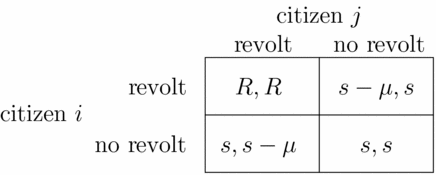
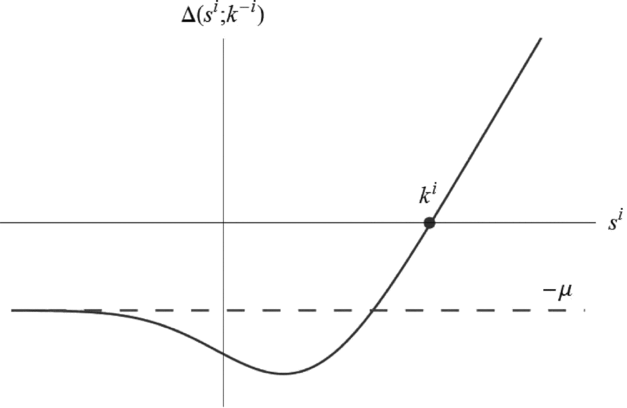
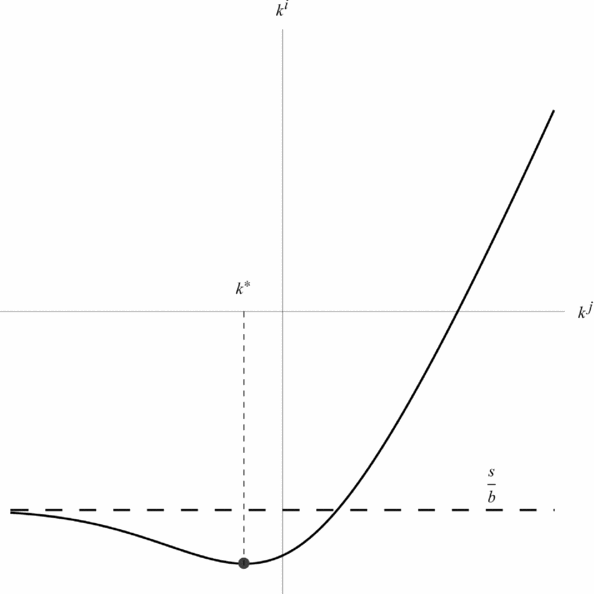
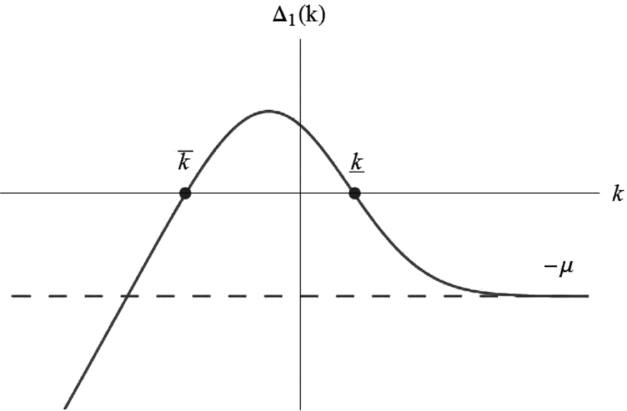
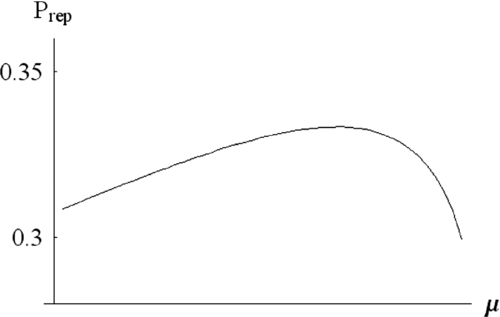
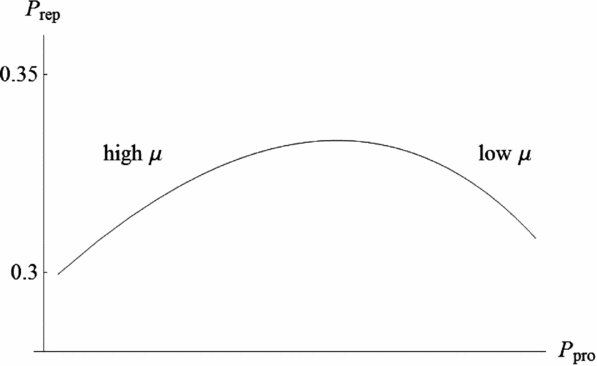
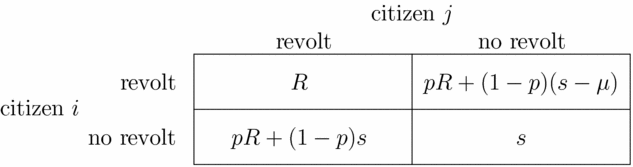

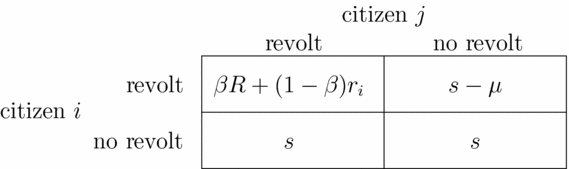





Comments
No Comments have been published for this article.