Although annual influenza vaccine is recommended for all healthcare personnel (HCP),1 only 78.4% of surveyed HCP reported receiving the influenza vaccine in the 2017–2018 season, among whom the highest coverage was observed in locations that required vaccination by the employer (94.8%).Reference Black, Yue and Ball2 Despite controversy surrounding mandatory vaccination, these policies have increased 25% in hospitals since 2013.Reference Greene, Fowler, Ratz, Krein, Bradley and Saint3 Some institutions, including UW Health, have opted to use a declination form for HCP refusing vaccination.Reference To, Lai, Lee, Koh and Lee4 In contrast to past years, for the 2018–2019 influenza season, Employee Health Services (EHS) required resubmission of personal waivers. The primary objective of our study was to evaluate the patterns of personal conviction waivers among HCP.
Method
This study was a prospective case cohort design investigating personal influenza vaccination waiver rates among HCP. UW Health system includes 4 hospitals, 57 ambulatory clinics, and several administrative sites. This study protocol was deemed a quality improvement and program evaluation project and was exempt from review by the institutional review board.
The HCP at UW Health had until December 10, 2018, to receive an influenza vaccine, to obtain an approved medical exemption, or to submit a personal waiver to EHS. Personal waivers were collected in each HCP’s private health record.
Data were collected on HCP demographics, job description, staffing location, and reason(s) for completing a waiver. In addition, HCP staffing location was coded based on primary contact with immunosuppressed patients, which was defined as staffing within a transplant or oncology unit or clinic.
Results
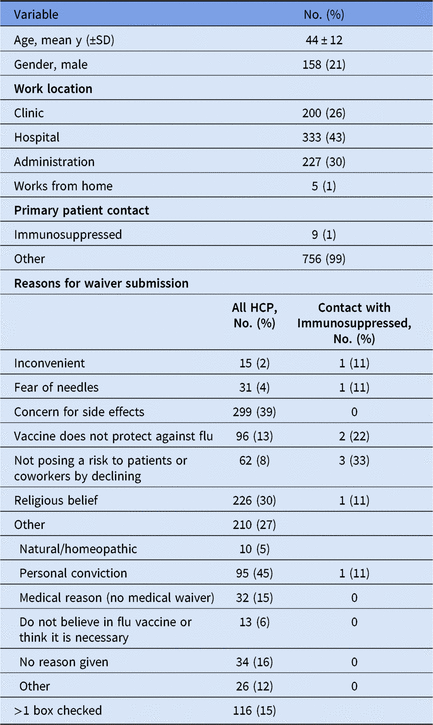
Of the 15,135 HCP, 765 (5%) individuals claimed a personal waiver in 2018 (Table 1). Submission of a personal waiver by HCP working primarily with immunosuppressed patients was much lower compared to all other HCP (odds ratio [OR], 0.31; 95% confidence interval [CI], 0.16–0.61; P = .0006). Fewer personal waivers were submitted in 2018 than were submitted or on file in 2017 (OR 0.9; CI 0.81 to 0.99l; P = .03). Staff serving in clinical roles were less likely to refuse influenza vaccination than those in administrative roles (OR, 0.45; 95% CI, 0.38–0.53; P < .0001). HCP working within a hospital were significantly less likely to submit a waiver compared to all other HCP (OR, 0.51; 95% CI, 0.44–0.58; P < .0001) as well as HCP who worked in a hospital compared to a clinic setting (OR, 0.64; 95% CI, 0.53–0.76; P < .0001). No difference in waiver rates was found between newly hired and existing employees. We were able to identify some employee groups with higher rates of claiming personal waivers compared to all HCP: environmental service workers (OR, 3.4; 95% CI 2.4–4.7), medical coders (OR, 2.8; 95% CI, 1.6–5.0), and patient schedulers (OR, 2.2; 95% CI, 1.7–2.9; P < .001) for all comparisons.
Employee Demographics (N = 765)

Note. Does not equal 100% as employees were able to check >1 reason.
Stated reasons for choosing a personal waiver include concern about vaccine side effects followed by religious objections (Table 1). The distribution of stated reasons is different for those who work primarily with immunosuppressed patients and included no one who expressed concern about vaccine side effects (Table 1). However, one-third of the group who had primary contact with immunosuppressed patients did not recognize that they posed a risk to their patients.
Discussion
In our study, HCP who worked with primarily immunosuppressed patients were more likely to receive a seasonal influenza vaccine even when offered the opportunity to choose a personal waiver. Similarly, HCP who worked in a hospital were also more likely to receive an influenza vaccine compared to personnel who work at an administrative site. Although we know reasons of HCP who chose to waive the vaccine, we can only presume that risk of exposing their patients may influence the decisions of those HCP who took vaccination. The EHS follows best-practices guidelines for healthcare worksite seasonal influenza vaccination, including no-cost vaccine administration on site during all shifts.5 Waiver submission was made relatively convenient as the form could be downloaded and submitted to EHS electronically.
Our institution’s influenza immunization rate of 93.4% for 2018 was higher than reported rates among HCP overall of 79%.Reference Black, Yue and Ball2 Interestingly though, our rates were lower than those of other sites where influenza immunization was required (95%).6 However, our findings of higher rates among those who work in a hospital reflect what was previously reported. Additionally, the published survey includes only HCP who have contact with patients. Our results showed that those who work in administrative buildings had much lower influenza vaccine uptake than those who work in hospitals or clinics.
Data on immunization waivers among healthcare workers are limited. However, the ease of choosing a waiver for school-based immunization requirements has been correlated with vaccine-preventable disease outbreaks.Reference Phadke, Bednarczyk, Salmon and Omer7 Future studies should consider this possibility in HCP.
Our study has some limitations. We were able to report immunization decision reasons only for those who chose to file waivers. We do not know why HCP chose to receive influenza vaccines. We were also limited by broad employment categories and therefore could not quantify patient contact by all of the HCP in our study. Instead, we categorized them by the area in which they worked. Certainly, other HCP have contact with immunosuppressed patients, but we chose primarily 2 types of patients, oncology and transplant because those that would be consistently immunosuppressed.
These results will aid EHS in designing and offering educational and system interventions to improve influenza immunization rates in our healthcare system. Although HCP influenza vaccine rates are very high, room for improvement exists; other large health systems have approached immunization rates nearing 98%.Reference Babcock, Gemeinhart, Jones, Dunagan and Woeltje8 Our analysis of waivers provides guidance on potential targets to decrease waiver rates among HCP.
Author ORCIDs
Mary S. Hayney 0000-0003-3307-5634
Financial support
No financial support was provided relevant to this article.
Conflicts of interest
All authors report no conflicts of interest relevant to this article.