Review of Literature
The rate of suicides and attempted suicides among adolescents has increased over the last 20 years (Hedegaard, Curtin, & Warner, Reference Hedegaard, Curtin and Warner2018). Suicide is the third leading cause of death in adolescents, following accidents and homicides, and the frequency of suicide drastically increases during adolescence (Dilillo et al., Reference Dilillo, Mauri, Mantegazza, Fabiano, Mameli and Zuccotti2015; Shain, Reference Shain2016). Most suicide attempts do not end in actual death; however, after the first failed attempt, the individual is at increased risk of a repeated attempt (Shand, Vogl, & Robinson, Reference Shand, Vogl and Robinson2018). A World Health Organization survey (WHO, 2014) comprising 108,705 participants from 21 countries found that suicide attempts are preceded by approximately one year of planning (Borges et al., Reference Borges, Nock, Abad, Hwang, Sampson, Alonso and Bruffaerts2010). In Israel in 2016 there were 390 suicides, 321 men and 69 women. The corrected suicide rate by age for Jews is an average of three times higher than for Arabs (Gal et al., Reference Gal, Goldberger, Kabaha, Haklai, Geraisy, Gross and Levav2012). Approximately 14% of high school students seriously considered attempting suicide, whereas 10.9% made a plan and 6.3% made at least one attempt (CDC, 2010). In Israel the highest rate of attempted suicide is found in the 15–24 age group, followed by the 24–44 age group. Attempted suicides are higher among Jewish women and men than among Arabs (Haklai, Reference Haklai2019).
The Israeli sample consisted of 1117 adolescents in the 9th through 11th grades. Those who attempted suicide were characterised by higher levels of suicide ideation, distress, and victimisation. Low levels of self-disclosure and parental support were significantly associated with undisclosed suicide attempts (Levi-Belz et al., Reference Levi-Belz, Gavish-Marom, Barzilay, Apter, Carli, Hoven and Wasserman2019).
Suicidal behaviour has no single explanation. Indeed, suicide is a final step that results from a range of problems and is influenced by various factors, including personality characteristics, thinking styles, and life events and processes (Kennebeck, Bonin, Brent, & Solomon, Reference Kennebeck, Bonin, Brent and Solomon2017). Adolescence is a period of unregulated mental and psychosocial changes: a search for identity, separation from parents, and major peer group involvement. Adolescents’ reactions to these developmental challenges may include aggression, seclusion, avoidance or even attempted suicide in extreme cases (Laido et al., Reference Laido, Voracek, Till, Pietschnig, Eisenwort, Dervic and Niederkrotenthaler2017; McLoughline, Gould, & Malone, Reference McLoughlin, Gould and Malone2015; Turecki & Brent, Reference Turecki and Brent2016).
School counsellors work to promote the mental wellbeing of school students and staff and to help them function optimally (Shimoni & Greenberger, Reference Shimoni and Greenberger2014). School counsellors should play a major role in dealing with adolescent suicide attempts; nevertheless, a meta-synthesis of 13 qualitative studies of counselling and psychotherapy with people at risk of suicide reported that very little is known about how to cope with such cases (Winter, Bradshaw, Bunn, & Wellsted, Reference Winter, Bradshaw, Bunn and Wellsted2014). The focus of most training is on prevention, with very little guidance given about what to do after a student has attempted suicide (Darden & Rutter, Reference Darden and Rutter2011).
The Israel Ministry of Education has a special unit devoted to coping with crisis situations, emergencies and suicide. This unit is concerned with mental preparation of the educational system for situations of stress, emergencies and crises, and with providing responses for the victims. The unit devotes extensive resources to suicide and its prevention, to writing and running intervention programs, and employs 80 district counsellors across Israel (Ministry of Education, 2020).
School counsellors are responsible for implementing intervention programs to identify signs of distress among students and for training school staff to recognise these signs (Schilling, Lawless, Buchanan, & Aseltine, Reference Schilling, Lawless, Buchanan and Aseltine2014). Indeed, in 46% of cases, friends of suicidal students knew about their friends’ intentions to commit suicide but did not report these intentions (Reis & Cornell, Reference Reis and Cornell2008). Moreover, about 55% of adolescents who attempted suicide or engaged in suicidal behaviours had been absent from school for extended periods of time before the attempt. Based on this finding, some researchers recommend considering long absences not as a discipline problem but rather as a deeper problem that requires school counsellor intervention (Levi-Belz, Krispin, Galilee, Bodner, & Apter, Reference Levi-Belz, Krispin, Galilee, Bodner and Apter2018). Appropriate support will increase the chances of helping students during difficult times and crises (Fineran, Reference Fineran2012).
Studies on field training of school counsellors found that the focus is typically on prevention, with very little guidance about what to do after a student has attempted suicide (Darden & Rutter, Reference Darden and Rutter2011). Counsellors’ heavy workload leaves them little time for coping with suicidal students. The study also found that counsellors exposed to incidents of suicide had a lower sense of professional self-efficacy (Christianson & Everall, Reference Christianson and Everall2008; Lund et al., Reference Lund, Schultz, Thomas, Nadorff, Chowdhury and Galbraith2018). Carpenter (Reference Carpenter2018) pointed out that school counsellors who themselves experienced personal trauma and loss may be even more vulnerable when dealing with adolescents’ suicide attempts. Studies also found that counsellors lack professional training and need the support of a team of suicide prevention professionals (Christianson & Everall, Reference Christianson and Everall2008, Reference Christianson and Everall2009; Cureton, & Clemens, Reference Cureton and Clemens2015; Robinson et al., Reference Robinson, Cox, Malone, Williamson, Baldwin, Fletcher and O’Brien2013). Studies that examined the reactions of educators and professionals involved in treating issues of wellbeing found that they experienced emotions such as guilt, blame, shock, disbelief and denial, and that on an unconscious level they distorted the details of the client’s suicide (Cureton & Clemens, Reference Cureton and Clemens2015; Levy, Koehler, & Hunt, Reference Levy, Koehler and Hunt2019; Munson, Reference Munson2009; Sherba, Linley, Coxe, & Gersper, Reference Sherba, Linley, Coxe and Gersper2019).
Despite the large body of knowledge in the field of adolescent suicide attempts, empirical knowledge is lacking about the coping skills of the educational staff, particularly those of high school counsellors. The prevalence of suicide attempts further underscores the need to review whether the psychological and educational staff available to these adolescents is equipped with sufficient skills to cope with such cases (Centers for Disease Control and Prevention, 2014). The few empirical studies that do exist examine the ways in which school counsellors cope with the suicide of a student (Carpenter, Reference Carpenter2018; Christianson & Everall, Reference Christianson and Everall2008, Reference Christianson and Everall2009; Nichols, Reference Nichols2018), but not with suicide attempts.
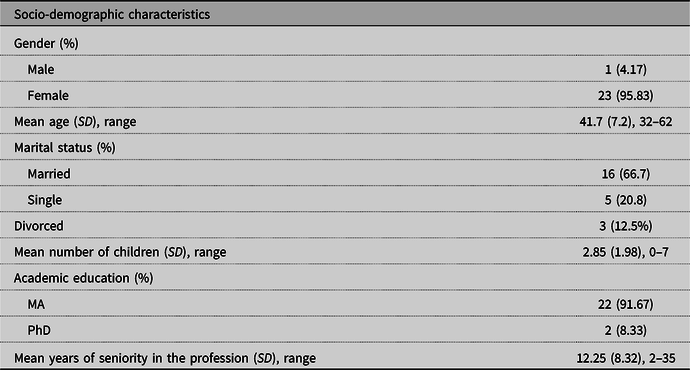
Participants’ characteristics (N = 24)

The Current Study
The purpose of this study is to provide in-depth knowledge and a more profound understanding of the experiences of school counsellors coping with suicide attempts among adolescents in Israel. In this research, we sought to enter the world of high school counsellors and learn about the ways they cope in the field, the difficulties they experience and the insights they gain. The objective was to determine what kind of changes are needed in the field to improve the welfare of the counsellors and at the same time give the adolescents the best help possible.
Methodology
The qualitative research procedure used in the study applied the phenomenological paradigm, which is based on the assumption that the social world is a world of subjects and not of objects. The procedure in qualitative methodology conforms to and is shaped by the researcher’s experiences when collecting and analysing the data. The aim of qualitative phenomenological research is not to discover reality, for there is no one absolute and correct reality, but rather to investigate different interpretations of that reality in order to describe and explain matters in their various manifestations and their complexity. The basic assumption is that the knowledge is inherent in the meaning people attribute to their lives. While there is some subjective resemblance between personal experiences and the significance attributed them, the experiences themselves have unique and personal components.
With this methodology, the researcher uses inductive logic, and the direction of the investigation evolves as the research progresses. The qualitative phenomenological approach is useful for studying sensitive topics that involve self-disclosure by the participants (Brinkman & Kvale, Reference Brinkmann and Kvale2015). In the present context, the sensitive topic was the impact of suicide attempts on the educational counsellors in the schools.
Consequently, the research questions also may change as time passes, as they are adjusted to better reflect the problem (Creswell & Poth, Reference Creswell and Poth2018). In the current study, the main research questions were: How do school counsellors experience and cope with adolescent suicide attempts? How do they understand the problem and deal with it in their professional and personal lives?
Participants
The study participants were 24 school counsellors from high schools across Israel who had dealt with adolescent suicide attempts over the last three years. Participants ranged in age from 32 to 62 (M = 41.7; SD = 7.2). Of the 24 study participants, 23 were female (96%). Their school counselling experience ranged from 2 to 35 years (M = 12.25; SD = 8.32). In terms of marital status, 16 (66.7%) were married, five (20.8%) were single, and three (12.5%) were divorced (Table 1).
Research Tools
The qualitative data in this study were collected by means of in-depth, semistructured interviews. The interview tool was used to gain a comprehensive understanding of the ways in which the school counsellors perceived the suicide attempts of adolescents with whom they had worked and the meaning they attributed to these attempts (Brinkman & Kvale, Reference Brinkmann and Kvale2015). Sample questions include the following: ‘Tell me about a case in which an adolescent you worked with was suicidal. Tell me how you found out about it. What thoughts and feelings did you have? How did you act? Why do you think this happened? How did the incident affect you? Who served as significant figures for the adolescent while coping with the incident? How did the parents cope?’ (For the entire list of guiding questions, see the Appendix).
Research Procedure
The Institutional Review Board of Oranim College of Education approved the study’s protocol. Participants were recruited across Israel using purposeful sampling, with the aim of generating a diverse sample reflecting different participants and thus providing a comprehensive picture of the subject being investigated (Patton, Reference Patton2002). A purposeful research sample includes participants whose selection is based on predetermined criteria, so as to provide broad and rich information on the phenomenon under study.
Accordingly, the study participants were counsellors working in high schools across Israel who counselled a student who had attempted suicide. Attempts were made to reach participants with different demographic background characteristics. The interviewees were recruited through the researchers’ direct and indirect social connections.
The interviewer was a high school counsellor, selected based on her previous experience and expertise. She was trained in the interview’s guiding questions and the interview protocol by a senior lecturer in school counselling. Prior to conducting the interviews, the interviewer was required to undergo a reflection process (Finlay & Gough, Reference Finlay and Gough2008) that included being able to reflect on the identities, social locations, assumptions and life experiences she brought to the research endeavour, as well as on her interactions with the interviewees.
Initial contact was established with the interviewees by telephone, and meetings were set up at a suitable place and time. At the beginning of each interview, the participant received an explanation about the purpose of the study and the interview procedure. Participants’ anonymity during the entire research and publication process was guaranteed. Interviewees were told they could withdraw from the study at any time and could refuse to answer any question. No incentives were offered. They were then asked to sign an informed consent form. Participant selection was not limited to any specific geographic location.
The interviews were conducted in Hebrew, then recorded, transcribed, and translated into English. Each translation was verified by two native English speakers, one of whom is a certified translator. The interviews were conducted at the interviewees’ homes or at their school office, according to the participant’s preference. Each interview lasted approximately one hour. Data collection commenced in April 2019 and was completed by June 2019, when theoretical saturation was reached (i.e., additional interviews yielded no new material for analysis).
Data Analysis
After collecting the data and transcribing the interviews, the two researchers began analysing the data in order to identify and code central themes and patterns. Each researcher then conducted separate thematic content analyses of the data, followed by a joint comparative examination of the individual analyses. The analysis was carried out using theme coding by searching for statements about the participants’ experiences with the phenomenon. The first phase of data analysis included reviewing and analysing the interviews based on open coding, while emphasising relevant statements using the open-coding method to identify repeated themes and motifs. The axial coding method used in the second phase of the analysis entailed cross-category comparisons of themes that emerged in several interviews. When categories or subcategories similar in content were identified, the number of categories was reduced accordingly. During the thematic content analysis, the researchers discussed disparities and sought agreement regarding theme content and meaning interpretation. The selective coding method used in the third phase involved omitting additional categories that did not address the central theme, with the aim of obtaining a clear and coherent picture of the main themes and their interrelationships. This reduction facilitated refining, targeting and organising the data to yield the final findings (Brinkman & Kvale, Reference Brinkmann and Kvale2015).
Trustworthiness
Trustworthiness in qualitative research is equivalent to reliability and validity in quantitative research. Trustworthiness was achieved in several ways. First, the interview material was transcribed verbatim, making it possible to return to the original narrations. Second, the analysis was conducted by two independent researchers to ensure credibility (Shenton, Reference Shenton2004). The researchers engaged in an ongoing reflection process. Inconsistencies were discussed until a consensus was reached. Throughout this report of the study, the school counsellors’ point of view is illustrated by examining and analysing excerpts from the interviews.
Results
In this study we examined the experiences of school counsellors in Israel who had coped with cases in which adolescents under their care had attempted suicide over the three years preceding the interview. Analysis of the interviews revealed a number of key issues that shed light on the counsellors’ perceptions and coping methods. The first theme is titled: ‘“I called to say goodbye”: School counsellors’ discovery of the suicide attempt’. This theme describes the moment the school counsellors discovered the suicidal incident and the guilt and responsibility they felt. The second theme is titled ‘“I have to worry about everyone”: How school counsellors cope after adolescents under their supervision attempt suicide’, and it addresses the counsellors’ complex experience in dealing with the adolescents, their families and the school administration. The interviewees described a sense of helplessness and emotional fatigue. Many felt that despite their lack of adequate skills and their fears of another suicide attempt, they served as the first responders in helping these adolescents. The third theme is titled ‘“You shouldn’t remain alone”: The importance of support in school counselling’. Despite understanding the importance of receiving support, a significant proportion of the counsellors felt threatened by their own need for mental healthcare and did not seek it out following these incidents. They believed they had the tools to cope and relied mainly on informal sources of support.
‘I called to say goodbye’: School Counsellors’ Discovery of the Suicide Attempt
The counsellors described adolescent suicide attempts as disconcerting, difficult, painful, and sometimes surprising and unexpected. In some cases, the counsellors had difficulty identifying adolescents at risk or signs of suicidal behaviours due to the multiple tasks that their job entailed. The counsellors described an emotionally charged atmosphere and anger towards the school administration for not enabling them to get to know the adolescents more closely, as they were expected to work on the group level. They felt frustrated because they were not closely acquainted with some of the adolescents assigned to them and feared losing a student. Most of the counsellors said they usually heard about suicide attempts only after they occurred and were not aware of any prior intentions. In some cases, the counsellors stated that adolescents contacted them during the attempt itself. One counsellor told about getting a phone call from an adolescent who had taken his parents’ car and was driving at accelerated speeds with the intention of committing suicide:
He [the student] called me after a family event at which he had a fight with his parents. He was upset and called me from the car … told me that if he drives between 0 and 50, nothing will happen to him, between 50 and 100, he may be slightly injured, between 100 and 150, he’ll be seriously injured, and between 150 and 200, he’ll definitely be killed … ‘I’m already going 170 km per hour’, he said. ‘I called you to say goodbye.’
School counsellors reported feeling frustrated and guilty when they were unaware that an adolescent was going through a crisis and therefore were unable to prevent the suicide attempt. They also noted that adolescents sometimes did leave a trail of disturbing clues that allowed the counsellor to recognise they were at risk. Some adolescents tried to hint at their distress and pain before they attempted suicide, but their clues did not always reach the counsellor in time or at all. In other cases, according to the interviewees, students did not voice their pain, opting to hide and repress it so they became invisible to the system. The study participants explained that adolescent suicide attempts are usually accompanied by an extreme sense of loss and guilt.
As hard as this is to hear and accept, you cannot save them all. Unfortunately, I do not know all the adolescents assigned to me. My job includes other responsibilities, and I cannot always fit conversations with the students into my daily schedule. At first, this really bothered me; I felt stressed all the time, but today, I realise that I cannot reach everyone. Am I okay with this? Does this pacify me? No, but that’s how it is.
‘I have to worry about everyone’: How School Counsellors Cope After Adolescents Under Their Supervision Attempt Suicide
After learning about a suicide attempt, the participants stated that they had to manage the situation on several fronts: with the adolescent and with his or her family. The counsellors described a sense of panic and worry upon learning about a suicide attempt, but noted that they had to mask their emotions in order to take the reins and manage the situation. They felt they had to remain completely in control at the time of the incident and not allow themselves to feel or identify with the adolescent’s pain and grief. Upon learning of the crisis, they acted automatically: ‘You must not break down or give yourself room for understanding or feeling. You must remain completely goal-focused within the situation.’
Only afterwards do they allow themselves to take inventory of their emotions. Yet they must quickly pull themselves together to face the next crisis. The counsellors understood the weight of being responsible for someone else’s life. As they put it, they had no one to complain to. They had to remain firm and strong and convey professionalism. They described an inner conflict between the efficient and professional behaviour that the job demanded and their overwhelming feeling of chaos. One counsellor compared her role to that of paramedics who provide first aid: both have a job to do, are obliged to act as professional service providers and must separate the traumatic incident from their personal lives.
You feel like you’re in a pressure cooker; you need to scream, run away, give someone else the responsibility, but then you take a deep breath and realise it’s all on you. Your adrenaline is high; there’s no room for your own feelings — they don’t exist at all, so you’re strong. And only afterwards do you cry quietly. And then you have no choice but to pull yourself together again and keep going; it doesn’t end.
The counsellors felt they played a central role in dealing with suicide incidents despite their lack of adequate training and their fear of another incident. Some counsellors described their attempts to persuade adolescents to seek psychological treatment, whether at school or outside. Many wanted to remove the case from their responsibility due to its difficult nature. Some said that helping these students took its toll on them in terms of resources, leaving them unable to attend to their other responsibilities:
She drained me; she drained me; the story itself also drained me, time and again. And also, when you are not the parent, you cannot endlessly carry this burden on your shoulders. If I were her parent, I would be there for her at all times, but for me, this was enough. I want to turn my attention to other things. There are other children, more difficulties and crises. I felt that this crisis was too much, it was taking too much of my time and energy.
All of the participants referred to the complexities of dealing with family members. They described difficulties in cooperating with the parents who had to deal with the grim news and often turned their anger and frustration towards the counsellors. Some of the participants thought that the parents felt guilty for failing to fulfil their parental responsibilities. Other counsellors said that some families felt ashamed that a family member had attempted suicide. The counsellors expressed compassion and empathy for family members and their difficulties and described their attempts to talk with the parents in an effort to help restore their confidence. The counsellors considered it important to demonstrate to the parents that they were not being judged or criticised, so as to get the parents to work with them. At the same time, the counsellors expressed a great deal of frustration with the amount of effort they had to invest, with being the target of the parents’ anger, and with the unfortunate fact that often parents were unavailable or failed to respond adequately to their children’s signs of distress/implicit calls for help. One of the counsellors said she felt like ‘an emergency room doctor who gives bad news and is rewarded with a violent response from the family’. The counsellors felt like messengers who pay the price for bringing bad news and are left to fend for themselves on the battlefront.
The mother hesitated and said that when the father came they would contact me. I explained that every moment was significant … I told her it was important to get to the hospital as soon as possible. After a while the father called me and said he didn’t think the girl had a problem; he thought they could handle things, and she [the adolescent] could handle things too. The father was angry that I had taken her to the hospital and said I was blowing things out of proportion.
When the counsellors’ attempts to cooperate with family members failed, their feelings of responsibility and loneliness were exacerbated. The matter was not yet over, and the counsellors had to be alert to the possibility of another suicide attempt. Throughout the interviews, the participants indicated that their job description included protecting the student and that this led to their feelings of physical and mental exhaustion.
It’s hard to feel that everything is on you, that you’re the one steering the boat and that you have to protect everyone — the parents, the child, the child first, but also the parents … So often after such an incident, I needed to go to bed, go to sleep, to gather the strength I needed to hold things together and make sure everyone was ok.
‘You shouldn’t remain alone’: The Importance of Support in School Counselling
All of the participating school counsellors indicated they had received some suicide training and knew that in the case of a suicide attempt they should contact the school counselling supervisor and the counselling service instructors. Yet, during an actual incident, the theoretical knowledge they had received during their training was often unhelpful. They panicked and consequently were unable to retrieve this knowledge.
Some of the counsellors, especially those with less experience, mentioned feelings of insecurity and a desire to avoid dealing with such incidents. Other counsellors who were in the early stages of their career emphasised the close, effective and reassuring involvement of their superiors in resolving the situation.
Once I encountered a case that I really didn’t know how to deal with; I simply did not know what to do. I picked up the phone and called my instructor and my supervisor and asked them: ‘Did I do the right thing, or did I make a mistake?’ They calmed me down … You should never stay alone in this so-called battle. Their guidance was really helpful, professional, personal, very individually oriented guidance.
Several counsellors noted that it was very important not to deal with such cases alone, but to find someone who can help and also provide support. They sought a nonjudgmental space where they could talk without hesitation, fear or concerns.
I think it’s a good idea to meet with other counsellors from the immediate vicinity or from elsewhere in the county and just talk about things in a group. Such meetings can provide good, proper and accepting guidance. Despite the fact that every story is different and every situation has its own complexities, I think it’s important to vent your emotions, listen, and brainstorm with people who have had similar experiences. It’s important to learn what to do and sometimes what not to do based on the experience of others. I think such meetings can play an important role.
Despite understanding the importance of support and assistance, some of the counsellors admitted that for the most part they did not receive support and felt uncomfortable receiving help. These participants had more experience, were more comfortable and familiar with the role of counsellor, and felt threatened by the possibility that they might need emotional assistance. Some participants did not believe they could receive adequate assistance and claimed they had the ability, strength and tools to cope on their own with the distress that ensued in such cases.
We never share enough; somehow we always take on a little more responsibility than we should, some kind of a rescue fantasy, which I think wanes after a few years [on the job] — but nevertheless, it still exists. We go to bed with it and get up with it in the morning. Support is available, and you can consult and get this support, but it does not help; it does not always help. Until the issue is resolved, you remain stressed, and getting some support or help won’t change that; the stress does not end. So, I can manage alone. If I can counsel others, I can help myself.
Some of the counsellors stated they received assistance from their fellow counsellors at school at regular school staff meetings or informal meetings in the counsellors’ or the teachers’ lounge where they could share their complex emotional reactions and thoughts about the incident. Others said they were assisted by informal support from others, especially from spouses and close friends. They also brought up the matter of confidentiality, and some felt remorse after talking about the issue. Despite the need to talk, they sometimes felt that the difficult incidents created a sense of fear and threat, and their relatives were surprised by the intensity of their emotional reactions.
Discussion
This study examined the experiences of school counsellors in Israel in coping with the aftermath of suicide attempts among adolescents under their care. The results of the analysis indicate that the discovery of a suicide attempt was disconcerting, shocking, and painful for the counsellors. They felt guilty and regretted the way they had worked with the students who had attempted suicide. They also felt frustrated by the limitations of their job. Dealing with the adolescents and their families was a complicated task for the counsellors. Despite their insecurity regarding their ability to handle the situation and in some a desire to avoid it altogether, the counsellors played a significant role in managing cases of attempted suicide. Nevertheless, they did not receive formal support and relied mainly on informal support from their peers and spouses.
Suicide is a complex issue that raises philosophical and ethical dilemmas. Therapeutic contact with people who have attempted suicide is fraught with drama and can undermine counsellors’ personal and professional attitudes, perceptions and beliefs (Christianson, & Everall, Reference Christianson and Everall2008, Reference Christianson and Everall2009). A suicide attempt can appear to be the chronicle of a death foretold, as it usually involves advance planning and decision making, although it can also be a momentary impulsive act. Shneidman (Reference Shneidman1998) used the term ‘mental pain’ to describe the suffering of the suicidal person. The interviewed counsellors had to deal with the mental aspects of the suicide attempts, including their students’ stories of distress and frustration, while at the same time addressing the students’ urgent needs. The findings of the study indicate that counselling students who attempt suicide has implications for the behavioural and emotional states of school counsellors.
In the participants’ experience, counselling a student who attempts suicide leads to profound emotional shock and a heavy mental strain, accompanied by burdensome feelings of fear, threat, anger, guilt, and insecurity. Confirmation of this can be found in the literature (Takahashi et al., Reference Takahashi, Chida, Nakamura, Akasaka, Yagi, Koeda and Sakai2011; Wurst et al., Reference Wurst, Mueller, Petitjean, Euler, Thon, Wiesbeck and Wolfersdorf2010; Yaseen et al., Reference Yaseen, Briggs, Kopeykina, Orchard, Silberlicht, Bhingradia and Galynker2013). Studies have found that therapists working with people who have attempted suicide experienced negative feelings of anger, frustration, lack of empathy and fear of involvement, leading them to avoid any emotional connection with patients (Awenat et al., Reference Awenat, Peters, Shaw-Nunez, Gooding, Pratt and Haddock2017; Bowers et al., Reference Bowers, Simpson, Eyres, Nijman, Hall, Grange and Phillips2006; Windfuhr et al., Reference Windfuhr, Bickley, While, Williams, Hunt and Appleby2010). Another explanation for the emotions experienced by school counsellors is that counselling those who have attempted suicide may bring to the forefront worries they were trying to suppress in their daily lives. These incidents may also remind them of situations that occurred in their personal or professional lives. Engaging with those who took this extreme step confronts the counsellors with the possibility that they themselves may reach a point where they can no longer cope with or suppress their own suicidal thoughts. This poses a real threat, raises their anxiety level and makes them want to avoid working with these students.
The counsellors described the weight of responsibility that their job entails, their consequent sense of guilt about not being able to prevent the suicide attempt, as well as their fear of recurring attempts. This finding resembles those of other studies in which professional teams claimed to have failed to preserve their patients’ mental wellbeing prior to a suicide attempt (Awenat et al., Reference Awenat, Peters, Shaw-Nunez, Gooding, Pratt and Haddock2017). In contrast, other studies examined psychologists who felt their client’s choice to attempt suicide was beyond their control and, consequently, they did not question their own professional abilities (Darden & Rutter, Reference Darden and Rutter2011; Wurst et al., Reference Wurst, Mueller, Petitjean, Euler, Thon, Wiesbeck and Wolfersdorf2010).
Some of the participants described feelings of anger and resentment towards those who tried to commit suicide. They saw that working with students who attempted suicide took extra time and reduced their ability to provide effective care to other students. In the healthcare sector as well, patients who were thought to be responsible for their condition and for their need of treatment provoked anger and irritability in healthcare providers, more so than did patients whose illness was beyond their control (Gulfi, Dransart, Heeb, & Gutjahr, Reference Gulfi, Dransart, Heeb and Gutjahr2015). A suicidal patient is seen as weak, selfish and immoral (Pompili, Girardi, Ruberto, Kotzalidis, & Tatarelli, Reference Pompili, Girardi, Ruberto, Kotzalidis and Tatarelli2005; Pompili, Manchineli, & Tatarelli, Reference Pompili, Manchineli and Tatarelli2003). A meta-analysis of 20 qualitative studies on patients who attempted suicide found that some patients felt their healthcare providers had neither time nor compassion for them. These patients felt their healthcare providers spent too little time with them because they were busy with other tasks or were interrupted during patient visits. Some patients reported having no one to talk to, feeling ignored, or feeling they were being stowed away like an object (Berg, Rørtveit, & Aase, Reference Berg, Rørtveit and Aase2017).
The present study found that in order to cope with their great emotional load, school counsellors regulated their emotions and focused on the task at hand to be able to function. They learned to protect themselves from difficult situations that could aggravate them and cause them to lose control or impair their functioning (Young & Bryan, Reference Young and Bryan2015). According to the current findings, the central strategy for dealing with stressors is physical and emotional distancing. These findings are consistent with extensive descriptions in the literature of medical and mental health professionals who distance themselves from their patients in order to protect themselves from painful feelings and minimise their emotional distress (Bloomberg & Sahlberg-Blom, Reference Blomberg and Sahlberg-Blom2007). Technical duties such as writing reports or working with school administrators require less emotional and mental effort than does psychosocial work. The therapeutic bond is the core of school counselling and is a major source of support for the students. The emotional distancing seen in the participants in the present study appears to emerge from a sense of threat and anxiety. Emotional closeness with adolescents entails openness, involvement, trust and a focus on the student, but it also involves proximity to death, fear, tension and helplessness. Studies among doctors and nurses have pointed to a desire to avoid the ‘hot potato’ and to transfer it to another professional (Medina, Kullgren, & Dahlblom, Reference Medina, Kullgren and Dahlblom2014).
The school counsellors interviewed in the present study reported feeling insecure and lacking insituation-specific skills for coping with suicide attempts, despite having received basic training. The research literature includes reports about educators who felt they had insufficient experience, skills, knowledge and ability to provide care for students who had tried to commit suicide (Christianson & Everall, Reference Christianson and Everall2008, Reference Christianson and Everall2009).
Counsellors believe that mental health experts should be responsible for treating adolescents who attempt suicide. Studies indicate that despite their desire to help, school counsellors are unsure how to communicate with children after a suicide attempt and fear that what they say may have a deleterious effect. According to research findings, physical and mental health professionals also often feel impotent and insecure when attempting to cope with the distress of young people who attempted suicide (Lachal, Orri, Sibeoni, Moro, & Revah-Levy, Reference Lachal, Orri, Sibeoni, Moro and Revah-Levy2015). Those who provide care for these young people have expressed their need for specialised interventions and specific training programs on this subject (Tallaksen, Braåte, & Tveiten, Reference Tallaksen, Braåten and Tveiten2013). They, too, mentioned feeling helpless in providing a useful response to parents who show resistance or shock or who minimise the risk involved (Slovak & Singer, Reference Slovak and Singer2012).
Some of the counsellors described their problems in making meaningful contact with the parents. They characterised the parents’ reactions as detrimental to treating and helping the adolescent. Some of the participants acknowledged that the parents of these youths experience deep pain and are undergoing a form of self-mourning due to self-blame, whereas others expressed anger and intolerance towards the parents’ responses.
A systematic review that included 44 studies from 16 countries found that the family’s experience following a child’s first suicide attempt resembles the child’s experience: loss of hope, blame, guilt, self-recrimination, a sense of total failure; rejection, isolation, and incomprehension; powerlessness, helplessness, and loss of control. Whether they were drowning in guilt or rejecting responsibility for their child’s suffering, parents confessed they found it difficult to rally around the child after a suicide attempt (Törnblom, Werbart, & Rydelius, Reference Törnblom, Werbart and Rydelius2013).
In the current study, the counsellors emphasised that they too needed support. Nevertheless, they acknowledged that most formal sources of support were not helpful and stated they were often uncomfortable as recipients of help. They were more comfortable and familiar with the role of therapist, and they felt that admitting a need for and seeking out mental healthcare would damage their professional reputation. The literature indicates that it is important for the school counselling staff to continue to receive professional support after dealing with a student’s suicide attempt. School staff members should deal only with situations that are within their area of competence. In many cases, enlisting external mental health services can be a key factor that helps staff members provide the support their students require (Cox et al., Reference Cox, Bailey, Jorm, Reavley, Templer, Parker and Robinson2016).
Study Limitations
Several limitations in this study should be noted. This qualitative study includes a small sample of participants, which precludes generalisation of the study’s findings. In addition, other issues that may have affected the counsellors’ experiences, such as whether they or people close to them had attempted suicide, were not examined in this work. Finally, the study was conducted in Israel among a population of educational counsellors working in the unique culture of that country. Hence, the topic should be examined in other countries as well.
Conclusion
This study sheds light on the experiences of high school counsellors who deal with suicide attempts among adolescents. The study found that counsellors feel responsible for their students. They fear they will overlook some of the adolescent’s difficulties and that the student may make additional suicide attempts. The counsellors feel anguish, confusion, helplessness, and anger towards the adolescent, and despite being at the forefront of caring for students in the school environment, they feel insecure. Dealing with the parents makes them the objects of a great deal of anger and frustration. They feel they are the bearers of bad news. The counsellors do not receive any formal support and are helped mainly by informal peer support.
Funding
The study was funded by The MOFET Institute (IL).
Appendix. Questions for Interviewing Teachers
-
What do you consider a suicide attempt?
-
What in your opinion are factors that can cause adolescents to attempt to commit suicide?
-
Tell me about a time when you had to cope with t a student who had recently attempted suicide.
-
After an attempted suicide, what do these students need from the counsellor and from the school?
-
What difficulties did you experience personally in the case you described? Please tell me about your thoughts, feelings and behaviours.
-
Who were some of the significant figures that helped you during this difficult time?
-
What helped you cope?
-
What effect — if any — does helping adolescents after a suicide attempt have on your professional performance? (For example, thinking about a career change, absenteeism.)
-
What are the school’s regulations in cases of attempted suicide?
-
Besides you, is there anyone else in the education system that can support adolescents following a suicide attempt?
-
Does the education system provide support for the adolescent’s family members?
-
Are there any intervention programs intended specifically for adolescents who appear suicidal or have attempted suicide?
-
In your opinion, what might be the effects of an intervention on the adolescents and on the school?
-
What do you think could be helpful to school counsellors after a student’s attempted suicide?
-
What do you suggest could be done to improve the well-being of school counsellors?
-
What advice would you offer a colleague who experienced a similar incident?