Introduction
Schizophrenia is an important source of disability across the world, as <20% of patients achieve full recovery (i.e. long-term improvement in both symptoms and functioning) after the first psychotic episode (Jääskeläinen et al. Reference Jääskeläinen, Juola, Hirvonen, McGrath, Saha, Isohanni, Veijola and Miettunen2013; Morgan et al. Reference Morgan, Lappin, Heslin, Donoghue, Lomas, Reininghaus, Onyejiaka, Croudace, Jones, Murray, Fearon, Doody and Dazzan2014). Functional recovery especially remains an unmet therapeutic challenge, as most therapeutic interventions only have marginal effects on functioning (Robinson et al. Reference Robinson, Woerner, McMeniman, Mendelowitz and Bilder2004; Wykes et al. Reference Wykes, Steel, Everitt and Tarrier2008), and the majority of patients reaching symptomatic recovery still experience social and functional problems (Oorschot et al. Reference Oorschot, Lataster, Thewissen, Lardinois, van Os, Delespaul and Myin-Germeys2012). According to a recent study, improvement in the social sphere is one of the most desired outcomes for both patients and their relatives (Balaji et al. Reference Balaji, Chatterjee, Brennan, Rangaswamy, Thornicroft and Patel2012). This stresses the need to better understand the nature of social dysfunctions and their underlying mechanisms in this population.
Social functioning has been defined as the capacity of a person to fulfil different societal roles (objective indicators such as the amount social contacts, whether or not the person has a partner, etc.) (Priebe, Reference Priebe2007; Brissos et al. Reference Brissos, Molodynski, Dias and Figueira2011; Käkelä et al. Reference Käkelä, Panula, Oinas, Hirvonen, Jääskeläinen and Miettunen2014). Definitions also usually take into account subjective indicators, such as the feelings and thoughts on the social situation. Most studies assess social functioning using clinician-rated scales or retrospective questionnaires. Burns & Patrick (Reference Burns and Patrick2007) reported that the Global Assessment of Functioning (GAF), the Global Assessment Scale (GAS; Endicott et al. Reference Endicott, Spitzer, Fleiss and Cohen1976) and the Social Functioning Scale (SFS; Birchwood et al. Reference Birchwood, Smith, Cochrane, Wetton and Copestake1990) are predominantly used as outcome measures in studies involving patients with schizophrenia. Among them, the SFS (existing in self-report or informant versions) provides the more detailed assessment of social functioning. According to Birchwood et al. (Reference Birchwood, Smith, Cochrane, Wetton and Copestake1990), this instrument does not rely on normative judgement, is less prone to biases, and should therefore accurately reflect daily life. The validity of the SFS has been established in several studies conducted on independent samples. Significant associations between the self-report and the informant-based versions were reported, although patients had a general tendency to report a lower degree of social functioning impairments compared with their relatives (Vazquez Morejon & Jimenez Ga-Boveda, Reference Vazquez Morejon and Jimenez Ga-Boveda2000). Furthermore, the SFS was shown to correlate with other scales assessing psychosocial functioning, and to discriminate patients with a schizophrenia spectrum disorder according to their employment status (Vazquez Morejon & Jimenez Ga-Boveda, Reference Vazquez Morejon and Jimenez Ga-Boveda2000; Hellvin et al. Reference Hellvin, Sundet, Vaskinn, Simonsen, Ueland, Andreassen and Melle2010; Piskulic et al. Reference Piskulic, Addington, Auther and Cornblatt2011). However, validation of this scale using real-life measures of social functioning is lacking. A previous study examined the ecological validity of a retrospective measure of mood in schizophrenia and found low correspondence with measures collected in the daily life of the patients (Blum et al. Reference Blum, Vakhrusheva, Saperstein, Khan, Chang, Hansen, Zemon and Kimhy2015). This finding suggests that several factors, such as memory impairments, influence the way patients report their symptoms and functioning in retrospective measures. Furthermore, it is unknown whether the different SFS dimensions accurately capture distinct social difficulties, as well as the subtle dynamics of social interactions in daily life. Gathering information about ecological validity is important to determine the usefulness of the SFS as an outcome measure in future treatment studies aimed at improving social functioning.
Real-life measures of social functioning can be obtained through the use of the Experience Sampling Method (ESM; Csikszentmihalyi & Larson, Reference Csikszentmihalyi and Larson1992; Myin-Germeys et al. Reference Myin-Germeys, Oorschot, Collip, Lataster, Delespaul and van Os2009). ESM is a structured diary technique that collects data in the real-life environment. The use of ESM has several advantages over classical assessment techniques (Myin-Germeys & van Os, Reference Myin-Germeys and van Os2007). First, it provides multiple measures over a short time period and, thereby allows capturing the extent to which symptoms and level of functioning fluctuate over time. Secondly, it is an assessment in the moment, as participants report their current thoughts, feelings and experience v. how they generally think, feel and behave. Previous ESM studies have shown that patients with schizophrenia spend significantly more time alone compared with healthy controls, display a greater preference for being alone while in the company of others and appraise the company of others as less pleasant (Janssens et al. Reference Janssens, Lataster, Simons, Oorschot, Lardinois, van Os and Myin-Germeys2012; Oorschot et al. Reference Oorschot, Lataster, Thewissen, Lardinois, van Os, Delespaul and Myin-Germeys2012). Similar findings were observed in undergraduates with high negative schizotypy scores but not in those with high social anxiety (Brown et al. Reference Brown, Silvia, Myin-Germeys and Kwapil2007; Kwapil et al. Reference Kwapil, Brown, Silvia, Myin-Germeys and Barrantes-Vidal2012; Barrantes-Vidal et al. Reference Barrantes-Vidal, Chun, Myin-Germeys and Kwapil2013), suggesting that a specific pattern of social alterations is observed along the continuum of psychosis.
In the present study, we examined first whether patients with a diagnosis of non-affective psychotic disorder and healthy control individuals differ in social functioning, as assessed with two different measures of social functioning: a retrospective measure (SFS self-report version) and momentary (ESM) indicators of social functioning. Based on previous findings (Birchwood et al. Reference Birchwood, Smith, Cochrane, Wetton and Copestake1990; Janssens et al. Reference Janssens, Lataster, Simons, Oorschot, Lardinois, van Os and Myin-Germeys2012; Oorschot et al. Reference Oorschot, Lataster, Thewissen, Lardinois, van Os, Delespaul and Myin-Germeys2012), we expected that patients would report significant social impairments compared with controls on the SFS and on ESM items. Secondly, we examined whether scores on the SFS are associated with momentary ESM indicators of social functioning, as such testing the ecological validity of the SFS, with stronger associations indicating higher ecological validity. Given the low ecological validity of retrospective measures of mood in patients with schizophrenia (Blum et al. Reference Blum, Vakhrusheva, Saperstein, Khan, Chang, Hansen, Zemon and Kimhy2015), we expected low correlations between the two measures of social functioning.
Methods
Participants
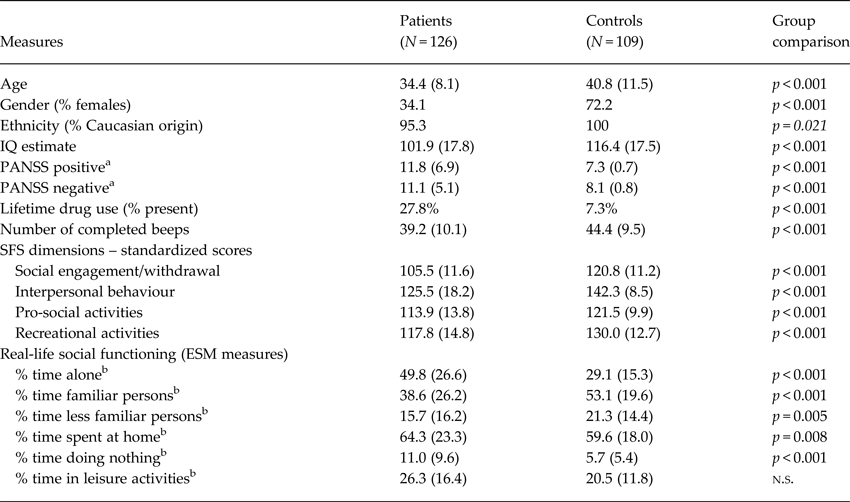
The sample consisted of 265 adult participants with a non-affective psychotic disorder and healthy controls (Table 1). All participants were recruited as part of the third wave (i.e. 7 years after the initial assessment) of the multi-centric Genetic Risk and Outcome of Psychosis (GROUP) study (Korver et al. Reference Korver, Quee, Boos, Simons and de Haan2012). Patients were recruited by four academic medical centers (Maastricht, Amsterdam, Groningen, and Utrecht) through mental state institutions in the Netherlands and Belgium. A Diagnostic and Statistical Manual of Mental Disorders, Fourth Edition (DSM-IV) diagnosis of a non-affective psychotic disorder was confirmed with the Comprehensive Assessment of Symptoms and History Interview (CASH; Andreasen et al. Reference Andreasen, Flaum and Arndt1992). The mean duration of illness in this group was 11.4 (s.d. = 5.8) years.
Descriptive characteristics of the sample; if not otherwise specified, mean (s.d.) are provided
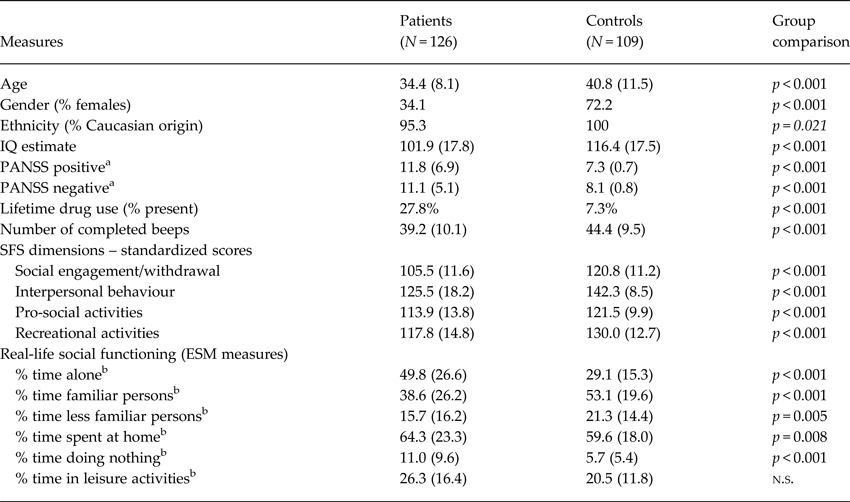
a Missing data for three patients and five controls.
b Time budget computed as follows: (number of reports/total number of valid beeps) × 100.
Controls were recruited through a system of random mailings in the same areas. They were screened with the CASH to exclude the presence of a psychotic disorder, and the Family Interview for Genetic Studies was used to establish absence of first-degree relatives with a psychotic disorder (G.R.O.U.P., 2011). In the control group, the presence of a history of non-psychotic mental disorders was not an exclusion criterion (e.g. history of a major depressive episode currently in remission). A short version of the Wechsler Adult Intelligence Scale – version 3 (WAIS-III) was administered to all participants to estimate intellectual functioning level (Wechsler, Reference Wechsler1997). The Positive and Negative Syndrome Scale (PANSS) was administered to assess the severity of positive and negative symptoms. The study was approved by the local medical ethics committee and written informed consent was obtained from all participants.
Social Functioning Scale
The SFS self-report version is composed of 79 items divided in seven dimensions: (1) social engagement/withdrawal (waking hours, time spent alone, initiation of conversations and social avoidance); (2) interpersonal behaviour (number of friends, presence of a partner, ability to start conversations and difficulty talking with others); (3) pro-social activities (frequency of activities involving passive or active interactions with other people, such as cinema, playing sport or visiting friends); (4) recreational activities (frequency of solitary activities, such as reading, cooking or gardening); (5) independence–competence (ability to perform skills necessary for independent living); (6) independence–performance (performance in skills necessary for independent living); and (7) employment/occupation (engagement in productive employment or structured programme). The subscales standardized scores were used, with higher scores reflecting higher levels of functioning. Internal consistency values (Cronbach's α) for each SFS dimension are provided in online Supplementary Table S1 (available online). The SFS independence–competence, independence–performance and employment/occupation dimensions were not examined in the scope of this article because they do not strictly reflect social functioning.
ESM social functioning
Real-life social functioning was assessed during 6 consecutive days using ESM. The maximum time interval between the SFS and the ESM procedure was 30 days (m = 4.22; s.d. = 6.68). Participants were carrying a digital apparatus, the PsyMate (Myin-Germeys et al. Reference Myin-Germeys, Birchwood and Kwapil2011), that beeps 10 times a day randomly between 7:30 and 22:30. After each beep, participants were instructed to immediately complete the questionnaire on the PsyMate and were allowed to do so within a 15-min interval. All participants received an initial briefing to review their understanding of the procedure. In line with previous studies (Myin-Germeys et al. Reference Myin-Germeys, Oorschot, Collip, Lataster, Delespaul and van Os2009), participants with less than 1/3 of valid reports were excluded from the analyses.
Several ESM items were used as indicators of real-life social functioning. First, participants had to report whether they were in the company of other persons and the nature of this company. The percentage of time spent alone, with familiar persons (i.e. partner, housemate, friends or family members) and with less familiar persons (i.e. healthcare professionals, acquaintances or strangers) was derived from this information. When participants were alone, the following items had to be completed on a seven-point Likert scale: ‘I like being alone’ and ‘I would rather be in the company of other persons’. When participants were accompanied by other persons, different items were rated: ‘I would rather be alone’, ‘I feel at ease in this company’ and ‘I feel threatened by this company’. Participants were finally asked to report their current location and activity. Three scores reflecting percentage of time spent at home, percentage of time doing nothing and percentage of time spent in leisure activities (e.g. internet, sport) were computed based on this information.
Statistical analyses
First, SFS scores and ESM measures were compared between patients and controls. Group comparisons for time-invariant variables (i.e. one observation per participant, such as the percentage of time spent alone) were performed using multiple linear regression models, controlling for age and gender in STATA 12.1 (StataCorp, 2014). Multilevel regression analyses were performed to compute group differences on time-varying variables (i.e. one observation per beep for each participant, which requires the use of multilevel analyses) using the XTMIXED command, again controlling for age and gender.
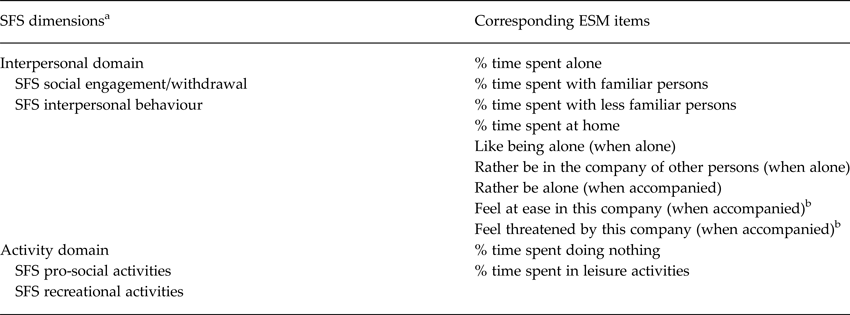
Secondly, multiple linear regressions or multilevel regression analyses were performed to examine the association between each SFS dimension and its corresponding ESM indicators within each group of participant (Table 2). As IQ might alter the strength of the association between the SFS and ESM measures of social functioning (e.g. low IQ might be associated with a stronger recollection bias and be associated with weaker associations between the studied variables), it was always added as a covariate in the analyses. The Simes correction (Simes, Reference Simes1986) was chosen to adjust for multiple testing with each SFS dimension, as the tests were not independent from each other. With the Simes correction, the most significant p value is tested against a threshold of α = 0.05/n (total number of tests), the second most significant value against a threshold of α = 0.05/(n − 1), etc. Nine ESM items were examined in association with the social engagement/withdrawal and interpersonal behaviour dimensions (for these dimensions: n = 9 tests) and two ESM items were examined in association with the pro-social and recreational activities dimensions (for these dimensions: n = 2 tests) (see Table 2).
SFS dimensions and corresponding ESM indicators of social functioning
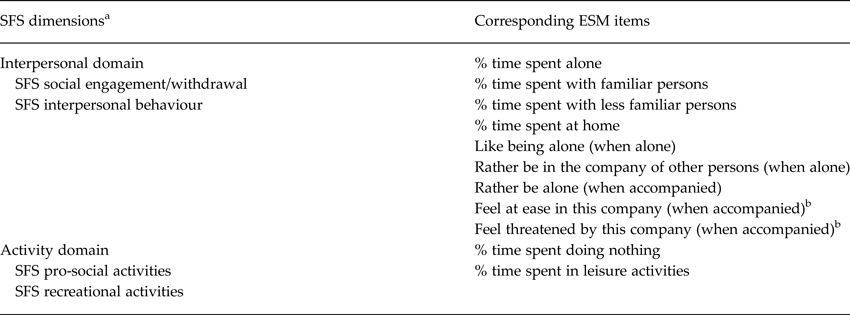
a The Simes correction was applied to each dimension to account for multiple comparisons (N = 9 comparisons for the social engagement/withdrawal and interpersonal behaviour dimensions; N = 2 comparisons for the pro-social and recreational activities dimensions).
b Only assessed in participants recruited in Maastricht (N = 189; 90 patients with a non-affective psychotic disorder and 99 healthy controls).
Results
Descriptive characteristics and group differences in social functioning
Thirty participants with fewer than 20 valid beeps were excluded. The final sample therefore consisted of 235 participants. Descriptive characteristics of both groups are reported in Table 1.
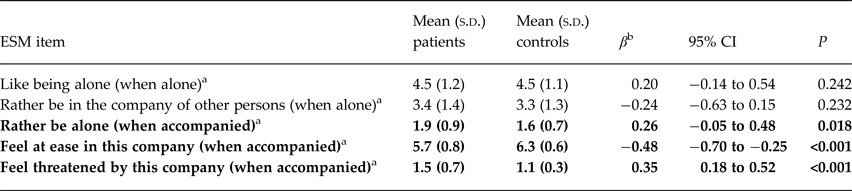
Patients with a diagnosis of non-affective psychotic disorder scored significantly lower on all SFS dimensions compared with healthy controls (all p < 0.001). In controls, a ceiling effect was observed for the SFS interpersonal behaviour dimension, with 89.8% of participants reporting the highest possible score. Group comparisons on ESM measures revealed that patients spent significantly more time alone (t = 6.22, p < 0.001) and at home (t = 2.69, p = 0.008), but less time with familiar (t = −4.31, p < 0.001) or less familiar (t = −2.83, p = 0.005) persons compared with controls. Patients also more frequently reported doing nothing (t = 4.81, p < 0.001), but the two groups did not differ regarding the time spent in leisure activities (t = 1.39, p = 0.164). Group differences regarding the appraisal of the social context were also observed. Results are shown in Table 3. Group differences were also examined in males and females separately (see online Supplementary Table S2, available online).
Group differences in the appraisal of the social context

Significant results are highlighted in bold.
a Items rated on a seven-point Likert scale ranging from 1 (=not at all) to 7 (=very).
b Positive β indicate higher values in patients compared with controls; negative β indicate higher values in controls compared with patients.
SFS interpersonal domain and real-life social functioning
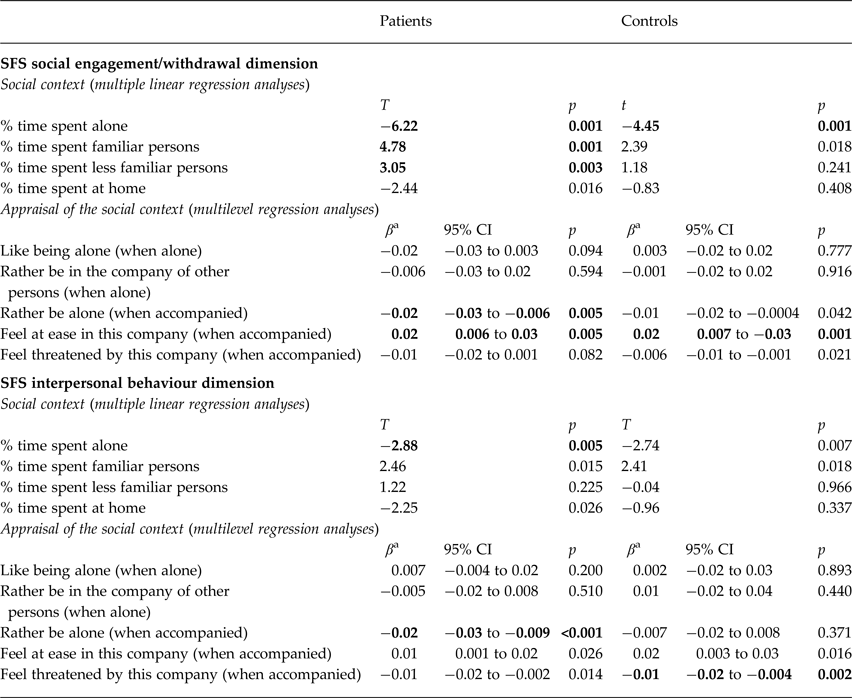
Associations between the interpersonal domain and ESM measures of social functioning in both groups are presented in Table 4.
Association between the SFS interpersonal domain and appraisal of the social context

All the analyses were performed with IQ as a covariate. Significant results after Simes correction are displayed in bold.
a Positive β indicates a positive association between an ESM item and the SFS dimension; negative β indicate a negative association between an ESM item and the SFS dimension.
In patients, the SFS social engagement/withdrawal dimension was negatively associated with the percentage of time spent alone, and positively with the percentage of time spent with familiar and less familiar persons. Several items relflecting the appraisal of social interactions (‘I would rather be alone’ and ‘I feel at ease in this company’) were also associated with this dimension. The SFS interpersonal behaviour dimension was negatively associated with the percentage of time spent alone and with negative appraisal of social interactions (‘I would rather be alone’). The remaining associations were not statistically significant or were below the α = 0.05 threshold but did not survive multiple comparison correction.
In the control group, the SFS social engagement/withdrawal dimension was associated with the percentage of time spent alone and with the appraisal of feeling at ease in social company. The SFS interpersonal behaviour dimension was only associated with the appraisal of feeling threatened by social company. Again, the remaining associations were not statistically significant or were below the α = 0.05 threshold but did not survive multiple comparison correction.
The results remained unchanged when the presence of lifetime drug use was included as an additional covariate in the analyses (data not shown), except that the association between the SFS interpersonal behaviour dimension and the appraisal of feeling threatened by social company was no longer significant in the control group after multiple comparison correction [β = −0.009 (95% CI: −0.016 to −0.002), p = 0.010].
SFS activity domain and real-life social functioning
The percentage of time spent in leisure activities was significantly but negatively associated with the SFS pro-social activities dimension in patients (t = −2.89, p = 0.005) and with the SFS recreational activities dimension in the control group (t = −2.73, p = 0.007). All the remaining associations were statistically non-significant.
Again, results remained unchanged when the presence of lifetime drug use was included as an additional covariate in the analyses (data not shown).
Discussion
In this study, social functioning was measured in a large group of patients with a diagnosis of non-affective psychotic disorder and healthy controls using the SFS self-reported version and ESM. Both measures revealed significant social impairments in patients. Associations between the two measures were examined to determine the ecological validity of the SFS. The SFS interpersonal domain (social engagement/withdrawal and interpersonal behaviour dimensions) was associated with the percentage of time spent alone in both groups and with negative appraisal of social interactions. The SFS activity domain (pro-social and recreational activities dimensions) was negatively associated with the time spent in leisure activities.
Characterization of real-life social functioning in schizophrenia spectrum disorders
Group comparisons on real-life measures of social functioning were generally consistent with previous ESM studies (Janssens et al. Reference Janssens, Lataster, Simons, Oorschot, Lardinois, van Os and Myin-Germeys2012; Oorschot et al. Reference Oorschot, Lataster, Thewissen, Lardinois, van Os, Delespaul and Myin-Germeys2012), as patients reported spending more time alone and at home, and less time in the company of familiar and less-familiar persons compared with controls. This finding can be driven by several factors, including higher rate of unemployment or the presence of negative symptoms in the patients’ group. Patients also felt less at ease and more threatened by the company of others and reported an increased preference for being alone while in the company of others. Interestingly, the two groups did not differ regarding their appraisal of solitude (e.g. patients did not report enjoying being alone to a greater extent than controls). According to the previous findings of Brown et al. (Reference Brown, Silvia, Myin-Germeys and Kwapil2007), this response pattern indicates that patients with a schizophrenia spectrum disorder are rather characterized by increased social anxiety but not increased social anhedonia in daily life. Anhedonia is considered as one of the core manifestations of negative symptoms in schizophrenia (Blanchard et al. Reference Blanchard, Kring, Horan and Gur2011) and was initially defined as a decreased ability to experience pleasure in various situations. Recent findings have highlighted the importance of distinguishing between consummatory (i.e. pleasure in the moment) and anticipatory pleasure in schizophrenia, as the former was shown to be largely preserved in several studies (e.g. Gard et al. Reference Gard, Kring, Gard, Horan and Green2007). The fact that patients spent an increased amount of time alone without reporting increased pleasure for being alone might represent indirect evidence for anticipatory pleasure impairments regarding social interactions. This hypothesis should be further tested in future studies.
Ecological validity of the SFS
Although the SFS social engagement/withdrawal and interpersonal behaviour dimensions were designed to assess different constructs related to social functioning, their pattern of associations with ESM measures was broadly similar. Indeed, both dimensions were related to real-life level of social interaction (i.e. percentage of time spent alone) in patients and controls. They were also associated with the appraisal of social situations (i.e. feeling less at ease or wanting to be alone while in the company of others) but were unrelated to the appraisal of solitude. Hence, these results suggest that lower scores on these dimensions reflect higher social avoidance (i.e. negative appraisal of social situations) rather than loss of interest in socializing (i.e. positive appraisal of solitude). This carries implications for future work investigating the mechanisms leading to social dysfunctions. Indeed, several studies showed that social anxiety and social anhedonia are explained by at least partly different mechanisms in schizophrenia (Brown et al. Reference Brown, Silvia, Myin-Germeys and Kwapil2007; Silvia & Kwapil, Reference Silvia and Kwapil2011; Cieslak et al. Reference Cieslak, Walsh-Messinger, Stanford, Vaez-Azizi, Antonius, Harkavy-Friedman, Goetz, Goetz and Malaspina2015).
Regarding daily-life activities, ESM measures revealed that patients reported doing nothing more often than controls, in accordance with earlier findings (Oorschot et al. Reference Oorschot, Lataster, Thewissen, Lardinois, van Os, Delespaul and Myin-Germeys2012). However, both groups did not differ regarding the time spent in leisure activities, which contrasts with lower scores on the SFS pro-social and recreational activities dimensions in patients. Moreover, the pattern of associations between both measures was different in patients and controls. In patients, the pro-social activities dimension was negatively associated with the percentage of time spent in leisure activities. Whereas most leisure activities from the ESM protocol can be solitary (e.g. TV or internet), the SFS pro-social dimension examines activities involving at least passive interactions with other persons (e.g. going to the movie), which may explain this result. Surprisingly, the recreational activities dimension was negatively associated with the percentage of time spent in leisure in controls, although both measures mostly reflect the involvement in solitary activities. A possible explanation for this finding is that the SFS assesses very specific activities that most people rarely perform (e.g. going to an exhibition), whereas ESM focuses on common leisure activities.
From a general point of view, we observed fewer significant associations between the SFS and ESM measures in the control group, suggesting that the SFS may be less sensitive at higher ends of the continuum. This is an important methodological aspect, especially for studies aimed at detecting subtle social difficulties in a given population. In addition, whereas ceiling effects were observed on the SFS in the control group, the distribution of the variables extracted from ESM had more interindividual variability, which represents an important measurement advantage.
Methodological considerations
The results of this study should be interpreted in light of the following methodological considerations. First, the average percentage of completed beeps reached 69%. Although the presence of missing data is inherent to ESM (i.e. participants are briefed not to adapt their routine to the research protocol), systematic biases cannot be entirely excluded (e.g. participants miss more beeps when they are accompanied by others). However, this is unlikely, as the number of completed beeps was unrelated to the percentage of time spent alone or in the company of others. Secondly, the percentage of time spent alone v. with others was computed based on the information provided at each beep and is therefore an estimate. The large number of collected data and the randomized occurrence of the beeps during the week make it likely that this estimate closely matches what really happened in reality. Thirdly, the present study only examined the ecological validity of the SFS self-report version and recruited patients were in the chronic phase of a non-affective psychotic disorder. It is therefore unknown whether the same conclusions would be equally true if the SFS informant version were used or if the same study was conducted on patients with a first psychotic episode. Fourthly, low internal consistency values were detected for the SFS interpersonal behaviour dimension both in patients and controls. This is likely due to the limited number of items composing this dimension and the ceiling effect that was observed. For this reason, caution regarding the interpretation of the associations between ESM items and the SFS interpersonal behaviour dimension is warranted, especially in healthy controls. Finally, we interpreted the findings within the framework of examining the ecological validity of the SFS. One might argue that the argument could be reversed and the obtained findings could reflect low validity of chosen real-life (ESM) items to measure social functioning. Although ESM items were similar to those used in previous studies (Brown et al. Reference Brown, Silvia, Myin-Germeys and Kwapil2007; Janssens et al. Reference Janssens, Lataster, Simons, Oorschot, Lardinois, van Os and Myin-Germeys2012; Oorschot et al. Reference Oorschot, Lataster, Thewissen, Lardinois, van Os, Delespaul and Myin-Germeys2012) and could be considered as a standard way of assessing daily-life social functioning, methodological studies should be conducted in the future to better justify the choice of ESM items in light of theoretical models of interpersonal functioning.
Conclusions
In conclusion, we showed that the SFS has some degree of ecological validity at assessing broad aspects of social functioning. In particular, low scores on the SFS interpersonal domain (social engagement/withdrawal and interpersonal behaviour dimensions) appear to capture social isolation and social avoidance, but not lack of interest in socializing. Moreover, the pattern of associations between ESM measures and these two dimensions was similar, suggesting that they do not reflect distinct aspects of social functioning. By contrast, ecological validity of the SFS activity domain (pro-social and recreational activities dimensions) was low. The SFS hence provides only partial information about the different facets of social functioning, which limits its use in treatment studies. This study also showed that associations between ESM measures and the SFS were less consistent in the control group, indicating lower sensitivity of the SFS when social functioning is within the normal range. ESM offers a rich alternative to classical assessment techniques, as it provides information on subtle variation in functioning over time and the influence of several contextual variables. It is also well suited for examining the effect of psychosocial interventions on specific mechanisms leading to social dysfunctions. Finally, the emerging field of Ecological Momentary Intervention (EMI) offers new avenues for bringing clinical interventions closer to the patients’ daily life, hence increasing their effectiveness and promoting their generalizability (Reininghaus et al. Reference Reininghaus, Depp and Myin-Germeys2015).
Supplementary material
For supplementary material accompanying this paper visit https://doi.org/10.1017/S0033291717001295.
Acknowledgements
The authors would like to thank all the participants who took part in the GROUP study.
Inez Myin-Germeys was supported by an ERC consolidator grant (ERC-2012-StG, project 309767 – INTERACT). Ulrich Reininghaus was supported by a VENI grant of the Dutch Research Council (451-13-022). The infrastructure for the GROUP study is funded by the Geestkracht programme of the Dutch Health Research Council (ZON-MW, 10-000-1002) and matching funds from participating universities and mental health care organizations (Site Amsterdam: Academic Psychiatric Centre AMC, Ingeest, Arkin, Dijk en Duin, Rivierduinen, Erasmus MC, GGZ Noord Holland Noord; Site Utrecht: University Medical Centre Utrecht, Altrecht, Symfora, Meerkanten, Riagg Amersfoort, Delta; Site Groningen: University Medical Center Groningen, Lentis, GGZ Friesland, GGZ Drenthe, Dimence, Mediant, GGZ De Grote Rivieren and Parnassia Bavo Groep; Site Maastricht: Maastricht University Medical Center, GGZ Eindhoven en de Kempen, GGZ Midden-Brabant, GGZ Oost-Brabant, GGZ Noord-Midden Limburg, Mondriaan Zorggroep, Prins Clauscentrum Sittard, RIAGG Roermond, Universitair Centrum Sint-Jozef Kortenberg, CAPRI University of Antwerp, PC Ziekeren Sint-Truiden, PZ Sancta Maria Sint-Truiden, GGZ Overpelt, OPZ Rekem). The analyses were supported by a personal fellowship from the Swiss National Science Foundation (162006 to M. Schneider).
Conflict of Interest
Professor van Os is/has been an unrestricted research grant holder with, or has received financial compensation as an independent symposium speaker from Eli Lilly, BMS, Lundbeck, Organon, Janssen-Cilag, GSK, AstraZeneca, Pfizer and Servier. Professor Myin-Germeys has received financial compensation as an independent symposium speaker from BMS and Janssen-Cilag. Professor De Haan has received research funding from Eli Lilly and honoraria from Eli Lilly, Janssen-Cilag, BMS and AstraZeneca. Dr Cahn is/has been an unrestricted research grant holder with, or has received financial compensation as an independent symposium speaker or as a consultant from Eli Lilly, BMS, Lundbeck, Sanofi-Aventis, Janssen-Cilag, AstraZeneca and Schering-Plough. Professor Kahn is/has been an unrestricted research grant holder with, or has received financial compensation as an independent symposium speaker or as a consultant from AstraZeneca, Eli Lilly, Janssen-Cilag, Otsuka, Sinovion, Roche and Envivo. The remaining authors declare no conflict of interest.