Introduction
Although organic agriculture has a long history, the market for organic products has only recently been developed worldwide, due to increasing consumer demand for healthy foods. In addition, increased awareness of environmental conservation among both consumers and producers has accelerated the development of organic agricultureReference Demiryurek and Guzel1, Reference Heckman2. It is currently practiced on about 31 million ha of land on 635,000 organic farms in about 120 countries worldwideReference Yussefi, Willer, Willer and Yussefi3. The latest survey revealed that there are 6,563,352 ha of land in 165,330 organic farms in the European Union's (EU) 27 member states, which corresponds to about 3.6% of the total agricultural land4. Worldwide, organic food and drink sales are worth about 33 billion US$Reference Yussefi, Willer, Willer and Yussefi3. Although the organic food market is currently only 1–4% of total food sales globally, it is growing rapidly, with the demand mainly concentrated in North America and EuropeReference Sahota, Willer and Yussefi5.
Organic agricultural activities were introduced to Turkey by European companies in the mid-1980s. At the beginning, these companies focused on classical Turkish agricultural export products such as dried figs, sultanas, apricots and hazelnuts. In parallel with the increase in demand from European countries, organic products in Turkey were diversified and production areas increasedReference Demiryurek6. Organic agriculture developed rapidly between 1990 and 2006. The number of organic products increased by over 26-fold (from 8 to 210), the number of organic producers increased over 45-fold (from 313 to 14,256) and the area under organic management increased about 186-fold (from 1037 to 192,789 ha, including lands being converted) over the same period7. Although only 0.8% of total agricultural land is currently organic, this share is expected to reach 3% by 2013 and 8% by 20208. Turkey is now one of the most important organic product suppliers to European markets. Most of the domestic organic production (about 80%) is exported and it represented about 30 million US$ in 20067.
Turkey is responsible for more than 75% of global hazelnut production and dominates the international market. Hazelnuts, one of the most important organic export products of Turkey, are mainly grown in the Black Sea regionReference Demiryurek6. Organic hazelnut exports were valued at about 30% of the total organic exports of Turkey in 2006; there were about 550 organic producers who produced 7159 tons of hazelnuts on 4100 ha7.
A literature review revealed many studies of the economics of organic production worldwideReference Pimentel9–Reference Ankomah and Yiridoe14. However, only a few studies on the economics of organic hazelnut production were found from TurkeyReference Demiryurek6, Reference Bülbül and Tanrıvermiş15, Reference Demirci, Erkuş, Tanrıvermiş, Gündoğmuş, Parıltı and Özüdoğru16 and ItalyReference Franco, Pancino, Ferrucci, Tous, Rovira and Romero17. These studies compared conventional and organic hazelnut systems. However, they failed to consider factors such as location, soil structure, farm size, production system and socio-economic background of operators.
Methodological issues have long been discussed by researchers in comparing organic and conventional production systemsReference Lampkin, Lampkin and Padel18–Reference Parra-Lopez, Calatrava-Requena and de-Haro-Gimenez22. When researching and comparing those systems, the factors mentioned above should be considered, and relatively similar farms and farmers from the same region should be selected by an appropriate sampling method. For that reason, cluster analysis was used in this research, to define and compare relatively similar organic and conventional farms and farmers.
The comparison of organic and conventional producers in terms of their socio-economic characteristics can show the relative economic performance of organic agriculture, help to support organic agriculture through modified policies and develop markets for organic products. Specifically, knowing the characteristics of good organic producers facilitates the defining of leader farmersReference Demiryurek, Slavik and Zakova23 in rural areas. This can help diffuse organic agriculture among producers through directing limited sources (i.e. time, finance and staff) to these pioneer producers, which will in turn be an example for potential organic producers. Therefore, the aims of this research were to compare the (i) socio-economic characteristics, (ii) production systems and (iii) economic performance of organic and conventional hazelnut producers in Turkey.
Materials and Methods
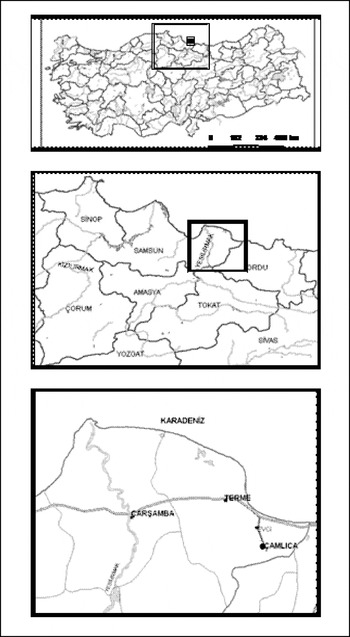
This study used a structured questionnaire to capture information. The main data of the research were collected from 64 randomly selected, conventional hazelnut producers and all the organic hazelnut producers (39) in the Terme district of Samsun province, Turkey (Fig. 1), during the production period 2004–2005. The survey targeted answers to its questions to be 95% accurate, with a 10% margin of error. Regarding validity and reliability of the survey, the authors conducted pilot interviews with five organic and five conventional producers to test the survey before the main fieldwork. Reliability was assessed using the test–retest method in which the survey was administered to the same group at two different times. AlphaReference Cronbach24 was used as an index of internal reliability or consistency for a set of questions, and an alpha of 0.80 or higher was considered to indicate an acceptable level of internal reliability.
The maps of Terme district of Samsun, Turkey.

The database of the research was extended with field observations, group discussions and interviews with selected leader farmers and the staff of public organizations. However, these data were mainly used to support and interpret the main survey data. The records of the Provincial Agricultural Directorates of the Ministry of Agriculture and Rural Affairs (MARA), the reports of public organizations and previous research results were also used in the research. Multiple data collection techniques were used to increase the validity and reliability of the research through triangulation.
In addition, this research is part of a longitudinal study in that the results were compared with previous researchReference Demiryurek6 conducted in the same area in 1997. The results of this study were also compared with previous studies on organic hazelnut production in other parts of TurkeyReference Bülbül and Tanrıvermiş15, Reference Demirci, Erkuş, Tanrıvermiş, Gündoğmuş, Parıltı and Özüdoğru16 and ItalyReference Franco, Pancino, Ferrucci, Tous, Rovira and Romero17.
The variables in this study can be divided into three broad groups: personal characteristics (age, education level and experience); farm characteristics (income sources, time allowance, own land, cultivated land, hazelnut area, capital, credit use, farm income and off-farm income) and hazelnut production characteristics (manure use, organic fertilizer use, lime use, cost of pest traps, cost of pesticides, nitrogen use, phosphorus use, labor use, hazelnut yield, hazelnut price, hazelnut cost per kg and gross margin for hazelnut).
When comparing personal characteristics and some farm characteristics, such as income sources, own land, cultivated land and hazelnut area, the authors included all organic hazelnut farms and randomly selected conventional farms for the analysis.
Since the production system among sample conventional and organic farms varied considerably, cluster analysis was used to define similar farms and farmers from both production systems, in terms of hazelnut production area, soil conditions, production techniques, similar and close locations, socio-economic status and management conditions, when comparing monetary variables.
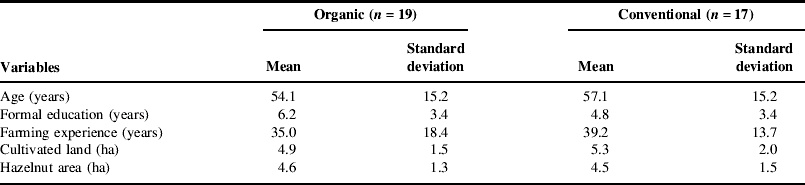
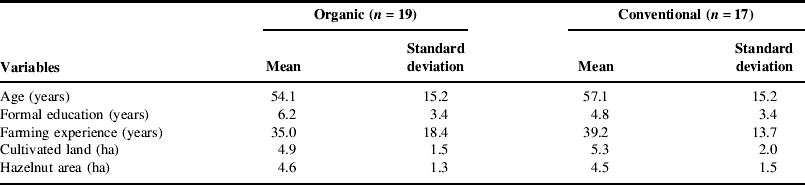
Cluster analysis is one of the multivariate analytical techniques which group respondents on the basis of characteristics they possess. It classifies respondents so that each respondent is very similar to others in the cluster, with respect to some predetermined selection criterionReference Hair, Anderson, Tatham and Black25. Cluster analysis was applied to the farm data such as the age, experience and education level of operators; farmland; and hazelnut area. The cluster analysis defined 19 organic and 17 conventional hazelnut farms with similar personal characteristics (age, education and farming experience) of growers, and similar size of hazelnut production areas, with the differences among them being statistically non-significant (Table 1). Based on the results of cluster analysis, hazelnut yields, labor and input uses, costs and incomes of conventional and organic hazelnut farms were compared.
Some characteristics of organic and conventional hazelnut producers selected on the results of cluster analysis.
The Student's t-test was used to test the hypothesis that means were equal, in terms of scale variables when comparing the two production systems. Statistical tests were performed with the Statistical Package for the Social Sciences (SPSS).
Results and Discussion
Age, education and experience
The age of a farmer is an important characteristic in explaining some aspects of decision-making and technology diffusion. The ways people behave, think and express their needs are closely related to ageReference Smith and Zopf26. An older person's experience may be equated with knowledge and judgment. On the other hand, ageing may adversely affect the transfer of information and technology in rural societies through negatively influencing the understanding and acceptance of innovation. Farmers' age profiles are related to appropriate extension methods; for example, where educational standards are rising from low levels, literacy and numeracy may be mainly associated with the younger agesReference Demiryurek6.
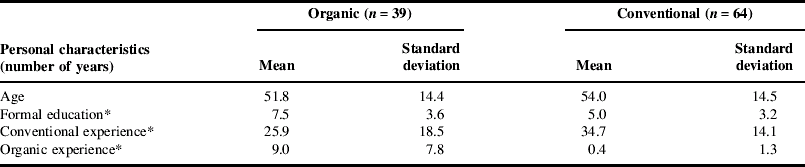
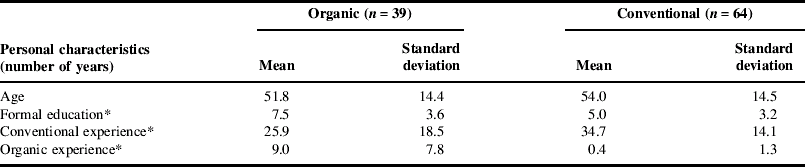
As can be seen from Table 2, both organic and conventional hazelnut producers were generally older and there was no statistical difference between them, although organic producers are expected to be young and innovative. This result confirms the results of similar research conducted in the same areaReference Demiryurek6. Due to the demographic structure of the region, older people generally stay in the villages, and relatively younger people go to towns and cities to find work.
Personal characteristics of organic and conventional producers.
* P<0.01.
This finding confirms the generalization of RogersReference Rogers27 who reviewed numerous studies of the relationship of age to innovativeness and found that in half of these studies, there was no particular relationship. However, several research studies conducted in different countries implied that organic producers were relatively younger, had urban backgrounds and were new entrants to agricultureReference Padel28, Reference Padel29. Overall, it is concluded that age, as a discrete factor in this research, appears to have had little or no influence on the decision to produce organic hazelnuts.
Another characteristic, education, as a process of learning, is usually perceived to be synonymous with formally structured institutions such as schools. Formal education is an investment in farmers' development. However, it can usefully be followed by, and supported with, functional non-formal education such as extension programs and distance educationReference Demiryurek and Guzel1, Reference Demiryurek30.
In this research, the education level of organic hazelnut producers, who generally had secondary school education, was significantly (P<0.01) higher than that of conventional hazelnut producers, who generally had primary school education (Table 2). A similar result was found in previous research in the same areaReference Demiryurek6. These findings are also supported by several research studies conducted in different parts of the world that showed that organic farmers generally had higher levels of formal educationReference Padel, Lampkin, Lampkin and Padel19, Reference Padel28, Reference Padel29.
Experience can be simply defined as knowledge or skill which is gained while doing a job31. The current knowledge and experiences of farmers influence their behavior at workReference Demiryurek6. Some previous studies have shown that most organic producers have had conventional farming experienceReference Padel, Lampkin, Lampkin and Padel19, Reference Anderson, Lampkin and Padel32–Reference Wynen, Lampkin and Padel34. As expected, the organic hazelnut producers had more organic production experience than conventional hazelnut producers (P<0.01) (Table 2). Average organic production experience in the same research area was 4.5 years in 1997Reference Demiryurek6. These two studies indicate that some of the producers have recently adopted organic agriculture, while others have ceased for various reasons. On the other hand, this result also implies that most of the organic producers in the research area have continued in organic agriculture.
Income and time allowance for agricultural and non-agricultural work
One factor that emerged from this study is that hazelnut growers earned most of their income from agriculture. Although some farmers also have other jobs apart from farming, they generally spent most of their time on agriculture. However, factors such as low farm income, seasonal production, temporary unemployment, higher risks in agriculture and desire to increase income, create pressure for farmers to seek other occupations.
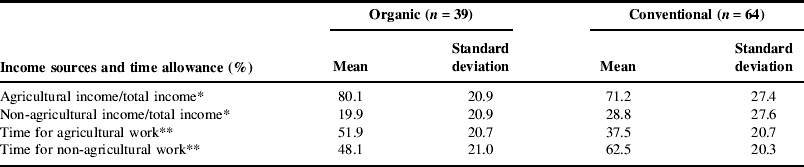
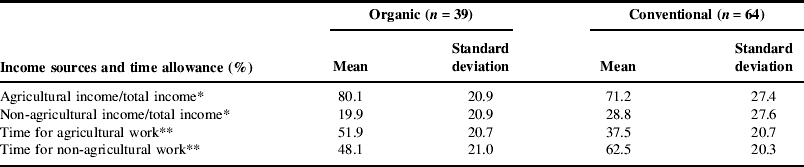
In this research, both groups of producers were asked to rate their sources of income and time allowance for agricultural and non-agricultural tasks. Table 3 shows that, compared to conventional hazelnut producers, organic producers spent more time on agricultural pursuits (P<0.01). As expected, both groups of producers earned most of their income from agriculture. Interestingly, the share of non-agricultural income for conventional producers was higher than that of organic producers (P<0.05), but overall they earned relatively lower income than the organic producers (Table 5). The fieldwork observations revealed that this mainly resulted from different types of work, in that most conventional producers generally worked in paid hourly labor off-farm, while relatively wealthier organic producers dealt with commerce. This supports previous researchReference Demiryurek6 that revealed that organic producers have higher social status, which was defined by RogersReference Rogers27 as a complex of factors, including income, level of lifestyle, possession of wealth and occupational prestige.
Income sources and time allowance for work activities.
* P<0.05 and ** P<0.01.
Land tenure
Land tenure refers to the rights of people to the land which they control or cultivate; tenure is a social relationship between people and the land. It is also closely associated with other variables such as the size of agricultural holdings, the system of agriculture and the class systemReference Rogers27.
The status of land tenure in the two groups was similar (Table 4). The majority of the total cultivated land was owned by the producer alone. Another common type of land use was that producers were cultivating farms with their family members such as parents, adult sons or brothers. It was interesting that taking or giving land for sharecropping or leasing was not common among the respondents, although they are in some other areas of Turkey. These results confirmed previous research results in the same areaReference Demiryurek6.
Land tenure of organic and conventional hazelnut producers.

* P<0.01.
The respondents were evidently not exposed to pressures for renting or sharing their land with people other than their relatives. The reason for this low level of land renting or sharing may have been due to owning a small area with several co-owners.
Only middle-aged and elderly people work on their land during the non-harvest period. On the other hand, younger people go to town to find a job, and some small land inheritors live and work in cities. Since hazelnut production does not require intensive input use and care, farming practices on their land are done by their relatives in the village or hired labor. Those people generally come to their land for the harvesting period which starts in late July. During harvesting, villages are crowded with local inhabitants, small landowners and labor hired for harvesting. At the end of August, hazelnut-producing villages in the Black Sea region are depopulated again, with only older people staying in the villages.
This study showed no real difference between organic and conventional producer respondents with regard to the allocation of land to different farm enterprises and product. As expected, most of the cultivated land was allocated to hazelnut production. This is a consequence of the very suitable soils, climate and topography of the area, coupled with hazelnuts being one of the most valuable cash crops in the region, and also relatively easy to grow. Apart from hazelnuts, farmers grow fruits and vegetables in small gardens near their homes.
As can be seen in Table 4, the hazelnut areas of organic producers were higher than those of conventional producers (P<0.01). This finding confirms previous research in the same areaReference Demiryurek6. This difference reflects the purposeful selection of producers by the organic contracting company, especially during the introduction of organic agriculture to the region. The company selected producers with relatively larger hazelnut areas from the same region and made contracts with them. This provided the company with access to a smaller number of producers who had larger farms, and hence it was easier to manage their operation and deal with producers. It meant that the company's project manager in the area could spend more time with a limited number of producers.
The average organic farm size in most countries is smaller than the conventional farmReference Padel, Lampkin, Lampkin and Padel19, Reference Padel29. These organic farmers generally had urban backgrounds and were new entrants to organic agriculture. On the other hand, in GermanyReference Pals, Braun, Dabbert, Lampkin and Padel35 and SwitzerlandReference Schmid, Lampkin and Padel36, there were no differences in terms of farm size between organic and conventional producers. In fact, Dubgaard found that commercial organic producers had relatively larger areasReference Dubgaard, Lampkin and Padel37.
Capital, credit and farm income
The income of a producer is mainly influenced by current capital and credits taken from outside, both from banks and personal borrowings. On the other hand, the rate of credit use is one of the indicators that the farm is market oriented. The agricultural capital in Turkey is mainly composed of land capital. Depending on the credit conditions, including interest rates, due date and paper works, credit use in rural areas is generally very lowReference Ceyhan38–Reference Ceyhan and Cinemre40.
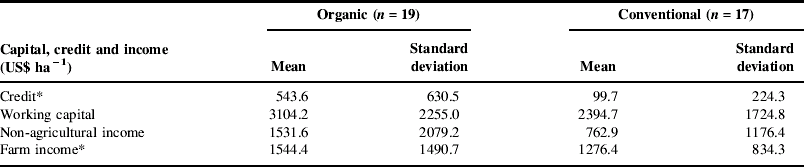
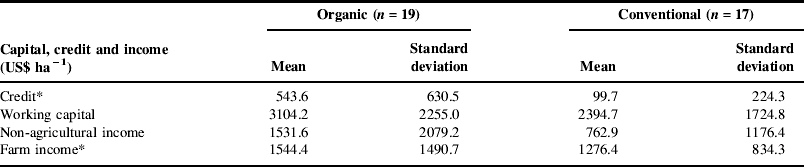
The organic hazelnut producers used more (over 5-fold) credit per area than conventional producers (P<0.01) (Table 5). The Turkish Agricultural Bank provides credit at low interest rates and with extended due date for organic producers. Similarly, the organic hazelnut producers used about 30% more working capital per area compared to the conventional producers. As a result of credit and capital used per hectare, the organic producers earned about 21% more farm income per unit of area than their conventional counterparts (P<0.01) (Table 5).
Capital, credit and income of organic and conventional hazelnut producers.
* P<0.01.
Demiryurek also found that the farm income of organic hazelnut producers was more than that of conventional producers in the same areaReference Demiryurek6. This was mainly due to a 12% premium on price available to the organic producers in 1997. In England, there were no agricultural income differences between similar organic and conventional farmsReference Lampkin, Lampkin and Padel41. The organic producers in Germany, Canada and Denmark obtained more agricultural income, while conventional producers received more income in Switzerland, Australia and the USAReference Lampkin and Padel10. Padel reviewed studies from around the world and concluded that the economic performance of organic agriculture depends mainly on consumer demand, market availability and government supportReference Padel29.
Input use
This section compared organic and conventional producers in terms of input use. The type of input use is one of the factors which differentiates organic production systems from their conventional counterpartsReference Rigby, Woodhouse, Young and Burton42, Reference Demiryurek and Mehlenbacher43.
The organic hazelnut producers used no synthetic fertilizers or pesticides. Indeed, the gardens, soils and products of organic producers were analyzed by the contracting company and the certification body during and after the production period. On the other hand, conventional hazelnut producers did use synthetic fertilizers and pesticides. Two kinds of fertilizers were commonly used, namely nitrogen (N) fertilizer as calcium ammonium nitrate and phosphate (P) fertilizer as triple superphosphate.
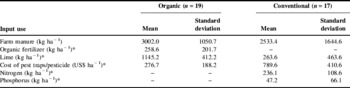
Table 6 shows that more nitrogen fertilizer was used than phosphate fertilizer. One reason for this was a difference in the frequency of use: N was used every year, while P was used once in three years due to its relatively longer retention than N in the soil. This result was confirmed by previous researchReference Demiryurek6.
Input use of organic and conventional hazelnut producers.

* P<0.01.
Liming reduces soil acidity and increases the availability of certain plant nutrients in the soil. However, with high rainfall and inclined areas, as is the case in the Black Sea region, calcium is easily leached from the soil, and soils are generally acidic. Hence liming was required by both conventional and organic (allowed) hazelnut producersReference Demiryurek6. In particular, both the organic company representatives and public extension workers advised farmers to apply lime.
Although lime was used by both groups of producers, the organic hazelnut growers used more lime (1145.2 kg ha−1) than the conventional producers (263.6 kg ha−1) (P<0.01) (Table 6). DemiryurekReference Demiryurek6 also found a similar result in that more organic producers (85%) applied lime than conventional producers (33.3%). The main reason for this difference may be explained by unawareness of the need for lime application among conventional producers, and the lack of advisory support for them.
Manure is a source of plant nutrients and organic matter, especially for organic producers, and its application was also advised by the private and public advisors. However, most of the conventional hazelnut producers were also applying manure in addition to synthetic fertilizers. They were also aware of the advantages of manure in terms of improving the properties of the soilReference Demiryurek6.
Although the organic hazelnut producers used more manure per unit of area than the conventional producers, there was no statistically significant difference between them. The main reason was that the organic producers used organic fertilizers, in addition to farm manure. Recently, organic fertilizer application has become popular among organic hazelnut producers due to its easy use. They were previously using poultry manure in addition to farm manureReference Demiryurek6, but the use of poultry manure from conventional enterprises was banned later by regulation and the certification bodies.
The use of synthetic pesticides is common in the region. It is easier, needs less labor and costs less than mechanical pest controlReference Demiryurek6. On the other hand, this is not allowed for the organic producers. Instead, mechanical and biological pest control methods and pest-resistant varieties are required. Sulfur is recommended for the control of the big bud mite (Phytoptus avellanae Nal.), as is the removal of big buds in winterReference Ozman-Sullivan and Akca44. There are also some organic pesticides available, such as Thuricide (Bacillus thuringiensis), but it is not used due to its higher costReference Demiryurek6. However, organic producers have recently started using pest traps (Table 6) and applying dust lime for pests, and using mechanical control, removal of infested or damaged branches and cutting or uprooting of weeds.
Labor
Additional labor requirement is often mentioned, in many studies, as a typical characteristic of organic farming. Padel and ZergerReference Padel, Zerger, Lampkin and Padel45 reported a 20% higher labor requirement in Germany on organic farms, compared to conventional farms. DubgaardReference Dubgaard, Lampkin and Padel37 found that in Denmark the labor requirement of organic farms exceeds by about one-third the needs of conventional farms. Muhlebach and MuhlebachReference Muhlebach, Muhlebach, Lampkin and Padel46 reported an average 12% increase in labor requirements on organic farms in Switzerland. This difference can be explained by the type of production. Generally, vegetable production needs more labor, while livestock and fruit production require no additional labor. Some studies have shown the effect of farm size on labor requirement. In general, small farms require higher labor use per unit of land than larger farms. For example, Zerger, quoted in Padel and ZergerReference Padel, Zerger, Lampkin and Padel45, found a decrease in the proportion of labor use as farm size increases.
In this study, labor use was measured by labor hour per hectare for different hazelnut production activities. The basic activities are plant nutrition and care (manuring, fertilizing, spraying, placing pest traps, liming, pruning, desuckering and scything) and harvest (collecting, drying, dehusking and transporting to market). These define the labor requirements for hazelnut production. Organic and conventional hazelnut producers generally apply similar inputs and plant care techniques (Table 6). For example, organic producers are not allowed to use synthetic fertilizers and pesticides. Instead of those inputs, they use manure and pest traps. Apart from this, similar plant care techniques are applied by both organic and conventional hazelnut producers. Both groups of producers use similar tools, which are generally manual equipment. The hilly topography does not facilitate mechanizationReference Demiryurek6.
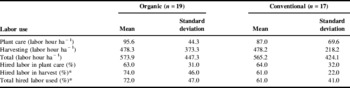
As seen in Table 7, the total labor requirement of organic hazelnut production was 1.5% higher than conventional production. This was mainly due to slightly more intensive plant care activities, such as the use of farm manure, organic fertilizers and lime in organic production (Table 6). In addition, harvest comprised about 84% of the total labor needs for both groups of producers. As expected, most of the labor requirements for harvest were met by hired labor.
Labor use of organic and conventional hazelnut producers.

* P<0.05.
Hazelnut yield, cost, price and income
Most studies have shown that organic farming systems have lower yieldsReference Kristiansen, Kristiansen, Taji and Reganold21, reduced input costs, higher labor costs and additional certification costsReference Padel, Lampkin, Lampkin and Padel19, Reference Padel28. Premium prices are needed to compensate for these disadvantages of organic farming. The prices of organic products are therefore higher than conventional ones in the marketReference Ankomah and Yiridoe14. Producers want to learn about income, costs and price differences between organic and conventional systems before making decisions about converting farms to organic production. These economic factors are the most influential factors before and during the conversion periodReference Demiryurek and Mehlenbacher47, Reference Kirner, Vogel and Schneeberger48. However, a premium price does not necessarily make organic production more profitable. There are other variables such as yields, prices for organic inputs, variable costs, labor requirements and farm structure which affect whole farm performanceReference Demiryurek6.
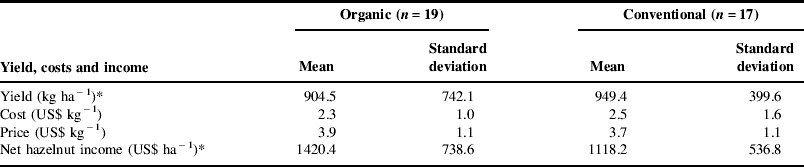
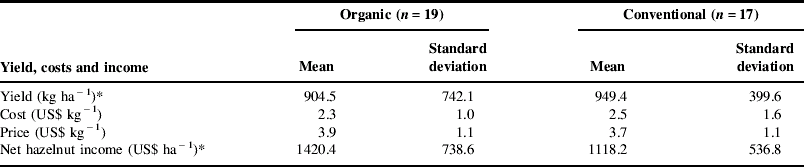
The yield of organic hazelnut producers was about 5% lower than those of the conventional producers (P<0.05) (Table 8). Many studies have shown that crop yields in organic farming in general are somewhat lower than in conventional farming systems. However, in some cases similar or higher organic production yields were obtainedReference Padel, Lampkin, Lampkin and Padel49. Yield differences between organic and conventional farming systems are difficult to interpret: they may depend on many factors, such as the variety of plant, seed quality, soil type, manuring systems, length of time under organic managementReference Lampkin, Lampkin and Padel18, technological development, access to information and the management skills of farmersReference Demiryurek6. Demiryurek found that the yield of organic hazelnuts sharply decreased during the conversion period due to lack of appropriate organic farming methods and inputs useReference Demiryurek6. However, the yield increased gradually after conversion and, in some cases, was even higher than conventional hazelnut production. The average yield increase of organic hazelnut production over conventional management in Turkey was 3% in 1997Reference Demiryurek6, 25% in 1999Reference Bülbül and Tanrıvermiş15 and 25% in 2002Reference Demirci, Erkuş, Tanrıvermiş, Gündoğmuş, Parıltı and Özüdoğru16. On the other hand, the organic hazelnut yield was about 1.5–2.0 tons ha−1 on an average farm, but it can reach 3.0 tons ha−1 on intensive and highly mechanized organic farms in Italy. This yield was even higher than on conventional farmsReference Franco, Pancino, Ferrucci, Tous, Rovira and Romero17. The differences in the yields in these studies may be explained by the differences in production years, location and intensity of input use.
Yield, costs, price and income of organic and conventional hazelnut production.
* P<0.05.
The costs of organic hazelnut production were 8.7% lower than for conventional production (Table 8). Although total labor needs were nearly the same in both production systems (Table 7), the differences in costs were mainly due to the costs of synthetic inputs, especially pesticides, used by the conventional producers (Table 6). On the other hand, the slightly lower yield of organic hazelnut production was compensated for by the relatively higher cost of conventional production. Other studies showed that the costs in organic hazelnut production were between 4 and 6%Reference Demiryurek6, Reference Demirci, Erkuş, Tanrıvermiş, Gündoğmuş, Parıltı and Özüdoğru16 lower.
Product prices, from a farmer's point of view, are most important. Farmers evaluate their financial and economic performance (albeit simply) according to product prices, and then make decisions about their farming systems, level of production and even the continuity of the farm businessReference Demiryurek6.
Studies show that premium prices for organic products are available in many European countries. However, the size of the premium paid differs from product to product and country to countryReference Swezey, Goldman, Bryer and Nieto50. The premium is needed to compensate for lower yields and increased labor requirements, to equalize farm incomes and to make organic production more attractive. It is one of the most important motivation factors for conventional producers to convert to organic farming in many countriesReference Padel28, Reference Padel29, Reference Muhlebach, Muhlebach, Lampkin and Padel46, Reference Swezey, Goldman, Bryer and Nieto50, including TurkeyReference Demiryurek and Mehlenbacher47.
Even though the organic producers sold their hazelnuts for 5.4% more (3.9 US$ kg−1) than the conventional producers (3.7 US$ kg−1), this difference was not statistically significant (P>0.1). This was mainly due to the low premium prices obtained by the organic producers. Some of the organic farmers could not even sell their product as organic due to lack of demand and absence of a marketing contract with foreign buyers. Previously, the organic producers had obtained from 12 to 15% premium prices in TurkeyReference Demiryurek6, Reference Demirci, Erkuş, Tanrıvermiş, Gündoğmuş, Parıltı and Özüdoğru16. In comparison, the price for organic hazelnuts in Italy was 15–20% higher than that of non-organic hazelnutsReference Franco, Pancino, Ferrucci, Tous, Rovira and Romero17.
In spite of this marketing failure, the organic producers obtained a 27% higher net hazelnut income than the conventional producers (P<0.05). DemiryurekReference Demiryurek6 previously found that the organic hazelnut producers had about 16% higher gross income than conventional producers. This implies that organic hazelnut production was generally more profitable than the conventional system, although it was dependent on the premium price, which is highly affected by foreign demand, domestic supply, market crises and availability of government price supports.
Overall, the economic performance of organic and conventional farms is different. This is influenced by the type of production, yields, cost of production, level of input use, labor use and availability of premium prices.
Summary and Conclusions
In this research, the individual characteristics, farming systems and economic performance of organic and conventional hazelnut farms in Turkey were compared. A significant point of the research is that both groups of producers were compared by cluster analysis. This analysis facilitated the definition of relatively similar farmers from both production systems and the comparison of various variables. Thus, the potential bias in comparing two different production systems and their performances was reduced or eliminated.
Understanding the economic performance of organic agriculture helps policy-makers to support organic agriculture by modifying policies and programs, and to develop markets for organic products. Specifically, knowing the characteristics of organic producers facilitates the definition of leader farmers in rural areas and can diffuse organic agriculture among producers by directing limited resources (i.e. time, finance and staff) to them. These pioneer organic producers can serve as a model for potential organic producers. Since economic factors are the main motivation for the conversion to, and sustainability of organic agriculture, this may also facilitate conversion of land into organic agriculture by potential producers.
We concluded that organic hazelnut producers were more highly educated, allocated more time for agricultural activities and had less conventional farming experience, due to the sustained influence of organic agriculture, as compared to conventional hazelnut producers. As expected, the organic producers used more labor, especially hired labor, than conventional producers. However, this difference did not relate to the low level of mechanization in organic farming. It was mainly due to higher labor requirements for input use, especially using farm manure and manual weed control. Apart from this, the organic producers used more lime, mainly as a soil amendment. Pest traps were recently adopted by most of the organic producers.
The use of commercial organic fertilizers has been gradually increasing in organic agriculture in Turkey. The lack of livestock keeping and high labor requirements for manure distribution on hilly areas were some of the reasons. These kinds of external and commercial inputs decreased labor requirements, but organic producers became more dependent on them. This also increased the costs of production and limited the diversification of production systems on organic farms.
As far as economic performance is concerned, the organic hazelnut producers invested more capital per unit of land and obtained more income. This was mainly due to the larger size of production area owned by organic producers, i.e. economy of scale. The organic producers do not use synthetic fertilizers and pesticides, so their costs of production are relatively lower than conventional producers. On the other hand, the cost of production is not affected by labor use. Since hazelnuts are generally manually harvested by hired labor, the harvest requires the same amount of labor in both production systems.
Based on recent research and previous studies in the research area, some conclusions can be made. Since agricultural extension and training activities facilitate farmers' adoption of organic agriculture, information and technical support should be regularly provided by public agencies and private companies promoting organic production. The use of farm manure and keeping of livestock should be promoted and financially supported for organic producers. These practices enhance nitrogen cycling and increase the ecological sustainability of organic agriculture. Recent widespread use of commercial organic fertilizers and pesticides among organic producers increases their dependence on inputs from outside the farm, and threaten the economic sustainability of organic systems.
Another threat is the marketing structure of organic agriculture. Farmers' dependence on export through private marketing companies and the lack of domestic markets for local organic products endanger the economic sustainability of organic production. Hence, organic producers should be encouraged and supported to cooperate and establish their own organic farmers' unions. This cooperation could help their members to obtain their inputs at lower cost and to improve their marketing efficiency.
Acknowledgements
We thank hazelnut producers in the research area for their valuable assistance and understanding. We also thank the Scientific Research Division of Ondokuz Mayis University (OMU) in Samsun, Turkey (project reference number: Z-418) for financial support. We acknowledge Professor John W. Doran, the editor in chief and peer reviewers for their contributions. We are also grateful to Mr. Gregory Thomas Sullivan from OMU, Foreign Languages Institute (OYDEM) for his suggestions and editorial contribution.