Introduction
A medical physics on-call program is needed to support emergency radiotherapy for palliative cancer patients.Reference Mitera, Swaminath and Wong 1 – Reference Kwok, DeYoung and Garofalo 5 Although most emergency events are simple, single- or multiple-beam spinal cord or whole-brain irradiations, the availability of time and human resource are the key factors in the program. This is because the on-call physicist is requested to standby 24 hours, including both off and on working hours, and 7 days per week irrespective of weekends or public holidays.Reference Bauza and Chow 6 In addition, since the emergency radiation treatment is expected to be completed within 2–3 hours, the on-call physicist is expected to report immediately after being called by the hospital and perform his/her physics duty (e.g., treatment plan QA) with the whole emergency radiotherapy team including radiotherapist, radiation oncologist and treatment planner within the time limit.Reference Andersson and Sousa 2 , Reference Danjoux, Chow and Drossos 3 , Reference Kwok, DeYoung and Garofalo 5 The physics on-call duty is intensive and needs more strategic planning.
According to our medical physics on-call program, there are about 25 on-call physicists in the team. The period of the on-call duty for each physicist is 1 week, and a schedule is made by the roster to rotate all physicists every 25 weeks in a year. Since everyone would want to have his/her on-call period avoiding the weeks of public holidays such as Easter and Christmas, and the weeks having a large number of events, a comprehensive, transparent and fair scheduling system is necessary among all on-call physicists. Usually, such a schedule is done by the roster assigning the physicists across different weeks randomly, without considering the distribution of events among different weeks in a year. Moreover, the roster may not give more credit to the physicist who performs the on-call duty during public holidays. Therefore, to maintain a better balance of workload in the scheduling system, the first task is to build a comprehensive database to record all the physics on-call events in the hospital. Then through a data analysis, the probability distribution of on-call events in a week/month/year and public holidays is found out. From the on-call database, we can also grade the weight of workload of a physicist performing an event in the low or high period. Physics on-call scheduling, therefore, can achieve a better balance of workload through optimisation based on the old data. This leads to a better planning of resource allocation and budget in the emergency radiotherapy program. The scheduling methods based on data optimisation include Monte Carlo simulation and artificial intelligence.Reference Bauza and Chow 6 , Reference Chow 7 Optimisation is a tool with the goal of operating a system more effectively and efficiently, while minimising the total labor cost as well as satisfying the service quality.
Research in data analysis and optimisation of healthcare has been done previously by other groups. Haghani et al. and Santibanez et al. studied the optimisation of real-time emergency vehicle response via dispatch and routing.Reference Haghani, Hu and Tian 8 , Reference Santibáñez, Chow and French 9 Gupta et al. investigated appointment scheduling and how to optimise that should a patient cancel, and how to effectively use that physician without wasting hospital resources.Reference Gupta and Denton 10 They looked at performance-based incentives of surgeons and the pros and cons of performance-based incentives. Harrell et al. studied healthcare optimisation using the MedModel tool, a healthcare simulation software that helps administrators simulate and experiment new strategies to solve healthcare problems such as wait time, patient traffic and delivery of care.Reference Harrell and Lange 11
The aim of this work was to create a comprehensive physics on-call database to record all on-call events. With on-call data accumulated over the past 8 years, statistical analyses can be carried out to determine the workload of each physicist, considering weights in different weeks (e.g., low period, high period and public holidays). Therefore, a credit score approach can be applied on the on-call scheduling.Reference Bauza and Chow 6 , Reference Abdou and Pointon 12 Moreover, the on-call data can help to determine the probability distributions of different on-call events in a week, month and year. This helps us to foresee the future event distribution so that a more accurate schedule can be created with expected outcome. In this study, physics on-call data from 2010 to 2018 were used.
Methods and Materials
Configuration and workflow of the database
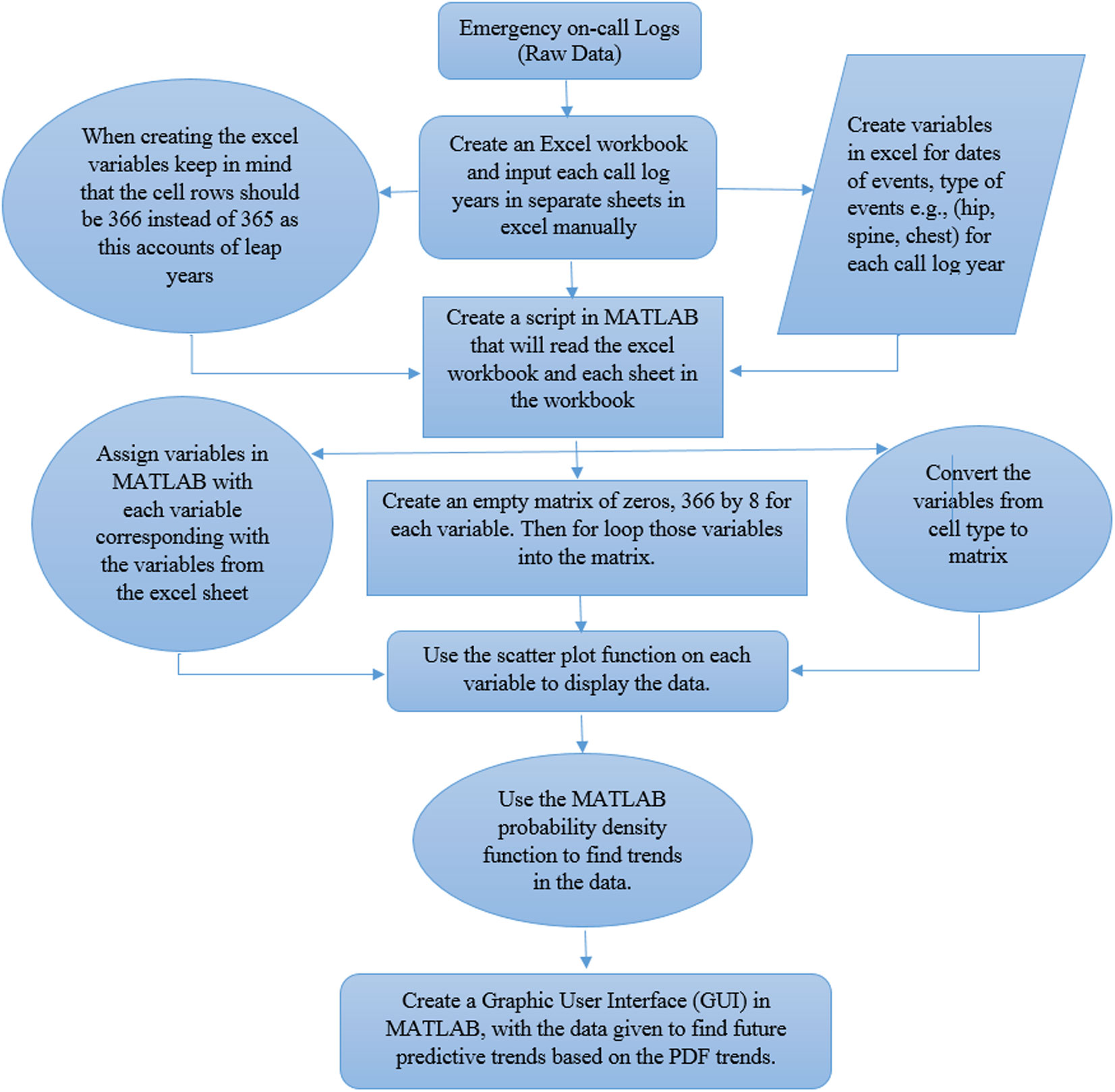
The physics on-call database was mainly built using the MATLAB and Excel software platforms. The raw on-call data in 2010–18 were input into an Excel spreadsheet. A script was used to read the data in the Excel workbook to the MATLAB, including all worksheets that were organised based on year. The configuration and workflow of the database is shown in Figure 1.
Flowchart showing the construction of the physics on-call database using MATLAB and Excel.

In Figure 1, every physics on-call event was entered to the Excel spreadsheet. The event included different variables such as date, time, treatment site, name of the attending on-call physicist, time required to perform the physics QA and so on. For the date of on-call event, all public holidays were marked in each year in the data record period (i.e., from 2010 to 2018). It should be noted that those holidays such as Easter and Christmas would be in different number of weeks every year. When the on-call data were transferred to the MATLAB platform, different variables were plotted and the related probability distributions were calculated.
Data input using Excel
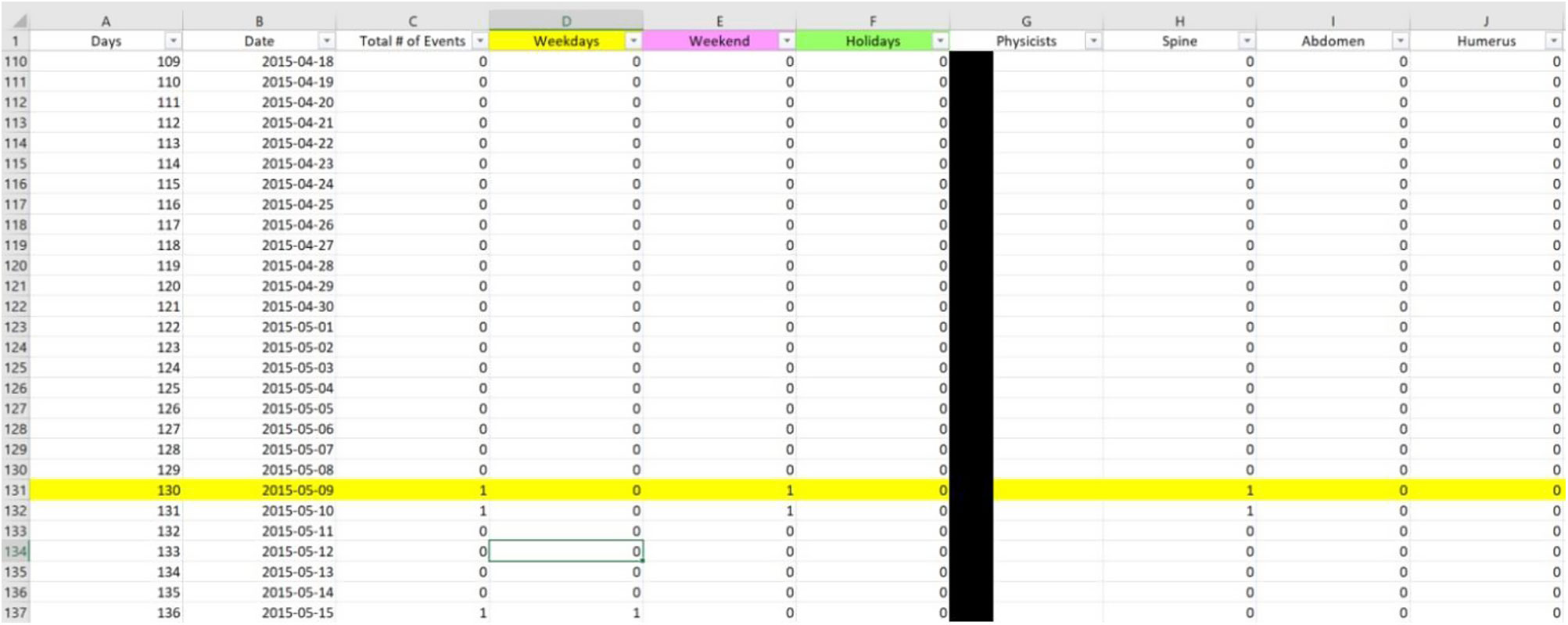
Excel was used for the physics on-call data input. Variables of the data were listed across row 1 and consists of 28 variables such as total number of events, date, physicist, treatment site and so on as shown in Figure 2. Columns of the spreadsheet were listed down from 1 to 366 corresponding to all days in a year. The reason for 366 instead of 365 was to account for the leap years. This is important when importing the data into MATLAB so that all variables were in the same array size 1-column-by-366-rows. This made it easier to manipulate the data in MATLAB. The Excel file was then populated with ‘0s’ and ‘1s’ for the ‘True’ and ‘False’. If a physics on-call event occurs on the day of 130th, which was a weekend as highlighted in Figure 2, the corresponding column of ‘Weekend’ was assigned an integer of ‘1’, representing ‘True’. Similarly, event treatment type was spine and, therefore, integer ‘1’ was assigned in that column.
Data from the Excel file displaying data input and assignments of ‘0’ (‘False’) and ‘1’ (‘True’). The names of physicists are shaded due to privacy.

Data analysis using MATLAB
MATLAB was used to read the Excel file and manipulate the data to display the probability trends of desired variables such as total events, incident dates of events and types of events. The date-times were converted from cell to matrix and put in an array of 1 column by n × 365·25 rows. The value of 365·25 represented the total number of days in a year considering the leap year dates. The total number of on-call year was equal to n. For example, variables a1 , a2 , a3 , and w were the summed values of total events per week, per month, per year and per 52 weeks, respectively. The data were then sent to a ‘For’ loop in MATLAB that combined each element in these independent variables of each year into one matrix. This matrix could then be manipulated to display the probability, or could use the built-in MATLAB functions, such as histogram, plot, or scatter-plot, to plot the data-points.
Results and Discussion
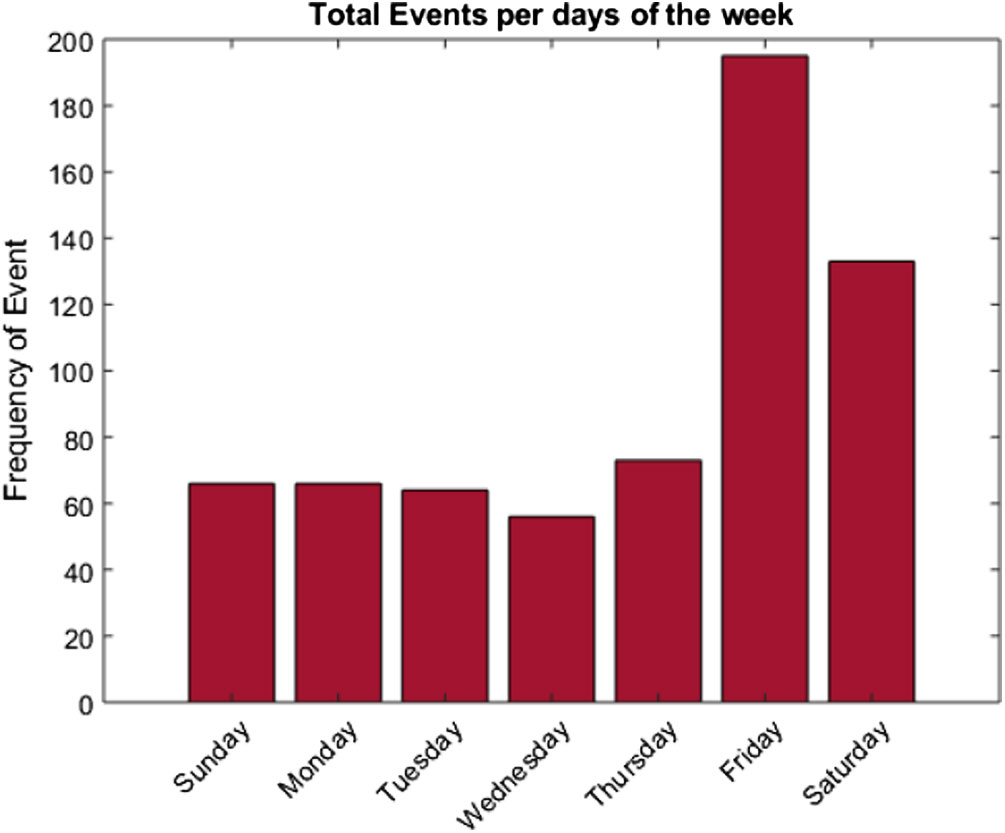
The frequency of event against all days in a week is shown in Figure 3.
Total number of physics on-call events per day of the week in 2010–18.

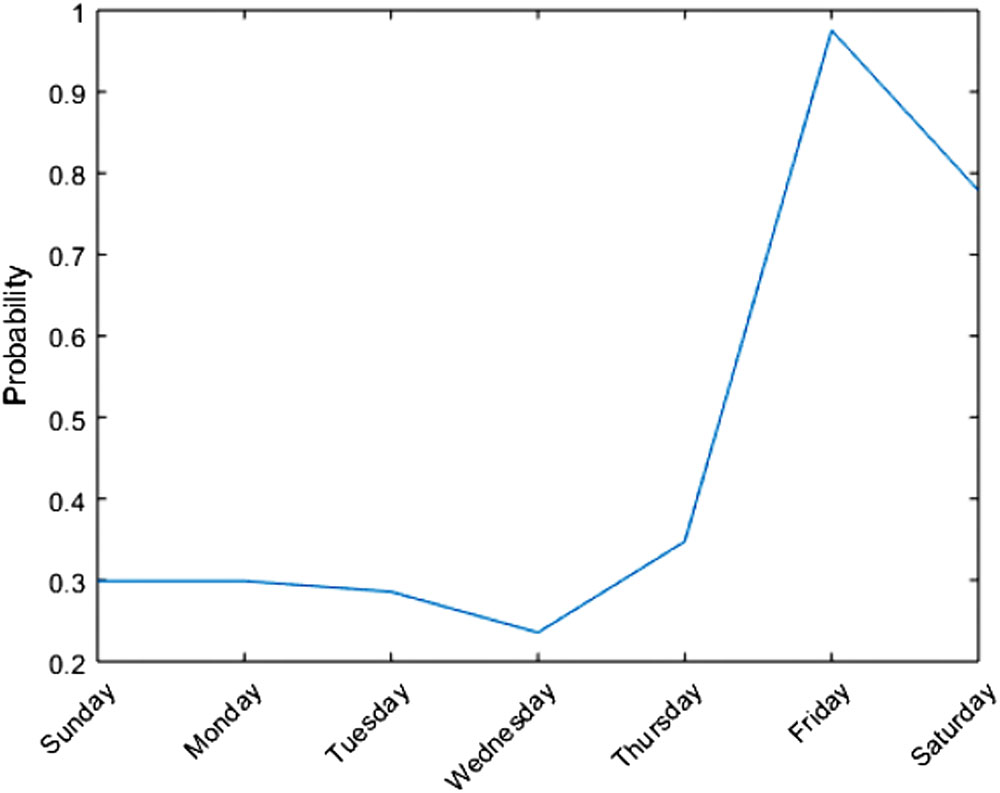
It can be seen in Figure 3 that the number of on-call events was varying similarly between 50 and 70 from Sunday to Thursday. The number of events increased (to the peak) over 190 on Fridays and then dropped to about 130 on Saturdays. There are more on-call events closer to the weekend, probably due to the effect of reduction of human resource, because the daytime radiation team working during the weekdays will be off and cannot support emergency radiotherapy during the weekend. Therefore, emergency radiotherapy is only supported by the on-call treatment team on Saturdays and Sundays. As the on-call radiation staff wanted to finish as many upcoming events as possible to avoid returning to the hospital during the weekend, more on-call events would happen on Fridays. It can be seen that the number of events decreased on Saturdays from Fridays and returned to normal on Sundays. The number of on-call events was also seen to decrease slightly from Sunday to Wednesday and then increase again from Thursday. Figure 3 can be transformed to a probability distribution per day of the week as shown in Figure 4.
Probability distribution of the total number of on-call events per day of the week in 2010–18.

In Figure 4, it can be seen that the probability of an on-call event decreased slightly from Sunday to Wednesday as all radiation staff returned to work on Monday. Then the probability started to increase from Thursday to Friday and then decrease to Saturday when only the on-call radiation team was working for emergency radiotherapy.
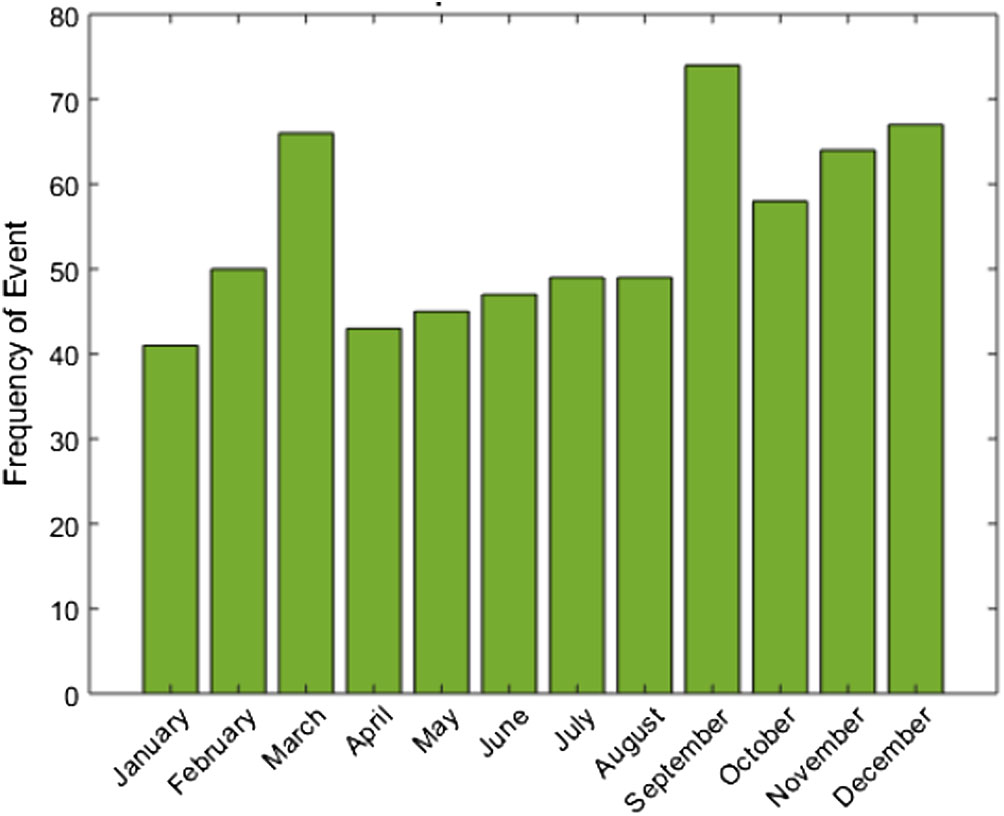
The total number of physics on-call events per month of the year is shown in Figure 5.
Total number of on-call events per month in 2010–18.

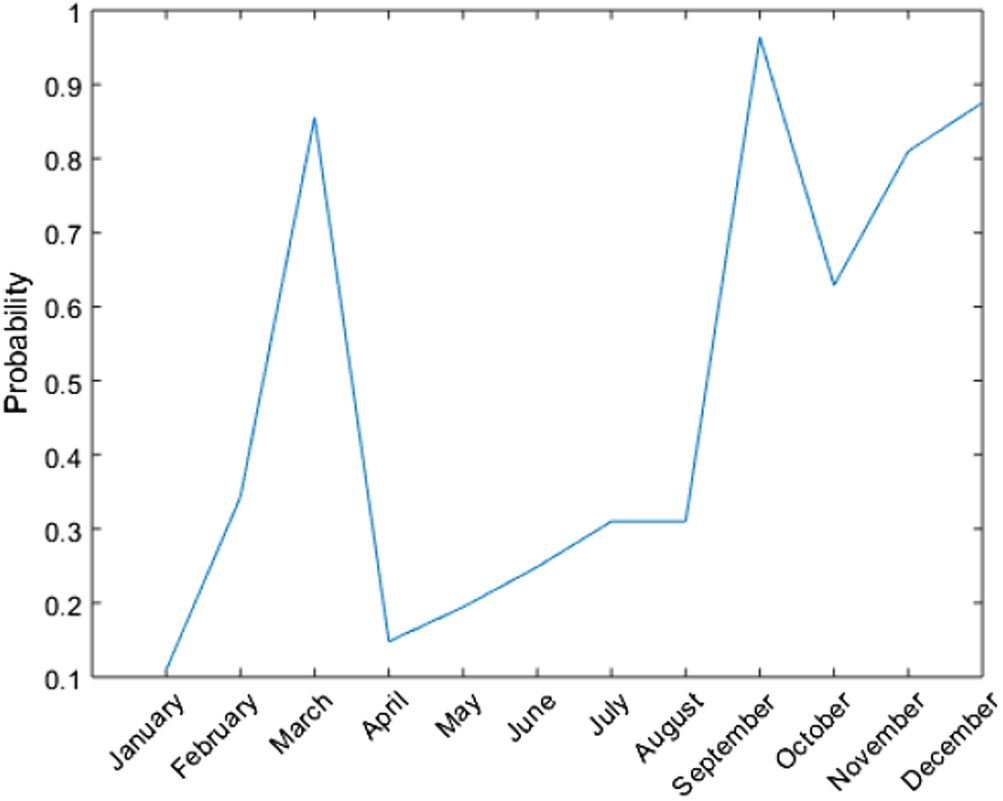
In Figure 5, the number of on-call events is found to have increased from January up to March, then it decreased in April and increased again up to the peak in September. In October, the number of events decreased from September, but increased to reach another peak in December. It should be noted that those months having a peak number of events are close to the public holidays such as March break, Labour Day and Christmas. It is expected that more radiation staff would take long holidays in those months, resulting in a shortage of human resource for emergency radiotherapy during the weekdays. Therefore, a heavier workload would be imposed on the on-call team. Figure 6 shows the probability distribution of Figure 5 for 12 months in the year. It can be seen that on-call events happened with higher probabilities in March, September and December. Therefore, more resource should be assigned in those months to deal with an increase in emergency palliative cases. The roster can therefore generate the on-call schedule by considering the statistical results in order to maintain a better balance of workload among all on-call physicists.
Probability distribution of the total number of on-call events per month of the year in 2010–18.

Conclusions
A database was constructed to record the physics on-call events using the Excel and MATLAB software. Physics on-call data from 2010 to 2018 were input into the database and analysed. It was found that both peak weekday and peak month of physics on-call events happened when the daytime radiation staff was not working during the weekends and holidays. This was because those emergency radiotherapy events could not be covered by the daytime staff. Probability distributions as a function of days in a week and months in a year, generated by the database, were used to find out the probability of an on-call event happening during a day or week. These results helped the roster to generate an on-call schedule with a better balance of workload among physicists. In addition, the results benefited budget allocation and resource planning for the on-call treatment team.
Author ORCIDs
James C. L. Chow 0000-0003-4202-4855
Acknowledgements
We would like to thank all the on-call physicists who provided information regarding their on-call cases for use in this work.