Introduction
Dissociative seizures (DS; also known as psychogenic nonepileptic seizures) are paroxysmal disruptions of awareness and behavioural control that can mimic epilepsy or syncope (Popkirov et al., Reference Popkirov, Grönheit, Schlegel and Wellmer2014, Reference Popkirov, Jungilligens, Grönheit and Wellmer2017). They are considered psychologically determined, based on features such as suggestibility, and associations with psychiatric morbidity and psychological trauma (Popkirov et al., Reference Popkirov, Grönheit and Wellmer2015; Brown and Reuber, Reference Brown and Reuber2016a). Beyond that, a range of experiential and biological factors have been identified that can predispose, precipitate or perpetuate the disorder (Brown and Reuber, Reference Brown and Reuber2016b). As a neurological dysfunction without a unique lesional or structural pathology, DS are recognised as a form of functional neurological disorder (FND; or ‘conversion disorder’). They can occur either in isolation, or in the context of various neuropsychiatric disorders (e.g. posttraumatic stress disorder), suggesting a transdiagnostic underlying mechanism (Brown and Reuber, Reference Brown and Reuber2016a).
The wide heterogeneity of presentations makes delineating shared neuropsychological mechanisms difficult. The recently proposed integrative cognitive model (Brown and Reuber, Reference Brown and Reuber2016b) addresses this problem by disentangling the seizure from precipitating and reinforcing pathways. In this model, ictal manifestations are the result of an activated learnt mental representation (like a behavioural computer programme). This so-called ‘seizure scaffold’ can emerge in the context of acute stress or injury, and can involve physiological stress sensations (e.g. derealisation or lightheadedness), instinctive automatisms (e.g. thrashing movements or freezing), personal illness experiences (e.g. epilepsy or syncope) or illness beliefs (e.g. observed seizures). Once established through physiological and psychosocial reinforcement (e.g. the numbing effects of dissociation, the escape of stress, the designation as illness), the ‘seizure scaffold’ can be activated as a maladaptive response to emotional distress, particularly when inhibitory cognitive control is impaired (e.g. under stress or due to frontal lobe lesions) (Brown and Reuber, Reference Brown and Reuber2016b).
In line with this model, alterations in emotion recognition and regulation have previously been demonstrated in DS patients and are thought to be critical predisposing factors (Pick et al., Reference Pick, Goldstein, Perez and Nicholson2019). Particularly alexithymia, the inability to properly identify and address internal emotional states, has been recognised as a common deficit among DS patients (Williams et al., Reference Williams, Levita and Reuber2018). This may help to explain the observation that patients often report somatic components of emotional states (e.g. heart palpitations) at the onset of seizures, without relating them to the respective emotions (Goldstein, Reference Goldstein2006; Stone and Carson, Reference Stone and Carson2013). Instead, these normal physiologic sensations are experienced as threatening and often unbearable symptoms of a disease (Goldstein, Reference Goldstein2006; Stone and Carson, Reference Stone and Carson2013). Whether an amplified or imprecise interoception (bodily awareness) influences this pathway is unknown. Furthermore, it is unclear whether impairments in processing of external emotional cues are associated with alexithymia in DS patients.
Emotional arousal can reflexively activate innate or learned defensive behaviours, but these are usually inhibited, and cognitive strategies such as situational reappraisal are instead employed for emotion regulation. In DS patients, however, less effective, emotion-focused regulation strategies such as suppression are assumed to predominate, and failure of emotion regulation can give way to the disinhibition of maladaptive responses, i.e. the seizure scaffold (Brown and Reuber, Reference Brown and Reuber2016b; Williams et al., Reference Williams, Levita and Reuber2018). The presumed interplay between emotion regulation and behavioural disinhibition in DS remains to be examined experimentally.
Once the ‘seizure scaffold’ is activated, movements are usually experienced as involuntary and beyond subjective control, which implies a loss of behavioural awareness or ‘sense of agency’ (Edwards et al., Reference Edwards, Moretto, Schwingenschuh, Katschnig, Bhatia and Haggard2011; Kranick et al., Reference Kranick, Moore, Yusuf, Martinez, LaFaver, Edwards, Mehta, Collins, Harrison, Haggard, Hallett and Voon2013; Baek et al., Reference Baek, Doñamayor, Morris, Strelchuk, Mitchell, Mikheenko, Yeoh, Phillips, Zandi, Jenaway, Walsh and Voon2017). Whether DS patients have impaired motor behavioural awareness in general, and whether such predisposition is correlated with the prevalence of dissociative experiences, is unknown.
The complexity of the affective-cognitive-behavioural cascade delineated above presents a challenge to experimental research of DS (Brown and Reuber, Reference Brown and Reuber2016a). Furthermore, DS rarely occur isolated, but rather as a transdiagnostic phenomenon in the context of various psychiatric and neurological disorders (Brown and Reuber, Reference Brown and Reuber2016a, Reference Brown and Reuber2016b). Here, we conducted a multimodal experimental study in a comprehensively characterised clinical sample and in healthy controls (HC) to analyse key traits and behaviours involved in DS pathophysiology. Specifically, behavioural measures of emotion recognition and regulation, interoception, inhibition, and sense of agency were set against pen-and-paper tests of related traits and experiences. We hypothesised interrelated impairments in emotion recognition, awareness, and regulation, as well as behavioural inhibition and awareness, and decreased interoceptive sensitivity. Furthermore, we expected these changes to validate the participants’ subjective ratings in corresponding questionnaires and to further explain relationships between the measured constructs.
Methods
Subjects
Adults with DS were prospectively recruited from our epilepsy centre inpatient unit. Diagnoses were confirmed via ictal video-EEG-recording (Popkirov et al., Reference Popkirov, Jungilligens, Grönheit and Wellmer2017). As we aimed to examine transdiagnostic cognitive phenomena associated with DS irrespective of contributing factors, and to increase clinical and ecological validity, patients with neurological and psychiatric comorbidity (e.g. epilepsy, anxiety and depression) were not excluded. HC were recruited via advertisements, received 10€ compensation and were excluded if currently affected by neurological or psychiatric disorders (except specific phobias). All participants provided written informed consent. The study was approved by the ethics committee of the Medical faculty of Ruhr University Bochum (Reg.-Nr. 17-6019).
Demographic and clinical data was collected using a custom questionnaire. An in-depth structured psychiatric interview (Mini-DIPS) (Margraf, Reference Margraf1994) was used to screen participants for current psychiatric disorders. Affective symptoms and trauma history were additionally assessed using the Beck Depression Inventory II (BDI-II) (Beck et al., Reference Beck, Ward, Mendelson, Mock and Erbaugh1961), the Beck Anxiety Inventory (BAI) (Margraf and Ehlers, Reference Margraf and Ehlers2007) and the Childhood Trauma Questionnaire (CTQ) (Bernstein et al., Reference Bernstein, Stein, Newcomb, Walker, Pogge, Ahluvalia, Stokes, Handelsman, Medrano, Desmond and Zule2003). All questionnaires were used in their German version; further details on all instruments and tasks are provided as online Supplementary Material.
Emotion recognition, awareness and regulation and behavioural inhibition
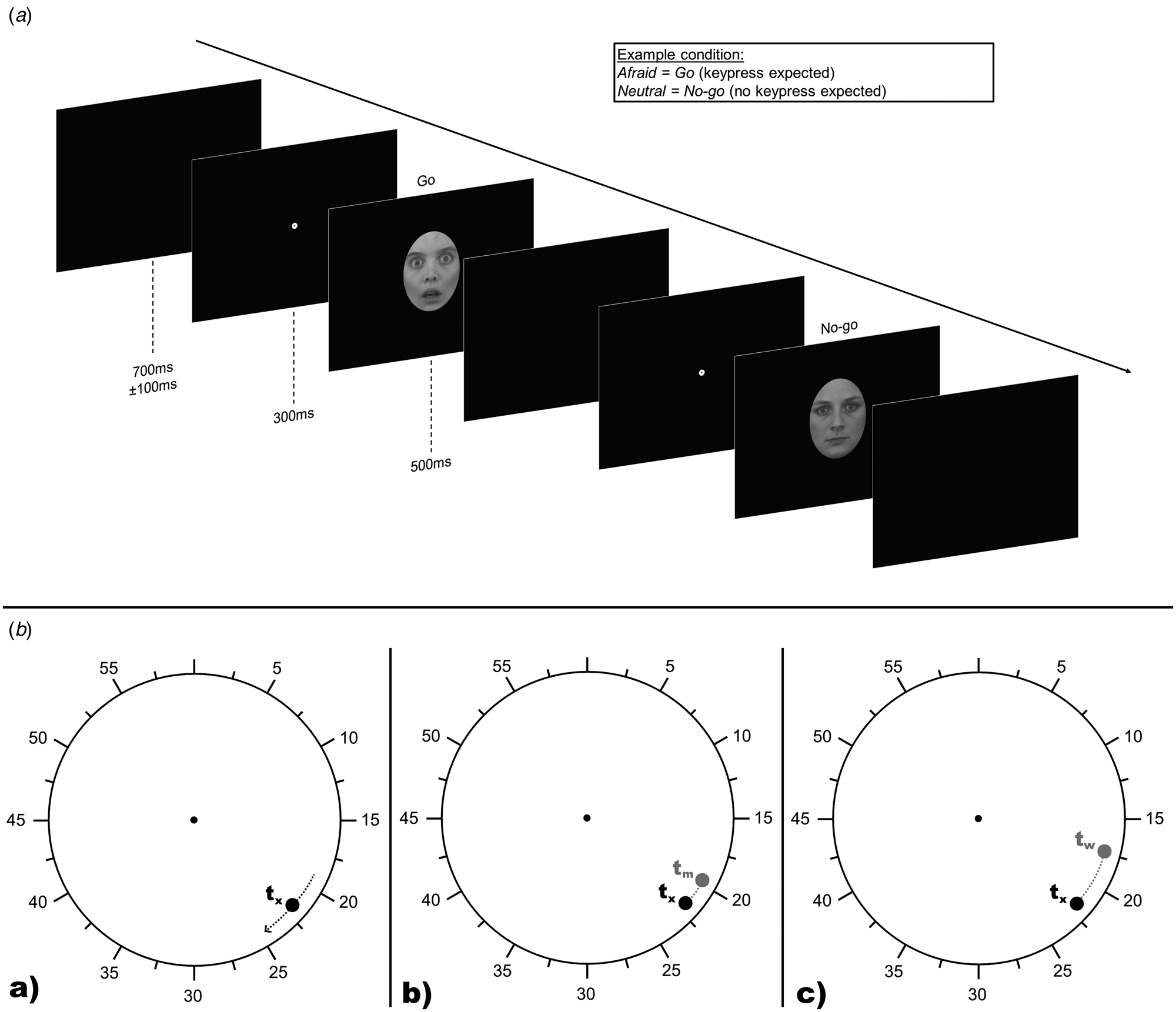
Impaired inhibitory behavioural control in the context of emotion dysregulation is thought to precipitate DS (Brown and Reuber, Reference Brown and Reuber2016b). To assess key abilities involved in this affective-cognitive-behavioural cascade, an emotional go/no-go task [broadly based on Tottenham et al. (Reference Tottenham, Hare and Casey2011)] was programmed in OpenSesame 3.1.6 (Mathôt et al., Reference Mathôt, Schreij and Theeuwes2012) and presented on a 17.3″ screen. Emotional (afraid, sad, happy) and neutral faces from the Karolinska Directed Emotional Faces (KDEF) dataset (Lundqvist et al., Reference Lundqvist, Flykt and Öhman1998) were used as stimuli. Subjects were instructed to press a key as fast as possible after a ‘go’ stimulus (e.g. a pre-defined emotional expression) and withhold their reaction following a ‘no-go’ stimulus (Fig. 1). Stimuli were presented in random order with a 3:1 ratio of go:no-go trials to elicit a response bias. The task consisted of five blocks (40 trials each): one training (afraid = go v. neutral = no-go condition) and four experimental blocks (sad = go v. neutral = no-go and vice versa; happy = go v. neutral = no-go and vice versa) in randomised order. The KDEF dataset includes faces in seven different emotion categories, each mapping onto one of the Ekmann's ‘basis emotions’. Sad and happy faces were chosen since these two emotions exhibited the biggest discriminative power regarding emotion recognition and emotion regulation in the study we broadly based our paradigm on (Tottenham et al. Reference Tottenham, Hare and Casey2011).
Illustration of behavioural tasks. (A) Illustration of the emotional go/no-go task. Two trials (one afraid = go, one neutral = no-go) are depicted here. Each trial consisted of a preparation phase (700 ms ± 100 ms jitter), a fixation dot (300 ms) and a presentation/reaction phase (500 ms). Reactions could still be given in the first 500 ms of the next preparation phase. Stimuli AF21AFS and AF01NES from the KDEF are used exemplarily in this illustration. (B) Illustration of the Libet clock. (a) The dot rotates on the clock face. Participants are instructed to press a key one at a random timepoint (t x). (b, c) Afterwards, participants are asked to indicate either the timepoint of the keypress (t m, illustrated in b) or their subjective ‘will to move’ (t w, illustrated in c). M-Judgement is calculated as M = t m–t x (b), W-judgement as W = t w–t x (c), over all given trials respectively.

In this experimental paradigm, failed inhibitory behavioural control is reflected in the false alarm rate (keypress on ‘no-go’ trial). Since overall performance hinges on correct facial expression categorisation, overall correct rate and sensitivity index (d′) reflect emotion recognition. In trial blocks where an emotional face is the target ‘go’ stimulus and constitutes 75% of stimuli that the subject is confronted with, successful inhibition in ‘no-go’ trials additionally requires emotion regulation. Error and false alarm rates in these conditions of emotional activation can thus be interpreted as failure of emotion regulation. Lastly, overall reaction time (from onset of stimulus presentation to key press) is taken as an index of task engagement and psychomotor speed.
To complement behavioural measures, participants’ emotion regulation strategies (‘reappraisal’ v. ‘suppression’) were assessed through the Emotion Regulation Questionnaire (ERQ) (Gross and John, Reference Gross and John2003; Abler and Kessler, Reference Abler and Kessler2009). Impairment in emotional awareness (alexithymia) was assessed using the Toronto Alexithymia Scale (TAS-20) (Taylor et al., Reference Taylor, Michael Bagby and Parker1991) with special consideration of the ‘externally oriented thinking’ subscale, since the tendency to focus on external affective cues, rather than internal emotional states is thought to be associated with the heightened threat perception found in DS patients (Williams et al., Reference Williams, Levita and Reuber2018). Since self-report measures on self-observational abilities have been discussed as a point of weakness of the TAS-20, participants also completed the four-item version of the Levels of Emotional Awareness Scale (LEAS). In this text-based measure of emotional awareness and alexithymia, written projections of the participants’ understanding of emotionally ambiguous hypothetical scenarios are rated by semantic aspects of emotional richness and complexity (Lane et al., Reference Lane, Quinlan, Schwartz, Walker and Zeitlin1990; Subic-Wrana et al., Reference Subic-Wrana, Beutel, Brähler, Stöbel-Richter, Knebel, Lane and Wiltink2014).
Behavioural and interoceptive awareness
Behavioural awareness was measured using a digital Libet clock setup (Libet et al., Reference Libet, Gleason, Wright and Pearl1983; Garaizar et al., Reference Garaizar, Cubillas and Matute2016) on a 17.3″ screen. In this classic experiment subjects press a key ‘at will’ while a dot makes its second rotation in a clock face at 2560 ms/rotation (Fig. 1). After the rotation is completed, subjects identify the position of the dot at which they first felt the ‘will to move’ (W-judgement) or, alternatively, the position when they actually pressed the key (M-judgement). After an instruction and training round, subjects completed two blocks (30 trials each) of W-judgement followed by two blocks of M-judgement. We deliberately chose a non-randomised order of block presentation to avoid confusion in patients that may arise when the more introspectively demanding blocks with W-judgements are presented later on. Error trials – trials with more than one keypress – were removed during analysis. Data of five DS patients was deleted after data acquisition due to a technical recording error. Outliers (exceeding 2 s.d. from the individual mean) were removed. Altogether, this comprised on average 3.2 out of a total of 120 trials per participant.
The ability to consciously differentiate and quantify bodily sensation (interoceptive awareness) was assessed with a heartbeat counting paradigm (Schandry, Reference Schandry1981). Subjects were asked to count their interoceptively perceived heart beats for three episodes of undisclosed duration (25/35/45 s). The actual number of heartbeats was recorded objectively in parallel using a Polar® RS800CX heart rate monitor. The quantified measure of interoceptive sensitivity is  $IS = \displaystyle \frac{1}{3} \sum \bigg(\frac{record-count}{record}\bigg) $. To control for possible confounding factors, blood pressure was measured, and the body mass index was assessed.
Dissociative experiences, which reflect a tendency for impaired behavioural and sensory awareness, were captured using the German version of the Dissociative Experiences Scale II (DES-II) (Bernstein Carlson and Putnam, Reference Bernstein Carlson and Putnam1993) (Fragebogen zu Dissoziativen Symptomen) and the SDQ-20 (Somatoform Dissociation Questionnaire) (Nijenhuis et al., Reference Nijenhuis, Spinhoven, Van Dyck, Van der Hart and Vanderlinden1996). Scores were correlated with CTQ to test the well-established link between early life traumatisation and dissociative predispositions (Pick et al., Reference Pick, Mellers and Goldstein2017).
Statistics
Statistical analysis was performed with IBM SPSS Statistics 21 (IBM Corp., 2012). The significance level was set at p < 0.05. Group comparisons in demographic, clinical and psychometric data as well as in behavioural measures were performed using χ2 test, MANOVA with follow up ANOVAs, Mann–Whitney-U-test and t test as applicable. Dependent variable selection for MANOVAs was based on theoretical conceptualisation (e.g. all variables that are understood to measure emotion regulation are included in one overarching MANOVA). The Ryan-Einot-Gabriel-Welsch and Quiot (REGWQ) procedure was used to correct for multiple comparisons. Test design is reported with the results. All reported correlation coefficients are Pearson's r or Spearman's r as applicable; the respective kind of correlation analysis is indicated throughout the results. Between-group comparisons of correlations were performed using VassarStats (Lowry, Reference Lowry2001).
Results
Subjects
Twenty patients with DS and 20 HC participated in this study. No significant between-group differences were found regarding age (mean: DS = 32.9 ± 12.8 years, HC = 29.4 ± 9.9 years; t(38) = 0.95, p = 0.348) and gender (both groups f:m = 14:6). Of note, two DS patients self-identified as transgender (both genetically female whilst identifying as male), while this was not the case in any of the HCs. Since our study was not intended to examine neurobiological sex differences in DS pathophysiology, gender categorisation was undertaken according to lived gender in line with current recommendations (Hendricks and Testa, Reference Hendricks and Testa2012). The groups differed in years of school education (mean DS = 10.5 ± 1.7 years; HC = 12.5 ± 1.4 years; t(38) = −3.412, p = 0.002). Since years of school education failed assumptions for inclusion in MANCOVA, we used bivariate Spearman correlations to test for confounding effects on other variables. The analyses revealed moderate correlations with a range of dependent variables in both groups, though of course causal directionality remains unknown. Overall, no systematic influence on our main findings could be identified.
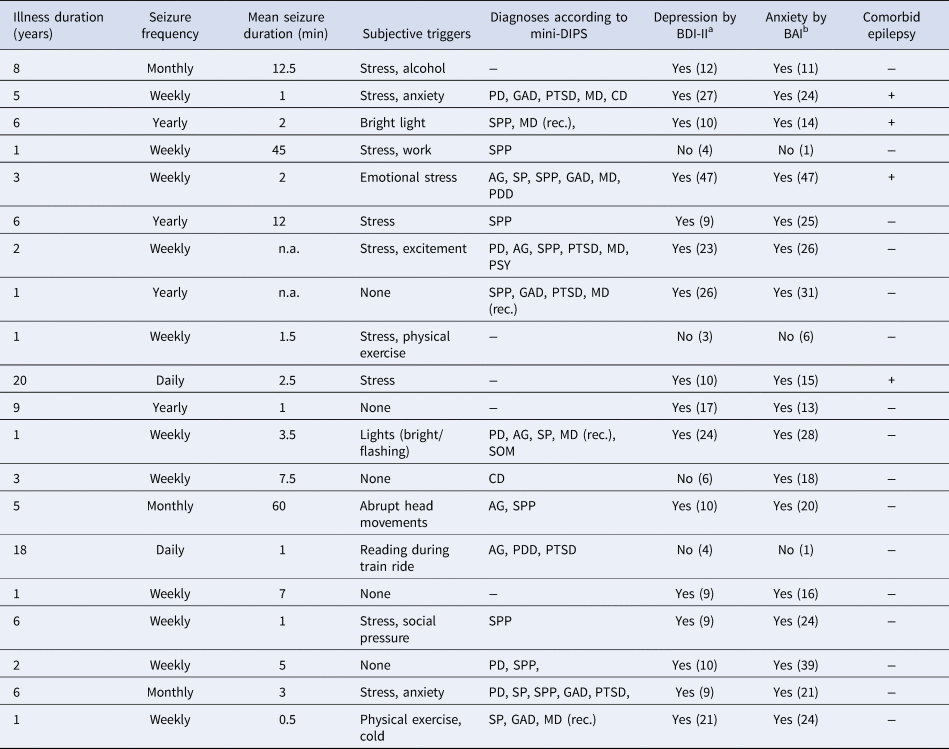
Table 1 describes clinical characteristics of the DS group; see online Supplementary Material for corresponding information on HC. While 15 of the 20 DS patients were given at least one Mini-DIPS diagnosis – mostly constituted by anxiety and affective disorders (34 and 9 diagnoses, respectively) – this was the case for 6 out of 20 HC (four cases of past episodes of major depression, two cases of specific phobias), thus constituting a significantly higher amount of diagnoses in DS (χ2 = 8.12, p = 0.001). DS patients showed more clinically relevant depressive (BDI-II score > 8) and anxiety (BAI score > 7) symptoms than HC (80% v. 15% and 85% v. 5%, respectively; BDI-II: χ2 = 16.942, p < 0.001; BAI: χ2 = 25.859, p < 0.001), and higher mean BDI-II (DS = 14.5 ± 10.73; HC = 3.65 ± 4.86; U = 48, p = 0.001) and BAI scores (DS = 20.2 ± 11.5; HC = 2.75 ± 2.38; U = 30,5, p = 0.001). CTQ scores did not significantly differ between patients and controls, even though each individual sub-score was numerically higher for patients (see online Supplementary Material for detailed values). A total of 50% of the patients named ‘stress’ or ‘emotional stress’ as a subjective trigger, while 30% named ‘somatosensory’ triggers such as ‘physical exercise’, ‘abrupt head movements’ or ‘reading during train ride’ (Table 1).
Characteristics of study participants with DS

DS, dissociative seizures; ES, epileptic seizures; min, minutes; PD, panic disorder; GAD, generalised anxiety disorder; PTSD, post-traumatic stress disorder; MD, major depression; CD, conversion disorder; SPP, specific phobia; rec., recurrent; AG, agoraphobia; SP, social phobia; PDD, persistent depressive disorder; PSY, psychotic events; SOM, somatisation disorder. In the five patients with mini-DIPS diagnoses of PD, seizure semiology was distinct from panic attack symptoms.aBDI-II score exceeding clinical cut-off (8 points). Individual BDI-II score in brackets.
b BAI score exceeding clinical cut-off (7 points). Individual BAI score in brackets.
Emotion recognition, awareness and regulation and behavioural inhibition
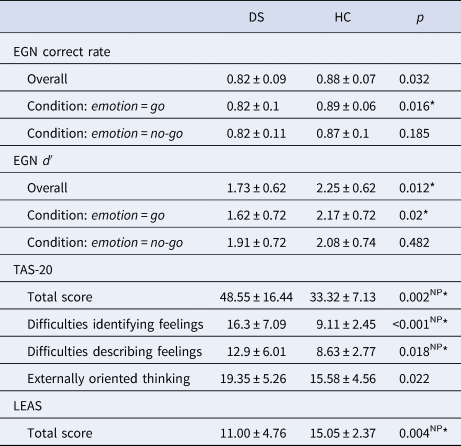
We first tested whether there were any differences in emotion recognition between groups using MANOVA (with d′ and correct rate of the emotional go/no-go task as well as LEAS as dependent variables). Pillai's trace indicated a significant between group effect (V = 0.271, F(3,36) = 4.45, p = 0.009). Follow-up ANOVAs found significantly lower values for behavioural measures of emotion recognition (overall d′, and d′ and correct rate for emotion = go conditions) for DS compared to HC (Table 2). These differences cannot be attributed to differences in task engagement and psychomotor speed, as mean reaction times over all trials and conditions did not differ significantly between groups (MANOVA: p = 0.486, follow-up ANOVAs: all p > 0.634).
Values of different measures of emotion recognition and alexithymia

EGN, emotional go/no-go task; TAS-20, Toronto Alexithymia Scale 20; LEAS, Levels of Emotional Awareness Scale; DS, dissociative seizures; HC, healthy controls; NP, non-parametric Mann–Whitney-U-test.
Mean ± s.d. as well as p-value of between-group comparisons (MANOVA or Mann–Whitney-U-test, as applicable; NP indicated non-parametric group comparisons using Mann–Whitney-U-test).
*Indicate between-group differences that remain significant following REGWQ correction for multiple testing.
Since affective disorders can be associated with altered emotional responding, a bivariate correlation analysis involving BDI-II and BAI scores was performed (inclusion in MANCOVA was not possible since values were not normally distributed). BDI-II scores were significantly correlated with the error rate for the emotion cues (in no-go condition) and, of course, inversely with the respective ‘correct rate’. BAI scores were significantly correlated with the overall error rate and inversely with the corresponding overall correct rate. No other significant correlations were evident.
Alexithymia scores as measured with TAS-20 (overall score and subscales) and LEAS (inversely coded) were significantly higher in DS than HC (Table 2). Correlation analysis between self-rated measures and related emotional go/no-go task performance revealed that for DS but not for HC, the TAS-20 score was negatively correlated with the correct rate (Spearman's r = −0.486, p = 0.030) and d′ (Pearson's r = −0.489, p = 0.029). This effect was mainly driven by significant negative correlations of these behavioural measures of emotion recognition with the TAS-20 subscales ‘difficulties describing feelings’ (with correct rate: Spearman's r = −0.540, p = 0.046) and ‘externally oriented thinking’ (with correct rate: Spearman's r = −549, p = 0.012; with d′: Pearson's r = −610, p = 0.004). Again, these correlations were not significant in HC.
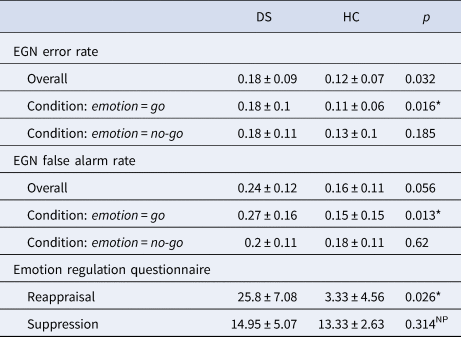
Measures of behavioural inhibition and emotion regulation from the emotional go/no-go task were compared between groups using another MANOVA (with overall error and false alarm rate as well as ERQ scores as dependent variables; V = 0.224, F(3,36) = 3.21, p = 0.034). Follow-up tests revealed that behavioural inhibition, reflected by the false alarm rate, was significantly reduced in DS compared to HC in trials where emotional faces were the dominating ‘go’ stimulus, with a similar constellation for the error rate (Table 3), indicative of problematic emotion regulation. When the predominant stimulus was a neutral face, between-group differences were smaller and not statistically significant (Table 3).
Measures of emotion regulation and behavioural inhibition from the emotional go/no-go task and the ERQ

EGN, emotional go/no-go task; DS, dissociative seizures; HC, healthy controls; NP, non-parametric Mann–Whitney-U-test.
Mean ± s.d. as well as p-value of between-group comparisons (MANOVA or Mann–Whitney-U-test, as applicable; NP indicated non-parametric group comparisons using Mann–Whitney-U-test).
*Indicate between-group differences that remain significant following REGWQ correction for multiple testing.
ERQ scores revealed differences in the employment of emotion regulation strategies: DS patients scored significantly lower on the ‘reappraisal’ subscale of the ERQ while there were no differences on the ‘suppression’ subscale (Table 3).
We checked for correlations of behavioural measures of emotion regulation with emotion regulation strategies of the ERQ. False alarm rates were significantly negatively correlated with ERQ reappraisal scores for DS (Pearson's r = −0.552, p = 0.012) but not for HC (Pearson's r = −0.229, p = 0.201). This suggests that for DS patients, a more pronounced tendency to rely on emotion-focused instead of problem-focused regulation strategies was associated with worse behaviourally assessed emotion regulation and behavioural inhibition. The ‘externally-oriented thinking’ subscale score of the TAS-20, which reflects the tendency to focus on external rather than internal emotional events, was also negatively correlated with the ERQ reappraisal score in DS (Pearson's r = −0.484, p = 0.031) but not in HC (Pearson's r = 0.033, p = 0.889). Further details on these results are provided as online Supplementary Material.
Behavioural and interoceptive awareness
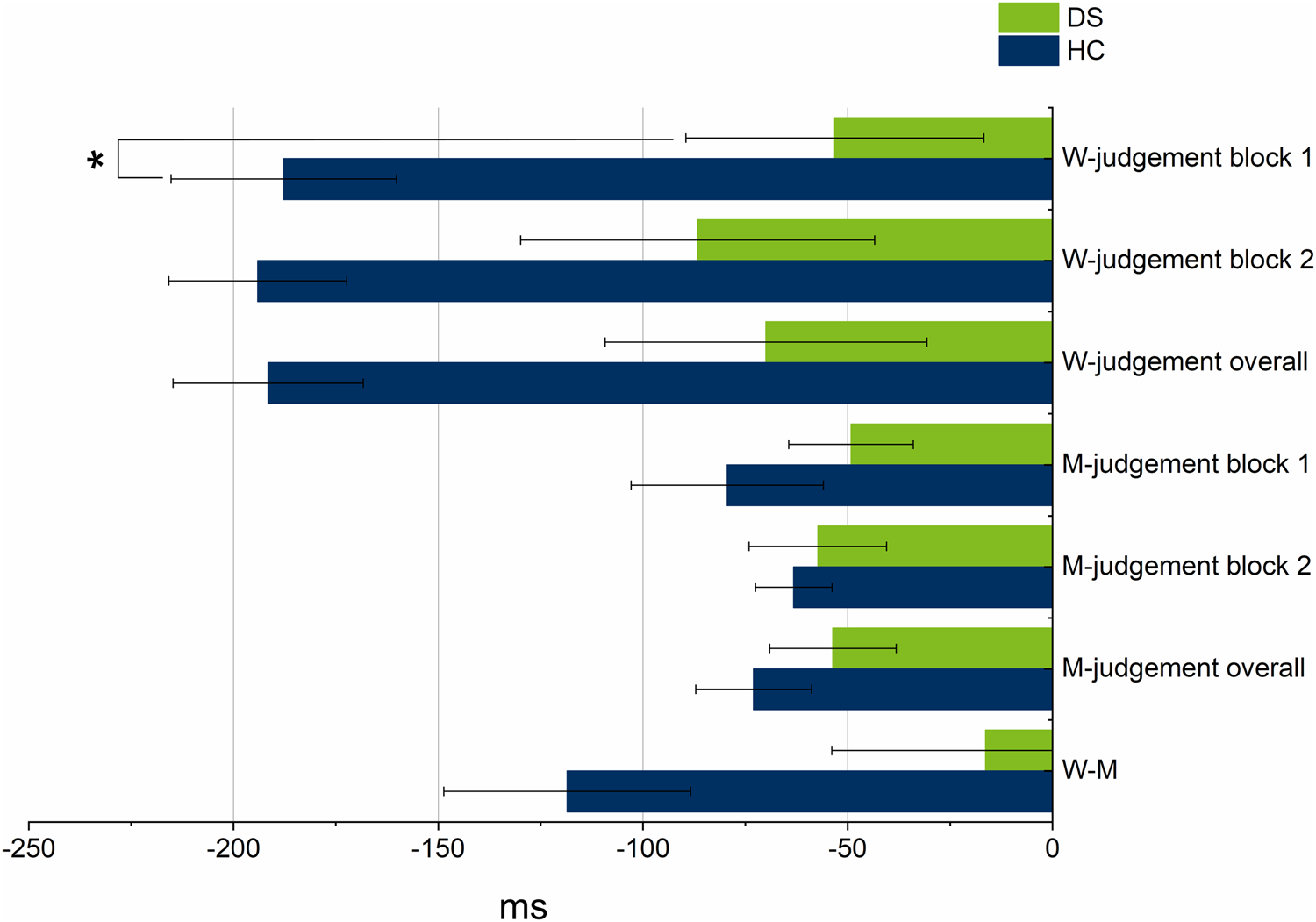
To evaluate the hypothesised differences in behavioural awareness, we compared the results of the Libet experiment between groups using a MANOVA with group as independent variable, and blockwise as well as overall W and M judgements, the W–M difference value, DES and SDQ score as dependent variables. This overarching analysis did not reveal a significant effect. Still, DS patients had shorter W-judgement times than HC, though this difference only reached statistical significance in block 1 (Fig. 2, W1-judgement: DS = −80.5 ± 140.47; HC = −192.69 ± 121.53; p = 0.049).
Mean values ± standard errors for the Libet's task measuring action awareness. Significantly lower W-judgement for DS patients compared to HC in 1st block. Data of other blocks follow this trend but are not significantly different between the two groups. To enhance comparability, data is presented as in previous relevant studies (Baek et al., Reference Baek, Doñamayor, Morris, Strelchuk, Mitchell, Mikheenko, Yeoh, Phillips, Zandi, Jenaway, Walsh and Voon2017).

Symptoms of somatoform dissociation as measured with the SDQ were significantly more common in the DS group (DS = 30.08 ± 9.71; HC = 21.22 ± 1.44; U = 18,5, p < 0.001); there were no significant differences concerning the DES (DS = 16.7 ± 18.37; HC = 10.02 ± 9.4; p = 0.175).
To evaluate the connection of early traumatic experiences with dissociative symptoms, we checked for correlations of CTQ scores with DES and SDQ scores. For DS patients, current dissociative experiences (DES score) were significantly correlated with overall CTQ score (Spearman's r = 0.577, p = 0.008), CTQ ‘emotional abuse’ subscale (Spearman's r = 0.685, p = 0.001) and CTQ ‘emotional neglect’ subscale (Spearman's r = 0.530, p = 0.016). This was not the case for HC, thus correlations differed significantly between groups (CTQ score: p = 0.019, CTQ ‘emotional abuse’ subscale: p < 0.001). SDQ and CTQ scores were not correlated.
The heartbeat counting paradigm showed that interoceptive sensitivity was not altered in DS patients compared to HC, with no significant between-group differences in IS values (mean IS: DS = 0.59 ± 0.3; HC = 0.64 ± 0.23, p = 0.256), even after considering blood pressure and body mass index as covariates (details in online Supplementary Material).
There were no significant correlations of DES and SDQ scores with measures of behavioural or interoceptive awareness from the Libet clock task or the heartbeat counting task, respectively (all |r| < 0.420, all p > 0.074). Further details on these results are provided as online Supplementary Material.
Discussion
Using behavioural experiments and complementary self-report questionnaires in 20 well-characterised patients with DS and 20 HC, we provide comprehensive neuropsychological evidence for key elements of the dysfunctional affective-cognitive-behavioural cascade thought to underlie DS (Brown and Reuber, Reference Brown and Reuber2016b; Popkirov et al., Reference Popkirov, Carson and Stone2018; Williams et al., Reference Williams, Levita and Reuber2018).
Emotion recognition, as quantified in the emotional go/no-go task, was impaired in the DS group, and correlated with related self-assessment in TAS-20, particularly in the ‘difficulties describing feelings’ subscale. Behavioural inhibition, especially under conditions that would require emotion regulation, was also reduced in the emotional go/no-go task compared to controls, and was correlated with neuropsychometric measures of emotional regulation (‘reappraisal’ scale of ERQ) which in turn correlated with scores on the ‘externally oriented thinking’ scale of TAS-20, denoting a focus on external emotional events rather than internal emotional states.
Current models of DS and FND in general consider difficulties with emotion processing a pivotal affective-cognitive deficit (Pick et al., Reference Pick, Goldstein, Perez and Nicholson2019; Williams et al., Reference Williams, Levita and Reuber2018). In line with our results, previous studies have suggested that DS patients have problems with recognising emotional faces, while at the same time having an increased attentional bias towards them (Bakvis et al., Reference Bakvis, Roelofs, Kuyk, Edelbroek, Swinkels and Spinhoven2009; Pick et al., Reference Pick, Mellers and Goldstein2016, Reference Pick, Mellers and Goldstein2019). While most previous studies exploring emotion processing in FND or DS patients used emotional faces as affective stimuli, their presentation and function differed. The majority of approaches used several different emotional categories [e.g. happiness, fear, anger, sadness, disgust and neutral in Kozlowska et al. (Reference Kozlowska, Brown, Palmer and Williams2013); anger, happiness, fear, disgust and neutral in Pick et al. (Reference Pick, Mellers and Goldstein2016); happy, fearful, sad and neutral in Szaflarski et al. (Reference Szaflarski, Allendorfer, Nenert, LaFrance, Barkan, DeWolfe, Pati, Thomas and Ver Hoef2018)] in emotion recognition and categorisation tasks. Other approaches used the implicit processing of emotional faces as a disruption mechanism for ongoing attentional processes, without an explicit emotion recognition task encompassed in their paradigms (Bakvis et al., Reference Bakvis, Roelofs, Kuyk, Edelbroek, Swinkels and Spinhoven2009; Gul and Ahmad, Reference Gul and Ahmad2014; Pick et al., Reference Pick, Mellers and Goldstein2018; Szaflarski et al., Reference Szaflarski, Allendorfer, Nenert, LaFrance, Barkan, DeWolfe, Pati, Thomas and Ver Hoef2018). Overall, those studies as well as our own approach mostly lack a non-affective paradigm controlling for the influence of the emotional content itself in comparison with the task-induced effects. The fact that some parameters of emotion recognition in our task were partially related to measures of affective symptoms (BDI-II und BAI scores) suggests that comorbid depression and anxiety might be mechanistically meaningful for emotion processing in DS patients.
Alexithymia and related deficits of emotional awareness and regulation have been repeatedly found among patients with DS (Brown and Reuber, Reference Brown and Reuber2016a; Williams et al., Reference Williams, Levita and Reuber2018). TAS-20 and LEAS scores in our study confirmed this finding. Furthermore, our correlation analyses support the hypothesis that deficits in processing of internal and external emotions are related, and that these impairments are associated with an increased focus on external rather than internal emotional states (Williams et al., Reference Williams, Levita and Reuber2018). This previously discussed attentional bias (Bakvis et al., Reference Bakvis, Roelofs, Kuyk, Edelbroek, Swinkels and Spinhoven2009; Pick et al., Reference Pick, Mellers and Goldstein2016, Reference Pick, Mellers and Goldstein2018) can manifest as threat hypervigilance, probably linked to dissociative symptoms (Melara et al., Reference Melara, Ruglass, Fertuck and Hien2018) and DS precipitation (Brown and Reuber, Reference Brown and Reuber2016b).
Loss of behavioural control, specifically disinhibition, is considered the final step of DS precipitation that activates innate or conditioned behavioural stress responses (‘seizure scaffold’) (Brown and Reuber, Reference Brown and Reuber2016b). While difficult to test, an impairment of action-inhibition can be detected using behavioural experiments. A study utilising a go/no-go task using non-affective stimuli in patients with functional movement disorders has previously demonstrated significantly higher rates of false alarm rates compared to healthy individuals (Voon et al., Reference Voon, Ekanayake, Wiggs, Kranick, Ameli, Harrison and Hallett2013). A more recent study of 29 patients with DS, functional limb weakness, or both, also utilising a non-emotional go/no-go task, found impairments in inhibitory control comparable to our results, but also significantly longer reaction times in patients compared to controls (Hammond-Tooke et al., Reference Hammond-Tooke, Grajeda, Macrorie and Franz2018). Interestingly, our analysis showed that the main measure of inhibitory failure – false alarm rate – was higher for patients over all trials, but across the different conditions it was more pronounced for trials that had emotional ‘go’ stimuli. Future studies could examine whether emotional and non-emotional cues elicit different performances within the same group of DS patients.
Behavioural awareness, specifically ‘sense of agency’, has been hypothesised to be critically impaired in motor FND (Baek et al., Reference Baek, Doñamayor, Morris, Strelchuk, Mitchell, Mikheenko, Yeoh, Phillips, Zandi, Jenaway, Walsh and Voon2017). Previous studies using the Libet clock paradigm in functional tremor as well as mixed motor FND (Edwards et al., Reference Edwards, Moretto, Schwingenschuh, Katschnig, Bhatia and Haggard2011; Kranick et al., Reference Kranick, Moore, Yusuf, Martinez, LaFaver, Edwards, Mehta, Collins, Harrison, Haggard, Hallett and Voon2013; Baek et al., Reference Baek, Doñamayor, Morris, Strelchuk, Mitchell, Mikheenko, Yeoh, Phillips, Zandi, Jenaway, Walsh and Voon2017) have yielded results that are in line with our findings in DS. Yet, due to a technical recording error the sample size in this study did not reach the intended sample size for this test, so our results require replication. On a clinical level, dissociative experiences can be regarded as expressions of a propensity to loss (or disintegration) of behavioural and sensorimotor awareness (Stone and Carson, Reference Stone and Carson2013; Popkirov et al., Reference Popkirov, Carson and Stone2018). The DES is widely used in DS research, but findings have been heterogeneous, presumably because it covers a large variety of both normal and pathological ‘psychoform’ dissociative experiences (Williams et al., Reference Williams, Levita and Reuber2018). In our sample, mean DES scores were not statistically different from controls, in line with previous studies (Brown and Reuber, Reference Brown and Reuber2016a; Williams et al., Reference Williams, Levita and Reuber2018). Regarding ‘somatoform’ dissociation, SDQ scores were significantly higher in DS compared to HC in our study and in line with previous studies (Fiess et al., Reference Fiess, Rockstroh, Schmidt and Steffen2015; Pick et al., Reference Pick, Mellers and Goldstein2017). Somatoform dissociation has been hypothesised to be related to altered interoceptive awareness, because insufficient or distorted bodily sensory information may compromise the interpretation of symptoms (Van den Bergh et al., Reference Van den Bergh, Witthöft, Petersen and Brown2017; Pick et al., Reference Pick, Goldstein, Perez and Nicholson2019).
Using the heartbeat counting task, we found that interoceptive sensitivity in DS patients was not different from that of HC, suggesting that alterations in somatic symptom perception might involve interpretative, rather than sensory, alterations. This finding diverges from reports on patients with persistent functional movement disorders (Ricciardi et al., Reference Ricciardi, Demartini, Crucianelli, Krahé, Edwards and Fotopoulou2016). Furthermore, the validity of the heartbeat counting paradigm has recently been criticised, as it might not only represent interoceptive sensitivity alone, but also participants’ beliefs about heart rate (Ricciardi et al., Reference Ricciardi, Demartini, Crucianelli, Krahé, Edwards and Fotopoulou2016). Thus, more comprehensive methods might be needed to grasp alterations of bodily awareness in DS, if there are any in-between attacks. A more comprehensive approach proposed by Ferentzi et al. (Reference Ferentzi, Bogdány, Szabolcs, Csala, Horváth and Köteles2018) could be to integrate across different measures of discrete aspects of interoception (such as a heartbeat counting task as used in our study, the water load test to investigate gastric perception abilities, bitterness sensitivity and pain threshold), since no single-channel approach has reached a sufficient level of validity and reliability. A further alternative would be the respiratory resistance test (Steptoe and Noll, Reference Steptoe and Noll1997), which also produced mixed results in different studies. Contrary to our expectations, self-reported measures of dissociative tendencies (DES and SDQ) did not correlate with experimental measures of behavioural or bodily awareness. Lastly, as proposed in traditional trauma-dissociation models (Popkirov et al., Reference Popkirov, Flasbeck, Schlegel, Juckel and Brüne2019), our study demonstrated a link between self-reported emotional abuse in childhood and current dissociative tendencies. Overall this is in line with current stress-diathesis models of FND that see the occurrence of symptoms as an interplay between developmental predispositions and acute precipitation (Keynejad et al., Reference Keynejad, Frodl, Kanaan, Pariante, Reuber and Nicholson2018).
Previous reviews have raised concerns about the high prevalence of methodological shortcomings in DS research (Brown and Reuber, Reference Brown and Reuber2016a; Pick et al., Reference Pick, Goldstein, Perez and Nicholson2019). The main weakness of our study was the relatively small sample size and thus its ability to only find large effects. Especially concerning the Libet experiment on behavioural awareness and the interoceptive sensitivity task, the study was likely underpowered and thus needs replication of these aspects. Among its strengths are the multimodal approach and the comprehensive clinical and psychological characterisation. We deliberately chose to include patients with neurological and psychiatric comorbidity, since we were interested in transdiagnostic neuropsychological impairments in patients with DS irrespective of each individual's biological or psychological predisposing factors. However, these factors (e.g. anxiety) may present possible confounders in our study. Thus, the inclusion of psychiatric and neurological patient control groups would be necessary to determine how illness-specific our findings are. In addition, comparing DS patients to other FND subgroups would be of interest.
In conclusion, our study adds comprehensive neuropsychological experimental evidence for alterations in emotional and behavioural awareness and control in patients with DS. Our findings contribute to a better understanding of the neuropsychology of DS, and can prove valuable in the development of psychotherapeutic treatment strategies. Since the cognitive-affective traits we studied are largely thought to be neuronally hard-wired, future studies could explore whether specific structural alterations underly respective impairments in patients.
Supplementary material
The supplementary material for this article can be found at https://doi.org/10.1017/S0033291719002861
Acknowledgements
We would like to thank all patients and healthy controls who participated in this study. Furthermore, we would like to thank Dr Wenke Grönheit, Dr Tim Wehner, Hanna Meister, Dr Natalie Zadrozny, Seena Anton and Dr Sabine Seidel for their help in the recruitment of patients.
Author contributions
JJ and SP formulated the initial study idea. JW and US contributed to the refinement of the structure and the study goals. JJ, HK, NA and SP evaluated the study aims and chose the applied methods. All authors contributed to the proposal for the local ethics committee. JJ performed experimental testing, data preparation and statistical evaluation. SP, HK and NA advised on evaluation. JJ and SP wrote the first draft. All authors contributed to the discussion and reviewed the final manuscript.
Financial support
This research received no specific grant from any funding agency, commercial or not-for-profit sectors.
Conflict of interest
None.
Ethical standards
The authors assert that all procedures contributing to this work comply with the ethical standards of the relevant national and institutional committees on human experimentation and with the Helsinki Declaration of 1975, as revised in 2008.