

Professional burnout has steadily become one of the major global health concerns impacting health care providers, attributable to high exposure to stressful situations.Reference Rodríguez, Knox and Hernández1 Health care providers serve as cornerstones of community, regional, national, and international public health emergency response.2 Beyond frontline providers, many others aid in the aftermath of an event (e.g., those providing professional mental health assistance).2 Over the past several decades, research has demonstrated varied impacts on health care providers; while many feel satisfaction through their work, others suffer adverse effects due to a combination of primary and secondary exposures to traumatic stress.Reference Rodríguez, Knox and Hernández1 These same health care providers are at risk for developing burnout, depression, post-traumatic stress disorder, and increased substance use.2, 3 Approximately 1 in 3 physicians is experiencing burnout at any given time, interfering with their own well-being, as well as the quality-of-care delivery.Reference Haq, Bashir and Kumar4 Not only are personal factors a risk for the development of psychological distress in health care providers, but shortages in the workforce also further exacerbate these pressures.Reference Rodríguez, Knox and Hernández1
Most notably during the early phases of COVID-19 pandemic emergency response, health care providers faced heavy workloads and extended hours, disproportionately impacting frontline professionals in emergency departments, intensive care units, and other COVID treatment facilities. Several studies examining health care providers in different countries documented exhaustion, anxiety, and depression in response to managing high volumes of COVID related cases.Reference Lai, Ma and Wang5, Reference Chew, Lee and Tan6 Furthermore, personal protective equipment (PPE) shortages, especially during the initial stages of the pandemic, contributed to health care professional burnout.Reference Maben and Bridges7
While burnout among health care providers is well-documented in high-income countries, its potentially heightened impact in low- and middle-income countries (LMICs) remains understudied. Health care systems in many LMICs were not equipped or prepared for the pandemic when already stretched thin from overcrowded health care systems and chronic resource scarcity.Reference Ouyan and Fitzpatrick8 A systematic review of health care providers burnout during the COVID-19 pandemic in LMICs highlighted the importance of specific interventions to support these providers in such settings.Reference Hossain and Khatun9
In Ecuador, an LMIC (low-and middle-income country),10 health care providers experience varied work conditions, resource availability, and disease complexities, depending on the facilities where they work. These, in turn, may have differing effects on mental health. To date, no large-scale evaluation of burnout and other psychological effects impacting health care providers in Ecuador has been conducted. This study aimed to assess compassion satisfaction, compassion fatigue, and burnout effects in health care providers from a wide cross-section of public health care institutions in Ecuador during the COVID-19 emergency response.
Methods
Setting and Sampling
This cross-sectional survey was conducted between February and July 2022. A total of 111 different public health care institutions in 23 of the 24 provinces in Ecuador participated in the study. Institutions selected were part of a previous implementation project, the RISE Project.11 Cochran’s formula was used to calculate the ideal sample size with a 95% CL and 5% width based on the number of health professionals in Ecuador in public and private institutions, information provided by the National Institute of Statistics and Census (INEC). A total universe of 84 047 health professionals nationwide of interest for this study was considered, with a proportion of 74.57% pertaining to the public sector.12 The call for participants was issued by every institution. Health care providers were eligible if they were 18 years or older and worked in a public health care institution during the COVID-19 pandemic. Participants were selected via convenience sampling based on their attendance at the timeframe of the RISE project implementation at their health care institution, and willingness to participate in this study. After being introduced to the study, interested eligible participants completed written consent. A paper survey was administered in a designated secure room at each health care institution. Responses remained anonymous and were recorded in Qualtrics by trained members of the research team.
Data Collection
The Spanish version of the revised Stamm’s Professional Quality of LIfe (ProQOL) Version-5 tool was used to measure self-reported professional quality of life. Roles include physicians, nurses, therapists, and social workers. Following Stamm’s ProQOL framework, the tool measures both positive and negative outcomes among providers: compassion satisfaction (CS) and compassion fatigue (CF). Compassion satisfaction refers to fulfillment and pleasure derived from helping others. The 10-item CS scale has scores ranging from 0-50. The second concept of compassion fatigue is defined as the psychological burden associated with working with survivors. The ProQOL tool measures CF based on 2 subscales: burnout (BO) and secondary traumatic stress (STS). The 10-item BO subscale ranges from 0-50. The 10-item STS subscale, which also ranges from 0-50, measures work-related, secondary exposure to others who have experienced extreme or traumatic stressful events. It captures negative effects such as sleep difficulties, intrusive images, or avoidance of traumatic event reminders.2 Participants were categorized as being (Low, Moderate, High) based on cut-off scores of (0-22, 23-41, 42-50), respectively. The Spanish version of ProQOL tool has been previously validated in Spanish-speaking countries.3
Covariates
Covariates measured included participants’ age, gender, geographic region, profession, and type of health care institution. Geographic region was defined based on the 4 geographical regions of Ecuador (Coast, Highlands, Amazon, and Galapagos Islands). For professional roles, participants were categorized into 5 groups: 1) physicians (medical interns, residents, attendings and departmental heads); 2) nurses and nurse assistants; 3) therapists (physical and respiratory); 4) first responders; and 5) other health care professions (psychologists, dentists, etc.). Participants were classified according to the study by the type of health care institution at which they worked: Level I (primary care centers and single office), Level II (basic and general hospitals), Level III (specialty care hospitals), Level IV (pre-hospital care with first responders), and Level V for institutions that could not otherwise be classified (e.g., university hospitals).
Statistical Analysis
First, descriptive statistics were used to summarize the distribution of the independent variables, as described in the previous section. Next, we evaluated whether the CS scale, BO, and STS subscales differed by gender, region, profession, and type of health care institution. Given data were non-normally distributed, group differences were assessed using the Kruskall-Wallis test. Individual pairwise comparisons were evaluated using the Dunn’s test. Last, Spearman’s correlation analysis was performed between CS and BO, as well as BO and STS subscales. Statistical significance was defined using a 2-sided alpha of 0.05. All analyses were performed using R statistics 4.4.0 version.
This research was approved by Universidad San Francisco de Quito’s Ethics Committee for Research of Human Beings/Institutional Review Board (P2023-007M). Participation was strictly voluntary. All subjects received verbal and written information and provided written informed consent prior to the study.
Results
Between February and July 2022, 2873 providers participated in the study. Among these, 2815 (98%) participants who completed all questionnaire sections were included in the analyses, surpassing the 291 sample size calculated by Cochran’s formula. Table 1 describes the distribution of covariates measured. By gender, 1767 (62.8%) identified as female and 1048 (37.2%) identified as male. Most participants were physicians (57.2%) and worked in public health care institutions in the Highlands region of Ecuador (59.3%).
Participant demographic characteristics (covariates) (N= 2815)

* mean [range]
When analyzing subscales scores, participants had a 45.6-point mean (range 22-50) for the CS score. Among participants, 0% scored low level, 15% average level, and 84.9% high level on pleasure derived from being able to do their job well according to the ProQOL V-5. For BO score, participants had a 23.5-point mean (range 10-41), with 42% of participants having a low burnout level, 57.1% average, and 0% high level of burnout. For the STS score, participants had a 25.5-point mean (range 10-50), with 37.6% of participants having a low level, 59.6% a moderate level, and 2.8% a high level of secondary traumatic stress.
As demonstrated in Figure 1, comparison of subscales using Spearman’s correlation coefficient demonstrated a negative correlation of the CS subscale with both BO (rho -0.4) and STS (rho -0.2) subscales with a significant P value (< 0.001), meaning that as the value of compassion increases, the presence of burnout and secondary traumatic stress decreases for participants. In contrast, when analyzing the relationship between BO subscale and STS subscales, a direct correlation was observed with a Spearman’s of 0.7 (P < 0.001); as the scores of secondary traumatic stress increase, so do the burnout scores.
Correlation between subscales- compassion satisfaction, burnout, and secondary traumatic stress.

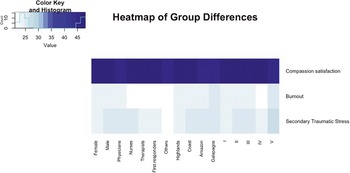
Table 2 shows results by gender. On average, both male and female participants had high compassion satisfaction and moderate level of burnout and secondary traumatic stress according to Stamm’s ProQOL categorical classification. There was no statistical difference for CS and STS scales based on the gender of the participants. Regarding the BO scale, there were significant differences by gender (P = 0.003) Male health providers (mean of 24) tended to have higher levels of burnout when compared to female providers (mean of 23.4). The mean differences across gender, professional role, region, and health care facility level are visually represented in the heatmap provided as Figure 2, illustrating comparative patterns among these groups.
Comparison of subscales among gender, professional role, region, and health care facility level in Ecuador during the COVID-19 pandemic

IQR: Interquartile Range.
Heatmap of median differences by groups across subscales.

The second analysis examined differences in CS, STS, and BO by regions (Table 2). Based upon Stamm’s PROQOL categorical classification, all regions had high compassion satisfaction, moderate level of burnout, and secondary traumatic stress on average. Both the Highland and Coast regions showed higher CS scores (median 47) compared to the Amazon and Galápagos (median 46). The results demonstrated statistical difference throughout the CS subscale. Based on Dunn’s test (Appendix 1) for the CS subscale (P < 0.001), there were significant differences comparing Coast and Highlands regions (P < 0.001). The Coast had a higher level of CS when compared with the Amazon (P < 0.001). No other significant differences were found between regions.
Next, we examined whether CS, STS, and BO differed by health care professional role. Overall, profession was associated with CS, STS, and BO (P < 0.001; Table 2). Pairwise comparison suggests that physicians scored the lowest in CS compared to all other groups (median rank of 46) in contrast to nurses (P < 0.001), first responders (P < 0.001), and physical/respiratory therapists (P < 0.001), all with mean ranks of 47. No difference was found between physicians and the “other” professions category for CS subscale results. For the BO subscale, an opposite trend was observed. A significant difference was found (P < 0.001) in which physicians were noted to sustain the highest burnout rate (median 24) in contrast to nurses (P < 0.001), first responders (P < 0.001), physical and respiratory therapists (P < 0.001), and others (P = 0.01), each with a median 22 points (Appendix 2). Lastly, for the STS subscale, physicians experienced a higher median when compared to first responders and technicians (P < 0.001 and P = 0.005, both with a median 23), as well as “other” professions (P < 0.0014, median of 21). Nursing staff also present higher STS levels when compared to first responders (P = 0.004) and other health care providers (P < 0.001) (Appendix 2). Table 3 illustrates the ProQOL categorical classifications for CS, BO, and STS per professional role.
Categorical classification of compassion satisfaction, burnout and secondary traumatic stress by health care professional role based on Stamm’s ProQOL

Last, CS, STS, and BO was associated with health care facility level (P < 0.05). Pairwise comparisons suggest that pre-hospital care institutions have higher CS (median 48) compared to the “other” category of institutions (e.g., university hospitals [median 45, P = 0.01]). Among the rest of health institution types, no difference was found for the compassion satisfaction subscale. When analyzing BO subscale scores, there were significant differences comparing Level III institutions vs Level IV (P = 0.05, median 24 and 21, respectively) and Level IV with Level V (P = 0.03, median 24 and 26, respectively [Appendix 3]). Finally, for the STS subscale, health care providers from both the Level II and Level III institutions (median 25) have higher STS than at the Level I institutions (median 23; P < 0.001 and P = 0.004, respectively). No difference was found among the other health care facility levels.
Discussion
In LMICs, health care providers face significant challenges due to resource scarcity, high workloads, and limited access to mental health support. Our study assessed compassion satisfaction, compassionate fatigue, and burnout in health care providers from a wide cross-section of public health care institutions in Ecuador, an LMIC, during the COVID-19 pandemic. As measured by the subscales of the ProQOL V-5, we expected to find moderate levels of compassion satisfaction and burnout, as well as high secondary traumatic stress among all health care providers, especially among physicians and nurses. Because the Coastal region of Ecuador was the earliest and most severely affected region at the onset of the COVID-19 pandemic, we hypothesized higher burnout scores from this area. We expected high BO and moderate CS through all levels, and higher STS in Level II and III institutions when compared to Level I institutions. In addition, we anticipated a negative correlation between CS and both BO and STS scores.
Our findings demonstrated high compassion satisfaction among the target population. Most participants were found to enjoy their job and were satisfied with their day-to-day tasks or environment. The high overall level of compassion satisfaction may reflect that health care providers in Ecuador were positively reinforced by their work. However, we found moderate burnout and secondary traumatic stress. Participants with moderate burnout may either shift to low or high burnout with time. Thus, interventions and actions taken by both individuals and institutions are pivotal in protecting against or mitigating progression of burnout. These substantive overall levels of burnout are in keeping with prior research of health care providers in LMIC settings.Reference Hossain and Khatun9
Likewise, 62.4% of participants reported moderate or high levels of secondary traumatic stress. Because all participants worked during the COVID-19 pandemic, many would have faced primary in addition to secondary exposure to traumatic events. Other scales (Perceived Stress Scale,Reference Harris, Gaffey and Schwartz13 Secondary Traumatic Stress Scale,Reference Bride, Robinson and Yegidis14 Maslach Burnout Inventory Human Service Survey,15 14-Item Resilience Scale,Reference Zelviene, Jovarauskaite and Truskauskaite-Kuneviciene16 General Self-Efficacy Scale,Reference Schwarzer, Jerusalem, Weinman, Wright and Johnston17 etc.) have similarly demonstrated increased secondary traumatization in health care providers due to the constant direct exposure to the patients’ “physical pain, psychological suffering, and death”Reference Orrù, Marzetti and Conversano18 during the COVID-19 pandemic.
Considering that the compassion satisfaction (CS) subscale is the positive consequence of helping behavior, whereas burnout (B) subscale and Secondary Traumatic Stress (STS) subscale have a negative connotation related to emotional distress, a negative correlation was hypothesized between CS vs B and CS vs STS. Multiple studies have analyzed these relationships in different regions and countries such as Saudi Arabia,Reference Rayani, Hannan and Alreshidi19 US,Reference Hooper, Craig and Janvrin20 South Africa,Reference Wentzel and Brysiewicz21 Brazil,Reference Violim Fabri, Trevisan Martins and Quina Galdino22 Panama,23 among others. As in these studies, a negative correlation between compassion satisfaction and both burnout and secondary traumatic stress was demonstrated.
While there were no significant differences in CS and STS levels based on gender, males tended to experience higher levels of burnout. This absence of statistically significant differences in CS and STS are consistent with broader trends observed in practice-based evidence, which show that gender does not significantly influence these scales.3 The higher levels of burnout among male health providers may reflect societal expectations and gender roles.Reference Linzer and Harwood24 These results highlight the importance of addressing gender-specific factors in the workplace to better support the mental health and well-being of all health providers.
Contrary to our expectations, the results of the geographic analysis demonstrated that health care providers in the Coastal region of Ecuador evidenced the lowest burnout scores. The higher levels of compassion satisfaction and lower levels of burnout observed in the Coastal region may be related to factors that promote resilience, such as comparatively better access to resources and a more supportive work environment.Reference Gelaw, Hanoch and Adini25 The higher burnout level in the Amazon regions may be attributed to factors such as workload, lack of control, insufficient rewards, and community breakdown.Reference Maslach and Leiter26 Nevertheless, it is important to note that these findings are not conclusive, and further research is needed to fully understand the reasons behind the observed regional differences in burnout and compassion satisfaction. Additional factors, such as individual characteristics, organizational culture, and social support, may also play a role in determining these outcomes. Thus, efforts to tackle the collective characteristics of a region in policy are highly encouraged. Opportunities such as community-based peer support, mental health training, rotation on crisis areas, and local institutional support systems could be explored based on each region’s needs.
When analyzing scores for the subscale CS by health profession, physicians had statistically significant lower scores when compared to nurses, respiratory therapists, and first responders, as well as higher burnout scores compared to all groups. It has been documented that physicians tend to have higher burnout rates when compared to other health care professions.Reference Valdes-Elizondo, Álvarez-Maldonado and Ocampo-Ocampo27, Reference Papazian, Hraiech and Loundou28, Reference Ayaslıer, Albayrak and Çelik29 Studies have demonstrated in similar settings that physicians have faced higher levels of depersonalization and reduced personal accomplishment at a personal level, while facing unequal distribution of workload and communication problems within health care settings when compared to nurses.Reference Ayaslıer, Albayrak and Çelik29 In Ecuador, physicians face multiple stressors that could be contributors to low CS and higher burnout, such as shortages of medical supplies, need of better medico-legal protection,Reference Patiño, Cantillo-Campos and Kearney30 and violence against health staff, which can hinder patient-doctor relationships and contribute to reduced compassion satisfaction.Reference Cobo31 These factors, in addition to the intense strain that was experienced due to COVID-19 with high patient volumes, limited resources, and increased workload,32 resulted in higher burnout, emotional exhaustion, depersonalization, and low sense of personal achievement compared with nurses.Reference Ramírez, Ontaneda and Jiménez33 Studies have also demonstrated that physicians in Ecuador have higher burnout rates associated with longer work experience, longer working hours, and higher patient loads when compared to nurses;Reference Ramírez34 furthermore, there is a lack of specialty training for many physicians.Reference Torres Toala and Irigoyen Piñeiros35
Results from our study demonstrated that all groups faced significantly different secondary traumatic stress levels when compared to each other. Physicians and nurses had the highest median of STS in comparison to all other groups. Both physicians and nurses have more prolonged and intense interactions with patients. In addition, they are tasked with making more critical decisions as well as managing complex cases compared to other health care professions. This was particularly relevant during the COVID-19 pandemic. Therapists, first responders, and other health professions usually operate in less intense settings and have a more limited engagement with patients, which may result in a lower emotional burden as compared to physicians and nurses.Reference Ogińska-Bulik, Gurowiec and Michalska36 Nevertheless, these differences are worth exploring further to reveal determinants for such gaps in Ecuador. Likewise, it demonstrates that support interventions should be tailored to each role and their specific needs, as mental strains and impact varies depending on their exposure and intensity. Although health care-related professionals include first-line workers, as in this study, the category also may include administrative personnel that should be further investigated to create different strategies targeting their needs as well. Considerations may include flexible scheduling, peer support groups, mental health coverage, mandatory breaks, emotional debrief sessions, on-site relaxation spaces, crisis intervention training, rotational staffing, and supervision programs, among others.
With respect to facility type, no difference was observed regarding compassion satisfaction and burnout. Compassion satisfaction may be influenced more by individual and contextual factors in Ecuador, rather than by institutional hierarchy; personal resilience and coping strategies may feature more importantly.Reference Davalos-Batallas, Vargas-Martínez and Bonilla-Sierra37 Similarly, burnout has been demonstrated to be more influenced by systemic issues within the health care system itself rather than characteristics attributed specifically to individual institutions.Reference Kléber, Jaramillo and Freire-Palacios38 Lack of resources and support systems and other shared challenges faced by health care providers in Ecuador exacerbate burnout and levels of compassion satisfaction uniformly within different settings and levels of care.Reference Schroeder, Kelly and Leighton39
For secondary traumatic stress, differences among health care providers at Level I, Level II, and Level III health care institutions were seen. Both Level II and Level III facilities had a higher median of STS than Level I institutions. This could be explained by the cases that are typically presented to each type of institution. Level I are usually primary care centers that focus on outpatient treatment or ambulatory care - providing the initial management of patients and redirecting them for definitive treatment to a Level II or Level III health care institution. Accordingly, Level II and Level III institution health care providers routinely treat higher acuity patients with greater emotional burdens and an increased risk of STS.Reference Reyes Valenzuela, Martos-Méndez and Blanco Abarca40 In Ecuador, given the social and cultural context, lack of adequate support systems for health care providers exacerbate STS, especially for those who work in intensive trauma care,Reference Reyes Valenzuela, Martos-Méndez and Blanco Abarca40 which tracks with higher institutional levels of care.Reference Herzog, D’Andrea and DePierro41 Not only is individual and collective context relevant, there are no current national or institutional frameworks or policies that oversee mental health prevention and management for health professionals. Notably, most LMICs do not have such policies, whereas HICs, such as the UK or countries in the European Union, have implemented national legislation on occupational health and safety for the health workforce that encompasses their mental health.
Limitations
Several limitations of this study should be noted. The revised Stamm’s ProQOL V-5 questionnaire has been widely used as a screening tool; however, it is not intended to identify individual causative factors. While the Spanish version of the tool has been previously validated in other Spanish speaking countries, to our knowledge, it has not been employed or validated in Ecuador and, thus, may not account for cultural differences of this setting. Finally, cut scores provided by the tool potentially tend to Type 1 error,3 rendering borderline scores, despite categorical assignments as low, moderate, or high, challenging to interpret.
Conclusions
In the face of an ever-broadening array of emergent public health threats and amidst risk of future pandemics, the findings from this study add timely insights - and point toward further research - into more granular understandings of health care providers’ burnout and related considerations in low- and middle-income countries (LMICs), such as Ecuador. Systematic literature review- and meta-analysis-based findings, to date, have pointed to substantial burnout prevalence among primary health care providers in LMICs that can imperil effective health care delivery, including but not limited to the Americas.Reference Ouyan and Fitzpatrick8 Insights from our study suggest that burnout among health care providers in each LMIC requires nuanced examination of intra-country regional and health care role differences in burnout patterns.
The findings of this study underscore the importance of utilizing the Professional Quality of Life Scale (ProQOL) in a continuous format to effectively identify both protective and risk factors associated with burnout among health care providers in an LMIC context. It is recommended that the health care institutions involved in this research continue to employ this screening tool with the same sample in future assessments. This longitudinal approach will facilitate a deeper understanding of the specific needs of each institution, enabling tailored strategies aimed at preventing health workforce burnout and enhancing mental health priorities. While the ProQOL serves as a valuable screening instrument rather than a diagnostic test, it is hoped that participants will leverage their results to gain awareness of potential protective and risk factors, prompting further exploration of any concerning flags with qualified health providers. Furthermore, these results denote the need of nationwide health care policies that target mental health prevention and management in health care professionals in Ecuador, while tailoring specific regional and professional role demands for more effective implementation. Similarly, institutional support systems may be tailored to enhance prevention targeted to different needs, as well as interventions on specific requirement areas according to ProQOL outcomes, demonstrating opportunities for prevention.
In the same way, it is highly encouraged for LMICs to conduct research to understand their local context to support legislative design for tailored needs. Although the current study has revealed significant differences in compassion satisfaction, burnout, and secondary traumatic stress levels among health care providers in Ecuador, further research is essential to elucidate the underlying reasons for these variations and enhance our understanding of the complexities surrounding professional quality of life in this context.
Supplementary material
The supplementary material for this article can be found at http://doi.org/10.1017/dmp.2025.114.
Acknowledgements
A special acknowledgment is extended to the Ecuadorian Ministry of Public Health (MOPH) for their continuous support, collaborative efforts, and ongoing partnership to conduct this study.
Author contribution
MJJC was responsible for data collection, analysis, and interpretation of data, and drafting the manuscript; AM was responsible for data analysis and interpretation and drafting the manuscript; NI was responsible for reviewing the manuscript; DJB was responsible for critical revision of the manuscript; EBH was responsible for critical revision of the manuscript; MG was responsible for conception and design of the study, interpretation of data, and drafting and critical revision of the manuscript.
Competing interests
All authors declare that they have no competing interests.




 Open access

