Introduction
Host specialization of insect populations to particular plant species results in the formation of subspecific groupings such as biotypes (Diehl & Bush, Reference Diehl and Bush1984). Biotypes that are adapted to one host may become maladapted to others, encouraging host fidelity and assortative mating, which may result in the formation of host races (Diehl & Bush, Reference Diehl and Bush1984). Host races are genetically differentiated, sympatric populations of insects that use different hosts, and between which there may be gene flow (Drès & Mallet, Reference Drès and Mallet2002). Host races, therefore, may be important intermediate forms in the speciation process and have been observed in many insect groups (Diehl & Bush, Reference Diehl and Bush1984; Berlocher & Feder, Reference Berlocher and Feder2002; Drès & Mallet, Reference Drès and Mallet2002). Among other characteristics, host races differ from biotypes by being partially reproductively isolated (Diehl & Bush, Reference Diehl and Bush1984). For host-adapted insect biotypes or races, reproductive compatibility or isolation can be evaluated using crossing experiments, the outcome of which may indicate the level of genetic variation between them. This information may be useful for weed control programmes that plan to use different insect biotypes or strains as biocontrol agents (Hopper et al., Reference Hopper, Roush and Powell1993).
The processes of hybridization are unpredictable and there may be differences in reproductive compatibility between genotypes, such as asymmetrical cross breeding (Hoffmann, Reference Hoffmann, Cullen, Briese, Kriticos, Lonsdale, Morin and Scott2004) or non-reciprocal cross-incompatibility (Wu et al., Reference Wu, Hopper, Neil, Voegtlin, Prokrym and Heimpel2004). The fitness of hybrids will depend on the genetic distances between their parents (Lynch, Reference Lynch1991; Edmands, Reference Edmands2002). Hybridization can result in outbreeding enhancement, whereby F1 hybrid offspring experience enhanced vigour in their fitness due to dominance, masking of deleterious alleles or epistasis (Lynch, Reference Lynch1991). Conversely, there may be outbreeding depression due to the disruption of coadapted gene complexes (Lynch, Reference Lynch1991; Burton et al., Reference Burton, Rawson and Edmands1999), under-dominance and epistatic interactions (Aspi, Reference Aspi2000; Turelli & Orr, Reference Turelli and Orr2000). Outbreeding depression may be expressed in terms of reduced performance in fitness-related traits such as survival, developmental time, viability and fecundity of hybrids compared to parental lines (Blows, Reference Blows1993; Stouthamer et al., Reference Stouthamer, Luck, Pinto, Platner and Stephens1996; Edmands, Reference Edmands2002; Gilk et al., Reference Gilk, Wang, Hoover, Smoker, Taylor, Gray and Gharrett2004). Extreme expressions of outbreeding depression include hybrid infertility, inviability or lethality, which are often seen in crosses between species due to between-locus incompatibility (Lynch & Walsh, Reference Lynch and Walsh2000). Hybridization may also result in incompatibility that is extrinsically induced, e.g. environmental conditions may influence the hybrid so that it is less fit than either of its parents in a particular environment (Rundle & Whitlock, Reference Rundle and Whitlock2001).
The host specificity of hybrid lines is varied and depends on whether the parental lines are highly adapted or maladapted to their hosts (Edmands, Reference Edmands2002; Spitzer, Reference Spitzer2006). Consequently, the interbreeding of genotypes may result in hybrids that interact differently with the parental hosts. For example, hybrids may have: (i) greater host specificity towards one or the other parental hosts due to dominance of certain genes (Craig et al., Reference Craig, Horner and Itami2001) or due to maternal effects (Dambroski et al., Reference Dambroski, Linn, Berlocher, Forbes, Roelofs and Feder2005); (ii) host specificity equal to that of parents due to a lack of dominance (Fry, Reference Fry1999); (iii) host specificity intermediate to both parents (Nitao et al., Reference Nitao, Ayres, Lederhouse and Scriber1991) due to additive effects (Caroll et al., Reference Carroll, Dingle, Famula and Fox2001); or (iv) a loss of host specificity compared to host-specific parents (Hoffmann et al., Reference Hoffmann, Impson and Volchansky2002). Studying these effects is necessary to gain an understanding of the genetics of insects selected as biological control agents and in anticipating their effectiveness in controlling their target pests (Hopper et al., Reference Hopper, Roush and Powell1993).
Biological control programmes have sometimes favoured the use of multiple, rather than single, strains of an insect species to increase diversity and the likelihood of establishment and effectiveness of the agents (Clarke & Walter, Reference Clarke and Walter1995). However, caution needs to be exercised when introducing new strains or geographic provenances due to the existence of sub-specific genetic diversity among insects that exhibit differential host specificity (Sheppard et al., Reference Sheppard, Heard, Briese, Jacob and Briese2003). Therefore, the status of, and biological differences between, morphologically identical biotypes or strains should be determined before the introduction of new biological control agents. Ignoring the existence of sub-specific host adaptation increases the risk of inducing hybrids that are poorly adapted to the target weed (Hopper et al., Reference Hopper, Roush and Powell1993). In particular, investigating the effect of hybridization between biotypes on the fitness and host specificity of hybrid offspring is an important step in biological control programmes in which more than one biotype is to be used (Hopper et al., Reference Hopper, Roush and Powell1993).
Dactylopius tomentosus (Lamarck) (Hemiptera: Dactylopiidae) is restricted in its host range to various species in the genus Cylindropuntia and has great potential for the biological control of invasive species in this genus (Mathenge et al., Reference Mathenge, Holford, Hoffmann, Zimmermann, Spooner-Hart and Beattie2009b). The biology of this insect has recently been described (Mathenge et al., Reference Mathenge, Holford, Hoffmann, Spooner-Hart, Beattie and Zimmermann2009a), and the existence of host-adapted biotypes of D. tomentosus with strong host affiliations to different Cylindropuntia hosts has been demonstrated (Mathenge et al., Reference Mathenge, Holford, Hoffmann, Zimmermann, Spooner-Hart and Beattie2009c). The identification of biotypes has unraveled the mystery behind the inconsistent performance of attempts to biologically control different Cylindropuntia species using D. tomentosus (Mathenge et al., Reference Mathenge, Holford, Hoffmann, Zimmermann, Spooner-Hart and Beattie2009b). Although the distinct entities within D. tomentosus have been afforded the status of biotypes, the extent of their genetic differentiation is not yet known; and there may be host races or even cryptic or sibling species in the mix.
In South Africa, two highly invasive cactus weeds, namely, Cylindropuntia fulgida (Engelmann) F.M. Knuth var. fulgida (Engelmann) F.M. Knuth and C. imbricata (DC.) F.M. Knuth, occur in sympatry in parts of their range (Henderson, Reference Henderson2001). In attempts to control the weeds, two D. tomentosus biotypes, designated Cholla and Imbricata (after the specific epithets of the plant species from which they originated) have been found to be well adapted to development on C. f. var. fulgida and C. imbricata, respectively, and are, therefore, the most suitable biocontrol control agents against each of these weed species (Mathenge et al., Reference Mathenge, Holford, Hoffmann, Zimmermann, Spooner-Hart and Beattie2009b). The Imbricata biotype, which was released 39 years ago in South Africa and effectively controlled C. imbricata, has had no impact on C. f. var. fulgida (Moran & Zimmermann, Reference Moran and Zimmermann1991). Therefore, introduction of the Cholla biotype has been initiated for biological control of C. f. var. fulgida. Where the two weed species occur in sympatry, the Cholla and Imbricata biotypes will coexist, creating an opportunity for hybridization, with possible implications for biological control of both weed species. Four possible scenarios are envisaged in which the biotypes may: (i) remain reproductively isolated and control each of their target weed species (Cholla on C. f. var. fulgida and Imbricata on C. imbricata); (ii) interbreed freely but produce offspring with limited vigour and/or host specificity (e.g. Hoffmann et al., Reference Hoffmann, Impson and Volchansky2002); (iii) interbreed asymmetrically causing dominance of one or other genotype (Hoffmann, Reference Hoffmann, Cullen, Briese, Kriticos, Lonsdale, Morin and Scott2004); or (iv) interbreed freely, producing offspring that are highly host specific to one or other of the weed species.
The current study involved reciprocal crosses of the Cholla and Imbricata biotypes to determine whether they are reproductively compatible. Once it had been demonstrated that the two biotypes interbred freely and produced viable offspring, efforts were made to evaluate the effect of hybridization on the fitness and host specificity of the hybrids compared to the parental lineages on C. f. var. fulgida and C. imbricata.
Materials and methods
Source of plants and insects, and their nomenclature
The Cholla biotype was obtained from C. cholla (F.A.C. Weber) F.M. Knuth from near La Paz in Baja California Sur, Mexico. Imbricata was obtained from C. imbricata from Gauteng Province, South Africa. This biotype originated from C. imbricata in Texas from where it was first introduced to Australia in 1925 and, thence, to South Africa in 1970 (Moran & Zimmermann, Reference Moran and Zimmermann1991; Julien & Griffiths, Reference Julien and Griffiths1998). These cultures were reared and maintained in the quarantine laboratory of the Weeds Division, PPRI, ARC, South Africa, as described in Mathenge et al. (Reference Mathenge, Holford, Hoffmann, Zimmermann, Spooner-Hart and Beattie2009b). The two test cactus species, C. imbricata and C. f. var. fulgida (hereafter C. fulgida), were sourced from Gauteng Province and were identified by taxonomists from the National Botanical Institute, Pretoria. Throughout this paper, insect biotypes are shown in emboldened text; the genome from the Imbricata biotype is signified by Ib and the genome from Cholla by Ch. In each hybrid cross, the first couplet represents the origin of the maternal genome, whereas the second couplet represents the paternal genome, e.g. IbCh is the hybrid from an Imbricata female and a Cholla male. The term, ‘preferred host’, denotes either the host plant from which a particular insect biotype originated or one which is known to be a suitable host for the biotype. The term ‘alternative host’ relates to the other host plant species used in the tests.
Cross breeding experiments
Thirty, one-day-old Imbricata crawlers were placed on each of four cladodes of C. imbricata, and the same number of Cholla crawlers was placed on each of four cladodes of C. fulgida. Each cladode was in a separate cage. After pupation of the males, all females were removed from two cladodes of each experimental group leaving only males. On the remaining two cladodes of each group, all males were removed leaving only females. Hybrid lines were then produced by pairing a cladode containing Cholla females with a cladode containing Imbricata males: reciprocal crosses, Cholla males with Imbricata females, were also made. In control treatments, males and females of the same biotype, Cholla males with Cholla females and Imbricata males with Imbricata females, were reared together in separate cages to produce pure lineage offspring. Insects within each cage were allowed to mate freely to produce F1 generations. All four types of crosses are, hereafter, referred to as lineages.
Host specificity tests
Host specificity tests, using the hybrid F1 generations resulting from the crosses detailed above and the pure lineages, were conducted on both C. fulgida and C. imbricata using the methods described in Mathenge et al. (Reference Mathenge, Holford, Hoffmann, Zimmermann, Spooner-Hart and Beattie2009b). The survival and development time to first moult of 30 crawlers (composed of variable proportions of males and females) from three replicates per lineage were assessed, as was the development time, mass and fecundity of the females. From these data, a fitness index (FI) was calculated and used to assess the potential rate of population increase of hybrid and pure lineages as follows:

where S is the proportion of individuals surviving to second instar, P is fecundity (the mean number of progeny per female) and T is mean developmental time from hatching to maturity of females.
Statistical analysis
Data were assessed for homogeneity of variance using Levene's test. Heteroscedastic data were transformed using square root or log transformations. The number of moulting crawlers, developmental time of crawlers, and female fecundity, mass and developmental time were then analysed using two-way or factorial analysis of variance (ANOVA) (Statistica 6.1, Statsoft Inc.). In the latter analyses, host and lineage (F1 generation of pure lineages or hybrids) were used as the main factors. Interactions significant at P<0.05 were further analyzed separately for each lineage per host plant species. Means of all lineages per trait were then separated using Tukey's HSD test calculated from the one-way ANOVA (Statistica 6.1, Statsoft Inc.). Pearson product moment correlation was used to assess the relationship between female mass, fecundity and developmental time for each hybrid and pure line offspring per host species.
Results
Cross breeding
The production of offspring from reciprocal crosses and the resulting F1 generations revealed that the Cholla and Imbricata biotypes were able to interbreed freely and reciprocally in the laboratory.
Host specificity of hybrid and pure lineage F1 offspring
Crawler development
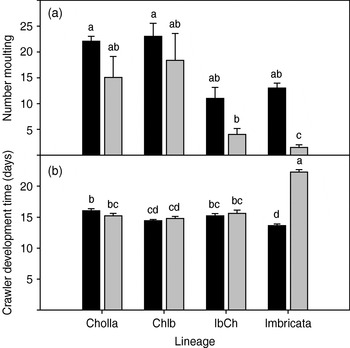
There was an interaction between lineage (hybrid or pure) and host in the mean number of crawlers undergoing first moult (F=3.75; df=3, 4; P=0.03). Overall, for any lineage, more crawlers survived to the first moult on C. imbricata than on C. fulgida (fig. 1a). Also, the mean number of crawlers moulting differed significantly between lineages on each host (C. fulgida: F=10.25; df=3, 7; P<0.05; C. imbricata: F=8.18; df=3, 7; P<0.05). There was a trend for more crawlers containing the Ch genome from their maternal parent to moult than those receiving the Ib genome from their maternal parent and for more crawlers to moult on C. imbricata than on C. fulgida. Few Imbricata crawlers survived to first moult on C. fulgida.
(a) Mean number of crawlers moulting and (b) mean crawler development time of pure lines (Cholla and Imbricata) and hybrid (ChIb and IbCh) offspring from crosses of the Cholla and Imbricata biotypes. For the hybrids, the first couplet represents the genome from the maternal parent, and the second couplet represents the genome from the paternal parent. The offspring were reared on C. fulgida and C. imbricata. Error bars bearing the same letter do not differ significantly at P=0.05 according to Tukey's HSD test (▪, C. imbricata;  , C. fulgida var. fulgida).

There was also a significant interaction between lineage and host in the mean developmental time of first instar crawlers (F=18.43; df=3, 301; P<0.05). Mean developmental time also differed significantly between lineages on each host species (C. fulgida: F=9.69; df=3, 111; P<0.05; C. imbricata: F=17.12; df=3, 190; P<0.05) (fig. 1b). Although there were statistically significant differences between means, the largest difference was between Imbricata and the rest of the lineages (fig. 1b). On C. imbricata, the Imbricata individuals that survived to first moult reached this development stage sooner than all other lineages; whilst, on C. fulgida, surviving Imbricata insects took significantly longer to reach this stage.
Female development and fecundity
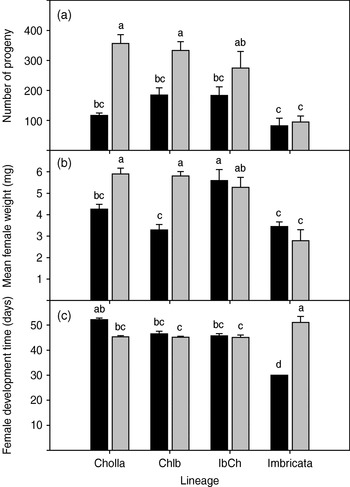
There was a significant interaction between lineage and host in the mean number of progeny produced by females (F=2.98; df=3, 199; P=0.03), and there were significant differences between F1 generations of both hybrid and pure lineages in their mean progeny (C. fulgida: F=4.18; df=3, 92; P<0.05; C. imbricata: F=3.90; df=3, 107; P<0.05). For most lineages, there was a trend for more progeny to be produced on C. fulgida than on C. imbricata (fig. 2a). The exception was Imbricata, where there was no difference between its natal host (C. imbricata) and C. fulgida.
(a) Mean number of progeny per female, (b) mean female mass and (c) mean female developmental time of pure lines (Cholla and Imbricata) and hybrid (ChIb and IbCh) offspring from crosses of the Cholla and Imbricata biotypes. For the hybrids, the first couplet represents the genome from the maternal parent, and the second couplet represents the genome from the paternal parent. The offspring were reared on C. fulgida and C. imbricata. Error bars bearing the same letter do not differ significantly at P=0.05 according to Tukey's HSD test (▪, C. imbricata; , C. fulgida var. fulgida).

Interactions between lineage and host were also found in mean female mass (F=10.89; df=3, 199; P=0.05) and differed significantly between lineages reared on the two host species (C. fulgida: F=7.92; df=3, 92; P<0.05; C. imbricata: F=9.01; df=3, 107; P<0.05) (fig. 2b). On C. fulgida, Imbricata females were significantly lighter than the other lineages. On C. imbricata, hybrid IbCh females had a higher mean mass than other lineages. The mean masses of Cholla and hybrid ChIb females were both significantly higher on C. fulgida than on C. imbricata. In contrast, the mean masses of the IbCh and Imbricata females were similar on the two hosts.
Interactions between lineage and host were again found in mean female developmental time (F=55.23; df=3, 199; P=0.05). The mean developmental time of the females differed significantly among lineages and also between hosts (C. fulgida, F=5.80; df=3, 92; P<0.05; C. imbricata, F=103.53; df=3, 107; P<0.05) (fig. 2c). The pattern in the female development time was similar to that of the crawlers, with Imbricata differing from the other hybrid lineages on C. imbricata.
Fitness index
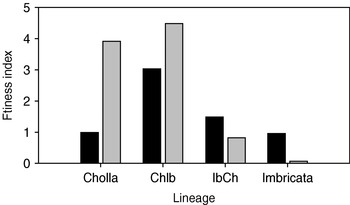
The fitness index demonstrated varying potential levels of population growth for the different lineages depending on the host (fig. 3). The Cholla lineage had a higher fitness index on C. fulgida than C. imbricata; whilst, in contrast, the fitness index of Imbricata was greater on C. imbricata than C. fulgida. The fitness index of the hybrids more closely resembled that of their maternal than their paternal parent. For example, the ChIb had a greater index on C. fulgida than on C. imbricata. Also, the hybrids had much greater fitness indices on the alternative host of their maternal parents compared to the pure lineages reared on their alternative host. Thus, there was a three-fold increase in the fitness index when ChIb was reared on C. imbricata compared to Cholla on C. imbricata and a 16-fold increase between IbCh on C. fulgida compared to Imbricata on C. fulgida. There were also small increases in the fitness indices of the hybrids on the preferred host lines of their maternal parents compared to the pure lineages (1.2-fold and 1.6-fold for ChIb and IbCh, respectively). Finally, the ChIb hybrid had larger fitness indices on the two cactus species compared to the IbCh hybrid.
Fitness index of pure lines (Cholla and Imbricata) and hybrid (ChIb and IbCh) offspring from crosses of the Cholla and Imbricata biotypes. For the hybrids, the first couplet represents the genome from the maternal parent, and the second couplet represents the genome from the paternal parent. The offspring were reared on C. fulgida and C. imbricata (▪, C. imbricata; , C. fulgida var. fulgida).

Correlation between female traits
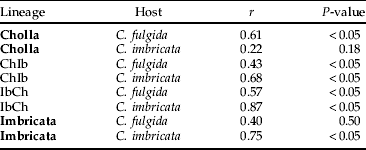
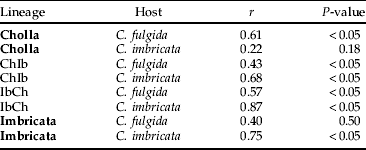
For most lineages and host combinations, there was a positive relationship between female mass and number of progeny, as evidenced by the correlation coefficients (r) (table 1). The exceptions to this were Cholla on C. imbricata and Imbricata on C. fulgida, where there was no relationship between mass and number of progeny. For most lineages, the magnitude of r was greater on the preferred host of the maternal parent than on the alternative host. The exception to this was ChIb hybrid, where the relationship was stronger on the alternative host of the maternal parent.
Correlation coefficients, r, representing the relationship between female mass and number of progeny and P-values for each lineage per host species.
Discussion
Adaptation to host plants plays a role in the evolution of reproductive isolation in some insects (Diehl & Bush, Reference Diehl and Bush1984) but not in others (Fry, Reference Fry1999). In this study, we investigated whether biotypes of D. tomentosus could interbreed successfully, and we evaluated the effect of hybridization on the fitness and host specificity of hybrid offspring. We showed that the two biotypes of D. tomentosus are reproductively compatible and that they hybridized under laboratory conditions, with reciprocal crosses producing viable offspring. It should be noted that the offspring arising from the crosses between the different biotypes were hybrids, as D. tomentosus does not reproduce parthenogenetically (Mathenge et al., Reference Mathenge, Holford, Hoffmann, Spooner-Hart, Beattie and Zimmermann2009a). Reciprocal crosses of biotypes of D. opuntiae also produced viable offspring (Volchansky et al., Reference Volchansky, Hoffmann and Zimmermann1999). This may imply that biotypes of Dactylopius species may not have developed sufficient behavioural, physiological or genetic changes during their prolonged association with their respective hosts to cause reproductive isolation and should be regarded as biotypes rather than as races.
Usually, when conspecific populations experience restricted gene-flow, they would be expected to differentiate genetically through mutation, natural selection and genetic drift and become adapted to their local environment (Burton et al., Reference Burton, Rawson and Edmands1999). Hybridization between such populations may result in F1 hybrids with either increased fitness (hybrid vigour) or reduced fitness (hybrid breakdown) relative to their parents (Edmands, Reference Edmands2002). Whereas hybrid vigour is more common in F1 generations, hybrid breakdown has also been reported in the form of reduced fitness in early life history traits, such as hatching rates, larval survival, developmental time and pupation rate (Blows, Reference Blows1993; Peer & Taborsky, Reference Peer and Taborsky2005) as well as in lower adult survival (Gilk et al., Reference Gilk, Wang, Hoover, Smoker, Taylor, Gray and Gharrett2004) and reduced fecundity (Templeton, Reference Templeton and Soulé1986; Wu et al., Reference Wu, Hopper, Neil, Voegtlin, Prokrym and Heimpel2004). In this study, the F1 hybrids of the two D. tomentosus biotypes showed no sign of hybrid breakdown when reared on C. fulgida and C. imbricata, instead exhibiting hybrid vigour. The biotypes of D. tomentosus, identified in our studies, are likely to have some degree of inbreeding as: (i) cochineal insects have limited mobility – females are sedentary and males tend to mate locally (Mathenge, personal observation), as has been found for other scales (Alstad & Edmunds, Reference Alstad and Edmunds1983); and (ii) D. tomentosus has overlapping generations (Mathenge et al., Reference Mathenge, Holford, Hoffmann, Spooner-Hart, Beattie and Zimmermann2009a), which allows intergenerational matings, thus increasing the chance of inbreeding (Cook, Reference Cook2001; Cook & Rowell, Reference Cook and Rowell2007). Therefore, the improved performance of the F1 hybrids in our study may have been caused by a release from negative effects of inbreeding (Burton et al., Reference Burton, Rawson and Edmands1999).
Where hosts occur in sympatry, the degree of allochronic isolation between the hybrid and pure lineages may influence gene flow between the biotypes (Scriber & Ording, Reference Scriber and Ording2005). Allochronic isolation is dependent on the climate and host genotypes, as these influence when moulting and the onset of reproduction occur (Itami et al., Reference Itami, Craig, Horner, Mopper and Strauss1998). The Cholla and Imbricata biotypes are unlikely to become allochronically isolated for two reasons. Firstly, the ranges of developmental times of the crawler and the adult female stages of both biotypes overlap, and their mean developmental time is not significantly different. Secondly, D. tomentosus has several overlapping generations per year (Mathenge et al., Reference Mathenge, Holford, Hoffmann, Spooner-Hart, Beattie and Zimmermann2009a). Hence, consistent mixing and cross-breeding between biotypes is inevitable in areas where weed species occur in sympatry.
There was no evidence of reproductive isolation, hybrid inviability or hybrid breakdown when the Cholla and Imbricata biotypes were crossed. This implies that there is free gene flow between the biotypes. However, gene flow is likely to be more prevalent from Cholla towards Imbricata because the ChIb genotype has higher fitness than IbCh on both C. fulgida and C. imbricata. The comparatively lower fitness of IbCh hybrids would reduce gene flow in the reverse direction, resulting in asymmetric hybridization similar to that demonstrated for D. opuntiae by Hoffmann (Reference Hoffmann, Cullen, Briese, Kriticos, Lonsdale, Morin and Scott2004). The genetic differentiation among D. tomentosus biotypes has not yet been studied, and the genetic distance between the Cholla and Imbricata biotypes is not known. If these two biotypes are genetically closer than other biotypes, it can be expected that hybridization and interactions among the rest of the biotypes (Mathenge et al., Reference Mathenge, Holford, Hoffmann, Zimmermann, Spooner-Hart and Beattie2009b) may result in different levels of heterosis and/or in hybrid breakdown.
Traits can be expressed differently in different hybrids (Carroll et al., Reference Carroll, Dingle, Famula and Fox2001), and hybrid offspring may exhibit improved fitness in particular traits and reductions in others (Aspi, Reference Aspi2000; Gilk et al., Reference Gilk, Wang, Hoover, Smoker, Taylor, Gray and Gharrett2004). Various levels of hybrid vigour were found in the F1 offspring of the D. tomentosus biotypes. When individual crawler and adult female traits were compared, the ChIb hybrid did not show vigour over Cholla but did over Imbricata and was superior to the IbCh hybrid. The IbCh hybrid showed vigour over Imbricata but not over Cholla and was inferior to the ChIb hybrid. However, when all traits were combined in the fitness index, both hybrids clearly outperformed the pure lineages. Therefore, both weed species were suitable for D. tomentosus hybrid survival, development and reproduction, which should ensure that population growth is maintained in areas where the two weeds occur in sympatry.
The hybrids exhibited differences in their performance depending on the origin of their maternal and paternal genomes. As noted above, hybrid offspring with the Ch maternal genome had greater fitness than those with the Ib genome. Hybrids with the Ch maternal genome had greater fitness on C. fulgida than on C. imbricata, whereas hybrids with the Ib maternal genome had greater fitness on C. imbricata than C. fulgida. Therefore, the increase in fitness shown by the hybrids over their maternal pure lineages was greater on the alternative host of the maternal parent than on the preferred host of the maternal parent. Thus, the host specificity of the two hybrids was reduced. Hoffmann et al. (Reference Hoffmann, Impson and Volchansky2002) also found reduced host specificity of F1 hybrid offspring compared to pure lineage offspring of host-affiliated biotypes of D. opuntiae. These results also underline the importance of reciprocal crosses in elucidating the potential outcomes of hybridization. The observed maternal effects may have several causes. Firstly, cochineal insects have either the Lecanoid or Comstockiela chromosome systems (Brown & Nur, Reference Brown and Nur1964; Nur, Reference Nur, Blackman, Hewitt and Ashburner1980, Reference Nur1982; Aquino-Pérez & Bárcenas, Reference Aquino-Pérez and Bárcenas2002). In these systems, the males transmit only maternal chromosomes, leading to maternal inheritance. In addition, mitochondria are predominantly inherited maternally; and the expression of the traits encoded in the mitochondrial genome and interactions with the nuclear genome also give rise to maternal effects. Lastly, vigorous females tend to give rise to relatively vigorous offspring, as was the case in this study.
Our study also revealed differences in host specificity depending on the stage of development and traits considered; C. imbricata was the most suitable host for crawler development whilst C. fulgida was better for adult female development. A similar phenomenon has been observed in other insect groups (Forister, Reference Forister2005). The differences between crawler and adult host specificity in the current study may be due to a number of reasons. Firstly, it may be due to differences in the manner in which genes influence survival and development at different life stages, as crawler and adult development are under different genetic control. Secondly, the contrast may arise from differences in male host specificity from that of females at the crawler stage, which could not be distinguished in our study. Due to the Lecanoid or Comstockiella chomosome systems described above, the males only have maternal type chromosomes (i.e. they are haploid), whilst the females are diploid. Therefore, the crawler generations contained individuals with two ploidy levels whilst the adult female stage contained only one. Therefore, the males may react differently from the females to the two host species. Thirdly, this outcome seems to be a consistent characteristic of the host use of D. tomentosus biotypes (Mathenge et al., Reference Mathenge, Holford, Hoffmann, Zimmermann, Spooner-Hart and Beattie2009b, Reference Mathenge, Holford, Hoffmann, Zimmermann, Spooner-Hart and Beattie2009c) and can be interpreted as a sign of trade-offs in life history characteristics – larval stages may develop faster at the expense of maturing at a smaller size and producing fewer progeny (or vice-versa). Fourthly, the contrast may be due to host quality differences in suitability for different developmental stages (Awmack & Leather, Reference Awmack and Leather2002); C. imbricata may possess qualities that are more suitable for crawler development, whereas those of C. fulgida may favour adult development. The contrasts in performance outlined above highlight the importance of using more than one trait from different developmental stages when assessing the effect of hybridization on insect host specificity.
Hybridization has implications for biological control. The reduced host specificity of F1 hybrids is beneficial in that each hybrid will be able to survive and contribute to the biological control of both C. fulgida and C. imbricata in areas of sympatry. As judged by its fitness index, the production of the ChIb hybrid should improve the control of C. imbricata and will either improve or have no effect on the biological control of C. fulgida. The IbCh hybrid should enhance the control of C. imbricata; but, if this hybrid increases to high levels in a population, then the control of C. fulgida may be reduced. However, because Imbricata can kill small plants of C. fulgida (Moran & Zimmermann, Reference Moran and Zimmermann1991) and because the fitness index of the IbCh hybrid is greater than that of Imbricata, any reduction in the overall capacity of the insects to control C. fulgida should be minimal. Nevertheless, the overall impact of these hybrids in the field would also depend on the extent of hybridization, population growth and the characteristics of the insects beyond the F1 generation.
Hybrid breakdown is more frequently expressed in a reduction in the performance of F2 and backcross generations (Blows, Reference Blows1993; Breeuwer & Werren, Reference Breeuwer and Werren1995; Armbruster et al., Reference Armbruster, Bradshaw and Holzappel1997; Aspi, Reference Aspi2000; Gilk et al., Reference Gilk, Wang, Hoover, Smoker, Taylor, Gray and Gharrett2004; Peer & Taborsky, Reference Peer and Taborsky2005) due to increased effects of breakup of favourable epistasis that exceed the advantages of dominance (Lynch, Reference Lynch1991; Peer & Taborsky, Reference Peer and Taborsky2005). The effect of recombination in the F2 and backcrosses can be a reversal to host specificity in some of the offspring as reported for crosses between D. opuntiae biotypes (Hoffmann et al., Reference Hoffmann, Impson and Volchansky2002). This outcome was seen as being detrimental to biocontrol using D. opuntiae because the host-specific F2 progeny produced on the non-preferred hosts did not survive. The effect may not be as severe for the biocontrol of C. fulgida and C. imbricata using D. tomentosus for two reasons: (i) any host-specific reversion to Cholla genotype arising from subsequent crossings would survive and have an impact on the control of C. imbricata; and (ii) the host-specific Imbricata genotype is able to use and kill small C. fulgida plants.
In conclusion, this study has demonstrated that the two biotypes of D. tomentosus are reproductively compatible and produce hybrids with enhanced fitness. Where the natural range of Cholla and Imbricata overlaps in areas where the two cacti occur in sympatry, hybridization between the biotypes is not expected to be detrimental to the biological control of either weed. However, as the performance of F1 and subsequent generations is not known in the field, we recommend that these biotypes should not be mixed during importation, mass rearing or release. Also, as a precautionary measure, as Imbricata is already established on C. imbricata in particular areas in South Africa, Cholla should be released manually in areas where C. fulgida occurs in isolated clumps, or using aerial towers (Gunn, Reference Gunn1979) where this weed occurs in monocultures, and Cholla should not be released in the vicinity of overlapping ranges of the two weeds. It is likely that the host specificity of each pure lineage cochineal, their sedentary life style and distribution of each host relative to the other may reduce the rate of encounter between the biotypes and encourage host-related isolation. This offers the best assurance for effective biocontrol of each weed by each agent upon release, subsequent to which post release monitoring should be conducted to assess the occurrence and effect of hybridization between the biotypes in the field.
Acknowledgements
We thank the Weeds Research Division of the Plant Protection Research Institute, Agricultural Research Council, Pretoria, South Africa for provision of facilities during this research and appreciate the help provided by their staff. We are grateful to the South African Department of Agriculture, the National Research Foundation and the University of Cape Town for financial assistance. We are grateful to the Centre for Plants and the Environment, University of Western Sydney, Australia for financial support and provision of facilities enabling the preparation of this manuscript. Permission to collect live specimens of D. tomentosus on C. cholla on the premises of the Centro de Investigaciones Biologicas del Noreste near La Paz in Baja California Sur, Mexico, is much appreciated. We would also like to thank Paul Milham for his help with preparing this manuscript.