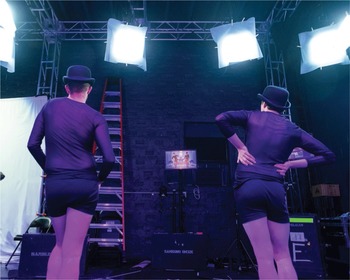
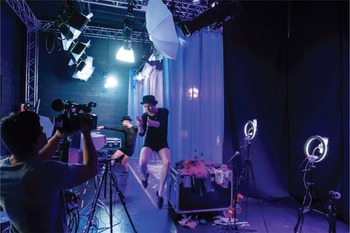
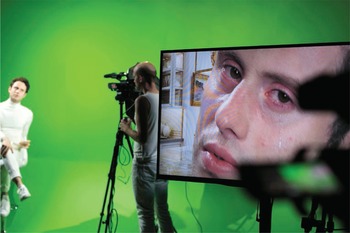
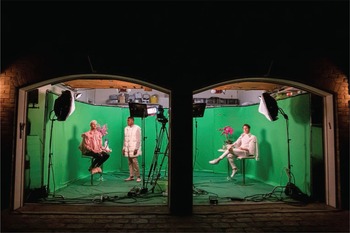
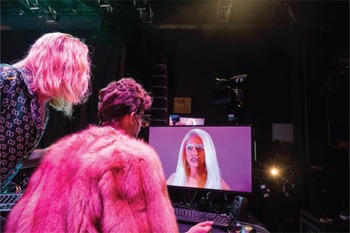
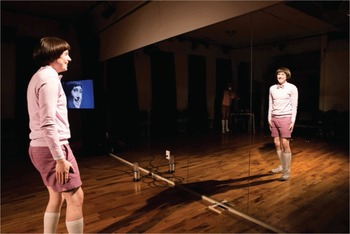
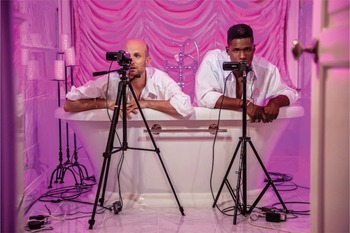
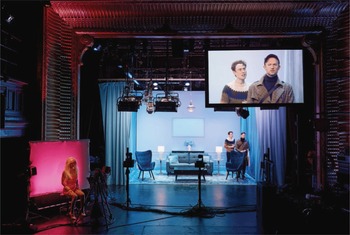
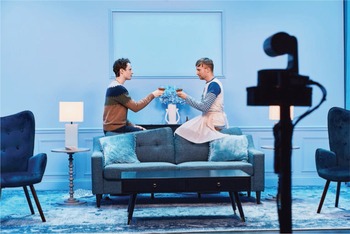
Viewfinders, selfie-mode, and rehearsal.mp4s are tools that allow Michael Breslin (left) and Patrick Foley to step in and out of frame, to view and enhance their performance and the application of their bodies. Circle Jerk, Theater Mitu, Brooklyn, NY, 2020. Livestreamed. (Photo by J.J. Darling)

Fake Friends is a New York–based theatre and digital media production company that produces original works for stage, livestream, and screen, led by creative directors Michael Breslin and Patrick Foley with founding members Catherine María “Cat” Rodríguez and Ariel Sibert and resident director Rory Pelsue. Their collaborations remix and reprocess their own personal, political, and pop cultural obsessions, layering references like third-hand samples in GarageBand. Breslin and Foley balance performing, writing, and directing within the work, blurring distinctions between actor, character, fiction, and fact; Rodríguez works as performer and/or dramaturg (a role I share). Footnote 1 In Circle Jerk, a queer comedy about white gay supremacy, Breslin, Foley, and Rodríguez play multiple roles: among them, circuit queen technocrat trolls Jurgen and Lord Baby Bussy; their creation, the deepfake-generated, ethnically ambiguous AI influencer Eva María; and satirized versions of the actors themselves (“Patrick,” “Michael,” “Catherine”). In Circle Jerk, the phrase “bad actor” carries the connotations of deep state, false flag, and bad faith alongside sham, ham, and hack.
While best known in its pandemic-era, livestreamed iteration, Circle Jerk was originally conceived for in-person audiences — a three-act farce with and about screens, rather than of and for them. From 2019 to 2020, the company reimagined the play as a choreography for three actors and 13 remotely operated cameras spread across three unit sets in the blackbox of Theater Mitu in Gowanus, Brooklyn. Two and a half years, a vaccine, and a booster later, the play was reconceived again for quick changes and a proscenium stage as a hybrid in-person and livestreamed production at the Connelly Theater (Fake Friends 2022). Footnote 1
In 2020, Fake Friends also redeveloped their earliest collaboration, This American Wife (2017), a self-excoriating/self-exonerating homage to “reality” in general and The Real Housewives franchise in particular, for remote audiences and a site-specific location — a rented McMansion in Great Neck, NY, which they wired from basement to dormer for livestream broadcast. Footnote 2 The group’s earlier works include A Doll’s House, Part 3 (2018), a “sequel to the Part 2 ‘sequel’” by Lucas Hnath that had a Broadway run in 2017. (Everyone in the company — except me — refused to watch or read the Hnath play; I couldn’t mention anything about it except in the emergency case of accidental plagiarism.) The protagonists of Fake Friends’ A Doll’s House, Part 3 are neither Ibsen’s “New Woman,” Nora, nor Hnath’s First and Latter Wave “New Women,” Nora and her daughter, trapped in a Sophoclean public debate. Part 3 instead centers on a developmentally arrested, hysteric-depressive version of the three voiceless siblings of the original, searching for their art form somewhere between New Media and capital-R Realism, ASMR role-play videos, and memories of their mother’s monologues. Footnote 3
The text that follows combines a talk given at Yale University’s Performance Studies Working Group meeting in May 2021 (“Vanity Monitor: Screen, Self, and Circuit”) and excerpts from a conversation among the Fake Friends, held over Zoom a few days after a week-long creative retreat in February 2022 and on the cusp of rehearsals for a new, hybrid edition of Circle Jerk. The talk arose partly out of my own research interests and partly from my own personal history of 2019–2020, and blended inquiry with anecdote. Research into the feedback loops and systems theories of 1960s–1970s popular cybernetics, and the TV and video art that drew upon them, was filtered through my own experience of screen fatigue (or, more accurately, seeing-myself-on-screen fatigue). This academic project was complicated by my creative research with Fake Friends, whose work has always investigated the mediated environments in which we encounter ourselves and others, and the possibilities, on screens, for transformations and de-creations of self.
Where Does She Get Her Confidence?
I first learned the terms “vanity monitor” and “confidence monitor” in my work as the dramaturg for Fake Friends. Even prior to the pandemic, Fake Friends’ work employed camcorders and cell phone imaging as compositional and dramaturgical aides. Viewfinders, selfie-mode, and rehearsal.mp4s are tools that allow Breslin and Foley to step in and out of frame, to view and enhance their performance and the application of their bodies. In our work, the closed-circuit monitor/mirror provides a tool for the refinement of self-presentation and story, both throughout our production process and in the aleatoric moment of performance.
In film and television production, a small, actor-facing screen showing a live feed of performance capture is called a “vanity monitor,” or sometimes a “confidence” or a “comfort monitor.” Any monitor can be a “vanity monitor”; the designation is only useful for specifying the monitor’s intended orientation. All three terms seem to imply a kind of need on the part of the actor — a need for reassurance, for confirmation of their own visibility, or beauty, or presence — that only the self-soothing circuit of video can provide. The term “vanity monitor” evokes the makeup mirror (and so the world of femme artifice) and the cardinal sin of vanity; as well as vanitas, the vanity of earthly pursuits, the delusion of self-importance or lasting legacy given the certainty of death. Footnote 4
More so than other monitors — technologies of vision, insight, and oversight proper to directors and security guards — the performer’s self-view is understood to be primarily superficial, concerned with what is surfaced for the screen. The performer, whether understood as vain or insecure and in need of comfort, is judged for volunteering vulnerability — even pathologized, diagnosed upon arrival on set as a narcissist or a neurotic (or both).
At the same time, the notion of a monitor that soothes or pacifies perhaps offers an (albeit condescending) acknowledgment of the backfooted power relation between the performer and their medium of capture. The exposed captured-object is at a disadvantage to the analytical capturing-apparatus; anxiety is inevitable. Read more sympathetically, the performer who exposes themselves is an exhibitionist, yes, a masochist, sure, but also brave.
During the pandemic, Fake Friends pivoted our productions from live-onstage to livestream and became entirely reliant on the mediation of cameras for access to our audiences. In this process, we developed a hybrid-televisual-cinematic-theatrical vocabulary of technologies and techniques, one that balances the necessity of camera choreography against a kind of programmed allowance for chance, contingency, improvisation, and the potential for serendipity — or the illusion of chance, contingency, improvisation, and serendipity.
The notion of a monitor that soothes or pacifies perhaps offers an (albeit condescending) acknowledgment of the backfooted power relation between the performer and their medium of capture. From left: Camera operator “Yolanda” Richards, Patrick Foley, and Michael Breslin in Circle Jerk, Theater Mitu, Brooklyn, NY, 2020. Livestreaming. (Photo by J.J. Darling)

I asked the Fake Friends which term they preferred: vanity, comfort, or confidence.
CATHERINE “CAT” RODRÍGUEZ: It doesn’t have anything to do with comfort or confidence for me; I guess there’s vanity in checking how I’m being framed — but also none at all. I’m checking sightlines, eyelines.
PATRICK FOLEY: I like “confidence” — it’s a little bit old-school theatrical. The confidence monitor is the video version of “Find your light, honey!” And it’s premised on the understanding that it doesn’t matter what you do if you’re not lit or seen. The way we interacted with the monitors for Circle Jerk was a functional thing, and they gave me confidence — what I gave and got felt reciprocal, like scene partners.
RORY PELSUE: The first two acts of Circle Jerk are choreographed more like dance numbers. That felt like a confidence thing; the monitors were just a means of making live performance happen. It’s not like a movie where you can stop and say, “Okay, scoot over, hit your mark, now we’re going to film it and then put it in the can,” and the characters weren’t supposed to be aware of the cameras most of the time.
But in the last act of Circle Jerk, all of the actors are filming themselves on their cell phones and the cell phones felt more like vanity monitors — not in the sense of being vain but like a mirror. Part of the way we interact with our phones is to look at ourselves — now I’m thinking of how we’re on Zoom right now, and I’m looking at myself as I’m talking to you in a way that I don’t, generally, in real life conversation.
“The camera functioned like a mirror.” Foreground: Patrick Foley on monitor, with Michael Breslin operating camera. This American Wife, Next Door at New York Theatre Workshop, 2018. Live/co-present. (Photo by Walls Trimble)

In moments that were meant to evoke the sense of privacy, the sense of a confession, or confessional, monitors were turned off or positioned out of view. From left: Michael Breslin, Jakeem Powell, and Patrick Foley in This American Wife, Great Neck, NY, 2021. Livestreamed. (Photo by Nina Goodheart)

MICHAEL BRESLIN: I guess which term I would use depends on the project. For the first act of Circle Jerk, we were always acting into any one of three preset PTZ cameras, Footnote 5 and we had to look at the monitors just to make sure we were hitting our marks and we were in our light — that does feel like a confidence thing.
But then, somehow, in This American Wife, the flatscreen monitor or the viewfinder felt like a vanity monitor from the beginning. Footnote 6 We would go between watching ourselves on the monitors to setting and adjusting the cameras ourselves; the camera functioned like a mirror, so for me there was an element of vanity. But in moments that were meant to evoke the sense of privacy, the sense of a confession, or confessional, we would turn off the monitors or position ourselves so we couldn’t see them.
Mirror Face
It has been pointed out to me by friends, intimates, and relatives that I execute a particular facial contortion when I check my own reflection. This is my “mirror face.” If you saw me catch my eye over the sink in a public bathroom, you’d notice the shift: the lifted brow, the sucked-in cheeks, the smirk and purse of my lips. My mother’s mirror face is a kind of rakish, cockeyed grin — a face I’ve never seen her make in any candid context. I know that my mirror face is not my own; I feel the strain of the muscular rearrangement every time. It is only with dedicated focus and concentration that I can rearrange my mirror face into something that feels more relaxed or that others recognize, a face that looks “like me.” This has long been a source of personal anxiety; I worry I have no idea what I really look like to other people, how I move through the world when I’m not looking.
During the early months of Zoom-acclimation, as I adjusted to teaching and making performance remotely, I had no idea you could hide your own camera feed, your self-view, from your own view of Zoom’s interface; I therefore spent a lot of time looking at my own mirror face.
The term “Zoom fatigue” was quickly coined to describe a particular sensation of alienation, exhaustion, distraction, and disengagement that seemed to be endemic to the platform, its technological-affect signature. For me, fatigue was also an accurate description of the consequences of the nasolabial effort and muscular cost of maintaining my mirror face. My jaw spasmed from perma-moue. I read news reports associating an uptick of TMJ complaints with a general effect of the pandemic.
When I eventually learned how to turn off my self-view, I found immediate relief. Thinking about this, as my face relaxed, it seemed to me that the entire pathology had been linked to the feedback between medium, image, self-perception, and performance — me, Zoom, and my own image, perceived and projected. I became interested in the notion of unconscious responses to the feedback loops between ideas of the self and technological mediation — feedback loops that connect the platform to the perceptual, the personal, the psychoanalytic. Within this circuit of communication, what system is primary, or in control: the system of mediation or the system of perception; self or view? Or rather, how is that control repeatedly negotiated as the circuit feeds into itself?
An Aside
Cybernetics: No “New” Media
According to reading I was doing into the well-documented links that connect the father of information theory and data compression, Claude Shannon, to cyberneticists like Norbert Wiener and Gregory Bateson; and Bateson and Wiener to John Cage’s compositional techniques, all of this thinking had a cybernetic inflection. Footnote 7 Cage’s writing in the catalog for the landmark 1968 exhibition Cybernetic Serendipity — the first of many to explore computer art and computation-as-performance — cites Marshall McLuhan alongside Arnold Schoenberg and Sanskrit theatre, and asks if “we” — humans — are an audience for computer art, and if, in fact, this technological encounter could turn “us” into artists, and charge life itself with a sacred and artistic attention:
Are we an audience for computer art? The answer’s not No: it’s Yes. What we need is a computer that isn’t labor-saving but which increases the work for us to do, that puns (this is McLuhan’s idea) as well as Joyce revealing bridges (this is Brown’s idea) where we thought there weren’t any, turns us (my idea) not “on” but into artists. […] Indians have known it for ages. Life’s a dance, a play, illusion. Lila. Maya. Twentieth-century art’s opened our eyes. Now music’s opened our ears. Theatre? Just notice what’s around. ([1968] 2018:24)
In its most popular definition, framed by Norbert Wiener, cybernetics postulated that similar systems of communication and control, input, output, feedback, and processing govern the mechanisms within and communications between animals and machines. In the decades after the publication of Wiener’s Cybernetics: Or, Control and Communication in the Animal and the Machine (1948), cybernetics as a branch of information and systems theory took on a life of its own as an almost infinitely replicable metaphor: anything (behavior, biology, society, ecosystem, organism, machine) could be understood as a system of communications and control or a system composed of other systems, the smaller-order system feeding into and receiving feedback from larger cybernetic systems executing their own imperatives. Wiener’s cybernetics proved to be broadly influential, particularly in the arts and soft sciences. It was also spiritually seductive. Wiener’s theories of analogous structures and interchangeability also implied the possibility of transfer across taxonomies and typologies of being, inviting metaphysical extensions beyond the bits and binaries of quantifiable signals and circuits into ideas of universal mathematics and other transcendental holisms — the Jungian unconscious as shared server.
This seduction from cybernetics into the sacred would be carried off by cyberneticists outside of Wiener’s discipline — cyberneticists like Gregory Bateson, who combined anthropology, psychoanalysis, and evolutionary biology and found a rabidly curious audience among the bicoastal US countercultures of the 1970s. His cybernetics professed a programmatic disdain for Western epistemology’s linearity, its claim to objectivity and to human exceptionalism, and above all the hubris of the sciences and scientific mindset, which refused to acknowledge their subsummation and participation within systems larger than themselves (Bateson Reference Bateson1972:433). Bateson’s cybernetics also offered the lure of holism, universality, and reconciliation — a lingua franca shared by nature, culture, mind and spirit, individual, collective, and global ecospheres. Unlike an algorithm, cybernetic analysis promises no readouts, predictions, or results, but instead offers a kind of pattern recognition — a perceptual capacity for understanding the links between cybernetic systems and the loops of their feedback. When allied to rhetorics of expanded perception and countercultural politics, cybernetic analysis offers the potential to deliberately alter systems, and by doing so step into an altered future. Footnote 8
It is in this moment — of an aspiration towards cybernetic cross-communication across the biological, mechanical, psychological, and aesthetic regimes of existence — that video (the technological predecessor of the digital vanity monitor) presents itself as a site for art-making and investigation of self, performance, and psychological analysis. For some, including Paul Ryan, video artist and member of the new media and performance art collective the Raindance Corporation, cybernetics was the theory behind and the practical tool for an investigation of the utopian potential of feedback loops between image and medium and self, performance, and self-perception; between monitor and actor. As its title suggests, Ryan’s 1974 book Cybernetics of the Sacred considers cybernetics a spiritual framework and posits participatory video practice as a form of “media therapy,” a psychoanalytic exploration modeled on Bateson’s cybernetic theories of mind-ecology. With videotape, he writes,
I am developing a different sense of myself […] very much like the Chi sense of myself I have gotten in doing some T’ai Chi Twan. I feel more able to move in my own fullness. And this awareness extends beyond the actual use of tape. Confidence seems almost to be a function of communicating with oneself. (1974:9)
Ryan also saw in videotape the promise of a new form of performer, conceptually situated somewhere between Augusto Boal’s spect-actor and the cognitive-conceptual shifts Cage describes in Cybernetic Serendipity. “With videotape,” Ryan writes, “the performer and the audience can be one and the same, either simultaneously or sequentially” (9). He describes the effects of first filming a student in an acting class delivering a monologue with no vanity monitor, and then again with a monitor she could use to see herself:
She said that she felt more secure facing the monitor than with me at a distance using the camera and no monitor […which] left her with no feedback other than the glassy-eyed lens. With her performance extended into the monitor, she was, to use [a phrase of McLuhan’s] “participating in her own audience participation.” Feedback was immediate and self-supplied. She could use simultaneously her expressive abilities as an actress and the set of responses she had as an ordinary theater goer […]. Enter the talented audience […] a new kind of performer is bound to develop. (1974:9)
Even among contemporary critics in the 1970s, video-based performance work was often associated with a kind of navel-gazing and narcissism, most famously by art critic Rosalind Krauss, who went so far as to call narcissism a defining characteristic of the very medium, essential to the genre by dint of its very formal attributes (1976). The idea of a closed circuit within which one generates and witnesses, creates, captures, is captured, and consumes is the technological extension of self that enables any number of fantasies of self-pleasure and self-regard — whether auto-fellatio or gazing so deeply into one’s own navel that you form a perfect circle and end up with your head up your own ass.
The notion of mediated self-regard as a mirror-void into which one might fall, abandoning present relationships and one’s own reality, a kind of trap, a potential delusion or even psychotic breaking point, is as old and archetypal as the myth of Narcissus; still the lake-surface/mirror-lens mise en abyme metaphors have not lost their luster. Footnote 9 The Narcissus myth is never far from mind at those moments when new imaging technologies converge with new cultural formations of the self and the social. Consider the various slippages between “selfie” and selfish; the “selfie” generation. Consider the title of the dystopian anthology series Black Mirror. On the other side, the side of accelerationism, technologies of self-monitoring are means of understanding and optimizing human potential — and, perhaps, the potential of humanity. Dive into the lake; optimize productivity through the insights you find; become immortal; perhaps, in the end, the self submerges the singularity.
To put this in Judeo-Christian terms — seeing one’s form as something made in God’s image = practice of faith. Seeing one’s reason and perception as made in God’s image = humanistic, Kantian. Seeing one’s ability to make images as Godlike = Romantic. To take one’s own image into one’s own hands, to interfere in one’s own reflection, to self-fashion = blasphemous, idolatrous, the Godlike power of vanity. To take the Lord’s work in vain.
Bad Methods
RODRÍGUEZ: When it came to acting into a cell phone, in the third act of Circle Jerk, being able to see what I was doing and have that inform my work was like real-time editing, and it was very technical — it was a skill.
When I was rehearsing on my own for Circle Jerk as the AI-invention Eva María, who exists only on-screen and speaks directly to camera, I practiced in front of a mirror so that I could see myself, and often I recorded myself trying different things out and then watched the takes back. It gave me live information, showed me what I was looking like in real time — I did actually train myself on a giant mirror in my house. I would sit in front of it, and I would deliver my to-camera monologues in front of it. And that helped, to train myself that way. That’s not to say that in the moment of performing I was trying to reproduce choices I’d made in the mirror — I’d like to think that work existed and afterwards I was free of it. In Circle Jerk, as Eva María, I never had a monitor to look at; and sometimes, when I didn’t have a monitor, it was like acting into a void.
BRESLIN: Rehearsing into a mirror is the Method actor’s biggest sin. It’s catechism, day one: if you rehearse in a mirror, you are a sinner.
FOLEY: There’s a particularly American disdain for technical prowess on the part of the actor. If the actor has a vanity monitor or a confidence monitor, then that means they’re editing or manipulating their performance in an authorial way. I think we like to think of actors as pure ids.
SIBERT: Pure ids, channels, conduits, something that doesn’t edit or mediate between input and output.
FOLEY: Exactly. In acting training — and I’ve heard this in terms of all art — I think it’s John Cage’s thought out of context — there’s this idea that you’re not supposed to create and edit simultaneously. Footnote 10 It feels like a conflict, or that you’re in conflict with yourself if, as an actor, you have the means to edit yourself.
BRESLIN: I’m reading Isaac Butler’s book [The Method: How the Twentieth Century Learned to Act (2022)] right now. This idea of spontaneity traces back to the arguments about acting from the 19th century. Should acting be emotional and spontaneous or should acting follow the Diderot model — technical, repeatable, melodramatic acting? You could use a vanity monitor to train yourself to act in Diderot’s way. Am I making the right face for this emotion?
This idea of American acting now is like what Patrick was describing — spontaneous, nontechnical…a sort of ineffable simulation of presence in the moment, or unpremeditated reaction.
RODRÍGUEZ: Is there something wrong with “vanity”? As performers, we’re already being controlled — whether it’s because there’s a camera operator elsewhere who’s controlling what the audience is seeing, or it’s just the fact of a camera or even an audience’s attention. We’re being taken in. So why not exert a little bit of agency? That could be called vanity, but I don’t necessarily think it’s a bad thing.
FOLEY: I find that looking at myself while I’m acting helps me to do less. And I feel like potentially every person who’s ever seen Circle Jerk would disagree, but I find that, looking at myself, I can be smaller and more subtle. And when you’re staring into your own eyes and you’re looking at someone you know, who you know has a functioning brain — it has the effect of streamlining communication. I know that I understand these sentences and the meaning that I’m communicating.
“As Eva María, […] when I didn’t have a monitor, it was like acting into a void.” From left: Patrick Foley, Michael Breslin, and Cat Rodríguez in Circle Jerk, Theater Mitu, Brooklyn, NY, 2020. Livestreamed. (Photo by J.J. Darling)

SIBERT: Because you’re your own audience. Cogito ergo sum. Or something.
FOLEY: I’m my own audience and I’m my own scene partner and I’m used to looking at my face and if I’m doing something that feels like over-illustrative, I’ll tell myself, “That looks unnatural, so cut it out.” That’s my own experience—I think that’s the vanity, probably.
Communication and Control
In the analyses of Zoom fatigue proliferating on popular outlets like Slate (Hadavas Reference Hadavas2020) and The Atlantic (Mull Reference Mull2020), the pressure to perform visibly and the psychological costs of screen-mediated self-regard were frequently acknowledged as root causes of Zoom-affective disorders. Professor Marissa Shuffler, quoted in a BBC article states, “When you’re on a video conference, you know everybody’s looking at you; you are onstage, so there comes the social pressure and feeling like you need to perform. Being performative is nerve-wracking and more stressful.” In the same article, professor Gianpiero Petriglieri describes performing and appearing on Zoom as feeling “like you’re watching television and television is watching you” (in Jiang Reference Jiang2020). In a peer-reviewed analysis, Jeremy Bailenson identified “increased self-evaluation from staring at video of oneself” as one of the root causes of Zoom fatigue, citing psychological studies of the feedback between mirrors and self-perception and the production of negative affects, including depression (see Bailenson Reference Bailenson2021). As Bailenson observes, “Zoom users are seeing reflections of themselves at a frequency and duration that hasn’t been seen before in the history of media and likely the history of people (with exceptions for people who work in dance studios and other places that are full of mirrors)” (Bailenson Reference Bailenson2021).
Perhaps the worker surrounded by mirrors has built up a kind of immunity to their own image and its distorting effects. Foreground: Patrick Foley, with Michael Breslin operating camera in background, in A Doll’s House, Part 3, Exponential Festival, Triskelion Arts, Brooklyn, NY, 2019. Live/co-present. (Photo by Walls Trimble)

These quotes link mechanisms of watching, seeing, being seen — pressure, performance, and the disturbance of self-perception — to Zoom’s deleterious effects. Zoom’s self-view produces anxiety, and the engine of anxiety is “performance” or the command to perform — “performance” understood as artificial, forced behavior or empty display; seen both as inauthentic and instinctive, automatic, irresistible; performance framed as exhausting, depleting; as a tax or a cost exacted for the privilege of existing in public, but without any of the (psycho)social rewards or benefits (such as intimacy, mutuality, moving-through-the-world-together, etc.) afforded by co-presence.
Bailenson’s “exceptions for people who work in dance studios and other places that are full of mirrors” make clear the implication that the only personalities comfortable with self-monitoring are performers, actors — implicitly atypical personalities; implicitly, narcissists. Self-view is evaluated from within a context of antitheatrical prejudice and media skepticism, a system of values that cordons off “performed,” “screen-mediated,” and “self-regarding” behavior from “healthier” forms of sociality.
Or perhaps Bailenson’s point is that the worker surrounded by mirrors has built up a kind of immunity to their own image and its distorting effects — a kind of control.
FOLEY: I think it’s important for the person on camera to feel totally at the mercy of the operator of the camera. We’ve played with that sensation in all our shows, but in the livestream version of This American Wife, it felt particularly acute because we didn’t have the juxtaposition that we had in the theatrical setting, where the audience saw how we filmed each other and created every image. There, the live audience got both experiences — watching the performer in the space capturing and watching what the camera captures in real-time, which was projected onstage. With the livestream, the camera operator has total control of what the audience sees — and, as a performer, that sensation of not knowing where the camera is focused is a very active negotiation of trust and submission.
BRESLIN: It’s such an interesting realization through this conversation: when we are aiming for a precise, theatrical style we use the confidence monitors, and when we’re aiming for a style that is less presentational, that creates the illusion of intimacy, we turn them off, so we can’t see them.
There are two interesting moments in our streaming production of This American Wife when we surrender — when the confidence monitors are off. As a performer, in those moments without a monitor, you wonder, is that camera even working? And what are they filming of me? But then there was one show where, for whatever reason, the performer-facing monitor on one of the cameras didn’t get turned off during a vulnerable moment of improvisation — and it was really difficult to do that section. It was hard to concentrate on having an open, improvisational spirit when I could also be angling my face and getting in the right light.
No Presents
The Zoom talk is a form that might be past the precipice of decline as we enter a tentative postpandemic era and many among the managerial, academic, and creative classes return to working in co-present spaces. Or maybe the Zoom talk might linger as the preferred expression of labor adapted to premises of distance, with all its particularities of genre — the thousand-yard stare of the presenter in share-screen mode, unable to assess their off-camera listeners’ attention; the equally outstretched minute after having closed all breakout rooms; the polite self-muting and the light humiliation of forgetting to unmute oneself. I already have some nostalgia for YouTube compilations of cats walking through the home studios of newscasters. For those who have never met me offline, do they remember me as my mirror face?
There’s a pithier term for “labor adapted to premises of distance”: the telecommute, coined in the 1970s to describe a privilege to which the white-collar worker, particularly the work-smart-not-hard or why-can’t-I-have-it-all worker, should aspire. Translated as “remote interchange,” the telecommute implies multiple processes of removal, substitution, distancing, transfer, even transubstantiation — work transforms from place to activity, from activity to identity. The 1990s slogan of the telecommute, “work is what you do, not where you are,” developed into “work is who you are, not where you are.” Footnote 11 The pandemic-normalized telecommute was just another erosion of the boundaries between leisure and labor, public and private, job and self — for better, for worse. Your home is an office, now, but you can be naked from the waist down at the morning meeting. If the “telecommute” is a metonym for multiple processes of dematerialization, it is a part without a body, standing in for something that wishes to disappear. As work unmoors from location, leisure loses its time, place, and sense of occasion, too — for better, for worse. BTS or the RSC on YouTube streamed live from empty houses, sharing a cinematic vocabulary with Netflix documentaries, drone shots over vacant sites. I missed most of the live broadcast; still, I liked the option to watch from home.
As I write this, in 2022, the option to “watch live” or “join via Zoom” still evokes, for me, associations of both new normal and institutional entropy, connection, and loss. The idea that the pandemic-normalized telecommute would/will change my way of working, making, watching, learning, feels like a 2019 Zoom wedding to me: an event that simultaneously is happening, will happen someday, and might never happen really, not how we thought it would.
SIBERT: Presence has been an issue or a problematic that comes up when it’s time to classify our work, particularly in the eyes of the press and others who have difficulty deciding whether or not we make theatre. How has the problematic of presence, especially when it comes to our online, livestreamed, “pandemic” work, shaped how we talk about it?
BRESLIN: Is there a difference — I know that there is — between presence and liveness? Because I don’t know that we’ve talked that much about presence. Liveness gets brought up more often.
SIBERT: Liveness and mediation are often opposed to one another, and by implication mediation is equated with absence: yes? We appear through a medium on the condition of our not being present… I’m thinking through Derrida, that language is both proof of presence and separates our selves from the present, puts something between us and meaning; and it exists because of our need to be able to communicate beyond the dead through writing or through others, in the condition of our own absence. And in that way mediation can signal both the absence of aliveness and a proof of our one-time presence all at once…the whole “metaphysics of presence” thing. I’m not sure I understand it.
“Our work […is] part of a crisis of authenticity, a kind of panic around both queer and aesthetics that forefront fakeness.” From left: Jakeem Powell and Michael Breslin in This American Wife, Great Neck, NY, 2021. Livestreamed. (Photo by Nina Goodheart)

I don’t think liveness and presence are the same, but in our case, in terms of people approaching our work who find it difficult to locate the “theatre” in it, I do think presence is at the root of the issue, and a set of concerns that doesn’t seem to cling to other forms of “broadcast theatre” that are more or less equally “live” or not “live.” We’re present to each other when we make work that we share digitally, but it’s crucial for some that the audience is absent, I think — that we’ve conceived of the work in conditions of absence… That’s an issue that makes it hard for people to call our work “theatre,” for those people who consider our work more like film or video.
BRESLIN: To me it’s wrapped up in everything about our work, not just the medium we’re working in now, online. It’s part of a crisis of authenticity, a kind of panic around both queer aesthetics and aesthetics that forefront fakeness, that don’t pretend not to be pretending. Panic I think is a good word for what’s set off in people who feel the need to legislate what is and isn’t theatre because they feel they’re protecting some sort of authentic version of what theatre is.
They feel as if they’re on the front lines of battle, protecting their homeland. And I want to say, “Hon, no one cares.” No one cares; it’s live, there are performers who are co-present — and that’s not even necessary. It’s live and it’s online and if you are going to fight about it, then maybe you should investigate why you’re getting so defensive.
SIBERT: But if it’s not necessary, would we ever make work where we were not co-present as a company?
FOLEY: No.
BRESLIN: No.
RODRÍGUEZ: We tried. There was Naked from the Waist Down. That was scrapped…quickly.
SIBERT: Naked from the Waist Down, for the record that I’m creating, was our brief attempt to make a Zoom play that involved us coming up with études and then never talking about it again.
FOLEY: It involved me stripping on my fire escape.
SIBERT: During the height of the pandemic. And I do think that the move that led Michael to bringing us into the idea of making Circle Jerk into a livestream was because we hated Zoom theatre so much, or at least because it was so impossible for us to make.
FOLEY: It was just ugly and there was no pleasure in it, or not a lot.
SIBERT: If we could make it pretty, would we want to do it?
PELSUE: Never say never. There would have to be a strong “why,” and I think the technology would have to be more interesting than Zoom if you’re going to make a work of art where nobody is co-present. But why not? If there was a reason that some piece had to be done in that manner and not just because you can’t gather, that could be interesting. Potentially. But often it’s been a genre of necessity.
SIBERT: We all think dramaturgically and analytically about these topics, but to hear your perspectives as performers, this panic around whether or not what we do is theatre, this crisis of authenticity, around presence and liveness, is also a panic of authenticity around screen acting, and what it means when a performer is able to shape themselves according to their own image. Is that practice necessarily inauthentic?
BRESLIN: We were getting this sort of panic before the pandemic. The question of “is this even a play?” started even from the first production of This American Wife, and the question of “is this theatre” — they’ve been part of our company’s thing since the beginning.
SIBERT: And it’s been a subject of recent controversy, which Cat had to deal with on a particular discussion board — the idea that the camera is a “fake friend” to theatre. Do you want to summarize that kerfuffle briefly?
RODRÍGUEZ: Is there a way to…? It was just so…not worth it.
SIBERT: Cat, you had answered a question about autofiction in theatre and mentioned our own work, which can be described as autofictional. The response from that scholar seemed to target the use of cameras in our work as leading maybe to the eventual dissolution of theatre as an artform…? Is that accurate?
RODRÍGUEZ: That is correct, yes. If you’re going to include that very, very stupid “con” controversy: what the members of that discussion board began to discuss was not just that assertion but the tone around it — it wasn’t just someone poo-pooing technology, but someone whose tone was very pointed. It almost felt, to Michael’s point, like this person who was attacking was so defensive because they felt they had been attacked. What was interesting to me was that this discussion took place within a group of dramaturgs — the message board has a following that is pretty diverse, but is made up of mostly self-identified dramaturgs, scholars, theatre historians, and practitioners. And still, the tone of that comment was dismissive, and that’s something that we often face, whether because we’re using a technology that puts into crisis, in an almost existential way, the field and people’s supposed or imagined places within it, and what that container is or can be, or because of how we frame ourselves. The comment was dismissive, in such a way that when folks started to reply they felt the need to say, “Cat was trained as a dramaturg.” And I had made a point to say who we are as a group and that we think about these things deeply and rigorously and playfully and mischievously. All of the different kinds of screens we use, what they’re attached to, and the effect they have on us are things that we think through, and in the doing of it and the reflection upon it we deepen a knowledge and a sense that was already there to begin with. But it’s not as simple as throwing a camera on the work.
“The question of ‘is this theatre’ [has] been part of our company’s thing since the beginning.” From left: Cat Rodríguez, Patrick Foley, and Michael Breslin in Circle Jerk, the Connelly Theater, New York, NY, 2022. Co-present and livestreamed. (Photo by Emilio Madrid for Fake Friends)

PELSUE: Obviously categorizing things is fun and helpful, but also can be limiting. But the question of whether something is theatre or not — it’s interesting that it’s so important. I feel that importance, too, but I’m reflecting on the question, “Would it matter if these works of art that we worked on so hard are or aren’t labeled as theatre?” I don’t know.
People fear becoming irrelevant or niche. Opera’s selling point, now, in 2020, is that it doesn’t use microphones so that you’re “really hearing the voice.” Of course, it’s mediated in many ways — acoustics and halls, etcetera — but that’s part of why you go to the opera. In some ways it seems increasingly necessary in a more technologically dependent world, and also increasingly niche. Sometimes both of those things are true — some forms of theatre might become more niche and that’s not necessarily a disaster for that form. It hasn’t been for certain forms, even if people don’t like the idea of them becoming more niche.
BRESLIN: Classification people should debate over it. Medium people should debate it. But what I’ve become interested in over the past two years is the vehement near-rage that some of the digital work has produced in certain people — to the point that they felt the need to get very public about their rage. I’m not sure I’d go this far but to me, and going off what Rory said about the fear of irrelevance, it’s not dissimilar from some Americans’ fear of being “taken over” […] I’d like to work through that argument and precisely what its ramifications are but if we were in a rehearsal room, I’d say something like “there’s a similar action happening.”
SIBERT: There’s a similar action happening even in TikToks I’ve seen that say “Controversial opinion: I have the right to exist as a straight person” — that claim that there are no straight spaces left online.
PELSUE: Just in terms of art, though, things do get replaced. There might be a little bit of pain because of that. I like operetta as a form but it doesn’t “coexist” with other forms of entertainment. It’s gone. And that’s just the way it is, it’s not necessarily good or bad. Sometimes, the fear of replacement…it might be coming.
From left: Patrick Foley and Michael Breslin in Circle Jerk, the Connelly Theater, New York, NY, 2022. Co-present and livestreamed. (Photo by Emilio Madrid for Fake Friends)

FOLEY: At least for Circle Jerk we drew from models like live-in-studio-audience network sitcoms, and made-for-TV plays of the ’40s and ’50s, some of which are nearly extinct forms — maybe becoming even more extinct as we move to an all-streaming personal entertainment ecosystem… I’m not sure the implications of that, either.
SIBERT: There’s a whole discussion on where and when and how broadcast media historicizes itself and how it figures out its definition and epoch, which we are also a part of in a way that I’m too tired to contemplate right now.
FOLEY: Maybe the rage is tied up in a fear that we’re all becoming separated from our bodies, a primal fear of not having a body anymore and all of us moving towards a hive-mind, Matrix-state. If co-present theatre is basically a physical experience of chemical interchange, obviously, that is really difficult to digitally replicate, of course. But if that’s the case then we can only talk about digital theatre in terms of the degrees with which we can approximate performers being together or people all watching together, etc.
SIBERT: I’m interested in the affect of these technologies and these moments in their deployment within various media — the affect being like the shared psychological and emotional climate that is surrounding them, which for me might somehow tie together my feelings of deep, physical pain when I have to look at myself on-screen too much and those moments of joy, creativity, and authorial agency within the perception of one’s image in our work.
Somehow that’s on the same spectrum with the affective climate around “what is theatre without presence,” or when mediated or when the camera is present, and then what kind of presence is the camera. What am I, the spectator, being replaced by, is, to me obviously a psychological, Freudian complaint, and…the loneliness of the Zoom era, the whole internet discourse around being “touch-starved,” goes into what Patrick mentioned, the fear of the dissolution of the body. The idea of antimaskers thinking, “I have a right to commingle, chemically,” maybe is an analogue to this idea that theatre or performance is the guaranteed right of co-presence — that co-presence is intrinsic to the medium and that there’s a right to sit together as a form of expression.
But we can play this game forever, with increasing anxiety about the potential consequences of our claims — and that’s my favorite kind of claim-game: high stakes, intellectual, maybe irresponsible, but nevertheless, at least analogically true.