


1. Introduction
In recent years, the term ‘processor’ or ‘processing state’ has figured prominently in the world’s headlines, including the import ban imposed by the United States (US) against third-country processed Russian-origin seafood,Footnote 1 Japan’s offshoring of aquatic processing factories to avoid the concerns of neighbouring countries over the risk of nuclear pollution,Footnote 2 and China’s fish product exports that were blocked entry into the US market for alleged migrant labour abuse in certain processing chains.Footnote 3 Amidst such public discussions, a state’s responsibility to regulate the processing of fisheries, as well as processor treatment, has been left underexplored, despite inherent conceptual and operational ambiguities. In recent decades, the jurisdictional trend in international fisheries law has clarified the obligations of non-flag and non-coastal states (i.e., the port, market, and state of nationality) for fish stock management and conservation.Footnote 4 Nevertheless, in ‘complex processing state supply chains where landings and imports may be split, distributed, re-mixed, processed and re-processed by several economic operators, and where exporters are often different operators from importers’,Footnote 5 there is an ever more urgent need to ascertain the provenance of processed products and the veracity of information about them. This is because, most of the time, the public knows little about where their seafood originates and the complex route it has taken to reach their plate.Footnote 6 Illegal, unreported and unregulated (IUU) fishing,Footnote 7 human rights violations, and associated crimes continue to run rampant in varying forms around the world.Footnote 8 Hence, much more effort is needed to attain the United Nations Sustainable Development Goal 14, i.e., ‘Life below water’, across regions and on time.Footnote 9
In this context, the present study is the first of its kind to undertake a holistic and rules-based investigation of the processing state’s regulatory role in response to the global imperative of mitigating illicit seafood supplies. It aims to assess the adequacy and resilience of current international fisheries law in recognizing and accommodating the regulatory duties of processing states for global fisheries. Section 2 begins by situating the processing state’s regulatory role within the existing parameters of international fisheries law and related regional and national legal frameworks. It highlights the relative ambiguity of the processing state’s responsibility for fisheries management in comparison to the mainstream jurisdictional titles (i.e., flag, coastal, port, and market states). Section 3 gathers practical support for activating the processing state’s engagement in the global fight against IUU fishing and associated fraud. Empirical data is drawn from the world’s largest seafood importer and consumer − the European Union (EU) − with an advanced set of anti-IUU norms and practices in place to scrutinize the processing state’s legal surveillance of processing fisheries within its territorial domain. The EU’s proactive movement towards mandating the true and accurate disclosure of middleman information, which should be verified by the competent authorities of a third processing state, is conducive to strengthened regulatory oversight of intermediaries in seafood supply chains. Section 4 concludes by promoting globally coordinated and targeted measures that more processing states can learn from and undertake to address seafood risks effectively falling under their purview.
2. A roadmap towards a processing state’s responsibility to regulate fisheries: Conceptual and jurisdictional basis
According to the spatial arrangement under the 1982 United Nations Convention on the Law of the Sea (UNCLOS), maritime boundaries limit the sphere of application of state laws and regulations, ‘whereby the intensity of the State’s legislative power decreases while moving away from the coast’.Footnote 10 Exceptions to this rule include the global imperative for states to co-manage shared fish stocks across their exclusive economic zones (EEZs) and straddling and highly migratory species that traverse EEZs and the high seas.Footnote 11 After the adoption of UNCLOS, international normative developments continued to clarify and reinforce the rule-based system of fishery jurisdiction. For one thing, the 1993 United Nations (UN) Food and Agriculture Organization (FAO) Compliance Agreement reemphasized the flag state’s primary responsibility for its flagged fishing vessels operating on the high seas.Footnote 12 For another, the 1995 UN Fish Stocks Agreement (UNFSA) became the main legal instrument to regulate the exploration and conservation of straddling and highly migratory species among member states.Footnote 13 Later, the International Plan of Action to Prevent, Deter and Eliminate Illegal, Unreported and Unregulated Fishing (IPOA-IUU) was adopted in 2001 to promote globally cooperative and integrated action against IUU fishing.Footnote 14 To this point, there is no unconditional freedom for states to fish in the world’s oceans. A state’s right to fish and more compelling obligations to manage and conserve fish stocks are subject to conditions established under the UNCLOS and specific legal instruments, such as the Compliance Agreement and the UNFSA to which the state is a party. In this context, the international legal regime governing marine fisheries is examined to determine whether it has established a legal basis for the processing state to contribute to global fisheries management, as detailed below.
2.1 Conceptual criteria
The processing sector has a significant impact on global fisheries when it shifts from the periphery to the core of post-harvest activities. According to the FAO, processing ‘refers to mechanical or chemical operations performed on fish in order to transform or preserve them’, developing from artisanal methods such as smoking, salting, and sun drying to labour-intensive or highly automated processing plants.Footnote 15 The FAO statistics track the significant trends in global seafood transformation driven by improvements in processing. The data suggest a steady movement towards more value-added production methods, echoing the growing trend of ready-to-eat purchasing habits in developed and emerging economies.Footnote 16
Neither the FAO nor other international organs have provided a universal definition for the fish processing state. The FAO’s description of processing above indicates that some objectively discernible factor should be attributable to the regulating state. For the benefit of analytical convenience, this paper defines a processing state as the country where fish processing takes place, whether on board a processing vessel or a vessel with processing facilities flagged to that state, within its ports or internal territory, regardless of the processing techniques applied. Inevitably, fisheries jurisdiction overlaps as ‘any territory may be a flag state, a port state, a processing state and an end-market state concurrently’.Footnote 17 In a broader sense, the state of nationality may also coincide with the processing state when its nationals are engaged in fish processing activities that fall within other states’ concurrent territorial control. Jurisdictional overlaps aside, the breadth of international fisheries law has explicitly included processing fisheries, thereby creating a reasonable space for the processing state to assume specific regulatory duties.
At the threshold level, the covered subject of ‘fish’ comprises both live-caught and processed aquatic products. Starting from the 1995 UNFSA, the term ‘fish’ refers to a broad combination of molluscs and crustaceans (except for sedentary species) without distinction between raw and processed products.Footnote 18 Under the 2009 FAO Agreement on Port State Measures (PSMA) − the first binding international instrument to tackle IUU fishing − the term includes ‘all species of living marine resources that have not been previously landed, whether processed or not’.Footnote 19 Many states have subsequently absorbed the description in their anti-IUU legislation, such as the 2008 EU IUU Regulation covering ‘all species of wild capture living aquatic resources, whether processed or not’,Footnote 20 and Japan’s 2020 Act on Ensuring the Proper Domestic Distribution and Importation of Specified Aquatic Animals and Plants Fisheries Law (Act) administering ‘aquatic animals and plants and processed products which are made of or from any of’ them.Footnote 21
Similarly, the legal notion of ‘fishing vessel’ has acquired rich meanings beyond catch-only vessels, driven by the momentum of ocean industrialization and specialization. The FAO Compliance Agreement targets ‘any vessel used or intended for use for the purposes of the commercial exploitation of living marine resources, including mother ships and any other vessels directly engaged in such fishing operations’.Footnote 22 The PSMA goes one step further by clarifying ‘any vessel, ship of another type or boat used for, equipped to be used for, or intended to be used for fishing or fishing related activities’.Footnote 23 The EU IUU Regulation contains a more elaborate list, ‘including support ships, fish processing vessels, vessels engaged in transshipment and carrier vessels equipped for the transportation of fishery’.Footnote 24 The EU’s leadership in mainstreaming catch certificates has boosted the FAO’s adoption of the Voluntary Guidelines for Catch Documentation Schemes (VGCDS) in 2017, wherein a fishing vessel is defined as ‘any vessel of any size used for, equipped for use for, or intended for use for the purposes of fishing or fishing-related activities, including support vessels, fish-processing vessels’.Footnote 25
Furthermore, the definition of ‘fishing’ activity has expanded to include auxiliary, supportive, and other value-adding activities related to the original harvesting. Under the PSMA, such ‘fishing related activities’ are understood to encompass
any operation in support of, or in preparation for, fishing, including the landing, packaging, processing, transshipping or transporting of fish that have not been previously landed at a port, as well as the provisioning of personnel, fuel, gear and other supplies at sea.Footnote 26
The identical terms are applied to delimit the scope of application of subsequent international guidelines, inter alia, the 2022 FAO Voluntary Guidelines for Transshipment.Footnote 27 The 2022 WTO Agreement on Fisheries Subsidies (AFS) incorporates the exact PSMA definition, prohibiting member states from using fisheries subsidies to support illicit fishing or target overexploited fish stocks.Footnote 28 Alternatively, the qualifying term ‘business operator’ used in the Japanese Act refers to ‘a person/entity (organization) that is engaged in the business of selling, exporting, processing, manufacturing or providing any’ covered species.Footnote 29 More innovatively, the VGCDS introduces a point-to-point and supply-chain management approach. Public regulators are urged to scrutinize ‘a sequence of processes involved in the production and distribution of fish from catch to the point of import in the end market, including events such as landing, transshipments, re-export, processing, and transport’.Footnote 30
In relation to the conceptual criteria, contentious processing practices have prompted more specific problem-solving initiatives in recent years. Firstly, IUU fishing is increasingly implicated in the processing segment of global fisheries, such as through transshipments at seaFootnote 31 or major port operations.Footnote 32 In response, the 2001 IPOA-IUU drives worldwide attention to ensuring that ‘at-sea transshipment and processing of fish and fish products in coastal State waters are authorized by that coastal State, or conducted in conformity with appropriate management regulations’.Footnote 33 On that basis, the FAO promulgated the Voluntary Guidelines for Transshipment in 2022 to address IUU catches laundered through transshipment channels, promoting minimum standards on transshipment authorizations, inspections, follow-up actions, and information sharing requirements among member states.Footnote 34 Meanwhile, the PSMA has tailored the obligation for port state parties to close coastline entry to illegally sourced fish landings and imports.Footnote 35 By integrating the FAO’s notion of IUU fishing, the WTO AFS has successfully extended the prohibition of subsidy measures from the end-product to the how-catch standard.Footnote 36 Inter-regime coordination can be expected to legitimize pro-environmental trade measures that increasingly distinguish products based on their production and processing methods (PPMs).Footnote 37
More rigorous access controls are embodied in the EU IUU Regulation and the 2016 US Seafood Import Monitoring Program (SIMP), respectively.Footnote 38 Both schemes require a varying set of key data elements (KDEs) (e.g., species names, landed and processed weights, catch areas, fishing gear, and processing methods) from import submissions to disclose how, when, where, and by whom fish were caught and processed along the chain.Footnote 39 Such data-sharing obligations are anchored in the whole-chain regulatory modality of the 1995 FAO Code of Conduct for Responsible Fisheries, which requires fish harvesting, handling, processing, and distribution to join efforts in minimizing negative impacts on the marine environment.Footnote 40
Secondly, the more intricate phenomena of mislabelling and misrepresentation (e.g., falsified names, misleading origin and farmed fish marketed as wild-caught) stay unabated in retailer and consumer markets.Footnote 41 The resulting environmental and economic consequences have prompted several market states to impose more exacting disclosure requirements than international guidelines on business actors. The aforementioned EU IUU Regulation and the US SIMP are unique in that they require the importer to report the weight of processed fish, apart from conventional KDEs.Footnote 42 Moreover, the 2013 EU Common Organization of the Markets Regulation requires mandatory and additional voluntary information from product labels regarding, e.g., species’ scientific names, information of an environmental, ethical, or social nature,Footnote 43 to trace products ‘at all stages of production, processing and distribution, from catching or harvesting to retail stage’.Footnote 44 Empirical study reveals that the EU’s initiative towards full-chain transparency has contributed to a ‘rather low’ rate of mislabelling across ‘a considerable portion of the European seafood market’.Footnote 45 Effective improvement of market order and consumer trust thus sets a positive precedent for other consuming states, such as Canada and Japan, to follow suit in their national legislative agendas.Footnote 46
Thirdly, the ubiquitous correlation between labour abuse, IUU fishingFootnote 47 and transnational organized crimes like human and drug trafficking is no longer secret,Footnote 48 especially in fishing communities with few alternative livelihood options.Footnote 49 Notably, industry-wide ‘processing is the sector where the largest proportion of women are employed’, up to 85 per cent in certain segments of the sector.Footnote 50 Vulnerable processors and communities can readily fall victim to labour abuse and criminal syndicate control. In recent times, the exposure of outrageous human rights violations has ignited a cascade of reactions from the US and the EU through presidential, parliamentary, or departmental authorizations.Footnote 51 For example, the EU has proposed to apply a holistic market prohibition ‘to products for which forced labour has been used at any stage of their production, manufacture, harvest and extraction, including working or processing related to the products’.Footnote 52 Relatedly, the contingent bans in certain market states on fish products originating from crisis regions (e.g., Russia for invading Ukraine and Japan for discharging nuclear wastewater) deserve sustained attention.Footnote 53 Besides the complete blockage of direct importation, more sophisticated countermeasures have emerged to stem the indirect importation of such tainted products that have been processed, repackaged, or delivered through a third country.Footnote 54
In sum, whether it involves processed fish, fish-processing vessels, or other related activities, the development of international fisheries law has laid a solid foundation for the processing sector to be regulated within the supply chain. Next, what is required is a necessary level of regulatory oversight of business actors involved and legally liable for any misconduct in that intermediary process. Due to globalization and the rapid advancement of technology, processing has evolved to encompass a range of transactions and techniques that transform fish from identifiable raw materials into a processed form. Consequently, the resulting regulatory difficulties can be substantial and present a compelling case for establishing a legally tenable basis to mitigate the risks outlined above.
2.2 Jurisdictional foundation
The reach of state jurisdiction for fisheries has been in a constant state of flux and evolution since ancient times.Footnote 55 The flag state jurisdiction for fisheries retains a predominant influence on the high seas and a concurrent obligation of surveillance in the EEZs of other coastal states.Footnote 56 Establishing the regime of EEZs has extended the coastal states’ sovereign rights to exploit and preserve marine resources within nearshore geographical limits. Later, the PSMA accords the regulatory right and duty to littoral states upon their territorial control of in- and out-of-port vessels, cargo and people on board.Footnote 57 The market state jurisdiction allows a fish importing or consuming state to regulate certain steps of the supply chain that fall directly within its customs, distribution, and marketing channels. Like port state jurisdiction, the locus of market entry control is situated within the territorial boundaries of the market state concerned. It is espoused by the classic territoriality principle, despite having tacit extraterritorial effects.Footnote 58 Except for international trade law compliance,Footnote 59 fishery-related market state measures continue to vary across different regional fisheries management organizations (RFMOs) and states, such as import and export permits, catch documentation schemes, and trade embargoes.Footnote 60 By comparison, the processing state’s role has a far less explicit footing in international fisheries agreements that underscore the primacy of flag and coastal state jurisdiction. It has also been eclipsed by the rising centrality of port and market state jurisdiction to complement the traditional jurisdictional patterns. Hence, a critical investigation of the sprawling legal arrangements is vital for understanding whether and to what extent the processing state’s responsibility is warranted for global fisheries management.
2.2.1 All state responsibilities for fisheries
The notion of the processing state is left outside the UNCLOS’ zonal arrangement, given that it has no ostensible connection to the origin or nature of marine fishing. The subsequent FAO documents, ranging from the Compliance Agreement to voluntary guidelines, come to reinforce rather than reinvent the wheel of jurisdictional allocation. However, when processing becomes a new industry lifeline, the development of international fisheries law becomes more responsive to the imperative of harnessing its strength and particularities. The consensus was initially reflected in the FAO Code of Conduct, which dedicates a whole section to ‘Post-Harvest Practices and Trade’.Footnote 61 Under the banner of ‘Responsible Fish Utilization’, all states are encouraged to ‘adopt appropriate measures to ensure the right of consumers to safe, wholesome and unadulterated fish and fishery products’.Footnote 62 This still sounds the alarm for processing fisheries, as the sector remains continuously fraught with various forms of commercial fraud, including product mislabelling and raw material substitution. Moreover, it is held that ‘States should encourage those involved in fish processing, distribution and marketing to … improve the use of by-catch to the extent that this is consistent with responsible fisheries management practices’.Footnote 63 The utility of processing factories, including numerous hand processors in developing countries, in minimizing waste and recycling incidental catches is emphasized.
The other pillar to realizing all state responsibilities for fisheries is the IPOA-IUU, an international plan of action associated with the Code of Conduct. The section on ‘All State responsibilities’ precedes those prescribing individual flag, coastal, port, and market states’ responsibilities to implement concrete anti-IUU measures. This ‘comprehensive and integrated approach’ is a key objective and principle of the IPOA-IUU, to ‘embrace measures building on the primary responsibility of the flag State and using all available jurisdiction in accordance with international law’.Footnote 64 Although the processing state is not listed, the breadth of IUU-supportive activities does not prevent it from taking more prudent and cooperative measures than in the UNCLOS era. Increasingly, IUU catches take advantage of intricate processing techniques to be laundered and repackaged as lawful products. Hence, fraudulent practices such as source, species, and weight manipulation may occur repeatedly when products move along the processing chain, allowing them to fall foul of national food codes more than once. When inhumane treatment is identified in that process, such as fish processors’ lengthy stays at sea and malnutrition, a violation of international obligations may also be established under applicable International Labour Organization (ILO) conventions.Footnote 65
Arguably, the ‘all State responsibilities’ section under the IPOA-IUU, which lays out concrete regulatory pathways, can be adapted for the processing state to take action, including: (i) adopting national legislation to ‘address in an effective manner all aspects of IUU fishing’ (Article 16); (ii) to ‘ensure that nationals subject to their jurisdiction do not support or engage in IUU fishing’ (Article 18); (iii) to ‘ensure that sanctions for IUU fishing by vessels and, to the greatest extent possible, nationals under its jurisdiction are of sufficient severity’ (Article 21); and (iv) to ‘avoid conferring economic support, including subsidies, to companies, vessels or persons that are involved in IUU fishing’ (Article 23). This is because the IPOA-IUU operates within the framework of the Code of Conduct. It should, therefore, be understood to urge all states to endorse equivalent responses against post-harvest events, including processing knowingly or unwittingly tied to IUU-caught fish.
More broadly, the conservation of marine living resources is acknowledged as ‘an element in the protection and preservation of the marine environment’.Footnote 66 It is worth contemplating whether the states’ general obligation under the UNCLOS Article 192 to protect the marine environment and that under Article 197 to cooperate will provide fertile ground for the processing state’s regulatory role to take shape. Despite the abstract wording in these provisions, the orders and opinions of the International Tribunal for the Law of the Sea (ITLOS) have consistently clarified the legal baseline for states’ regulatory activism to materialize.Footnote 67 The jurisprudence has been ‘characterised by an increasingly dynamic understanding of the Convention, which emphasises an integrated, rather than a zonal, approach’.Footnote 68 In that sense, the processing state’s regulation is integral to the common pursuit of all states, as emphasized by the IPOA-IUU, to preserve the legal and sustainable attributes of global seafood supplies. Since the ITLOS’ opinions are limited to the maritime zones, a state’s specific regulatory duty for at-sea and even onshore processing has valuable insights and experience to be learnt from the PSMA. In the light of the PSMA’s success in activating the port state jurisdiction over its ports and on-site processing facilities, comparable consensus and incentives may be explored ‘for the processing state to exercise due diligence and ensure that fraud is minimised in its supply chains and that fraudsters can be swiftly identified and sanctioned’.Footnote 69
2.2.2 Clarifying the processing state’s regulatory responsibility for fisheries
Today’s seafood supply is becoming increasingly complex and distant, with each critical event along the chain. Neither the state of origin nor the end market state alone can feasibly mitigate a multitude of biological, technical, and human risks between the numerous nodes.Footnote 70 The processing state should assume a critical role in correcting falsified or abused middleman links by establishing precisely ‘where anomalies occur and who is responsible for them’.Footnote 71 In this respect, the FAO highly recommends ‘to distinguish the functions of the processing state from those of the port state and end-market state, so that functions can be assigned to a specific state-type overseeing transactions in parts of the supply chain under their purview, and to present them without repetition of each state type’.Footnote 72 The call for a more visible role of the processing state needs to be evaluated under the international legal framework that allows for multiple and intertwined jurisdictional titles for fisheries.
Firstly, when the processing state doubles as the flag state for targeted fishery resources, its legal duty for processing has been implied in different forms in different legal arrangements. Among others, the EU IUU Regulation sets forth a definite obligation on fishing vessels flagged to a member state not to ‘in any way assist, engage in fish processing operations or participate in any transshipment or joint fishing operations with IUU fishing vessels’.Footnote 73 Thus, the regulatory authority rests on each flag member state to decouple its fishing vessels from processing activities that tend to launder IUU catches. The stance aligns with the flag state’s concurrent supervisory responsibility under the UNCLOS for its fishing vessels operating in the EEZ of a third coastal state.Footnote 74 As processing activity is likely to occur post-capture on a fishing vessel, it should fall under the jurisdiction of the responsible flag state. In a different vein, processing and processor treatment on the high seas should be regulated exclusively by the flag state and relevant RFMOs to which the flag state is a party. In this respect, the theory of the vessel as part of the ‘floating territory’ of the flag state has been used to justify flag state jurisdiction over all conduct on its vessels operating on the high seas.Footnote 75 It thus establishes the flag state’s jurisdiction as sui generis control over the ‘ship community’ within the boundaries of a ship.Footnote 76
When fish processing takes place within a foreign port, the PSMA similarly implicates the flag state’s concurrent responsibility for surveillance to a certain degree − ‘Each Party shall encourage vessels entitled to fly its flag to land, transship, package and process fish, and use other port services, in ports of States that are acting in accordance with, or in a manner consistent with this Agreement…’.Footnote 77 In this sense, flag state members are encouraged to restrict trade and cooperation with port states which act in consistency with their PSMA commitments. In such circumstances, the regulatory arm of the flag state may extend to cover in-port processing where unloaded cargoes reach foreign territory. It cannot exercise direct territorial control of the processing activities in real-time, given that the crew and conduct involved fall directly within the port state jurisdiction. It is on the grounds of extraterritorial personality jurisdiction that the state retains a concurrent supervisory role over its nationals engaged in IUU-supportive processing. Notwithstanding the merits of extraterritorial jurisdiction premised on nationality (especially when the port state is not a party to the PSMA), the flag state’s jurisdiction to police the processing of illegally caught fish on foreign land is logically restricted by distance and information asymmetries. Time lags are unavoidable since the flag state may launch concrete investigations and trials only after the nationals return to their homeland.
Secondly, it follows that the processing state may also overlap with the port state, that is, to be the same state, when processing takes place within a domestic port. In that scenario, the PSMA gives the port state exclusive authority to deny IUU vessels and landings access to its ports for the landing, transshipment, packaging, and processing of fish. Even after an IUU vessel arrives at its port, the port state can lawfully deter its utilization of such facilities.Footnote 78 Although the processing state’s function is not particularly mentioned by the PSMA, its annexes have included certain requirements on port inspection to address the landing of processed or manipulated fish. For instance, it is stipulated that port inspectors should have been trained in the ‘[v]erification and validation of information related to landings, transshipments, processing and fish remaining onboard’.Footnote 79
In both pre- and post-entry scenarios, restrictive port state measures should be applied after negative inspection results. Beyond that sequence of action at the customs, the jurisdictional and practical question remains: does the port state assume a continuing surveillance role under the PSMA to keep tracking lawful foreign landings post-entry? As the treaty currently stands, the port authorities have no clear responsibilities for ensuring the legality of products that are internally processed and transmitted after customs clearance. In other words, the port state jurisdiction for processing fisheries stops at the port entry point and does not flow onwards to impact downstream activities.
Thirdly, the market state jurisdiction is an advisable remedy to close that regulatory loophole from port entry to the consumer’s plate. However, a market state can be either a processing state, an end-market state, or both, where its regulatory roles still need to be carefully distinguished.Footnote 80 The international society currently lacks a Market State Measures Agreement to mandate concrete anti-IUU and fraud actions from fish-consuming states. The only international guidepost is the IPOA-IUU, wherein market-related measures are treated interchangeably with trade-related measures, a subset of import and export controls or prohibitions, to deprive IUU fish of market access opportunities. The ruling philosophy still premises on entry point control, but the doubt remains rooted in how processing within the market state’s territory will be regulated to guarantee lawful final products. Mislabelling or misrepresenting a seafood product to defraud the consumer is likely to constitute fraud in most states, irrespective of whether the seafood product has been illegally caught. Since no international obligation exists for the market state to demand accountability from local fish processors, the latitude of domestic law-making in that direction remains theoretical.
Unsurprisingly, only states with sizable purchasing power have adopted holistic market rules that bear on intermediary fish processors. In recent decades, the EU and the US have been among the early movers in launching domestic legal campaigns against seafood mislabelling and misrepresentation, albeit with varying market effects.Footnote 81 In some instances, local customers can still be cheated into buying illegally processed or deliberately mislabelled products despite a lawful source of importation.Footnote 82 Under the recently adopted WTO Agreement on Fisheries Subsidies, the market state is not obligated to notify the subsidising state of imported seafood originating from illicit sources or involving illegal processing steps. It is only given the option to provide an annual list of IUU vessels and operators violating its national law to the WTO Committee on Fisheries Subsidies.Footnote 83
Based on the above legal analysis, the study argues that the international legal framework is relatively flexible in accommodating the processing state’s regulatory function, but is not fully prepared to recognize its independent jurisdictional title for fisheries. This is due primarily to the lack of a clear legal basis under the UNCLOS and post-UNCLOS instruments to sufficiently distinguish the processing state’s role from other jurisdictional players. As things stand now, flag, port, and market states can all legitimately police fish processors and processing activities on the grounds of flag, territorial, or extraterritorial nationality connections. Their concurrent jurisdiction over processing activities remains largely fragmented, as it pertains to different jurisdictional powers operating under varying regulatory statuses. Given the overlapping jurisdictional parameters, international fisheries law has yet to assign clear responsibilities to these states concerning the processing of IUU products and associated fraud. To overcome such fragmentation, new efforts should be sought to clarify and develop the processing duties of these states and the importance of their respective roles in fighting IUU fishing and fraud. Such efforts can be made through treaty negotiation and interpretation, state practice, and/or international policy development under the FAO’s auspices to establish the legal basis upon which a ‘proxy’ flag, port, or market state is held accountable for the processing link under its purview. For sustainable and responsible fisheries management to materialize in the processing sector, the designation of the processing state’s regulatory responsibility, if not jurisdiction, has become a necessary addition to international fisheries law.
The explicit duties regarding processing should nevertheless be exercised in accordance with the generally accepted jurisdictional titles of states. When the processing state coincides with existing jurisdictional regimes at-sea (i.e., flag state) or on-site (i.e., port and market states), consensus can be sought from regional and global policy agendas to specify an adequate level of regulatory surveillance and responsiveness to the processing links from entry to exit. At the start of a supply chain, the flag state should exercise primary jurisdiction over processing on board its fishing vessels within the EEZs and on the high seas. It should be obligated by concrete legal commitments to discharge responsibilities over the processing activity and actors, regardless of whether the processed materials have been legally captured. At the landing point, port state authorities should be empowered to identify erroneous or falsified catch certificates and refuse to import IUU-sourced material without delay. Such action aims to disincentivize more opportunists seeking to dump illegal raw materials into low-standard processing states. The port state should tolerate no blind spots that might allow illegal catches to enter the next processing node without country-level monitoring of movements. After fish are landed or imported into a port, no jurisdictional proxy is more capable than the market state to monitor the subsequent product transformation and delivery series. The market state should take over the responsibility of the port state to deter any lawful fish materials from entering illegal domestic processing links. The local processing sector cannot be left in a sheer legal vacuum as it remains in many low-standard consumer markets.
In comparison to one-off entry point control, the more difficult task is perhaps for the market state to institute information checkpoints along the entire processing chain up to the exit gate, namely, ‘to trace products from landing or importation at ports of arrival through ownership changes and processing exportation or re-exportation’.Footnote 84 To that purpose, domestic multi-agency responses (e.g., fisheries, market surveillance, food security, and consumer protection) are expected to emerge from a well-coordinated plan of action. Only after these domestic watchkeepers are satisfied with the legality of processed products can the integrity of supply chains departing from that market state be validated. So far, ensuring the legality and transparency of post-entry activities has proved relatively challenging due to the lack of international guidelines on market state measures. As demonstrated below, the necessity for the market state’s verification of the legality of processed products has matured as a standard legal practice across the EU membership for fish products processed and imported from any third country.
3. Preparedness to integrate the processing state in whole-chain regulation of fisheries: The practice of the EU
In comparison with global consensus-building, regionalization has its distinct advantages. There is more common sense among like-minded states about protecting their common market and fishing industry against illegal interests. In this view, regional legal frameworks are easier to establish, as well as to launch a comprehensive campaign against IUU fishing and its linkages with various chain actors. Moreover, regional fisheries policy within economic blocs ‘help to provide a compliance and enforcement guarantee’ and ‘technological and financial support’ for the competent authorities of member states.Footnote 85 The EU’s anti-IUU strategy draws upon the most successful regional integration in the world, embedding fisheries management as a Union-level priority.Footnote 86 The EU IUU Regulation has redirected member states from a catch-focused approach to supply-chain governance, involving stakeholders and enhancing transparency at all stages, from promulgating rules to implementing measures.
3.1 EU IUU Regulation builds in the processing state link
About two-thirds of the EU’s fish demand is met through imports, making it the largest single market, accounting for 34 per cent of the global value of aquatic imports in 2020.Footnote 87 Most of these products shipped to the EU are landed, processed, or transited from third countries on cargo ships. Therefore, rigorous supply-chain scrutiny is required to prevent ‘control shopping,’ where IUU fish may slip through a prior weak point in control to enter the EU-destined supply chain.Footnote 88 The EU IUU Regulation and implementation rules place the 27 member states at the forefront of confronting illegal seafood by operating a unified and state-to-state catch certificate scheme. The scheme applies to ‘all imports of marine fishery products into the Community and exports from the Community … to fishery products which have been transported or processed in a country other than the flag State before reaching the territory of the Community’.Footnote 89 A full suite of KDEs must be documented on paper or in electronic documents accompanying each consignment arriving at or departing from the EU ports. A new regulatory regime thereby emerges to monitor the legality of catches from third-country and EU fishing vessels, whether imported or exported, to comply comprehensively with the anti-IUU objective.
The EU IUU Regulation Article 14, titled ‘Indirect importation of fishery products’, imposes special information disclosure requirements in the form of ‘a statement established by the processing plant in that third country and endorsed by its competent authorities in accordance with the form in Annex IV’.Footnote 90 The statement should describe the unprocessed and processed products, along with their respective quantities, to accompany the catch certificate issued by the flag state. Annex IV lists concrete data elements, ranging from vessel and processor identifications to landed, processed, and final product weights, to be endorsed by the third processing state through signature and seal. The official endorsement aims to facilitate mass balance monitoring (i.e., fish landed = fish in storage + fish processed or sold), as conducted by EU inspectors and auditors, to verify the legality of materials covered by a given catch certificate. The verification process aims to prevent deliberate or unintended splitting, co-mingling, and substitution of fish materials by processing plants in a third country, which may occur under the guise of altered, forged, or duplicated catch certificates.Footnote 91
When processed fish arrive at EU ports, border inspection involves cross-examining all submitted documents (e.g., catch certificates, processing statements, and transport documents), seeking additional evidence from external sources, and physically inspecting inbound products.Footnote 92 To verify declaration data and the existence and authenticity of processing documents, EU member states are authorized to request the assistance of the competent authorities of a third country other than the flag state.Footnote 93 The third-processing state’s prompt feedback is critical to identify ‘inconsistencies between the trade patterns and the known fishing-related activities of a third country, in particular in respect of the characteristics of its processing industry or its trade in fishery products’.Footnote 94 The information can be communicated electronically between relevant flag, processing, and importing authorities under the framework of EU-led inter-state cooperation.Footnote 95 When information collaboration is strengthened, the processing state is more likely to be engaged in monitoring the whole-chain movement of seafood products.
Furthermore, a Union-wide blacklist of non-cooperating third countries aims to sanction severe violations whereby all EU member states may suspend fish imports and exports from certain blacklisted nations. According to Article 31.1 of the EU IUU Regulation, ‘[a] third country may be identified as a non-cooperating third country if it fails to discharge the duties incumbent upon it under international law as flag, port, coastal or market State, to take action to prevent, deter and eliminate IUU fishing’. The processing state’s responsibility for the processing plant’s declaration lies within a broad and flexible interpretation of the market state’s jurisdiction. Thus, its legal liabilities can be established as the Commission ‘shall primarily rely on the examination of measures taken by the third country concerned in respect of: … access of fisheries products stemming from IUU fishing to its market’.Footnote 96 The processing state is susceptible to blacklisting if it discharges no effective responsibility to crowd out IUU-caught fish from its domestic processing sector. Like any other kind of exporting states, the processing state can seek to be delisted if it is only identified by the EU as having ‘taken concrete measures capable of achieving a lasting improvement of the situation’.Footnote 97
After importation into the EU territory, outbound fish movement is covered by a separate export certification scheme. When included in the IUU vessel list, ‘the exportation and re-exportation of fishery products from IUU fishing vessels for processing shall be prohibited’.Footnote 98 The export prohibition manifests the EU’s pipeline approach to prevent the diversion of IUU-caught fish from its well-protected market to other under-regulated third-party processing markets. Once intercepted by EU port authorities, illegal fish cannot readily escape the border via port or market shopping, as EU port authorities are authorized to ‘confiscate and destroy, dispose of or sell such fishery products in accordance with national law’.Footnote 99 When illegal fish materials are re-exported and substantially transformed in another processing state other than the EU, they may re-emerge as lawful commodities of that country of origin and leak into uninformed consumer markets elsewhere.
Besides allowing import and export control of processed products, the regulation places additional obligations on the state of nationality to steer its nationals away from IUU-supportive activities. In international fisheries law, the state’s jurisdiction premised on nationality has seen limited motivation to develop into a full-fledged binding commitment.Footnote 100 Without prejudice to the primary responsibilities of flag and coastal states, EU member states are required to cooperate amongst themselves and with third countries to identify and punish nationals ‘by engagement on board or as operators or beneficial owners of fishing vessels included in the Community IUU vessel list’.Footnote 101 In that sense, EU citizens are prohibited from participating in at-sea processing or owning vessels capable of processing illegal catches. These tailor-made requirements establish a legal basis for the state of nationality, often exercising distant oversight over extraterritorial personality connections, to coordinate information and action with the states of primary jurisdiction. Hence, the EU’s legal sensitiveness alerts the global society to the imperative of availing and combining all possible state action to adapt to the increasing complexity of fishing industry networks and ownership structures.
3.2 Implementation impacts on the processing state’s responsibility of fisheries regulation
Since it entered into force on 1 January 2010, the implementation of the EU anti-IUU toolset has achieved a generally positive effect in addressing the inadequate exercise of jurisdiction by third states, albeit with uneven results among member states.Footnote 102 The 2022 audit conducted by the European Court of Auditors covers the implementation period from 2014 to 2020. The report discloses that, with the absence of complete data, in 2019, ‘Member State authorities received around 285,000 catch certificates and 35,000 processing statements from third countries’.Footnote 103 As processing statements are attached to catch certificates within each indirect importation submission, approximately one out of eight import declarations implicates the involvement of a third processing state. Border inspectors must then check whether the ‘catch certificates for processed products specify the same species and quantity as the processing statement’,Footnote 104 namely, data consistencies among all importer-submitted documents. When verification of data raises doubts, in 2019, 19 member states made more than 1,000 requests for the given flag states to confirm the validity of importation documents. Only four member states (Hungary, Romania, Sweden, and Slovakia) did not request additional information from any third countries between 2016 and 2019 for undisclosed reasons.Footnote 105 However, no further information has been revealed regarding whether any flag states asked for the assistance of any processing state to streamline the cross-verification process.
In total, ten EU member states rejected 29 imports and less than 0.01 per cent of all catch certificates received in 2019. Most importation refusals resulted from invalid catch certificates and inconsistencies in the identification of document-product matches.Footnote 106 Institutional barriers to full transparency have aroused scholarly criticism, including (i) no EU-wide database of catch certificates or processing declarations received by the member states;Footnote 107 (ii) no digitized and systematic information-sharing mechanisms between individual member states,Footnote 108 with the Union-wide digital CATCH platform mandated for use from 10 January 2026;Footnote 109 and (iii) no public disclosure of the Commission’s specific compliance recommendations to a third state.Footnote 110 These information barriers render it difficult to assess the influence of EU warnings (‘yellow card’) or final listing (‘red card’) to drive normative changes in third processing states. More comprehensive data available to the public and country-specific disclosures are thus warranted to accomplish that fact-finding task.
During the carding process, ‘the Commission gathers information on third country action against illegal fishing from a wide range of sources [including] indications that a third country may not be complying with international fisheries laws or its responsibilities as a flag, coastal, port, or processing state’.Footnote 111 Notably, the processing state’s regulatory performance is separated from that of other states of jurisdiction and even substitutes that of the market state in the statements of audits. Whether that choice of terms is intended or not, it reveals that the third processing state’s regulatory capacity and international cooperative stance have become a primary legal concern of EU inspectors. Recurrent falsified or inaccurate processing declarations can be considered symbolic of a third processing state’s systematic governance failure, which, as a result, finds no exemption from Union-wide negative listing.
In practice, the processing state’s performance is assessed on equivalent criteria and through the same staged process as those for flag and coastal states, including EU-sought questionnaire feedback, analyses of sample processing statements, on-the-spot evaluations, and other formal or informal dialogues.Footnote 112 Among the five commonly cited shortcomings that could lead to a carding decision, three equally apply to gauging the processing state’s governance, including: (i) national legal framework; (ii) regional and multilateral cooperation in fisheries management and enforcement; and (iii) market state measures and traceability.Footnote 113 The third benchmark imposes distinctive obligations on the processing state to ‘implement robust traceability and certification schemes, providing for the verification of information submitted by operators’.Footnote 114 A comprehensive checklist must be established by the processing state, encompassing regular reviews and audits of processing firms’ accounting systems, physical inspections of processed products and processing plants, and electronic databases to monitor catch certificates, landing declarations, e-logbook data, and information from designated ports.Footnote 115 In this respect, the FAO advises on comparable criteria for the processing state’s internal traceability, ranging from the authorization of imports through registration and licensing of storage and processing premises, distribution and transfers among them, to final dispatch and export.Footnote 116
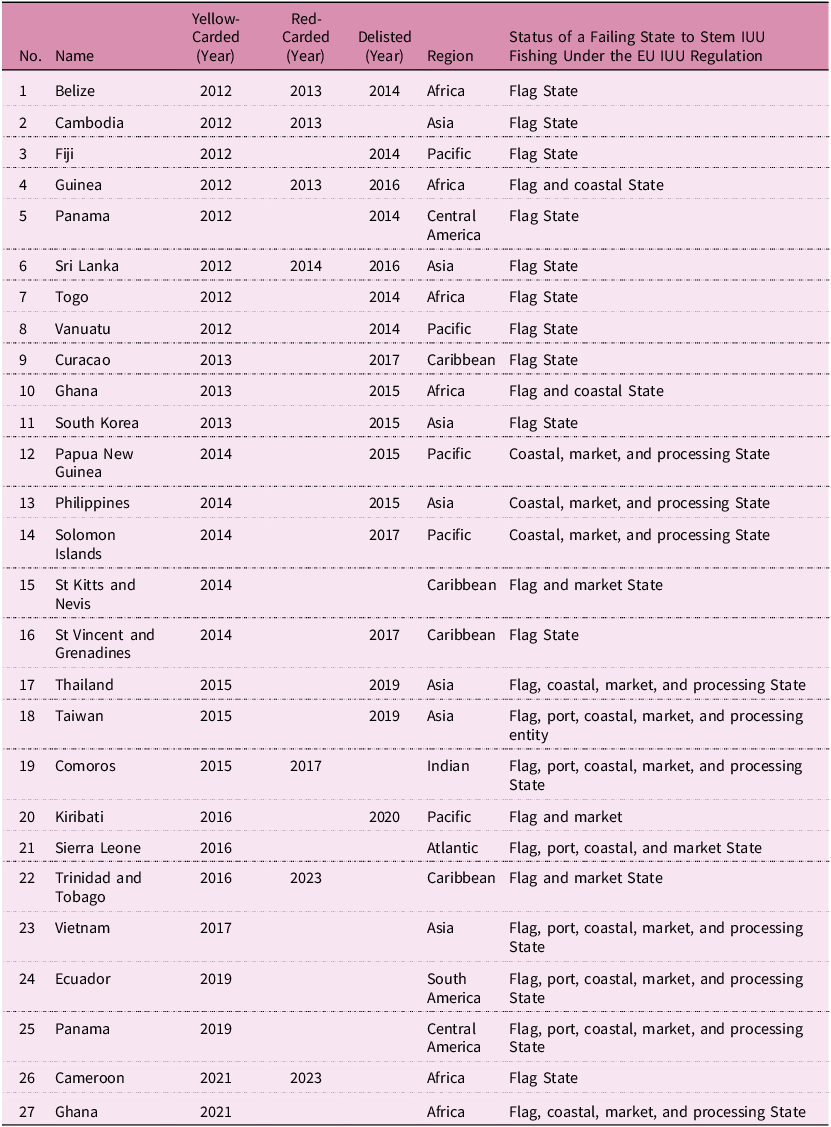
Table 1 summarizes that, as of the time of writing, the European Commission has issued a total of 27 yellow cards to 25 foreign fishing entities. The Asian region attracts the most frequent identifications (seven), followed by Africa (six) and the Pacific (five). Seven warnings have led to formal listing as non-cooperating third countries, which face EU fish trade embargoes of varying durations. Although most governments have made necessary compliance efforts to delist themselves, four remain with valid import prohibitions (Cambodia, Comoros, Trinidad, and Tobago, and Cameroon), and six are still on the watchlist (St Kitts and Nevis, Sierra Leone, Vietnam, Ecuador, Panama, and Ghana).
List of non-cooperating third-country carding decisions by the European Commission

Table 1 Long description
The table has 27 rows and 6 columns. The columns are labeled No., Name, Yellow-Carded (Year), Red-Carded (Year), (Year), Region, and Status of a Failing State to Stem IUU Fishing Under the EU IUU Regulation. The table lists various countries and entities that have been issued yellow and red cards by the European Commission, along with the years these cards were issued, their regions, and their statuses. Row 1: No. 1, Name Belize, Yellow-Carded 2012, Red-Carded 2013, Year 2014, Region Africa, Status Flag State. Row 2: No. 2, Name Cambodia, Yellow-Carded 2012, Red-Carded 2013, Year empty, Region Asia, Status Flag State. Row 3: No. 3, Name Fiji, Yellow-Carded 2012, Red-Carded empty, Year 2014, Region Pacific, Status Flag State. Row 4: No. 4, Name Guinea, Yellow-Carded 2012, Red-Carded 2013, Year 2016, Region Africa, Status Flag and coastal State. Row 5: No. 5, Name Panama, Yellow-Carded 2012, Red-Carded empty, Year 2014, Region Central America, Status Flag State. Row 6: No. 6, Name Sri Lanka, Yellow-Carded 2012, Red-Carded 2014, Year 2016, Region Asia, Status Flag State. Row 7: No. 7, Name Togo, Yellow-Carded 2012, Red-Carded empty, Year 2014, Region Africa, Status Flag State. Row 8: No. 8, Name Vanuatu, Yellow-Carded 2012, Red-Carded empty, Year 2014, Region Pacific, Status Flag State. Row 9: No. 9, Name Curacao, Yellow-Carded 2013, Red-Carded empty, Year 2017, Region Caribbean, Status Flag State. Row 10: No. 10, Name Ghana, Yellow-Carded 2013, Red-Carded empty, Year 2015, Region Africa, Status Flag and coastal State. Row 11: No. 11, Name South Korea, Yellow-Carded 2013, Red-Carded empty, Year 2015, Region Asia, Status Flag State. Row 12: No. 12, Name Papua New Guinea, Yellow-Carded 2014, Red-Carded 2015, Year empty, Region Pacific, Status Coastal, market, and processing State. Row 13: No. 13, Name Philippines, Yellow-Carded 2014, Red-Carded 2015, Year empty, Region Asia, Status Coastal, market, and processing State. Row 14: No. 14, Name Solomon Islands, Yellow-Carded 2014, Red-Carded empty, Year 2017, Region Pacific, Status Coastal, market, and processing State. Row 15: No. 15, Name St Kitts and Nevis, Yellow-Carded 2014, Red-Carded empty, Year empty, Region Caribbean, Status Flag and market State. Row 16: No. 16, Name St Vincent and Grenadines, Yellow-Carded 2014, Red-Carded empty, Year 2017, Region Caribbean, Status Flag State. Row 17: No. 17, Name Thailand, Yellow-Carded 2015, Red-Carded 2019, Year empty, Region Asia, Status Flag, coastal, market, and processing State. Row 18: No. 18, Name Taiwan, Yellow-Carded 2015, Red-Carded 2019, Year empty, Region Asia, Status Flag, port, coastal, market, and processing entity. Row 19: No. 19, Name Comoros, Yellow-Carded 2015, Red-Carded 2017, Year empty, Region Indian, Status Flag, port, coastal, market, and processing State. Row 20: No. 20, Name Kiribati, Yellow-Carded 2016, Red-Carded 2020, Year empty, Region Pacific, Status Flag and market. Row 21: No. 21, Name Sierra Leone, Yellow-Carded 2016, Red-Carded empty, Year empty, Region Atlantic, Status Flag, port, coastal, and market State. Row 22: No. 22, Name Trinidad and Tobago, Yellow-Carded 2016, Red-Carded 2023, Year empty, Region Caribbean, Status Flag and market State. Row 23: No. 23, Name Vietnam, Yellow-Carded 2017, Red-Carded empty, Year empty, Region Asia, Status Flag, port, coastal, market, and processing State. Row 24: No. 24, Name Ecuador, Yellow-Carded 2019, Red-Carded empty, Year empty, Region South America, Status Flag, port, coastal, market, and processing State. Row 25: No. 25, Name Panama, Yellow-Carded 2019, Red-Carded empty, Year empty, Region Central America, Status Flag, port, coastal, market, and processing State. Row 26: No. 26, Name Cameroon, Yellow-Carded 2021, Red-Carded 2023, Year empty, Region Africa, Status Flag State. Row 27: No. 27, Name Ghana, Yellow-Carded 2021, Red-Carded empty, Year empty, Region Africa, Status Flag, coastal, market, and processing State.
Source: European Commission, Oceans and Fisheries, Illegal Fishing, ‘Overview of IUU procedures’, 29 May 2024, available at ec.europa.eu/oceans-and-fisheries/fisheries/rules/illegal-fishing_en.
Note: 1The list of fishing entities is organized in chronological order by the time when a yellow card was received, and then in alphabetical order for those receiving the yellow card on the same day.
2It is acknowledged by the EU that the terms ‘state’ and ‘country’ with respect to the fishing entity Taiwan are used in the context of the IUU Regulation only.
The Commission gives concrete evidence and legal reasoning for each notification to a third country. The official records demonstrate a paradigm shift from emphasizing the flag state’s primary responsibility to a holistic evaluation of the state’s flag, port, coastal, and market responsibilities established under international agreements and guidelines.Footnote 117 From 2014, two years after the first set of warnings issued to several flag states, large littoral states like the Philippines and Thailand, and small island countries like Papua New Guinea and St Kitts and Nevis became subject to an all-inclusive evaluation radar. To date, more than half of the warnings issued (15 out of 27) highlight the regulatory deficiencies of non-flag states in disciplining their nationals, firms, and processing factories along the supply chain. Two second-carded countries (Panama and Ghana) were initially banned and delisted solely due to flag state duties. The second carding decisions against both of them illustrate an escalating situation of jurisdictional malfunction, as neither legal system was found sufficient to ‘prevent access of fisheries products stemming from IUU fishing to its market’.Footnote 118
The European Commission’s special reference to a processing state’s regulatory failure to support eventual carding decisions is thought-provoking. As indicated by Table 1, as many as 13 identifications have been raised against foreign market states. Among them, 10 carding decisions involve thoroughly evaluating the market states’ capabilities to prevent local processors from laundering imported IUU catches. In other words, most market states are held accountable for the lack of supervision of intermediary processors rather than primary producers or harvesters. The level of identification of ineffective processing state regulation even exceeds that of port states (six only). No port state is eventually blacklisted, though two market states are, with Comoros explicitly named as a failing processing state.
Among the others, the case of Thailand illuminates the concrete benchmarks applied in the EU identification process. The country is the top producer of canned tuna products, accounting for more than half of global trade. The majority of tuna imports are distributed to around 50 domestic canneries, about 95% of whose output is re-exported to foreign markets, including Europe, Japan, and the US.Footnote 119 Thailand is suspected of processing fish from third countries that have not been notified to the European Commission, including Vanuatu, the Federated States of Micronesia and the Marshall Islands, thus increasing the likelihood of IUU material laundering.Footnote 120 The industry profile highlights Thailand’s pivotal role in certifying the legality of imported fish materials and processed products that have been re-exported. That duality of legal duty makes it crucial for Thailand to collaborate with third countries from which raw materials are sourced and local processing plants that make onward exports.
The European Commission employed a combination of quantitative and qualitative evaluation methods to assess Thailand’s regulatory status and performance. For instance, despite the large volume of fish traded with regular partners, few verifications were carried out by the competent authorities on third-country imports into Thailand. The government failed to cooperate with other states and RFMOs to stem IUU catches effectively from entering its processing and re-exportation links:
10 % of landings in Thai ports are verified … catch certificates often arrive weeks or even months after import into Thailand. The linkage between import permit and catch certificate number is very difficult if not impossible to establish, rendering traceability even more difficult.Footnote 121
Since 2010 Thailand carried out only 26 verifications out of thousands of imports from third country flag States and only 14 of these verifications have been replied to by the third country flag States … Thailand has failed to cooperate with other States to facilitate communication by firstly not publicising formal contact points for inter-State communication and secondly by not entering into agreements or arrangements with States from which it imports fishery products for processing.Footnote 122
In the public-private endeavour of data authentication, the Thai government was also found incapable of detecting infringements and taking appropriate enforcement action against fraudulent behaviour. Persistent regulatory deficiencies rendered it impossible to guarantee transparency or the traceability of international seafood supplies derived from Thailand:
the traceability systems developed by the Thai public authorities are not incorporated into the accounting systems of companies and therefore do not ensure that data is exhaustive and reliable since there is no link between what is recorded in the authorities’ systems with what is recorded in the companies’ accounting and production systems. This situation undermines the reliability of the traceability chain at company level. Furthermore, the electronic databases supporting the authorities’ systems are incomplete and crucial documents in the supply chain such as the Import Movement Document do not record critical data (e.g., name of supplying vessels and actual total quantity purchased by the processing company). This highlights the failures of the traceability system as a whole.Footnote 123
The 2012 visit also revealed that 40 000 tonnes of imported tuna had not been controlled by the Customs authorities. Collaboration between DOF [Department of Fisheries] and Customs to ensure accuracy of imports for raw materials is weak.Footnote 124
The above investigations shed light on serious data irregularities, including: (i) catch certificates linked with known IUU activity; (ii) incorrect or inconsistent data on catch certificates, such as incorrect International Maritime Organization number; inconsistencies between caught, landed, and processed weights; vessel not listed in RFMO approved registers; carrier vessel not on the list of RFMO established carrier vessels; landing dates before transshipment dates, quantities and dates amended on catch certificates.Footnote 125 Given the increasing instances of processing state identification in Table 1, the above alarming issues surrounding incomplete or unreliable processing data are indeed not unique to Thailand. With the repeated application of similar assessment criteria and easy-to-use indicators, the EU’s evaluation of the processing state’s responsibility has solidified into a norm, rather than an exception in fish import decisions.
In the normative sphere, the processing of raw fish materials in Thailand was established as undermining various sustainable post-harvest rules, including Article 11 of the Code of Conduct and Paragraph 71 of the IPOA-IUU, as elaborated in Section 2.2 above. It was also found contrary to Thailand’s commitment to the National Action Plan of the Improvement of Traceability System for Imported Fishery Products, which was adopted in April 2013.Footnote 126 Therefore, for the Thai yellow card to be lifted in January 2019, the Commission must ensure that the third processing state has sufficiently reformed its legal and administrative systems relating to fisheries. Of note, the country should have ‘reinforced controls over landings of foreign fishing vessels in Thai ports and strengthened cooperation with flag States in the Indian and Pacific Oceans’.Footnote 127 Also acknowledged are the transformative efforts taken by Thailand to address human rights violations and forced labour industry-wide, as the first Asian country to ratify the ILO’s Convention on Work in Fishing.
4. Conclusions
International fisheries law mandates a genuine and sufficient nexus to the location or nature of marine fishing for a state to exercise relevant jurisdictional power. Along with a steady transition from a zonal to a more integrated approach, the present study raises questions about the resilience of current configurative parameters in international fisheries law in establishing the processing state’s regulatory duty. First, the all-state responsibilities for fisheries regulation, as recognized by post-UNCLOS instruments like the IPOA-IUU, solidify the whole-chain regulatory modality, promoting cooperation among conventional fish regulators and various chain actors. The processing state gains multiple pathways and opportunities to complement and reinforce rather than reinvent the wheel of global fisheries jurisdiction. Second, according to the incumbent legal arrangements, the processing state has shifted from a ‘black box’ figureFootnote 128 to be represented by overlapping yet fragmented jurisdictional parameters. When at-sea processing involves the mistreatment of products and humans, the flag state may be prompted to adopt targeted countermeasures within its jurisdictional remit. When the processing of IUU products is to be completed in a port, the port state can exercise objective territorial jurisdiction to deny access and use of its port services. When commercial fraud occurs in the downstream market, the market state may step forward to crack down on consumer-cheating behaviour of local processors, sellers, and re-exporters.
Pending the establishment of new international norms to define states’ specific duties for processing clearly, the EU’s practices have evolved to provide a practical path forward. As the world’s largest seafood importer, the EU exercises the ultimate authority to decide on the origin and types of seafood products that could be allowed market entry. The clear trend within the EU’s third-country carding process is to systematically evaluate a concerned processing state’s regulatory performance through a pipeline of inspection, identification, and compliance procedures. The number of third processing states warned in Table 1 demonstrates the EU’s routine reference to and gradual mastery of processing state evaluation, thereby embedding third countries’ fisheries regulations within a global and multi-stakeholder complex of seafood governance. Notwithstanding the nature of unilateral listing, the EU’s persuasive market influence and relative implementation efficiencies have become the key driving force to regulatory improvement in third countries. In the case of Thailand, beyond market forces, the EU has also been observed ‘exerting its powers of expertise, monitoring, and agenda setting to facilitate Thailand’s progress’.Footnote 129 The success is attributable to the creation and combination of qualitative and quantitative measurements, which together assess the viability of internal traceability within a third processing state. Foreign intermediary states are examined and suspected whenever it is identified that no reliable connection exists between landed, processed, and re-exported fish products.
In light of the operationalization of the EU’s third processing state evaluation, there is a glimmer of hope for the legal baseline applied to incentivize wider adoption and convergence on national legislation. Although no clear legal basis exists in international fisheries law to demand specific processing state measures, both EU practice and FAO recommendations emphasize the need for fundamental legislative, administrative, and enforcement infrastructure and capacity building, without which no processing state can guarantee due diligence for its participating supply chains. As the present study reveals, the processing state’s regulatory responsibility should ensure a seamless flow of information-based checks and controls to safeguard the legality of any transaction events occurring within its territorial domain.

 Open access

