Implications
As improper designs and lack of modern equipment are still some of the main problems in animal husbandry, studies providing information to the field to check the accuracy of the current husbandry methods, reduce stress and improve the animal welfare have a special importance. The easiest way to determine the welfare of animals is to measure the stress status of the animals during the routine husbandry procedures. The stress responses to those applications will help to assess the perception of the animals to the way they are exposed. From this point of view, covering stress responses for several routine applications under the same study, examining the welfare status of sheep, determining the time saved, assessing the labor usage and recommending alternative methods for better results are the main expected contributions of this research to the scientific area.
Introduction
Management methods and selection of the appropriate animals are being studied to minimize handling problems and the negative consequences for the handlers and the animals (Le Neindre et al., Reference Le Neindre, Boivin and Boissy1996). Many detrimental effects of handling stressors on animal performance and health are likely due to fear. Animals can be stressed by either psychological stress (restraint, handling or novelty) or physical stresses (hunger, thirst, fatigue, injury or thermal extremes; Grandin, Reference Grandin1997). Thus, reducing stress during handling will provide advantages of increasing productivity (Grandin, Reference Grandin1998). The stress of handling can be reduced by using well-maintained systems. Bearing this in mind, the development of appropriate systems should be guided by the requirement to ensure high standards of animal welfare (Goddard et al., Reference Goddard, Waterhouse, Dwyer and Stott2006). An animal's welfare largely depends on its environment and husbandry, and this has led to the concept that we should ‘fit the farm to the animal’ to enhance welfare (Kilgour, Reference Kilgour1978). Detailed knowledge of stress responses in agricultural animals allows the formulation of housing and husbandry requirements, including handling by humans, which will benefit welfare and health of farm animals, as well as production efficiency, product quality and consumer acceptance (Blokhuis et al., Reference Blokhuis, Hopster, Geverink, Korte and van Reenen1998). Determining the stress perception by the animals lets us understand the welfare status of the animals and accuracy of the husbandry methods practiced. As productivity and profitability of the flock is directly influenced by the welfare of the animals, researches on determining the proper flock husbandry methods and appropriate equipment provide important information for better husbandry procedures.
Choice of parameters
Many routine sheep handling procedures are stressful in that they result in elevated levels of cortisol, glucose, hematocrit and heart rate (Hargreaves and Hutson, Reference Hargreaves and Hutson1990a, Reference Hargreaves and Hutson1990b and Reference Hargreaves and Hutson1990c). This natural defense reaction can also be revealed artificially by the administration of some chemical substances such as ACTH (Paltrinieri et al., Reference Paltrinieri, Panelli, Comazzi and Sartorelli2002).
Oxidative stress is commonly defined as an imbalance between oxidants and reductants (antioxidants) at the cellular or individual level (Lykkesfeldt and Svendsen, Reference Lykkesfeldt and Svendsen2007). Excessive production of free radicals and concomitant damage at cellular and tissue levels are controlled by cellular antioxidant defense systems. Antioxidants can be broadly defined as any substance that delays, prevents or removes oxidative damage to a target molecule (Halliwell and Gutteridege, Reference Halliwell and Gutteridege2007). Antioxidants are compounds that are involved in effective scavenging of free radicals and in suppressing the actions of reactive oxygen substances. Antioxidant defenses are widely distributed and include both enzymatic and non-enzymatic systems. The major enzymatic antioxidants are superoxide dismutase, glutathione-peroxidase (GSH-Px) and catalase. Reduced glutathione (GSH), vitamin C, vitamin E, β-carotene, ceruloplasmin and bilirubin are some of the non-enzymatic factors that may function as antioxidants (Murray et al., Reference Murray, Mayes, Granner and Rodwell1993). GSH and its redox enzymes are the most important cellular antioxidants and play a major role in protecting cells against oxidative stress caused by reactive oxygen species (ROS; Shan et al., Reference Shan, Aw and Jones1990). In animals, reduced form of GSH and of other thiols (e.g. thioredoxin) is used to decompose the peroxide. Strongly electrophilic carbonyl compounds induce rapid and significant depletion of intracellular GSH content, suggesting that this is a relevant detoxification mechanism. Once GSH is depleted, cells exhibit an intracellular change in redox status and propagate an oxidative stress response following their production (Pamplona and Costantini, Reference Pamplona and Costantini2011). When reactive forms of oxygen (ROS) are produced faster than they can be safely neutralized by antioxidant mechanisms, oxidative stress results (Sies, Reference Sies1991). Moreover, short-term stress rapidly elevates plasma T3, T4, prolactin, insulin and growth hormone concentrations (Scott et al., Reference Scott, Schaefer, Jones, Mears and Stanley1993). Adrenal corticoids, mainly cortisol elicit physiological adjustments that enable animals to tolerate stressful conditions (Correa-Calderon et al., Reference Correa-Calderon, Armstrong, Ray, DeNise, Enns and Howison2004). Plasma cortisol levels are elevated after either physical or psychological stress (Hashizume et al., Reference Hashizume, Haglof and Malven1994).
According to the mentioned literature, it is obvious that plasma GSH values decrease with acute stress, whereas cortisol, T3, T4 levels increase.
The aim of this study was to compare the stress response of sheep with a range of non-painful handling procedures applied in traditional and new ways by reviewing the routine applications and evaluate the welfare status in sheep.
Material and methods
Forty 2-year-old Pirlak ewes were used as the study material. The ewes lambed during February and March. Measurements were taken during several routine husbandry procedures such as milking, shearing, weighing, loading and hoof care. Animals were randomly divided into two groups as control and treatment for each application. Applications were made in a range of 2-month intervals. Initial measurements were taken in April to examine the stress responses to milking application. Two months later, in June, second measurements were taken to assess the consequences of shearing methods. Third, fourth and fifth measurements were recorded in August, October and December, respectively, to assess weighing, loading and hoof care results. Comparisons between pre- and post-application periods were made by blood sample analysis. Treatment procedures were as follows:
1. Milking: control group was hand milked, whereas treatment group was machine milked by the researchers.
2. Shearing: control group was shorn by traditional hand sheep shears (grass shears) in the laying position, whereas treatment group was shorn by clippers by the experienced shearers. Entire fleece was removed during the applications.
3. Weighing: Control group was moved to a frameless scale by catching and pushing. Animals were restrained on the scale by human force while treatment group was directed to a sided digital scale by a handling race. One person operated the drafting gate while another stood behind the sheep and drove them down the race with shouts and arm movements.
4. Loading: a temporary ramp constructed from the materials of farm junkyard was used for loading as it was not common to use modern loading ramps. The length, height and width of the ramp were 4.5 m, 100 cm with a slope of 20° and 150 cm, which quickened the flow of sheep and allowed more than one sheep transition. During the application, control group was moved to a trailer by shouting, pushing and lifting by hands, whereas treatment group was directed using a ramp.
5. Hoof care: hooves were trimmed using a hoof trimmer in the laying position in control group as traditionally done, whereas treatment group was restrained from the head on the standing position by experienced workers.
Data regarding time spent for each application, as well as heart and respiratory rates were recorded during milking, shearing, weighing, loading and hoof care applications. A stethoscope was used to record the heart rates from the left side of the thorax, whereas respiratory rates were counted by visual inspection from the movements of the flank on the fossa paralumbalis region. Respiration was counted as one motion for inspiration (breathing in) and expiration (breathing out). Thirty minutes of a habituation phase was performed before each application. During this phase, animals were tried to get used to the handlers so as to avoid them to be perceived as an additional stress factor. Sampling was done by taking blood samples 15 min before and after each application and measurements of heart and respiratory rates were taken during the applications. Afterwards, changes in malondialdehyde (MDA), GSH-Px, cortisol, T3 and T4 parameters were determined at the lab. For blood MDA and GSH analysis, 3 ml blood samples were collected from each animal, transferred to the lab and analyzed without keeping a waiting time. MDA concentration was determined by the double heating method of Draper and Hadley (Draper and Hadley, Reference Draper and Hadley1990). The principle was based on the spectrophotometric measurement of the color occurring during the reaction to thiobarbituric acid (TBA) with MDA. For this purpose, 2.5 ml of 100 g/l trichloroacetic acid solution was added to 0.5 ml homogenate in a centrifuge tube and placed in a boiling water bath for 15 min. After cooling under tap water, the mixture was centrifuged at 1000 × g for 10 min, and 2 ml of the supernatant was added to 1 ml of 6.7 g/l TBA solution in a test tube and placed in a boiling water bath for 15 min. The solution was then cooled under the tap water and its absorbance was measured at 532 nm. Concentration of MDA was calculated by multiplication of the absorbance value with dilution value and expressed in nmol/ml. GSH levels were assessed by the Beutler's classic DTNB (di thio bis nitro benzoic acid) method (Beutler et al., Reference Beutler, Olga and Barbara1963). Shimadzu UV 1601 spectrophotometer was used during the analyses. T3 and T4 were analyzed by the appropriate test kits.
The gathered data were analyzed by using SPSS for Windows 11.0 Standard Version pocket program. After normality tests of the data, ‘t’-test was applied for comparisons of groups, whereas paired t-test was applied for comparison of pre- and post-applications.
Results
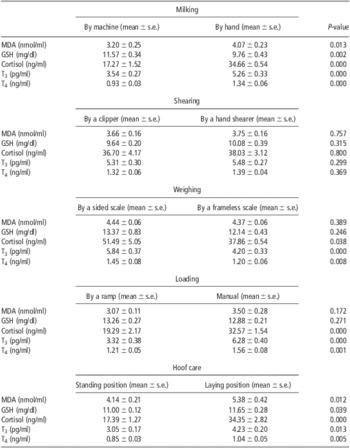
The stress responses were assessed according to the results of the physiological and behavioral data. Effects of husbandry methods on stress parameters are shown in Table 1. Among the stress parameters measured in this study, cortisol, T3 and T4 responses were more evident compared with MDA and GSH responses. Particularly, cortisol responses were dramatic in terms of significance and numerical profile. Results for comparisons of milking methods revealed that machine milking caused a lower stress than that of hand milking (P < 0.05). Although shearing process caused stress in both groups, no significant difference was seen between the groups. Traditional weighing method caused a lower stress according to the cortisol, T3 and T4 values (P < 0.05). For loading procedure, cortisol, T3 and T4 levels were found to be higher in manual loading group compared with the ramp used group during loading (P < 0.05). With regard to hoof care methods, values for MDA, GSH, cortisol, T3 and T4 found to be lower in the standing position.
Comparison of husbandry procedures in terms of the changes in stress parameters in sheep (n = 40)

MDA = malondialdehyde; GSH = glutathione.
P < 0.05; P-value: Student's t-test.
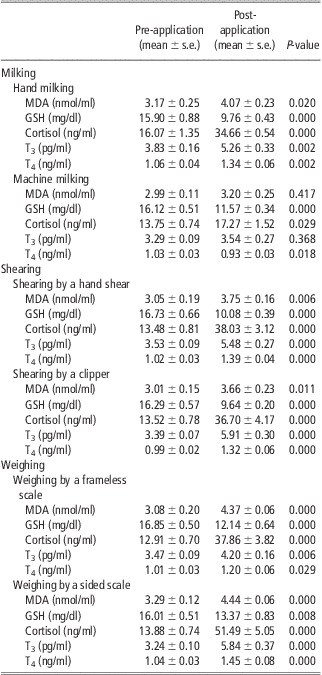
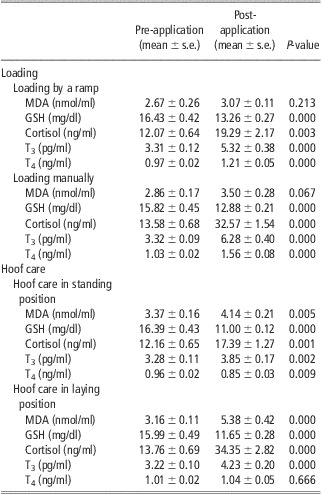
Comparison of pre- and post-husbandry procedures in terms of the effects on stress parameters also demonstrated significant differences between treatment groups (Table 2a and Table 2b). The values differed for hand milking, whereas no significant difference was observed in MDA and T3 values in machine milking group (P < 0.05). Both shearing techniques displayed a clear difference in stress parameters between pre- and post-application periods. All the parameters in weighing groups changed significantly (P < 0.05).
Comparison of pre- and post-husbandry procedures in terms of the changes in stress parameters in sheep (n = 40)

MDA = malondialdehyde; GSH = glutathione.
P < 0.05; P-value: Paired t-test.
Comparison of pre- and post-husbandry procedures in terms of the changes in stress parameters in sheep (n = 40)

MDA = malondialdehyde; GSH = glutathione.
P < 0.05; P-value: Paired t-test.
For loading process, GSH, cortisol, T3 and T4 parameters differed significantly (P < 0.05) in both treatment groups. With regard to hoof care, parameters except T4 in laying group differed significantly (P < 0.05).
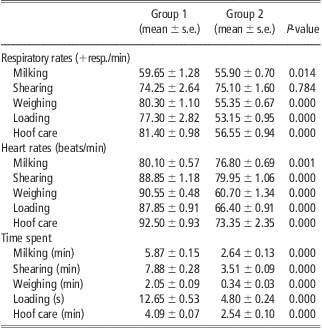
Minute-based measurements of heart and respiratory rates during milking, shearing, weighing, loading and hoof care are shown in Table 3. According to the results, the number of the respiratory rates during the applications differed except for the shearing process (P < 0.05). All the parameters displayed significant differences between groups in terms of heart rates (P < 0.05). One of the dramatic results in this study was the time spent for each application. Time saved for milking, shearing, weighing, loading and hoof care was 3.23 min, 4.37 min, 1.71 min, 7.85 s and 1.55 min, respectively, and time spent for each application differed between the groups (P < 0.05).
Minute-based measurements of heart and respiratory rates during milking, shearing, weighing, loading, hoof care procedures and time spent for the applications (n = 40)

P < 0.05; P-value: Student's t-test; Group 1: Hand milking; shearing with a hand shearer weighing by a frameless scale; loading manually; hoof care in laying position; Group 2: Machine milking; shearing with a clipper; weighing by a sided scale; loading by a ramp; hoof care in standing position.
Discussion
This study showed that stress caused by traditional routine applications could be reduced by using new husbandry techniques bearing in mind that the routine handling procedures caused stress in sheep as reported by several researchers (Grandin, Reference Grandin1998; Dwyer and Bornett, Reference Dwyer and Bornett2004; Fitzpatrick et al., Reference Fitzpatrick, Scott and Nolan2006).
Among the stress parameters measured in this study, cortisol, T3 and T4 responses were more evident compared with MDA and GSH responses. This might be explained by the mechanisms of the hormones and oxidant/antioxidant system. Particularly, for acute stress, hormonal system can be stimulated faster to help sheep prevent its body against the stress factors. It has been proposed that acute rises in corticosteroids following perturbations of the environment may actually avoid chronic stress as they may work primarily as ‘anti-stress’ hormones (Wingfield and Kitaysky, Reference Wingfield and Kitaysky2002). Among the hormonal parameters, cortisol is a useful indicator of short-term stresses from handling or husbandry procedures (Lay et al., Reference Lay, Friend, Bowers, Grissom and Jenkins1992). On the other hand, oxidative stress is commonly defined as an imbalance between oxidants and reductants (antioxidants) at the cellular or individual level (Lykkesfeldt and Svendsen, Reference Lykkesfeldt and Svendsen2007). As excessive production of free radicals is controlled by cellular antioxidant defense systems, a quick reduction of antioxidant activity in plasma should be expected under stressful conditions. This can be considered as the first stage of the antioxidant defense mechanism under stress, which would be followed by substitution of the decreased amount. Therefore, the reduction in GSH values was not contradictory to the indications of the previous studies.
With regard to these findings, all animals exposed to stress tended to respond gradually with increasing response intensity after the applications; however, better results were observed in using new husbandry methods compared with traditional ones in each of the five applications in terms of physiological stress parameters.
Less stress was observed in the standing position compared with the lying position for hoof care, whereas sheep milked by machine felt less stress than that of milked by hand. For a better interpretation, it must be taken into account that sheep were not familiar to hoof care in standing position. Their hooves were traditionally trimmed in the laying position. It could also be useful to remind that animals were familiar to hand milking but not to machine milking. However, Pirlak sheep breed is not a milk type breed. Therefore, the breeders generally do not milk the sheep except for a short period, a month after lambing, if they wish. At those times, sheep are commonly milked by hands not by machines.
One of the common points of the applications was gentle handling. In other words, the methods described as ‘new’ provided the handling to be easier and gentle compared with the traditional ones. In a similar study, Mateo et al. (Reference Mateo, Estep and McCann1991) compared gentle handling with forced human handling in sheep and found that gentle contacts with handlers can improve the approachability of sheep.
Animals in this study were exactly familiar to hand shearer but not clipper. Sheep are traditionally and generally sheared by shearers in Turkey. Therefore, using clippers was novel for them. Although no significant difference was observed between the shearing methods, machine shearing numerically displayed lower stress in this study. As shearing itself has a significant stressful effect on animals, the differences between the methods used might not be apparent in each trial. Hargreaves and Hutson (Reference Hargreaves and Hutson1990a) reported shearing as the most stressful routine application. Therefore, sheep's previous experience of shearing way becomes more important than expected.
Traditional weighing method caused lower stress than new way. This might be due to the lack of being familiar to the handling race and sided digital scale. The animals were not familiar to a sided scale. They were used to be weighed on frameless scales. Grandin (Reference Grandin1998) confirms this approach and indicates that the amount of stress caused by a handling procedure such as restraint in a squeeze chute is determined by how the animal perceives it. Handling stresses that are non-painful are mostly determined by the amount of fear. Similarly, several researchers report that novelty is a very strong stressor of farm animals (Moberg and Wood, Reference Moberg and Wood1982; Dantzer and Mormede, Reference Dantzer and Mormede1983). Laboratory tests generally seem to be more objective than subjective methods such as auscultation, inspection or palpation. During a handling procedure, an animal may not perceive the handling as a heavy stress factor although heart and respiratory rates increase. Running horses in a field could be a good example for the situation. Depending on the intensity of the activity, heart and respiratory rates increase. However, this does not mean that the animals always feel stress. Therefore, sheep being forced to move during weighing procedure naturally responded with higher heart and respiratory rates in this study. In contrast, the biochemical test results indicated that animals did not perceive the handling as a heavy stress factor or fear. Another point to be considered was that the animals were accustomed to be weighed traditionally.
It cannot be said that animals were familiar to any of the loading methods because the loading process is not often required during the routine handling procedures. They are only loaded when taken to slaughterhouses or sale. The methods in loading animals differ according to the circumstances. Sheep are sometimes loaded using ramps if available; however, they are generally loaded holding by hands without using ramps. It also depends on the vehicle type used for loading and transport, as well as the presence of a ramp. If the vehicle has appropriate accessories or a ramp available at farm, then loading becomes easier. It must also be kept in mind that loading ramps need to be able to suit the type of vehicle used for sheep transport. The results in this study for loading process demonstrated that using ramp dramatically reduced stress and a quick and effective loading was performed. As loading is an important stage of transportation animals, beginning the process with less stress will make the handling easier and proper. Parrott et al. (Reference Parrott, Hall and Lloyd1998) indicated that the elevation in heart rate and cortisol at the beginning of transportation was partly the result of loading. Thus, loading animals should be applied by using a ramp. In addition, considering the fact that exposure to stress just before slaughter directly affects the meat quality, the result in this study may attract the attention of the breeders who still do not pay enough attention in loading animals to the transportation vehicles.
Significant differences were observed between most of the parameters during pre- and post-applications in the same groups in this study. Reports in the literature on the effects of stressful stimulus are similar. Moolchandani et al. (Reference Moolchandani, Sareen and Vaishnav2008) examined the effect of restraint and isolation in pre- and post-applications in sheep and reported that restraint and isolation stress significantly affects on the plasma cortisol with an increasing trend. In another research, Mears et al. (Reference Mears, Brown and Redmond1999) examined the effects of handling, shearing and previous exposure to shearing on cortisol and β-endorphin responses in ewes. They found significant differences between pre- and post-applications and indicated that handling and shearing elevated plasma cortisol and β-endorphin concentrations. In contrast to the elevation observed in MDA, cortisol, T3 and T4 levels, a converse change was seen in GSH values between pre- and post-applications in this study. Zhang et al. (Reference Zhang, Forman and Choi2005) reported that acute exposure to oxidative stress is expected to decrease the GSH pool at least transiently, because GSH is used to remove oxidants. The decrease in GSH levels in this study seems normal as it is a cellular antioxidant and plays an initiative role in neutralizing the ROS. Therefore, a decrease should be expected under the presence of stress factors in such experiments. In contrast, in case of the incompetence of GSH to cope with ROS, oxidative stress occurs. Determination of MDA here allows detecting the degree of lipid peroxidation and the level of free oxygen radicals indirectly (Deger et al., Reference Deger, Deger, Bicek, Ozdal and Gul2009). Therefore, the converse relationship between GSH and MDA explains the preventive body antioxidative defense systems. On the other hand, as an increase was expected in the concentration of plasma cortisol levels after the stimulation of stress, higher values of cortisol in this study were not surprising.
Time saved for milking, shearing, weighing, loading and hoof care was 3.23 min, 4.37 min, 1.71 min, 7.85 s and 1.55 min, respectively. This result appears to provide a tangible advantage of using new husbandry methods to the breeders.
Several researchers reported an increase in heart and respiratory rate in farm animals due to environmental stressors or routine handling process (Srikandakumar et al., Reference Srikandakumar, Johnson and Mahgoub2003; Marai et al., Reference Marai, El-Darawany, Fadiel and Abdel-Hafez2007). An apparent increase in heart and respiratory rates was seen in this study as well. Differences between pre- and post-application periods in terms of minute-based measurements for heart and respiratory rates during milking, shearing, weighing, loading and hoof care were 3.3, 8.9, 29.85, 21.45, 19.15 and 3.75, 0.85, 24.95, 24.15, 24.85, respectively.
On the basis of the interpretation above, it could be said that when distribution of the significant physiological stress parameter results between old and new methods were examined, a linear and continuous relationship in favor of new methods was observed in all parameters except the ones for weighing (P < 0.05). Similar but more distinctive linear results were observed in the post-application stress parameters compared with the pre-application values. An incremental linearity appeared in MDA, cortisol, T3 and T4 values, whereas converse change occurred in GSH values. Minute-based measurements also completely confirmed the same linearity (P < 0.05).
With regard to the duration of the procedures, an evident linearity was also seen parallel to the physiological parameters. Methods of which took longer time displayed obvious stress signs in animals. Therefore, the results for each handling procedure were accepted because of the different methods and the time spent. On the other hand, neither of the results found to be explained or interpreted because of the duration of the procedure among different handling procedures. For instance, difference in time spent for milking methods was 3.23 min, whereas it was only 7.85 s for loading. Despite the distinctive shorter time in loading, change in T3 values between loading methods (2.96) was higher than that of milking methods (1.72). Similarly, a change in MDA values between hoof care methods (1.27) was again higher than the changes in milking methods (0.87) despite the shorter time in hoof care.
As a result of the findings in this study, we emphasize that using new ways in animal husbandry provide advantages for breeders in terms of saving time, labor and flock management, as well as contribute to animal welfare.
Conclusion
Handling animals properly and minimizing stress during the routine applications will increase handling efficiency, improve yields and welfare. To reach these goals, good techniques with modern equipments should be developed and established in animal husbandry.
It was concluded that using new methods in sheep husbandry provided advantages in terms of saving time and reducing labor, as well as improved conditions for welfare of animals. In addition, it facilitates the routine flock management works.
Acknowledgment
This work was supported by the Scientific Research Projects Committee of Afyon Kocatepe University (Project no: 06.VF.09).