China's far western Xinjiang Uyghur Autonomous Region (XUAR) is one of the most heavily policed areas in the world. Xinjiang is China's largest administrative unit and rich in natural resources including oil, gas, coal, cotton, salt and rare earth minerals, among others.Footnote 1 It is now also a strategic bridgehead for global power projection under President Xi Jinping's 习近平 ambitious Belt and Road Initiative.Footnote 2 Since the creation of the People's Republic of China (PRC) in 1949, the Chinese Communist Party (CCP) has spent billions of dollars asserting its sovereignty, authority and culture over this remote frontier region and its indigenous, chiefly Muslim population, which includes the 11 million-plus Turkic-speaking Uyghur population. In recent years, the state's colonial project has intensified, helping to spark a new wave of Uyghur resistance and militancy.
The precariousness of Xinjiang's stability maintenance (weiwen 维稳) situation came into sharp relief in 2013 and 2014, when Uyghur resistance groups executed a series of high-profile attacks in the Han Chinese heartlands. Following a suicide bombing in Beijing's Tiananmen square (October 2013), a train station stabbing in Kunming (March 2014) and a subsequent market square bombing in Urumqi (April 2014), Party officials announced a nationwide counter-terrorism campaign.
This article analyses the rapid evolution of the police apparatuses in Xinjiang over the last decade. Our focus is on the different types of uniformed police officers. While perhaps the most visible element of Xinjiang's security state, front-line cops are only one detachment in a set of overlapping yet distinct weiwen bureaucracies. In Xinjiang, the police work alongside, and often in competition with, the People's Liberation Army (jiefangjun 解放军, PLA hereafter), the People's Armed Police (wujing 武警, PAP hereafter), the Ministry of State Security (guo'anbu 国安部, MSS hereafter), “city guards” employed by the City Urban Administration and Law Enforcement Bureau (chengguan 城管), as well as a large number of private security guards (bao'anyuan 保安员), hired thugs and neighbourhood watch (or “red-armband”) volunteers (hongxiu zhang 红袖章). Yet, as Murray Scott Tanner notes, information about the PLA, PAP and MSS (including troop sizes) are a carefully guarded state secret.Footnote 3 By exploiting a unique, publicly available data source on police recruitment, we empirically document, for the first time, the ballooning number of police in Xinjiang and suggest that this data can serve as a proxy indicator for interpreting the wider securitization of Xinjiang society.
Debating China's “Security State”
Following the 1989 Tiananmen Square protests, stability maintenance work (weiwen gongzuo 维稳工作) emerged as the top priority for CCP leaders. Over time, this has resulted in a dramatic expansion of China's domestic security apparatuses, what Yuhua Wang and Carl Minzner call the “Chinese security state.”Footnote 4 This new modality of governance, which incentivizes local coercive personnel and institutions, has contributed to the widespread “securitization” of Chinese society, while ironically increasing social insecurity and instability in response.Footnote 5 Public security chiefs and the heads of the Party's powerful Political and Legal Affairs Committee (zhengfawei 政法委), in particular, have been given more oversight in local affairs, placing them in a stronger bargaining position with regard to budgetary and policy matters.Footnote 6 In particular, the Ministry of Public Security now plays a key role in intelligence work and high-tech surveillance.Footnote 7 These changes help to explain, at least in part, the increase in domestic security spending in recent decades, especially in restive frontier regions like Tibet and Xinjiang.Footnote 8 Yet increased security spending does not necessarily correlate with enhanced coercive capabilities.
As Sheena Chestnut Greitens demonstrates, China's coercive capacity is comparatively weak (far less than Russia or the US on a per capita basis, for example) and varies greatly both spatially as well as temporally.Footnote 9 She warns against “uncritically employing budget statistics to gauge China's domestic coercive capacity.”Footnote 10 Similarly, other studies have pointed to inadequate resources, poor morale and ill-discipline among local police forces following the “commodification of security” in the post-Mao reform period.Footnote 11 The PRC's security state has deep historical roots, but it is also a complex web of often competing coercive bureaucracies that the party-state sometimes struggles to control.Footnote 12
In her comparative analysis of coercive architectures in authoritarian regimes, Greitens distinguishes between a fragmented and decentralized design and a more centralized and socially exclusive model, arguing that the former helps to prevent internal coups while the latter is better for putting down popular protests.Footnote 13 The security architecture of the PRC is bureaucratically fragmented yet also highly centralized through the Party hierarchy.Footnote 14 One understudied aspect of coercion is its social visibility and penetration, with the party-state employing various mass and informal surveillance and mediation processes in order to pre-empt instability,Footnote 15 and how the footprint of the coercive apparatuses affects state–society relations as well as internal political stability.
Like Greitens, our study demonstrates the low starting point of coercive capacity in the XUAR, and brings the picture forward into the era of Xi Jinping, where we demonstrate a prodigious growth in police numbers to meet renewed concerns about instability following the 5 July 2009 riots in Urumqi and more recent terror attacks. While previous studies have focused on the domestic security budget or senior personnel appointments as a proxy for securitization, our project offers the first empirical analysis of police recruitment in order to chart the evolution and structure of Xinjiang's security state and its staffing profile since 2009. We document the development of a tiered yet socially inclusive policing profile, one which increasingly relies on low-skilled, high-paid Uyghur foot soldiers to increase the coercive capabilities and reach of the party-state across the XUAR.
Overall, it is clear that the security state in Xinjiang cannot rely solely on high-tech surveillance technologies at present; it also requires vast numbers of cadres, police and other assets on the ground in order to achieve its preventative posture. Moreover, by shifting from recruiting highly trained formal or special police officers to wooing lesser-educated minority applicants, the state has expanded the role of the police within the wider coercive apparatuses while also integrating ethnic minority groups into the task of stability maintenance.
Methodology and Public Employment Categories
The sensitivity of ethnic and security issues in China and the increased difficulties of conducting open fieldwork in Xinjiang necessitate methodological flexibility and creativity in any analysis of policing in Xinjiang. To this end, our methodology draws on four different sources. The first three centre on publicly available information: government recruitment and outcome documents; government statistical data sources; and Chinese language media reports on security innovations, the security industry and other aspects. The fourth source consists of local informant reports, corroborated by statements from people who have recently travelled to the region, including the second author who visited the region in 2013 and 2014.
At the core of our data are hundreds of public recruitment documents, which have been collected from government and private recruitment websites by the first author. Beginning in 2006, detailed XUAR public and civil service job advertisements were made available on the Chinese internet.Footnote 16 These advertisements contain a range of useful data, such as the number and types of positions, regions and often wage information. Specific requirements for residency, ethnicity, education or required experience are also often included. The data include intakes of the Xinjiang Production and Construction Corps (Xinjiang shengchan jianshe bingtuan 新疆生产建设兵团, or bingtuan 兵团 for short) (XPCC hereafter). This 3 million-plus strong paramilitary organization is under the joint administration of the central government and the regional XUAR government, and controls a number of settlements and cities in Xinjiang. By first aggregating these documents and then disaggregating and analysing the resulting data, it is possible to track formal police recruitment in Xinjiang over time.
The analysis of contract-based police and security-related positions proved far more complex, as this informal state sector has expanded rapidly and has come to dominate police recruitment since 2014. Here, we had to deal with hundreds of scattered job advertisements posted by local (county, prefecture, bingtuan) governments. Since government positions typically carry a unique identifying number (zhiwei bianma 职位编码) and come with additional details such as educational and other requirements, double-counting was avoided by carefully entering all relevant details into a digital database. While the complexity of the empirical work renders it impossible to guarantee an error-free or complete count, all necessary care was taken to ensure reliable data outcomes.
Over the last couple of decades, the structure of the Chinese police force has undergone radical transformation, as economic and administrative reforms have opened up new categories of employment and encouraged market innovations. In the past, all police were public officials; today, there are a range of formal and informal positions that exist in both the state and the private sector.
China's public employment sector is made up of two main categories. The first and most prestigious category is that of civil servant (gongwuyuan 公务员). Apart from high remuneration and job security, civil servant positions come with significant administrative powers, endowing their holders with considerable social power and prestige. Positions in core government agencies (jiguan danwei 机关单位) are typically always assigned through the civil service. These include security-related positions, which come under the umbrella of the so-called political-legal system (zhengfa xitong 政法系统), including those in the PAP, public security organs (gong'an jiguan 公安机关), the judicial system (sifa xitong 司法系统), the court system (fayuan xitong 法院系统), law enforcement units (zhifa 执法), and the prosecutorial system (jianchayuan xitong 检察院系统). Consequently, those in the formal police force, which includes both regular police officers (renmin jingcha 人民警察) employed by the public security system (subsequently referred to as PSB officers) and officers in the special police units (tejing 特警)(known hereafter as SPU officers), are civil servants. This has been the case both in Xinjiang and elsewhere.
The second major employment category is that of public service unit (shiye danwei 事业单位), at times referred to in the literature as extra-bureaucracies.Footnote 17 Examples of public service positions include those in public schools, culture, science, health, environmental services, and the state media. Additionally, this category covers a range of lesser-skilled assistant positions, such as “technical staff” (jishu renyuan 技术人员) or “worker” (gongzuo renyuan 工作人员), in the core government agencies mentioned above.
Police recruitment and the public employment quota system
Both civil and public service positions are allocated through a quota system (bianzhi 编织).Footnote 18 Since they typically guarantee employment until retirement (unless gross misdemeanours are committed), such posts represent a significant long-term expense and therefore are subject to quota restrictions. Civil service recruitment quotas, in particular, cannot be easily transcended since the funding responsibility rests with the central government.
This quota system places a crucial restriction on the expansion of the formal police force. Consequently, a third public employment category has gained substantial traction in recent years: informal assistant police staff (xiejing 协警, or fujing 辅警) who are employed on a contract basis. The origins of this para-policing force are poorly documented. Chinese sources date its inception to the formation of “united defence teams” (lianfangdui 联防队) during the late 1980s.Footnote 19 Owing to a shortage of regular police officers, the central government requested that neighbourhood committees and work units organize such teams in order to improve public security and keep a lid on rising crime.Footnote 20
In the early 2000s, these forces were increasingly referred to as xiejing, although there was no centralized system to govern their roles, responsibilities or employment procedures. Assistant police officers are usually local residents who are deputized to assist regular police officers in their duties. From the mid-2000s, assistant police positions were referred to as “public welfare positions” (gongyixing gangwei 公益性岗位), a relatively recent category that encompassed low-paid posts within the general public service sectors (yet outside the formal quota system).Footnote 21 In theory, assistant police officers are hired to carry out patrols and ID checks and do not possess any enforcement rights (xingzheng zhifaquan 行政执法权). In practice, however, they operate in a grey zone of mediation and intimidation.Footnote 22 Besides the assistant police, other para-policing categories have emerged in recent years, such as the city guards who have gained notoriety among the public for savagely beating unlicensed street vendors or other citizens over minor offences.
In an effort to regulate and institutionalize the growing assistant police force, the central government issued a document in late 2016 outlining suggested requirements for the recruitment, deployment and training of such forces.Footnote 23 Subsequently, regional governments have issued documents summarizing the implementation of this directive.
In recent years, assistant police recruitment has emerged as an important means by which cities and provinces can boost their community policing and surveillance capabilities. In addition to bypassing recruitment quota restrictions, assistant police positions usually offer much lower salaries and fewer benefits. Current developments, however, suggest that informal police wages and associated benefits, in Xinjiang at least, have witnessed significant improvements. Here, a substantial number of assistant police positions have been advertised as being “public service-like” (shiye xing 事业性), meaning that their pay and benefit levels are commensurate with formal public service employment.
Finally, assistant police positions are often based on short-term employment contracts (pinyong hetong 聘用合同), which typically range from one to three years in duration. Consequently, local governments can flexibly advertise such positions when required without entering into long-term financial commitments if funding abilities or security needs should change.
In Xinjiang, security-related recruitment has become even more complex in recent years. In 2016 and 2017, in a significant break with traditional practice, the majority of Xinjiang's formal police positions (SPU and PSB officers) were advertised as being on a contract basis and outside of the civil and public services.Footnote 24 This means that we have to distinguish between formal and informal police forces in their policing status and authority on the one hand, and the formal versus informal nature of their terms of employment on the other hand. In this article, “formal police” is used synonymously with SPU and PSB officers, while “informal police” refers to the assistant police force. Similarly, “formal employment” designates positions within the civil and public service quota systems, while “informal employment” relates to contract-based positions outside the quota system (bianzhiwai 编制外).
The Scaffolding of Xinjiang's Police State
In this section, we combine our analysis of advertised security-related recruitment with a discussion of the wider securitization infrastructure in Xinjiang. Over the last decade, there has been a steady and strategic expansion of the police force in Xinjiang that is, in our view, best understood through five distinct stages of development: a) before the 2009 riots (2003–2008); b) in response to the 2009 riots (2009–2011); c) expanded policing in the rural south (2012–2013); d) grid-style community policing and big data surveillance (2014–2015); and e) the massive expansion of surveillance manpower in tandem with the establishment of a dense convenience police station system under the XUAR's new Party secretary Chen Quanguo 陈全国 (2016–2017).
Estimating the base level, 2003–2008
Despite claims that Wang Lequan 王乐泉 ruled Xinjiang with an iron-fist during his 15-year tenure as Xinjiang Party secretary (1994–2010),Footnote 25 advertised police recruitment was relatively small prior to 2009. This reflected China's overall security strategy, which at the time was more focused on the large coastal cities.Footnote 26
Xinjiang does not publish past or present numbers of active police officers. In order to establish a base-level estimate, it is necessary to take recourse of the total national staffing figures from the Ministry of Public Security, which rose from 1.6 million in 2002 to 2 million in 2011.Footnote 27 If we estimate MPS staffing levels in 2007 at 1.75 million, an equivalent per capita count would yield a stock level of 28,600 police for Xinjiang. However, following Yitzak Shichor's assessment, it is more likely that Xinjiang's per capita police count amounted to perhaps only 60–80 per cent of the national average.Footnote 28
Table 1 shows XUAR advertised police officer positions prior to 2009. The very low annual figures between 2003 and 2005 support a below-average stock level estimate compared to the rest of the country. Advertised positions increased rapidly in 2006 and 2007, and even prior to the 2008 Tibetan uprising. The advertised 2008 intake nearly doubled compared to 2007, evidently a clear response to the emerging situation in the Tibetan regions and increased securitization across China in the lead up to the Beijing Olympic games.
XUAR Police Officer (renmin jingcha 人民警察) Recruitment (Civil Service)

Sources:
XUAR and XPCC civil service recruitment notices.
Responding to the 2009 riots, 2009–2011
The 5 July 2009 riots in Urumqi surprised the nation. Top Party officials were shocked by the scale of the violence and their inability to quickly quell the unrest with the locally available security forces. The situation only stabilized after Beijing airlifted nearly 30,000 PAP and SPU officers, along with a range of heavy equipment, to Xinjiang from 31 cities across China.Footnote 29
In response, Zhou Yongkang 周永康, the head of the CCP's Political and Legal Committee and a member of the Politburo Standing Committee at the time, was dispatched to the region to coordinate the government's response, which included the first-ever local recruitment of SPU officers in Xinjiang.Footnote 30 While SPUs existed in Xinjiang prior to 2009, their numbers were insufficient to deal with large-scale security threats. SPU forces are a highly effective but also relatively expensive strike force. Party officials also sought to expand the region's undermanned police force after Zhang Chunxian 张春贤 succeeded Wang Lequan as Party secretary in April 2010. As a result, total security-related recruitment doubled from 8,647 advertised positions in 2006–2008 to 17,352 positions in 2009–2011, with most of these posts designated for major urban centres like Urumqi.
Expanded policing and surveillance in the rural south, 2012–2013
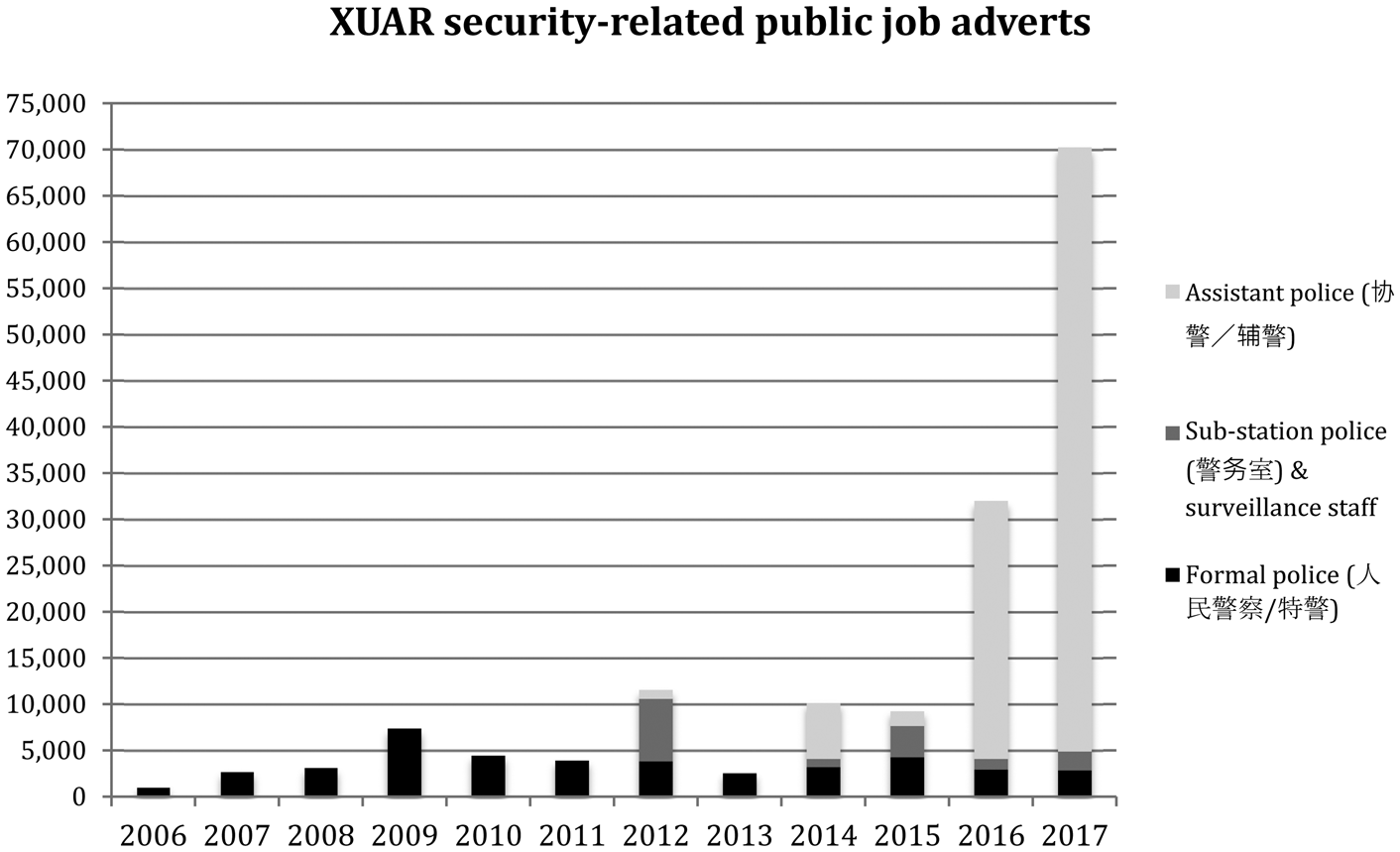
In January 2012, the region announced the recruitment of 8,000 new police officers in order to bolster security ahead of the 18th CCP National Congress.Footnote 31 The 2012 intake marked a significant turn in Xinjiang's policing strategy. A total of 12,030 security-related positions were advertised, a 56 per cent increase in advertisements compared to 2009. About 7,700 of the 9,800 advertised police force positions were for so-called “police sub-station workers” (jingwushi jingwu renyuan 警务室人员), who were to man small, community-based police substations (jingwushi 警务室) across the region. XUAR officials committed themselves to fully implementing the “one village, one policeman” (yicun yijing 一村一警) scheme, which had been rolled out in various eastern provinces during the early 2000s.Footnote 32 Under this policy, a single substation police officer oversees up to three assistant police staff in each rural village.Footnote 33 The 2012 intake therefore initiated the establishment of a multi-tiered police force. Police substation officers are part of the formal police force, except that their post is a public service post rather than a civil service one. Additionally, this intake marked the first time that Xinjiang advertised informally employed assistant police officers, albeit at a fairly low number (955 positions).
Overall, 71 per cent of the XUAR's 2012 police substation recruitment targeted regions with a Uyghur population share of 40 per cent or higher; this is far more than in 2009, when only 40 per cent of all security-related recruitment was aimed at such regions.
Grid-style community policing and big data surveillance, 2014–2015
In the wake of high-profile terror attacks in Xinjiang and elsewhere across China, which triggered Zhang Chunxian's “war on terror” declaration, the 2014 intake marked a decisive shift in Xinjiang's security strategy that is not reflected in numbers alone. On the one hand, it reinforced the trend towards large-scale, flexible police force expansion by advertising nearly 6,000 lower-tier assistant police positions. On the other hand, it introduced numerous new security-related recruitment categories in line with massive investments in high-tech surveillance and community-based policing.
One important aim of the 2014 intake was the consequent expansion of so-called “grid-style social management” (shehui wanggehua guanli 社会网格化管理). Grid management harnesses new surveillance technologies and big data analytics to comprehensively monitor activities within a discrete geometric zone.Footnote 34 It was piloted in Beijing and Shanghai during the early 2000s and then gradually rolled out in frontier regions like Xinjiang and Tibet following the 2008–2009 unrest.Footnote 35
In order to provide the necessary manpower, XUAR officials began advertising for “patrol and prevention” (xunluo fangkang 巡逻防抗) and “grid patrol and prevention” (wanggehua xunkang 网格化巡抗) staff. Most of the advertised positions were poorly paid and offered on an informal (contract) basis, much like the assistant police category positions, with clear overlaps in employment terms. At the same time, the XUAR also began to employ dedicated police technicians in an effort to enhance smart surveillance capabilities. In 2014, security recruitment included, for the first time, video surveillance (shipin jiankan 视频监看) staff, who were employed on a “public service-like” basis, as explained above. The evolution towards new surveillance-oriented, technology-focused security jobs continued in 2015 with the introduction of internet surveillance and prevention (wangluo jiankan 网络监看) positions in addition to the existing internet security (wangluo anquan 网络安全) job category, which was first introduced in 2009. In Urumqi alone, over 160,000 security cameras were installed by 2016, with 1,000 video surveillance staff to monitor them on a 24-hour basis.Footnote 36
“Convenience police stations” and the massive expansion of surveillance manpower, 2016–2017
Since Chen Quanguo became regional Party secretary in August 2016, police recruitment has increased exponentially, reaching levels that have never been seen before, either in Xinjiang or in China as a whole. In outlining his policy agenda in September 2016, Chen stressed the importance of “placing stability above all else,” and called on security officials to adopt a more proactive, systematic and fine-grained approach to combatting the “three evil forces” of terrorism, extremism and splittism.Footnote 37
During Chen's first 12 months in office, the XUAR advertised 100,680 security-related positions, representing a 13-fold increase over the average number of advertisements in the years 2009 to 2015.Footnote 38 Nearly all of these positions (97,629) were advertised for formal as well as assistant police forces. This compares to only 64,505 advertisements (45,056 for police forces) during the decade between 2006 and the summer of 2016. Chen's unprecedented recruitment drive seeks to boost the party-state's surveillance capabilities across all parts of Xinjiang, without a particular focus on potentially restive Uyghur regions. Between 2016 and 2017, only 35.5 per cent of advertised positions were designated for regions with a Uyghur population of 40 per cent or higher, which is below the XUAR's overall Uyghur population share of 47.9 per cent (2015).
Notably, 86 per cent of the new hires were for assistant police positions, and most of them were directly associated with the construction of so-called “convenience police stations” (bianmin jingwuzhan 便民警务站) across the XUAR. In dense urban centres such as Kashgar 喀什 and Urumqi, these stations can now be found every 300 to 500 metres, after Chen first pioneered this approach in the Tibetan Autonomous Region in 2011. As a key part of grid management infrastructure, each station is responsible for monitoring a dedicated zone.Footnote 39 From the texts of job advertisements, it is clear that the primary duties of assistant police forces are extensive patrols (often 24-hour shifts) and manning the numerous new checkpoints that have been established across the region. An academic who visited Xinjiang in April 2018 noted that “in Uyghur neighbourhoods in Urumqi, Turpan and Kashgar, there was an exponential increase in the presence of Uyghur police officers (without firearms) patrolling the streets, working at convenience police stations and checking phones and IDs of Uyghur pedestrians and drivers.”Footnote 40
While precise numbers are unclear, some have estimated that the XUAR government built or renovated an estimated 7,300 of these stations across Xinjiang by March 2017, with hundreds more commissioned in the subsequent months.Footnote 41 Depending on their size, convenience police stations have a staffing quota of six to thirty security personnel, while current advertised posts suggest around 12 to 13 assistant police officers per station.Footnote 42 This suggests that Xinjiang's police recruitment drive will probably continue.
This latest wave of security-related recruitment completes what we can tentatively call a three-tier policing strategy in Xinjiang (Figure 1). The top tier consists of regular (PSB) police officers and the SPU police force. The middle tier is composed of substation police officers who form localized hubs of policing, often in rural and remote regions with previously low levels of securitization. Finally, the third and lowest tier comprises various types of assistant police staff who provide a large amount of additional manpower at the local community level.
Total Police Recruitment by Type of Police Force across the XUAR, 2006–2017

Measuring the scale of Xinjiang's police force
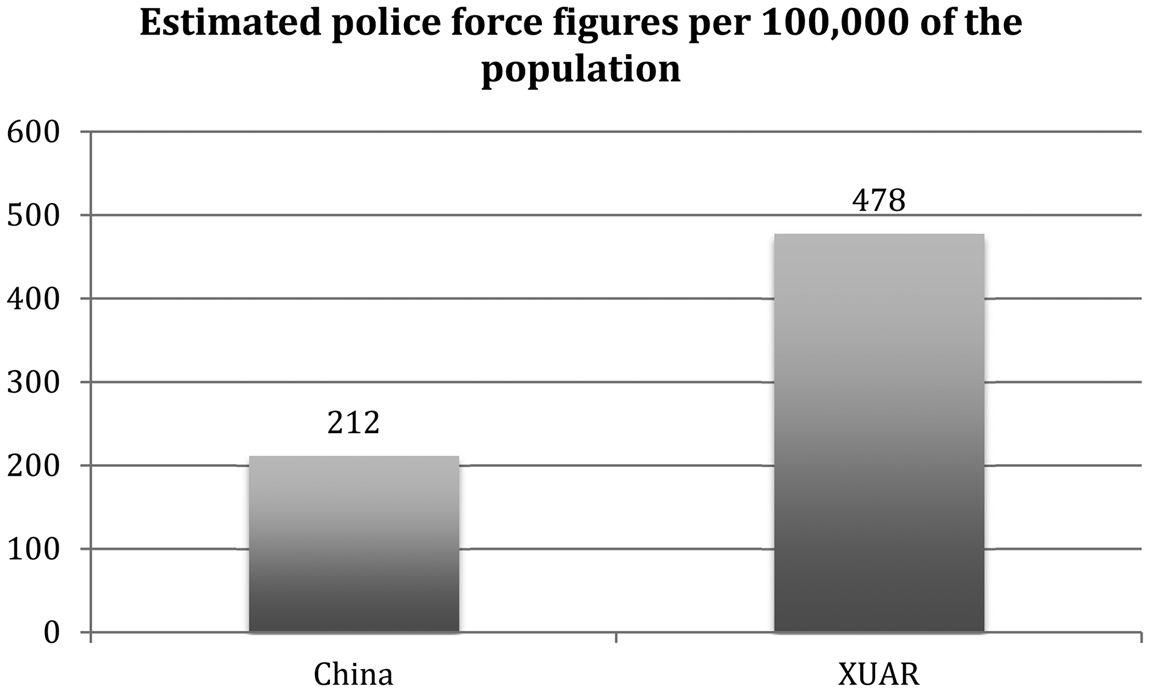
To get an impression of the significance of these recruitment volumes, we attempt to compare police force figures for China as a whole and the XUAR on a per capita basis. As noted above, China's uniform police numbers were estimated at 2 million in 2011. Our estimate for a national stock figure in 2017 assumes that growth rates in recent years have been faster than during the period between 2002 and 2011, as regions other than the XUAR also recruited assistant police positions, although not nearly as many. We conservatively estimate the national 2017 stock figure to be 2.625 million, or 212 per 100,000 of the population.Footnote 43
For the XUAR, the total per capita figure is based on an estimated 2007 stock level of 21,480, or 75 per cent of the national per capita average at that time. The XUAR 2017 stock level is assessed based on a conservative 75 per cent recruitment rate estimate for all policing-related advertisements between 2008 and August 2017, as well as an annual attrition rate of 3 per cent owing to retirement, death and other causes. This yields a total police stock figure of 112,886.Footnote 44 The resulting per capita count is 478, which is 2.3 times the estimated national per capita figure (see Figure 2). In 2017, Xinjiang's per capita police figure was an estimated 17 per cent higher than that of Hong Kong.Footnote 45 In addition, Xinjiang has very likely exceeded the per capita police count of the former German Democratic Republic (GDR), which stood at about 453 in 1989.Footnote 46 Since police officers only represent one component of the security state, such comparisons cannot be used to compare either the surveillance capabilities or the overall coercive capacity of each region's security state. They simply show the magnitude of Xinjiang's most recent police intakes.Footnote 47
Per Capita Count of All Police Force Types, Excluding the PAP

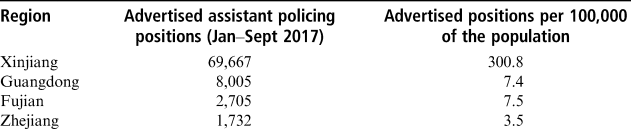
Even though assistant police recruitment has become a new trend throughout China, Xinjiang's recent recruitment drive is unprecedented in scale. Assistant police recruitment figures are difficult to assess with great accuracy owing to the highly scattered nature of the post advertisements. Even so, our compilation of assistant policing-related advertisements for January to September 2017 shows that, on a per capita basis, Xinjiang advertised 40 times more positions than either Fujian or Guangdong province, and nearly 90 times more than Zhejiang province (Table 2).
Regional Comparison of Informal Police Recruitment

Sources:
Assistant police recruitment notices from the respective regions (all administrative levels).
The combination of low-skilled foot soldiers stationed in and around convenience police stations and high-tech surveillance equipment connected to an expanding information processing system has created “complete coverage,” according to the XUAR 2018 work report, “without any chinks, blind spots, or blank spaces.”Footnote 48 Over the past decade, the focus of Xinjiang's security apparatus has shifted from responding to outbreaks of violence to preventing and even predicting where unrest might occur. During a 2017 inspection tour of Xinjiang, the Party's top security official, Meng Jianzhu 孟建柱, praised the rapid advancement of digital policing, calling for the “organic merger of modern technologies with counter-terrorism work, in order to push forward and deepen the use of big-data, AI and other technologies … [in] weiwen work.”Footnote 49
Yet, these official assessments overstate the capabilities of digital policing in Xinjiang at present. Despite massive investments in new technologies, surveillance work is still in many ways reliant on large-scale human resource recruitment. As visitors to the region have noted, the party-state currently relies on a large number of unarmed informal police staff (not to mention private and volunteer security officials) to perform daily security tasks such as monitoring CCTV feeds, conducting patrols, ID checks and scanning mobile phones for suspicious content.Footnote 50
Informal Police Recruitment: Outcomes and Conditions
Police recruitment in Xinjiang has focused almost entirely on informal, contract-based positions since 2014. This section seeks to analyse recruitment outcomes and employment conditions for this new category of informal police. Below, we will argue that by offering high wages and good benefits in exchange for fairly low educational requirements, the assistant police force boosts the security ranks while providing employment opportunities for underprivileged segments of the population. This lures rural, surplus labourers and lesser-educated minorities like the Uyghurs into policing their own people.
Informal police recruitment outcomes
Hiring shares are the percentage of advertised positions that are actually filled by applicants. In Xinjiang, hiring shares for police officers who are recruited on a formal employment basis are typically higher than 80 per cent, for example numbering 88 per cent in the 2015 civil service intake. This is not surprising considering the popularity of civil service employment, with recruits enjoying higher wages, comprehensive benefits and secure lifetime employment. In contrast, assistant police positions have typically been characterized by lower pay, fewer benefits, time-limited contracts and demanding patrol duties.Footnote 51 In this context, sustained high hiring shares for informal policing jobs would be somewhat surprising.
A sample of four rural sub-police station intakes from 2012, which included advertised positions in Hotan 和田, Kashgar, Aksu 阿克苏 and Changji 昌吉 prefectures, resulted in a hiring outcome of 1,736 out of 1,810 advertised positions, a hiring share of 96 per cent. A sample of eight assistant police intakes from Tacheng 塔城, Changji, Kashgar and Turpan 吐鲁番 prefectures in 2016 achieved a hiring share of 86 per cent (3,208 of 3,732 positions filled). However, a similar sample of 15 assistant police intakes from the regions of Bayingolin 巴音郭楞, Hami 哈密, Karamay 克拉玛依, Tacheng, Kashgar, Turpan, Aksu and Bortala 博尔塔拉 in 2017 showed that only an average of 66 per cent of advertised positions were filled (7,781 of 11,709). This 2017 sample, however, is heavily dominated by intakes for Bayingolin, many of which had low hiring shares. In contrast, eight other regions with available outcome documents for 2017 featured the same high hiring share of 86 per cent as the 2016 sample (3,039 of 3,527 positions filled).
Strong regional variation and an insufficient number of outcome documents across different regions make hiring share estimates difficult. However, despite their lack of formal job security and demanding working conditions, hiring shares for informal police jobs remain largely comparable to those in formal government employment. This is all the more surprising when considering that under Chen Quanguo, over 90,000 of such informal police positions were advertised within 12 months.
Rising informal police wages
This perhaps unexpected assessment is likely related to the fact that Xinjiang's current informal police market pays remarkably and increasingly well, while educational requirements are comparatively low. Rising wages for informal police positions mirror a national trend. As recently as 2010, an online forum user from Anhui complained that assistant police officers only earned 600 to 900 yuan per month.Footnote 52 Another social media user from a smaller, county-level city lamented in 2012 that their monthly assistant police salary amounted to only 740 yuan.Footnote 53 A forum discussion in late 2013 to early 2014 among those in assistant police positions yielded a monthly average salary of 1,290 yuan. Many complained that their jobs did not provide any benefits.
By 2017, the situation had changed drastically. A cursory survey of 14 assistant police job advertisements in Fujian and Guangdong provinces that year shows that in the smaller cities in these regions, monthly gross salaries ranged between 3,000 to 3,300 yuan/month, while larger cities or provincial capitals paid between 4,150 and 5,000 yuan/month.Footnote 54 Moreover, all of the surveyed positions now came with a standard set of social benefits, the so-called “five insurances” (wu xian 五险) of pension, medical, unemployment, injury and maternity insurance, as mandated by the 2011 Social Insurance Law.
In 2016/17, nearly 93 per cent of XUAR police positions were advertised as being on an informal (contract) basis and outside the formal quota system (Table 3). However, as shown below, contract-based positions now pay nearly as well as or even better than formal government employment. In addition, all recent informal police positions in Xinjiang were advertised with the standard set of social benefits (“five insurances”).
2016 and 2017 XUAR Informal Police Intakes by Employment Type

Sources:
XUAR and XPCC civil and public service recruitment notices; informal police job advertisements from all administrative levels. Figures do not include formal police positions advertised outside the civil service or second-tier police force positions.
Already in 2014, only 7 per cent of all advertised assistant police positions came with notably inferior employment conditions compared to formal government posts. An example is Shache 莎车 county in Kashgar prefecture, which was recruiting patrol and prevention staff on a 2,600 yuan monthly wage. However, this wage was 23 per cent higher than the Kashgar prefecture average of 2,114 year/month, making it quite a decent source of income for a rural southern region.
As the number of informal police positions skyrocketed in late 2016, so did wages, with many positions paying monthly salaries that were almost comparable to positions in the formal state/corporate sector.Footnote 55 Between January and August 2017, the promised monthly pay for new recruits in all types of informal security-related positions in Xinjiang averaged 4,727 yuan/month. This was only 11 per cent below the 2016 average for formal corporate/state employment of 5,312 yuan/month, and significantly higher than the 2016 average private enterprise wage of 3,231 yuan/month.Footnote 56 Also, informal security-related job wages in Xinjiang exceeded those taken from a sample of 14 intakes from Fujian and Guangdong provinces (3,961 yuan/month) by 19.3 per cent. Most positions (58 per cent) paid between 4,000 and 6,000 yuan/month, while only 4.4 per cent of them continued to remunerate at very low levels (Figure 3).
Shares of Advertised Non-formal Security-related Positions by Monthly Wage Level, January–August 2017

Lower educational requirements
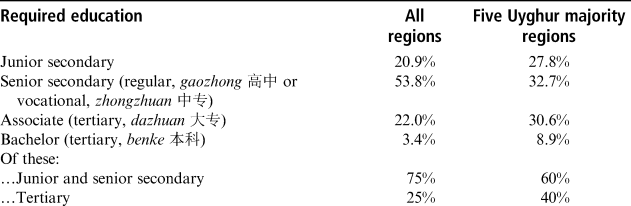
Despite offering competitive salaries and increasingly comprehensive benefits, and frequently providing opportunities to enter formal government employment through exams, the educational requirements for informal police positions are basic. Whereas formal civil service security-related positions always require at least a lower tertiary degree (dazhuan 大专), many informal security-related jobs only specify a secondary education, and at times only a junior secondary degree, as their minimum educational requirement. For Xinjiang's five prefectures with a Uyghur majority population, the distribution is more strongly skewed towards each extreme, with most positions requiring either junior secondary schooling or specifying a tertiary degree (see Table 4). Even so, the majority of advertised posts in these regions still carry lower requirements than civil service positions.Footnote 57 According to informants, locals complain that the “cultural level” (suzhi 素质) of many assistant police officers is very low, a factor they attribute to these positions’ low educational requirements. In particular, a visiting academic was told by Uyghur informants in April 2018 that lesser-educated Uyghur assistant police officers were considered to be some of the worst bullies in the entire police force.Footnote 58
Informal Police Positions by Educational Requirements and Region

Sources:
Informal police job adverts from all administrative levels. The five Uyghur majority regions are Aksu, Hotan, Kashgar, Kizilsu and Turpan.
A closer look at advertised informal police pay levels shows that they do increase with required educational levels (Table 5). However, the gap between positions mandating senior secondary versus tertiary degrees is not nearly as pronounced as for other government or formal private sector work in general. In particular, average pay levels for positions that only require junior secondary degrees are much higher than for the types of low-skilled jobs that this underprivileged segment of the population would otherwise be able to secure. Compared to the Xinjiang average, salaries for secondary graduates in the five Uyghur majority regions are about 20 per cent lower, reflecting a larger pay gap between secondary and tertiary graduates in these regions. However, they still compare favourably to local private sector salaries.
Average Advertised Pay for Informal Police Positions by Educational Requirements and Region, January–August 2017

Sources:
Informal police job advertisements for all administrative levels. Figures are based on the 56,939 analysed informal security-related positions advertised in 2017 throughout the XUAR that specified both required education and monthly pay.
Consequently, the employment situation of Xinjiang's informal police sector contrasts sharply with general employment trends in China, where job prospects and resulting pay levels are directly correlated to educational achievement. In 2011, the average wage of urban tertiary degree holders was 2.4 times higher than the pay levels of those holding high school degrees and 3.2 times higher than for those with just a junior middle school degree.Footnote 59
Minority police employment and self-policing
Average informal police wages in Uyghur majority regions are similar to those across the XUAR (Table 5). This is remarkable in light of the fact that there is a large disposable income gap between the Han-dominated, industrial north and the rural south. In 2016, for example, Kashgar prefecture's annual per capita disposable income amounted to 11,273 yuan, 39 per cent below the XUAR average.Footnote 60 By comparison, the oil city of Karamay in the north had an annual per capita disposable income of 35,770 yuan.Footnote 61
High-wage informal police positions that do not require a tertiary education represent a new career option for lesser-privileged minority populations. While outcome documents that list recruits by ethnicity are relatively rare, a non-representative sample of three assistant police recruitment drives in Kashgar prefecture in 2015 and 2016 shows that 83.2 per cent of those hired were Uyghurs. Informant and visitor reports confirm that many new police positions in the south of the province are being filled by ethnic minorities, many of whom appear to originate from the countryside.Footnote 62
According to several sources, many Uyghurs and other disenfranchised minorities have been entering the security forces since at least 2015/2016, partly owing to a lack of viable employment alternatives but also because they thought it would protect them from future persecution.Footnote 63 Under Chen Quanguo, Uyghurs living in southern villages are facing far more stringent residential restrictions. For example, they cannot easily get a permit to live or work in urban centres. Accepting a police position is one way to escape this confinement while at the same time securing stable, yet not unproblematic, employment.
Consequently, this massive informal police recruitment drive kills two birds with one stone for the party-state. Not only do they flexibly enlarge the state's surveillance apparatus but they also provide well-paying jobs for impoverished minority populations, while getting ethnic groups to police their own people. Ethnic minorities have long served the Party in China. However, the number of Uyghurs and other minorities recruited into the police force in Xinjiang far exceeds previous recruitment and forms a key part of the current regime's security strategy. Moreover, Uyghur recruitment into the police force represents a large-scale employment creation strategy in a context where extreme securitization measures have negatively impacted other employment sectors and prompted those with better skills and educational levels to leave the region.
However, Uyghurs and other minorities who join the police force have reportedly had to endure in an extremely demanding and stressful environment. Informants and visitors have noted that the police in Xinjiang suffer from health and social problems owing to the high pressures of the job and frequent overtime. A substantial share of assistant police wages consists of performance-dependent bonuses, which are cut if performance goals are not met. Even worse, however, is the fact that minorities are reportedly unable to freely resign from police positions. According to several sources, those who seek to do so are threatened with detainment in re-education camps.Footnote 64 An assistant policeman from Kizilsu 克孜勒苏, a Kyrgyz minority region with a significant Uyghur population share, posted on a legal advice website that he wants to resign but that his superior is threatening him with internment in a re-education camp should he do so.Footnote 65
Conclusion: Winning the War on Terror?
The securitization of Xinjiang society is set to become increasingly institutionalized over the coming years. The XUAR government's most recent work report affirms that the unabated terror risk requires continued vigilance. Asserting the need to “maintain a high-pressure, strike-hard posture,” it maintains that the current “preventative measures” must be “normalized” across society in 2018.Footnote 66
In order to meet this demand, Xinjiang's police recruitment is pushing the boundaries of the formal public recruitment system, a development that may well be a harbinger of developments elsewhere in China. Importantly, for Xinjiang, the security forces have become a major employer, especially in the more impoverished minority regions. This creates new social mobility opportunities for Uyghurs and other minority youth while co-opting them into the party-state system and increasing the Party's security footprint.
By incorporating minorities into the police, the CCP is drawing on an age-old colonial strategy, one which enlists “natives” to watch over other “natives” while the colonial masters continue to pull the strings behind the scenes. Yet, as Chen Xi notes, securitization is not only expensive – as noted by the rising wages attached to informal police positions – but can also undermine the Party's legitimacy by encouraging “excessive and illegitimate uses of force.”Footnote 67 This encourages “unruly behaviour” and also undermines inter-ethnic trust and sociability in Xinjiang. In the end, securitization feeds on itself, with the fear of instability leading to increased security work, which in turn increases fear and sparks unrest.
On the surface, Xinjiang's heavy-handed securitization approach seems to have reduced the frequency of political violence. The last reported major attack occurred near Aksu in September 2015, and since early 2017 there has not been a single reported attack involving fatalities. However, tough policing methods can foster fertile breeding grounds for radicalization over the long run. As Toni Michel, borrowing a phase from Abraham Maslow, put it, securitization, understood as the weltanschauung of viewing all things through the security lens, is like “holding a hammer – and suddenly every problem looks like a nail.”Footnote 68
Rather than channelling popular discontent through inclusive socio-political mechanisms, intense securitization tends to indiscriminately suppress radical and moderate views alike, thus failing to allow the development of the diversified and bottom-up responses urgently needed for countering discontent and radicalization. Xinjiang's extreme security measures, and in particular the practice of detaining many thousands of people –perhaps over a million and a half – in secret extrajudicial re-education camps, are sure to further alienate the Uyghur population, especially if and when detainees are returned to their communities.Footnote 69
Ultimately, however, stability maintenance in the region also depends on a delicate “partnership of stability” between Xinjiang's sizeable Han population and the party-state.Footnote 70 Severe restrictions on movement and omnipresent security measures add considerable costs to doing business in Xinjiang. Perhaps even more significant, they make daily life unpalatable for many, including the younger generation who complain about a lack of a vibrant and fun nightlife when compared to the eastern regions. Anecdotal reports from local informants suggest many Han have left Xinjiang or are actively preparing to do so should an opportunity arise. If the normalization of the present security state more directly disaffects the Han, then Xinjiang's “partnership of stability” is in danger of disintegrating.
Acknowledgements
The authors gratefully acknowledge the helpful comments of colleagues on previous drafts and for sharing insights from their ethnographic research in Xinjiang. This project received funding from La Trobe Asia and the China Studies Research Centre at La Trobe University.
Biographical notes
Adrian ZENZ is an independent researcher and supervises PhD students at the European School of Culture and Theology, Korntal, Germany. His research focus is on minority education, public recruitment and securitization in Tibet and Xinjiang. He is the author of Tibetanness under Threat: Neo-integrationism, Minority Education and Career Strategies in Qinghai, PR China (Global Oriental, 2013), co-editor of Mapping Amdo: Dynamics of Change (Prague Oriental Institute, 2017) and a frequent contributor to the international media.
James LEIBOLD is associate professor and head of the department of politics, media and philosophy at La Trobe University in Melbourne, Australia. He is the author and co-editor of four books and over thirty peer-reviewed articles and book chapters on ethnic issues in modern China.