Stereotypes are rigid and oversimplified sets of beliefs (perceptions) about members of a group or category of people. By representing the typical traits of a group or category of people, stereotypes let us understand new individuals in terms of old beliefs, thus providing a great deal of information with a minimum amount of cognitive effort. These sets of beliefs provide insight into how others might behave and how we ourselves should behave in social encounters. The difficulty is that these sets of beliefs are often overgeneralized and do not completely represent any particular older person or situational context.
Numerous age stereotypes exist, most of them negative, linking older age with traits and concepts such as disease, disability, dependence, incompetence, and demise (Barrett & Cantwell, Reference Barrett and Cantwell2007; Kwong See, Hoffman, & Wood, Reference Kwong See, Hoffman and Wood2001; Rowe & Kahn, Reference Rowe and Kahn1998; Ryan & Kwong See, Reference Ryan and Kwong See1993). Positive stereotypes of older adults (e.g., older adults are honest, kind, wise, affluent, powerful, dependable, and happy) also exist in our society (Kwong See et al., Reference Kwong See, Hoffman and Wood2001; Lee, Carpenter, & Meyers, Reference Lee, Carpenter and Meyers2007; Palmore, Reference Palmore1990; Ryan, Jin, & Anas, Reference Ryan, Jin and Anas2009; Ryan, 2002; Ryan, Jin, Anas, & Luh, Reference Ryan, Jin, Anas and Luh2004). However, it is the negative stereotypes of aging that predominate (Kite, Stockdale, Whitley, & Johnson, Reference Kite, Stockdale, Whitley and Johnson2005; Stones & Stones, Reference Stones and Stones1997).
Beliefs are associated with attitudes (Wilkinson & Ferarro, Reference Wilkinson, Ferraro and Nelson2002). Attitudes are positive or negative evaluations of beliefs that often predispose a person to feel and behave in line with the evaluation (Hummert, Garstka, Shaner, & Strahm, Reference Hummert, Garstka, Shaner and Strahm1995; Wilkinson & Ferarro, Reference Wilkinson, Ferraro and Nelson2002). In a meta-analysis of the literature through 2000, Kite et al. (Reference Kite, Stockdale, Whitley and Johnson2005) found that attitudes towards older people were more negative than attitudes towards young adults. Attitudes can lead to discrimination (i.e., behaviour directed at people because of their membership in a group) (e.g., Kwong See & Heller, Reference Kwong See and Heller2004, Reference Kwong See, Heller, Palmore, Branch and Harris2005; Kwong See & Ryan, Reference Kwong See, Ryan, Schwarz, Park, Knauper and Sudman1999; Kwong See et al., Reference Kwong See, Hoffman and Wood2001; Wilkinson & Ferarro, Reference Wilkinson, Ferraro and Nelson2002). The meta-analysis of 232 studies by Kite et al. (Reference Kite, Stockdale, Whitley and Johnson2005) supports the notion that evaluations of older adults are complex and multidimensional. Kite et al. (Reference Kite, Stockdale, Whitley and Johnson2005) and Kite and Johnson (Reference Kite and Johnson1988) found that differences in attitudes towards younger and older adults were minimized when the studies focused on personality traits, as opposed to competency dimensions, which indicates that attitudes can be more or less negative, depending on the dimension being assessed.
Beliefs about and attitudes towards one age-specific disease, Alzheimer’s disease (AD), have been largely overlooked. It is estimated that half a million Canadians have AD or another related form of dementia. Projections are that, by 2025, the number of persons affected by these diseases will double as the population ages (Alzheimer Society of Canada, 2010). AD is characterized by progressive memory loss. Other symptoms of AD may include coordination problems, loss of cognition, impaired judgment, behaviour and personality changes, and the inability to perform normal activities of daily living. Whereas the progression of the disease is generally gradual, the rate and nature of symptom development can vary tremendously from one individual to another. Symptoms may occur at different times in different individuals, and not everyone will experience every symptom. Because of this variability, it has been recognized that an individualized approach to care is necessary to allow individuals to maintain their dignity and remaining abilities as the disease progresses (Rader, Reference Rader1995).
Using the Alzheimer Disease Knowledge Test and the multiple-choice version of the Facts on Aging Quiz #1, Rust and Kwong See (Reference Rust and Kwong See2007) found generally poor knowledge levels about AD and aging (42% and 39% correct respectively) among undergraduate students. Although the quiz is a test of knowledge and not intended as a measure of stereotypes, the most common misconceptions and areas of ignorance on the quiz suggested that participants were relying on age stereotypes (e.g., grouchy, poor, socially isolated, bored) when answering the questions, although there was a tendency to admit more ignorance by choosing the “don’t know” option when questions assessed knowledge about AD. A clear measure of beliefs about AD, therefore, is lacking.
Attitudes towards persons with AD have been explored by Kahana, Kinney, Kercher, Kahana, Tinsley, King et al. (Reference Kahana, Kinney, Kercher, Kahana, Tinsley and King1996). These researchers compared the attitudes of nursing home employees towards three target groups including well elderly, physically ill elderly, and persons with AD. They used a sample of items from Rosencranz and McNevin’s (Reference Rosencranz and McNevin1969) semantic differential scale as a measure of attitudes. These items included the following attributes: (a) good, (b) optimistic, (c) warm, (d) pleasant, (e) wise, (f) generous, (g) friendly, (h) cooperative, (i) acceptable, and (j) profit from help. Results indicated that the overall evaluations of the three groups were most positive for the well elderly, more negative for the physically ill elderly, and most negative for the persons with AD. This pattern was observed for all of the items except “optimistic”.
The cognitive aspects of AD are often noted in the media, and such information is readily available on the Internet, such as on the Alzheimer Society website (Alzheimer Society of Canada, 2010). However, physical and social aspects of the disease are not often discussed, and it is unclear how well-known the disease-related changes in these domains are. Although the Kahana et al. (Reference Kahana, Kinney, Kercher, Kahana, Tinsley and King1996) study provides some insight about attitudes generally, very little is known about the nature of people’s beliefs and stereotypes about AD held in our society and the valence (degree of negativity) about the beliefs. This is important to know, as beliefs presumably guide behaviour that individuals exhibit towards persons with AD.
As a first step, using a convenience sample and a new instrument, the objective of this study was to explore beliefs about aging and AD in the cognitive, social, and physical domains. The methodology we adopted has been used successfully before to develop a tool to measure a previously unexplored domain (language) and to document beliefs about aging in that domain (see Ryan, Kwong See, Meneer, & Trovato, Reference Ryan, Kwong See, Meneer and Trovato1992).
Method
Participants. Undergraduate students (n = 140) participated in the study. Those who indicated that they were not native speakers of English rated their proficiency in English on a 7-point Likert scale ranging from 1 (poor) to 7 (excellent). Those who rated their proficiency as 5 or less were eliminated from the sample because proficiency in English was deemed important for understanding the items and completing the questionnaire. The remaining sample consisted of 117 students who ranged in age from 17 to 43 years (M = 19.90 years, SD = 3.12 years). All participants received course credit in their introductory psychology course for participation.
Materials. The development of this questionnaire was modelled after the development of the Language in Adulthood (LIA) Questionnaire (Ryan et al., Reference Ryan, Kwong See, Meneer and Trovato1992) which assesses beliefs about the language abilities of young and old adults. The format of the LIA was used in this questionnaire, as were some questions from the LIA. Other items were added so that three domains of interest (cognitive, social and physical) could be examined. Items categorized into cognitive, social, and physical domains were selected to allow determination of whether beliefs differ in the pattern of positivity or negativity between these domains, since these are the categories that were identified by Slotterback and Saarnio (Reference Slotterback and Saarnio1996) as the major categories of attributes in an examination of several studies.
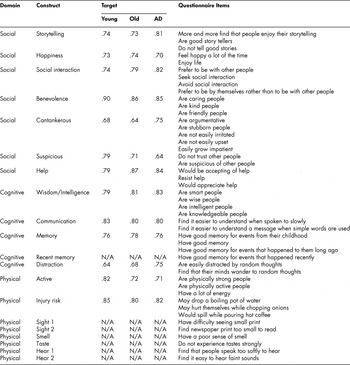
The questionnaire consisted of 46 statements about cognitive, social and physical abilities (see Table 1 for items). Development of items was guided by beliefs and stereotypes about aging identified in the literature (Kwong See et al. Reference Kwong See, Hoffman and Wood2001; Levin & Levin, Reference Levin and Levin1980; Palmore, Reference Palmore1990; Rowe & Kahn, Reference Rowe and Kahn1998; Ryan & Kwong See, Reference Ryan and Kwong See1993; Ryan et al., Reference Ryan, Kwong See, Meneer and Trovato1992). For example, it has been shown that older adults are rated as being better storytellers than young adults; therefore, items about storytelling were selected for the questionnaire (Ryan et al., Reference Ryan, Kwong See, Meneer and Trovato1992). Similarly, other studies have demonstrated that older adults are rated as more benevolent than younger adults. Therefore, items such as “are kind people” and “are friendly people” were selected (Kwong See et al., Reference Kwong See, Hoffman and Wood2001). Additional items were guided by intuitive guesses about what might be beliefs about AD (e.g., proclivity towards injury while performing activities of daily living).
Final questionnaire subscales and reliability estimates

On the items, participants rated the degree to which they agreed that each statement pertained to three target groups – typical 25-year-olds (young target), typical 75-year-olds (old target), and typical institutionalized persons with AD (AD target) – using 7-point Likert scales (described below). Items listed in Table 1 were those viewed by participants when rating the three target groups. When rating young-target groups, the item would read “typical 25-year-olds are good storytellers,” “typical 75-year-olds are good storytellers,” or “typical institutionalized persons with AD are good storytellers”.
By looking at the differences in ratings between the young target and the old target, we can determine participants’ beliefs (perceptions) about differences between these two target groups. We inferred that these differences reflect beliefs about the aging process. By looking at the differences in ratings between the old target and the AD target, we inferred that these differences reflected beliefs (perceptions) about persons with AD, over and above what might be expected just from aging.
Procedure. Participants were presented with a booklet that contained five sections. Participants were asked to indicate their degree of agreement with each statement on a 7-point Likert scale ranging from 1 for strong disagreement to 7 for strong agreement for each statement. In the first section of the booklet, participants indicated the degree to which they agreed that the statements pertained to themselves. Participants rated themselves as a target group first to stimulate thinking about the items and to provide a benchmark against which to rate typical others (typical 25-year-olds, 75-year-olds and AD target group). The self-ratings were not pivotal to the questions asked in this study, because in this examination we were not interested in comparing self-perceptions across different age groupings (see Ryan et al., Reference Ryan, Kwong See, Meneer and Trovato1992), but rather, in documenting differences in beliefs, if any, about different target groups. In the second, third, and fourth sections of the booklet, participants indicated the degree to which they believed the statements pertained to the young, old, and AD target groups in counterbalanced order. In the fifth section, participants provided demographic information.
Results
Reliability estimates (Cronbach’s alpha) were calculated for constructs represented by more than one item (estimates for constructs composed of only one item are marked N/A) for each target group. These are presented in Table 1. Reliability was generally reasonable with most estimates above .70 (Nunnally & Bernstein, Reference Nunnally and Bernstein1994).
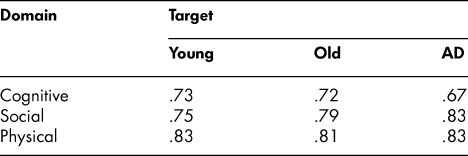
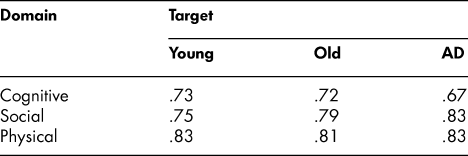
Reliability estimates were then calculated for each of the three target groups and in each of the three domains (cognitive, social, and physical). All the items comprising each domain were included in the calculation of the reliability estimates. The Cronbach’s alphas for each of the domains are presented in Table 2.
Reliability estimates for the cognitive, social, and physical domains for each target
Questionnaire items were recoded so that higher scores (7) always represented more positive beliefs, and lower scores (1) always represented more negative beliefs. For example, Strongly Agree (7) on the item “are friendly people” would indicate a positive belief, so this item would not need to be recoded. Alternatively, Strongly Agree (7) on the item “are stubborn people” would indicate a negative belief, so the participants’ responses on this item would be recoded such that 7 would be recoded to 1, 6 to 2, and so on. In this way, a 7 would now indicate a positive belief.
The main analyses we conducted were repeated measures multivariate analyses of variance. The Wilks’ lambda criterion was used for multivariate tests. Then univariate statistics and planned comparisons were conducted to understand the multivariate effects. Planned comparisons examined perceptions of the young target to perceptions of the old target to assess beliefs about aging, and we also compared perceptions of the old target to perceptions of the AD target to assess beliefs about AD over and above what is expected from aging. Reported effect sizes are partial eta squared (η 2).
Beliefs about Aging and AD in the Cognitive Domain
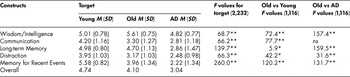
Composite scores for each construct were created by averaging the responses on the items comprising each construct (e.g., communication) for each target (i.e., young, old, and AD) separately. A multivariate analysis of variance was conducted for cognitive constructs of the beliefs questionnaire. This yielded a significant multivariate effect for Target F(2, 115) = 401.0, p < .001, η 2 = .88. Means, standard deviations, and the univariate simple contrasts to compare beliefs about aging (young vs. old), and AD (old vs. AD) are presented in Table 3.
Beliefs about aging and AD in the cognitive domain

*p < .05; **p < .001. ns = not significant. Higher scores indicate more positive beliefs for each construct.
The young target was rated most positively, the old target less positively, and the AD target least positively on all constructs except for Wisdom/Intelligence and Communication. For Wisdom/Intelligence, the old target was rated more positively than the young target, and the AD target was rated more negatively than the old target. The AD target was not rated differently than the old target on Communication.
Beliefs about Aging and AD in the Social Domain
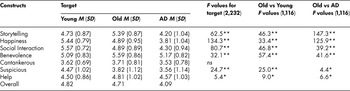
Composite scores for the constructs in the social domain were calculated in the same way as composite scores in the cognitive domain. A multivariate analysis of variance was conducted for social items of the beliefs questionnaire. This yielded a significant multivariate effect for Target F(2, 115) = 92.4, p < .001, η 2 = .62. Means, standard deviations, and the univariate simple contrasts to compare beliefs about aging (young vs. old) and AD (old vs. AD) are presented in Table 4.
Beliefs about aging and AD in the social domain

*p < .05; **p < .001. Higher scores indicate more positive beliefs for each construct.
ns = not significant.
For Suspiciousness, Social Interaction, and Happiness, the young were rated more positively than the old, and the old were rated more positively than AD. For Storytelling and Benevolence, the old were rated more positively than young and AD. The old were rated as being more accepting of help than the young or those with AD. There were no differences between targets in ratings for the Cantankerous construct.
Beliefs about Aging and AD in the Physical Domain
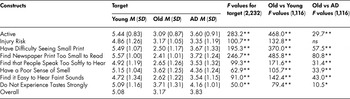
Composite scores for the constructs in the physical domain were calculated in the same way as composite scores in the cognitive and social domains. A multivariate analysis of variance was conducted for physical items of the beliefs questionnaire. This yielded a significant multivariate effect for Target F(2, 115) = 271.4, p < .001, η 2 = .83. Means, standard deviations, and the univariate simple contrasts to compare beliefs about aging (young vs. old) and AD (old vs. AD) are presented in Table 5.
Beliefs about aging and AD in the physical domain

*p < .05; **p < .001. Higher scores indicate more positive beliefs for each construct.
ns = not significant.
Students rated the old more negatively than the young on all constructs in the physical domain. Ratings of old and AD did not differ for Injury Risk. On all other constructs, beliefs about AD were more positive than for old.
Discussion
The objective of this study was to explore beliefs about aging and AD in the cognitive, social, and physical domains. Although beliefs about aging (e.g., Ryan et al., Reference Ryan, Jin, Anas and Luh2004, Reference Ryan, Jin and Anas2009), beliefs about AD in the social domain (Kahana et al., Reference Kahana, Kinney, Kercher, Kahana, Tinsley and King1996), and knowledge about aging and AD have been explored (e.g., Rust & Kwong See, Reference Rust and Kwong See2007), beliefs about AD in the cognitive, social, and physical domains have been largely undocumented. This study contributes to the literature by beginning the documentation of these beliefs in a sample of young adults. The instrument used to assess beliefs had reasonable reliability (Nunnally & Bernstein, Reference Nunnally and Bernstein1994) and can be used to assess beliefs about aging and AD in the cognitive, social, and physical domains.
Assessing students’ beliefs about aging and AD in the cognitive, social, and physical domains provides new information concerning beliefs about AD. In the cognitive domain, beliefs about the young target were more positive than beliefs about the old target on items – long-term and recent memory, susceptibility to distraction, and communication/language understanding – that are not associated with positive aging stereotypes (i.e., wisdom) (Palmore, Reference Palmore1990). Overall, students generally expected decline in cognitive abilities due to aging. This finding is consistent with the findings of Ryan (Reference Ryan1992), Ryan et al. (Reference Ryan, Kwong See, Meneer and Trovato1992), and Ryan and Kwong See (Reference Ryan and Kwong See1993). The same pattern was observed in terms of the differences between old and AD targets, except that wisdom/intelligence was expected to decline, and there was no difference in perceived communication/language understanding. This indicates that AD is seen very differently from normal aging in the cognitive domain.
What has been found that is unique from other studies concerning beliefs about cognition is what the beliefs about AD are in the cognitive domain. It has been documented that in AD, cognitive declines are believed to be larger than the declines expected in normal aging. Interestingly, there was no difference in the perception of AD and old targets on language understanding (communication). One interpretation is that language understanding is perceived to be poor in older age and not distinguishable from the language understanding of older persons with AD. Alternatively, the finding suggests that there is the belief that language understanding is preserved in the disease process.
In terms of the positive social stereotypes of aging in the social domain (i.e., storytelling and benevolence; Giles, Ryan, & Anas, Reference Giles, Ryan and Anas2008; Ryan et al., Reference Ryan, Kwong See, Meneer and Trovato1992, Reference Ryan, Jin, Anas and Luh2004), students in this study indicated that the old were better storytellers and more benevolent than the young. A documented negative stereotype of aging is that older adults are seen as cantankerous (Palmore, Reference Palmore1990). However, participants did not indicate that the old were more cantankerous than the young. Participants did indicate that older adults were less likely than young adults to want social interaction and were perceived to be less happy and more suspicious. This belief is in line with the controversial theory of aging, proposed by Cumming and Henry (Reference Cumming and Henry1961), which holds that aging is characterized by mutual withdrawal between the older person and society (disengagement theory). Such a belief can lead to less meaningful social interaction with older adults.
Beliefs about the AD target in the social domain were, overall, more negative than beliefs about the old target (desire less social interaction, less happy, more suspicious, less accepting of help) and in comparison to normal aging, storytelling (expressive language) and benevolence was perceived as declining. The overall pattern of findings is consistent with those of Kahana et al. (Reference Kahana, Kinney, Kercher, Kahana, Tinsley and King1996), who compared the attitudes of nursing home employees towards well elderly and persons with AD. The items they used (good, optimistic, warm, pleasant, wise, generous, friendly, cooperative, acceptable, and profit from help) were mostly social in nature. They found that the overall evaluations were more negative for the persons with AD than the well elderly for all of the items except for “optimistic”.
In the physical domain, students’ beliefs about the old target were more negative (i.e., less active; more likely to be injured; have difficulty with vision, hearing, sense of smell, and taste) than beliefs about the young target. This is consistent with stereotypes of aging that link aging with a decline in sensory functioning, physical ability, personal vitality (Giles et al., Reference Giles, Ryan and Anas2008), and actual declines in physical functioning. Surprisingly, participants’ beliefs were more positive for the AD target than for the old target in the physical domain except for injury risk. They believed that persons with AD had a higher level of activity and better sensory functioning than the old and that persons with AD were no more likely than the old to be at risk for injury. It is possible that students’ positive view of the physical aspects of AD is the result of the belief that AD is solely a disease of the mind, or perhaps they have been exposed to information about the wandering registry or news stories where persons with AD have wandered away from home and have been found at a previous residence. Such information could lead one to believe that persons with AD are very physically capable.
Whereas there is considerable literature documenting declines in sensory functioning and physical strength in aging (e.g., Schieber, Reference Schieber, Birren and Schaie2006), the literature has lacked an emphasis on these areas in AD. Therefore, it is difficult to say how the beliefs are linked to reality. Students’ beliefs that persons with AD are physically capable and not cognitively capable could lead to fear of persons with AD. This could lead people to avoid interactions with persons with AD and could give some insight into the origins of reservations about working with older adults and persons with AD (Giardina-Roche & Black, Reference Giardina-Roche and Black1990). A lack of desire to work with adults has been exhibited by different student groups, including physician assistants (Woolsey, Reference Woolsey2007), nutrition students (Lee, Hoerr, Weatherspoon, & Schiffman, Reference Lee, Hoerr, Weatherspoon and Schiffman2008), student nurses (Henderson, Xiao, Kelton, Paterson, & Siegloff, Reference Henderson, Xiao, Kelton, Paterson and Siegloff2008), and student social workers (Cummings, Cassie, Galambos, & Wilson, Reference Cummings, Cassie, Galambos and Wilson2006).
Overall, this study has corroborated some previously found results and introduced new insights for further research. Across domains, it was found that beliefs about some receptive aspects of language (comprehension with slowed rate of speech) were not perceived differently compared to aging, suggesting perhaps a belief about preserved functioning, but that expressive language (as shown by storytelling) may be declining in the AD disease process. There is also a perception that AD is primarily a disease of the mind, but the body, in comparison to normal aging, is associated with enhanced physical prowess. The findings – perceived gains in the physical domain and largely losses in the social and cognitive domains – advance our understanding of beliefs about AD. The finding of beliefs about gains and losses is consistent with the age-related gains and losses identified by lifespan theorists (Baltes & Carstensen, Reference Baltes and Carstensen1996; Heckhausen, Dixon, & Baltes, Reference Heckhausen, Dixon and Baltes1989). Interaction and, potentially, treatment of persons with AD may also be affected by these multidimensional stereotypes.
Studying beliefs is important because beliefs are potentially modifiable (Guo, Erber, & Szuchman, Reference Guo, Erber and Szuchman1999). There is evidence that one person’s expectations for the behaviour of another person can actually affect that other person’s behaviour through the operation of covert communication processes. Learman, Avorn, Everitt, and Rosenthal (Reference Learman, Avorn, Everitt and Rosenthal1990), in a randomized controlled trial, found that depression among nursing home residents could be reduced by raising the expectations that caregivers had for the residents, demonstrating that caregivers’ expectations can have consequences for the health of the residents for whom they care. Therefore, to be able to alter people’s beliefs and expectations of older adults and persons with AD, it is necessary to be able to identify people’s beliefs.
When beliefs are rigid and oversimplified, and applied to all members of a group or category of people, they may result in behaviours that are inappropriate in certain situations in which the stereotypic beliefs do not fit the situation. Research has demonstrated that older adults’ perceptions about aging can affect their health and cognition (Levy, Reference Levy2003; Levy, Slade, & Gill, Reference Levy, Slade and Gill2006; Levy, Slade, Kunkel, & Kasl, Reference Levy, Slade, Kunkel and Kasl2002; Levy, Zonderman, Slade, & Ferrucci, Reference Levy, Zonderman, Slade and Ferrucci2009). Interventions that promote more realistic beliefs and views of aging and AD, and education concerning appropriate behaviours, could result in more appropriate interactions with older adults and persons with AD. This, in turn, could have significant effects on the health and well-being of these groups.
The limitations of this study provide directions for future research. This study used a convenience sample only to develop the instrument. Future work using the instrument should assess the beliefs of other groups, such as caregivers of older adults and persons with AD to see if beliefs differ as a function of experience or the age of the raters (e.g., Woolsey, Reference Woolsey2007). Further work could examine the validity of the measures by studying the congruence between beliefs measured by the instrument and behaviours towards older people and persons with AD. Investigating the relationship between beliefs about aging and AD and interactions with persons with AD would be informative and could guide the creation of evidence-based education about AD. Finally, the instrument itself could be improved by further work to refine constructs so that a construct can be measured by multiple items for those constructs now measured only by a single item.