Implications
The results of the work allow having an overview of the practice on castration of piglets in almost all the European countries. Results included details about the castration procedure, the extent of the practice, piglet age at castration, the person performing the castration, use of anaesthesia and analgesia, complications as well as female castration.
Introduction
‘PIGCAS’ is the acronym of the project ‘Attitudes, practices and state of the art regarding piglet castration in Europe’, which is a Specific Support Action in the sixth framework programme in the European Union (EU) countries (http://w3.rennes.inra.fr/pigcas/index.htm). The overall objective of the project has been to provide information on pig castration that will support EU policy.
The 27 EU countries produce about 250 million pigs for slaughter per year (Faostat, Rome, Italy, http://faostat.fao.org/default.aspx). About two-thirds of these are produced in five countries: Germany (20%), Spain (16%), France, Poland and Denmark (about 10% each). Overall, the mean carcass weights have been rather stable at 86 to 88 kg for the last 10 years. However, there are considerable variations between countries, and also within countries over time. In a historical view, including the last 40 to 50 years, carcass weights have increased. Probably, a corresponding increase in boar taint would have been experienced, if castration was not routinely performed in most countries.
The specific objective of PIGCAS work package 2 that is presented in this paper, was to improve knowledge on the extent of the practice of piglet castration and how it is performed in different countries within Europe (Fredriksen et al., Reference Fredriksen, Lundström, Migdal, Prunier, Tuyttens and Bonneau2008). Information was gathered and evaluated about the extent of the practice, conditions under which castration is performed and variations between countries. Possible interactions with other painful husbandry practices such as tail docking and teeth resection were evaluated as well. For comprehensiveness, different kinds of production systems were considered, even those that operate on a small scale. The intention was to collect information from as many EU countries as possible, plus Switzerland and Norway, since these two countries already had taken action against castration before this project started.
Material and methods
Information from the different countries was collected by one national contact person from each country. Identified as national contacts were persons who were expected to know both the national practice on castration and the pig industry, and who volunteered to do the job for free. A guideline and a questionnaire for collection of data were developed and translated to the different languages (except for a few countries that used the English version). Stakeholder organisations representing farmers/breeders, veterinarians, the meat industry and pig health services were contacted and interviewed or asked to fill in the questionnaire. All interviewees were asked to give answers representative of the production system they represented; however, from some countries also individual farmers were interviewed. The different production systems considered were conventional production, organic production and other non-conventional systems, mostly extensive production.
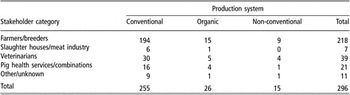
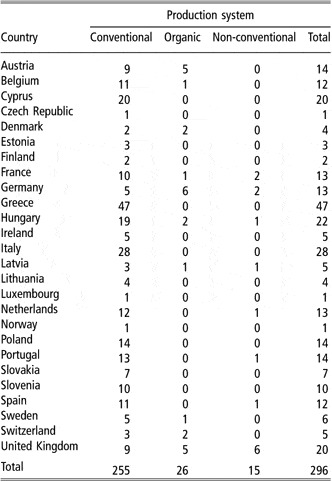
A total of 277 completed questionnaires from 26 countries were received. Unfortunately, it was not possible to identify a national contact person from Romania, Bulgaria and Malta. These countries are therefore missing. Fifteen of the answers were representing more than one production system, giving a total of 296 observations in the final dataset. The numbers of respondents per country varied from 1 to 47. The distribution of respondents by production type and stakeholder category is given in Table 1, and the distribution of respondents by country is given in Table 2. Because the distribution of stakeholder categories within each country was very different, it was not possible to analyse possible differences in the answers between the different stakeholder categories. All answers were given equal weight when mean numbers and distributions were calculated.
Distribution of answers to the questionnaire on practice on castration of piglets by production system and stakeholder category

Distribution of answers to the questionnaire on practice on castration of piglets by country and production system

Results
Extent of practice
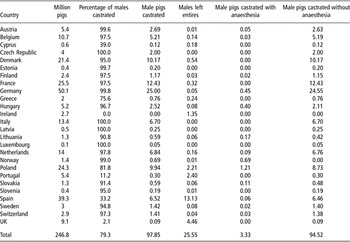
In most EU countries, castration is performed on 80% to 100% of the male pigs in conventional production (Figure 1, Table 3). The exceptions are United Kingdom and Ireland where castration is hardly performed at all. Also, in some of the southern countries (Cyprus, Portugal and Spain), a limited percentage of the male pigs is castrated. Also, in Greece, production of entire males seems to be rather common. In most countries, there seems to be little difference between the percentages of piglets castrated in conventional and non-conventional production systems. The exceptions to this are the Netherlands, where an animal friendly production system without castration exists, as well as Spain and Portugal, where an extensive production system exists with all piglets being castrated because they are slaughtered at higher weights (150 to 180 kg live weight). Meat from these animals is mainly used for production of high-quality cured products.
Estimates of the percentage of male pigs (conventional production) castrated per country, given as the average of answers given within each country.

Statistics on number of pigs slaughtered in European Union, and other selected countries in 2006Footnote 1

Number of male pigs left entire and number of male pigs castrated with and without anaesthesia estimated from the information given in PIGCAS WP2 – Extent of practice.
1 Numbers are millions of heads (Faostat, Rome, Italy, http://faostat.fao.org/default.aspx).
Age at castration
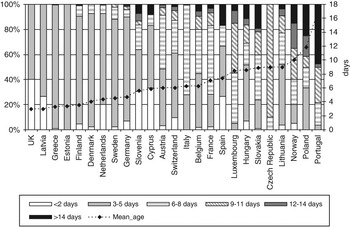
In 65% of the countries, the mean age at castration is estimated to be in the interval 3 to 7 days after birth in conventional production (Figure 2). However, age at castration as well as procedures for castration differ widely both within and between countries. Nations with a higher estimated mean age are Portugal (17 days), the Czech Republic (9 days), Hungary (8.5 days), Poland (12 days), Lithuania (9 days) and Norway (10 days). In 62% of the countries, castration was reported to be performed more than two weeks after birth in a minor part of production.
Estimated mean and distribution of age at castration in conventional production per country.

In most cases there are only small differences between conventional and non-conventional production in respect to age at castration. But there are non-conventional production systems in France, Portugal and Spain, where castration is performed at a considerable higher age than in conventional production systems (11 to 45 days in France, 45 days in Spain and 90 days in Portugal).
Who performs the castration?
In 15 of the 25 countries where castration is performed, it is performed by the farmers in more than 88% of the cases. Exceptions to this are the Czech Republic, Slovakia, Estonia, Lithuania and Norway, where the majority of castrations are performed by veterinarians. Also in Slovenia, Hungary, Poland and Cyprus, a considerable part (>20%) of the castrations are performed by veterinarians. Some countries have special trained personnel (medical technicians) to perform castration (Slovenia, Hungary, Latvia, Lithuania, Italy and Cyprus). In Hungary and Latvia, a much higher percentage of the castrations are performed by veterinarians in non-conventional production (75% in both countries) than in conventional production. In Portugal, castration in extensive production was reported to be performed by specially trained technicians.
The use of an assistant for catching and handling the piglets seems to be common in most countries. The exceptions seem to be France, the Netherlands, Denmark, Latvia, Sweden and Spain where the majority of the respondents answer that this is used in less than 25% of the cases.
Castration procedure
There seems to be a large variety of methods for restraining the piglets during castration, both between and within countries. Overall, to suspend the piglets by the legs seems to be the most common method, but also to suspend the piglets in a v-trough or in a commercially available device seem to be common methods. In addition, approximately 15% of respondents answered that a common method was that the person that performed the castration fixated the piglets himself, either between his legs or with one hand, performing castration with the other hand.
Overall, it is more common (78%) to use two incisions than one incision (22%), but in most countries both methods are used. In Spain, Latvia and Slovenia, one incision was most commonly used. When two incisions are used, these are normally of longitudinal direction, while a transverse incision is used when a single incision is used for both testicles.
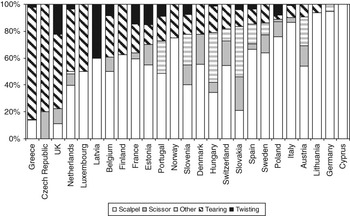
The most common procedure for cutting the spermatic cord is by using a scalpel (Figure 3). However, there seems to be large variation in procedure, both within and between countries. In some countries, tearing is the predominant procedure. Only Latvia, Germany and Cyprus reported that tearing is not used at all. Cutting the spermatic cord by scissor or by twisting is less common. In some countries, other methods are also used (in most cases reported to be by emasculator).
The distribution of different procedures used to cut the spermatic cord. The answers were originally given as not used (<5%), seldom used (5% to 25%), commonly used (25% to 75%), very commonly used (75% to 95%) and always used (>95%) and have been converted into estimates of percentages for each method.

The estimated time effort per piglet reported by the individual respondents varied from 6 to 360 s. The average per country varied from 21 to 71 s. It was asked for the estimated time consumed for the whole procedure, including catching and handling.
The use of disinfectants to prevent infection from castration seems to be common or very common in most countries. The exceptions are Denmark and Norway where it is rarely used, and Germany, Slovenia and Finland where some respondents report common use while others report the use of disinfectants to be seldom. The use of antibiotics at castration is less common than disinfectants, but in 10 of the 26 countries some respondents report that it is used very commonly or always. In the Netherlands, Estonia and Italy, more than 50% of the respondents answer that it is used very commonly or always. A large number of different types of antibiotics were reported to be used, but the most common one was Amoxicillin.
Anaesthesia and analgesia
In most countries, anaesthesia is not used or used very seldom (Table 3). The exceptions are Norway, Lithuania, Hungary, Poland and Slovakia. In Norway, anaesthesia is used for practically all castrations, because it is mandatory by law since 2002. In Lithuania, two of four respondents answered that anaesthesia was used commonly or very commonly. In Hungary, Poland and Slovakia, most of the respondents answered that anaesthesia was used seldom or not at all, while a few respondents answered that it was used very commonly or always. The explanation is probably that anaesthesia is used as a routine at castration in a very low percentage of the herds. Different variants of local anaesthesia with lidocaine seemed to be most common. The combination of subcutaneous and intratesticular injection was most common, followed by testicular injection alone and a combination of injection subcutaneously and in the spermatic cord. In some countries (Poland, Slovenia, Slovakia, Switzerland, Austria and Sweden) general anaesthesia by injection (ketamin, azaperone, methomidata, mopenthium natricum or pentobarbital) was also reported. In most cases where anaesthesia was reported to be used very commonly or always, the percentage of veterinarians performing the castration was reported to be high. But in Hungary and Poland, also the combination of a high percentage of farmers performing the castration and very common use of anaesthesia was reported. There were very few differences in the use of anaesthesia between the different production systems within the different countries. One exception to this was organic pig production in the Netherlands, where local anaesthesia was mandatory from July 2007. Also in Germany and Switzerland, tendencies of more common use of anaesthesia in non-conventional production systems could be detected. But, even here, none of the interviewees answered that it was used more often than seldom (5% to 25%).
Analgesia was reported to be used even more seldom than anaesthesia. Only in the Netherlands, Slovenia and Hungary a minority of the respondents answered that it was used commonly or always. The active substances reported for analgesia were metamizol-natrium, tolenamid, ketoprofen, carprofen, meloxicam, flunixinmeglumin, azaperone, petafen, ketamine, algopirin and lidocaine.
Complications
Overall, complications due to castration do not seem to be a common problem in any country. However, variations were reported within countries, and it seems to be a problem in some individual farms. Death as a complication to castration was reported to occur very seldom (0.1% to 1%) or never (<0.1%) by more than 75% of the respondents in all countries, and for 17 of 25 countries, this was the case for 100% of the respondents. Protrusion was slightly more common, but still reported as a problem by very few respondents. Abscesses and reduced general condition were about equally common, but the frequencies varied between countries. Only in three and six countries respectively, a minority of the respondents reported these complications to occur in more than 5% of the cases. Other complications were reported by very few respondents. Complications mentioned were arthritis (France and Finland), irritation/inflammation (France), streptococcus infection/sepsis (Belgium), hernia (Slovenia) and stress (Poland).
Interaction with other potential painful procedures
Within the PIGCAS project, the extent of other possibly painful practices such as tail docking, teeth resection, ear tagging, tattooing, vaccination and iron injection, has been assessed. It was asked whether these procedures were commonly performed, and at what time they were performed compared to castration.
In Switzerland, Finland, Norway and Sweden, tail docking is not performed at all. In addition, a minor percentage of the respondents in Slovenia, Hungary, Poland and Estonia reported that tail docking is not performed. In the remaining countries, tail docking seems to be performed on most farms, either before castration or at the same time as castration. It is very seldom performed after castration.
Teeth resection is reported to be performed on the majority of animals in most countries except Norway, Sweden, Finland, Denmark and Italy. There might, however, be some confusion about the term ‘teeth resection’, whether this only includes cases were the tooth pulp is uncovered or whether it also includes grinding. When it is performed, it is most commonly done before castration (probably most commonly just after birth), but it is also quite commonly performed at the same day as castration.
Ear tagging is commonly performed in all countries except Estonia, United Kingdom, France, Latvia, Portugal and Cyprus. It is most commonly performed more than 4 days after castration, but it is also common to do it at the same day as castration in several countries.
Tattooing seems to be less common. No information is given by a lot of countries, which probably means that it is not usually performed. The time of the procedure seems to vary, but more than four days after castration seems to be most common.
Vaccination of piglets is performed in most countries (except Finland, Latvia, Norway and Switzerland). The time of the procedure seems to vary, but more than four days after castration seems to be most common.
Iron injection is a common procedure and is performed on 80% to 100% of the animals in all countries but Norway (30%), where oral treatment is the most common practice. Iron injection is most commonly done at the same day as castration, but it is also very common to do it more than four days before castration or 1 to 4 days before castration.
Female castration
According to the call, the PIGCAS project should also include information about female castration. Only two of the respondents, one from Spain and one from Portugal, answered that castration of females was performed. The Spanish answer was from a single conventional farm, where 75% of the female pigs were castrated, while the answer from Portugal represented extensive production with pigs of the Alentejana breed. In this case, all female pigs were castrated. The average age at castration was 35 and 90 days respectively. Castration was performed by a veterinarian (Spain) or by special trained technicians (Portugal), without anaesthesia or analgesia. Both disinfectants and antibiotics were very commonly used. The reported reason for castration was in both cases to avoid negative meat flavour. Complications were reported to occur very seldom or seldom.
Discussion
To our knowledge this is the first report on practice on castration across Europe. There are, however, some limitations and shortcomings of the dataset. It was not possible to verify whether or not each respondent had sufficient knowledge or gave correct answers. Consequently, opinions of different people with varying knowledge on the topic and representing stakeholder groups of varying size are all given equal weight. In addition, it cannot be excluded that some respondents gave socially/legally acceptable (biased) answers. This could have been improved by using anonymous answers. However, with anonymous answers, it would have been impossible to categorize and verify the data when answers were unclear. Because of the attributes of the data, the results should be treated with caution.
The results show that surgical castration of male pigs without anaesthesia is so far the most common practice in Europe, including approximately 94 million animals per year, corresponding to 77% of all male pigs. Surgical castration without anaesthesia is a routine that is most commonly performed by the farmers themselves. The procedure is moderately time consuming, and might also affect the management of the animals in a positive way (less aggression and calmer animals during fattening) (European Food Safety Authority (EFSA), 2004).
Raising entire males is much less common than castration, and only a few countries find it possible not to castrate. Approximately 25 million entire males are raised in Europe per year. The United Kingdom and Ireland abandoned castration of piglets 20 to 30 years ago. The main reasons were the economic benefits related to faster growth, better feed conversion and leaner carcasses of entires. In addition, the carcass weight in these countries has been considerably lower than the average carcass weight within the EU, which has probably contributed to a limitation of the boar taint problem. At present, almost all pigs in these countries are left entire. Also in some of the southern countries (Spain, Portugal, Cyprus and Greece), a considerable but decreasing part of the pig industry is based on raising entires. The reason for castration in these countries is that these pigs are slaughtered at a considerable higher age. Rearing entires is time-effective in regard to the redundant procedure of castration. Rearing entires might, however, introduce some management challenges regarding entire male pig behaviour.
Castration with anaesthesia is presently a common practice in very few EU countries only, with an estimated number of approximately 3 million of pigs per year. Only in Norway is this the exclusive method, since castration without anaesthesia is prohibited by law (Norwegian Ministry of Agriculture and Food, 2002 and 2003). In some of the Baltic and eastern countries, anaesthesia was reported to be used, but only in a minority of the herds. In Norway, the method of choice is local anaesthesia, most commonly given as a combination of intratesticular and subcutaneous injection of lidocain (Fredriksen and Nafstad, Reference Fredriksen and Nafstad2006). Also in the other countries, this was the predominant method, but general anaesthesia by injection was also reported.
Also, Switzerland has decided that castration without anaesthesia will be forbidden (from 2010), and several projects on general and local anaesthesia have been performed during the previous years in the ProSchwein project (http://www.shl.bfh.ch/index.php?id=145&L=0&no_cache=1&sword_list[0]=proschwein). Inhalation anaesthesia with isofluran and intranasal spray are among the methods that have been tested (Jäggin et al., Reference Jäggin, Gerber and Schatzmann2006). In the Netherlands, an intention agreement has been signed by organisations representing the pork chain, from farmers to supermarkets (November 2007), aiming at abandon castration without anaesthesia. According to the Dutch Minister of Agriculture, Nature and Food Quality, G. Verburg (Spoolder and Baltussen, Reference Spoolder and Baltussen2008), most Dutch pork will probably be obtained from animals that have been castrated under anaesthetic by 2009. The final aim is to put an end to castration, but as no concrete solutions have been found yet, the issue in the meantime is resolved by castrating pigs under anaesthetics.
Castration with anaesthesia (and analgesia) is more time consuming than castration without anaesthesia, and depending on national regulations it might include assistance by trained personnel. The effect on management as well as the risk for the personnel performing the castration is probably similar to castration without anaesthesia. However, human safety might be an issue regarding some types of general anaesthesia.
At present in Europe, immunological castration is only approved in Switzerland (since January 2007). It is, however, not yet in use in ordinary practice. The only licenced product so far, Improvac® (Pfizer Inc., Parkville, Victoria, Australia, http://www.improvac.com/), is however, approved in several countries outside Europe; Australia, New Zealand, Brazil, Mexico, Korea, Thailand, Philippines, Costa Rica, Guatemala, South Africa, Chile, Venezuela, Panama, El Salvador and Russia. Sales or market share information are unfortunately not available. However, in most of the mentioned countries, the actual product launch occurred during 2007–08, but in Australia the product has been licenced since 1998. Despite the advantages of immunocastration and the fact that the cost of vaccination has fallen to 2 to 3 Euros per pig, the technology has not been widely adopted by the Australian producers (Campbell, Reference Campbell2007). The major reason for this is the Australian grading and payment systems, which are based on carcass weight and P2 fat thickness only and not on eating quality. Since there is a potential increase in P2 fat thickness in immunocastrates compared to entires, the use of immunocastration may result in reduced price to the farmer (Campbell, Reference Campbell2007).
Production of only female pigs based on sorting of semen according to sex might be a possible alternative to castration in the future. However, since the technique is not yet available for routine use in pigs, it is not presently in practice in Europe, and will not be discussed further here.
In this work package of the PIGCAS project, only the extent of the different alternative practices has been focused on. The different alternatives have been evaluated for their consequences for pig welfare in work package 3 of the same project (von Borell et al., Reference von Borell, Baumgartner, Giersing, Jäggin, Prunier, Tuyttens and Edwards2009).
The data presented here reveal several cases of inconsistency between current practice and EU legislations. According to EU legislations (European Community (2001) – Council Directive 2001/93/EC, amending Council Directive 91/630/EEC), castration after seventh day of life, shall only be performed under anaesthetic and additional prolonged analgesia by a veterinarian. With the very rare use of anaesthesia and analgesia that is demonstrated in the present data, it seems clear that castration of a considerable number of pigs in Europe is not performed according to the current legislations. On the other hand, the age limit of seven days seems to be caused more by practical reasons than by solid scientific basis (Prunier et al., Reference Prunier, Bonneau, von Borell, Cinotti, Gunn, Fredriksen, Giersing, Morton, Tuyttens and Velarde2006).
Also the procedure with tearing of tissue to cut the spermatic cord is in disagreement with present legislations (European Community (2001) – Council Directive 2001/93/EC, amending Council Directive 91/630/EEC). There is, however, a discussion going on about the pros and cons associated with the different techniques, since tearing is shown to reduce the risk of bleeding after castration (Taylor and Weary, Reference Taylor and Weary2000). The PIGCAS data showed that tail docking was practiced commonly in most countries. According to EU legislations, routine tail docking of piglets is prohibited, but they can be docked on the advice of a vet where tail biting is likely to occur. Over all, there seem to be many violations of EU law when it comes to pig castration and also tail docking. Future efforts should look into the reasons for this and find the background for the use of different methods in different countries/traditions.
The extent of female castration cannot be assessed from the PIGCAS data. According to EU legislations (European Community, (2001) – Council Directive 2001/93/EC, amending Council Directive 91/630/EEC), castration of female pigs is not allowed. It is therefore likely that people are reluctant to deliver any information on it. It may therefore be speculated that the real extent of female castration in Europe might be higher than suggested by these two reports.
Acknowledgements
We would like to thank the PIGCAS core group and all the national contacts (Christine Leeb, Austria; Monique van Oeckel, Belgium; Alkis Koumas, Cyprus; Michal Sprysl, Czech Republic; Laurits Lydehøj Hansen, Denmark; Margus Birkenfeldt, Estonia; Mari Heinonen, Finland; Eberhard von Borell, Germany and Luxembourg; George Maglaras, Greece; Istvan Nagy, Hungary; Peadar Lawlor, Ireland; Maria Teresa Pacchioli, Italy; Ligita Melece, Latvia; Vigilijus Jukna, Lithuania; Hans Spoolder, The Netherlands; Olga Moreira, Portugal; Ivan Bahelka, Slovakia; Marjeta Candek-Potokar, Sloveina; Antonio Velarde, Spain; Guiseppe Bee, Switzerland; and Kim Mathews, UK) for their participation in collecting and preparing data and the EU commission for financing the project.