INTRODUCTION
Babesia are intraerythrocytic parasites of significant importance to both human and veterinary medicine worldwide. Ixodid ticks are considered to be the main vectors for the transmission of Babesia parasites (Homer et al. Reference Homer, Aguilar-Delfin, Telford, Krause and Persing2000). Both Ixodes canisuga and I. hexagonus have previously been commonly found on Eurasian (European) badgers (Meles meles) in Britain (Peirce and Neal, Reference Peirce and Neal1974), though recent data indicates that Ixodes ricinus is the most common ticks species in Britain (Jameson and Medlock, Reference Jameson and Medlock2011). Pooled samples of I. canisuga ticks collected from badgers in Spain were found to be positive for Theileria annae DNA (also referred to as B. annae/B. vulpes), (Baneth et al. Reference Baneth, Florin-Christensen, Cardoso and Schnittger2015; Millan et al. Reference Millan, Proboste, Fernandez de Mera, Chirife, de la Fuente and Altet2015) this is not however conclusive proof that the ticks were capable of transmitting the parasite or that they acquired the parasites from the badgers.
The Eurasian (European) badger is Britain's largest native (indigenous) carnivore species. Though badgers are not considered to be endangered in Britain, they are a protected species. Badger numbers fluctuate year on year and are adversely affected through illegal persecution (baiting and trapping) and habitat destruction (increasing urbanization). The last comprehensive survey of the Scottish badger population suggested that there are between 7300 and 11200 main badger setts in Scotland (Rainey et al. Reference Rainey, Butler, Bierman and Roberts2009). While in England and Wales there are reported to be 66 400–76 900 main badger setts (Judge et al. Reference Judge, Wilson, Macarthur, Delahay and McDonald2014). Combined, this is thought to equate to approximately 300 000 individual badgers in Britain (Young et al. Reference Young, Marquez-Grant, Stillman, Smith and Korstjens2015). Badgers feed predominantly on invertebrates (earthworms, slugs, snails, carabid beetles and insect larvae), but they will also consume cereal crops, occasionally hunt vertebrate prey (including small mammals, rabbits and birds) (Robertson et al. Reference Robertson, McDonald, Delahay, Kelly and Bearhop2014) and scavenge carrion (Young et al. Reference Young, Marquez-Grant, Stillman, Smith and Korstjens2015).
There is currently little information available concerning the prevalence of haemoparasites in British wildlife. The only study of Piroplasmida in British badgers was conducted by Peirce and Neal in 1974, where samples were collected from Cornwall (South West England) and the paper described intraerythrocytic organisms resembling piroplasms, but was unable to clearly identify the infectious agent (Peirce and Neal, Reference Peirce and Neal1974). A study of British rodents (predated by badgers) by Healing (Reference Healing1981) demonstrated Babesia parasites in Giemsa-stained blood smears from wood mice (Apodemus sylvaticus), bank voles (Clethrionomys glareolus) and short tailed voles (Microtus agrestis), but again did not speciate the Babesia parasites found (Healing, Reference Healing1981). More recent studies examining other British carnivores have included the identification of a Hepatozoon parasite closely related to Hepatozoon canis, in granulomatous lesions in the heart and skeletal muscles of Scottish Pine martens (Martes martes) (Simpson et al. Reference Simpson, Panciera, Hargreaves, McGarry, Scholes, Bown and Birtles2005). While another study examining red foxes (Vulpes vulpes) from around Britain, found parasite DNA for Babesia annae in 46/316 (14·55%) of bloody lung exudate samples (Bartley et al. Reference Bartley, Hamilton, Wilson, Innes and Katzer2016). Piroplasmida DNA belonging to a Babesia microti-like organism (FJ225390) has been found in 20% (n = 5) of badgers from the Burgos Province of Spain, this parasite showed 97% identity to the published sequence of B. annae (AY150069) (Gimenez et al. Reference Gimenez, Casado, Criado-Fornelio, de Miguel and Dominguez-Penafiel2009).
This current study aims to determine the prevalence and identify the species of Babesia parasite DNA present in blood and spleen samples collected from badgers in Scotland.
MATERIALS AND METHODS
Sample collection
Sixty-four badger carcasses were collected from around the Lothians and Borders regions of Scotland, following collisions with motor vehicles and stored at −20 °C (all carcasses were collected with the knowledge and permission of Scottish Natural Heritage) (Bartley et al. Reference Bartley, Wright, Zimmer, Roy, Kitchener, Meredith, Innes and Katzer2013; Burrells et al. Reference Burrells, Bartley, Zimmer, Roy, Kitchener, Meredith, Wright, Innes and Katzer2013). Where possible, full necropsies were performed on the carcasses and individual tissue samples were collected using sterile scalpels and forceps. From 52 of the badger carcasses necropsied, samples of spleen (n = 47) and blood (n = 47) were collected. For 42 of the badgers both blood and spleen samples were available, while five animals had only spleen and a further five badgers provided only blood samples.
DNA extraction
The method used to extract DNA from samples was as previously described (Katzer et al. Reference Katzer, Canton, Burrells, Palarea-Albaladejo, Horton, Bartley, Pang, Chianini, Innes and Benavides2014). In brief, the Wizard® genomic DNA purification protocol (Promega, Madison WI, USA) was used, the method was modified to allow for the use of 0·4 g of starting material. The DNA samples were resuspended in a final volume of 200 µL DNase/RNase free water and stored at −20 °C prior to analysis. Extraction controls (water) were processed with every batch of spleen and blood samples. These not only acted as indicators of contamination, but were also used as additional negative controls for PCR.
PCR detection of Babesia DNA in blood and spleen samples from European (Eurasian) Badgers (M. meles)
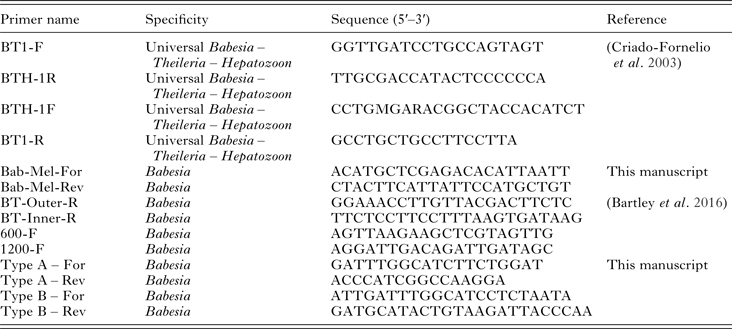
A semi-nested PCR to detect the 18S rRNA gene was used to screen blood (n = 29) and spleen (n = 28) samples for the presence of piroplasmids (Babesia and Theileria and Hepatozoon) 18S rRNA DNA. The PCR used for the initial sample screening has been previously described (Bartley et al. Reference Bartley, Hamilton, Wilson, Innes and Katzer2016). In brief, a semi-nested PCR using universal Babesia/Theileria primers BT1-F and BTH-1R was used for the primary amplification and BT1-F and BT1-R (410 bp) for the second round amplification (Table 1) (Criado-Fornelio et al. Reference Criado-Fornelio, Martinez-Marcos, Buling-Sarana and Barba-Carretero2003). Following sequence analysis of the initial screening results, Babesia-specific Primers (Bab-Mel-For and Bab-Mel-Rev) (601 bp) (Table 1) were designed (Primer3web v4·0·0) and used as second round primers to examine all blood (n = 47) and spleen (n = 47) samples.
Primer names, specificity and sequences used for the detection of Babesia DNA in badger blood and spleen samples

The PCR reaction mixture has been previously described (Burrells et al. Reference Burrells, Bartley, Zimmer, Roy, Kitchener, Meredith, Wright, Innes and Katzer2013). Briefly each reaction (20 µL) contained final concentrations of: Tris–HCl 45 mm, (NH4)2SO4 11 mm, MgCl2 4·5 mm, BSA 0·113 mg mL−1, EDTA 4·4 µ m and each of dATP, dCTP, dGTP and dTTP 1·0 mm, forward and reverse primers (Eurofins MWG Operon) 0·25 pm each and Taq polymerase 0·75 U (Bioline Ltd. London, UK) and 2 µL of each DNA sample. To increase the sensitivity of the assay each sample was analysed in quadruplicate.
Samples that gave positive results for all quadruplicates using the Babesia-specific (Bab-Mel) primers were also tested in another semi-nested PCR using the primers BT1-F and BT-Outer-R (Table 1) in the primary reaction and BT1-F and BT-Inner-R (Table 1) in the second round reaction, producing an 18S rRNA gene fragment of ~1·7 Kb. The reaction mixture and conditions for this PCR were as previously described (Bartley et al. Reference Bartley, Hamilton, Wilson, Innes and Katzer2016).
Following secondary amplification, 10 µL of each PCR product was analysed by agarose gel electrophoresis (2% agarose in 1× TAE buffer), stained with gel red (1:10 000) (Biotonium, Hayward, CA, USA) and visualised using UV light.
PCR clean up and sequencing of initial PCR amplicons
PCR amplicons were purified using the commercially available Wizard® SV Gel and PCR Clean-up System (Promega, Madison WI, USA), as per the manufacturer's instructions. The purified PCR products were eluted in a final volume of 30 µL DNase/RNase free water. The nucleic acid content of each sample was determined using spectralphotometry (Nanodrop ND 1000). For sequencing (Eurofins MWG Operon), 100 ng of each sample was sent with each primer (BT1-F, BTH-1F, BTH-1R and BT1-R), this created an overlapping forward and reverse consensus sequences for each sample.
Cloning of amplicons representing the 18S rRNA gene of Babesia in badger blood and spleen samples
Clones from PCR amplicons representing the Babesia 18S rRNA gene were generated using the BT1-F and BT-Inner-R primers as has been previously described (Bartley et al. Reference Bartley, Hamilton, Wilson, Innes and Katzer2016), with the following differences. White colonies were screened using the Bab-Mel-For and Bab-Mel-Rev PCR primers (Table 1), for the presence of the Babesia 18S rRNA gene insert. The purified plasmid DNA (Isolate II Plasmid Mini Kit, Bioline, London, UK) (100 ng per primer) was sent to be sequenced (Eurofins MWG Operon) using T7 and SP6 primers along with, 600-F, 1200-F, BTH-1F, BT1-R and BTH-1R (Table 1), this created an overlapping forward and reverse consensus sequences for each clone.
Comparison of Babesia DNA sequences found in badgers in Scotland
Primers were designed (Table 1) to span polymorphic regions within the Babesia 18S rRNA sequence, these primers allowed the detection and discrimination of Babesia parasite DNA type A (KX528553) and type B (KX528554) sequences found in this study. Spleen (n = 47) and blood (n = 47) samples were tested with combinations of types A and B-specific primers (type A forward – type B reverse or type B forward and type A reverse) to determine if genetic recombination occurred between the type A and B sequences. The PCR reaction mixture used for this analysis is identical to that described previously (Bartley et al. Reference Bartley, Wright, Zimmer, Roy, Kitchener, Meredith, Innes and Katzer2013). Optimal annealing conditions (59 °C) were determined using a gradient PCR, the general reaction conditions were as previously described (Bartley et al. Reference Bartley, Hamilton, Wilson, Innes and Katzer2016).
Sequencing and phylogenetic analysis
Consensus sequences were generated using SeqMan Pro(TM) (v 12·3·1) and compared against other published sequences using the National Centre for Biotechnology Information (NCBI) Basic Local Alignment Search Tool (BLAST) tool, to produce a percentage identity. The European Molecular Biology Laboratory – European Bioinformatics Institute (EMBL-EBI) Multiple Sequence Comparison by Log- Expectation (MUSCLE) software was used to create multiple sequence alignments of the results generated in this study against published sequences. Phylogenetic analysis was performed on a ~1·2 kb consensus using PhyML 3·0 software (ATCG, Phylogeny.fr). The Gblocks program was used for automatic sequence alignment curation, while PhyML was used for phylogenetic tree creation and the TreeDyn software was used to draw the phylogenetic tree (Anisimova and Gascuel, Reference Anisimova and Gascuel2006; Dereeper et al. Reference Dereeper, Guignon, Blanc, Audic, Buffet, Chevenet, Dufayard, Guindon, Lefort, Lescot, Claverie and Gascuel2008; Guindon et al. Reference Guindon, Dufayard, Lefort, Anisimova, Hordijk and Gascuel2010).
Statistical analysis
Proportion positive (prevalence), with confidence intervals (95% CI), was calculated for the presence of Babesia DNA in spleen and blood samples, as well as for the numbers of samples positive for type A or B Babesia sequences and the samples that were positive for both types A and B. All calculations were carried out using Minitab 15 (v15·1·0·0).
RESULTS
Detection of Babesia parasite DNA in blood and spleen samples from badgers in Scotland
The current study aimed to determine the prevalence and species of Babesia parasite DNA present in Scottish badgers. Spleen and blood samples were collected from badgers that had died as a result of collisions with motor vehicles. Due to the protected nature of badgers in the UK, this work was undertaken with the knowledge and permission of Scottish Natural Heritage, who oversee the welfare of the badger population in Scotland.
During the initial screening of samples, forward and reverse consensus sequences were generated from 11 animals (six blood and five spleen) using the universal Babesia and Theileria PCR primers BT1-F and BTH-1R and BT1-F and BT1-R. These consensus sequences were analysed using NCBI BLAST. Five of these consensuses (881 bp) demonstrated 100% identity to KT223484 (badger type A isolate), a sequence from a Babesia sp. found in badgers from Spain, three samples demonstrated 100% identity to KT223485 (badger type B isolate), a second Babesia isolate also found in badgers from Spain. The remaining three samples demonstrated a third DNA sequence which had a high level of sequence identity to KT223485 (99·3% identity) and 95·6% identity to KT223484 but was clearly different from the other two DNA sequences identified in the Scottish badgers. No other Piroplasmida species were detected in the badgers.
Prevalence of Babesia DNA in spleen and blood samples from badgers
The PCR primers Bab Mel-F and Bab-Mel-R (Table 1) were designed to specifically amplify Babesia 18S DNA, which was identified during the initial sample screening using Pan-Piroplasm primers. The Bab Mel (F and-R) primers were used to determine the prevalence of Babesia parasite DNA in blood and spleen samples from badgers collected from across the Lothians and Borders regions of Scotland. The results are illustrated in Table 2, where it can be seen that 14/47 (29·8%) [95% confidence interval (CI) 16·7–42·9%] spleen and 28/47 (59·6%) (95% CI 45·6–73·6%) blood samples were positive for Babesia DNA using the Bab-Mel (F + R) primers (Table 1). With 9/42 (21·4%) (95% CI 9·0–33·8%) of the badgers having tested positive, where both spleen and blood samples were available for testing. A total of 33/47 (70·2%) (95% CI 57·1–83·3%) of the badgers tested positive for the presence of Babesia DNA in at least one sample.
Prevalence of Babesia sp. DNA in spleen and blood samples from Badgers in East/Central Scotland

No – Number.
a Calculation is based on the number of animals where both spleen and blood samples were collected at post-mortem examination and were available for testing (n = 42).
The PCR amplicons of six samples (two blood and four spleen) were sequenced using the Bab Mel-(F + R) primers creating 530 bp overlapping forward and reverse consensuses. Two spleen samples demonstrated 100% identity to KT223484 [badger type A isolate (Spain)], while four samples (two blood and two spleen) demonstrated 100% identity to KT223485 [badger type B isolate (Spain)].
Comparisons of Babesia DNA sequences found in spleen and blood samples from badgers in Scotland
Table 2 illustrates the results from the PCR analysis using the type A and B primers (Table 1). Type A sequences were seen in 6/47 (12·8%) (95% CI 3·2–22·3) spleen and 18/47 (38·3%) (95% CI 24·4–52·2) blood samples. Type B sequences were seen in 9/47 (19·1%) (95% CI 7·9–30·4) spleen and 22/47 (46·8%) (95% CI 32·5–61·1) blood samples. Both type A and B sequences were found in 5/47 (10·6%) (95% CI 1·8–19·4) spleen and 15/47 (31·9%) (95% CI 18·6–45·2) blood samples. The overall results show that 10/47 and 25/47 individual badgers were positive for type A or B Babesia DNA in spleen and blood, respectively (see Table 2).
Since mixed genotypes were frequent the possibility of recombination within the same species was considered probable. To test this postulation all spleen (n = 47) and blood (n = 47) samples were tested using combinations of type A and B primers (type A forward – type B reverse or type B forward and type A reverse). Using these primer combinations PCR amplicons were seen for 4/47 spleen samples (8·5%) (95% CI 5·3–16·5) and 22/47 blood samples (46·8%) (95% CI 32·5–61·1). Six PCR amplicons from four animals were purified as described above and sent for sequencing (MWG Operon) and showed evidence of genetic recombination with type A and B sequences. A representation of the genetic recombinations seen in the six samples is illustrated in Table 3. As the type A and B primers were used for sequencing the purified PCR products, full-length consensus sequences were not always produced. Some observations in Table 3 were made based on a consensus (annotated by UPPER CASE letters), while when only a single strand was available these observation are annotated with lower case letters. The consensus sequences from all six PCR amplicons demonstrating genetic recombinations were submitted to Genbank, as Babesia sp. isolate Ba15(a) (KY250472), Ba15(b) (KY250473), Ba22(a) (KY250474), Ba22(b) (KY250475), Ba21 (KY250476) and Ba27 (KY250477).
Evidence of intragenic recombination events occurring between variant alleles of type A and B Babesia isolates

FA – RB*– type A forward – Type B reverse primers used to generate consensus.
FB – RA* – type B forward – Type A reverse primers used to generate consensus.
Upper case (A, C, G and T) sequence generated from forward and reverse consensus.
Lower case (a, c, g and t) sequence generated from a single direction only.
– =Indel.
Cloning and phylogenetic analysis of Babesia DNA found in blood and spleen samples
Amplicons from three samples produced using the BT1-F and BT-Inner-R primers were cloned, 12 Babesia 18S rRNA gene plasmid clones were created (four clones per sample), each was sequenced to create overlapping consensuses. The general consensus from each sample was submitted to GenBank, Badger type A UK1 (KX528553), Badger type B UK1 (KX528554) and Badger type B UK2 (KX528555) and used in the phylogenetic analysis.
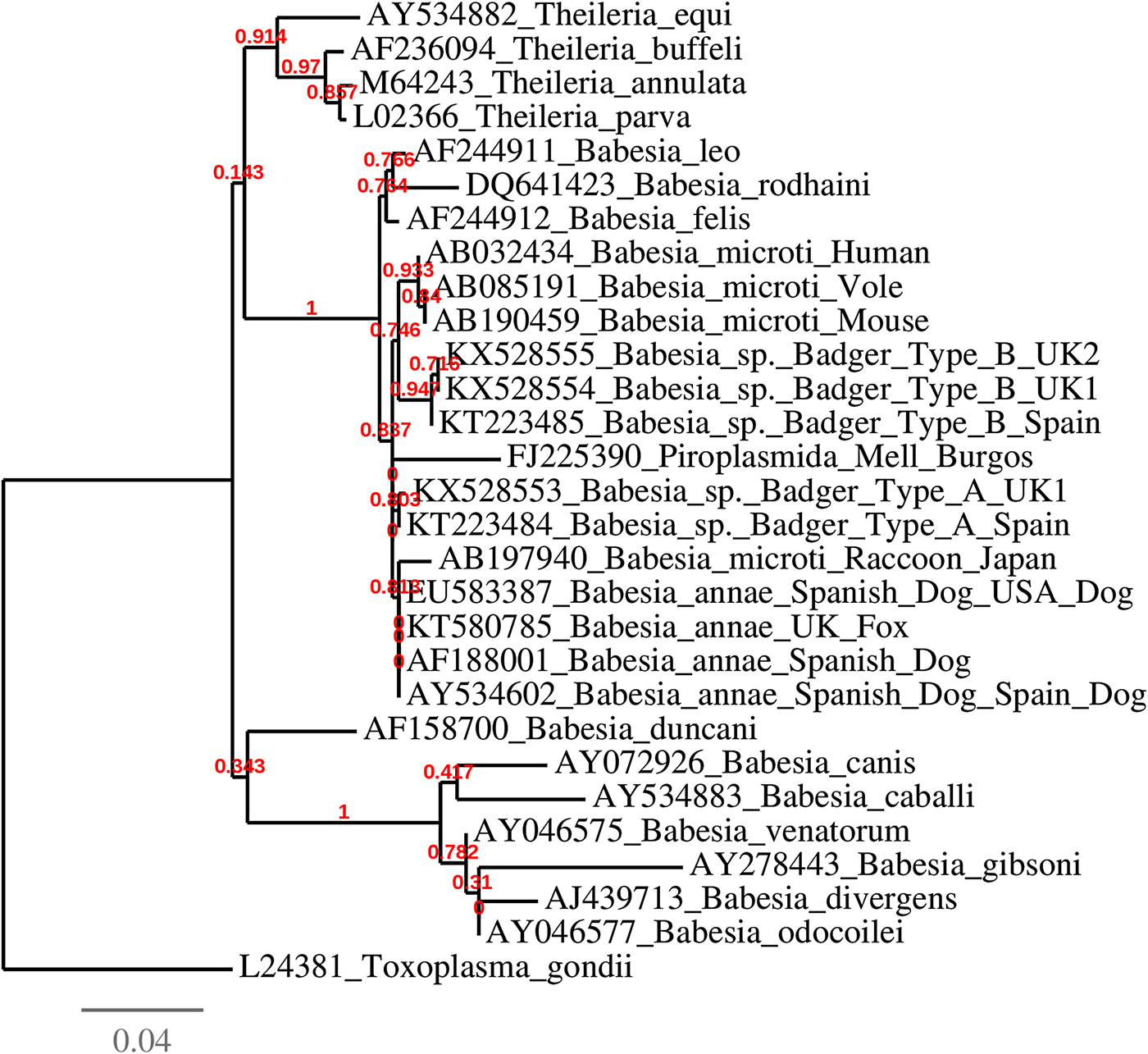
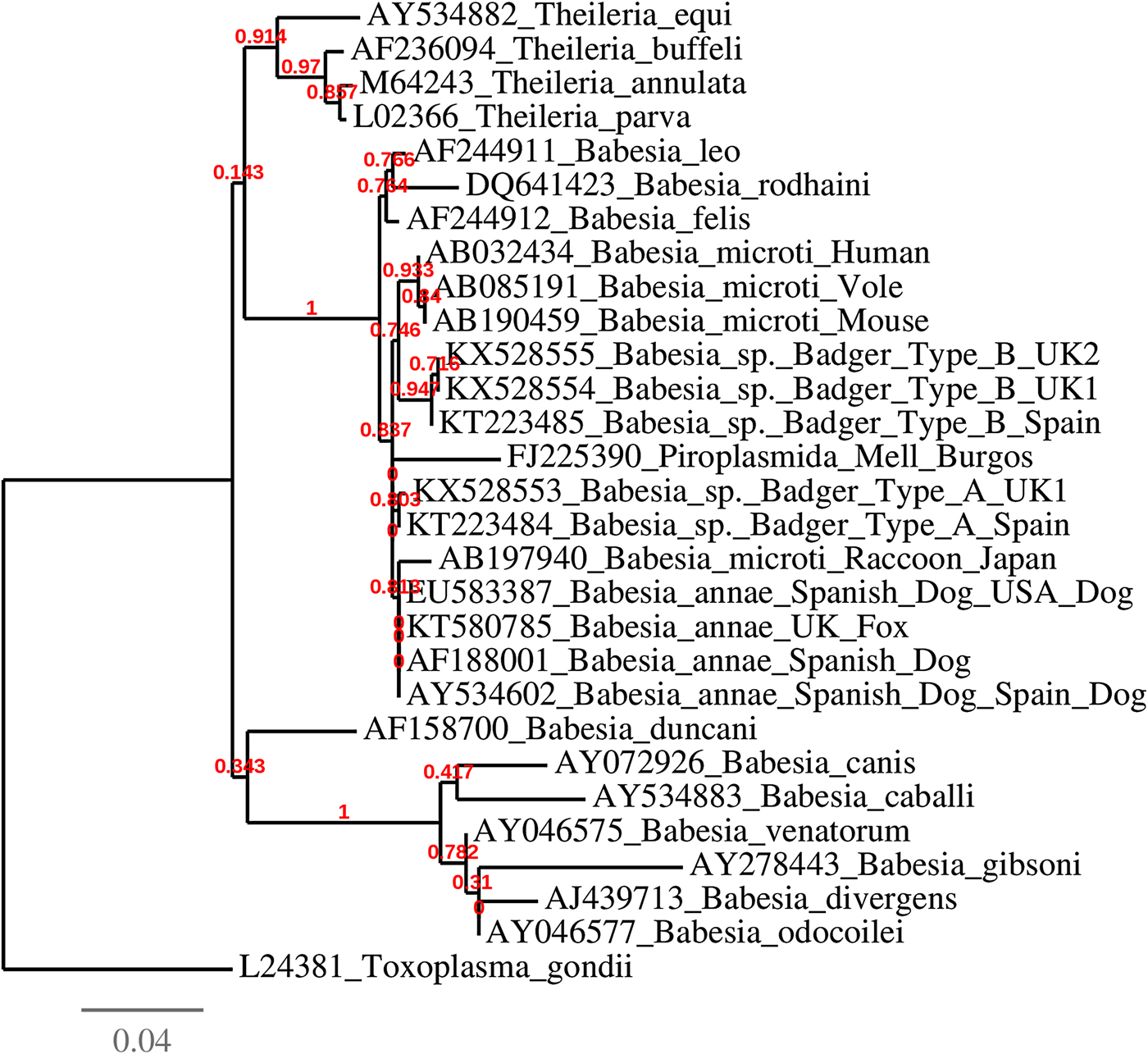
The results from the phylogenetic analysis (Fig. 1) demonstrate that the three Babesia sequences identified during this study are clearly distinct from each other. The Babesia type A UK1 (KX528553) sequence grouped most closely with KT223484 (Badger type A, Spain) (98·8% identity over 1439 bp) and FJ225390 a piroplasm previously identified in badgers. The Babesia type B UK1 (KX528554) and Babesia type B UK2 (KX528555) sequences showed the greatest parsimony to each other (99·3% identity over 1557 bp) and KT223485 (Badger type B, Spain) than to the Babesia type A UK1 sequence (97·3 and 96·9% identity respectively over 1545 bp). All three UK Babesia sequences are situated in a clade with the B. annae isolates (KT580785 and AF188001) found in foxes and dogs, along with Babesia/B. microti-like parasites found in wildlife species including otters and raccoons as well as B. felis and B. leo.
Phylogenetic tree demonstrating differences in the 18S rRNA gene of Piroplasmida parasites. The results are based on the maximum-likelihood approximation of the standard likelihood ratio test score. The branch length is proportional to the number of base pair substitutions. Scale bar indicates the base pair substitution rate.
DISCUSSION
This study has identified three distinct sequences of Babesia [Badger type A UK1 (KX528553), Badger type B UK1 (KX528554) and Badger type B UK2 (KX528555)] in the badger blood and spleen samples tested, however more types of Babesia may be present in the badger population as not all samples that tested positive for Babesia DNA could be assigned to either type A or B. This is the first molecular identification of Babesia DNA in blood and spleen samples from badgers in Britain. Previously, intraerythrocytic organisms resembling piroplasms have been observed in blood smears from badgers in Britain and Turkey (Peirce and Neal, Reference Peirce and Neal1974; Simsek et al. Reference Simsek, Dumanli and Koroglu2003) and parasite DNA has been isolated from badger blood samples in Spain (Gimenez et al. Reference Gimenez, Casado, Criado-Fornelio, de Miguel and Dominguez-Penafiel2009). This current study is the first to report Babesia parasite DNA being isolated from the spleens of badgers. A recent study of spleen samples collected from red foxes (V. vulpes) in the state of Brandenburg, Germany demonstrated a high prevalence (47·5%) of T. annae (also referred to as B. annae) (Liesner et al. Reference Liesner, Krucken, Schaper, Pachnicke, Kohn, Muller, Schulze and von Samson-Himmelstjerna2016). Our study demonstrates that sample selection for the detection of Babesia parasites is important. The use of spleen as well as blood increased the frequency of detection of the parasite, five animals would have appeared negative for the presence of Babesia DNA, had only blood samples been used. However, the collection of spleen samples is only possible during post-mortem studies. Ante-mortem studies of parasite prevalence would be reliant on blood samples, but would have the advantage of enabling researchers to examine the clinical condition of the animal and possibly collect any infesting ticks.
The results from this current study show a high prevalence 33/47 (70·2%) of Babesia sp. DNA in the badgers sampled from East/Central Scotland, although the overall sample size was low. The high prevalence demonstrated in this study would suggest that the infectious organisms have been present in the Scottish badger population for a considerable length of time, as the parasites appear to be widely dispersed across the entire region of East/Central Scotland. Previously reported incidence of piroplasm infections in badgers appeared to be rare, with isolated cases being reported in Britain (Peirce and Neal, Reference Peirce and Neal1974), Turkey (Simsek et al. Reference Simsek, Dumanli and Koroglu2003) and in Spain (Gimenez et al. Reference Gimenez, Casado, Criado-Fornelio, de Miguel and Dominguez-Penafiel2009). However, all of these studies in badgers, including ours, have only examined small numbers of animals, so are unable to give a clear indication of the prevalence of Babesia infections in the resident badger populations within each country. The previous studies in Britain and Turkey also relied solely on direct microscopic examination of blood smears, with only the most recent study (Gimenez et al. Reference Gimenez, Casado, Criado-Fornelio, de Miguel and Dominguez-Penafiel2009) providing a molecular identification of the infectious organism (Piroplasmida FJ225390). It is highly likely that the prevalence of Babesia infections being detected using PCR would be higher than that seen using blood smears due to the increased sensitivity and specificity of PCR analysis.
The three Babesia sequences identified in this study are closely related, but are distinct from one another and from the other published Babesia and Piroplasmida sequences found in other wildlife species. The greatest parsimony (fewest evolutionary changes) of the UK badger sequences KX528553 and KX528554 is to the Babesia sp. isolates found in Spanish badgers KT223484 and KT223485, respectively. The fact that parasite DNA with 98·75% identity is being isolated from the same host species in different countries would suggest that the sequences are highly conserved and host specific. The high level of host specificity is further supported by fact that the B. annae (KT580785) DNA found in British foxes (Bartley et al. Reference Bartley, Hamilton, Wilson, Innes and Katzer2016) was not found in the badgers, though both animal species will hunt similar prey species and were collected from similar habitats and locations across East Central Scotland. The results from this present study also demonstrate that more than one sequence can be found in an individual animal; with many of the animals examined in this study demonstrating the presence of multiple Babesia sequences. The presence of mixed infections with Babesia parasites are common and have been reported in B. bovis infections in cattle in Asia (Vietnam, Sri Lanka and Mongolia) (Liyanagunawardena et al. Reference Liyanagunawardena, Sivakumar, Kothalawala, Silva, Battsetseg, Lan, Inoue, Igarashi and Yokoyama2016).
Genetic recombination appears to be occurring between the parasites identified in this study. Combinations of the type A and B 18S rRNA gene sequences were identified in 22/47 animals and six of these were submitted to GenBank (KY250472 – KY250477). This would suggest that we have identified different strains of the same species of Babesia parasite and not separate parasite species. Genetic recombination is not uncommon amongst Babesia parasites and has been previously reported in the genes encoding merozoite surface antigens (MSAs) in isolates of B. bovis (Yokoyama et al. Reference Yokoyama, Sivakumar, Tuvshintulga, Hayashida, Igarashi, Inoue, Long and Lan2015).
The phylogenetic results from this present study (Fig. 1) indicate a close association between the Babesia isolates found in badgers and B. annae (KT580785) as well as a B. microti (AB197940) found in raccoon dogs and raccoons. This is in agreement with the observations made by Gimenez et al. (Reference Gimenez, Casado, Criado-Fornelio, de Miguel and Dominguez-Penafiel2009), who noted that the Piroplasmida (FJ225390) found in badgers in Spain was closely associated with B. annae and other B. microti-like organisms.
Further work is required to determine whether the Babesia isolates present in the badgers cause clinical disease, or whether they are of potential zoonotic importance. Further study is also required to determine the prevalence of Babesia infections in badgers throughout the rest of Scotland and across the entire badger population in the UK and the vectors (if any) that are transmitting the disease between hosts.
ACKNOWLEDGEMENT
The authors would like to thank Sarah Middleton for her contributions to this project.
FINANCIAL SUPPORT
The authors would like to thank Scottish Government's Rural and Environment Science and Analytical Services Division (RESAS) for supporting this work.