Since 1967, there have been 15 bridge collapses in the United States resulting in fatalities.1–10 According to Federal Highway Administration data, 73,764 US bridges are categorized with the same “structurally deficient” rating that the Interstate 35W (I-35W) bridge in Minneapolis had received in the years before its collapse on August 1, 2007 into the Mississippi River, killing 13 people and injuring 127.11 This article describes the emergency medical service (EMS) agencies' response to this incident.
Minneapolis/St. Paul is a metropolitan area with 2.6 million residents in 7 counties. Overall, 24 emergency medical service (EMS) agencies serve geographic primary service areas within these counties assigned by the state of Minnesota. In the metropolitan area, a joint powers agreement provides a framework for cooperative planning. In recent years these efforts, funded largely by hospital preparedness and Metropolitan Medical Response System grant funding, have resulted in a common 1-page incident management plan that was adopted by all agencies in 2005.12 In addition, consistent triage tags, vests, and other equipment were purchased for all supervisors and vehicles. Simple Triage and Rapid Treatment (START) is the basis for the triage system on the published card.Reference Benson, Koenig and Schultz13 Close working relationships have been established at the supervisor level and between other public safety agencies through this committee work, the Metropolitan Medical Response System, and major community exercises.
Hennepin County Medical Center (HCMC) EMS is an urban, third-service advanced life support (ALS) provider serving most of Minneapolis and surrounding suburban communities. The annual call volume is 58,000 calls per year. Previous literature has described the EMS system and its on-call medical director program.Reference Ho, Conterato and Mahoney14, Reference Hick and Ho15 Minneapolis Fire Department (MFD) personnel are emergency medical technician–basic trained and respond to select EMS calls per dispatch criteria. Average fire response time and ALS response time are 3 and 6 minutes, respectively.
HCMC EMS dispatch houses the West Metro Medical Resource Control Center (MRCC), which is the EMS communications hub for hospital diversions, multiple casualty incidents, and other special events. It provides notifications and updates, tracks patients, and monitors system status during mass casualty incidents. In larger events, MRCC aids patient distribution by recommending hospitals to ambulances when the closest or most appropriate facility exceeds capacity.
METHODS
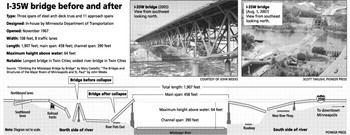
The I-35W bridge connecting portions of Minneapolis was built in 1967 and was the busiest bridge in Minnesota, carrying more than 140,000 vehicles per day on 8 lanes of traffic. The roadway was 116 ft above the river's surface. The bridge was unique at the time of construction for its extended arch of 458 ft (total span >2000 feet) over the Mississippi, which avoided the need for river pilings below the nearby lock and dam but contributed to a lack of failure redundancy. The bridge was categorized on recent inspections as “structurally deficient” but not imminently in danger of failing.
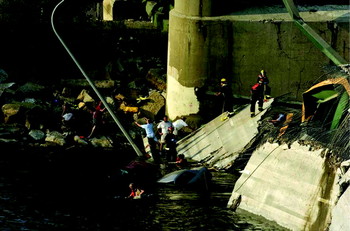
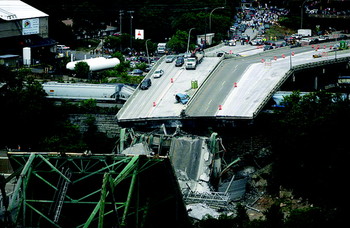
On August 1, 2007, traffic was confined to 2 lanes in each direction because of resurfacing work. At 1805 hours bumper-to-bumper traffic was present in both directions on the bridge and moving at slow speeds; 114 vehicles were on the span and 18 construction workers were at work on the bridge deck. The center section of the bridge dropped directly into the river, and the north and south ends buckled toward the banks, collapsing the entire span (Figs. 1–4). In the first few minutes, 49 calls were placed to 9-1-1, with a total of 540 calls during the course of the evening. It was initially unclear which bridge had collapsed into the river or the scope of the collapse. The address entered into the computer-aided dispatch (CAD) system was for a location several blocks away from the bridge because of geolocation of the initial cellular caller, who could not provide an address.
Interstate 35W bridge before and after with details of collapsed sections. Note that 64-ft maximum height refers to navigable clearance, not bridge deck height. Graphic courtesy ofSt. Paul Pioneer Press(copyrighted and reprinted with permission).

Rescue operations on center span. Many responders lacked appropriate personal protective equipment for water rescues. Photo courtesy ofStarTribune/Brian Peterson (copyrighted and reprinted with permission).

North side of bridge collapse. Most critically injured patients were located below this overhanging section. Photo courtesy ofStarTribune/David Brewster (copyrighted and reprinted with permission).

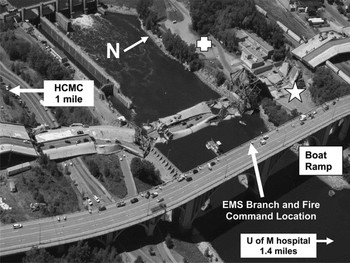
Overview of bridge collapse site; photo taken 2 days after collapse. Star indicates downstream side of north collapse zone. This was the location of the casualty collection zone from which patients were transported by pick-up trucks. Cross indicates upstream side location of majority of EMS units; a retaining wall restricted evacuation of nonambulatory patients to this location.

EMS Response
At 1807 hours, EMS, fire, and police were assigned to the incident by the Minneapolis Emergency Communications Center. MFD Engine 11 arrived at 1812 hours as part of the first alarm assignment and requested a second alarm at 1817 hours. The arriving deputy chief then requested all available MFD engine, truck, and boat companies. Mutual-aid agencies back-filled MFD stations per the regional plan. HCMC EMS dispatchers initially assigned 1 ambulance and a supervisor, and designated a tactical radio channel, updating the call within minutes for 3 additional ambulances as additional CAD information from the 9-1-1 center was entered.
The EMS role switched from triage, treatment, and transportation to support for firefighters, collapse rescue teams, and other agencies
An alert was sent via the Web-based MN-Trac alerting and resource tracking system to all hospitals and EMS services in the area from MRCC at 1809 hours advising of a multiple casualty incident. A total of 25 updates were sent from MRCC between 1809 and 2359 hours.
The HCMC EMS duty supervisor arrived at 1809 hours and assumed EMS branch director duties according to the regional incident response plan. Four additional ambulances were immediately requested. Off-duty supervisors and EMS physicians were notified and responded. Unified command between fire and EMS was established within the first 10 minutes of the event on the 10th Avenue bridge just downstream (Fig. 4), which provided an overview of the entire scene. The Minneapolis Police Department (MPD) established a larger base of operations and command center on the south bank in a parking lot and unified command moved to that location later during the operations.
Triage and treatment areas were rapidly set up on the north and south banks and an EMS supervisor was assigned to each bank. Within the hour, these divisions were further by separated into “upstream” and “downstream” divisions and later to NE, NW, SE, and SW divisions. EMS supervisors coordinated with MFD battalion chiefs who were similarly assigned.
South Side Operations
Victims left their cars and assisted others, rapidly self-evacuating the bridge structure. Fires had broken out in several vehicles, including a large tractor-trailer adjacent to a school bus full of children. Bystanders assisted with initial rescues. A preliminary rapid search of the south side did not reveal any critical (“red”) patients or obvious void spaces where casualties were likely to be trapped. Casualties in the river were not accessible from the south side because of open water, fencing, and retaining walls.
A treatment and transport area was established and an adjacent staging area was designated on an open road adjacent to the Minneapolis American Red Cross building. Several ambulances made round trips from this site to local hospitals with yellow- and green-coded casualties. Many other people were evaluated and declined EMS transport, preferring to stay at the scene. No documentation was kept on those patients. Red Cross staff assisted patients to the area and welcomed victims into their building, which created some confusion because EMS personnel were not aware of the numerous children who had been taken inside.
North Side and Center Span Operations
The majority of serious injuries were managed on the north side of the river because of the much greater extent of structural collapse and resulting vehicular damage on the north bank, as well as the evacuation of casualties from the center span (river portion) to the north side boat ramp via fireboats and wading rescues (Fig. 4).
Access to the north side was complicated by the fact that the 1-lane roadway serving the area was connected only on the upstream side to streets; the other side twisted up the bank and ended in a railroad yard. Downed live power lines limited ambulance approach to about 100 yards from the scene (Fig. 4, between cross and bridge). Moving casualties from the downstream to the upstream side was significantly complicated by a 10-ft-tall retaining wall between the collapse site and the ambulances.
… successful response during the first 30 minutes hinged on paramedics following their regional Incident Response Plan rather than being directed by supervisors
One member of the crew that arrived first assumed the transportation coordinator function and called for additional ambulances and traffic control, and a staging location. He then coordinated ambulance loading based on patient acuity. The second crew member (triage) went onto the debris field wearing a helmet and carrying a trauma bag and triage tags. Bystanders who were medical professionals assisted multiple victims and provided the triage officer valuable initial information about the number of victims and injuries.
The triage officer accessed the first patient, who died on initial contact and was black-tagged. During this encounter, the paramedic was struck by a fist-sized chunk of falling concrete but was not injured because he was wearing his safety helmet.
The next red patient was ambulatory, but with major penetrating chest trauma. He was rapidly passed down an extension ladder on a backboard by MFD and HCMC personnel to the upstream side (because this was the only location where an ambulance was available). The patient experienced cardiac arrest as he was being loaded into the ambulance. The patient was intubated and intravenous normal saline was given en route, but the patient was pronounced dead at the receiving hospital after a brief evaluation and interventions.
Additional patients with mental status changes and other critical injuries were red-tagged and quickly evacuated on backboards via the upstream-side extension ladder. Green patients were directed down the ladder and around power lines to waiting ambulances.
Multiple yellow casualties were extricated rapidly from areas threatened by overhanging debris and carried on backboards (some initially on plywood sheeting that was part of the original concrete molds for the bridge deck) to the downstream side of the debris field to await transport pending ambulance access. A casualty collection area was established. One ambulance was able to access the downstream side, but directions back to the access point could not be followed by subsequent crews. (The directions involved following a gravel road adjacent to railroad tracks about 1.5 mi through a construction site and down to the river.) Pickup trucks in or near the railroad yard were located by law enforcement personnel and 7 patients were loaded and transported with fire and EMS personnel attending. The initial civilian trucks emerged on city streets about 6 blocks from the University of Minnesota Medical Center and took their patients there directly. Subsequent pickups were met by ambulances, and additional ambulances were escorted back down to the river, providing a rehab-and-rescue presence on the downstream side.
The scene was cleared of patients by 95 minutes after the initial 9-1-1 call (although several apparently uninjured children were transported for evaluation at parent request from the Red Cross building 129 minutes after the call), at which time the operational focus shifted from rescue to recovery. The EMS role switched from triage, treatment, and transportation to support for firefighters, collapse rescue teams, and other agencies. Adequate personnel were available by this time to set a perimeter and prevent additional civilians from entering the area. The downed power lines were rendered safe. Public safety personnel were cleared off the collapsed sections until structural engineers approved recovery operations. EMS continued to provide on-site support to the recovery operation for the next several days.
Six EMS agencies and 29 ambulances (11 HCMC, 18 mutual aid) participated in the response, transporting 50 patients to 6 area hospitals including 24 patients to HCMC (the closest level 1 trauma center). Two of these agencies (Allina and North Memorial) are large, urban, third-service ALS providers and usual mutual-aid partners for HCMC. Another was the University of Minnesota First Responders, who provided basic life support rehab and treatment location assistance to HCMC paramedics. Two others were rural ambulance services that happened to be completing transfers to hospitals close to the collapse. They were directed by the state patrol or their dispatch center to assist. They transported several yellow and green patients to hospitals under the direction of on-scene EMS supervisors. EMS supervisors from Allina and North Memorial assisted at staging, command post, and treatment locations. In addition, border agencies provided back-fill to answer 9-1-1 calls as needed into these agencies' primary service areas.
RESULTS/DISCUSSION
Safety
Multiple victims were still in the water or on the remains of the fallen span in the river when MPD and MFD arrived. Hydraulics created by the damming effect of the downed span were unpredictable. Numerous water rescues were conducted by reaching and throwing to people in the water. Many public safety personnel performed these rescues or were on the river portion of the debris lacking adequate personal flotation devices and protective equipment. Fortunately, no secondary casualties occurred.
Debris continued to shift during rescue efforts. At one point, apparent movement of a large vertical section of the north span prompted evacuation of the area. This process of alerting could have been improved by the use of an air horn or other amplification device.
A perimeter was not possible early in the event because of the open nature of the top of the riverbank, and many civilians flooded into the area trying to assist efforts.Reference Cone, Weir and Bogucki16 Although they were generally compliant with instructions, ensuring bystander safety consumed significant rescuer time.
Falling and overhanging debris was a significant threat. In addition to the paramedic struck by debris, a victim who survived the plunge into the river escaped from the vehicle, only to be killed by a falling lamppost. Another vehicle was crushed by falling debris shortly after the occupant was extricated.
Sharp rebar and concrete was pervasive at the site, including below the water surface. A few responders sustained minor lacerations during recovery efforts.
Heat was a significant concern for personnel in turnout gear, with high humidity, light winds, and temperatures in the 90°F range. Thunderstorms with frequent lightning strikes and small hail passed a few miles north of the area during the rescue phase. A light rain fell at the site. Evacuation and shelter areas were identified in case of lightning. One of these possible shelters was found to house a large amount of hazardous materials, including radiological agents and mercury. These materials were checked and determined to be secure by University of Minnesota staff.
Part of the north side roadway collapsed onto railroad cars. A tanker car was not breached, but a large hopper car was. The cargo was identified as nontoxic polystyrene by MFD at 1836 hours. Information about the breach was not available to the EMS branch until much later in the event, however.
Downed live power lines on the north side presented a hazard for most of the rescue phase. The utility company apparently had a representative in the police command post 1 hour before the lines were rendered safe. Lines running under the bridge structure were also an issue. A demolition worker sustained severe electrocution injuries 1 week after the initial collapse when he contacted an unrecognized live wire while jack-hammering debris.
Incident Command and Communications
EMS incident command functioned well. The initial EMS supervisor assigned (T.W.) is a member of the Minneapolis and St. Paul Type III Incident Management Team. Unified command with the fire incident commander was rapidly established (Fig. 4). MFD had established Fire Mobile Command on the 10th Avenue bridge downstream and had a good overview of the scene, and police established their command adjacent to the Red Cross building in a parking lot and large garage area. This decision by the police deputy chief was made in anticipation of a need for a much larger base of operations that would further obstruct emergency vehicle traffic on the 10th Avenue bridge and his concern about the possibility of the 10th Avenue bridge being a secondary target if the I-35W collapse had been intentional. The geographic separation prevented early establishment of a true unified command but was understandable. A liaison should be present in each command post if this occurs in future events.
Fire Mobile Command became extremely crowded with mutual-aid agencies, and EMS was not able to maintain a position inside the vehicle; this has been identified for corrective action at future events. As the event transitioned to recovery, EMS moved its command to the Unified Command Post set up by MPD and maintained coordination with MFD via a liaison.
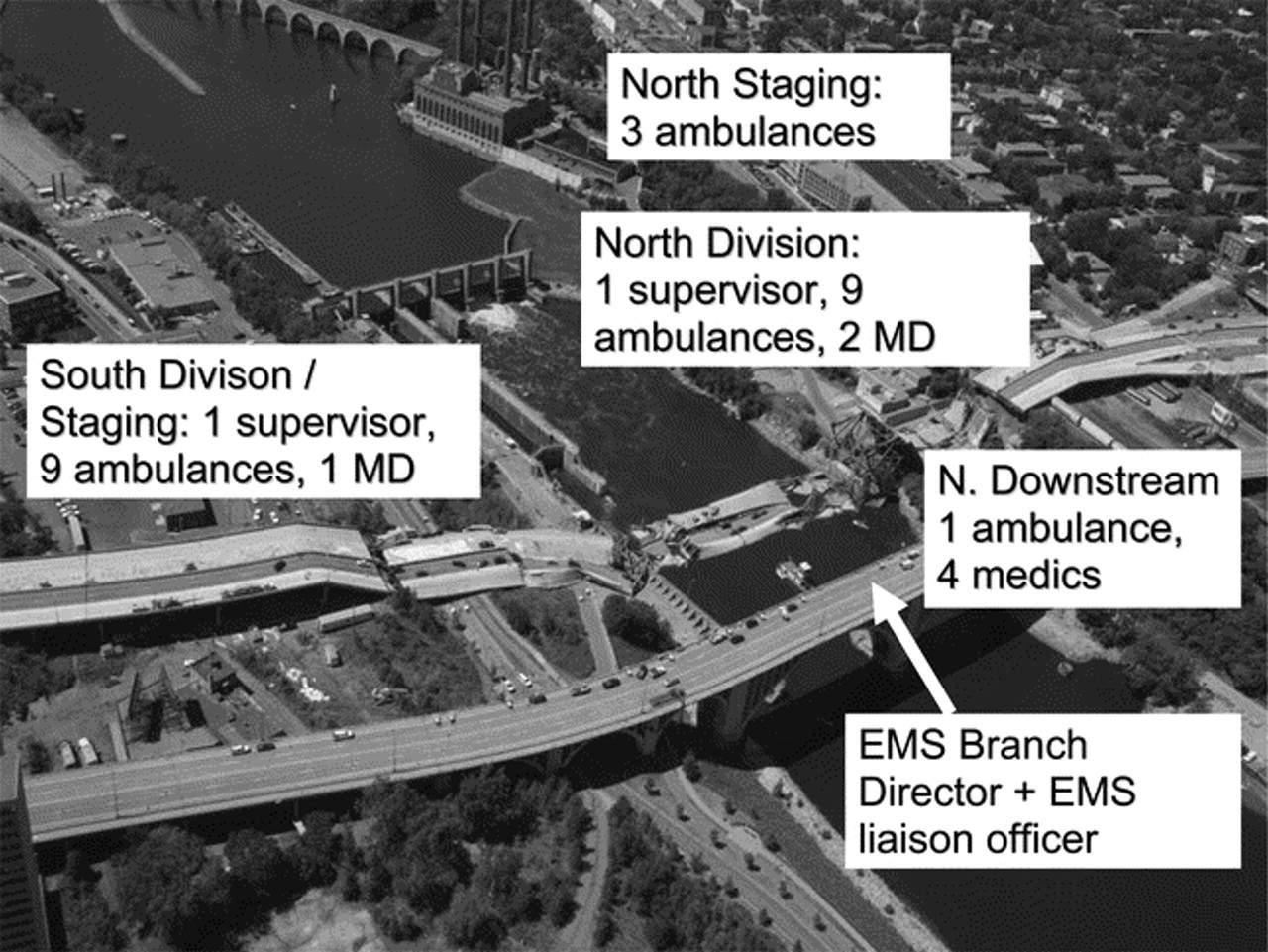
The incident was rapidly separated into north and south divisions, with an EMS supervisor assigned to each. This supervisor worked with the north and south fire battalion chiefs to organize efforts in their respective areas. The north side downstream division was visually hidden from the upstream supervisory personnel by debris and a retaining wall, limiting situational awareness and resource management ability, in addition to contributing to significant and often confusing radio traffic as several people in the downstream unit communicated resource needs and issues to the north division supervisor (Fig. 5). Formal SE, SW, NE, and NW divisions were assigned during the recovery phase but would have been helpful earlier, with supervisors for each division.
EMS resource deployment at 40 minutes after the incident.

An additional EMS supervisor was assigned to the HCMC garage to monitor the rest of the service area operations and assign arriving staff and resources. A communications supervisor was assigned to the HCMC dispatch center and MRCC.
Considering the geographic scope of the event, successful response during the first 30 minutes hinged on paramedics following their regional incident response plan rather than being directed by supervisors. Initial responding ambulance crews reported a high degree of comfort with the way that they had completed their initial tasks under the plan.
Several mutual-aid EMS units and many fire units self-dispatched to the scene. These units were not generally needed and were directed to staging, where they were directed back to their usual service areas. Several mutual-aid fire agencies did attempt to access the river bottom and blocked an access road; fortunately, this road was not being used for EMS egress or other critical traffic. A prestaging area has been discussed as a need in future events to prevent some of the congestion in the staging areas from occurring. Services also have been reminded about the importance of avoiding self-dispatch.
A single incident talk-group was used by EMS for the incident. By comparison, fire used 3 tactical channels and shared a channel for water rescues with law enforcement. EMS could have used additional talk-groups, but did not for simplicity. Radio traffic on this talk-group was heavy, but did not interfere with important communications. Some communications from individual units could have been reduced with additional training. Person-to-person communication between EMS supervisors and fire battalion chiefs was extremely helpful in joint decision making. Cellular telephones were used occasionally for more extended noncritical conversations, with some carrier-dependent system failures and dropped calls consistent with the loads on the system. Text-messaging functions were preserved throughout the incident.
Public information officers uniformly felt that they were understaffed early because they needed personnel to develop talking points, assemble information, and meet media needs. The media was monitored for information that was inaccurate. For example, a request for all medical professionals to come to the scene was conveyed by at least 1 station.
Triage
Triage tags were used in the casualty collection area on the north side, but otherwise were not applicable because of the availability of ambulances. Our EMS system uses the tags only when patients are waiting for rescue or evacuation to enhance prioritization, and not for patient tracking.
Paramedics reported that they did not use simple triage rapid treatment (START) or any other structured triage method, but based triage on injuries as they would on a routine basis. They believed uniformly that they were rapidly able to sort red, yellow, and green casualties without use of a triage tool and transport them to an appropriate facility. No patients required secondary hospital transfers, suggesting appropriate destinations, and patients arriving at hospitals had decreasing levels of acuity, suggesting appropriate triage (see Hospital Response to a Major Freeway Bridge Collapse for further information).
START triage has applicability, in that several of the initial victims were triaged red or highest priority based on altered mental status. However, several ambulatory patients were categorized as red (an open chest wound victim who later died and an intraabdominal injury [liver laceration] patient) or yellow (2 patients with spinal fractures), which by START criteria would have been green patients. Two nonambulatory patients that START would have categorized yellow were tagged red by the examining medic on the basis of abdominal rigidity in 1 case and pallor in the second that went directly to the operating room with intraperitoneal hemorrhage. This parallels our institutional experience that there appears to be a subset of patients that START categorizes as yellow that are actually red—usually with thoracic or abdominal injuries—but whose vital signs or clinical examination do not yet meet START criteria.Reference Bultman and Hick17 START is a valuable tool, but it is likely that experienced providers can more accurately categorize patients based on presenting symptoms, examination, and vital signs in rapid fashion. Further study of START is needed to determine how this intuitive system can be most effectively applied. The Sacco triage systemReference Sacco, Navin and Fiedler18 would not have been helpful in this setting because no data on the casualties would have been entered by the time of transport. It may be more helpful when evacuation of a larger number of victims occurs over a longer period of time, but this will likely have limited applicability for most mass casualty incidents.
Treatment
Basic life support care was provided to all victims. Few victims received ALS care (1 intubation, 3 with intravenous line established on-scene for medication administration). Rapid extrication and transportation to hospitals was the focus of EMS efforts. Because of incomplete records, only 25% of the HCMC-transported patients were able to be billed for EMS services; all of these were yellow and red patients.
Multiple backboards were brought from the HCMC EMS garage facility (about 1 mi away). However, cervical collars were not attached to the backboards and responding rigs' supply of “short” cervical collars was quickly exhausted. Adequate supplies of morphine were not available to the north downstream sector owing to limited amounts carried by the individual paramedics and no effort to systematically obtain more from arriving ambulances. Morphine could have been given subcutaneously to more patients. Some fractures were not splinted before transport if the patient was comfortable, although distal neurovascular function was ensured before transport. Many patients that would normally have received full spinal precautions were ambulatory at the scene and precautions were applied in a discretionary fashion based on available resources and patient complaints.
Transport
EMS units nearly uniformly failed to provide status as arrived at the scene by pushing the key on the mobile CAD terminal. Therefore, the CAD did not recognize attempts to give a crew's status as being en route to a hospital because the crews had never officially arrived on scene. Dispatch was still able to locate crews on the global positioning system map, but crew accountability and times were disrupted due to the failure to use the CAD per protocols and the splitting of some crews between different ambulances and areas at the scene. This system had only been in place for a few months at the time of the incident and thus errors may reflect lack of familiarity with the system.
Several pickup trucks were used to transport victims from the north downstream location to hospitals. This was a judgment call made by paramedics who had been waiting for ambulances to arrive when it was unclear whether the ambulances were able to access the road. Although austere and not ideal, the pick-ups provided timely and effective evacuation for yellow casualties without any airway or mental status problems.
Tracking
Patient information is supposed to be tracked via each unit calling MRCC at the time they leave a mass casualty scene; however, this failed in 75% of cases, resulting in MRCC having to call each ED via telephone to assemble patient lists. In retrospect, a regional decision 3 years ago to allow EMS units to call hospitals via cellular telephone with patient information has resulted in most units using this method and bypassing MRCC. Thus, during a major incident, the crews did not follow the plan because it was a task or step that they were not routinely executing—a common point of failure in several of the communication and system issues identified.
Behavioral Health Response
A family support center was set up at the request of MPD the evening of August 1 at a hotel close to the collapse site. This was initially overseen by a unified command group of local public health (both city and county), American Red Cross, and MPD officials, which led to confusion about scope, mission, and assignment of roles and responsibilities. Family reunification, information, and behavioral health support were provided at this site for the next several days, and moved to a secondary smaller location during the prolonged recovery operation. A previous functional drill involving several of the participating agencies conducted in May 2007 proved extremely valuable in setting up operations for the support center. Notably, several entities were interested in specific behavioral health operations that sometimes conflicted with the intent of other agencies or supervising agencies (although this did not affect the actual operations at the site). Defining the incident management framework and lines of authority, as well as the interventions and support to be provided at the site, is a focus of planning for future events.
Critical Incident Stress Management peer counselors conducted more than 20 voluntary public safety debriefings in the days and weeks following the bridge collapse, and information about coping with incident stressors was provided to all public safety personnel. Many providers who were not responders felt substantial guilt about not being there, and many responders expressed that they “wished they could have done more,” despite their efforts. Initial responders felt “powerless” in the face of the event, particularly those initial triage officers who had contact with conscious patients that died either on scene or at the hospital. Symptoms of insomnia, anorexia, hypervigilance, irritability, and nightmares were experienced by many responders (including the authors) following the incident. Long-term psychological effects are likely to be delayed and more complex. In general, responders tended to express great pride in the overall response and outcome, but they were critical of their own contribution and performance.
CONCLUSIONS
The collapse of the I-35W bridge presented rare logistical and scene hazard challenges to the local EMS system. An organized and effective EMS response involving multiple agencies occurred, including adaptive strategies for unforeseen contingencies. Overall incident management was successful and a simplified regional response plan was used effectively. Triage was effective despite lack of a structured system being applied. Challenges included poor situational awareness for the entire scene early in the event, communications issues, specific equipment and supply needs, behavioral health planning, and public information monitoring and management. Discordance between points of plan and actions taken often were caused by paramedics performing familiar rather than recommended actions, which is a common phenomena.Reference Burstein19
We are fortunate that this tragedy never became a disaster, in that it did not outstrip the resources of the community to provide appropriate prehospital medical care. It should, however, improve system performance in potential future events that may be larger in scale as structured after-action analysis is conducted and corrective action taken.
Authors' Disclosures
The authors report no conflicts of interest.
Acknowledgments
The authors wish to acknowledge the citizens of Minneapolis, who came to one another's aid and provided invaluable early assistance to responders; to MFD, MPD, Allina EMS, and North Medical Transportation for their partnership and dedication to community service; to the West Metro MRCC; and to the dedicated personnel of HCMC and HCMC EMS for their exemplary efforts and teamwork.