INTRODUCTION
Introduction of parasites into new geographical regions can have dramatic ecological impacts, facilitate host switches, threaten biodiversity and increase disease (Kennedy, Reference Kennedy, Pike and Lewis1994; Taraschewski, Reference Taraschewski2006; Dunn, Reference Dunn2009). Where transfers cross different climate zones, the events and adaptations required may mirror those linked with predicted trends in climate change, especially ‘global warming’ (e.g. Marcogliese, Reference Marcogliese2008). Complex interactions may occur, as in the case of Schistosoma mansoni and S. intercalatum in Cameroon where interspecies hybridization and exploitation of new intermediate hosts have changed the ecology of infection (Webster et al. Reference Webster, Southgate, Tchuem Tchuenté, Combes and Jourdane2003). In aquaculture, geographical expansions of Anguillicola crassus and Gyrodactylus salaris are well-documented, including host-range extension to native fish species in new areas (Kennedy and Fitch, Reference Kennedy and Fitch1990; Bakke et al. Reference Bakke, Cable and Harris2007). Establishment of introduced species may generate intense selection pressures involving adaptation to novel hosts, transmission cycles and environmental conditions (e.g. Mas-Coma et al. Reference Mas-Coma, Valero and Bargues2009).
The focus of this study is a helminth parasite of an ectotherm vertebrate host in which all life-cycle stages are influenced directly by external environmental temperature. This increases the impact of novel thermal regimes in areas of introduction in contrast to parasite life cycles in endotherm hosts where only the ‘off-host’ stages are exposed to external temperature change.
The African amphibian Xenopus laevis has been employed worldwide in biological research since the 1930s. Associated with this laboratory use and the pet trade, the species has been released into diverse environments in North and South America, Europe and Asia (Tinsley and McCoid, Reference Tinsley, McCoid, Tinsley and Kobel1996; Lillo et al. Reference Lillo, Marrone, Sicilia and Castelli2005; Lobos and Jaksic, Reference Lobos and Jaksic2005; Fouquet and Measey, Reference Fouquet and Measey2006). In several regions, environmental conditions may replicate the Mediterranean climate of the South African Cape where introduced populations almost certainly originated. For instance, in California, USA, conditions are near optimal for individual and population growth (Tinsley and McCoid, Reference Tinsley, McCoid, Tinsley and Kobel1996). However, X. laevis has also been introduced in regions with cooler, apparently less favourable, temperature regimes as in the UK.
Protopolystoma xenopodis is a monogenean specific to X. laevis that has become established with its host species in several novel geographical regions including one isolated colony in Wales (Jackson and Tinsley, Reference Jackson and Tinsley1998a; Tinsley and Jackson, Reference Tinsley and Jackson1998). This host population was probably introduced in the 1960s (Tinsley and McCoid, Reference Tinsley, McCoid, Tinsley and Kobel1996; Measey and Tinsley, Reference Measey and Tinsley1998) and, in the absence of evidence of subsequent introductions, its parasite almost certainly arrived at the same time and has persisted to the present. Strict host specificity excludes any potential transfer to other amphibian species and there are no reservoir hosts that could maintain the parasite independently of X. laevis.
Based on material from Africa, there is relatively comprehensive information on the life-cycle characteristics of P. xenopodis, making this one of the best documented monogeneans with respect to environmental factors affecting reproduction, transmission and survival (reviewed by Tinsley, Reference Tinsley2004). Parasite biology is highly sensitive to external environmental factors especially temperature (Jackson and Tinsley, Reference Jackson and Tinsley1988, Reference Jackson and Tinsley1998a, Reference Jackson and Tinsley2002), host factors especially immunity (Jackson and Tinsley, Reference Jackson and Tinsley2001, Reference Jackson and Tinsley2003, Reference Jackson and Tinsley2005), and within-population parasite factors including intra-specific competition (Jackson and Tinsley, Reference Jackson and Tinsley1988) and inter-specific interactions (Jackson and Tinsley, Reference Jackson and Tinsley1998b, Jackson et al. Reference Jackson, Tinsley and Hinkel1998, Reference Jackson, Pleass, Cable, Bradley and Tinsley2006). Field and laboratory data show that P. xenopodis populations are characterized by relatively low prevalence (40%) and very low intensities of infection (mean 1–2 adult worms/ host, maximum burdens almost invariably <7 worms/ host), low reproductive output (typically around 9 eggs/ worm/ day at 20°C), and a pre-patent period of about 3 months at 20°C (Tinsley, Reference Tinsley2004). Most published studies relate to parasite performance at 20°C, but more limited data confirm that constraints on life-cycle dynamics are severe at lower temperatures. Thus, per capita egg production below 10°C is <1 e/w/d and eggs fail to complete development at low temperatures (Jackson and Tinsley, Reference Jackson and Tinsley1998a; Jackson et al. Reference Jackson, Tinsley and Du Preez2001). Even a 5°C decrease in temperature, relevant to temperate regions, may extend the time to hatching of infective larvae from about 4 weeks at 20°C to a median of about 9 weeks at 15°C (Jackson et al. Reference Jackson, Tinsley and Du Preez2001). These rate-limiting effects contribute to seasonal cycles of transmission in natural habitats in southern Africa, including the Cape where water temperatures fall to 10°C in winter and transmission is minimal for 2–3 months each year (Tinsley, Reference Tinsley, Tinsley and Kobel1996). This response to low temperature suggests that, in a cool north temperate climate, transmission may be entirely precluded for much longer periods annually.
Overall, this study aims to quantify temperature effects at a series of key points in the life cycle: (a) viability and developmental rates of eggs; (b) growth and developmental rates of juveniles post-infection; (c) period to maturity; (d) survival post-infection and contribution to further transmission. This paper provides the background and presents results on stages developing in the external environment (a). A separate account records development of within-host stages (Tinsley et al. Reference Tinsley, York, Stott, Everard, Chapple and Tinsley2011). The approach adopted has recorded the schedules of development of life-cycle stages taken from natural infections ‘in the wild’ and maintained under controlled environmental conditions in the laboratory. Temperature regimes were selected to permit calibration of life-cycle timing in the range 10–20°C (relevant to the Welsh site) and at 25°C (relevant to the natural range in Africa and exploring the potential effects of climate warming). Results are of wider significance for assessing the feasibility of exotic parasite infections (in this case from Africa) to become established in cool temperate environments, and will contribute to the debate on the effects of global climate change on the potential for increased parasite infection levels and disease severity.
MATERIALS AND METHODS
Fieldwork
This investigation forms part of a larger ecological study of an introduced population of X. laevis in the Alun Valley, Glamorgan, Wales, continuing from 1981 to the present. Infections of P. xenopodis were followed in 1999–2008 at a single pond in pasture farmland where all X. laevis were individually marked. Water temperatures at the site were recorded throughout the year (at 30 min intervals) with Tinytag Aquatic 2 and Tinytag Plus data loggers (Gemini Data Loggers (UK) Ltd) submerged on the pond bottom (water depth approx. 60 cm). Temperatures at other water depths, and pH, were also recorded during fieldwork visits.
Sources of material
To investigate factors affecting egg development, trials in the range 10–20°C employed eggs collected from naturally infected wild-caught X. laevis from the introduced population in Wales. Trials at 25°C employed eggs from patent experimental infections of laboratory raised juvenile X. laevis previously exposed to parasite larvae hatched from eggs originating from wild-caught Welsh hosts (i.e. a laboratory F1 generation of Welsh parasites). As a guide to the genetic diversity of eggs in these trials, the wild-caught X. laevis comprised an ‘egg factory’ of 11 hosts, producing eggs at a rate indicative of 1–2 worms/ host. The laboratory raised hosts comprised 13 individuals carrying an estimated 1–5 adult worms each.
Laboratory procedures
Parasite eggs were pooled from aquaria in which infected X. laevis had been maintained at 20°C in a 12L:12D photo-period. The water was allowed to settle and sediment decanted, with rinsings, into crystallizing dishes from which eggs were transferred with a Pasteur pipette to Petri dishes for incubation. To standardize the effects of conditions prior to transfer to selected temperatures, eggs were harvested over 24 h periods, collected each day at 10.00–12.00 h, and transferred to 40 mm diameter Petri dishes half-filled with aged, dechlorinated tap water at 20°C. Dishes were placed in incubators by 16.00 h on the collection day and maintained in the centre of controlled environment cabinets (Sanyo Environmental Test Chamber MLR-351, Sanyo Ltd) at 10, 12, 15, 18, 20 or 25°C with 12L:12D photo-period. Temperature variation was <0·1°C. At each temperature, there was a minimum of 4 dishes of eggs (typically ca. 20 eggs/ dish) collected over different 24 h periods. Eggs were left undisturbed in the incubators for the first 2 weeks of development (at 25°C) or 3 weeks (other temperatures) after which a standard routine of checks was carried out between 09.00 and 10.00 h each day. All dishes were removed from an incubator together so that eggs were disturbed, out of the controlled conditions, for the same time. Each dish was exposed to illumination from a fibre-optics light on the microscope stage generally for a maximum of 1 min. The number of eggs hatched since the previous check was recorded every 24 h; empty egg capsules were removed after hatching. To counteract evaporation, especially at higher temperatures, Petri dishes were topped up using water aged in the incubator (all dishes at one temperature were topped up at the same time). To avoid growth of algae and potential increase in salt concentrations following topping-up, eggs were transferred to new dishes at approximately 2-week intervals: the replacement dishes of water were left in the incubator for the night preceding transfer and all dishes at a particular temperature were transferred on the same day. A further set of trials with otherwise identical manipulations employed flat-bottomed 96-well micro-plates (Nunc) in place of Petri dishes (following Jackson and Tinsley, Reference Jackson and Tinsley2007), but only the data recorded at 10°C were used in this account. The movement of dishes, exposure to light on the microscope stage, and disturbance of eggs were intended to provide a consistent stimulus for emergence of those larvae ready to hatch on a particular day.
Data analysis
Data were analysed using SPSS version 16. Generalized linear models with binomial error distributions were employed to investigate the influence of temperature on egg viability; Akaike Information Criterion (AIC) scores were used to assess model fits and likelihood ratio tests used to assess significance. Post hoc comparisons between binomial hatch probabilities at different temperatures were performed using LSD tests in a model where temperature was fitted as a categorical variable. The influence of temperature on time to hatching was investigated non-parametrically due to inequality of sample variances using Spearman's Rank and Mann-Whitney U tests. Means and percentages are given with their standard errors as estimated from models.
RESULTS
Environmental conditions at the field site in Wales
The habitat of the X. laevis population is a pond with area ca. 140 m2, constructed in the mid-1800s for livestock watering; maximum water depth is ca. 60 cm overlying up to 1 m of accumulated mud. About 70% of the perimeter is formed by vertical limestone walls, but there are ramps providing gently sloping banks for access by livestock. About half of the water surface is shaded by tree canopy and about half exposed to sun. Water pH is near neutral. The pond has no drainage inflow or outflow: water derives from precipitation and groundwater seepage.
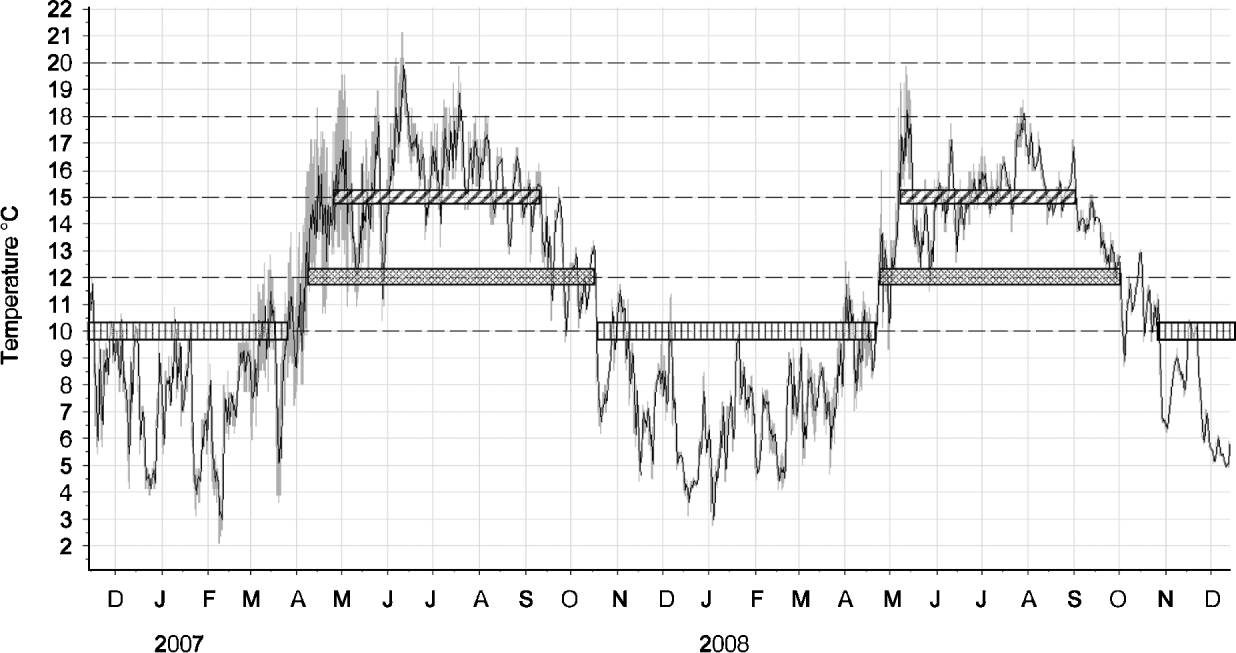
Temperatures for 2 years, 2007 and 2008, provide a reference for the field conditions experienced by the host-parasite system. Air temperatures in April 2007 were the warmest recorded for Wales (data since 1914) with the mean 3·3°C and maximum 4·7°C above the average for 1971–2000. Temperatures returned to average during May and for the summer as a whole (http://www.metoffice.gov.uk/climate/uk/2007/). In 2008, summer mean temperatures in Wales were exactly average (http://www.metoffice.gov.uk/climate/uk/2008/). Fig. 1 shows water temperatures in the pond for December 2006 to December 2008. Data logger records for mean temperatures suggest that conditions were similar in the 2 years. Considering the periods of greatest activity for hosts and parasites, average temperature between 1 May and 1 October was 14·9 (range 9·6–21·1) °C in 2007 and 14·9 (10·1–19·9) °C in 2008, and between 1 June and 1 September was 16·2 (12·8–21·1) °C in 2007 and 15·5 (12·6–18·6) °C in 2008. However, these averages conceal considerable differences relevant to this study, especially in the extension of warmer temperatures both earlier and later in summer 2007. Thus, water temperatures rose to 15°C 2 weeks earlier in 2007 than in 2008 and fell below 15°C 1 week later in 2007 than in 2008. The effect is indicated by the total time logged above 15°C (including all fluctuations): 104 days in 2007 compared with 75 days in 2008, and in the total area above 15°C: 3802°C h and 1886°C h respectively. With reference to present studies of parasite developmental periods (see below), water temperatures were >12°C for 28 weeks in 2007 and 23 weeks in 2008; >15°C for 20 weeks in 2007 and 17 weeks in 2008; >18°C for 6 days in 2007 and 2 days in 2008 (Fig. 1).
Water temperatures at the study site pond, Wales for Dec 2006 – Dec 2008. Horizontal bars indicate the periods when temperatures exceeded 15°C ( ) and 12°C (
 ) or were below 10°C (
 ). Durations were selected on the basis of abrupt major changes in temperature (in both directions), ignoring subsequent short-term fluctuations.

Between these 2 summers, from September 2007 to May 2008, the logger recorded temperatures <12°C for 205 days and <10°C for 169 days. Water temperatures were more-or-less continuously <10°C from mid-October to late April (over 6 months) (Fig. 1). In winter, the pond was ice-covered periodically; water temperatures fluctuated between 2°C and about 10°C and were <6°C on a total of 28 days in 2006–2007 and 47 days in 2007–2008. Spot checks on temperature variation at different water depths and locations in the pond showed a range of up to 8°C at midday in early June, between deep water in permanent shade (15°C both in the water column and on the mud substrate) and shallow water over mud banks exposed to sunshine (23°C).
Effects of temperature on embryo viability
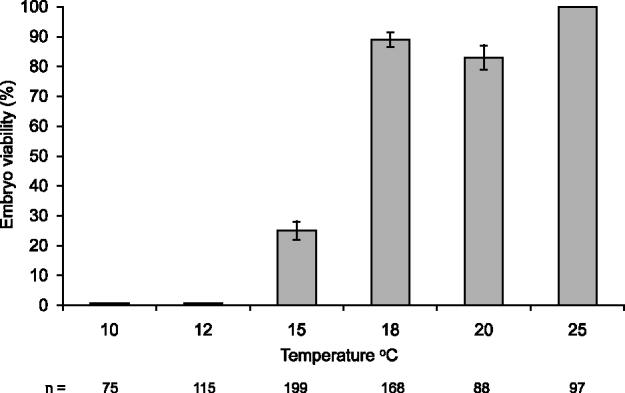
Viability was assessed as the proportion of larvae completing development within the egg capsule at 10, 12, 15, 18, 20 and 25°C (sample sizes in Fig. 2, total 742). Embryos showed no visible signs of development at 10 and 12°C. After incubation at both temperatures for 3 months, eggs were transferred to 20°C to determine whether development would resume: all were found to have died. Developmental success changed over a relatively narrow temperature range: the 3°C increments produced a shift from zero viability at 12°C, to 25% (±3·1) at 15°C, and 89% (±2·4) at 18°C. The further 2° increase to 20°C resulted in no improvement in egg viability (83%±4·0); 100% of eggs completed development at 25°C. The influence of temperature on proportional egg viability was highly significant: a step function with temperature included as a cubic term produced the best fit to the data (χ 2 (df=3)=607·5; P<<0·001). Post hoc tests (Fisher's LSD) were used to make pair-wise comparisons between temperatures. With the exception of the 10–12 and 18–20°C comparisons (P>0·999, P=0·222 respectively), all pair-wise tests were highly significant (P<0·001). Oncomiracidia that completed development within the egg capsules all hatched successfully.
Effect of incubation temperature (each ±0·05°C) on viability of embryos of Protopolystoma xenopodis (bars show means±s.e., samples sizes below). Pair-wise differences between temperatures are statistically significant except 10–12 and 18–20°C.

Effects of temperature on egg hatching schedules
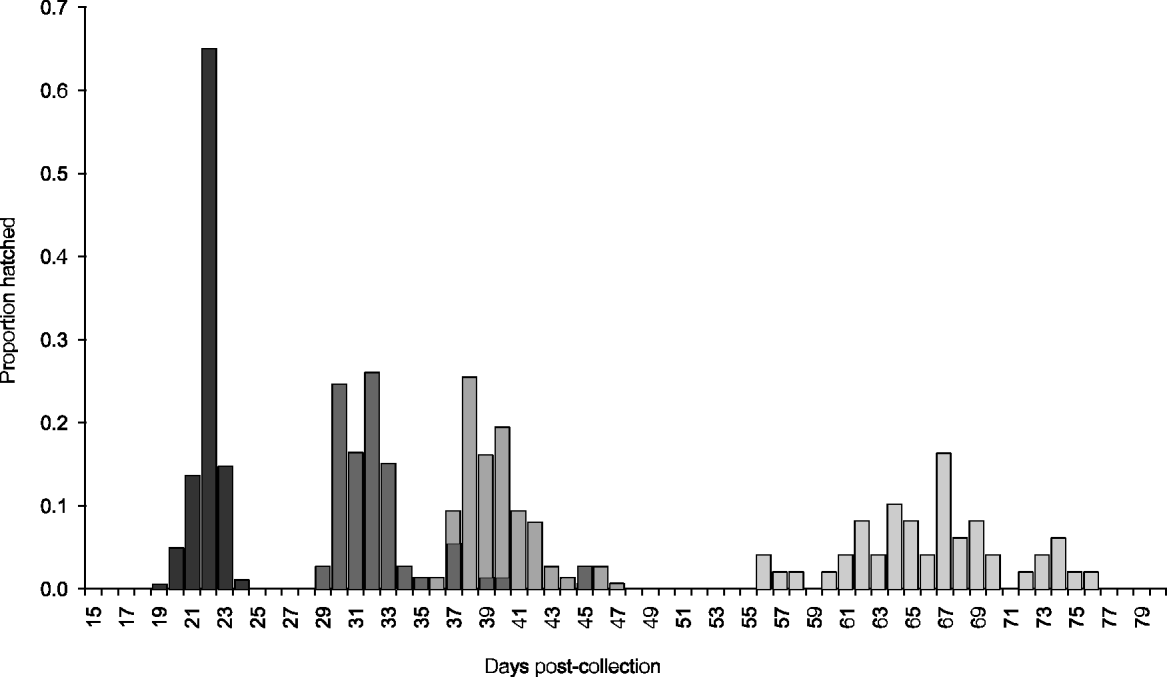
Fig. 3 shows the proportions of each sample that hatched each day at 15, 18, 20 and 25°C (sample sizes 49, 149, 73, 97). Mean times to hatching were 66·2±0·69, 39·5±0·19, 32·3±0·36 and 21·9±0·08 days respectively. Increasing temperature resulted in significantly shorter hatching time (Spearman's Rank r(366)=−0·941; P<<0·001). Hatching windows (the period over which larvae emerged) were clearly distinct and non-overlapping for temperatures separated by 3 and 5°C, but there was an overlap with the 2°C separation between 18 and 20°C (Fig. 3). A Mann-Whitney test demonstrated a significantly shorter period to hatching at 20°C compared with 18°C (U(149,73)=510·5; P<<0·001). The durations of hatching windows increased with declining temperature. At 25°C, hatch synchrony was high with all larvae emerging over 6 days (days 19–24) and most hatching on a single day (66% on day 22). At 20°C, the hatching window was 17 days (but 95% of emergence occurred over 12 of these days); at 18°C hatching occurred over 14 days and at 15°C over 21 days. The relationship between hatching time and temperature was non-linear: the 5°C decrease from 25 to 20°C produced a 50% increase in mean time to hatching, but the decrease from 20 to 15°C doubled the equivalent period. With further decrease to 12°C all eggs died without completing development (see above).
Frequency distributions of hatching times of eggs of Protopolystoma xenopodis incubated at 15°C  , 18°C
 , 20 °C
 and 25°C
 (see text for sample sizes). The difference between the overlapping ‘hatching windows’ at 18 and 20 °C is statistically significant.

DISCUSSION
Environmental conditions affecting infection
In comparison with most parasitic platyhelminths, P. xenopodis is characterized by low prevalence and intensity in natural populations and low rates of egg production (all reducing output of infective stages into the environment), relatively long developmental period to egg hatching (delaying transmission), and slow development post-infection to maturity (extending generation time) (reviewed by Tinsley, Reference Tinsley2004, Reference Tinsley, Thomas, Renaud and Guégan2005). These processes are temperature dependent and outcomes are therefore further constrained in cool environments. From this study, correlation of water temperatures in the habitat of X. laevis in Wales with developmental schedules recorded in the laboratory emphasizes the very narrow window for activity by infective stages. Water temperatures only briefly exceeded 18°C (for a few days each year) but parasite eggs failed to develop at temperatures <15°C that occur for about 8 months each year; infective larvae required 11 weeks to complete hatching at 15°C.
Many studies in the literature provide basic data on effects of temperature on parasite life cycles. Overall, there is extensive evidence that temperature represents a major factor regulating transmission: for instance, van Dijk and Morgan (Reference Van Dijk and Morgan2008) (endotherm hosts) and Chubb (Reference Chubb1977) (ectotherm vertebrates). For monogeneans, there are empirical data showing the temperature dependence of specific life-cycle stages (e.g. Kearn, Reference Kearn1986; Tubbs et al. Reference Tubbs, Poortenaar, Sewell and Diggles2005). Now-classic studies include the finding that development of eggs and intramolluscan stages of Fasciola hepatica are inhibited below 10°C (Ollerenshaw, Reference Ollerenshaw, Taylor and Muller1974). This should preclude life-cycle completion during periods of year and in geographical regions where low temperatures persist for long periods. Thus, sheep liver fluke has not established in Iceland where mean temperatures remain below 10°C for over 10 months each year (Torgerson and Claxton, Reference Torgerson, Claxton and Dalton1999). On the other hand, fascioliasis is a severe endemic disease in the High Andes where meteorological records show that average monthly temperatures do not rise above 7°C (Mas-Coma et al. Reference Mas-Coma, Bargues, Valero, Fuentes, Combes and Jourdane2003). The explanation lies in short-term variations in micro-environmental conditions. At high altitudes, in the air-water interface on damp soil, solar radiation may induce diurnal pulses of parasite development, ultimately allowing transmission (Mas-Coma et al. Reference Mas-Coma, Bargues, Valero, Fuentes, Combes and Jourdane2003; Tinsley, Reference Tinsley, Thomas, Renaud and Guégan2005; Robinson and Dalton, Reference Robinson and Dalton2009).
For the Protopolystoma – Xenopus system, water volume and relative thermal stability in the study-site pond exclude small-scale temperature fluctuations that could improve the developmental schedule of eggs on the substrate. This is confirmed by the data logger records taken at 30-min intervals.
The schedule for development of eggs of P. xenopodis calculated in this study is likely to be robust for the majority of total output that accumulates on the pond bottom where host animals typically occur both when inactive and when feeding on benthic invertebrates (Measey and Tinsley, Reference Measey and Tinsley1998). By contrast, the thermal regime may be more favourable for eggs laid on the sloping margins of the pond. From the habitat dimensions given above, and allowing for areas subject to dense shade, about 25% of the pond perimeter has shallow water providing warmer temperatures in summer. However, hosts occur infrequently in these areas in daylight (when at increased risk of aerial predation), so only a small subset of the overall output of parasite eggs will be deposited here. With vertical walls surrounding most of the pond, most eggs will settle in deeper water and predictions relating egg development to recorded temperatures should be realistic.
Effects of temperature on infective stages
The temperature intervals employed in the current study (10, 12, 15, 18, 20, 25°C) span the breakpoint in transmission attributable to thermal effects on egg development and survival. Jackson (Reference Jackson1993) found that eggs incubated at 10°C for 2 months were arrested but retained high viability; when transferred to 20 °C, their development resumed and hatching then occurred after the period normally required at this higher temperature. However, the activity of hatched larvae appeared to be compromised after exposure of eggs to cold for >1 month and embryo viability was reduced after 3 months of arrest. The present trials showed that all eggs died when maintained for over 3 months at 10 and 12°C. This has the inevitable outcome that eggs produced by P. xenopodis make no contribution to transmission for the major part of the year. In this and a previous study by Jackson et al. (Reference Jackson, Tinsley and Du Preez2001), 15°C represents the minimum temperature for embryogenesis.
As noted in accounts of other monogeneans (e.g. Kearn, Reference Kearn1986; Whittington et al. Reference Whittington, Chisholm and Rhode2000) and of P. xenopodis in particular (Jackson et al. Reference Jackson, Tinsley and Du Preez2001; Jackson and Tinsley, Reference Jackson and Tinsley2007), eggs produced during one 24 h period and developing under uniform conditions hatch over many days. This may have adaptive significance as a risk-spreading strategy to exploit mobile hosts that are only intermittently encountered. The temporal distribution of larval emergence may also achieve greater heterogeneity of parasite genotypes in established infrapopulations, with relevance to out-breeding. However, where there is an abrupt temperature-driven cut-off in hatching, as in Wales, this trait – otherwise presumably advantageous in transmission – may be responsible for considerable loss of reproductive output (see below and Fig. 4).
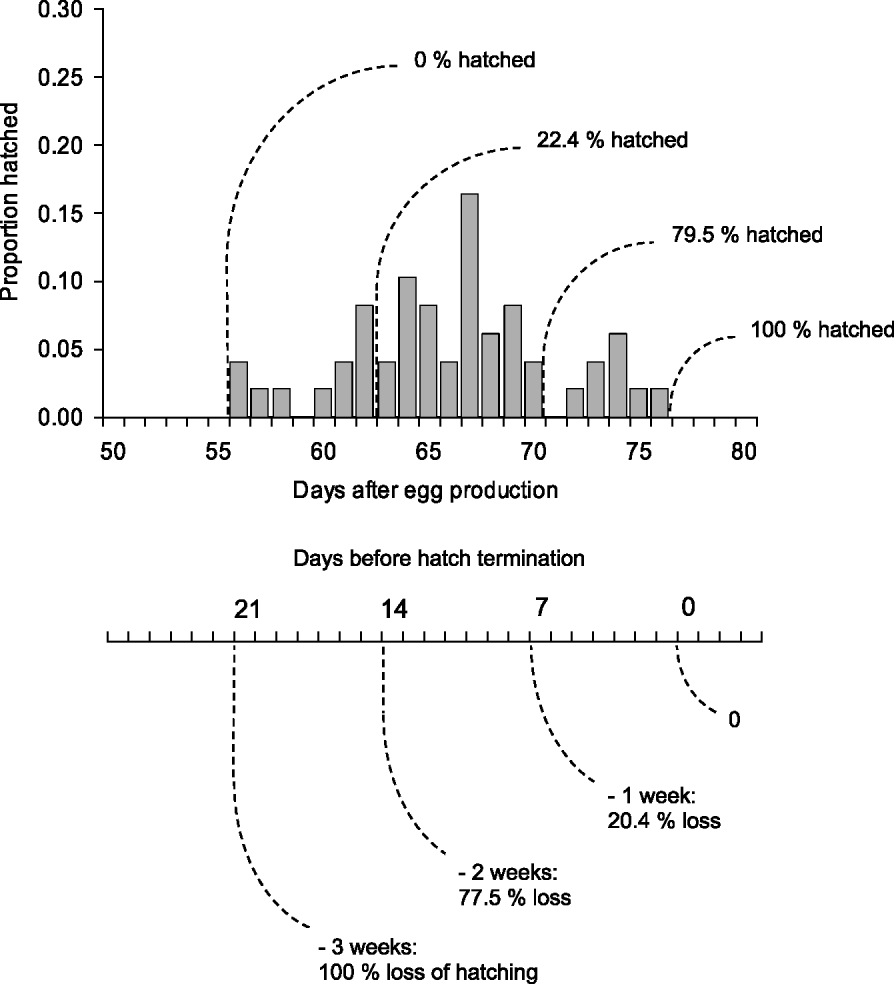
The effect of the egg ‘hatching window’ of Protopolystoma xenopodis on emergence of infective stages at the end of the transmission season. Timing is based on development at 15°C (close to the minimum for egg viability and the mean temperature in the natural habitat in Wales for May – September), and shows the final 3 weeks of the 11-week schedule of development/ hatching at this temperature. The upper part shows proportions of larvae hatching per day (bars) and per week (curved lines), beginning on day 56 after production and completed on day 77. The lower part depicts the fate of a single day's production of eggs in the period preceding inhibition of hatching by declining temperatures. The curves indicate the proportions of the larval population that are lost when there is a 1, 2 or 3 week reduction in the hatching period before termination (because of later production of eggs or earlier onset of low temperatures that close the ‘hatching window’).

It might be predicted that the environmental conditions in Wales should contribute to strong selective pressure, operating over at least 40 years, for faster egg development and hatching. Jackson et al. (Reference Jackson, Tinsley and Du Preez2001) recorded variations in hatching schedule between samples from different geographical areas in Africa. Overall hatching windows at 15°C for 2 isolates of P. xenopodis (from the Cape and Swaziland respectively) were 49–79 and 56–88 days post-collection, compared with present data from the Welsh population of 57–77 days. These ranges might indicate a reduction in the hatching window in Wales (from about 30 to 20 days), but it would require more intensive studies to detect whether there has been a shift in response times. At the threshold for development, 15°C, viability was only 25% in samples from the Welsh population whereas Jackson et al. (Reference Jackson, Tinsley and Du Preez2001) recorded >95% viability at this temperature in samples from S. Africa and Swaziland. If significant, this change would be in the opposite direction to that predicted; however, since there is a steep decline in viability near to 15°C (and zero viability with a further 3°C decrease), small variations in experimental conditions and in parasite effects could produce these differences between studies.
Interpretation of life-cycle events in the natural habitat in Wales
From the combined evidence of this and previously published studies (including Jackson and Tinsley, Reference Jackson and Tinsley1998a and reviews by Tinsley, Reference Tinsley2004, Reference Tinsley, Thomas, Renaud and Guégan2005), it is possible to predict a general schedule for the production of infective stages affecting the X. laevis population in Wales.
Constraints on egg production
Jackson and Tinsley (Reference Jackson and Tinsley1998a) measured the effect of temperature on egg production rate in P. xenopodis by transferring 2 groups of infected X. laevis along a thermal gradient from 20 to 6°C (with delays for acclimation at each level). In these hosts, mixed with respect to age, gender, experience of infection and hence immune state, mean per group output ranged from about 12 e/w/d at 20°C to <1 e/w/d at 6°C. On this basis, egg production in the Welsh population may just exceed 10 e/w/d at the highest summer temperatures. However, with average temperature between 1 June and 1 September 16·2°C in 2007 and 15·5°C in 2008, the mean maximum output is probably more usually about 9 e/w/d during June, July and August (the rate at 16°C recorded by Jackson and Tinsley (Reference Jackson and Tinsley1998a)). Significantly, egg production can continue even in mid-winter in Wales. At 10°C, the per capita daily rate is 1–2, but for more than half of each year output is probably <1 e/w/d (Jackson and Tinsley, Reference Jackson and Tinsley1998a).
Timing of egg development
Data in Fig. 3 show that eggs require 5–7 weeks to hatch at 18°C, but this temperature was reached in the 2 summers shown in Fig. 1 on only 2–6 days. Minimum hatch time is likely to be closer to 8–11 weeks recorded at 15°C. Water temperatures in 2008 did not exceed 15°C until early May, often dropped below this in early summer, and then fell consistently below 15°C in early September.
The beginning of the period when egg production can contribute to transmission includes output during early spring (at 10–12°C) when eggs remain undeveloped but survive until rising temperatures in early May permit embryogenesis. Eggs produced during this time will add to a pool of larvae that begin hatching after about 8 weeks of temperatures above 15°C. Egg output rates are low at spring temperatures but the accumulation of eggs, beginning development more or less simultaneously, could contribute to an enlarged infective larval population once hatching begins. In the thermal environment at the study site, the extent of this contribution is likely to be limited. Jackson et al. (Reference Jackson, Tinsley and Du Preez2001) showed that brief exposure to low temperature shock (5°C for 18 h followed by incubation at 25°C) had a small but significant effect on embryo viability. In Wales, sudden decreases over several days in early Spring (declining to <6°C in March in both 2007 and 2008) may depress viability and infectivity: temperatures did not reach 10°C consistently (excluding erratic spikes) until late March in 2007 and late April in 2008. So, the contribution to transmission made by eggs arrested at low temperatures and then recovering to complete development is likely to be restricted to only a few week's output (at only about 2 e/w/d) before the onset of temperatures ⩾15°C.
Timing of host invasion
The start of the period of transmission can be predicted from the requirement for 8 weeks of water temperatures ⩾15°C for eggs to hatch. In both 2007 and 2008, the onset of favourable conditions in early May was interrupted by a return of temperatures declining to 12°C, repeated briefly in June, that would have retarded embryo development rates. There may have been some compensation from spikes ⩾18°C (especially in 2007) so a reasonable estimate for the start of hatching would be late June (2007) to early July (2008).
The end of transmission in autumn is determined by the point at which eggs fail to hatch because their development is not completed before arrest at declining temperatures. Present studies did not assess the extent to which partly developed eggs could complete development and hatch at temperatures immediately below 15°C, but embryogenesis is arrested completely at 12°C. Fig. 1 shows that, in both recorded years, there was a steep decline from 15 to 10°C in the second (2008) or third (2007) weeks of September and fluctuations did not rise above 13°C after 1st October (both years). Even if brief ‘spikes’ around 13–15°C in late September could permit minor development (as in 2007) and even if emergence might continue at 1 or 2°C below the threshold determined in this study, the time extension during rapidly falling temperatures would be very short (i.e. only a small additional contribution to infection after temperatures have declined <15°C). Therefore, in both 2007 and 2008, host infection is likely to have stopped by late September.
Constraints on transmission
With an end to hatching in late September and a minimum developmental period of 8 weeks, eggs produced after the start of August have insufficient time to complete development. The limit on reproduction is actually more severe than this. The extended period of the ‘hatching window’ leads to failure to hatch for an increasing proportion of eggs produced in the 3 weeks preceding the final cut-off. To illustrate the principle involved, Fig. 4 is based on a time-scale of 8 weeks for development and 3 weeks for hatching at 15°C. Assuming a final end-point of 7 August, only the output up to about 14 July will result in complete hatching of each day's production. For eggs produced 1 week later (up to 21 July), about 20% of the daily output will not hatch; then 1 week after this (28 July), about 77% of eggs produced will fail to hatch; finally, during the 3rd week, even the small remainder will be eliminated by the ‘shutdown’ at declining temperatures. This represents a considerable loss of reproductive investment made at a time when water temperatures (and parasite life-cycle rates) are near to their highest in the year. The rapid decline, hatching reduced from 80% to 23% between the 1st and 2nd weeks, is determined by the shape of the frequency distribution in Fig. 4.
From these calculations, the overall period during which egg production actually contributed to transmission in 2007 would have extended from late March to early August, a maximum of about 19 weeks, and in 2008 from late April to early August, about 15 weeks. However, the contributions at both ends of this period are reduced. In the first few weeks, output would have been very low, with reduced viability/ infectivity and a hatching schedule little more advanced than that of eggs newly produced in May. During the final 3 weeks, a declining proportion of eggs would have hatched. The period of output free of these restrictions and contributing to transmission is actually May, June and half of July, about 10 weeks. All eggs produced between early August and late March/ late April will die without hatching, over 7 months of reproductive output in 2007 and over 8 months in 2008.
There may be a limited increase to this schedule of transmission involving eggs laid in warmer shallow water where development may be accelerated (perhaps by 1–2 weeks) and the period of infection extended. However, the structure of the pond habitat and predator avoidance behaviour by the host, limit the output of parasite eggs in these more favourable micro-environments.
The temperature records for 2007 and 2008 illustrate the strong effect of year-to-year environmental variations on transmission involving relatively short-lived infective larvae. The duration of water temperatures ⩾15°C was over 3 weeks longer in 2007 than in 2008 (attributable principally to the early boost to the seasonal thermal cycle from exceptionally warm conditions in April, see above). Because this temperature represents a critical threshold for egg development of P. xenopodis, variations around this cut-off have a comparatively major effect on transmission: potentially increasing the period of invasion by about 30%. In addition to their extended duration, the warmer temperatures in 2007 (represented by the greater area under the curve of temperatures >15°C, see above) will have maintained increased rates of egg output and egg development in comparison with 2008, contributing further to enhanced invasion rates. For helminths with development thresholds near to this critical 15°C boundary, even small increases in ‘climate warming’ may have a significant effect on parasite infection.
In summary, the life-cycle metrics of P. xenopodis are strongly limited in an environment dominated by low temperatures. Parasite egg output is continuous throughout the year, but eggs produced during 7–8 months each year are destined not to hatch. Temperatures allowing infective stages to develop extend from late April/ early May to mid-September but host invasion begins only in late June/ early July. The present data pinpoint the period of parasite egg production that actually contributes to transmission: 15–19 weeks per year in the 2 study years. However, exclusion of periods when egg output is very low (in April) and when hatch rate is declining (late July), indicates a period of effective reproductive output of only about 10 weeks per year (early May to mid-July). As a consequence, when egg output rates are near their maximum, in early mid-August, the window for completion of egg development has already closed. The overall period of host invasion is similar, about 10 weeks/ year, but this is staggered by about 8 weeks with respect to corresponding egg output. Invasion is probably precluded entirely for about 9 months each year, between late September and late June/ early July. The halt in autumn is attributable to the failure of eggs to complete development at declining temperatures; the continued inhibition until the following early summer reflects the time-lag after favourable temperatures return in spring before infective larvae complete development.
The establishment of an African parasite in a cool north temperate environment presents an exceptional opportunity for understanding limiting factors in transmission biology. This study has quantified the schedules for development and host invasion in the natural habitat. Clearly, the persistence of this infection in Wales for at least 40 years indicates that the very restricted input of infective stages can maintain the parasite population. The effects of temperature on these stages subsequently within the host are of major importance for understanding the survival of this introduced parasite: these are considered in an accompanying account (Tinsley et al. Reference Tinsley, York, Stott, Everard, Chapple and Tinsley2011).
ACKNOWLEDGEMENTS
We thank the Thomas and Lewis families, Croescwtta Farm, Vale of Glamorgan, for access to the field site. We are grateful for assistance in the laboratory from Josie Richards and Andy Bond.
FINANCIAL SUPPORT
This project was supported by research grant BB/D523051/1 from BBSRC.