In the fifteenth century, quality woollens production moved decisively from towns to the countryside, and increased dramatically as both export and home demand increased.Footnote 1 Bruce Campbell has suggested that ‘non-agricultural employment may have contributed roughly a tenth of rural incomes by 1300. Two centuries later this proportion had probably doubled, as manufacturing fastened more vigorously onto rural labour.’Footnote 2 By 1540, perhaps as many as 18 per cent of the adult population, 264,000 people, were involved in making cloth; most of them women who prepared the yarn in the countryside, and wives who sat by their husbands’ side at the broadloom.Footnote 3 This explosion of rural industry was largely orchestrated by clothiers who, in the hundred years from 1450 to 1550, transformed English clothmaking, and therefore helped to make English woollens the juggernaut in the continental textile trade it had become by the mid-sixteenth century. Rural clothiers’ contribution to English clothmaking has been noted, but the manner of this achievement has not been fully explained.Footnote 4 Why and how did they innovate, harness rural skills and organise clothmakers to make a range of high-quality woollens? This article considers their importance to industry development and the economy; outlines the skills, capital and organisation that transformed clothmaking; shows how they specialised regionally in terms of both product and organisation to broaden the range of quality woollens by the mid-sixteenth century; and why their strategic influence then declined.
Clothiers’ and graziers’ contribution to this century's economy has been far greater than many historians have conceded. Recent projections for economic growth have per capita textiles/leather output and sheep numbers declining from 1450 to 1550, based on very low estimates for the size of the domestic market, and its decline along with population after the Black Death.Footnote 5 Richard Britnell went so far as to conclude that ‘it requires a strong prior commitment to academic convention to find any unprecedented development of commerce in the period 1450–1550’.Footnote 6 Further, it has been suggested that increases in standards of living have been exaggerated; that the growth in wages after the Black Death were far lower than the rise in harvest wages might indicate, that tenant farmers burdened with rent and tithes had great difficulty to make agriculture pay in the face of falling prices, and that any additional income had little impact on the standard of living since it was spent mainly on food.Footnote 7
A recent review of all the research on wages and the cost of living provides a more optimistic perspective as it has confirmed that unskilled labourers’ standard of living improved until the end of the fifteenth century.Footnote 8 This article provides additional evidence for a rising standard of living and suggests that, in clothmaking areas, additional household income may well have offset the rising cost of living in the first half of the sixteenth century. The growth and productivity of pastoral farming together with rapidly growing cloth production and rising cloth quality stimulated the economy once population decline ended in the fifteenth century, and economic growth returned after the mid-fifteenth century depression. Domestic cloth consumption and exports, as well as the weight and quality of woollen cloth, rose.Footnote 9 Peasants and their wives wore more expensive, colourful cloth, rapidly accepting new fashions that included doublet and hose, and probably used linings more extensively as cheaper woollens became more readily available.Footnote 10 My projections suggest that cloth production rose by over 100,000 cloths from the early 1440s to the early 1540s, and sheep numbers may have increased by three million.Footnote 11 The value of exported cloth from London in the depressed 1460s was an estimated £33,400 annually, and in the 1530s £314,700, almost a tenfold increase.Footnote 12 These estimates, of course, are based on many assumptions, but they have been developed from a detailed analysis of trends in both pastoral farming and cloth production, and the estimates for domestic consumption in 1541–5 of 190,000 cloths are far lower than Craig Muldrew's estimate of 299,000 cloths in the 1590s, so my projections may be conservative.Footnote 13
This rapid growth in textile production between 1470 and 1550 must have impacted the total economy, especially since sheep and cloth production combined probably accounted for close to a third of total national output, and levels of annual economic growth were so low.Footnote 14 It has been estimated that the per capita output increase from the 1340s to the 1470s, a period when rising wages and falling prices would suggest reasonably strong economic performance, only resulted in an annual increase of 0.20 per cent, and it was even lower at 0.04 per cent from the 1470s to the 1650s.Footnote 15 Given this stagnant economy, the flourishing cloth industry and high productivity sheep farming that sustained it, must have increased economic growth from 1450 to 1550.
Clothiers, working with merchant adventurers and other overseas cloth merchants, made this growth possible. They were the architects of the rising quality and value of English broadcloth, and of kersey as an important secondary cloth for export. Clothiers had to reorganise the business system to make it more efficient, while at the same time raise the skill level of rural clothmakers. In contrast to urban drapers they allocated capital to streamline production. Clothmaking became more specialised as each region produced only the cloths for which they could develop a competitive advantage.
From around 1450 it is useful to identify two types of clothier: merchant clothier and complete clothier.Footnote 16 The merchant clothier bought cloth from the weaver or fuller, perhaps had it piece-dyed, sheared and packed, and then sold it to a merchant in a distant market. This was the role that the merchant draper had performed in larger urban clothmaking towns. Clothiers’ marketing role made sense because someone had to assemble rural cloth, leaving weavers, fullers and shearmen free to weave, full, shear and sometimes sell their cloth locally. The complete clothier controlled cloth production. He started by buying wool and then either supervised or brought in-house all production processes until the cloth was ready for sale. There was a further distinction between wealthy leading complete clothiers who sold the cloth mostly in London and the smaller, less capitalised complete clothiers who might be no wealthier than successful weavers, and who sold their cloth to better capitalised clothiers with superior distribution networks.Footnote 17
The complete clothier is the central figure because he transformed the industry during the critical period from 1460 to 1530, but there were always independent clothmakers with whom he co-existed: weavers, fullers, dyers and shearmen with varying degrees of dependence on clothiers. This article concentrates on full broadcloth made in the West Country counties of Somerset, Wiltshire and Gloucestershire; the East Anglian clothmaking region of southern Suffolk and northern Essex, and the Kentish Weald; and on fine kersey centred on Newbury – all areas in which complete clothiers had a significant impact. As a rough generalisation the complete clothier made high-quality broadcloth and kersey that he sold in London; the merchant clothier handled price-sensitive coarse broadcloth, kersey and straits, much of which was sold domestically.Footnote 18
Urban drapers, mercers and other merchants sold the cloth overseas, and redistributed cloth across the country. The different categories of cloths for sale at the end of the clothiers’ century is well illustrated in the Salisbury draper David Lewis's 1548 woollens inventory. He spread his inventory across three shops.Footnote 19 His ‘great shop’ carried quality broadcloth and kersey worth £90 4s 1.5d. As a prosperous draper he was primarily interested to sell fine broadcloth valued, on average, at 52.8d/yd and narrow kersey at 16.3d/yd. The ‘shop next to the courtyard’ held northern broad dozens, osettes (straits), some quality frieze, and some black kersey valued in total at £16 10s 11.5d. The northern dozens were worth 23d/yd while the coloured narrow cloths were worth 12d/yd. Lastly there was ‘the little store’ with £13 15s 8d in goods. This contained cottons, frieze, and rugs three quarters of a yard wide priced between 2–15d/yd but most around 6d/yd. The export market was even more focused on quality broadcloth and kersey.Footnote 20 There was, therefore, a broad quality range for sale. Quality coloured broadcloth earned a price more than double that of coarse cloth, and quality kersey was a third more expensive than coarse kersey or straits. Cottons could be bought for less than a tenth of a quality coloured broadcloth.
I
In England, rural cloth had always been able to tap into a regional and even national market because urban clothworkers never had the political clout to restrict free trade. In 1300, expensive greased woollens were a minor part of the market, and Flemish imports had severely restricted English urban production of these fine cloths.Footnote 21 Urban clothmaking also faced competition from rural clothmakers that could easily make coarse worsted and serge (cloth with a worsted warp and woollen weft) that they often sold in towns.Footnote 22 Free trade was given the force of law in 1535 when the Statute of York allowed domestic and alien merchants to trade throughout the country.Footnote 23 In the early fourteenth century, rural clothmakers were quick to take advantage of the carding and wheel spinning of weft thread using cheaper wools that provided perhaps a 50 per cent improvement in productivity over combing and spinning with a distaff and spindle.Footnote 24 This transformed greased woollens from a niche to a mass market. As early as 1326 the small priory at Maiden Bradley in Wiltshire, for example, was buying narrow and broad blanket, pannus and russet from neighbouring small towns as well as at Salisbury.Footnote 25 London burellers, who had successfully made coarse worsteds and serges since the early thirteenth century, had disappeared by mid-century.Footnote 26 The greater complexity of making greased woollens, especially in the finishing processes, led urban drapers to buy rural cloth and then finished it in towns. By the end of the century many rural clothmakers from Somerset, Wiltshire, Kent, Surrey/Sussex and Suffolk/Essex had adopted the broadloom and were selling broad dozens (cloth half the length of a standard broadcloth) and straits/kersey (cloth a foot wide and 12 yards long) to London merchants looking for cheaper cloth for export.Footnote 27 In Somerset from December 1396 to October 1397 19,411 dozens and 4,461 narrow straits paid the alnage subsidy: in Kent from July 1394 to November 1395, dozens alnaged were equivalent to 1,385.5 assize cloths, far more than the 456 full-size broadcloths recorded: in adjacent Surrey and Sussex, from 1391 to 1394, all cloths were dozens.Footnote 28 Much of this production must have found its way to London since these quantities far exceeded local demand.
Rural cloth's growing access to national and international markets is reflected in the establishment of cloth halls, many of which were set up at the end of the fourteenth century. London's establishment of a covered market in 1396, Blackwell Hall, permitted closer supervision of provincial cloth, but it also made it easier for rural clothmakers to market their cloth, and for alien and other merchants to buy it.Footnote 29 Other towns, Bury St Edmunds, Colchester, Coventry, Bristol and Norwich are known to have regulated the sale of rural cloth at around the same time.Footnote 30 At the end of the fifteenth century, York made arrangements for the sale of different cloth types. Its drapers and tailors were able to restrict the sale of foreign cloths in 1492 to the Thursday market when they could exercise their right-of-search. Inexpensive Kendal cloth could be sold wholesale at the inns.Footnote 31 Southern merchants sold their cloth wholesale to be retailed by tailors, hosiers and drapers. In 1501 West Riding cloth was to be sold on the street from the Common Hall towards Stayngate, while Northern Riding and Kendal cloth was to be sold on the street from the Common Hall towards Conyngstreet.Footnote 32
Free trade in England contrasted with greater protectionism in the Low Countries.Footnote 33 Worcester was the one exception that perhaps proved the rule, since it successfully secured passage of an act in 1533 that limited production to the county's boroughs, probably because there was limited parliamentary opposition, and it simply reflected the status quo.Footnote 34 What weighed in its favour was that half its citizens were involved in the industry, there was very little rural Worcestershire production to displace, the town specialised in high-quality short, and particularly long white cloths that were not produced in significant quantities elsewhere in the region, and strict regulation was deemed necessary to maintain consistent quality.Footnote 35
Clothiers therefore benefited from the weaknesses of urban clothmaking, high labour costs and the rigidity and protectionism of artisan guilds, as well as from the growing pre-eminence of London that allowed rural clothmakers to bypass provincial towns.Footnote 36 In towns, weavers and fullers had to sell their cloth to merchants, and clothworking guilds had strict rules on the number of apprentices and servants, which limited business size.Footnote 37 In London, weavers were in decline before the end of the fourteenth century as overseas merchants purchased mainly lower quality provincial cloth that they then finished.Footnote 38 In contrast, a clothier enjoyed the relative freedom to evolve his business and attract the skills and labour he needed. A weaver or fuller could become a merchant, a merchant might organise cloth production, and a sheep farmer could also be a yarnmaster, and then a clothmaker.Footnote 39 Capital determined both the organisation and its size, and the business tended to consolidate over time as the largest clothiers came to dominate distribution.Footnote 40 It took at least three generations of Springs to make them the richest clothiers in the land, and two generations of Winchcombes and Stumpes to acquire great wealth.
By the 1470s a national market concentrated on London had emerged, as merchant adventurers dominated the cloth trade with the Low Countries, and London merchants were far better capitalised than their provincial competitors.Footnote 41 Successful clothiers in each region exploited their advantages to meet the specialised needs for both export and domestic markets, in wool and other raw materials, lower labour costs, and proximity to markets. Some villages, regions, and one family (Winchcombe), were able to develop a valuable international reputation for distinctive, high-quality cloth, among them Winchcombes, Glemsfords, Coggeshalls, Castlecombes, Stroudwaters, Suffolks and Kents. For a hundred years the export market expanded with few setbacks, which provided a continuous stream of opportunity that enterprising clothiers strove to grasp.Footnote 42 Further, the domestic market, which was larger than the export market, also grew as standards of living rose. More people were buying commercially-made cloth rather than making homespun, while changes in fashion and eventually population growth stimulated consumption.Footnote 43 Improvement in the overall quality and reputation of English exported cloth from 1400 to 1550 is unmistakable.Footnote 44 In the 1390s the Hanse had turned to rural clothmakers to find cheap narrow straits, and exported broadcloth from eastern ports was of relatively low quality.Footnote 45 In the 1440s Italians were still mostly buying cheap westerns at 26s a cloth and far fewer bastards, probably white broadcloths, at 38s 2d from the western counties.Footnote 46 Forty-five years later, aliens exporting through London in 1488–9, were buying coloured broadcloths priced around 60s, and then, in far fewer quantities white broadcloths at 40s, coloured westerns at 40s, white westerns at 30s and bastards at 26s 8d.Footnote 47 English woollens became more attractive in Antwerp when the currency was debased in 1464. By then, English wool accounted for as much as 70 per cent of pre-finished manufacturing costs for the finest Flemish woollens.Footnote 48 In order to remain competitive many Flemish draperies replaced English with lesser quality Spanish wools.Footnote 49 The English response seems to have been to increase standard broadcloth weight and quality to widen its competitive advantage.Footnote 50 In the next century quality cloth included fine kersey and superfine long cloth from Worcester, Glemsford, Coggeshall, Reading and the Kentish Weald that challenged the finest cloth from Bruges, Leiden or Armentières.Footnote 51
II
The decision to become a complete clothier was not an easy one. Strategically, it made sense because it was the best way to ensure consistent high quality, particularly if wool dyeing was required, but it did mean that he had to divert scarce capital from financing trade to production that urban merchants had almost always avoided. Cloth production therefore had to have been at least as profitable as trade. Clothiers were funded with mostly rural capital, and credit availability was under pressure in the fifteenth but rising in the sixteenth century, if we are to believe that credit moved in step with the money supply.Footnote 52 London merchants in 1535 had three-and-a-half times as much tied up in credit as they did in business inventory, while clothiers had 26 per cent more capital tied up in their business goods than in their hopeful debts, ones they had a reasonably certain chance of recovery.Footnote 53 For example, John Bawden of Horsemonden, Kent's 1564 inventory indicated that two thirds of his business investment was in raw materials, wages owed and cloth, and a third in financing trade.Footnote 54
Historians have assumed that the clothiers’ advantage was cheap labour and firewood, but this was only partly true, because clothiers were competing by the mid-fifteenth century, not primarily with urban cloth but with rural unfinished cloth that was finished and dyed in towns. Drapers were typically purchasing rural cloth of variable quality that had been mechanically fulled, tentered and taken to the alnager to pay the subsidy, but not burled (impurities in the cloth removed), wet sheared, dry sheared, or in-the-piece dyed.Footnote 55 He therefore gave the cloth to the urban fuller to check quality and start the finishing process. The fuller placed it over a perch close to the waterfront and inspected that the cloth had been evenly fulled, beat the cloth again if necessary, burled and wet sheared the cloth, and re-tentered the cloth to dry it.Footnote 56 It was then given to the shearmen and dyer to colour and finish the cloth. Urban finishing was grossly inefficient; cloth had to be moved from place to place in towns, the urban fullers’ work included additional work that arose from fixing quality problems that the rural clothier might avoid if he studiously supervised the process from end-to-end. Work at the perch was lower paid than fulling so probably women in the countryside did much of this work.Footnote 57
Many clothiers were based in small towns but their fulling operations were often beside rural streams and they depended on carders, spinners, weavers and fullers in the countryside. Once one clothier had become successful other clothiers would be attracted, so that a cluster of clothiers developed along river systems creating some economies of scale and healthy competition that lowered prices and raised quality.Footnote 58 Complete clothiers were able to adjust their business operation to fit market needs: they had to supervise each stage but they rarely needed to conduct all production processes in-house. It was a mixture of the putting out system where all processes were subcontracted, and the domestic system in which work was done in-house.Footnote 59 There were isolated examples of a factory system, but these were unusual as the capital investment and operational inflexibility usually offset any economies of scale.Footnote 60
Leading complete clothiers making quality cloth had one thing in common: they operated a wool warehouse, and tightly-controlled yarn preparation.Footnote 61 Skills in weaving, fulling and finishing were of little value if yarn quality was poor. Clothiers purchased quality wools and sorted them for fine or coarse cloths, for warp and weft yarn, organised a network of spinners, and then carried a yarn inventory. A large clothier might have to organise over a hundred, mostly part-time, women – a few working in his woolhouse, but most spread across rural villages. Some showed appreciation in their wills. In 1486 Thomas Spring II left the substantial sum of £66 13s 4d to his spinners, fullers and weavers and in 1539 the Cranbrook clothier Stephen Draner, left £30 to his spinners and weavers.Footnote 62 Half the hours to make the standard finished broadcloth was in yarn preparation, and most of the work was by spinsters or wives who combined spinning with household and agricultural duties.Footnote 63 Of the sixty people employed to make a Yorkshire broadcloth in 1588, forty-two were sorters, carders and spinners; and for a similar kersey output, forty-eight were involved in this preliminary work.Footnote 64 The best-documented example for the organisation of spinners was a Newbury workhouse in the 1620s and 1630s, with an output of four broadcloths a week. The wool was sorted, washed, dyed, carded and oiled in the workhouse and then delivered every two weeks to six spinning houses in the surrounding villages up to twenty miles from Newbury, as well as in Newbury itself.Footnote 65 Approximately seventy spinners were paid between 2d and 4d/lb depending on thread quality to feed weavers at the workhouse and produce additional yarn for sale.
While the primary benefit from controlling an army of spinners was to achieve consistent quality, an inventory to feed the looms, and to sell leftover yarn to others, there may also have been cost savings as spinners were trained to produce a carded, wheel-spun warp to produce an all-carded woollen. Carding and wheel spinning of wefts on the Great Wheel had largely replaced combing and spinning with a distaff and spindle in the fourteenth century. It is likely that all warps with the exception of superior cloths were carded and wheel spun by the mid-sixteenth century.Footnote 66 The 1552 cloth act specifically identifies Coggeshalls and Glainsfords handiwarps, fine white cloths from western Suffolk and Essex whose warp was still spun with a distaff and spindle. However the pace of diffusion of carded and wheel spun warps is unknown.Footnote 67 A new spinning wheel, the Saxony wheel that permitted the continuous drafting, twisting and winding-on of the yarns can be traced back to 1475, and was clearly used for woollen warps and wefts in the early sixteenth century.Footnote 68 Armentières in western Flanders had mastered how to make an all-carded fine woollen towards the end of the fifteenth century.Footnote 69 The first direct reference to an all-carded English woollen is at Norwich in 1502, where woollen weavers’ ordinances declared that low warp threadcount narrow cloths (350 warp threads per yard) were all wheel-spun.Footnote 70 The Saxony wheel provided substantial improvements in productivity but it was used more extensively in the linen industry, and it may have been that spinners had been trained to produce warp thread using the Great Wheel.Footnote 71 Clothiers therefore involved themselves in yarn preparation at a time when there were substantial opportunities to not only improve quality and consistency of the yarn, but also improve spinning productivity, whether it was on the Great or Saxony wheel.
Leading clothiers making coloured cloth operated dyehouses, and almost all the surviving clothier inventories before 1550 included dyeing operations. Clothiers had a comparative advantage over urban dyers because they could dye in-the-wool, whereas merchants buying unfinished cloth would dye-in-the-piece. By the mid-sixteenth century most Suffolk and Kent broadcloth and much Newbury kersey was dyed blue with woad in-the-wool and then some of it would be redyed in-the-piece locally, in London or on the continent. Wool dyeing provided a more consistent colour as different batches of wool could be intertwined. Clothier dyehouses were to be expected in Suffolk, Kent and Berkshire where coloured cloth predominated, but is surprising to find them in the West Country where most production was white unfinished broadcloth. In 1472 Walter and Joan Mayhew of Croscombe, Somerset were woad and madder-dyeing their wool; in 1480 Richard Rychards of Dursley, Gloucesterhire specialised in red cloth as he had madder and alum in his dyehouse as well as red cloth in his warehouse; in 1495 John Chew from Somerset ran a dyehouse.Footnote 72 Castlecombes and Stroudwaters had a reputation for reds, and there was some cloth dyeing to meet domestic demand. Of all rural clothmaking areas it was Kent that built its reputation on the quality of its coloured broadcloth. Stephen Draner, the Cranbrook clothier who died in 1539, had woad, madder and alum worth £25 3s 4d and blue wool worth £6.Footnote 73 As almost all kerseys were sold dyed and finished, sixteenth-century Newbury fine kersey clothiers also based their reputation, at least in part, on the quality of their dyeing.Footnote 74 John Winchcombe bought up most of the Southampton woad in 1539/40, reducing his excise duties in return for shipping his kersey there.Footnote 75
The other process that clothiers selling coloured cloth often brought in-house was shearing and dressing in order to standardise quality prior to sale. The quality of raising the nap and shearing it, and the number of times this was done, determined the final feel of the cloth.Footnote 76 Thomas Ravyn, from Needham Market Suffolk, for example, had four pairs of shears and hooks required to secure the cloth on the shearing board in his 1538 inventory.Footnote 77
There is no evidence that clothiers had any difficulty attracting weavers to weave their cloth. In Suffolk we can see the decline in independent weavers in debt actions recorded in the plea rolls in the second half of the fifteenth century as clothiers now financed cloth production.Footnote 78 Some weavers remained independent while others became clothiers’ outworkers. Clothiers had to have played an important management role in the conversion from narrow to broadcloth, and this may have led some clothiers to weave their own cloth. John Scoten of Naylond, Suffolk for example had his own weaving shop with three broadlooms in 1539.Footnote 79 John Winchcombe was reputed to have run a weaving shed with two hundred looms, and William Stumpe to have employed as many as 3,000, but these figures are obviously inflated.Footnote 80
Over time there might be consolidation as clothiers’ growing market power, capital, and ability to divert production to dependent clothworkers put great pressure on the independent artisan who was often forced to work for clothiers to make a living.Footnote 81 Suffolk and Essex weavers complained in 1539 that clothiers had looms in their own homes, employed their own weavers and fullers, and were pricing their cloths so low that it forced weavers to become clothiers’ servants.Footnote 82 In 1555 clothiers were restricted to a single loom, and weavers to two looms, which prevented any further development of a rural factory system and favoured the small independent weaver.Footnote 83
III
The advantage of all the leading clothiers was their reputation, network of buyers, and the capital needed to deliver cloth to London and extend credit. Perhaps the best example is the relationship between Newbury clothiers and the London mercer Thomas Gresham as he was prepared to buy 6,000 kerseys annually from a small number of clothiers.Footnote 84 The cloth mark was the clothiers’ brand name, and could have considerable value.Footnote 85 In 1536 all clothiers and weavers had to mark their cloths, although this had become common practice before then.Footnote 86 Capital for investment and managing the business separated the large from small clothiers. Working capital accounted for around half the movable goods of eight surviving clothier probate inventories deposited at the Prerogative Court of Canterbury between 1480 and 1539, valued on average at £541.Footnote 87
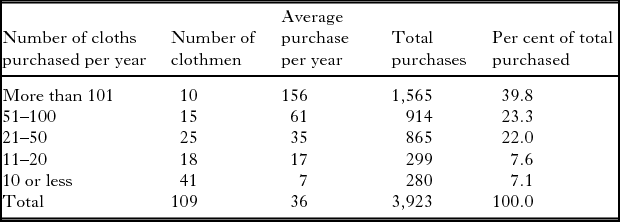
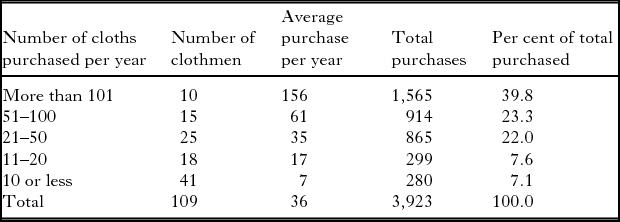
Leading clothiers had direct relationships with London merchants, thereby avoiding Blackwell Hall. William Stumpe had his own factor in London.Footnote 88 Some clothiers went as far as to join London companies. John Greneway of Tiverton, Devon, joined the London Drapers and the Merchant Adventurers companies while he also shipped cloths from Devon ports, some in his own ship.Footnote 89 At least one clothier is known to have personally sold his cloth in European markets. John Sandford, of Stonehouse, Gloucestershire was an exporter of cloth to Germany and had a residence and agency in that city, where he died in 1560 during one of his periodic visits.Footnote 90 The accounts of the London draper Thomas Howell in the 1520s and the London mercer Thomas Kytson in the 1530s show that London merchants were buying from a large number of clothiers. Thomas Howell purchased both finished and unfinished broadcloth from Colchester and Denham in Essex, and Hadleigh and Stoke Naylond in Suffolk, as well as cheaper vesses and fine white Glemsfords and Coggeshalls. Thomas Kytson purchased unfinished broadcloths from 109 different clothmen in the small towns and villages of western Wiltshire and eastern Somerset during the 1530s (Table 1).Footnote 91 Many suppliers were clothiers he dealt with over a number of years. His largest supplier was John Clevelod of Beckington, a small village in Somerset between Westbury and Trowbridge from whom he bought, on average, 371 cloths a year. Ten clothiers sold him more than one hundred cloths. At the other extreme there were forty-one from whom he bought a pack of ten cloths or less.
Thomas Kytson's purchases of unfinished broadcloths in Somerset and Wiltshire, 1529–39.
Sources: C. Brett, ‘Thomas Kytson and Wiltshire clothmen, 1529–1539’, Wiltshire Archaeology and Natural History Magazine, 97 (2004), 29–52 (39–40); C. Brett, ‘Thomas Kytson and Somerset clothmen, 1529–1539’, Somerset Archaeology and Natural History, 143 (1999), 35–62 (38–9).
The coarser the cloth, the more likely that clothiers would be merchant clothiers instead of complete clothiers. Coarse cloth production had migrated during the fifteenth century to Devon and Cornwall, Wales and northern England, where labour was cheaper and the cloth mostly woven by independent weavers. Merchant clothiers were needed to finish and market the cloth. Late sixteenth century Yorkshire produced coloured dozens and kersey, heavily concentrated in a few key towns, Halifax, Leeds and Wakefield. There were some complete clothiers, but also independent wool dyers and yarnmasters who supplied yarn to weavers, who then sold cloth to merchant clothiers.Footnote 92 The business system for cottons and frieze, was different in that clothiers were excluded. Poor weavers, working cloth-by-cloth, week-by-week, sold their cloths to urban drapers who contracted for the specialised finishing they required, and then bought wool for next week's work. Welsh cottons were taken to March towns, especially Shrewsbury, while in the sixteenth century Manchester and Bolton became finishing centres for Cheshire and Lancashire cottons and frieze. An act in 1565 regulated Shrewsbury's drapers and cloth finishers.Footnote 93 Shrewsbury specialised in cottons, ‘plains bought on Monday being cottoned and on the road to London by Wednesday’.Footnote 94
IV
Clothiers’ rise was staggered as individual regions responded to the need for specific cloths. It began in the West Country, which by the end of the fourteenth century accounted for half of the country's quality cloth production, followed by Suffolk/Essex in the later fifteenth, and Kent and Newbury in the early sixteenth centuries.Footnote 95 West Country success was probably a function of several factors: proximity to Bristol, which exported, on average, higher quality cloth than eastern ports; fine Cotswolds wool; early dispersion of the broadloom; small-scale agriculture that provided low cost labour; and its rural fulling mills.Footnote 96 Among the first complete clothiers may have been Thomas and John Prysshton, from Pensford, Somerset who took 795 and 570 dozens respectively to the alnager in 1395–6 to pay the subsidy, which was 20 per cent of Somerset's production.Footnote 97 We do not know for sure whether they organised the manufacture of all that cloth, or whether they were local merchants assembling the cloth. However, Pensford was a ‘new’ village since it was not a taxation unit early in the century and seems to have grown around fulling mills close to a ford on the road to Bristol. Somerset clothmaking was now organized along capitalistic lines, producing broadcloth rather than narrow cloth, and clothiers or local merchants were no longer dependent on Bristol, but were also serving a wider market that included Salisbury, Southampton and London. It may have been that the entrepreneurial Prysshtons, with good mercantile contacts, introduced the broadloom to Pensford, organised spinning, and built a mill. Once the Prysshtons had passed away, production declined. At this time most rural cloth woven in the countryside was finished in towns. Sussex and Surrey clothmakers, for example, complained in 1391 that fullers were buying Guilford cloth to be fulled elsewhere, which helped urban dyeing and finishing industries, but undermined local fullers.Footnote 98
The best-documented fifteenth-century development of a rural textile industry was at Castle Combe in northern Wiltshire.Footnote 99 It was not until Sir John Fastolf inherited the manor in 1409 that a significant cloth industry developed based on his annual purchase of around forty red and white cloths a year for his troops fighting in France. His steward William Worcester, whose notebooks have given us the best description of rural clothmaking in late medieval England, put the manor's industrial success down to Fastolf's half-century tenure. His contributions were not only his cloth purchases, but also the revival of its market, and creation of an annual fair. But above all the greatest benefit was his laissez-faire attitude to his tenants, and his maintenance of peace on the manor. Tenants leased land along the By Brook stream, building fulling mills. The clothier William Haynes owned four, one of which cost £30 to rebuild, and his wife's brother, Richard Halwey, three. The clothiers’ business was rooted in their fulling mills and dyehouses turning out the red cloth for which the area soon earned a national reputation. Success attracted labour. Richard Halwey had nine employees working for him in 1450, both apprentices and servants. It was possible for Walter Power to come to the area from Ireland, find work as a journeyman, then to establish his own business, employ his own servants and apprentices, buy property and rebuild his house for £100.
Expansion of late fifteenth century West Country clothmaking was closely related to the rapid growth of demand for unfinished cloth at the four annual Brabant fairs at Antwerp and Bergen-op-Zoom, which, by the end of the fifteenth century, may have accounted for 70 per cent of English cloth exports. There is evidence of rising prosperity in Wiltshire by the 1460s, even when exports were depressed.Footnote 100 The lynchpin of the clothier's operation was the fulling mill, which he frequently rented on a long-term lease in the sixteenth century, because fulling and tentering were the last processes in the production of white, unfinished cloth.Footnote 101 Rents for fulling mills were falling in the first half of the sixteenth century, and at least in Gloucestershire clothiers mostly controlled them.Footnote 102 Wiltshire remained the centre of the industry in the sixteenth century followed by Gloucestershire and then Somerset.Footnote 103
Clothiers in Suffolk/Essex, Kent and Newbury capitalised on the opportunity to produce coloured quality cloth, as both trade to southern Europe and the home demand expanded.Footnote 104 The low cost of labour and firewood favoured rural dyeing, but the most important advantage was probably woad-dyeing in-the-wool. Proximity to London was critical to gauge the fashion for specific colours. The most successful region was along the Stour and its tributaries that formed the border between Suffolk and Essex; and the Essex rivers Colne, Blackwater and Brain. Suffolk had successfully developed a market for its narrow cloths since the fourteenth century, many of which were dyed. The clothier's accomplishment was to speed up the transition from cheap straits and kersey to high-quality coloured broadcloth, which required better wools, mostly from Lincolnshire, an investment in dyeworks, and upgrading technical skills. The number of independent dyers declined just as Suffolk clothmaking drastically expanded in the second half of the fifteenth century, suggesting that the leading clothiers brought dyeing in-house.Footnote 105 Suffolk seems to be the only area where some urban capital was invested in clothmaking and London merchants themselves became clothiers.Footnote 106 Thomas Howell was able to buy blue, yellow, green, red, tawny, violet, russet and blue-brown cloth from Suffolk clothiers in 1527, often in exchange for woad, but he was also buying white cloth that he had dyed and finished in London.Footnote 107 It may have been that Suffolk clothiers were able to offer coloured cloth for almost the price of quality unfinished western whites by using cheaper wools, mainly from Lincolnshire.Footnote 108 Many coloured broadcloths were priced around £3 in the later 1520s, and vesses around £2 15s, which was close to the £2 18s 10d that Sir Thomas Kytson paid for his Wiltshire unfinished whites in 1529–30.Footnote 109 A 1565 act required that all exported Suffolk and Kentish cloth was to be finished, and therefore dyed.Footnote 110 In practice Suffolk cloth was mostly dyed blue and then redyed on the continent.Footnote 111
There were two other Suffolk/Essex cloths that further illustrate clothiers’ ability to specialise. The first was coloured cloths called vesses, originally of much lower quality and produced to less exacting standards, but by the 1520s priced just below standard broadcloth.Footnote 112 While coloured cloth dominated, fine white cloth was made in the western villages of Glemsford, Cavendish, Coggeshall, Bocking and Braintree. In terms of quality these were superfine cloths with rock-spun warps, comparable in quality to those made in Worcester and the Kentish Weald.Footnote 113
Kentish clothiers specialised in higher quality coloured long cloth up to forty yards, while also producing some standard cloths and vesses. Long cloths in Stephen Draner's 1539 inventory were three times as expensive than the £3 3s 10d paid by Thomas Kytson for standard white cloths in 1538–9: there were two brown-blues at £10 a cloth and another two fine brown-blues at £15.Footnote 114 The strategy seems to have been to produce coloured cloth equivalent in quality to long white Worcesters, but to offer a wide and expanding range of colours as the breadth of the colour palette broadened with subtle shade differences in greys and browns.Footnote 115 Wealden production is estimated to have been around 13–14,000 cloths, equivalent to almost 10 per cent of the export market by the 1560s, so they found a market for dyed finished cloth at Antwerp.Footnote 116 Clothiers totally dominated clothmaking because they had the capital to dye wools.Footnote 117 Eighty of the 241 dyeing fines resulting from the 1549 cloth act that regulated fraudulent dyeing practices, and exacted in London from 1554 to 1585, were paid by Kent clothiers.Footnote 118 Another distinction of Kent clothiers was that they, only occasionally, owned fulling mills. It has been estimated that ten to fifteen mills were sufficient to full all the cloths, so cloth was taken to a few large-scale mills, probably overshot mills.Footnote 119 As a result much of the finest cloth was sheared and pressed in London.Footnote 120
Lastly there was a cluster of Newbury clothiers making coloured kersey early in the sixteenth century: they were innovators because kersey was, exclusively, a rural cloth.Footnote 121 It was probably John Winchcombe I who established the town's reputation, although we know little about him. He died in 1519 but it must have been his success that accounted for his son's great wealth assessed in 1522.Footnote 122 John Winchcombe II and Thomas Dolman built on their fathers’ work, as they and several others produced an estimated 9,000 high-quality coloured kerseys annually in the late 1540s.Footnote 123 They used wool from their own sheep, as well as wool purchased mostly in Berkshire, owned dyehouses, fulling mills and tenter grounds. They dyed and combed the wool in their own warehouses, put the wool out for spinning, probably wove some of the kerseys in-house as well as put the wool out to weavers whose production they dominated, fulled the cloth either in their own mills or those they controlled, and then finished the kerseys themselves. Such were the reputation of Winchcombe and Dolman kerseys that their production seems to have been mostly bought by a few domestic and alien merchants, among them Thomas Gresham in the 1540s, for sale in Antwerp, and they were sometimes paid in advance.Footnote 124 Thomas Cromwell purchased 1,000 Winchcombe kerseys in 1539.Footnote 125 From 1538 to 1544 the Antwerp commission agents, van der Molen, paid 38–48s for Winchcombe kerseys from around Newbury, 36–8s for ‘broom and two keys’ marked kerseys, and 6–8s less for northern kerseys.Footnote 126 As in Suffolk many kerseys were dyed blue to be redyed on the continent, but there were also many reds.Footnote 127
Clothiers that sold cheaper cloths were less wealthy and were rarely complete clothiers as they sold less distinctive cloth that required lower level skills. In Yorkshire there were a few large complete clothiers who operated in much the same way as those in the West Country or Suffolk, but most were small farmers who also made a dozen every week, purchased the wool from wooldrivers, spun it with family members and then took the woven cloth to fairs and markets.Footnote 128 Merchant clothiers then sent the cloth to London, either to Blackwell Hall or at a booth they rented at the annual St Bartholemew's fair.Footnote 129 However, as the exports of coloured northern dozens and kersey rose, clothiers probably increased their control over production, investing in dyehouses as did the Leeds clothier John Pawsome in 1576.Footnote 130 Similarly Devon clothiers purchased narrow cloths from small-scale independent weavers and fullers.Footnote 131 Welsh cotton weavers mostly bought their wool in local markets, spun it and wove it themselves and then returned to the same markets to sell their inconsistent lengths of cloth and buy more wool.Footnote 132 Kersey clothiers in the Weald were both dyeing their own wool, weaving the cloth, taking it to the local mill, and then having it finished by shearmen.Footnote 133
The success of rural clothiers was not lost on clothmakers in towns who could see the benefits of controlling the total production system.Footnote 134 In both Reading and Worcester, the two most successful sixteenth-century cloth towns, clothiers were operating side-by-side with independent clothworkers. At York there are references to mercers and drapers who left money to their dyers, fullers, spinners and weavers.Footnote 135 In 1439, the York merchant, Thomas Clynt left money to fullers in both York and Tadcaster, and to spinners and dyers, both in York and its suburbs, and Thomas Curtas remembered fullers and weavers at Stamford Bridge in 1461.Footnote 136 The Salisbury weaver William Cuff in 1500 had a wool house, spinning house, yarn house, weaving house and warehouse for finished cloth.Footnote 137 At Colchester by the end of the fifteenth century production was in the hands of a few clothmakers who appeared to be involved at all stages of the production process.Footnote 138
V
After 1550, clothiers’ investment in production became less attractive as a result of government regulation to control clothiers, and increased price competition from cheaper broadcloth, kersey and new draperies. Success attracted regulation. The first clothier act was in 1512, which set rules for clothiers as they dealt with spinners, weavers and fullers, and this was expanded in the 1514 cloth act.Footnote 139 There was evidence of concentration in the industry as early as the 1520s. In 1525, when the proposed Amicable Grant taxation met with stirrings of rebellion at a time when many clothworkers were unemployed, the Dukes of Norfolk and Suffolk summoned the leading Suffolk clothiers, including Thomas Spring, to pacify clothworkers.Footnote 140 Three years later, when the slowdown in the cloth trade created unemployment in March 1528, the Duke of Norfolk met with forty leading clothiers at Nayland, Suffolk to see if they would continue production.Footnote 141 In May, clothiers complained that they could not sell their cloth, nor could they find the oil necessary to spin their wools.Footnote 142 In 1536, Kent weavers, obviously under pressure from encroaching clothiers, petitioned that clothiers be limited to one loom to make coloured cloth, and that justices of the peace should settle grievances between weavers and clothiers.Footnote 143
Collapse of the Antwerp market in 1550 cemented opposition to clothiers’ increasing influence as towns complained about their loss of industry, independent clothworkers their loss of work and independence, and government was convinced that pasture should be returned to arable to feed a growing population and avoid civil strife when harvests failed. The 1552 cloth act, revised in 1557–8, set stricter weight and size standards that could be more effectively enforced. The act also stated that drapers or clothiers could only practice if they were licensed by justices of the peace, or their cloths would be forfeit.Footnote 144 Another act from the same parliamentary session restricted the weaving of woollen cloth to those who had been apprenticed to making or weaving broadcloth for seven years.Footnote 145 In 1553, legislation removed any impediments to urban clothmaking, perhaps an inducement for clothiers to move to towns.Footnote 146 The following year clothiers operating outside a city, borough or market town were prevented from owning more than one loom, or benefit from looms set up elsewhere; and weavers were restricted to two looms and apprentices.Footnote 147 Those wanting to be clothiers had to set up in towns, unless they lived in Yorkshire, Cumberland, Northumberland and Westmoreland.
The second half of the century was far more difficult for clothiers than the first as they found it more difficult to make the high profits that innovation and rapid growth had made possible a century before.Footnote 148 English cloth became more expensive in overseas markets as export duties rose in 1558 and the currency was strengthened.Footnote 149 Exports remained below mid-century peak levels for the remainder of the century. Clothiers could no longer play off the Hanse and other alien merchants against merchant venturers, complete clothiers were under pressure from cheaper Yorkshire dozens, and fashion was moving to lighter, cheaper new draperies. Searching clothiers’ cloth under the cloth acts produced considerable fines of clothiers’ fraudulent cloth.Footnote 150 As of 1565, Suffolk and Kentish cloth for export had to be finished.Footnote 151 Perhaps the only change that favoured clothiers, at least those making coloured cloth, was that local woad production, almost negligible at mid-century, had replaced imports by the end of the century.Footnote 152
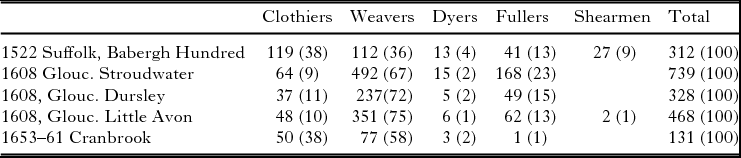
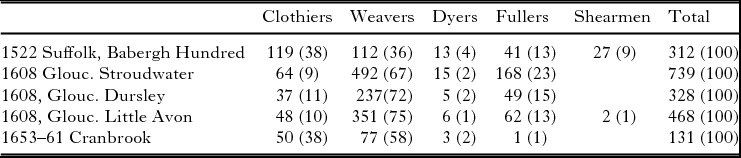
A comparison can be made between the textile trades in two highly-developed clothworking areas: Suffolk's Babergh Hundred in 1522, which included Lavenham, Long Melford and Nayland at the height of their prosperity, and Gloucestershire's clothmaking regions over eighty years later (Table 2). In both districts, we have occupational statistics for the bulk of the adult male working population, the Suffolk survey of all those with goods worth £4 plus all those paid wages, the Gloucestershire returns are for those deemed fit to fight in the wars.Footnote 153 Suffolk clothiers clearly controlled production as their average moveable wealth was £97 16s 9d, compared with weavers at £2 14s 2d. For comparison, a list of mid-seventeenth-century Cranbrook occupations taken from the marriage register show the continued dominance of clothiers, and the low number of fullers.
Clothworking employment in the woollen industry: Suffolk Babergh Hundred in 1522, Gloucestershire in 1608, and Cranbrook in 1653–61.
Sources: J. Pound, The Military Survey of 1522 for Babergh Hundred, Suffolk Record Society (1986), App. E; J. Tann, Wool and Water: The Gloucestershire Woollen Industry and its Mills (Stroud, 2012), pp. 1–5; M. Zell, Industry in the Countryside: Wealden Society in the Sixteenth Century (Cambridge, 1995), p. 121.
West Country unfinished broadcloth had been evolving from the late fourteenth century, the great expansion along the Stroudwater had taken place in the late fifteenth century, and it had become a generic product with well-established distribution networks.Footnote 154 There was still some value for clothiers’ control over the whole production process in terms of consistency and reputation, and the capital they could employ, but less than a century before. Weavers could buy wool from woolbroggers or yarn from yarnmasters as well as from clothiers.Footnote 155 It seems that many West Country clothiers no longer found it worthwhile to make unfinished cloth as clothiers in Gloucestershire in 1608 were only around 10 per cent of clothworkers. It became more typical for the clothier who dealt in unfinished cloth to buy cloth from the weaver and full it at their own mills. Kerridge has noted that clothiers put much of the spinning out to capital farmers rather than organise it themselves.Footnote 156 There continued to be a few complete clothiers but many in effect reverted to become merchant clothiers using their capital to expand the number of cloths they sold, using factors to sell cloths at Blackwell Hall.Footnote 157 For the quality kersey and coloured broadcloth clothier who worked with dyed wool, there remained an advantage to control yarn preparation.Footnote 158 Rural clothmaking continued to respond to changes in consumer demand and technology and merchant clothiers continued to market rural cloth, but the profits from investment in production processes diminished after 1550.
Acknowledgements
This article has been greatly improved by the detailed and thoughtful referees' comments.