



Introduction
Various labels are assigned to the deliberately deposited objects recognised in the archaeological record, including hoards, structured deposits and grave goods. Hoards, often comprising metal objects, are usually defined on the basis of their isolated contexts and the perceived quality or quantity of their contents (e.g. Bradley et al. Reference Bradley, Haselgrove, Linden and Webley2013: 209). They are traditionally given over to finds specialists. In contrast, grave goods accompanying the dead, inhumed or cremated, lie within the realm of funerary archaeology. Finally, ‘structured deposition’ is a catch-all term given to objects cached in other contexts, often found on settlement sites, for example, in pits, ditches and buildings (cf. Hill Reference Hill1995). Although these categories of objects are interpreted as the residue of ritual activity, the nature of such ritual behaviour is understood to be distinct in each case. The high material value of hoards leads to the interpretation of their deposition either for safe keeping or, more often, as propitiatory offerings (Bradley Reference Bradley and Fagan1996: 305). Meanwhile, our tendency to focus on the human body relegates grave goods to the role of accompanying the dead, either for use in the afterlife or as dedications by mourners (e.g. Parker Pearson Reference Parker Pearson1999: 7). Structured deposits—by nature a generic category—have been interpreted in more varied and less specific ways (for an overview, see Garrow Reference Garrow2012). The addition of descriptive terms to highlight differences in composition and depositional context—for example, deliberate, formal, placed, ritual, selected, special, token (Brudenell & Cooper Reference Brudenell and Cooper2008: 15–16)—adds yet more categories.
The classification of assemblages described above, based on non-mutually exclusive characteristics, has created unhelpful divisions that hinder our understanding. Structured deposits that include disarticulated human bone, but which are found in settlements, for example, fall outside the focus of mainstream funerary archaeology, while groups of ‘bodiless objects’ within cemeteries—that is, those objects which appear never to have accompanied the deposition of a body—are frequently categorised as ‘cenotaphs’ (e.g. Nilsson Stutz & Tarlow Reference Nilsson Stutz, Tarlow, Tarlow and Nilsson Stutz2013: 6) in recognition of their probable mortuary associations. Such distinctions have served to elevate the presence of the physical remains of the human body over other types of material, and have thus limited the scope of our interpretations (Brudenell & Cooper Reference Brudenell and Cooper2008: 25–29). With this in mind, I discuss these various assemblage classes under the umbrella term ‘cached object’ (see Archaeological Institute of America 2020).
Using later prehistoric Britain as a case study, I use contemporary theories of death, dying and bereavement to suggest that cached objects frequently represent the careful deposition of ‘problematic stuff’ left behind by the dead. This recognition is not intended to identify new types of deposit, nor necessarily to replace existing interpretations, but rather to unite previously divided materials under a common interpretive lens. The objective is to demonstrate that ‘emotional value’ is a legitimate consideration in our understanding of ‘cached’ objects in the archaeological record.
Structured deposition in later prehistoric Britain
In contrast to the monumental ritual landscapes of the preceding periods, the archaeological record of later prehistoric Britain, from around 1800 BC, is predominantly ‘domestic’ in character (Brück Reference Brück1995: 245). With rare regional exceptions (e.g. the Arras Culture in East Yorkshire and the Aylesford-Swarling Culture in south-east England; Stead Reference Stead1991; Fitzpatrick Reference Fitzpatrick2007), visible normative burial rites and dedicated funerary monuments are rare (see Harding Reference Harding2016). There are few formal cemeteries from this period and human remains are elusive. If recovered at all, bones are usually isolated and frequently deposited in settlement contexts (Brück Reference Brück1995; Armit Reference Armit, Bradbury and Scarre2017). Indeed, it seems likely that most of the dead were excarnated—defleshed and disarticulated by natural or artificial means (Carr & Knüsel Reference Carr, Knüsel, Gwilt and Haselgrove1997)—rather than interred in graves. At this time settlements became the focus of ritual activity, and the artefacts we find on such sites probably represent selective deposition, rather than the product of casual loss and discard (e.g. Hill Reference Hill1995; Bradley Reference Bradley2005: 33 & 208–209).
This selectivity is indicated by the unusual distributions of artefacts on later prehistoric settlements in Britain, and the frequent occurrence of ‘structured deposits’: a catch-all term for caches of objects and animal bones (and occasionally human remains; Brück Reference Brück1995; Armit Reference Armit, Bradbury and Scarre2017) that were carefully selected and deposited in specific places (e.g. in ditch terminals, roundhouse entrance postholes, pits) at specific times. The term was originally coined in reference to an apparent patterning in the deposition of objects (such as pottery, bone and flint) at Neolithic ritual monuments (Richards & Thomas Reference Richards, Thomas, Bradley and Gardiner1984), but has since been adopted more widely to describe a variety of cached objects on domestic sites (e.g. Hill Reference Hill1995).
A typical example of a structured deposit is represented by the fleshed head (cranium and beak) of a great auk, along with articulated cattle vertebrae and a complete pottery vessel (possibly with its contents), deposited behind the wall of a wheelhouse at Cnip, on Lewis (Scotland), during its construction in the third century BC (Armit Reference Armit2006: 198 & 220–21). In this instance, this ‘foundation deposit’ presumably served a propitiatory role in the dedication of the new building and its inhabitants. Webley's (Reference Webley2007) study of Late Bronze Age roundhouses in southern England demonstrates that similar deposits were made to signify the end of a building's life. Roundhouse floors appear to have been meticulously swept clean of domestic debris, providing further evidence that certain objects were deliberately left behind. At the Late Iron Age settlement at Broxmouth in south-east Scotland, for example, dished floor profiles and the undercutting of inner wall-faces attest to the erosion caused by frequent sweeping-out (Büster & Armit Reference Büster, Armit, Armit and McKenzie2013; Figure 1)—a process that appears to have prompted the subsequent laying of paved floor surfaces.
Section through House 4 at Broxmouth, south-east Scotland, showing the dished floor profile and undercutting of the drystone walls, which were built one inside the other over five consecutive stages of remodelling. Paved floor surfaces were constructed on top of each other from stage 3 onwards (figure by L. Büster).

Unfortunately, the labelling of such evidence as structured deposits, which in turn is used as a proxy for ritual behaviour, is often where the interpretive process ends, and brings us no closer to understanding the motives behind the deposition of this material. Considering these assemblages within a broader spectrum of ‘cached objects’ and recognising our own emotional attachment to ‘things’ (e.g. Bell & Spikins Reference Bell and Spikins2018) may, however, help us to move forward.
Problematic stuff: reassessing the mundane
‘Continuing bonds’ theory was developed by modern bereavement studies (e.g. Klass et al. Reference Klass, Silverman and Nickman1996; Walter Reference Walter1996; Stroebe et al. Reference Stroebe, Abakoumkin, Stroebe and Schut2012), growing out of a dissatisfaction with common perceptions of the nature of grief. Traditional approaches emphasised the need for detachment from the deceased (Freud trans. Reference Freud, Strachey and Strachey1957), or asserted that the grieving process progressed through a unilinear series of stages towards the restoration of a pre-bereavement status quo (Kubler-Ross Reference Kubler-Ross1969; Bowlby Reference Bowlby1973, Reference Bowlby1980; Worden Reference Worden1991). Grief, however, is far more complex than a linear trajectory of ‘recovery’, and (consciously or unconsciously) individuals often form ‘continuing bonds’ with the dead—new types of relationships that endure to a greater or lesser extent throughout their lives (Shuchter & Zisook Reference Shuchter, Zisook, Stroebe, Stroebe and Hansson1993: 34; for the application of continuing bonds theory in an archaeological context, see Croucher Reference Croucher2017).
A recent study exploring the applicability of archaeology in discussions of death, dying and bereavement with healthcare professionals (Büster et al. Reference Büster, Croucher, Dayes, Green and Faull2018; Croucher et al. Reference Croucher, Büster, Dayes, Green, Raynsford, Boyes and Faull2020) reveals that objects are central to the maintenance of continuing bonds:
my mum died very suddenly when I was 25 […] and just before she died, she'd bought a big tub of Horlicks [a malted-milk drink powder] which she gave to me for some reason, because she bought two on offer or something, and I could not throw this away. It was in the cupboard for five years! And it was solid. But because she'd bought it, it became like an artefact […] I did throw it away in the end, I suppose it was a symbol of my getting through the grief (participant 20, in Büster et al. Reference Büster, Croucher, Dayes, Green and Faull2018: 269).
The jar of Horlicks—a mass-produced and inexpensive item, acquired by the deceased only days before their death as part of a routine shopping trip—was transformed through the act (and timing) of ‘gift-giving’ into an emotionally charged ‘artefact’: the material embodiment of the last physical interaction between two living individuals. The bereaved participant explained that, although they did not like Horlicks (and perhaps it would have felt inappropriate to consume it in any case), they could not casually dispose of this ‘artefact’. This was no longer just a jar of Horlicks: it had been transformed into something deeply problematic.
The same sentiments are echoed in the words of J. Brammer (Reference Brammer2017), writing about the difficult task of clearing out her late mother's house:
So, when is a doily not a doily? When it goes from being one of my mother's kitsch furniture accessories when she was alive, into a sacred reminder of her homeliness now that she's gone […] The significance of the doilies and anything she had touched, grew overnight […] I decided to honour her by framing and hanging them so her story could be woven into the walls of my home.
Here we see previously old-fashioned and ‘unnecessary’ ephemera taking on new meanings and becoming problematic, not because of their material or aesthetic value, but because of their mnemonic power. If we accept the possibility for emotional attachment to even the most mundane objects, then, as Brudenell and Cooper (Reference Brudenell and Cooper2008: 24) point out, “any attempt to define rigid criteria for identifying ‘special’ deposits may ultimately miss the point”.
Towards an emotional archaeology of the mundane
There are many examples in the archaeological record of attempts to maintain continuing bonds with the dead, not least in the erection of large funerary monuments that served as mnemonic devices for the living. Equally visible, particularly as structured deposits, but perhaps as yet unrecognised, is the disposal of the problematic stuff that bound the living and the dead together: material that was too entwined with the social identity of the dead to be reused by the living, yet too symbolically charged for casual discard as part of normal processes of waste management.
The material value of certain artefacts has long been recognised, as signified, for example, through cultural preferences for particular raw materials, the time and skill involved in the manufacture of certain objects, or their rare and exotic nature. It is this form of value that is often prioritised in our understanding and categorisation of hoards. Increasingly, however, materiality (e.g. Meskell Reference Meskell2005) and biographical (e.g. Gosden & Marshall Reference Gosden and Marshall1999; Joy Reference Joy2009) approaches to the study of artefacts have also championed the symbolic value that certain objects may have possessed as material manifestations of distant lands, the product of technological transformations or their embodiment of other (intangible) properties. Interpretations of this nature often influence our understandings of grave goods. But recognition of problematic stuff as a legitimate and powerful response to even the most mundane objects, such as the aforementioned jar of Horlicks, dictates that we include another important value category in our discussion and interpretation: emotion (Figure 2). It is through this lens that we might better understand the ritual behaviours that led to the caching of objects in the archaeological record. It is, of course, not necessarily the case that any object chosen for or warranting deposition in a controlled and structured way embodies a single value category. Indeed, once such artefacts are brought together, the resulting assemblages will themselves take on new meanings. But it is important to recognise the raw emotional power that everyday objects can acquire at certain times and places.
Types of value that may have been attributed to cached objects (figure by L. Büster).

Reinterpreting bodiless objects: the invisible ‘graves’ of Iron Age Britain
In the few areas of Iron Age Britain where a normative visible burial rite exists, bodies are often associated with artefacts (grave goods). The inhumations and chariot burials of the Arras Culture of East Yorkshire, for example, contain some of the most spectacular objects known from this period, including brooches featuring enamel and coral inlay, and elaborate necklaces of glass and amber (Giles Reference Giles2012). Many of these items presumably belonged to the deceased, or were sufficiently entwined with their social identity to necessitate removal from circulation upon their death.
Yet, it is not just those items worn on the body that can assume problematic status. We must also consider other categories of artefact (Figure 3). Objects also become problematic through their association with the dead body, via, for example, their use in post-mortem care and mortuary rites. This category of object may well be represented by the toilet instruments (e.g. tweezers, nail cleaners and ear scoops) found in graves at Mill Hill (Deal), King Harry Lane (St Albans) and Biddenham Loop (near Bedford) in southern England, and at Arras and Wetwang Slack in East Yorkshire (Harding Reference Harding2016: 179–80), as well as in later prehistoric graves on the Continent (Fontijn Reference Fontijn2002: 200–201). Notably, these objects have also been recovered from structured deposits in regions in which formal graves are absent: the nail-cleaner built into the wall of ‘Hut II’ at Hownam Rings in the Scottish Borders (Piggott Reference Piggott1948: 211) represents one such example. Then come the items owned by the deceased: objects such as those represented in the modern-day quotations presented above. Analogies for these different categories of object have precedence elsewhere. In the medieval Christian church, for example, relics could comprise the physical remains of a saint's body (‘first class’), objects owned or used by a saint (‘second class’), or objects that had touched a first- or second-class relic (‘third-class’) (Jestice Reference Jestice and Jestice2004: 887).
Ways in which objects might gain ‘problematic’ status (figure by L. Büster).

We could also add an additional tier of problematic stuff: the artefacts associated with the past lives of those still living, such as previous social states transcended through certain rites of passage, or objects that represent “the paraphernalia of a specific kind of personhood” (Fontijn Reference Fontijn2002: 217). In a modern context, this might manifest itself in the reluctance of parents, for example, to dispose of the infant clothes of grown-up children, with one social media user lamenting that “I have a bag for charity and a bag called ‘I'm not ready to let go yet’”. Other examples might include the retention by adults of teenage clothes that no longer fit or are no longer fashionable, or of cassette tapes that can no longer be played. While such phenomena will be difficult to recognise in the archaeological record, they might be glimpsed, for example, in the inclusion of worn-out objects or miniatures in (adult) graves. Miniature items are often interpreted as ‘votives’ (e.g. Green Reference Green1987). Using a different interpretive lens, however, there is no reason to discount the possibility that such objects might represent a cherished childhood toy, such as the diminutive sword in its wooden scabbard found in the grave of two adults at the Roman cemetery of Cranmer House, Canterbury (Bennett Reference Bennett, Frere, Bennett, Rady and Stow1987: 66). Problematic stuff might also be evidenced by the inclusion of adult-sized objects in children's graves; that is, objects—such as the three copper rings interred with a child at Barrow Hills in Oxfordshire (Brück Reference Brück2004: 314)—that were destined for individuals who did not live long enough to wear them.
In any region or period with mortuary traditions that involved the digging of graves, the disposal of problematic stuff would potentially have been fairly straightforward, as it could have accompanied the deposition of the body (or its remnants). But what happened to these objects when there was no grave in which to deposit them? What happened to problematic stuff in the communities of later prehistoric Britain, for example, whose predominant mode of disposal of the dead involved the complete dispersal of the body through excarnation? Human remains are themselves sometimes incorporated into structured deposits. The femur interred with a weaving comb and copper alloy fibula in a pit at Maiden Castle, Dorset (Sharples Reference Sharples2010: 239), provides just one example. These bones surely represent ‘token’ remnants of the deceased, collected from the scattered remains of bodies that had been defleshed and disarticulated through excarnation, as McKinley (Reference McKinley, Tarlow and Stutz2013: 154) similarly argues for cremation graves of this period. With this in mind, it is perhaps unsurprising that a downturn in the construction of barrows, and the associated interment of bodies and grave goods, across much of Europe after 1500 BC coincides with an increase in the deposition of weapon hoards, which are frequently associated with isolated human bones and placed in watery contexts (Fitzpatrick Reference Fitzpatrick, Cunliffe and Miles1984; Bradley Reference Bradley and Fagan1996: 306; Barrett & Needham Reference Barrett, Needham, Barrett and Kinnes1988). Conversely, the emergence of large Urnfield (flat grave) cemeteries across continental Europe in the Late Bronze Age (c. 1050 BC) coincides with a downturn in the deposition of objects in rivers (Fontijn Reference Fontijn2002: 152 & 234).
Returning to the invisible mortuary rites of Iron Age Britain, it is similarly unsurprising that torcs (neck rings)—which are prominent in burials from the Middle East to eastern France (Eluère Reference Eluère1987: 23–24), and which feature in some of the best-known continental funerary assemblages of the period (e.g. Glauberg, Vix and Reinheim; Brun & Chaume Reference Brun and Chaume1997; Bartel et al. Reference Bartel, Frey, Herrmann, Kreuz and Rösch1998; Echt Reference Echt1999)—are a frequent component of hoards (Snettisham in Norfolk being perhaps the best-known example; Joy & Farley Reference Joy and Farleyin press). The deposition of socially charged items in non-mortuary contexts was probably accompanied by similar performances and rituals to those practised at funerals (i.e. events that included the deposition of dead bodies) at other times and in other places. As such, variations in patterns of deposition may have less connection with fundamental changes in the perception or expression of social identity, than with changes in contemporaneous modes of disposal of the dead.
The house as memory box
Broxmouth, in south-east Scotland, was a hillfort settlement site occupied, apparently continuously, for around 800 years between c. 640 BC and AD 210 (Armit & McKenzie Reference Armit and McKenzie2013: xv). The site was variously enclosed and unenclosed, expanded and contracted, over six phases of its use-life, which culminated in a settlement (c. 100 cal BC–cal AD 155) of densely packed timber and stone roundhouses, many of which saw repeated refurbishment on the same house-stance (Büster & Armit Reference Büster, Armit, Armit and McKenzie2013). Despite the structural stability of the existing fabric, new walls and paved floors were periodically installed, encasing the inhabitants in increasing layers of stone. Upon construction of each successive phase of the roundhouse, single artefacts or small caches of objects were carefully placed between the wall skins and beneath floors. As discussed above (Figure 1), floor erosion indicates the continual sweeping of domestic debris out of the roundhouses, suggesting that those objects found in the structures were deliberately deposited.
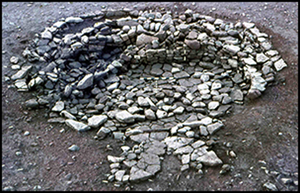
One roundhouse in particular (House 4) displays at least five stages of modification (Figures 1 & 4). AMS dates suggest that remodelling took place on a generational or bi-generational basis, roughly every 40–60 years, during which transitional deposits were placed into the fabric of the structure (Büster & Armit Reference Büster, Armit, Armit and McKenzie2013: 138–51; Büster Reference Büster2021). Some of the objects appear to reference one another, despite being deposited over several generations. Single bone spoons were, for example, placed beneath the walls of the first and last iterations of the roundhouse, five or more generations apart. Furthermore, quernstones (one deliberately defaced and most placed with their grinding surfaces downwards) appear repeatedly to have been incorporated into the paved floors.
House 4 at Broxmouth, which saw periodic modification on the same house-stance, but whose inhabitants retained the defunct fabric of previous iterations of the structure (visible here as multiple concentric arcs of walling) (photograph courtesy of Broxmouth Archive).

The structured deposits in House 4 comprised everyday items that were not of high material value. They would, however, have been intimately tied to the social identity of certain individuals. Some objects may well have been owned by the deceased, but communal or household items may also have taken on mnemonic associations with specific individuals or groups though routine use. Quernstones, for example, would have been tangible reminders of previous lives lived: the heavy use-wear and surface abrasion testament to days, months and years of a daily grind that transformed human bodies as well as the stones themselves. This mnemonic power was, like J. Brammer's doilies, ‘woven’ into the fabric of House 4.
At Broxmouth, as elsewhere, it is important to remember that it is the discard, rather than the use, of objects that we observe in the archaeological record. Such discard appears to represent an attempt to dispose appropriately of these powerful and problematic items, perhaps after long periods of retention, as reflected in the statement below:
my granddad […] he had this pair of shoes […] it was one of the items of clothing that I remember him wearing. These dreadful misshapen shoes. And I couldn't throw those away. Then one day they were sitting in my bedroom and it's as if I could hear his voice in my head saying ‘what are you doing keeping those? Do you think that's how I want you to remember me? Get rid of them!’, so I got rid of them. But it was like I think you have to hold onto things until it's time to release them (participant 28, pers. comm.).
A set of gaming pieces (Figure 5) deposited in House 4 represents perhaps the clearest example at Broxmouth of this tension between curation and deposition: one piece was incorporated into the infill of a pit while another two were deposited, along with a human cranial fragment and a human mandible, at the base of a newly constructed wall at least two generations later (Büster & Armit Reference Büster, Armit, Armit and McKenzie2013: 138–51). The latter surely represent the careful and deliberate ‘disposal’ of objects that had served as tangible cues in stories and oral traditions associated with the past occupants of House 4 (Büster Reference Büster2021), but were now no longer required (or desired) by the living.
Polished antler gaming pieces deliberately deposited within the fabric of House 4 at Broxmouth (image courtesy of National Museums Scotland).

Problematic stuff: grave goods for the elusive dead
By drawing on contemporary attitudes to death, dying and bereavement, I have examined the relationship between people and objects, and between the living and the dead, in a way which transcends traditional narratives of power, status and wealth. Through the lived experiences of bereaved individuals today, I have demonstrated the emotional power that even the most mundane objects can acquire at certain times and in certain places, and that this transformation from everyday to problematic is ad hoc and unpredictable. As demonstrated by the jar of Horlicks, this transformation need not conform to any deep-rooted or widely shared cultural understanding of particular classes of artefact. As such, we must recognise that by focusing on valuable, exotic and rare objects, or certain object types, we have created biases in our recognition and interpretation of cached objects in the archaeological record.
In the context of later prehistoric Britain, and in other times and places where ‘grave-less’ mortuary rites predominate, this has far-reaching implications for the interpretation of artefacts deposited outside of formal ‘funerary’ settings. By considering groups of cached, ‘bodiless’ objects (e.g. structured deposits and hoards) from the perspective of problematic stuff, the false dichotomies created by traditional categorisations of this material become clear. Furthermore, the experiences of bereaved individuals reveal a tension between the retention of objects in the maintenance of continuing bonds with the dead and their eventual ‘disposal’ after varying periods of curation, perhaps long after the deposition and/or disintegration of the physical remains of the dead. A more integrated approach to the interpretation of cached objects—one which does not prioritise the human body over other types of material—is necessary.
The recognition of problematic stuff allows us to reconceptualise cached objects in non-funerary contexts as representing the ‘safe’ and culturally appropriate disposal of symbolically charged material that was considered inappropriate for either continued circulation in the world of the living or disposal in the context of everyday waste management. This phenomenon has implications not only for our understanding of cached objects in later prehistoric Britain, but for the interpretation and reassessment of whole categories of material culture that have been overlooked for their ‘mundane’ nature and non-funerary contexts of deposition. It also illuminates the potential of harnessing contemporary emotional perspectives to facilitate deeper and more meaningful understandings of the behaviours that underlie the archaeological record that we encounter today, and of the minds of individuals that were, in some ways, not so different from our own.
Acknowledgements
Thanks to Ian Armit and Karina Croucher for many fruitful discussions and to the participants of the Continuing Bonds Project for sharing their stories; some details in the quotations used here have been changed to protect the identity of the participants. Thanks also to Ian Armit for feedback on a preliminary draft of this article and to the two anonymous peer reviewers for their helpful comments.
Funding statement
The ideas in this paper have developed over a number of years during the author's research as part of the Broxmouth Project, funded by Historic Environment Scotland, and the AHRC-funded Continuing Bonds Project (grant AH/S005196/1), both of which were undertaken at the University of Bradford.



