Introduction
Various natural products have been used commercially as crop protection agents (Copping and Duke, Reference Copping and Duke2007) and essential oil-based compounds have started to make a commercial impact recently (Koul et al., Reference Koul, Walia and Dhaliwal2008). Allelochemicals from essential oils are secondary metabolites that are found abundantly in aromatic plant families like Apiaceae, Pinaceae, Lamiaceae, Myrtaceae, Rutaceae and Umbelliferae (Isman and Machial, Reference Isman, Machial, Rai and Carpinella2006). Essential oils are generally considered safe for the environment because they possess an array of biodegradable compounds, which are non-toxic to mammals, birds and fish (Misra et al., Reference Misra, Pavlostathis, Perdue and Araujo1996; Stroh et al., Reference Stroh, Wan, Isman and Moul1998). They possess multiple pest control properties like toxicity, repellency, feeding deterrence and oviposition deterrence (Hummelbrunner and Isman, Reference Hummelbrunner and Isman2001; Koschier and Sedy, Reference Koschier, Sedy, Marullo and Mound2001; Koul, Reference Koul2005, Reference Koul2008); however, the interest for their use was renewed with emerging demonstration of their fumigant and contact insecticidal activities to a wide range of pests in the 1990s (Isman, Reference Isman2000). The rapid action against some pests is indicative of neurotoxicity, and there is evidence for interference with the neuromodulator octopamine (Kostyukovsky et al., Reference Kostyukovsky, Rafaeli, Gileadi, Demchenko and Shaaya2002) by some oils and with γ-aminobutyric acid-gated chloride channels by others (Priestley et al., Reference Priestley, Williamson, Wafford and Sattelle2003).
The fumigation of insect pests in stored products is well known (Cox, Reference Cox2004), often providing nearly 100% control, but the treatment of plants in greenhouses and open fields is not as effective on account of the high volatility of the most essential oils. The slow rates of release from current formulations, ineffective application and high costs are some of the main problems that presently limit practical possibilities of using essential oils in open crop situations (van Tol et al., 2007). However, the toxicity of essential oil compounds against crop pests like western corn rootworm Diabrotica virgifera virgifera Leconte, the two-spotted spider mite Tetranychus urticae Koch, and domestic pests like the common housefly Musca domestica Linnaeus has been demonstrated (Lee et al., Reference Lee, Tsao, Peterson and Coats1997). The essential oil of marjoram Origanum majorana L. (Lamiaceae) and rosemary oil Rosmarinum officinalis L. (Lamiaceae) shows feeding and oviposition deterrence against onion thrips. Some essential oil components are either repellent (Bruce et al., Reference Bruce, Birkett, Blande, Hooper, Martin, Khambay, Prosser, Smart and Wadhams2005) or even toxic to some aphid species (Sampson et al., Reference Sampson, Tabanca, Kirimer, Demirci, Baser, Khan, Spiers and Wedge2005). Pine weevils have been shown to be deterred by essential oils containing carvone or its derivatives (Schlyter et al., Reference Schlyter, Smitt, Sjödin, Högberg and Lofqvist2004). Similarly, 16 natural monoterpenoids have been evaluated against Ostrinia nubilalis (Hubner) (Lepidoptera: Pyralidae) to show larvicidal and insect growth regulatory activities (Lee et al., Reference Lee, Tsao and Coats1999). These studies, therefore, suggest the significant potential of essential oil allelochemicals as a safe and eco-friendly approach for insect control.
Due to scanty information available on the efficacy of essential oil compounds on borers, our objective was to determine the bioefficacy and potential in terms of toxicity and antifeedant action individually and in binary mixtures of known commercially available allelochemicals present in essential oils against the maize borer Chilo partellus Swinhoe (Lepidoptera: Pyralidae), and to establish the application methods so that these compounds could be used on a larger scale in an integrated pest management (IPM) system.
Maize Zea mays L. (Poaceae) is an important staple food in Asia, Africa and Latin America, where it serves as a human subsistence crop. In India, insect pests pose a great challenge to its higher productivity. C. partellus is the most prevalent one and a serious pest of maize, causing 26.7–80.4% yield losses in different agro-climatic regions (Hari et al., Reference Hari, Jindal and Malhi2008). Early instars (up to the third stage) feed initially on the leaf epidermis and higher instars then bore into the central shoot, resulting in the production of ‘dead hearts’ under severe infestations. Accordingly, early third instars were used for direct application for toxicity and fourth instars for antifeedant effects to demonstrate whether the feeding by boring larvae could be prevented.
Materials and methods
Insects
Bioassays were conducted using C. partellus larvae obtained from a laboratory colony maintained on a green gram-based artificial diet (Kanta and Sajjan, Reference Kanta and Sajjan1992) prepared as per standard procedure (Siddiqui et al., Reference Siddiqui, Sarup, Panwar and Marwaha1977). Larvae (75) were kept in a diet jar (15 × 10 cm in diameter). The jars were wrapped all around from the outside with a black paper sheet, leaving the diet layer at the bottom uncovered. The jars were maintained at 26 ± 1 °C, 16 h light–8 h dark photoperiod and 70 ± 2% relative humidity (RH). The larvae were allowed to feed undisturbed within the jars until pupation. The newly emerged moths were then placed in oviposition jars (15 × 10 cm in diameter), which were wrapped from the inside all around with wax paper that served as the ovipositional substrate. After 3–4 days, the wax paper sheets harbouring egg masses were removed and egg mass areas were cut from the sheets and transferred to culture medium for their continued maintenance. Early third and fourth instars from these cultures were used in the experiments.
Essential oil compounds
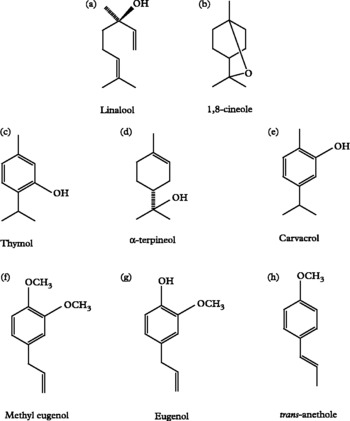
Eight compounds, i.e. linalool, 1,8-cineole, thymol, α-terpineol, trans-anethole, carvacrol, eugenol and methyl eugenol (Fig. 1), were used in the present study. The compounds were selected on the basis of their known repellent properties (see review by Koul et al. Reference Koul, Walia and Dhaliwal2008), their common occurrence in the essential oils of mint, myrtle, coriander, citrus and rosemary, and convenient commercial availability. The compounds were obtained commercially (97–99% purity from Sigma/Aldrich Chemie, GmbH, Steinheim, Germany and Acros Organics, Morris Plains, New Jersey, USA) and were evaluated individually to determine their efficacy levels against C. partellus and also as biorational mixtures (combination of a biological agent other than a living organism). The combinations were selected on the basis of their molecular structure (aromatic, e.g. thymol, trans-anethole; bicyclic, e.g. 1,8-cineole; and acyclic system, e.g. linalool). Compounds were dissolved in acetone for topical application or as emulsions for application to leaf whorl discs.
Structures of various essential oil compounds evaluated: (a) linalool, (b) 1,8-cineole, (c) thymol, (d) α-terpineol, (e) carvacrol, (f) methyl eugenol, (g) eugenol and (h) trans-anethole.

Relative toxicity assays of essential oil compounds
Acute toxicity (measured as mortality after 24 h) of essential oil compounds was determined by topical application to early third instars (body weight 12–17 mg/larva). Larvae were individually weighed prior to treatment. Various concentrations of essential oil compounds were prepared, using acetone as a carrier such that each larva received 2 μl of solution per treatment, with acetone alone as the control. Doses used were 50–800 μg/larva for linalool, 1,8-cineole, terpineol, thymol and trans-anethole, and 600–1200 μg/larva for carvacrol, eugenol and methyl eugenol. Doses were applied to the dorsum of each larva using an Arnolds micro applicator (Burkhart, London, UK). In each experiment, 32 larvae per treatment in four replicates were used. All treated larvae from each replicate were transferred individually into a Solo cup (29.57 ml capacity) containing a 1 g block of artificial diet. Treated larvae were then placed in a sealed plastic tray lined with moistened filter paper and held for 24 h in a growth chamber (16 h light–8 h dark, 26 ± 1 °C and 70 ± 2% RH). The tray was covered with black paper as C. partellus exhibit positive phototropism. After 24 h, the dead larvae were counted and data tabulated for mortality assessment.
Sublethal effects on growth
Sublethal effects of all the compounds were investigated using early third instars (12–17 mg body weight) treated topically and then placed on standard artificial diet in Solo cups (29.57 ml capacity), and weighed at 3 and 6 days post-treatment to determine the effects on growth of larvae as a percentage of growth in controls. Treatment cups were held in plastic trays and reared as described above in bioassays for acute toxicity. Sublethal dosages of LD10 and LD30 were calculated using Probit analysis based on the findings of the first experiment (acute toxicity of individual compounds). For each treatment, 24 larvae were used in four replicates and weights determined for each larva. Controls received acetone only.
Antifeedant bioassays
Antifeedant effects were investigated using leaf disc choice bioassays. Fresh leaf discs were made from whorls of 65-day-old maize plants, cv. Kesri (Punjab Agricultural University, Ludhiana) susceptible to C. partellus. Leaf discs of 10.5 cm2 were used. The compounds in the range of 100–300 μg/cm2 were painted onto two sides of leaf discs with an Accupipet (Tarson, Kolkata, India) variable volume pipette. Compounds were dissolved in a mixture of acetone and water (1:1) as solvents, with 0.1% emulsifier (Triton X-100) added as a surfactant. Controls were treated with the solvent mixture only. The solvent was dried at ambient temperature (26 ± 1 °C) before the insects were released onto the discs. The larvae were reared on maize leaf whorls to maintain natural conditions. Larvae of 50–60 mg body weight per larva (fourth instars) were selected and starved for 4 h prior to testing. Each larva was placed in Petri dishes (9 cm in diameter) with one treated and one untreated leaf disc. Each treatment was replicated 10 times. Leaf desiccation was prevented by using wet cotton swabs in each Petri dish. Larvae were allowed to feed for 10–12 h, and subsequently the leaf discs were removed and the consumed area was measured using a laser leaf area meter (CI-203CA, CID, Inc., Camas, Washington, USA). The feeding inhibition was calculated using the formula (Isman et al., Reference Isman, Koul, Luczynski and Kaminski1990):

For each compound tested, a FI50 (concentration required to produce 50% feeding inhibition compared with untreated discs) was determined.
Efficacy of binary mixtures
The acute effects of binary mixtures of various compounds used in the study were determined as described above. Initially, the LD50 value of the most effective compound of the pair was chosen and further experimentation included variation of the dosage around this value, with values somewhat lower and higher than the LD50 of the most active compound. Actual mortalities were compared with expected mortalities based on the formula described by Hummelbrunner and Isman (Reference Hummelbrunner and Isman2001) as:

where E is expected mortality and O a and O b are observed mortalities of pure compounds at the given concentration. The effects of mixtures were designated antagonistic, additive or synergistic by analysis using χ2 comparisons:

where O m is observed mortality from the binary mixture and E is expected mortality; χ2 with d.f. = 1 and α = 0.05 is 3.84. A pair with χ2 values >3.84 and having greater than expected mortality was considered to be synergistic, with χ2 values < 3.84 representing additive effects.
Antifeedant effects of binary mixtures
The compounds were mixed in a 1:1 (w/w) ratio, such that each represented half of the total dose tested (i.e. 50 μg of linalool and 50 μg of terpineol would be found in a 100 μg/cm2 concentration). Choice tests were carried out and analysed as described for individual compounds. FI50 values were determined for the mixtures.
Statistical analysis
Probit analysis (Finney, Reference Finney1971) was used to determine LD50, LD90, FI50 and the corresponding 95% CI. Deterrent parameters were compared with ANOVA followed by Tukey's multiple range test to determine differences between means of treatment (Wilkinson, Reference Wilkinson1990). Linear regression analysis (Neter et al., Reference Neter, Wasserman and Kutner1985) was used to determine effective concentrations.
Results
Relative toxicity of different essential oil compounds
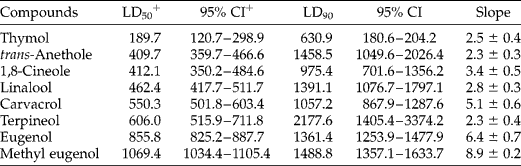
Thymol was the most active compound against C. partellus early third instars at LD50 of 189.7 μg/larva followed by trans-anethole (Table 1). Linalool and 1,8-cineole were significantly similar to trans-anethole (Table 1) based on the overlap of the CI. Among other compounds like carvacrol, α-terpineol, eugenol and methyl eugenol, LD50 values ranged from 550.3 to 1069.4 μg/larvae (Table 1). Characteristic behavioural changes were observed, following topical application of the compounds, eliciting symptoms of neurotoxicity, i.e. extreme agitation and hyperactivity. Forced diuresis and convulsions were also observed, leading to paralysis and death of the larvae. However, no mortality was recorded in controls in these experiments.
Relative toxicity of different essential oil compounds (μg/larva) to early third instars of Chilo partellus
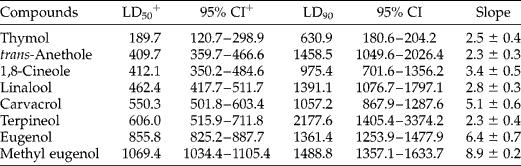
+ LD, lethal dose; CI, confidence interval.
Effects on growth
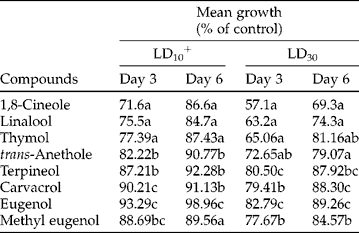
The idea in this expt was to demonstrate the efficacy of compounds at sublethal treatments via topical application of different essential oil compounds. Accordingly, LD10 and LD30 level doses of different compounds applied to the early third instar larvae showed that inhibition in growth did occur. Less growth was recorded at LD30 levels than at LD10, which was obvious in all the treatments (Table 2). At these sublethal doses, growth (calculated as mean growth as % of control) was inhibited by 15–37% on average due to linalool and about 15–43% after treatment with 1,8-cineole. Most of the other compounds tested also showed significant inhibition in growth after 3 and 6 days at LD10 and LD30, respectively (Table 2). Although significant differences between LD10 or LD30 and controls occurred at 3 days, there was recovery in the LD10 treatment, approaching the weights of the controls by the sixth day. However, the recovery was not complete over time between 3 and 6 days. 1,8-Cineole was the most effective in reducing growth of C. partellus larvae at LD10 and LD30 (Table 2).
Effects of sublethal doses of different essential oil compounds on the growth of early third instars of Chilo partellus
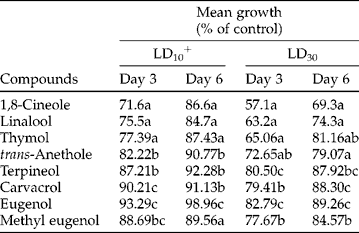
For each time interval, means within a column followed by the same letter are not significantly different based on Tukey's test (P < 0.05).
+ LD, lethal dose.
Antifeedant effects of essential oil compounds
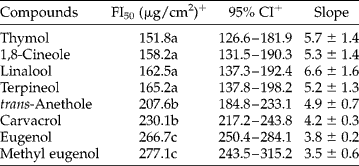
To evaluate the concentration required to inhibit feeding by 50%, FI50 was determined for all the compounds (Table 3). The feeding inhibition by all the eight essential oil compounds tested was achieved at average concentration of < 300 μg/cm2 treatment. Thymol, 1,8-cineole, linalool and terpineol were similar in inducing feeding inhibition (P < 0.05) followed by trans-anethole, carvacrol, eugenol and methyl eugenol (FI50 values ranging between 207.6 and 277.1 μg/cm2; Table 3).
Relative feeding deterrence induced by different essential oil compounds in fourth instars of Chilo partellus
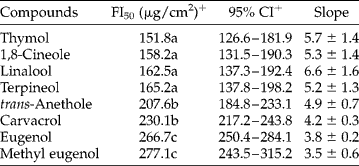
Means within a column followed by same letter are not significantly different based on Tukey's test (P < 0.05).
+ FI, feeding inhibition; CI, confidence interval.
Toxicity of binary mixtures
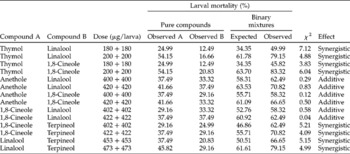
Bioassays using binary mixtures of essential oils revealed that combination of thymol+linalool or 1,8-cineole and terpineol+linalool or 1,8-cineole, respectively, synergized the toxicity against C. partellus larvae (Table 4). Linalool and 1,8-cineole exhibited an additive effect when combined with each other or with trans-anethole, respectively. The combination of various compounds with eugenol, methyl eugenol and carvacrol did not exhibit any synergism or additive effect.
Relative toxicity due to binary mixtures of essential oil compounds to early third instars of Chilo partellus and measures of interactions

Antifeedant effects of binary mixtures
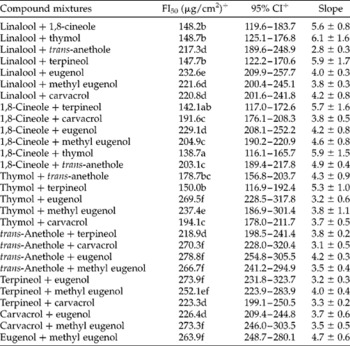
Antifeedant activity data of binary mixtures indicated that combination of linalool with 1,8-cineole, linalool with terpineol or thymol, thymol with terpineol, or 1,8-cineole with terpineol or thymol were very effective compared with others, showing FI50 of < 150 μg/cm2. All other combinations were effective in the range of 178.7–278.8 μg/cm2 (Table 5).
Relative feeding deterrence induced by binary mixtures (1:1, w/w) of essential oil compounds against fourth instar Chilo partellus larvae

Means within a column followed by the same letter are not significantly different based on Tukey's test (P < 0.05).
+ FI, feeding inhibition; CI, confidence interval.
Discussion
Eight compounds evaluated via topical application against early third instar C. partellus larvae showed that thymol was the most active (LD50 = 189.7 μg/larva) and methyl eugenol the least (LD50 = 1069.4 μg/larva). Linalool and 1,8-cineole were similar in their activity against C. partellus (LD50 = 412.1 and 462.4 μg/larva, respectively). Although these doses appear to be high compared with chemical insecticides, they are safe and more environmentally benign compared with organophosphates, organochlorines and carbamates due to their lower toxicity to vertebrates showing LD50 values ranging from 2 to 5 g/kg (Dev and Koul, Reference Dev and Koul1997) in rats when ingested orally. In fact, essential oil compounds have been considered safer than other plant-derived chemicals like azadirachtin, rotenone or pyrethrum (Stroh et al., Reference Stroh, Wan, Isman and Moul1998). This could be attributed to existing detoxifying metabolism pathways and biorational mode of action of monoterpenoids.
The individual efficacy of linalool and 1,8-cineole shows similar potential; however, linalool causes hyperactivity like extreme agitation. In fact, several essential oil compounds have been reported to block octapamine, a neurotransmitter unique to insects that functions similarly to epinephrine (adrenaline) and norepinephrine found in vertebrates (Hummelbrunner and Isman, Reference Hummelbrunner and Isman2001). Octapamine agonists and antagonists are known to act as antifeedants and can have substantial chronic effects on insect behaviour, with symptoms including knockdown, agitation, hyperactivity, tremors, forced diuresis and death (Nathanson et al., Reference Nathanson, Hunnicutt, Kantham and Scavone1993); the symptoms of action also observed in the present study in C. partellus larvae.
The contact toxicity of eugenol (Ngoh et al., Reference Ngoh, Cho, Pang, Huang, Kini and Ho1998), acute toxicity of carvacrol and repellency of 1,8-cineole to various cockroaches (Maugh, Reference Maugh1982) are also well known, which implies their wide spectrum of activity. Rosemary oil allelochemical 1,8-cineole is also an oviposition deterrent against Thrips tabaci Lindeman (Thysanoptera: Thripidae) (Koschier and Sedy, Reference Koschier, Sedy, Marullo and Mound2001) and a potential insecticidal compound that could reduce the growth rate, food consumption and food utilization in some post-harvest pests and household insects (Koul et al., Reference Koul, Walia and Dhaliwal2008). Origanum onites L. compounds like carvacrol and thymol are effective larvicides against the pine processionary moth Thaumetopoea wilkinsoni Tams (Cetin et al., Reference Cetin, Erler and Yanikoglu2007). Linalool has also been demonstrated to be a potential repellent of the red bud borer Resseliella oculiperda (Rubs.) in grafted apple trees (van Tol et al., Reference van Tol, Swarts, Linden and Visser2007).
In terms of the toxicity of thymol, it shows high potency against C. partellus (LD50 = 189.7 μg/larva) and apparently a high potency against lepidopterans in general (Hummelbrunner and Isman, Reference Hummelbrunner and Isman2001; Cetin et al., Reference Cetin, Erler and Yanikoglu2007). Thymol also showed a synergistic effect with linalool and 1,8-cineole, but trans-anethole was only additive when combined with linalool or 1,8-cineole. Synergistic effect of complex mixtures is very important in plant defence against herbivory. It is often observed that complex essential oil compositions are more efficacious than the pure compounds (Don-Pedro, Reference Don-Pedro1996; Ho et al., Reference Ho, Ma and Huang1997; Hori, Reference Hori1998). Linalool was also synergistic when combined with 1,8-cineole or terpineol, which is not the case with earlier reports where only additive effects were recorded against Spodoptera litura (Fabricius) (Lepidoptera: Noctuidae) larvae (Hummelbrunner and Isman, Reference Hummelbrunner and Isman2001). This implies that synergistic or additive effects of binary mixtures and the activity could be species specific and, therefore, no generalization could be drawn from this study.
It was obvious from the present findings that on one hand the essential oil compounds induced toxicity to C. partellus larvae and on the other, if provided in sublethal concentrations, there was approximately 15–43% of reduction in growth, which was transitory and some recovery was observed after 6 days of treatment. Sublethal effects like reduction in oviposition or feeding on a plant induced by the presence of volatile plant chemicals may be even more important than acute toxicity to reduce the economic impact of herbivores (Rice and Coats, Reference Rice and Coats1994). This is also significant in the sense that a week's duration could be sufficient for abiotic and biotic factors to act, as has been shown with predators and parasitoids accounting for the majority of deaths when various allelochemicals are used against insects (Isman, Reference Isman1984). The explanation by Isman (Reference Isman, Roitberg and Isman1992) in this regard is highly plausible that acute toxic effects, as demonstrated by LD50 values, are usually the yardstick by which products are measured. However, compounds with little immediate toxicity may still confer protection to crops through reduction of fitness in insect herbivores, and combined with other effects such as feeding deterrence and growth inhibition, may be sufficient to protect such a crop through its vulnerable stages of growth. In nature, allelochemicals are usually present only in sublethal concentrations but they seem to provide adequate protection.
In terms of the behavioural response, thymol, linalool and 1,8-cineole deterred feeding of insects in a dose-dependent manner. However, they are less active than the most potent natural insect antifeedant, azadirachtin, but at par with many other allelochemicals isolated and evaluated for antifeedant effects (Koul, Reference Koul2005). Comparison of LD50 values with feeding inhibition values yielded a generally positive correlation (r = 0.85). Thymol, 1,8-cineole and linalool were similar in activity against C. partellus larvae. There was notable potentiation in terms of feeding deterrence in some of the binary mixtures. Linalool+1,8-cineole, thymol or terpineol and 1,8-cineole+terpineol or thymol were more deterrent than the pure compounds. Apparently, combinations of compounds are more desirable in that the insecticidal spectrum of action is increased, because various species have variable responses to individual compounds.
Toxicity data of essential oil compounds revealed some general trends. The alcohols and phenols are more active in combinations than as individual compounds. However, it has been demonstrated that monoterpenoid ketones are more active individually than alcohols and phenols (Rice and Coats, Reference Rice and Coats1994). Earlier findings indicate that phenolic compounds like thymol were more effective against larvae than the partially saturated compound terpineol (Hummelbrunner and Isman, Reference Hummelbrunner and Isman2001). However, this trend cannot be generalized if the activity of the open-chain compound linalool is considered, which showed higher activity than 1,8-cineole in S. litura or almost similar activity in C. partellus. From the synergistic evaluation also, no generalized trend could be demonstrated in the various binary mixtures. This can be attributed to the differences in effect at the site of action that may account for the enhanced activity of some compounds.
Given the above findings, some candidate compounds could be selected to develop unique mixtures that could serve as acute toxicants, effective growth inhibitors or feeding inhibitors. Specifically, thymol, 1,8-cineole and linalool seem to have high potential. These compounds occur in many essential oil-bearing plants (Koul et al., Reference Koul, Walia and Dhaliwal2008). In fact, some plants are very rich in these compounds like thymol (27%) in Origanum compactum Benth (Lamiaceae); linalool (68%) in Coriandrum sativum L. (Apiaceae); and 1,8-cineole (36.2%) in Eucalyptus (Myrtaceae) plants (Bakkali et al., Reference Bakkali, Averbeck, Averbeck and Idaomar2008). The combination of compounds is more desirable because the insecticidal spectrum of some binary mixtures is increased. Such studies are in progress to develop binary mixture foliar sprays for effective control of lepidopteran pests on a larger scale in order to use them in an IPM system.
Acknowledgements
Authors are thankful to Dr Juan A. Morales-Ramos, USDA, Stoneville, USA, for his valuable comments on the earlier version of this manuscript.