INTRODUCTION
The white shark, Carcharodon carcharias, is generally known as a coastal and offshore species, usually found close to continental and insular shelves in temperate and sub-tropical seas. However, it has also been recorded oceanically (transiting individuals) and occurs in the equatorial tropics as well (Klimley & Ainley, Reference Klimley and Ainley1996). Its distribution in the eastern Pacific ranges from the Gulf of Alaska to the Gulf of California and the Revillagigedo Islands and from Panama to Chile (Klimley & Ainley, Reference Klimley and Ainley1996). Compared with other sharks, little is known of its abundance (Compagno, Reference Compagno1984). In Mexico, the white shark has been recorded at Cedros, San Benito, Guadalupe, and the Revillagigedo Islands in the Mexican Pacific, and is occasionally observed along the western coast of the Baja California Peninsula (McCosker & Lea, Reference McCosker, Lea, Kimley and Ainley1996). Heretofore, its presence in the Gulf of California was limited to a few records (Kato, Reference Kato1965; Galván-Magaña et al., Reference Galván-Magaña, Nienhuis and Klimley1989). The aim of this study is to summarize all records of white sharks in the Gulf of California.
MATERIALS AND METHODS
White shark captures were reported from Gulf of California fishing camps in the States of Baja California, Baja California Sur and Sonora, Mexico. Information on white sharks came from three primary sources: (1) records from local newspapers; (2) white shark sightings made by scientists and reliable divers; and (3) shark parts or photographs examined by the authors. Whenever possible, the appropriate fishermen were contacted to obtain more information about such records. Some individuals were sexed and variously measured, but several records lacked any reliable measurements, and total length (TL) was estimated by examining photographs and/or sets of jaws. To estimate TL of photographed specimens, we compared the shark's length with that of adjacent persons or objects of known size in the photographs (Gadig & Rosa, Reference Gadig, Rosa, Klimley and Ainley1996). For calculation of TL from jaw (tooth) measurements, we used the methodology of Shimada (Reference Shimada2003), measuring the height of the enamel of the largest tooth.
RESULTS
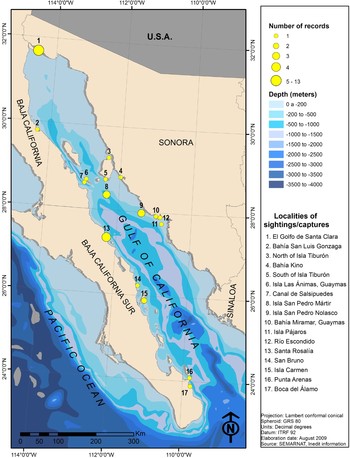
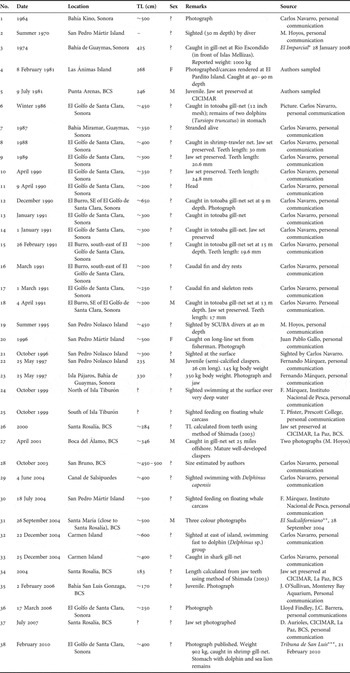
Thirty-eight records of white shark from 17 localities in the Gulf of California are presented here (Table 1; Figure 1). The locality with most sightings/captures was El Golfo de Santa Clara, Sonora, in the uppermost Gulf. In the central Gulf, between the Baja California Peninsula and Sonora (including several islands), a higher number of white sharks were recorded compared to lower Gulf localities, where records were restricted to the peninsula in the south-western Gulf.
Localities (numbered) and frequencies of records (size of circles) of white shark sightings and captures in the Gulf of California (also see Table 1).

Chronology of records of white shark in the Gulf of California (See Figure 1).

*, El Imparcial, a daily newspaper published in Hermosillo, Sonora; **, El Sudcaliforniano, a daily newspaper published in La Paz, BCS; ***, Tribuna de San Luis, a daily newspaper published in San Luis Río Colorado, Sonora; BCS, Baja California Sur.
White shark captures occurred mainly in (now illegal) totoaba gill-nets or shrimp trawl nets at different depths (9–90 m). Also, reliable SCUBA divers sighted white sharks at 30–40 m depths near San Pedro Mártir and San Pedro Nolasco Islands (Figure 1).
In some captured specimens, the authors did the examination of stomach contents of some adults (300–400 cm TL) which consisted of bottlenose dolphins (Tursiops truncatus), unidentified whale remains and California sea lions (Zalophus californianus). A juvenile specimen examined had an empty stomach.
No seasonal particularly notable shifts in distribution (‘preferences’) were seen in the records. Nineteen records were from the cold season (December to May) and seven records were from the warm season (June to November) (Table 1).
The presence of juveniles (<300 cm TL) was highest during the cold season with ten records; whereas during the warm season only one juvenile was recorded. Adults were more common during the cold season with nine records; whereas in the warm season six adults were recorded.
DISCUSSION
The white sharks reported here ranged from 170 to >500 cm TL. Working with records worldwide Compagno (Reference Compagno2001) reported size at maturity for males to be between ~350 and 410 cm TL, and between ~400 and 500 cm for females. Unfortunately, for most of our Gulf of California records we lack data on gender and thus could not accurately determine reproductive stage. However, we can infer from size-ranges that 15 records corresponded to juveniles and 14 to adults specimens. The remaining records belonged to unmeasured individuals.
Presence of juveniles was mostly restricted to the upper Gulf, mainly in the relatively shallow waters off the fishing town of El Golfo de Santa Clara (Figure 1), and this is probably associated with feeding habits. Juveniles apparently show a dietary preference for benthic and coastal fish (Klimley, Reference Klimley1984; Tricas & McCosker, Reference Tricas and McCosker1984), and the northern Gulf is habitat to seasonally large schools of medium to large-sized fish, such as the endemic species Gulf corvina (Cynoscion othonopterus) and totoaba (Totoaba macdonaldi), which could be consumed by juveniles.
Navarro & Arizmendi (Reference Navarro and Arizmendi2003) and Salomón-Aguilar et al. (Reference Salomón-Aguilar, Villavicencio-Garayzar and Reyes-Bonilla2009) reported an abundance of newborns and pregnant females of several shark species in the Gulf, suggesting that this area could be an important nursery area. Klimley (Reference Klimley1985) found white shark pups in California waters that were probably born off the coast of northern Baja California to Santa Barbara, California, at the northern edge of the temperate zone.
Considering the general absence of large white sharks in these southern coastal areas, it is possible that more northern-occurring gravid females move southward into this environment to release their pups so as to optimize their survival and decrease risk of predation. No newborns or pregnant females have been recorded in the Gulf of California, and there is no evidence of births there. However, the presence of small (<3 m TL) juveniles, suggests that the northern Gulf of California may be a secondary nursery ground, where juveniles apparently migrate from cool waters in the Pacific on the outer side of the Baja Peninsula to warmer waters in the Gulf (http://www.topp.org/blog/2_200_mile_journey_juvenile_white_shark) to find locations with abundant food for growth and protection (Bass, Reference Bass, Hodgson and Mathewson1978). Juveniles were more frequent in the northern Gulf from January to April when sea surface temperatures were lowest (average 15°C).
Adults were recorded in the Gulf of California during the whole year at a range of sea surface temperatures (15–30°C). According to Klimley (Reference Klimley1985), water temperature does not determine white shark distribution in adults. Bass (Reference Bass, Hodgson and Mathewson1978) suggested that water temperature was not an important factor for the presence of larger white sharks off eastern South Africa, because they were recorded from February to June when temperatures decreased, but they were absent from September to January when similar temperatures were recorded.
Klimley (Reference Klimley1985) stated that adult white sharks off south-east Farallon Island, California, were present from August to March, but were absent from April to July. Based on records of sightings and captures of white sharks off Farallon Island, this last author suggested that adult white sharks travelled southward to waters off Baja California to breed from March to June. The presence of adults in the Gulf of California (this paper) could support this hypothesis, although the majority of our records represent juvenile specimens.
The presence of adult white sharks near California sea lion (Zalophus californianus) colonies at San Pedro Mártir and San Pedro Nolasco Islands (Aurioles & Zavala, Reference Aurioles-Gamboa and Zavala-González1994), may indicate that prey availability influences white shark distribution in the Gulf of California. There are records of at least 30 marine mammal species occurring permanently or seasonally in the Gulf of California (26 cetaceans, four pinnipeds), making it one of the most diverse areas worldwide for marine mammals (Vidal et al., Reference Vidal, Findley and Leatherwood1993), and several of those species could serve as important prey for adult white sharks.
Abundant availability of food, e.g. large schools of demersal squid, small pelagic, benthic and demersal fish in the Gulf of California would allow the presence of white sharks, as happens with several species of both large and small sharks which also use the shallow waters and coastal bays of the Gulf of California as nursery areas, including hammerhead sharks (Sphyrna lewini and S. zygaena), smooth hound sharks (Mustelus henlei, M. lunulatus and M. californicus), blacktip sharks (Carcharhinus limbatus), Pacific sharpnose sharks (Rhizoprionodon longurio), and tiger sharks (Galeocerdo cuvier) (Navarro & Arizmendi, Reference Navarro and Arizmendi2003; Márquez-Farías et al., Reference Márquez-Farías, Rodríguez-Valencia and Cisneros-Mata2006; Galvan, Reference Galván, Urciaga, Beltrán and Lluch2009; Salomon-Aguilar et al., Reference Salomón-Aguilar, Villavicencio-Garayzar and Reyes-Bonilla2009).
Although we have little information on how the white shark uses the Gulf of California, records of its areas of occurrence probably indicate feeding areas for adults around islands, where marine mammals (especially California sea lion) are abundant, or areas where coastal and benthic and demersal fish are abundant and form important prey for juveniles.
Conservation and management implications
Although the white shark is included in the Mexican Official regulation (NOM-ECOL-059) prohibiting its commercial capture, enforcement mechanisms are insufficient, or they are not well implemented. There are no specific actions to protect this shark in Mexico, even though it continues to be captured as by-catch in artisanal fisheries off the western coast of Baja California and in the Gulf of California.
We hope that white shark occurrences in the Gulf of California here reported will serve to increase enforcement of protection regulations and aid in the conservation of this important worldwide apex predator.
ACKNOWLEDGEMENTS
We thank Juan Pablo Gallo-Reynoso and Lloyd Findley (Centro de Investigación en Alimentación y Desarrollo, AC-Guaymas), Rita Benavides (OVIS Organización Vida Silvestre AC), Omar Vidal (World Wildlife Fund-Mexico), Jose I. Castro (National Marine Fisheries Service), John O'Sullivan (Monterey Bay Aquarium, California), David Aurioles (Centro Interdisciplinario de Ciencias Marinas, La Paz), Juan Carlos Barrera (Comisión de Ecología y Desarrollo Sustentable del Estado de Sonora) and Tad Pfister (Prescott College, Kino Bay) for information on white shark records. We thank the Instituto Politécnico Nacional (Comisión de Operación y Fomento de Actividades Académicas, Estimulo al desempeño del investigador y Programa institucional de formación de investigadores) for research fellowships. Thanks also to two anonymous referees for English editing and valuable comments on our manuscript.