Introduction
Across the world, in many places in which English is not widely spoken, English text often appears on posters, storefronts, billboards, street signs, warning signs, menus, and many other forms of publicly visible written texts. English is often featured alongside one or more additional languages. These signs are typically seen as unremarkable by passersby looking to buy goods, for information regarding prohibited activity, or even just for a comfortable coffee shop. An increasingly robust scholarly literature has examined these signs since the publication of Landry and Bourhis' (Reference Landry and Bourhis1997) foundational study which popularized the term linguistic landscape. Linguistic landscape scholarship now includes large-scale quantitative examinations of publicly visible signs in cities such as Tokyo (Backhaus, Reference Backhaus2007), smaller-scale examinations of the written language within individual workplaces in a single building (Hanauer, Reference Hanauer2010), studies on mobile linguistic landscapes such as shopping bags (Alomoush, Reference Alomoush2019) and many other studies conducted in widely varying locations with widely varying foci (McKiernan, Reference McKiernan2019; Yuan, Reference Yuan2019).
This study adds to linguistic landscape research by focusing on South Korea (henceforth Korea) and the linguistic landscape of coffee shops near Seongsu Subway Station in Seoul. Drawing on data collected on 89 coffee shops within this neighborhood in Seoul, we highlight three findings. First, we demonstrate that English can hold multiple meanings within the space of the coffee shop. It is used to represent modernity, foreignness and cosmopolitanism as well as superior coffee and coffee-related knowledge. Further, the absence of English can mark a more retro or less contemporary atmosphere and a more local orientation for coffee shops. Second, we demonstrate how coffee shops with English-only menus have higher average prices, coffee shops with Korean-only menus have lower average prices, and coffee shops with Korean-and-English menus have average prices that are between coffee shops with English-only menus and Korean-only menus. Third, we show how the overall atmosphere, aesthetics, and style of coffee shops relate to the language of menus and the prices featured in those coffee shops in distinctive ways.
English and coffee in Korea and the Korean linguistic landscape
English has been studied in Korea with great intensity for decades, and the term ‘English fever’ (Park, Reference Park2009; Cho, Reference Cho2020) is often used in scholarly discussions to reflect the serious effort, competition, and concern surrounding English education in Korea. However, English has taken on values in Korea beyond that of an academic topic or object of study and certification. Scholars have also examined how a pursuit of English reflects affective desires for the cosmopolitan and global identities associated with English in Korea (e.g. Park & Abelmann, Reference Park and Abelmann2004; Curran, Reference Curran2018), which shape how English is deployed and read in the linguistic landscape of Korea.
A limited number of studies have examined the role of English in Korea's linguistic landscape (e.g. Vlack, Reference Vlack2011, Lawrence, Reference Lawrence2012; Park & Yang, Reference Park and Yang2015; Tan & Tan, Reference Tan and Tan2015; Lee, Reference Lee2019; Choi, Tatar & Kim, Reference Choi, Tatar and Kim2019). Importantly, Tan and Tan (Reference Tan and Tan2015: 66) found that English is often used in the brand names of products and stores and serves a decorative function in popular commercial areas, including those not frequented by tourists. Further, Lawrence (Reference Lawrence2012) highlighted how the proportion of English differed significantly depending on the neighborhood. Additionally, studies of Seoul's linguistic landscape have examined the use of English in and around cafes. For example, Tan and Tan (Reference Tan and Tan2015: 76) wrote:
[in cafes] English is dominant in brand signs, whereas Korean is almost solely used in non-brand signs. This is true even in the residential areas where Korean signs are more common. English used in café signs can be seen here to index a modern and Western identity associated with cafés.
Similarly, Park and Yang (Reference Park and Yang2015: 37) argued that ‘youth-populated domains such as coffee shops and cosmetic stores mobilized English to index a sense of modernity’ and Lawrence (Reference Lawrence2012: 89) concluded that ‘[i]n any region of the country, certain shops frequently have English signs, including coffee shops . . . ’ These conclusions align with broader understandings regarding the use of English in the linguistic landscape of regions in which English is not the most common or dominant language (see Vandenbroucke, Reference Vandenbroucke2016). However, none of these studies focused specifically on the role of English within coffee shops. Key to the present study is the understanding that coffee shops in Korea share important similarities, namely that they offer coffee-based beverages, but they can differ significantly in terms of their intended customers, size, location, atmosphere, and the types of coffee products offered as well as the language used in their menus and signage. Therefore, an examination of the linguistic landscape in coffee shops is an opportunity to examine the particularities of how English is used within similar establishments.
Data selection and collection
We chose to examine coffee shops in Korea because they are ubiquitous and often changing spaces in the Korean linguistic landscape. Korean people are avid consumers of coffee, averaging more than 500 cups per head each year (Korea Herald, 2018) and Seoul has perhaps the highest concentration of coffee shops in the world (see Lee & Kim, Reference Lee and Kim2016). Further, like English more generally, coffee shops in Korea have been recognized as sites of modernity and cosmopolitan longing (Bak, Reference Bak2005; Song, Reference Song2014). This makes coffee shops an interesting and important site for considering contemporary deployments of English in Korea today.
We chose the neighborhood around Seongsu Station for our analysis because it is an up-and-coming area famous for its stylish cafes. It has received relatively little attention from tourists and foreign residents of Korea compared to well known tourist locations like the trendy Gangnam neighborhood. Choosing to focus on an area relatively less visited by international tourists and foreign residents allows for examination of how English and Korean are deployed for Korean customers, rather than those who cannot understand Korean and require English signage for communicative purposes. This expands the interpretive possibilities of this study to apply to other similar areas in Korea.
Data was collected by traversing the neighborhood surrounding Seongsu Station on foot, carefully walking down all major streets and smaller alleyways within at least 200 meters of Seongsu Station. When encountering a coffee shop, the exterior was photographed and then, upon entering the coffee shop, the interior and menus were photographed if permission was granted by staff. Coffee shops with staff members who indicated they did not want menus photographed are not included in the quantitative analysis. We excluded from our data collection those establishments whose primary business was not the sale of coffee-based beverages, such as businesses that are primarily bakeries which also sell coffee. Data was collected between September 9 and October 18, 2019, with a total of seven days of data collection. We limited the duration of data collection to reduce the possibility that prices may change as we collected data.
Data
A total of 114 potential coffee shop-like places were photographed; 101 were determined to be coffee shops for the purposes of this study, and a complete set of data, including photographs of all relevant menus, was obtained for 89 coffee shops. Of the 12 coffee shops for which data was not obtained, two declined to have their menus photographed and one seems to no longer exist despite a large external sign still being present. Seven of the remaining nine were not open when first visited and were either not revisited before the end of data collection or were not open when visited again. The final two did not have data collected due to uncertainty over whether these locations could accurately be categorized as coffee shops at the time of data collection.
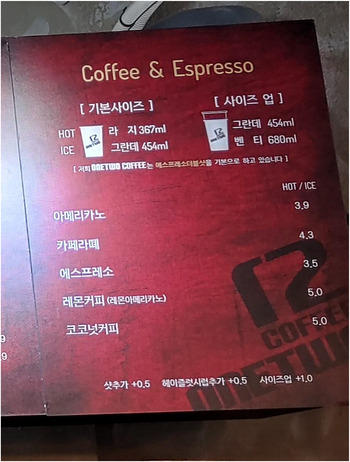
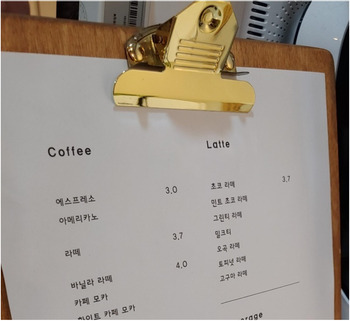
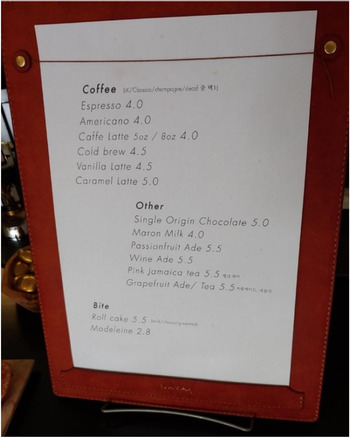
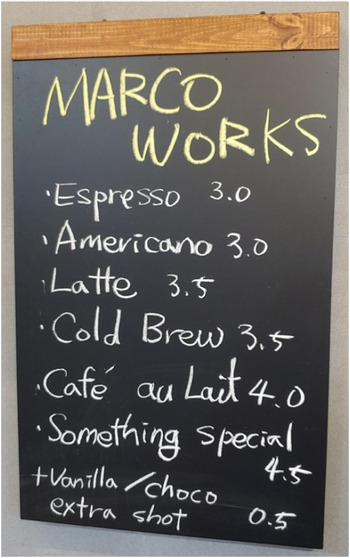
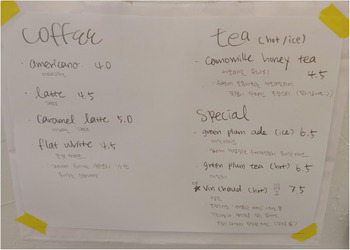
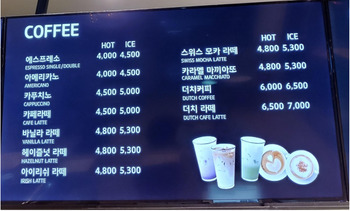
We categorized the coffee shops according to the language of the menu. Menus written in the Korean alphabet, Hangeul, were categorized as Korean-only (see Figures 1 and 2), menus written in the Roman alphabet were categorized as English-only (see Figures 3 and 4), and menus that reproduced the menu items twice, once in each language, were categorized as Korean-and-English (see Figures 5 and 6). For the purposes of categorization, we considered only the language of the products on offer. Other uses of language, such as headings which list the types of beverages or products being offered (see the top of Figure 1) or supplementary information such as small additional texts conveying further information (see the small Korean text in Figure 3) did not influence the categorization of these menus. Therefore, the menu of One Two Coffee in Figure 1 is considered a Korean-only menu and the menu of Lowkey Coffee in Figure 3 is considered an English-only menu. We chose this approach as we believe this best reflects the general language of these menus and reduces ambiguity between these categories.
The menu of One Two Coffee

The menu of Maris Coffee

The menu of Lowkey Coffee

The menu of Marco Works

The menu of BBHay

The menu of 20 Space

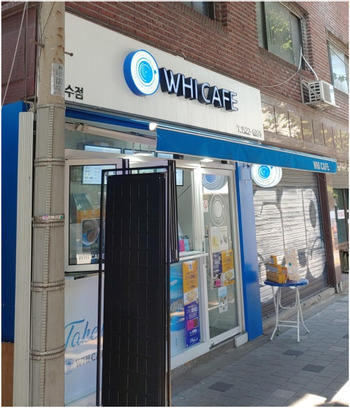
Of the 89 coffee shops in our data, 15 were the outlets of large chains and nine were take-away coffee shops, selling coffee primarily to be taken away with limited to no seating available (see Figure 7), with six coffee shops being both part of large chains and take-away coffee shops. Of the large-chain coffee shops, 14 out of 15 featured Korean-and-English menus, with the remainder having a Korean-only menu. Of the nine take-away coffee shops, six featured Korean-and-English menus, two featured Korean-only menus, and one featured an English-only menu. The majority of coffee shops examined in this study were small independent businesses. We verified this by an online search to determine if a coffee shop was part of a larger chain.
The exterior of Whi Cafe, a take-away only coffee shop which is part of a large chain

Analysis and discussion
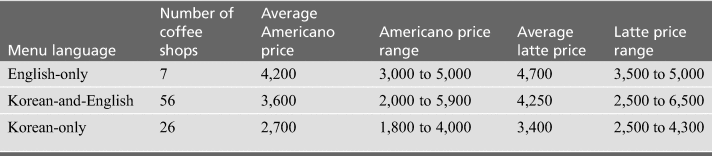
The two staple drinks offered in Korean coffee shops are Americano and cafe latte. Taking an average of the price of an Americano and a cafe latte or their equivalents reveals an important and readily apparent difference in coffee product prices between coffee shops with English-only menus, Korean-and-English menus, and Korean-only menus (see Table 1).
A comparison of menu language and beverage price

All prices are in Korean won, with 1,000 Korean won equal to approximately 0.84 USD as of February 2020.
There was considerable overlap in price range in all three categories, and some coffee shops with Korean-only menus were more expensive than those with English-only menus. Additionally, several of the most expensive coffee shops had Korean-and-English menus. Nevertheless, the data revealed a clear difference between the average prices of coffee shops with English-only menus, Korean-only menus, and Korean-and-English menus. We contend that the relationship between menu languages and coffee prices is part of a broader relationship between types of coffee shops and coffee prices, with menu languages being an important and distinguishing element of coffee shops. Drawing upon earlier scholarship on the Korean linguistic landscape (Tan & Tan, Reference Tan and Tan2015: 76), we argue that some coffee shops in Korea create an atmosphere, style, and aesthetic that is cosmopolitan, Western, foreign, and unlike how more typical Korean spaces are imagined, with the use of English being an important element of this representation. These same coffee shops also typically represent themselves as places of coffee expertise, serve coffee products which are represented as higher quality, and draw upon representations of coffee authenticity which often use English, as English is a representation of globalization and coffee knowledge from abroad. Representations of foreignness, cosmopolitanism, and coffee expertise, all of which can draw upon English, often justify or at least co-occur with higher prices for coffee products. Given that this neighborhood is not often visited by international tourists, it is unlikely that the English signage in these coffee shops is part of an effort to serve those customers who cannot speak Korean. It is much more likely that this use of English is used to attract and serve Korean customers. This implies that the use of English is part of creating an aesthetic and style for a coffee shop, rather than communicating with customers who require English signage for communication.
The experience of walking into, spending time within, and writing notes about 89 individual coffee shops in this neighborhood, alongside collecting and analyzing photographs of menus and other parts of these places, enables a reasonable understanding to be obtained of the overall aesthetics, style, and atmosphere of these different coffee shops. This understanding allows for a relatively simple, albeit not exhaustive, descriptive analysis of the different types of coffee shops that exist in this neighborhood.
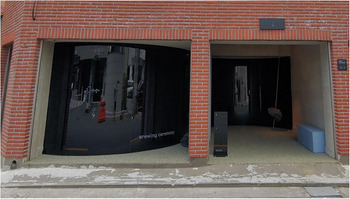
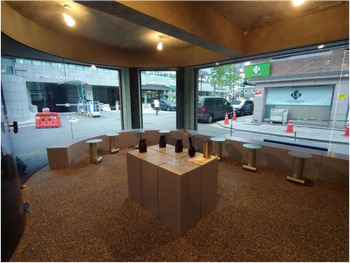
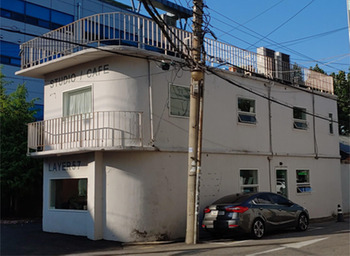
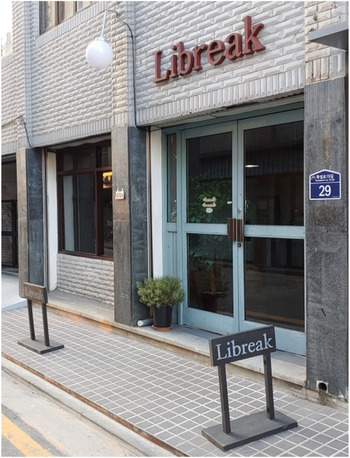
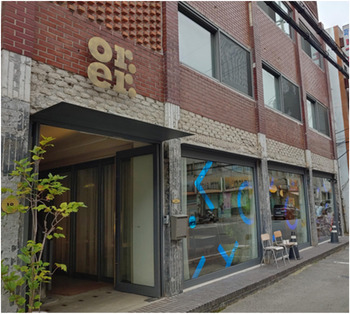
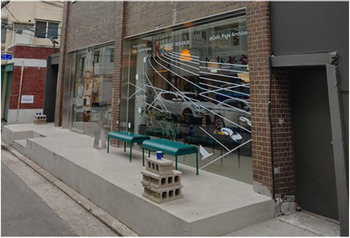
Some coffee shops seem to be constructed to achieve a sophisticated aesthetic that would serve to attract customers from across Seoul, and offer a level of sophistication and ambience beyond that of ordinary coffee shops. These coffee shops often feature a distinctive interior design, and offer beverages and baked goods that are well suited to being photographed and shared on social media. Such coffee shops draw upon globally circulating understandings of coffee, design, and style. Brewing Ceremony (see Figures 8 and 9), Layer 57 (see Figure 10) and Libreak (see Figure 11) are all excellent examples of this type of coffee shop and all feature English-only menus and use English elsewhere in their interiors as well. Brewing Ceremony, Layer 57, and Libreak also featured relatively higher prices, i.e. 5,000 won, 4,000 won, and 4,500 won respectively for an Americano or equivalent. Style and aesthetics, coffee product price, and the use of English come together within these coffee shops in a way that is sensible and easily understood, creating a particular type of sophisticated coffee shop. Additionally, some of these more stylish and sophisticated coffee shops such as or.er. and Cafe Pose (see Figures 12 and 13) feature Korean-and-English menus and again some of the highest prices within our data, i.e. 5,500 won for an Americano at both coffee shops. Coffee shops such as or.er. and Cafe Pose demonstrate that different possible arrangements of aesthetics, coffee product prices, and the languages of menus are possible within the broader relationship between average prices and the language of menus. Further, or.er. and Cafe Pose show that English within a menu, even if accompanied by Korean, is an important element in creating this type of coffee shop as none of the coffee shops with Korean-only menus strongly adopted this sophisticated aesthetic nor did any adopt prices above 4,000 won for an Americano.
The exterior of Brewing Ceremony

The interior of Brewing Ceremony

The exterior of Layer 57

The exterior of Libreak

The exterior of or.er

The exterior of Cafe Pose

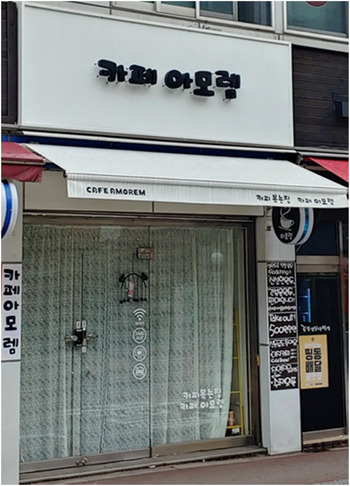
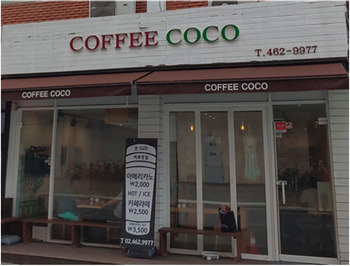
We also found that certain coffee shops are constructed as more accommodating to people who want a welcoming, friendly, and comfortable place that is interesting but not intimidating to local residents and those potential customers who are less familiar with contemporary coffee trends, chic interior design, and English. Cafe Amorem (see Figure 14), and Coffee Coco (Figure 15) serve as excellent examples of this type of coffee shop. Both of these coffee shops use Korean-only menus and feature Korean extensively within their interiors and exteriors. They offer relatively lower prices for an Americano, i.e. 3,000 won in Cafe Amorem and 2,000 won in Coffee Coco. There is an alignment in these coffee shops between the language of the menu, the style and aesthetics of the coffee shop, and the prices offered. This produces a place that is more welcoming and comfortable for those less interested in coffee knowledge and contemporary style and design.
The exterior of Cafe Amorem

The exterior of Coffee Coco

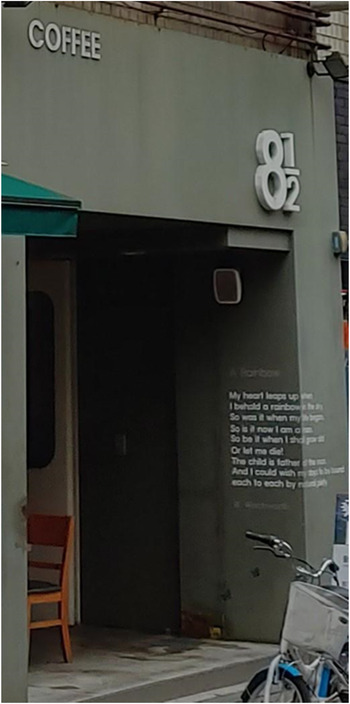
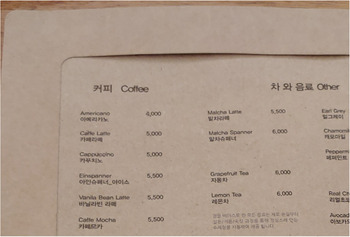
Importantly, there is ambiguity between these types of coffee shops, with many different ways of constructing many different types of coffee shops. English can be used extensively by some coffee shops with a warm, friendly, and comforting atmosphere, such as the coffee shop Coffee 8½, which features a Korean-and-English menu, an English quote on the exterior (see Figure 16), an English and Korean quote from Le Petit Prince on the wall of the interior, and a relatively low price for an Americano of 2,300 won. Similarly, English may be used less frequently by some coffee shops with a sophisticated Instagram-friendly interior design and atmosphere such as 마를리 (see Figure 17), which features Korean-and-English menus (see Figure 18) and a relatively higher price for an Americano of 4,000 won. BBHay has a Korean-and-English menu (see Figure 5) but features handwritten French poetry on its interior glass surfaces, written by the owner, numerous examples of French print media with French text posted on its interior walls, and charges 4,000 won for an Americano. These examples show some of the different ways aesthetics, price, and the language of menus can align within coffee shops in this neighborhood.
The exterior of Coffee 8½

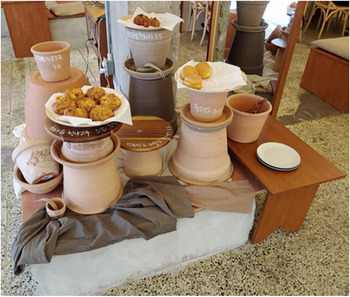
The interior display of 마를리

The menu of 마를리

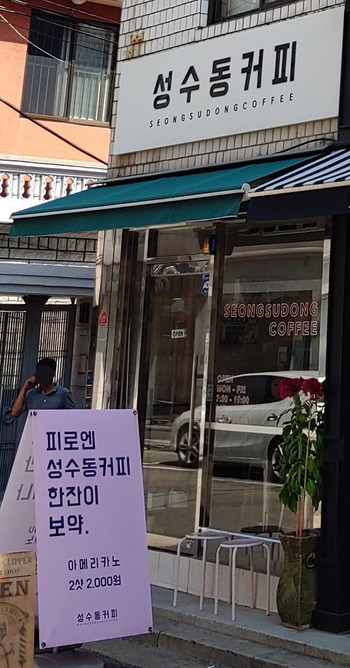
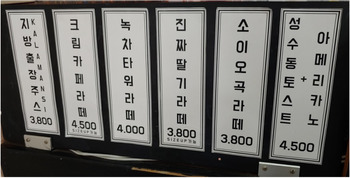
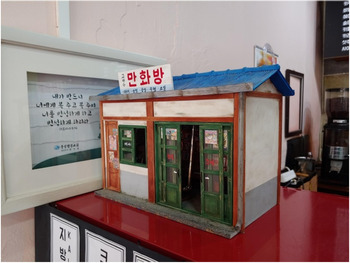
Additionally, some coffee shops emphasize their Korean elements, as discussed in Lee's (Reference Lee2019) analysis of Seoul's linguistic landscape. Lee (Reference Lee2019: 510) suggests that some coffee shops purposefully use only Korean as part of a unique identity and brand, drawing on nostalgia and a desire for a more retro style. Given the spread of coffee shops with English-only menus and Korean-and-English menus, a Korean-only menu can act as a distinctive choice that identifies a coffee shop as a place of nostalgia with a retro style. Seongsudong Coffee (see Figure 19) uses Korean throughout its different menus displayed in different ways within the coffee shop (see Figure 20 for an older-style specialized menu) and features in its interior small architectural models of older Korean buildings such as a manhwa bang, a comic book store (see Figure 21). It also has very low prices: 2,000 won for an Americano. A sense of nostalgia and a retro style shape Seongsudong Coffee, limiting the English employed within the signage of this coffee shop, influencing the prices charged, and creating an atmosphere that can welcome local people and those less interested in sophisticated coffee consumption and contemporary interior design.
The exterior of Seongsudong Coffee

An older-style menu within Seongsudong Coffee

A model of an old-fashioned comic book store in Seungsudong Coffee

Conclusion
This article offers an analysis of coffee shop menus, coffee product prices, and the overall aesthetics and atmosphere of coffee shops in the neighborhood around Seongsu Station in Seoul. Our findings support previous research highlighting how English and coffee shops are sites of modernity and Western consumption (Lee, Reference Lee2006; Tan & Tan, Reference Tan and Tan2015). Additionally, we found, like Lee (Reference Lee2019), that Korean can be part of constructing a coffee shop as comfortable and nostalgic, as demonstrated by Seongsudong Coffee. However, our findings also push back against recent work on Korea's linguistic landscape. For example, Lee (Reference Lee2019: 516) suggested that ‘coffee shops run by a mega franchise tend to write their signs mostly in English,’ implying that the decision to use English is related to the size of the franchise. In contrast, we found that independent coffee shops which emphasize their sophisticated aesthetics and style alongside their knowledge of coffee often feature English-only menus while larger franchise coffee shops much more typically adopt Korean-and-English menus, with 14 out of 15 of these coffee shops in our data featuring Korean-and-English menus.
We must also highlight that English can take on multiple associations in different coffee shops. English-only menus are much more likely to be part of a sophisticated coffee shop with relatively higher prices while a Korean-and-English menu may be found in many different types of coffee shops, some of which offer relatively inexpensive coffee products. The English in an English-only menu or a Korean-and-English menu can be part of a coffee shop with a sophisticated aesthetic, with the English being part of the overall stylization of this place. Within these sophisticated coffee shops, there is a naturalization and alignment of English, aesthetics, and higher prices for coffee products. Alternatively, the English within some Korean-and-English menus may be part of a different type of coffee shop in which the connection between English and price is unclear, as with BBHay, which may use English as a general mark of globalization but otherwise emphasizes its French qualities as part of its overall aesthetics.
Additionally, there are limits on the prices charged by coffee shops with Korean-only menus. Among coffee shops with Korean-only menus only five of 26 coffee shops charge more than 3,000 won for an Americano, with 4,000 won being the highest price charged among these coffee shops. The prices charged by coffee shops with Korean-only menus suggest that the use of English can be associated with the acceptance of higher prices for coffee products and that an absence of English can be associated with an upper limit on coffee product prices. Ultimately, this examination of aesthetics, language use, and prices within coffee shops around Seongsu Station shows the multiple ways in which English can be valued, both literally and figuratively, within contemporary Korea.
 MICHAEL CHESNUT is an assistant professor at Hankuk University of Foreign Studies (HUFS). His research interests include the linguistic landscape, ways of incorporating linguistic landscape data and scholarship into language teaching, second language writing pedagogy, and ‘foreign’ language teacher identity. Recent work in preparation includes a study on the experiences of Irish teachers of English in Korea, and an ongoing study examining multilingualism in the COVID-19 related linguistic landscape of Korea. Email: michael.chesnut@hufs.ac.kr
 NATHANIEL MING CURRAN is a PhD Candidate at the University of Southern California's Annenberg School for Communication and Journalism. His research on topics related to English and Korea can be found in: Media, Culture & Society; International Journal of Communication; Communication, Culture & Critique, and International Journal of Bilingual Education and Bilingualism. His research is supported by the 2020 Korean Studies Grant Program of the Academy of Korean Studies (AKS-2020-R-21). Email: ncurran@usc.edu