

Introduction
From Tahrir Square to the Maidan, in the last decade, protesters in every corner of the world have mobilized for greater democratic freedoms. Thanks to the digital revolution, their demonstrations quickly took on a global character – in 2019, an amateur video of police repression in the streets of Hong Kong went viral in Chile, inspiring tactical innovation; and diffusion of symbols and slogans gave a strikingly similar flavor to protests in places as different as Lebanon, Bolivia, or Sudan.Footnote 1 Contemporary protesters turn to social media not only to organize, or keep citizens informed when governments crack down on local media, but also to address – and win over – a global audience. This often includes sending images and videos of protesters being violently treated by police into the virtual ether to stoke outrage and increase awareness of their struggle.
How should we expect American audiences to react to such footage of overseas protests? Human rights scholars have shown that news stories of violent repression increase the likelihood of sanctions or other punitive actions against offending governments (Heinrich, Kobayashi and Long, Reference Heinrich, Kobayashi and Long2018; Nielsen, Reference Nielsen2013) and drive public support for such penalties (Allendoerfer, Reference Allendoerfer2017). Much of this research measures reactions to news about human rights violations in print media. However, given the prevalence of broadcast and digital media sources, many Americans receive news of contemporary global protests not through words, but through a stream of photographs and videos. The political communication literature indicates that differential presentation of news yields differences in political learning (Graber and Dunaway, Reference Graber and Dunaway2017, p. 165–66); thus, in this article, we explore the effects of video footage of repression on American foreign policy preferences.
We also seek to better integrate the robust literature on citizen journalism with research on rights violations and foreign policy responses. Communications scholars have argued that new technology has revolutionized the traditional media sphere (Gordon, Reference Gordon2007), and that mobile phone cameras, in particular, allow activists to share their own “graphic testimony in a bid to produce feelings of political solidarity” (Andén-Papadopoulos, Reference Andén-Papadopoulos2014, p. 1). Nevertheless, scholars have debated whether selfie-cam footage is more or less credible than traditional news media (Carr, Barnidge, Lee and Tsang, Reference Carr, Barnidge, Lee and Tsang2014; Swasy, Tandoc, Bhandari and Davis, Reference Swasy, Tandoc, Bhandari and Davis2015). Motivated by this area of inquiry, we test whether mobile phone footage or traditional TV news footage has a greater effect upon public support for protesters abroad.
Through two survey experiments and text analysis of open-ended survey responses, we find that perceiving foreign protests as violently repressed increases American support for targeted sanctions against a hostile regime and that repression of protesters makes human rights issues more salient for respondents. However, our violence treatment does not change viewers’ willingness to learn more about protests or inspire political action on behalf of protesters. Furthermore, we find no evidence that the source of a media clip compounds the effects of violence upon support for sanctions or learning more about protests.
Repression, Media, and Public Opinion
Social movement research shows that violent repression of protests may yield functional benefits to the protesters’ cause by spurring policy action – a process termed “functional victimization” (McAdam and Su, Reference McAdam and Su2002, p. 704). Repression can create public outrage, backfiring on a repressive government (Chenoweth and Stephan, Reference Chenoweth and Stephan2011; Hess and Martin, Reference Hess and Martin2006) and rallying further mobilization (Martin, Reference Martin2007; McAdam, Tarrow and Tilly, Reference McAdam, Tarrow and Tilly2003). Once protesters win public support, they are more likely to see changes in attitudes of elected representatives (Wouters and Walgrave, Reference Wouters and Walgrave2017) and in public policy (Agnone, Reference Agnone2007; Giugni, Reference Giugni2007).
Similarly, research on foreign policy preferences shows that narratives of victimization shape public opinion. For example, Americans favor military humanitarian interventions in support of victimized populations (Eichenberg, Reference Eichenberg2005; Jentleson, Reference Jentleson1992; Kreps and Maxey, Reference Kreps and Maxey2017). They also support diplomatic pressure, economic sanctions (Brancati, Reference Brancati2014), and cutting humanitarian aid to punish human rights violators (Heinrich, Kobayashi and Long, Reference Heinrich, Kobayashi and Long2018; Nielsen, Reference Nielsen2013), even if the recipient is a strategically important country (Allendoerfer, Reference Allendoerfer2017).Footnote 2
Hence, we derive the following hypotheses regarding the reactions of members of the American public to foreign protest footage:
H1: Violent repression increases public support for US action to assist foreign protesters.
H2: Violent repression increases public interest in foreign protests.
Repressive states whose actions are widely publicized in the media are more likely to be penalized for human rights violations (Heinrich, Kobayashi and Long, Reference Heinrich, Kobayashi and Long2018; Nielsen, Reference Nielsen2013). But are these publicity effects robust to recent digital transformations in the media sphere? Research on “liberation technology” (Diamond, Reference Diamond2010, p. 70) emphasizes how social media opened up opportunities for activists to expose human rights abuses (Tucker, Theocharis, Roberts and Barberá, Reference Tucker, Theocharis, Roberts and Barberá2017; Tufekci and Wilson, Reference Tufekci and Wilson2012). New technology has allowed activists to produce media content themselves, without reliance on journalistic coverage, and to show, rather than tell, outside audiences their story. However, some scholars have argued that selfie-cam footage is less trustworthy than traditional media (Swasy, Tandoc, Bhandari and Davis, Reference Swasy, Tandoc, Bhandari and Davis2015). Others have shown that it can be more convincing to certain segments of the population, such as those disillusioned by the traditional media, and less convincing to others (Carr, Barnidge, Lee and Tsang, Reference Carr, Barnidge, Lee and Tsang2014).
We contribute to this literature by testing whether movements can generate awareness and support for policy change through digitized citizen journalism. The premise of such a claim is that mobile technology not only facilitates transmission of information but also personalizes the audience’s experience (Lynch, Reference Lynch2014; Tufekci, Reference Tufekci2017), helping viewers identify and sympathize with the protesters and thus increasing support (Muñoz and Anduiza, Reference Muñoz and Anduiza2019). This leads us to:
H3: Effects of violent repression will be magnified when the media source is mobile technology, as opposed to traditional news.
Study 1
Our first study investigates Hypothesis 1 using data from an Amazon MTurk survey experiment fielded on a sample of 1,008 respondents in May 2016. The study was designed to evaluate the effects of violent repression of protests across three geographical areas. To mimic how most Americans consume the news, we used 30-second videos as treatments. The survey employed a 2 × 3 factorial design, and videos varied on two dimensions: violent or nonviolent reaction of security forces, and location (Egypt, Hong Kong, and Ukraine).Footnote 3 The videos were cut from real-life footage about the Arab Spring, the Umbrella Movement, and the Maidan protests and edited to appear as similar as possible across locations. The first half of the violent and nonviolent videos was the same, but the clips differed in the police reaction in the second half.
Respondents in each experimental condition were instructed to watch a video showing a “recent pro-democracy protest” in a foreign country. We only presented respondents with protesters demonstrating peacefully because use of violence negatively influences the perception of the movement (Chenoweth and Stephan, Reference Chenoweth and Stephan2011; Huff and Kruszewska, Reference Huff and Kruszewska2016; Wouters, Reference Wouters2018). Respondents were not informed where the protests took place and in fact, we took measures to obscure the location, so that results would not be driven by views of US policy toward specific countries. Videos had no sound so as to prevent inferences based on the language, and visual cues, such as flags and banners, were blurred. Ethnicity was cued visually through close-ups of protesters’ faces. After the videos, participants were asked whether and why they would favor or oppose the US government placing sanctions on the country’s government. We also asked which forms of political action respondents were willing to engage in to support the protesters and how much money they would be willing to donate.
Results
Police violence increases support for sanctions
We find that violent repression of the protesters increases support for US sanctions against the challenged regime, but the violence treatment does not make respondents more likely to engage in political action. On average, watching footage of a pro-democracy demonstration in which the police reacted violently increased support for sanctions by about 7% (
 $\[{\overline X_0}\]$
= .379,
 $\[{\overline X_1}\]$
= .444). However, repression had no statistically significant effect on declared willingness to donate money in support of the protesters or to take political action – such as signing a petition or calling a Congressional representative. In short, our violence hypothesis holds for attitudes toward US foreign policy, but it does not extend to behavioral outcomes.Footnote 4 Figure 1 presents difference-in-means estimates for all outcome questions, with all protester ethnicity conditions pooled together. All plots displayed in the article use binary outcome variables.Footnote 5 Results using ordinal outcome variables were consistent with these findings.
Marginal effect of police violence on foreign policy preferences and political behavior without control covariates. 90% and 95% confidence intervals. Top panel shows the effect on support for sanctions using a binary variable constructed based on a seven-point scale measuring how strongly respondents favor US sanctions in support of the protesters. Middle panel shows the marginal effect on money donations in dollars, and bottom panel displays stated willingness to engage in action in support of protesters.

Balance testing confirms that our randomization prevented significant demographic differences across treatment groups. Nevertheless, as shown in Model 3 of Table 4 in the Appendix, when control variables are added, the effect of violence is no longer statistically significant at conventional levels, whereas respondent characteristics do shape support for sanctions. For example, Republicans support sanctions on host governments less than other groups. This is consistent with previous findings that ideology affects preferred policy responses to democratic repression abroad (Faust and Garcia, Reference Faust and Garcia2014). However, the small sample size and complicated design of Study 1 may be underpowering our analysis of the violence effect. We thus replicate our violence manipulation in Study 2 with a simpler design and a larger sample.
Why does support increase when police repress the protest?
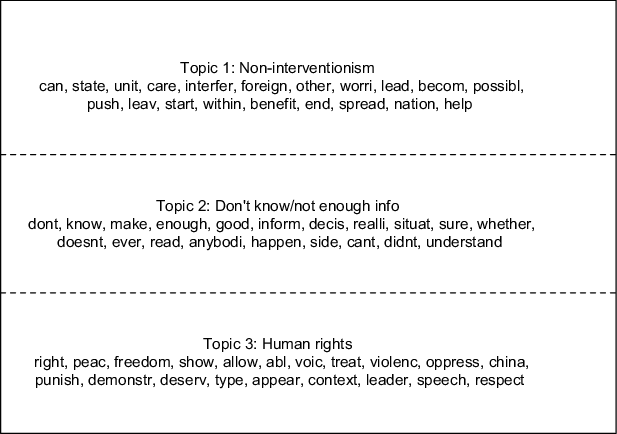
To explore why repression of protesters increases support, we analyzed the results of an open-ended question, which asked respondents why they supported or opposed sanctions, using a Structural Topic Model (Lucas et al., Reference Lucas, Nielsen, Roberts, Stewart, Storer and Tingley2015; Roberts et al., Reference Roberts, Stewart, Tingley, Lucas, Leder-Luis, Gadarian, Albertson and Rand2014). We estimated the effect of experimental treatment – violent repression – on text written by survey respondents via a three-topic model without additional covariates.
Figure 2 summarizes each of the 3 topics with the top 20 most probable and exclusive words (FREX). From these words, we inferred the following topic labels: “Non-Interventionism,” “Don’t Know/Not Enough Info,” and “Human Rights.” The first topic, with words such as “interfere,” indicates a focus on apprehension about US involvement abroad. A response with the highest proportion of words drawn from the topic starts with: “Each country can and must resolve its inner political problems without any external interference.”
Structural topic model topics with violence as treatment.

The second topic seems to focus on a lack of sufficient information, including words like “inform,” “decision,” and “know.” An exemplar response states: “I don’t know enough about the situation to make an informed decision.”
The third topic is characterized by words such as “rights,” “freedom,” and “oppression.” An exemplar response reads:
“Later in the clip it showed law enforcement in riot gear spraying the crowd with what is probably pepper spray and beating unarmed protesters who appear to be shielding themselves with their arms. This isn’t the sort of reaction I’d support for any type of protest and it would be ideal if the US government did not support it, either.”
Others highlight the importance of human rights: “The oppression of these people and their fundamental right to protest is being threatened,” and, “It is important for all humans to be able to have a voice and have basic human rights.”
Whether respondents watched a video with a violent police reaction had an effect on topic prevalence in their written responses. Figure 3 presents difference-in-means estimates for the effect of seeing footage of a repressed pro-democracy movement on the proportion of responses dedicated to Topics 1, 2, and 3. On average, violent repression increased the proportion of responses discussing the “Human Rights” topic by nearly 5%. This indicates that repression of protesters might make the violation of human rights more salient for respondents, leading them to feel more sympathetic toward the protesters’ cause, and lends further support to literature emphasizing the importance of moral public opinion in shaping foreign policy. Moreover, the decrease in prevalence of Topic 2 in the violence condition suggests that repression provides people with sufficient information to form an opinion about the victimization of the protesters and make a moral judgment about US intervention in their defense.
Effect of violence as treatment on topic prevalence.

Study 2
For our second study, we fielded an MTurk survey in April 2018 with 1,748 respondents to replicate our violence findings and determine how media source affects public reactions to repression. The survey design was similar to Study 1, but this survey employed a
 $\[2 \times 2\]$
factorial design in which both the source of video and the level of police violence were manipulated. Manipulating source of the video means that respondents were assigned to watch either (1) footage with a TV newscast intro and full screen presentation or (2) the same video edited to look like cell phone footage through a filter that added thick black margins to each side of the video frame. Titles at the start of each video designated them as either “news report” or “mobile phone” footage.
Footnote 6
Once again, respondents saw either protests repressed by violence or protests without repression.
Respondents were told that they would watch a video showing a recent protest overseas calling for more democratic governance. This time, we used edited footage of the 2014 protests in Venezuela, though respondents were not informed of the protest location. Again, sound was muted and most visual cues (i.e., flags and signs) were blurred.
After watching the video, respondents were asked how much they favored the USA imposing targeted sanctions on elites in the country where the protests took place. Footnote 7 This time, we specified that sanctions targeted elites to eliminate worries that sanctions could hurt the wider population (as shown in McLean and Roblyer Reference McLean and Roblyer2017). Finally, respondents were asked if they would like to learn more about the protests. Given that respondents in Study 1 were unwilling to take more costly actions in support of protesters, we provided this option to measure whether treatments had an effect upon a very low-cost behavioral outcome. Footnote 8
Results
We estimate the effects of the footage source and the repression treatment, as well as the interaction between the two treatment indicators for these two outcome variables with simple linear regression models using only the violence and mobile variables, and where appropriate, an interaction term. Results for Study 2 are robust to the inclusion of demographic and attitudinal covariates. Footnote 9
Violent repression increases support for sanctions
Figure 4 presents the effects of violent repression on both outcomes of interest. Again, we find that on average, violent repression of the protesters increases support for the USA imposing targeted sanctions against the challenged regime by 7% (
$\[{\overline X_0}\]$
= .483,
$\[{\overline X_1}\]$
= .552). The results of Study 2 provide greater support for Hypothesis 1, but they do not support Hypothesis 2: the effect on the “learn more” variable is very small, negative, and not statistically significant.
Footnote 10
Marginal effect of violent repression on targeted sanctions support and interest in learning more about protests. 90% and 95% confidence intervals.

Mobile treatment does not intensify effects of violence
We expected to find that mobile footage would have a positive impact upon sanctions support and interest in protests when violent repression occurred. However, the marginal mobile effect conditional on displaying violence is only positive for the sanctions outcome, and it is not significant in either case. Footnote 11 Figures 5 and 6 present treatment effects for these outcome questions. Both plots rely on a regression with an interaction term between the mobile and violent treatments.
Effects on support for targeted sanctions. 90% and 95% confidence intervals.

Effects on interest in learning more about protests. 90% and 95% confidence intervals.

The third rows in each figure show that violence displayed through mobile phone footage does not have any additional effect on sanctions support or learning more about protests than violence displayed via traditional news footage. However, the significant marginal effect depicted for violence in the first row of Figure 5 indicates that violence in the TV news condition has a positive effect on support for targeted sanctions when compared to support for sanctions in the group receiving the nonviolent, TV news condition.
Footnote 12
The second row of Figure 5 shows that the effect of displaying violence via mobile news compared to the nonviolent mobile news condition is also significant, this time at the
 $\[\alpha \]$
= 0.10 level.
Footnote 13
In sum, violent repression continues to have a positive and significant effect on support for sanctions when displayed through either media type individually, but violence displayed via mobile phone footage is not more impactful than violence displayed via traditional media.
In fact, levels of trust in the footage did not vary across types: on a six-point Likert scale from 0 to 5, with a 2 meaning that the clip was “somewhat untrustworthy” and a 3 meaning that the clip was “somewhat trustworthy,” the average trustworthiness of the TV news clip was 3.17 while the average trustworthiness of the mobile phone clip was 3.15. The 0.02 difference was not statistically significant. Footnote 14
Once again, Republicans were less likely to support punitive sanctions. Alternatively, voter turnout – a proxy for greater political engagement – and warmer feelings toward Latin America both increased sanctions support.
Conclusion
In this article, we use survey experiments to explore how the source of footage and level of police violence featured in news about protests abroad shape American preferences for US action in support of protesters. Our results show that violent repression increases support for sanctions against the regime, but switching from traditional media footage to mobile phone footage does not magnify the effects of violence.
The effects in our study only hold for attitudes; they do not extend to even low-cost behaviors. Recognizing the limitations of an experimental manipulation consisting of a single viewing of a short video, we expect that repeated exposure to protest footage or an accompanying narrative calling for action might have stronger effects, potentially changing the behavioral outcomes. Still, this point drives home the significance of our results related to attitudinal change: even brief exposure leads to greater support for sanctions.
Our findings indicate that by sharing their stories directly with the publics of countries like the USA, protest movements abroad may secure the sympathy of segments of the US public and facilitate greater citizen approval of US government sanctions against foreign governments engaged in the repression of protesters.
Supplementary material
To view supplementary material for this article, please visit https://doi.org/10.1017/XPS.2021.1