Introduction
Approximately 6% of all preterm births and less than 1% of all births in the United States are delivered before 28 weeks’ gestational age (Hamilton, Hoyert, Martin, Strobino, & Guyer, Reference Hamilton, Hoyert, Martin, Strobino and Guyer2013; Martin, Hamilton, Osterman, Curtin, & Matthews, Reference Martin, Hamilton, Osterman, Curtin and Matthews2015). An inverse relationship between gestational age and neuropsychological outcomes is well-documented, with survivors of birth at the lowest viable gestational ages at greatest overall risk of disability (Aarnoudse-Moens, Weisglas-Kuperus, van Goudoever, & Oosterlaan, Reference Aarnoudse-Moens, Weisglas-Kuperus, van Goudoever and Oosterlaan2009). Maintenance of adequate ventilation and cerebral perfusion in these extremely preterm infants is essential to avoid toxicity or oxidative stress and to ensure neurological health (Schmidt et al., Reference Schmidt, Whyte, Asztalos, Moddemann, Poets, Rabi and Roberts2013; Volpe, Reference Volpe2008). Yet, optimal targeting of blood oxygen levels has been a major challenge that remains unresolved (Askie, Henderson-Smart, & Ko, Reference Askie, Henderson-Smart and Ko2009).
The results of randomized control trials conducted to determine optimal oxygen target ranges have not yet allowed for definitive recommendations. Lower oxygen target ranges that have had the beneficial effect of lowering rates of retinopathy of prematurity are also associated with unacceptable even higher mortality rates than those consequent to higher target ranges (Askie, Reference Askie2013; Di Fiore et al., Reference Di Fiore, Walsh, Wrage, Rich, Finer, Carlo and Martin2012; Silverman, Reference Silverman2004). For instance, the Surfactant, Positive Pressure, and Pulse Oximetry Randomized Trial (SUPPORT) comparing lower (85–89%) and higher (91–95%) oxygen target groups found a significantly increased rate of mortality for the lower group (19.9 vs. 16.6%, respectively), leading to a recommendation that practitioners adjust target ranges upward (Carlo et al., Reference Carlo, Finer, Walsh, Rich, Gantz, Laptook and Higgins2010). However, subsequent analyses found no significant differences in the rate of death or neurodevelopmental impairment among extremely premature infants randomly assigned to early continuous positive airway pressure or early surfactant administration and to a lower or higher target range of oxygen saturation (Vaucher et al., Reference Vaucher, Peralta-Carcelen, Finer, Carlo, Gantz, Walsh and Higgins2012). Data were combined from three randomized controlled trials conducted in Australia, the United Kingdom, and New Zealand (Benefits of Oxygen Saturation Targeting; BOOST II), and also found a target range of 91–95% preferable to the 85–89% target range (Stenson et al., Reference Stenson, Tarnow-Mordi, Darlow, Simes, Juszczak, Askie and Brocklehurst2013). Moreover, significantly greater mortality in the 85–89% target range group compared with the 91–95% target range group (23.1% vs. 15.9%, respectively) was reported in a subgroup of infants treated using a revised oximeter-calibration algorithm, sufficient to recommend that oxygen saturation targets less than 90% using current oximeters be avoided (Askie, Reference Askie2013). Analysis of all BOOST-II infants studied showed that the 85–89% target range group had less retinopathy of prematurity (10.6%) than the 91–95% target range group (13.5%) yet more necrotizing enterocolitis (10.4% vs. 8.0%, respectively).
Further analyses were conducted specifically for extremely preterm birth. The Neonatal Oxygenation Prospective Meta-analysis (NeOProM; Askie et al., Reference Askie, Brocklehurst, Darlow, Finer, Schmidt and Tarnow-Mordi2011) combined data on infants born below 28 weeks’ gestation and randomized to either low (85–89%) or high (91–95%) target groups within 24 hr of birth from five trials: the Surfactant, Positive Pressure and Pulse Oximetry Randomized Trial (SUPPORT) trial in the United States; the three trials in BOOST II (Stenson, Brocklehurst, & Tarnow-Mordi, Reference Stenson, Brocklehurst and Tarnow-Mordi2011); and, the Canadian Oxygen Trial (COT) that included data from Germany, Finland, Argentina, and Israel (Schmidt et al., Reference Schmidt, Whyte, Asztalos, Moddemann, Poets, Rabi and Roberts2013). NeOProM found significantly increased mortality and rates of necrotizing enterocolitis and significantly decreased severe retinopathy of prematurity in the 85–89% target group. Significant differences in rates of bronchopulmonary dysplasia, brain injury, and patent ductus arteriosus were not found. It was therefore recommended that oxygen saturation rates for extremely preterm infants be targeted at 90–95% until 36 weeks’ postmenstrual age, awaiting confirmation or disconfirmation through further studies (Saugstad & Aune, Reference Saugstad and Aune2014). Data showing increased rates of mortality consequent to lowered target rates outweighed the advantageous outcome of lowered rates of retinopathy of prematurity (Owen & Hartnett, Reference Owen and Hartnett2014; Saugstad & Aune, Reference Saugstad and Aune2011). In contrast, a randomized, double-blind trial with 25 participating hospitals targeting oxygen saturations of 85% to 89% compared with 91% to 95% found no significant effects on rates of death or disability in infants studied up to age 18 months (Schmidt et al., Reference Schmidt, Whyte, Asztalos, Moddemann, Poets, Rabi and Roberts2013). Therefore, studies that determine definitive guidelines for safe and efficacious target rates, avoiding increased mortality and reducing retinopathy of prematurity incidence, remain an ongoing critical priority. Notably, efforts to set precise targets and avoid adverse events are further complicated since target ranges may vary with advancing gestational and postnatal age (Stenson et al., Reference Stenson, Tarnow-Mordi, Darlow, Simes, Juszczak, Askie and Brocklehurst2013).
With the optimal oxygen saturation target range yet to be determined, and mortality risk of high concern, it is not surprising that the neuropsychological outcomes in extremely preterm survivors of varying oxygen saturation targets are as yet unreported. However, knowledge of psychological outcomes relative to designated target ranges has potential to contribute greatly to medical decision-making, especially at early age. An expanding literature already documents that preschoolers born extremely preterm are at especially high risk of intellectual, neuropsychological, and behavioral deficits (see review by Baron & Rey-Casserly, Reference Baron and Rey-Casserly2010), with adverse effects often extending throughout adolescence and into adulthood (Anderson & Doyle, Reference Anderson and Doyle2008; Baron, Leonberger, & Ahronovich, Reference Baron, Leonberger and Ahronovich2013; De Groote et al., Reference De Groote, Vanhaesebrouck, Bruneel, Dom, Durein, Hasaerts and van Mol2007; Doyle & Anderson, Reference Doyle and Anderson2010; Hallin, Hellstrom-Westas, & Stjernqvist, Reference Hallin, Hellstrom-Westas and Stjernqvist2010; Wilson-Ching et al., Reference Wilson-Ching, Molloy, Anderson, Burnett, Roberts, Cheong and Anderson2013). Importantly, neuropsychological outcomes associated with preterm birth are not solely determined by gestational age. These will vary as a consequence of the methodological refinement and implementation of obstetric and neonatal intensive care advances, individual heritability, demographic and environmental characteristics, and epigenetic mechanisms (Doyle, Reference Doyle2004; Hakansson, Farooqi, Holmgren, Serenius, & Hogberg, Reference Hakansson, Farooqi, Holmgren, Serenius and Hogberg2004; Kilbride, Thorstad, & Daily, Reference Kilbride, Thorstad and Daily2004; Zlatohlavkova et al., Reference Zlatohlavkova, Kytnarova, Kubena, Fleischnerova, Dokoupilova and Plavka2010). It can be reasonably anticipated that with eventual determination of optimal saturation target ranges an associated effect will be found in early-age neuropsychological outcomes, although the direction and magnitude of such effects is currently unclear.
Historically, most cognitive outcome studies of extremely preterm birth were conducted either to assess neurodevelopmental progress before 3 years of age using infant development scales and behavioral questionnaires or, bypassing the preschool years, only after school entry using a broader range of cognitive and behavioral instruments. Thus, investigations at preschool age are sparse although these early years are a critical period of rapid physiological maturation and active brain development. This long-existent gap is being narrowed with the recognition that neuropsychological integrity is now reliably and validly assessed before age 5 and that discriminating differential functioning across cognitive domains is possible in preschoolers (Anderson & Reidy, Reference Anderson and Reidy2012; Baron & Anderson, Reference Baron and Anderson2012; Bauer, Leventon, & Varga, Reference Bauer, Leventon and Varga2012; Conti-Ramsden & Durkin, Reference Conti-Ramsden and Durkin2012; Mahone & Schneider, Reference Mahone and Schneider2012; Piek, Hands, & Licari, Reference Piek, Hands and Licari2012). Accordingly, a wider spectrum of developing cognitive capacities are now examined in preschoolers at high risk following preterm birth, including executive functions (Baron, Kerns, Muller, Ahronovich, & Litman, Reference Baron, Kerns, Muller, Ahronovich and Litman2012; Edgin et al., Reference Edgin, Inder, Anderson, Hood, Clark and Woodward2008), attention, nonverbal proficiency, motor skill, pre-academic competence, functional communication (Baron, Erickson, Ahronovich, Baker, & Litman, Reference Baron, Erickson, Ahronovich, Baker and Litman2011; Stjernqvist & Svenningsen, Reference Stjernqvist and Svenningsen1995; Torrioli et al., Reference Torrioli, Frisone, Bonvini, Luciano, Pasca, Lepori and Guzzetta2000; van de Weijer-Bergsma, Wijnroks, & Jongmans, Reference van de Weijer-Bergsma, Wijnroks and Jongmans2008), memory (Baron, Erickson, Ahronovich, Litman, & Brandt, Reference Baron, Erickson, Ahronovich, Litman and Brandt2010; Rose, Feldman, & Jankowski, Reference Rose, Feldman and Jankowski2005), and behavioral development (Mansson, Stjernqvist, & Backstrom, Reference Mansson, Stjernqvist and Backstrom2014).
To our knowledge, there have been no reports in the literature of a tiered method of oxygen delivery as an alternative to standard administration and maintenance methods in which low and high target ranges are set. Oxygen, an integral part of respiratory support, can also cause tissue injury through the formation of reactive oxygen intermediates and peroxidation of membrane lipids. Premature infants are particularly sensitive to the toxic effects of oxygen since they have reduced antioxidant defenses, explaining why maintaining optimal balance continues to be a challenge in this most vulnerable group. Smaller infants tend to stay in oxygen longer and thus are at a higher risk of oxygen related toxic injury. A tiered approach to oxygen delivery was tried to maintain brain growth and development and minimize these toxic effects.
This initiative provided us with a unique opportunity in our single center, high volume, tertiary care, Level IV neonatal intensive care unit (NICU) to conduct an observational study of the neuropsychological outcomes in preschoolers of this quality improvement initiative that was time-limited and conducted before the publication of the above-noted cautionary reports and recommendations. Our two primary research questions were (1) whether group differences would be found on neuropsychological outcomes (with and without controlling for gestational age) and, (2) whether tiered oxygen delivery was more beneficial at a specific gestational age. We hypothesized that group membership (Tiered oxygen or Non-tiered oxygen) would be associated with neuropsychological outcomes, and a differential effect might be found across gestational age. To our knowledge, comparable neuropsychological data in the literature are lacking (Askie, Reference Askie2013). We believe this is the first report of effects of tiered oxygen saturation target rates in extremely preterm preschoolers.
Methods
Participants
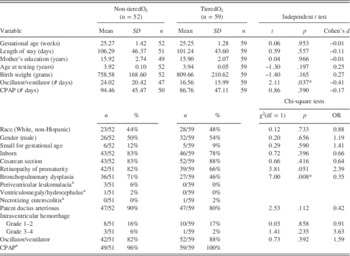
The Institutional Review Board (IRB) of Inova Children’s Hospital in Falls Church, Virginia, USA approved the protocol and procedures described below, and written parental informed consent for each child was obtained before comprehensive neuropsychological testing at age 3 years. Participants were recruited through mailing of IRB approved letters to the last known addresses of eligible children; follow-up telephone calls were made to families for letters returned to sender. Of 350 children born below 28 weeks’ gestational age between 2007 and 2010 who survived to NICU discharge, 51 (15%) were unreachable; 12 (3%) met exclusion criteria, that is, severe sensorineural impairment (n=3), genetic disorder (n=2), or non-English speaking (n=7); 18 were outborn (5%; transferred from another hospital); 20 (6%) had relocated; and 4 (1%) were untestable. Of the remaining 245 eligible for study, 20 (8%) cancelled or were no-shows multiple times; 7 (3%) declined participation; 107 (44%) were non-respondents; and 111 (45%) participated. Analyses comparing study participants and non-participants showed that participants did not differ from non-participants on any demographic or medical variables, except that a greater number of non-participants in the tiered birth years were inborn (91%) compared with participants (78%; p<.05) (see Table 1).
Participant demographics and medical characteristics by O2 group

a Chi-square tests could not be conducted for variables in which cells counts were 0.
*p<.05.
CPAP=continuous positive airway pressure; OR=odds ratio.
The 111 three-year-old participants were born at 230/7 through 276/7 weeks’ gestation and tested between 3 years 6 months and 3 years 11 months, for a mean age 3.93 years (SD=0.08). Fifty-nine of these participants were born between 2009 and 2010 and formed a tiered low oxygen group (TieredO2) due to their participation in a quality control initiative that preceded recommendations for minimal oxygen saturation set at 91%. A comparison non-tiered oxygen group (Non-tieredO2) consisted of the remaining 52 participants born between 2007 and 2008 and treated in our NICU before implementation of the quality control initiative. The TieredO2 group participants were each stratified into three levels according to their age in weeks, with an aim to limit oxygen exposure. Thus, each preterm participant in the TieredO2 group received targeted supplemental O2 rates of 83–93% until age 32 weeks, 85–95% until age 35 weeks, and 95% after age 35 weeks. The pre-initiative Non-tieredO2 comparison group saturation targets were set at 89%–100%. In our small study, the mortality rates for the TieredO2 and Non-tieredO2 groups were 9.66% and 9.31%, respectively.
Table 1 shows participant demographic and medical variable statistics. Analyses of variance and chi-square tests of independence were used to examine differences between the two groups. Maternal education, a proxy for socioeconomic status, did not significantly differ between the groups. Although there were no significant TieredO2-Non-tieredO2 group differences in the percent of children on the oscillator/ventilator (88% vs. 82%, respectively (p=.391), the TieredO2 group had fewer days on the oscillator/ventilator compared to the Non-tieredO2 group (t(104)=2.11; p=.037; d=−0.41). The TieredO2 group was statistically significantly less likely to have bronchopulmonary dysplasia [χ2 (1, n=110)=6.89, p=.009] than the Non-tieredO2 group. Notably, days on oscillator/ventilator and bronchopulmonary dysplasia are highly interrelated. Groups did not significantly differ on any other demographic or medical variable. Retinopathy of prematurity was descriptively higher in the Non-tieredO2 group (82%) than the TieredO2 group (66%), but not statistically significant (p=.051).
Test Instruments
Participants were administered developmentally appropriate standardized neuropsychological tests for preschool-aged children by trained examiners who volunteer for an intensive 1-year testing experience. Examiners were supervised by the study research coordinator, who also reviewed examiner scoring accuracy before data entry. The following measures were administered:
Differential Ability Scales-Second Edition (Elliott, Reference Elliott2007)
The Differential Ability Scales (DAS–II) is a multi-subtest battery normed for children aged 2 years 6 months to 17 years 11 months. It provides a general conceptual ability (GCA) standard score, which highly correlates (.84) with the Wechsler series Full Scale IQ (Elliott, Reference Elliott2007); Verbal Cluster, Nonverbal Reasoning Cluster, and Spatial Cluster scores; and individual “core” subtest scaled scores for verbal comprehension, naming vocabulary, picture similarities, matrices, pattern construction, and design copying. Also administered was a “diagnostic” subtest measuring auditory attention, recall of digits-forward, which is independent of GCA calculation and provides a T-score with a mean of 50 (SD=10).
Developmental Test of Visual-Motor Integration-Fifth Edition (Beery & Beery, Reference Beery and Beery2004)
The Developmental Test of Visual-Motor Integration (VMI) is a developmentally appropriate paper-and-pencil measure of visual-motor integration that requires the child to draw a series of lines and increasingly complex geometric designs. It provides a standard score with a mean of 100 (SD=15).
Purdue Pegboard Test of Manual Dexterity (Gardner & Broman, 1979)
The Purdue Pegboard Test assesses unimanual and bimanual dexterity by requiring rapid placement of round pegs into holes aligned vertically on a formboard. It provides a raw score for number of pegs correctly placed within 30 s for each of three trials (right upper extremity, left upper extremity, and simultaneous bilateral placement).
Motor Assessment Battery for Children, Second Edition (Henderson, Sugden, & Barnett, Reference Henderson, Sugden and Barnett2007)
The Motor Assessment Battery for Children (MABC-2) is a measure of motor difficulties that provides a Total test score based on the fine and gross motor performances performed across three subsections consisting of multiple tasks, that is, manual dexterity (posting coins, threading beads, drawing), coordination (catching and throwing a beanbag), and balance (one-leg standing, raised heel walking, jumping). It provides a Total Score from 0 to 108.
Statistical Analysis
SPSS version 17.0 was used to examine neuropsychological outcomes using independent t tests, Pearson correlation coefficients, and analyses of covariance (ANCOVAs). The Exploratory Software for Confidence Intervals (ESCI) developed by Cumming (Reference Cumming2012) was used to calculate confidence intervals around effect sizes. O2 group was dummy coded and used as an independent variable (1=TieredO2, and 0=Non-tieredO2). Gestational age was used as a covariate for ANCOVAs. The following assumptions were tested and met: homogeneity of variances, normally distributed scores on outcomes, homoscedasticity, and normality of residual errors. To retain statistical power an a priori decision was made to set α at .05 for all analyses; however, results emphasize standardized effect sizes for all analyses and their pattern. Effect sizes for two-group comparisons were calculated using Cohen’s d and defined as small being 0.2, moderate as 0.5, and large as 0.8 (Cohen, 1988). Analyses were conducted both for the total cohort (those inborn at our hospital and transferred directly to the NICU and outborn participants transferred to the NICU from other institutions) and for a reduced sample of inborn participants. Results were similar for the total and reduced samples; thus, only results based on the total sample that provided us with the greatest statistical power are reported.
Results
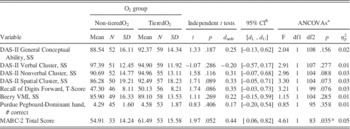
Independent t tests were conducted to compare the TieredO2 and Non-tieredO2 groups on neuropsychological outcomes (see Table 2). Low statistical power resulted in non-statistically significant but appreciable effects for outcomes. Descriptively, we noted a consistent pattern of effect sizes in which TieredO2 performed better on seven of eight outcome measures with low effect sizes (d range: .17–.44); Non-tieredO2 performed better only on the verbal measure. Table 2 also shows the 95% confidence intervals around the d effect sizes.
Descriptive statistics, t tests, and ANCOVAs for neuropsychological outcomes by oxygen group

*p<.05.
a ANCOVAs were conducted controlling for gestational age.
b 95% confidence intervals (CIs) for effect sizes were calculated using Exploratory Software for Confidence Intervals (ESCI) Cumming (Reference Cumming2012). d unb refers to an unbiased estimate of Cohen’s d as described by Hedges (Reference Hedges1981) and Cumming (Reference Cumming2012), and was equal to Cohen’s d estimates for all effect sizes in this table.
SS=standard score with mean=100 (SD=15); T-score mean=50 (SD=10); Scaled score mean=10 (SD=3). DAS-II=Differential Ability Scales, 2nd Ed.; MABC-2=Motor Assessment Battery for Children, 2nd Ed.; MABC-2 Total Score ranges from 0 to 108; >67=no significant movement difficulty, 57–67=at-risk, 56 or below=significant movement difficulty; VMI=developmental Test of Visual-Motor Integration.
Pearson correlation coefficients indicated gestational age was positively related to outcomes (p<.05, r: .210 to .367). Thus, ANCOVAs were conducted to determine whether the groups differed after controlling for gestational age. The TieredO2 group performed statistically significantly better than the Non-tieredO2 group on the MABC-2 Total score after controlling for gestational age, p=.035, η p 2=.05
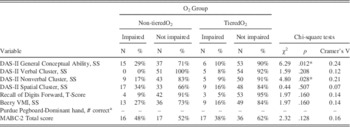
Chi-square tests of independence were used to determine whether the percent of children who demonstrated significant deficits on each measure were different across O2 groups (see Table 3). For these analyses, impairment was defined as a score ≥1.5 SD below the population mean. Participants in the TieredO2 group were statistically significantly less likely to be impaired than Non-tieredO2 group participants in GCA and Spatial Cluster (p<.05). Descriptively, TieredO2 group participants were less likely to be impaired than Non-tieredO2 group participants on seven of the eight outcomes, the Non-tieredO2 participants less likely to be impaired only on the Verbal Cluster.
Frequencies of impairment for neuropsychological outcomes by oxygen group

*p<.05.
a Frequencies of impaired participants could not be determined for variables reported in raw score metrics. Impaired was defined as 1.5 SD or more below the population mean. SS=standard score with mean=100 (SD=15); T-score mean=50 (SD=10); Scaled score mean=10 (SD=3). DAS-II=Differential Ability Scales, 2nd Ed.; MABC-2=Motor Assessment Battery for Children, 2nd Ed.; VMI=Developmental Test of Visual-Motor Integration.
Our second primary research question was whether tiered oxygen delivery was more advantageous at a specific gestational age. Hierarchical moderated multiple regression was used to determine if O2Group membership, gestational age, and the interaction between O2Group and gestational age were significant predictors of the neuropsychological outcome variables. A significant interaction effect between O2Group and gestational age in auditory attention (recall of digits-forward) explained 6% unique variance above and beyond the first-order effects of O2Group membership and gestational age, t(98)=2.59, p=.011, sr2=.06. No statistically significant interaction effect was found for any other outcome.
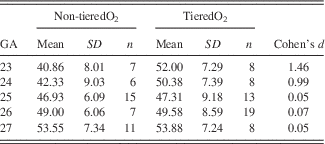
A graphical depiction of the statistically significant interaction effect of O2Group membership and gestational age on recall of digits-forward is shown in Figure 1. The Non-tieredO2 group gestational age had a linear relation with recall of digits-forward (R2=.30); the slope of the regression line indicates that for every 1-week increase in gestational age there was an average increase of 3.24 T-score points in auditory attention. For the TieredO2 group, a nonlinear quadratic equation best described the relation between gestational age and recall of digits-forward (R2=.06). As shown in the graph, the TieredO2 rate’s effect on attention appeared to be greatest at 23–24 weeks’ gestation. We further followed-up the statistically significant interaction effect by examining descriptive statistics for each O2 group by gestational age, shown in Table 4. Cohen’s d values in Table 4 correspond to the gap between the regression lines in Figure 1, and indicate that the largest difference between O2 groups was observed for those born at 23 and 24 weeks’ gestation (large Cohen’s d effect sizes 0.99 and 1.46, respectively). The groups did not appear to differ on recall of digits-forward for those born at 25–27 weeks’ gestation.
Interaction effect of O2Group membership and gestational age on recall of digits-forward.

Descriptive statistics for oxygen groups by gestational age for recall of digits-forward T-scores

GA=gestational age in weeks.
Discussion
Group comparisons of neuropsychological outcomes between extremely preterm preschoolers who as neonates received three-tiered stratification of oxygen rates (83–93% until 32 weeks, 85–95% until 35 weeks, and 95% after 35 weeks; TieredO2 group) and extremely preterm preschoolers born in the years preceding this initiative whose saturation rates were set in the standard way at 89–100% (Non-tieredO2 group) were not statistically significant. However, descriptively the TieredO2 group had better general intellectual, executive function, and visual-motor, and motor performances compared with the Non-tieredO2 group. Mean difference effect sizes and confidence intervals around these effect sizes were in similar direction and magnitude across measures. After controlling for gestational age, we also found motor performance significantly better in the TieredO2 than Non-tieredO2 group, with low effect size, an interesting result since neuromotor deficits following extremely preterm birth are well-documented important antecedents to adverse cognitive development and early academic proficiency (Gidley Larson et al., Reference Gidley Larson, Baron, Erickson, Ahronovich, Baker and Litman2011). While these findings suggest that the tiered oxygen quality improvement initiative did not have adverse effects on cognitive or neuropsychological functioning in these preschoolers we acknowledge that it is difficult to interpret the significance of these data. Further investigation, preferably longitudinal study through randomized control trials, will be required to determine the efficacy of setting tiered oxygen limits based on corrected gestational age.
Verbal performance was better in the Non-tieredO2 group, with small effect size. This tentative result requires replication to determine its significance, and could suggest that the tiered procedure oxygen delivery to primary language cerebral regions might have had a more important effect than for other developing neuropsychological functions. Reports that preterm birth alters axonal integrity and microstructural neural connectivity (Lubsen et al., Reference Lubsen, Vohr, Myers, Hampson, Lacadie, Schneider and Ment2011), with effects specific to language (Constable et al., Reference Constable, Vohr, Scheinost, Benjamin, Fulbright, Lacadie and Ment2013; Ment & Constable, Reference Ment and Constable2007; Schafer et al., Reference Schafer, Lacadie, Vohr, Kesler, Katz, Schneider and Ment2009), including alternative neural network development (dual language pathways) and greater reliance on the language non-dominant right hemisphere (Mullen et al., Reference Mullen, Vohr, Katz, Schneider, Lacadie, Hampson and Ment2011) suggest that this domain might prove to be an interesting area of further study.
Additionally, multiple regression analysis showed a statistically significant interaction effect between gestational age and oxygen group in auditory attention (recall of digits-forward), explaining 6% unique variance. Only this variable showed a significant interaction effect. The TieredO2 group’s effect on attention was greatest for the most at-risk participants in our cohort, those born at 23 and 24 weeks’ gestation. Large effect sizes (ds=.99–1.46) indicated that the TieredO2 group performed 1 to 1.5 SDs above the Non-tieredO2 group. This intriguing result suggests span tasks may be particularly useful measures in future protocols studying oxygen saturation target rates in preschoolers.
Birth at the lower limits of viability has an especially high association with neurodevelopmental risk (Baron et al., Reference Baron, Erickson, Ahronovich, Baker and Litman2011; Baron, Weiss, Litman, Ahronovich, & Baker, Reference Baron, Weiss, Litman, Ahronovich and Baker2014; Waber & McCormick, Reference Waber and McCormick1995), and of long-term intellectual and behavioral impairment (Moore, Lemyre, Barrowman, & Daboval, Reference Moore, Lemyre, Barrowman and Daboval2013; Msall & Park, Reference Msall and Park2008). These data showing differential effects by gestational age further suggest that the method of tiered oxygen target ranges may not be harmful and could be productively trialed to evaluate this method’s usefulness as an alternative or more optimal oxygen delivery protocol than current methods. The optimal oxygen limits for this tiered approach still requires study.
We should acknowledge other potential explanations for our findings than the tiered method of oxygen delivery. These include that bronchopulmonary dysplasia, a model of chronic hypoxia in the developing brain (Newman, Debastos, Batton, & Raz, Reference Newman, Debastos, Batton and Raz2011), was the only medical characteristic that significantly differed between the TieredO2 and Non-tieredO2 groups, 46% and 71%, respectively. Risk of developing bronchopulmonary dysplasia is greatest in infants born at earliest gestational age whose lungs are immaturely developed, and type of mechanical ventilation delivered to preterm infants has an effect on bronchopulmonary dysplasia (Sun et al., Reference Sun, Cheng, Kang, Xiong, Zhou, Zhang and Zhu2014), a condition associated with long-term adverse effects on neurodevelopment (Beam et al., Reference Beam, Aliaga, Ahlfeld, Cohen-Wolkowiez, Smith and Laughon2014; Sun et al., Reference Sun, Cheng, Kang, Xiong, Zhou, Zhang and Zhu2014). In our study, the tiered oxygen delivery method was associated with fewer ventilation days, similar continuous positive airway pressure days, and a lower incidence of bronchopulmonary dysplasia in the TieredO2 group, perhaps partly explanatory for these outcomes.
Our study’s strengths included single-center participant homogeneity for all demographic and all but one medical characteristic, a sensitivity analysis showing that recruited participants were representative of non-participants, and multi-domain neuropsychological outcome measurement using well-normed standardized tests at the rarely studied but developmentally critical age of 3 years. Limitations included that the technology that allows for definitive readings of oxygen saturation rates remains in development and presumptive target ranges might be skewed, a complication inherent to use of this instrumentation across care centers (Hagadorn et al., Reference Hagadorn, Furey, Nghiem, Schmid, Phelps, Pillers and Cole2006). Without technology to show histograms constant monitoring was not possible; however, audit training was conducted and procedures were in place for the neonatal team to ensure targeted oxygen rates were within limits. The years 2009–2010 focused on oxygen targeting and we had no other substantial initiative introduced during the time period of this study. It might be critiqued that this was not a randomized control trial and not a causal study, and causality cannot be stated due to non-random assignment to groups. However, single-centers that provide systematized and consistent care to neonates with similar demographic and medical characteristics have merit (Kutz, Horsch, Kuhn, & Roll, Reference Kutz, Horsch, Kuhn and Roll2009). Center care of extremely preterm infants influences clinical outcomes, and high volume centers such as ours are likely to experience greater survival rates and fewer major neonatal morbidities (Bartels, Wypij, Wenzlaff, Dammann, & Poets, Reference Bartels, Wypij, Wenzlaff, Dammann and Poets2006; Kutz et al., Reference Kutz, Horsch, Kuhn and Roll2009; Phibbs et al., Reference Phibbs, Baker, Caughey, Danielsen, Schmitt and Phibbs2007; Smith et al., Reference Smith, Ambalavanan, Li, Cotten, Laughon, Walsh and Goldberg2012), and avoid some demographic and procedural confounds that characterize larger multi-center investigations. There are potential cohort effects that ongoing research should clarify. Generalization of these outcomes to NICUs whose patients have substantially different demographic and medical characteristics is cautioned. We also note that in this cohort with high mean maternal education, mean GCA for both groups was below the population mean; however, the Non-tieredO2 group obtained the lower GCA, an interesting finding given this group’s higher Verbal Cluster performance. Reduced power due to a uniquely defined cohort born in 2009–2010 limited our ability to find more instances of statistical significance; however, small but positive effect sizes for seven of eight measures suggest a trend in support of further study.
In conclusion, optimal targeting of blood oxygen levels in extremely preterm neonates remains a major challenge, with evidence-based recommendations for saturation target ranges uncertain despite pooling of international data and collaborative multi-institutional investigations. Recruitment of this cohort at age 3 afforded us a unique opportunity to study emergent neuropsychological functioning consequent to a novel method of tiered oxygen stratification, to our knowledge the first such report. Finding a pattern of better TieredO2 than Non-tieredO2 group outcomes across all domains except language is encouraging and suggests that tiered oxygen saturation targets merit further investigation, preferably through randomized controlled trials that determine which gestational ages, which methods, and which target ranges will result in the most optimal medical and neuropsychological outcomes. These data also suggest that a tiered approach might maintain efficacy while reducing medical morbidity and perhaps neurocognitive and neuromotor morbidity. As well, emergent and selective neuropsychological functions measured in preschoolers born extremely preterm have strong heuristic value and perhaps the potential to determine the efficacy of early cognitive intervention in this highly at-risk population. Studies that delineate whether single tertiary care centers with high volume and high level of care using tiered oxygen targeting could contribute to more optimal neuropsychological outcomes in those born extremely preterm are also warranted.
Acknowledgment
These data, in part, were presented at the European Pediatric Academic Societies meeting in Barcelona, Spain, October 19, 2014. The authors declare no Conflicts of Interest.