INTRODUCTION
Schistosoma japonicum infection has been a major health concern in China for more than 50 years (Wang et al. Reference Wang, Chen, Guo, Zeng, Hong, Xiong, Wu, Wang, Wang, Xia, Hao, Chin and Zhou2009). Over these past 5 decades, the estimated number of infected individuals has been reduced by extensive control measures to below 900 000, localized mainly to endemic hotspots in 5 provinces. Despite these major efforts, the number of infected individuals is no longer decreasing, largely due to the difficulties of control in and around the great lakes in the southern provinces, notably Dongting Lake in Hunan province and Poyang Lake in Jiangxi Province, where many human cases occur. The impending completion of the Three Gorges Dam in 2009 has also evoked concern of the spread of new transmission zones to previously non-endemic areas both below and above the dam (Hotez et al. Reference Hotez, Zheng, Long-Qi, Ming-Gang, Shu-Hua, Shu-Xian, Blair, Mcmanus and Davis1997; Xu et al. Reference Xu, Wei, Yang, Dai, Yu, Chen and Su2000; Seto et al. Reference Seto, Wu, Liu, Chen, Hubbard, Holt and Davis2008; Zhu et al. Reference Zhu, Xiang, Yang, Wu and Zhou2008).
Infection with S. japonicum may result in hepatic schistosomiasis which has 2 distinct stages of disease. The first is characterized by early hepato-splenic inflammation due to the immunopathological reaction to ovideposition in the liver and is associated with acute infection which is further characterized by a high fever, nausea, diarrhoea and headaches. The long-term implications of schistosome ovideposition in the human host are observed in patients with chronic and advanced disease. These individuals display signs of severe liver damage resulting from large collagen deposits in the periportal spaces causing fibrosis (Burke et al. Reference Burke, Jones, Gobert, Li, Ellis and McManus2009). This can lead to portal hypertension, splenomegaly, shunting and gastrointestinal varices, which can result in internal bleeding and subsequent death. Diagnosis and surveillance of disease relies heavily on ultrasonography. Although it is possible to detect some pathological features and mild forms of diffuse fibrosis using ultrasonography (Manzella et al. Reference Manzella, Ohtomo, Monzawa and Lim2008), it can be difficult as in many cases there are no apparent signs of disease.
It is estimated that soil-transmitted helminths (STHs), along with the schistosomes, account for more than 40% of the total tropical parasite burden, excluding malaria (WHO, 1999). Amongst the most common STHs are Ascaris lumbricoides, Trichuris trichiura, hookworms (caused by Necator americanus and Ancylostoma duodenale) and Strongyloides stercoralis (Hotez et al. Reference Hotez, Brindley, Bethony, King, Pearce and Jacobson2008).
The clinical features of A. lumbricoides infection are strongly associated with the stage of infection and location of the parasite within the host. During larval migration, aggravation of the alveoli and bronchioles in the lungs is common, resulting in coughing, asthma and pneumonitis which can also lead to skin rashes, eosinophilia and fever as a result of a hyper-allergenic response (Khuroo, Reference Khuroo1996; O'Lorcain and Holland, Reference O'Lorcain and Holland2000). The presence of adults in the small intestine has a greater and more severe outcome causing vomiting, abdominal pain and distension, colic and anorexia due to decreased food intake and malnutrition (Akgun, Reference Akgun1996; Sandouk et al. Reference Sandouk, Haffar, Zada, Graham and Anand1997; Mukhopadhyay et al. Reference Mukhopadhyay, Saha, Maiti, Mitra, Banerjee, Jha, Mukhopadhyay, Samanta and Das2001; Bethony et al. Reference Bethony, Brooker, Albonico, Geiger, Loukas, Diemert and Hotez2006). The clinical complications can be life-threatening and cause serious morbidity, particularly in children.
The many symptoms associated with light or moderate T. trichiura infections are non-specific and as such, can be confused with other diarrhoeal diseases. Typically, infected individuals may experience headaches, diarrhoea, vomiting, flatulence, and associated weight loss (Gilman et al. Reference Gilman, Chong, Davis, Greenberg, Virik and Dixon1983; Bundy and Cooper, Reference Bundy and Cooper1989; Stephenson et al. Reference Stephenson, Latham and Ottesen2000b). The severity of the symptoms has been shown to correlate positively with intensity of infection (Gilman et al. Reference Gilman, Chong, Davis, Greenberg, Virik and Dixon1983). The major morbidity arises from heavy infection and results in Trichuris Dysentery Syndrome (TDS) which is characterized by bloody mucous and results in severe anaemia (Bundy and Cooper, Reference Bundy and Cooper1989; Stephenson et al. Reference Stephenson, Holland and Cooper2000a; Bethony et al. Reference Bethony, Brooker, Albonico, Geiger, Loukas, Diemert and Hotez2006).
Anaemia is also often associated with hookworm infections due to the blood feeding nature of mature worms in the host's intestines which causes intestinal bleeding and nutrient loss by the host (Devaney, Reference Devaney2005). The severity of the symptoms associated with hookworm infection is normally associated with infection intensity though often, the hosts underlying health status may play an important role.
S. stercoralis differs from the other STHs due to its ability to replicate within the host. Strongyloidiasis has been largely neglected due to most infections being asymptomatic or having mild, non-specific gastrointestinal symptoms. In immunocompromised persons, however, the infection may become hyperinfective or disseminated due to the reproductive capacity of the parasite inside the host and can result in a 65%–90% mortality rate.
The impact of STHs, especially on children in developing countries, is significant although, due to the non-specificity of the clinical presentation of these parasites, morbidity can be difficult to measure as the observed symptoms may result from infection with other parasites, or be exacerbated by prevailing malnutrition and/or other diseases and conditions.
It is a common observation in human population studies of helminth infections that infection intensity (measured as eggs per gram of faeces (EPG)) is over-distributed. This is often caused by the large variation in egg counts which is typically over-dispersed with a minority of individuals accounting for the majority of the total population EPG and worm burden (Bradley and May, Reference Bradley and May1978). This over dispersion is likely to be the result of variation in parasite exposure between individuals but also to variation in individual susceptibility to infection (Anderson and Gordon, Reference Anderson and Gordon1982). Epidemiological studies measuring exposure, infection and re-infection patterns in helminth-infected populations have identified individuals who seem to show an innate pre-disposition or resistance to a range of helminth infections often based on low exposure/high infection intensity and high exposure/low infection intensity, respectively (Bundy et al. Reference Bundy, Cooper, Thompson, Didier, Anderson and Simmons1987; Chan et al. Reference Chan, Bundy and Kan1994; Ross et al. Reference Ross, Sleigh, Li, Williams, Li, Waine, Tang, Forsyth and McManus1998; Li et al. Reference Li, Sleigh, Ross, Li, Williams, Forsyth, Tanner and McManus1999).
This review describes recent data collected on helminth infections in the Poyang Lake, Jiangxi province China that have been used to investigate human genetic susceptibility to parasite infections in rural communities with a particular focus on S. japonicum.
HELMINTH INFECTIONS IN THE POYANG LAKE REGION, CHINA
STHs are widespread in rural China and to date have been grossly ignored. Data from the National Survey of 2003 showed prevalence of soil-transmitted nematodes to be 19·6%, including hookworm infection 6·1%, Ascaris infection 12·7% and Trichuris infection 4·6% (Chen et al. Reference Chen, Tang and Xu2008). This was significantly less than the prevalence estimates from the 1990 National Survey, despite there being no systematic control of STHs operating; the 1990 data had indicated the prevalence of A. lumbricoides and T. trichiura in China to be much higher than the global estimates with 531 million (47%) and 212 million (19%) people infected, respectively (Hotez et al. Reference Hotez, Zheng, Long-Qi, Ming-Gang, Shu-Hua, Shu-Xian, Blair, Mcmanus and Davis1997). However, the data from the 1990 National Survey had been predominantly collected in agriculturally intensive regions located within the Yangtze River basin. S. japonicum is also highly endemic to the regions of the Yangtze River basin in China and has been a major focus for the Chinese public health sector for over 50 years due to the significant level of morbidity observed in chronically infected individuals.
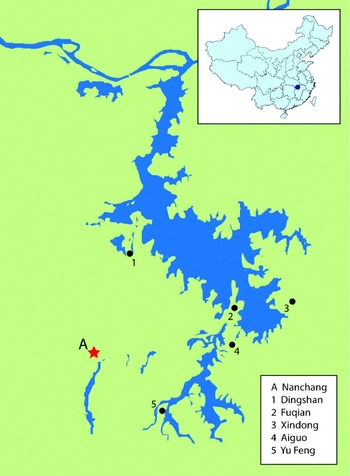
Baseline surveys undertaken in 2004 and 2005 in the Poyang Lake region (Fig. 1) assessed the prevalence of S. japonicum infection as well as STHs in 5 administrative villages (Ellis et al. Reference Ellis, Raso, Li, Rong, Chen and McManus2007a). Among the 5 administrative villages, the observed prevalences for A. lumbricoides and T. trichiura ranged from 0% to 38·8% (mean 30·9%), and from 2·4% to 58·1% (mean 47%), respectively, whereas the S. japonicum prevalence ranged from 12·2% to 20·9% (mean 15·7%). The difference in helminth prevalence between the administrative villages was highly significant (Chi square; P<0·001).
The location of the five administrative villages in the Poyang Lake region, China where baseline surveys were undertaken in 2004 and 2005 by Ellis et al. (Reference Ellis, Raso, Li, Rong, Chen and McManus2007a) to assess the prevalence of Schistosoma japonicum and soil-transmitted helminths in resident villagers. The location of Nanchang, the provincial capital city of Jiangxi province is also shown.

The results of the survey indicate that S. japonicum infection in the Poyang Lake is of major public health concern despite recent reports that schistosome infections in China have been reduced to less than 5% in some endemic areas (Zhou et al. Reference Zhou, Guo, Wu, Jiang, Zheng, Dang, Wang, Xu, Zhu, Wu, Li, Xu, Chen, Wang, Zhu, Qiu, Dong, Zhao, Zhang, Zhao, Xia, Wang, Zhang, Lin, Chen and Hao2007). Prevalence estimates of S. japonicum infection in Sichuan province have also shown to be over 10% in some communities indicating a re-emergence of schistosomiasis, in addition to the spread of schistosomiasis to previously non-endemic communities (Liang et al. Reference Liang, Yang, Zhong and Qiu2006). A recent study of helminth infections in Yunnan province have also demonstrated STH prevalences to be strikingly high with prevalence estimates of 92·6%, 88·8% and 88·8% for A. lumbricoides, T. trichiura and hookworm, respectively (Steinmann et al. Reference Steinmann, Du, Wang, Wang, Jiang, Li, Marti, Zhou and Utzinger2008a). In addition, this and other studies have also indicated S. stercoralis and Taenia spp. infections are highly prevalent with estimates of 19·3% and 26·3%, respectively (Spear et al. Reference Spear, Seto, Liang, Birkner, Hubbard, Qiu, Yang, Zhong, Xu, Gu and Davis2004; Seto et al. Reference Seto, Lee, Liang and Zhong2007; Steinmann et al. Reference Steinmann, Zhou, Du, Jiang, Xiao, Wu, Zhou and Utzinger2008b). The results of these and the studies undertaken in Jiangxi province (Ellis et al. Reference Ellis, Raso, Li, Rong, Chen and McManus2007a) strongly indicate an underestimation of the true prevalence of helminth infections in rural China. It is evident that STH infections have been grossly ignored and control strategies should be implemented in endemic regions to reduce the associated morbidity attributable to these parasites.
RISK FACTORS FOR S. JAPONICUM INFECTION
Several epidemiological studies have investigated risk factors for S. japonicum infection in rural China (Seto et al. Reference Seto, Lee, Liang and Zhong2007; Ross et al. Reference Ross, Sleigh, Li, Williams, Li, Waine, Tang, Forsyth and McManus1998, Reference Ross, Sleigh, Li, Williams, Aligui and McManus2000; Zhou et al. Reference Zhou, Ross, Hartel, Sleigh, Williams, McManus, Luo, He and Li1998; Li et al. Reference Li, Sleigh, Ross, Li, Williams, Forsyth, Tanner and McManus1999). It is inevitable that environmental factors such as water contact play a key role in the risk of infection, while other variables such as infection history have also been shown to be good predictors of re-infection and suggest that some individuals are naturally more predisposed to re-infection than others (Ross et al. Reference Ross, Sleigh, Li, Williams, Li, Waine, Tang, Forsyth and McManus1998; Li et al. Reference Li, Sleigh, Ross, Li, Williams, Forsyth, Tanner and McManus1999). Interestingly, schistosomiasis transmission and re-infection risks have been thought to be different above and below the Three Gorges Dam due to the differences in landscape and the water sources and river systems. Transmission in the hilly and mountainous regions of Sichuan province is not associated with direct water contact through fishing or reed cutting (Spear et al. Reference Spear, Seto, Liang, Birkner, Hubbard, Qiu, Yang, Zhong, Xu, Gu and Davis2004; Seto et al. Reference Seto, Lee, Liang and Zhong2007) but is associated more with land use, predominantly tobacco and vegetable farming, and the irrigation systems present (Spear et al. Reference Spear, Seto, Liang, Birkner, Hubbard, Qiu, Yang, Zhong, Xu, Gu and Davis2004). This has been supported by more recent studies from the elevated plains of Yunnan province where tobacco growers were also at more risk of re-infection (Steinmann et al. Reference Steinmann, Zhou, Li, Li, Chen, Yang, Fan, Jia, Li, Vounatsou and Utzinger2007).
Data collected at baseline in 2004 from total population surveys in 4 villages in the Poyang Lake region were used to determine risk factors for S. japonicum infection (Ellis et al. Reference Ellis, Li, Rong, Chen and McManus2006). The cohort comprised 2705 individuals belonging to 400 families that ranged in size from 3 to 188 persons. All individuals were tested for infection and the average schistosomiasis prevalence in all pedigrees was calculated to be 14·4%. In addition, all individuals were interviewed to assess risk factors and schistosomiasis history including previous treatment number and previous acute infection which was defined as a previously diagnosed symptomatic infection characterized by fever, weakness, loss of appetite, headaches and dizziness which had been verified by the Kato-Katz faecal smear test (Katz et al. Reference Katz, Chaves and Pellegrino1972) for the presence of schistosome eggs.
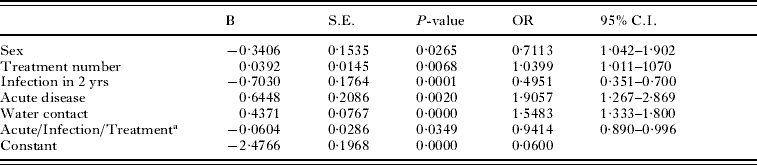
A multivariate logistic regression was carried out and the covariates found to be significant are shown in Table 1. Analysis of the data demonstrated the importance of gender in the risk of infection, possibly reflecting behavioural differences between the sexes in the study population. There were no significant differences between the age groups, however, which provided no evidence to support the concept of age-acquired immunity to schistosomiasis japonica (Ross et al. Reference Ross, Sleigh, Li, Williams, Aligui and McManus2000). Given the extensive control strategies implemented in China, and the wide-scale use and availability of praziquantel, it is not surprising that schistosomiasis history was shown to be a relevant factor for infection in the study by (Ellis et al. Reference Ellis, Li, Rong, Chen and McManus2006). Schistosomiasis history variables: acute infection, number of previous treatments and schistosomiasis infection in the preceding 2 years were all found to be significant. The number of previous treatments was positively associated with re-infection, suggesting a pre-disposition to infection.
Risk factors for Schistosoma japonicum infection
(Data from Ellis et al. Reference Ellis, Li, Rong, Chen and McManus2006.)

B, residual coefficients. OR, Odds ratio.
a Interaction between acute disease, previous number of treatments and treatment in the previous 2 years.
It is also noteworthy that acute disease is an indicator of infection and the obtained odds ratios indicated that an individual who had had acute infection was at almost twice the risk of infection as someone who had not (OR=1·906). The analysis also showed a significant interaction between previous treatments and acute disease indicating that predisposition to re-infection and acute infection are related.
POLYPARASITISM AND HELMINTH INTERACTIONS
It is inevitable that in regions co-endemic for parasitic infections that co-infection and polyparasitism is observed. Indeed, a large number of studies from across Southeast Asia, South America and Sub-Saharan Africa have described populations having significant helminth infection prevalence, with individuals harbouring multiple infections being the norm (Booth et al. Reference Booth, Guyatt, Li and Tanner1996; Keiser et al. Reference Keiser, N'goran, Traore, Lohourignon, Singer, Lengeler, Tanner and Utzinger2002; Tchuem Tchuenté et al. Reference Tchuem Tchuenté, Behnke, Gilbert, Southgate and Vercruysse2003; Raso et al. Reference Raso, Luginbühl, Adjoua, Ian-Bi, Silué, Matthys, Vounatsou, Wang, Dumas, Holmes, Singer, Tanner, N'goran and Utzinger2004). Due to the high prevalence of these infections in the Southern provinces of China, poly-parasitism is also frequently observed (Xu et al. Reference Xu, Yu, Jiang, Yang, Lai, Zhang and Zheng1995; Booth et al. Reference Booth, Guyatt, Li and Tanner1996; Hotez et al. Reference Hotez, Zheng, Long-Qi, Ming-Gang, Shu-Hua, Shu-Xian, Blair, Mcmanus and Davis1997). Approximately 62·6% of the population there was shown to be infected with at least 1 or more parasites and 43·7% were found to harbour 2 or 3 concurrent parasitic infections from the 1990 National Survey (Xu et al. Reference Xu, Yu, Jiang, Yang, Lai, Zhang and Zheng1995; Hotez et al. Reference Hotez, Zheng, Long-Qi, Ming-Gang, Shu-Hua, Shu-Xian, Blair, Mcmanus and Davis1997). More recent reports have demonstrated extensive polyparasitism in a village in Yunnan Province where over 80% of the population harboured 3 or more parasites concurrently (Steinmann et al. Reference Steinmann, Du, Wang, Wang, Jiang, Li, Marti, Zhou and Utzinger2008a).
Interestingly, a large number of studies have shown that single or co-infections occur at a lower frequency than expected, suggesting that the similarity in the human immune response to both species may account for the decrease in parasite number (Keiser et al. Reference Keiser, N'goran, Traore, Lohourignon, Singer, Lengeler, Tanner and Utzinger2002; Tchuem Tchuenté et al. Reference Tchuem Tchuenté, Behnke, Gilbert, Southgate and Vercruysse2003; Fleming et al. Reference Fleming, Brooker, Geiger, Caldas, Correa-Oliveira, Hotez and Bethony2006). In contrast, however, it has been observed that those infected with a number of different helminth species have significantly higher infection intensities, and greater morbidity than if singly or doubly infected (Keiser et al. Reference Keiser, N'goran, Traore, Lohourignon, Singer, Lengeler, Tanner and Utzinger2002; Tchuem Tchuenté et al. Reference Tchuem Tchuenté, Behnke, Gilbert, Southgate and Vercruysse2003), suggestive that immunosuppression may be involved at this level of infection.
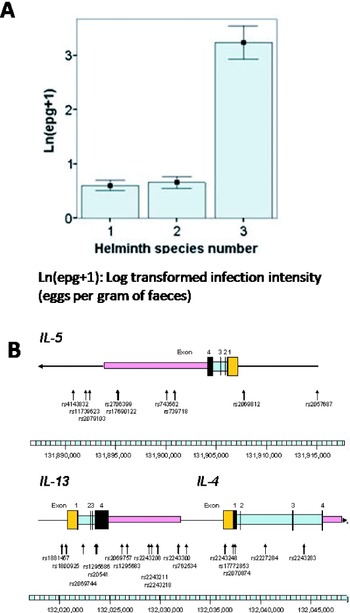
In hyper-endemic communities in the Poyang Lake assessed for S. japonicum, A. lumbricoides and T. trichiura, it was not surprising to find that of the total population, 61·7% harboured at least 1 of the helminth species and 27·8% were shown to harbour at least 2 parasite species (Ellis et al. Reference Ellis, Raso, Li, Rong, Chen and McManus2007a). Of those infected with S. japonicum, the relationship between infection intensity and parasite species number was investigated. There was little difference in infection intensity in those only infected with S. japonicum and in individuals who were co-infected; however, a significant increase in infection intensity was observed in those harbouring all 3 helminths (Fig. 2) indicating those with high infection intensities were most at risk of having multiple helminth infections. Univariate analysis was undertaken to investigate parasite interactions. A significant (P=0·03) increase in risk of T. trichiura infection was evident in individuals infected with S. japonicum (Odds Ratio=1·28; 95% C.I.=1·03–1·60). Further, there was a strong association between A. lumbricoides infection and T. trichiura infection (P<0·001; Odds Ratio=4·43; 95% C.I.=3·67–5·34). The latter association could be due largely to the similarity in transmission of these two nematode species which is closely related to poor hygiene behaviour and the lack of adequate sanitation (Booth et al. Reference Booth, Guyatt, Li and Tanner1996; Tchuem Tchuenté et al. Reference Tchuem Tchuenté, Behnke, Gilbert, Southgate and Vercruysse2003; Raso et al. Reference Raso, Luginbühl, Adjoua, Ian-Bi, Silué, Matthys, Vounatsou, Wang, Dumas, Holmes, Singer, Tanner, N'goran and Utzinger2004). There were no associations observed between S. japonicum and A. lumbricoides infection.
(A) Mean (log-transformed) infection intensity (Ln(epg+1)) of Schistosoma japonicum infection in individuals harbouring different numbers of helminth species in the Poyang lake area. Error bars represent 95% confidence intervals. (B) Human IL-5, IL-4 and IL-13 and the genomic structure of each gene showing the location of the tagSNPs. (Data from Ellis et al. Reference Ellis, Zhao, Chen, Montgomery, Li and McManus2007b).

Notably, water contact was found to be a significant risk factor for individual infection, co-infection and multiple infections which would suggest water contamination as a common feature of the transmission of S. japonicum, T. trichiura and A. lumbricoides and indicates that development of sanitation and clean water facilities would be valuable in preventing helminth transmission (Ellis et al. Reference Ellis, Raso, Li, Rong, Chen and McManus2007a).
GENETIC EPIDEMIOLOGY OF SINGLE, CO- AND MULTIPLE HELMINTH INFECTIONS
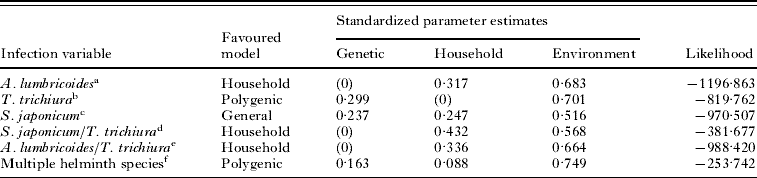
As previously mentioned, a characteristic feature of helminth infections is an over-distribution of observed faecal egg counts whereby a minority of individuals account for the majority of the parasite burden (Gandhi et al. Reference Gandhi, Jizhang, Khoshnood, Fuying, Shanwen, Yaoruo, Bin, Haechou, Chongjin, Yan, Wensen, Dungxing, Chong, Shuhua, Hawdon and Hotez2001; Montresor, Reference Montresor2007; Belizario et al. Reference Belizario, De Leon, Lumampao, Anastacio and Tai2009). Further, individuals who experience high intensity of infection have been shown to aggregate in families. The Jirel family study undertaken in Nepal showed significant household clustering and familial aggregation in a population endemic for A. lumbricoides and indicated a strong heritability accounting for ~40% of the variation observed in faecal egg counts (Williams-Blangero et al. Reference Williams-Blangero, Subedi, Upadhayay, Manral, Rai, Jha, Robinson and Blangero1999). Aggregation of infection intensity has also been demonstrated at a family level for T. trichiura (Williams-Blangero et al. Reference Williams-Blangero, Mcgarvey, Subedi, Wiest, Upadhayay, Rai, Jha, Olds, Guanling and Blangero2002), with a significant heritability estimate of 28%. Similar findings were also observed in hookworm infections in communities in Zimbabwe and Papua New Guinea (Williams-Blangero et al. Reference Williams-Blangero, Blangero and Bradley1997; Breitling et al. Reference Breitling, Wilson, Raiko, Lagog, Siba, Shaw and Quinnell2008). Genetic susceptibility has also been shown in endemic populations for S. mansoni (Bethony et al. Reference Bethony, Gazzinelli, Lopes, Pereira, Alves-Oliveira, Willams-Blangero, Blangero, Loverde and Correa-Oliveira2001, Reference Bethony, Williams, Blangero, Kloos, Gazzinelli, Soares-Filho, Coelho, Alves-Fraga, Williams-Blangero, Loverde and Correa-Oliveira2002) and S. japonicum (Ellis et al. Reference Ellis, Li, Rong, Chen and McManus2006).These familial aggregation studies had only investigated the clustering of single helminth infections and very little was known of the genetics underlying multiple helminth infections In order to address this, a total of 498 families were identified from the Poyang lake study cohort in 2005 to investigate familial aggregation of helminth infections (Ellis et al. Reference Ellis, Raso, Li, Rong, Chen and McManus2007a). Four models were tested for each individual helminth infection: environmental, household, polygenic and general (household and polygenic). The favoured models for each infection, with corresponding parameter estimates, are provided in Table 2. There was no familial aggregation of A. lumbricoides infection though significant clustering was observed at a household level indicating the importance of domestic environment. Strong and significant heritability was observed for T. trichiura infection with no significant household effects. The estimated heritability and lack of domestic environment are similar to previous observations with T. trichiura (Williams-Blangero et al. Reference Williams-Blangero, Mcgarvey, Subedi, Wiest, Upadhayay, Rai, Jha, Olds, Guanling and Blangero2002). Common domestic environment did appear to play a role in the risk of S. japonicum infection as well as a genetic involvement. Heritability remained high at 23·7% and was a significant risk factor; household was found to account for 24·7% of the risk of infection. These results are comparable to those of studies on S. mansoni (Bethony et al. Reference Bethony, Gazzinelli, Lopes, Pereira, Alves-Oliveira, Willams-Blangero, Blangero, Loverde and Correa-Oliveira2001, Reference Bethony, Williams, Blangero, Kloos, Gazzinelli, Soares-Filho, Coelho, Alves-Fraga, Williams-Blangero, Loverde and Correa-Oliveira2002) and support the hypothesis that genetic factors are involved, at least in part, in determining risk of infection and indicate possible similarities underlying host resistance to the different schistosome species infecting humans. In contrast, a study investigating familial and household aggregation in endemic communities in Sichuan province found no evidence of either genetic or household factors involved in the risk of S. japonicum infection after adjusting for village effects (Seto et al. Reference Seto, Zhong, Kouch, Hubbard and Spear2005). These results indicated that infection relies predominantly on geographical location and environmental factors and may reflect again difference in transmission between the hilly/mountainous regions and the lake and marshland regions of Hunan and Jiangxi provinces.
Summary of the favoured models of the variance components analysis for single, co- and multiple helminthic infections adjusted for significant covariates
(Data from Ellis et al. Reference Ellis, Raso, Li, Rong, Chen and McManus2007a.)

a Covariates included in the model: water contact, Trichuris and administration village.
b Covariates included in the model: age, water contact, A. lumbricoides, S. japonicum and administration village.
c Covariates included in the model: age, sex, water contact, treatment number, Trichuris and administration village.
d Covariates included in the model: sex, water contact and administration village.
e Covariates included in the model: water contact and administration village.
f Covariates included in the model: age, sex, water contact and administration village.
Variance components analyses were also undertaken for co-infections of helminth parasites which had previously shown significant parasite-parasite association (Ellis et al. Reference Ellis, Raso, Li, Rong, Chen and McManus2007a). Significant household clustering was observed for both S. japonicum/T. trichiura and A. lumbricoides/T. trichiura co-infections. The significant clustering of co-infection with T. trichiura and A. lumbricoides could further illustrate their homogeneous mode of transmission. This would not be the case, however, for the significant clustering of co-T. trichiura/S. japonicum infection, and supports the hypothesis of water contamination as a major risk factor for all 3 parasite species (Ellis et al. Reference Ellis, Raso, Li, Rong, Chen and McManus2007a). Finally, clustering of polyparasitic infections (i.e. the number of parasites species harboured) was determined and although the risk of infection with multiple helminth parasites was shown to be largely environmentally influenced, the genetic component was significant, accounting for 16·3% of the risk, and suggesting poly-helminth infections tend to aggregate in families. This would indicate that there may be common genetic components involved in susceptibility to multiple helminthic infections and that susceptibility to one parasite is not necessarily independent of susceptibility to another.
The results of this study demonstrate the high prevalence of STHs in rural communities in China. The household clustering observed suggests that socio-economic factors contribute to risk of infection and reflects the poor sanitation and hygiene conditions prevailing in these communities. Socio-economic factors have been shown to be associated with risk of helminth infections in China not only for STHs but for Taenia spp. and Trichinella spp. infections as well (Steinmann et al. Reference Steinmann, Zhou, Li, Li, Chen, Yang, Fan, Jia, Li, Vounatsou and Utzinger2007). Thus, targeted chemotherapy of low-income families could provide an effective means of reducing helminth infections in high risk individuals or households. Further, a recent study in Brazil has shown that adults residing in households with school children who were found to be infected with STHs were more likely to be infected as well (Massara et al. Reference Massara, Peixoto, Enk, Da Silva Barros, Dos Santos Carvalho, Sakurai and Schall2006). This again illustrates the importance of household clustering of infection and demonstrates an efficient method of identifying those at high risk of infection for control by targeted chemotherapy. Whilst chemotherapy is clearly fundamental to any control program for STHs, it is clear that improved sanitation and health education is crucial for maintaining low parasite burdens. Indeed, combining drug treatment programs with improved hygiene conditions has resulted in marked reductions in prevalence of many helminth infections (Esrey et al. Reference Esrey, Potash, Roberts and Shiff1991; Asaolu and Ofoezie, Reference Asaolu and Ofoezie2003) and has recently shown great promise for geo-helminth control in Korea (Hong et al. Reference Hong, Chai, Choi, Huh, Rim and Lee2006).
ANALYSIS OF THE 5Q31-33 REGION AND SYMPTOMATIC SCHISTOSOMIASIS
There have been relatively few genetic studies that have investigated human susceptibility to helminth infections (Campino et al. Reference Campino, Kwiatkowski and Dessein2006). Segregation analysis identified a co-dominant major gene involved in controlling infection intensity with S. mansoni in a Brazilian population (Abel et al. Reference Abel, Demenais, Prata, Souza and Dessein1991) which was subsequently linked to the 5q31-q33 region of the human genome (Marquet et al. Reference Marquet, Abel, Hillaire, Dessein, Kalil, Feingold, Weissenbach and Dessein1996). A genome-wide scan using the same data supported these findings (Marquet et al. Reference Marquet, Abel, Hillaire and Dessein1999) which were also confirmed by a separate study in Africa (Muller-Myhsok et al. Reference Muller-Myhsok, Stelma, Guisse-Sow, Muntau, Thye, Burchard, Gryseels and Horstmann1997). The 5q31-q33 region is known to contain the Th2 gene cluster encoding the IL-4, IL-5 and IL-13 cytokines which have all been implicated in susceptibility/resistance to schistosome infection (Al-Sherbiny et al. Reference Al-Sherbiny, Osman, Barakat, El Morshedy, Bergquist and Olds2003; Leenstra et al. Reference Leenstra, Acosta, Langdon, Manalo, Su, Olveda, Mcgarvey, Kurtis and Friedman2006). Further, polymorphisms in the promoter region of IL-13 have been associated with S. haematobium infection (Kouriba et al. Reference Kouriba, Chevillard, Bream, Argiro, Dessein, Arnaud, Sangare, Dabo, Beavogui, Arama, Traore, Doumbo and Dessein2005). A large number of immunological studies have clearly demonstrated the role of these cytokines in the immunomodulation of several helminths, including schistosome infections in murine models (Finkelman et al. Reference Finkelman, Shea-Donohue, Goldhill, Sullivan, Morris, Madden, Gause and Urban1997; Gause et al. Reference Gause, Urban and Stadecker2003) and in humans (Turner et al. Reference Turner, Faulkner, Kamgno, Cormont, Van Snick, Else, Grencis, Behnke, Boussinesq and Bradley2003; Jackson et al. Reference Jackson, Turner, Rentoul, Faulkner, Behnke, Hoyle, Grencis, Else, Kamgno, Boussinesq and Bradley2004a). In addition, individuals identified as being resistant to schistosome infection were shown to produce markedly high levels of IL-5 and IL-13 in response to schistosome antigen in vitro. We conducted a nested case-control study to investigate single nucleotide polymorphisms (SNPs) in these 3 candidate genes to identify any associations with S. japonicum re-infection and symptomatic infection (Ellis et al. Reference Ellis, Zhao, Chen, Montgomery, Li and McManus2007b).
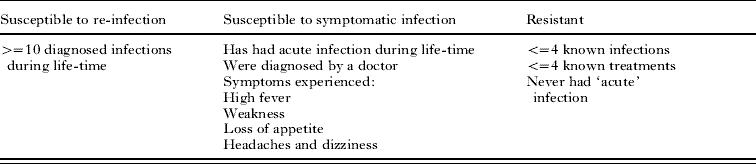
Individuals putatively susceptible to re-infection and to symptomatic infection were identified as were an equal number of putatively resistant individuals. The phenotype classifications are shown in Table 3. A total of 30 tagged SNPs were identified and genotyped spanning a region of 20 kb across the IL5 locus and a 24 kb region across the IL13 and IL4 genes (an average spacing of 1 SNP every 3·03 kb and 1·51 kb, respectively) and tested for association using Haploview. We found evidence for association between S. japonicum infection and individual tagging SNPs in both IL-5 and IL-13 for allelic association tests; however, all associations found with S. japonicum infection were not found to be significant, when tested for global significance.
Phenotype classification of susceptible and resistant individuals to Schistosoma japonicum re-infection and symptomatic infection

Investigation of allelic associations between acute infection and individual tagging SNPs detected 5 significant SNPs; 1 in IL-13 and 4 in IL-5 all of which belonged to the same haplotype block. Of these, 2 SNPs in IL-5 (rs4143832 and rs17690122) remained significant after permutation tests (P=0·025 and P=0·019, respectively). They were in strong LD with each other belonging to the same haplotype which also remained significant after correction for multiple testing (P=0·019). Logistic regression provided an odds ratio of 2·3 (P=0·004; C.I.=1·30–4·01) and 2·25 (P=0·005; C.I.=1·27–4·00) for each SNP marker, respectively.
It is clear that the definition of the phenotype is of utmost importance for the correct interpretation of results. Symptomatic infection in this study was classified by the onset of a hyper-allergenic response to infection, and subsequently, the results could suggest a predisposition to an acute reaction to infection rather than to infection itself. Despite this, the strong relationship between re-infection and acute or ‘symptomatic’ infection and the similarity in the immune response between schistosome infection and an allergic reaction would suggest that mechanisms controlling both phenotypes (acute infection and acute reaction) could be similar. The relationship between resistance to certain parasitic diseases and measures of atopy and asthma has long been suggested and several genetic association studies on susceptibility/resistance to parasitic diseases overlap with associations that have been identified for susceptibility to atopy and asthma (Peisong et al. Reference Peisong, Yamasaki, Mao, Enomoto, Feng, Gloria-Bottini, Bottini, Shirakawa, Sun and Hopkin2004; Barnes et al. Reference Barnes, Grant and Gao2005). Assessment of atopic conditions in individuals of this study would provide great insight into the relationship between allergy and S. japonicum infection and this merits further investigation.
It is also important to note that the SNPs identified in this study may not be causal variants but may be in strong linkage disequilibrium (LD) with the true pre-disposing SNP(s) although, given the strong LD between the two SNPs and the significance of the haplotype block, it is reasonable to postulate that the true variant lies in the downstream region of IL-5. In addition, the impact of these polymorphisms on the overall immune response should also be considered. Acute infection is often characterized by a marked eosinophilia (>10% of total leukocyte count) and eosinophil-mediated hepatic inflammation (Bierman et al. Reference Bierman, Wetsteyn and Van Gool2005; Ross et al. Reference Ross, Vickers, Olds, Shah and McManus2007). As eosinophil growth and activation is largely controlled by the release of IL-5 by CD4+ T cells (Broide et al. Reference Broide, Hoffman and Sriramarao1999; Simon et al. Reference Simon, Plotz, Dummer and Blaser1999), reduced levels of IL-5 may affect eosinophil recruitment which is crucial in the response to parasite invasion (de Jesus et al. Reference De Jesus, Silva, Santana, Magalhaes, De Jesus, De Almeida, Rego, Burattini, Pearce and Carvalho2002; Ganley-Leal et al. Reference Ganley-Leal, Mwinzi, Cetre-Sossah, Andove, Hightower, Karanja, Colley and Secor2006). Moreover, IL-5 produced by T-lymphocytes plays a vital role in human protection against other gastro-intestinal helminth infections (Rodrigues et al. Reference Rodrigues, Abel, Piper and Dessein1996; Cooper et al. Reference Cooper, Chico, Sandoval, Espinel, Guevara, Kennedy, Urban, Griffin and Nutman2000; Turner et al. Reference Turner, Faulkner, Kamgno, Cormont, Van Snick, Else, Grencis, Behnke, Boussinesq and Bradley2003; Jackson et al. Reference Jackson, Turner, Rentoul, Faulkner, Behnke, Hoyle, Grencis, Else, Kamgno, Boussinesq and Bradley2004a, Reference Jackson, Turner, Rentoul, Faulkner, Behnke, Hoyle, Grencis, Else, Kamgno, Bradley and Boussinesqb; Quinnell et al. Reference Quinnell, Pritchard, Raiko, Brown and Shaw2004) and suggests that high IL-5 production may also protect against multiple species infections as well.
SOLUBLE MARKERS OF ACUTE SCHISTOSOMIASIS
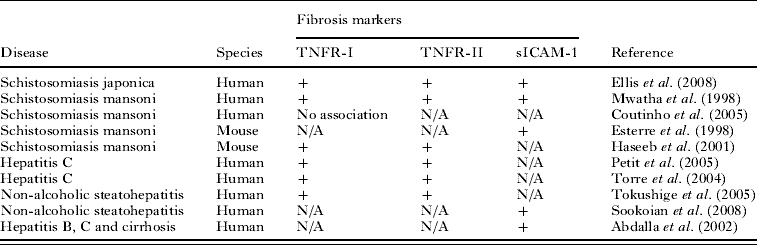
The use of biochemical markers to detect hepatic damage has been studied in a variety of liver disorders and infectious diseases (Medeiros et al. Reference Medeiros, Reed, Castelo and Salomao2000; Abdalla et al. Reference Abdalla, Sheesha, Shokeir, El-Agrody, El-Regal, Abdel-Khalik, Freeman, Boneberg and Hh2002; Lin et al. Reference Lin, Wang and Sheu2002) including schistosome-induced fibrosis with a few showing potential in the initial detection of hepatic damage (Burchard et al. Reference Burchard, Guisse-Sow, Diop, Ly, Lanuit, Gryseels and Gressner1998; Kardorff et al. Reference Kardorff, Mugashe, Gabone, Mahlert and Doehring1999). Soluble (s) ICAM-1 and tumour necrosis factor receptors I (TNFR-1) and II (TNFR-II) have been shown to be associated with numerous liver disorders (Table 4). The shedding of these membrane proteins relies on Th1 cytokines, such as TNF-alpha and IFN-gamma, which have been implicated in susceptibility (Dessein et al. Reference Dessein, Kouriba, Eboumbou, Dessein, Argiro, Marquet, Elwali, Rodrigues, Li, Doumbo and Chevillard2004; Bonnard et al. Reference Bonnard, Remoue, Schacht, Pialoux and Riveau2006) or resistance (Henri et al. Reference Henri, Chevillard, Mergani, Paris, Gaudart, Camilla, Dessein, Montero, Elwali, Saeed, Magzoub and Dessein2002; Booth et al. Reference Booth, Mwatha, Joseph, Jones, Kadzo, Ireri, Kazibwe, Kemijumbi, Kariuki, Kimani, Ouma, Kabatereine, Vennervald and Dunne2004) to hepatic schistosomiasis, respectively. Further, murine studies have also implicated these proteins in periportal fibrosis in advanced human schistosomiasis mansoni and have been shown to correlate well with schistosome granuloma formation.
Summary of results of previous studies investigating the association between hepatic fibrosis and circulating TNRF-I, TNFR-II and sICAM-1 levels

+, Positive significant association.
N/A, data not available.
Serum levels of sICAM-1, TNFR-I and TNFR-II were measured in Chinese patients with different clinically defined stages of schistosomiasis japonica and controls (Ellis et al. Reference Ellis, Li, Hou, Chen and McManus2008). These included 35 patients with acute schistosomiasis, 45 patients with chronic schistosome infections, 34 advanced patients with evidence of severe morbidity, and 20 patients with no known history of exposure to infection. Antigen-specific IgG and IgG4 levels were also measured in all patients.
The results showed significantly elevated levels of sTNFRs and sICAM-1 amongst the acute and advanced groups compared to chronic and controls, confirming their role in hepatic schistosomiasis. In addition, mean sTNFR-II levels were significantly higher in acute patients compared to advanced (P<0·00001) and chronic patients (P<0·00001) and showed the strongest association of the markers with acute disease (OR=1·099). Bi-variate correlations were estimated between the protein markers. All markers correlated positively with each other with sTNFR-I and sTNFR-II showing the highest correlation (Pearson correlation=0·723; P<0·00001) thus demonstrating a linear relationship between the two. Both sTNFR-II and sICAM-1 correlated significantly with infection intensity thus suggesting a role in granuloma formation and ovideposition which had previously been observed in experimental murine models of schistosomiasis (Ritter and McKerrow, Reference Ritter and McKerrow1996; Jacobs and Van Marck, Reference Jacobs and Van Marck1998).
A significant correlation was also observed between sICAM-1, infection intensity and eosinophil count amongst acute patients, supporting previous findings that sICAM-1 mediates eosinophil recruitment and subsequent inflammation (Teixeira et al. Reference Teixeira, Talvani, Tafuri, Lukacs and Hellewell2001; Forbes et al. Reference Forbes, Hulett, Ahrens, Wagner, Smart, Matthaei, Brandt, Dent, Rothenberg, Tang, Foster and Hogan2006). Antigen-specific IgG and IgG4 were elevated only amongst the acute and chronic patients, and suggested a strong humoral immune response to infection but not in the advanced stages of disease. Although the levels were clear indicators of active infection, they were similar across the acute and chronic groups and thus could not differentiate between the two groups.
The results suggest that measurement of fibrosis markers, particularly sTNFR-II and sICAM-1, could serve as an additional diagnostic tool for the detection of hepatic inflammation. The significant differences observed in levels between the acute and chronic groups also make these markers potential targets for the diagnosis of acute infection. These markers also demonstrate potential for the initial detection of advanced stages of fibrosis, though further work is required to determine how they correlate with disease severity and ultrasound grading to evaluate their value for monitoring disease progression.
FINAL REMARKS
It is now clear from our studies and other recent reports that STHs are highly prevalent in rural China and the implementation of systematic control in rural areas is needed to reduce the chronic morbidity associated with these parasites. In this review, we have demonstrated that socio-economic and lifestyle factors are involved in determining the risk of infection and suggest that improved sanitation and hygiene conditions are crucial for the long-term control of STHs and S. japonicum in endemic communities. Combined with targeted drug treatment of low-income, high risk households this approach may also reduce mass chemotherapy costs. Further, recent trials in China have demonstrated tribendimidine to be a promising broad-spectrum drug, being effective against Ascaris and hookworm infections in addition to showing promise against Strongyloides and Taenia spp. (Steinmann et al. Reference Steinmann, Du, Wang, Wang, Jiang, Li, Marti, Zhou and Utzinger2008a) and it may prove to be an effective means of control not only against single STH species but polyparasitic infections as well.
As previously discussed, S. japonicum infection in China remains highly prevalent in existing endemic foci and the increase in the number of infections and acute cases in recent years, indicates re-emergence of schistosomiasis in other areas (Zhou et al. Reference Zhou, Wang, Chen, Wu, Jiang, Chen, Zheng and Utzinger2005). Further, completion of the Three Gorges Dam in 2009 is predicted to spread transmission to previously unaffected regions (Hotez et al. Reference Hotez, Zheng, Long-Qi, Ming-Gang, Shu-Hua, Shu-Xian, Blair, Mcmanus and Davis1997; Xu et al. Reference Xu, Wei, Yang, Dai, Yu, Chen and Su2000). This is anticipated to increase the number of chronic infections and acute schistosomiasis cases. It is clear that whilst there is no vaccine available, adequate control is crucial in maintaining low prevalence and minimizing transmission. Further work is required to investigate the role of IL-5 in susceptibility to infection and to develop methods for the identification of those at high risk of acute S. japonicum infection. Targeted primary prevention through artemether administration (Tian et al. Reference Tian, Xiao, Xiao, Zhou, Liu, Zheng, Chen, Qu, Zhang, Yao, Zhang and Zhang1997; Song et al. Reference Song, Xiao, Wu, Zhang, Xie, Xu, Hu, Cui, Chen and Zheng1998; Li et al. Reference Li, Chen, He, Hou, Ellis and McManus2005) could substantially reduce morbidity associated with acute disease at a low cost to the health care system. In addition, development of new diagnostic tools to rapidly and effectively identify new hepatic cases would also minimize severity and long-term morbidity in schistosomiasis japonica patients.