INTRODUCTION
Depression is a common sequel of neurological conditions which can impede the process of rehabilitation adversely affecting outcome. It is therefore important to identify and treat mood disturbance effectively (Rosenthal et al., Reference Rosenthal, Christensen and Ross1998; Royal College of Physicians, 2005; Turner-Stokes & Hassan, Reference Turner-Stokes and Hassan2002). The Beck Depression Inventory (BDI) provides a convenient symptom checklist to quantify the severity of depressive symptoms. However, interpretation can be complex, as many of the somatic symptoms that are commonly associated with depression in the general population may occur either as a direct result of the neurological condition itself (e.g., fatigue) or in relation to the ward environment (e.g., loss of interest in sex). Current understanding of depression after brain injury suggests that it results from the complex interplay of biological factors, including lesion site, genetics, and neurotransmitter disruption, that interact with psychosocial factors that include education, premorbid mood/alcohol problems, and social support (Dikmen et al., Reference Dikmen, Bombardier, Machamer, Fann and Temkin2004; Jorge & Starkstein, Reference Jorge and Starkstein2005; Moldover et al., Reference Moldover, Goldberg and Prout2004). Concerns that the BDI might overestimate depression in medical patients with prominent physical symptoms have also been expressed in relation to lower back pain, chronic pain, severe burns, primary care, and obesity surgery (Arnau et al., Reference Arnau, Meagher, Norris and Bramson2001; Morley et al., Reference Morley, Williams and Black2002; Munoz et al., Reference Munoz, Chen, Fischer, Roehrig, Sanchez-Johnson, Alverdy, Dymeck-Valentine and le Grange2007; Thombs, Reference Thombs2007; Wesley et al., Reference Wesley, Gatchel, Garofalo and Polatin1999).
Typically, this question has been examined using factor analysis (FA) to identify the item components of multidimensional scales. FA may be useful in this context to identify those items most likely to reflect actual mood disturbance. Within neurological conditions, analyses have typically focused on condition-specific samples such as traumatic brain injury (TBI; Rowland et al., Reference Rowland, Lam and Leahy2005). However, neurological rehabilitation settings typically manage a range of conditions, including those affecting the brain, spinal cord, and peripheral nervous symptoms. This is the context in which the clinician is required to judge the effects of mood.
In our search of the literature, we found no reports of FA of the BDI or BDI-II in the specific context of neurorehabilitation and only found three reports in the context of TBI (Christensen et al., Reference Christensen, Ross, Kotasek, Rosenthal and Henry1995; Green et al., Reference Green, Felmingham, Baguley, Slewa-Younan and Simpson2001; Rowland et al., Reference Rowland, Lam and Leahy2005). Christensen et al. studied the BDI in 170 people receiving rehabilitation for TBI and reported five factors identified as (1) symptoms of major depression, (2) symptoms of TBI, (3) hopelessness/anhedonia, (4) negative self-appraisal, and (5) cognitive distortions. Unfortunately, their study was reported only as a conference abstract, so no details are available on which to judge the rigor of the analysis. Green et al. examined the factor structure of the original BDI with 117 TBI patients at 2 years after discharge. They reported three factors, which they called (1) affective/performance complaints, (2) negative attitudes toward self, and (3) somatic complaints. Rowland et al. examined the factor structure of the BDI-II in a sample of 51 individuals within 6 months of TBI. They reported three factors labeled (1) negative self-evaluation, (2) symptoms of depression, and (3) vegetative symptoms. However, the strength of their conclusions was limited by the small sample size. No previous studies have examined the factor structure of the BDI-II in a mixed neurorehabilitation sample.
In this study, we report an FA of the BDI-II in a large sample of patients undergoing postacute neurorehabilitation. We used exploratory factor analysis (EFA) to identify the factors underpinning the BDI-II. In the second part of this study, we used confirmatory factor analysis (CFA) to examine the best solutions from the EFA in terms of goodness of fit (Thompson, Reference Thompson2004).
METHOD
Exploratory Factor Analysis
Participants
Participants were 353 inpatients of a specialist neurorehabilitation unit for complex neurological disability in London. The sample comprised 212 (60%) males and 141 (40%) females. All were assessed on the BDI-II as part of an integrated care pathway for depression after brain injury (Hassan et al., Reference Hassan, Turner-Stokes, Pierce and Clegg2002), within a mean of 17 days [standard deviation (SD) = 21, range 1–47] from admission. The mean age was 43.8 years (SD = 21.0, range 13–77) and mean length of stay 99 days (SD = 60, range 10–411). Diagnoses were as follows: stroke: right hemisphere (n = 93, 26.5%), left hemisphere (n = 73, 20.8%), multiple (n = 10, 2.8%), subarachnoid hemorrhage (n = 16, 4.6%), pontine hemorrhage/brain stem (n = 20, 5.7%), TBI/hypoxic brain injury (n = 61, 17.4%), spinal cord injury (n = 17, 4.8%), Guillian–Barre syndrome/transverse myelitis (n = 13, 3.7%), and other neurological conditions (n = 48, 13.7%).
Prevalence of depression
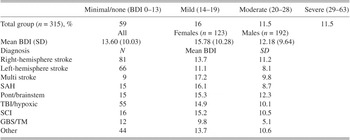
BDI-II scores were calculated for 315 patients with no missing data. Scores ranged from 0 to 47 with a mean of 13.60 (SD = 10.07). The prevalence of depression using the cutoffs from the BDI-II manual is provided in Table 1 along with mean BDI-II scores by gender and diagnostic group. BDI-II total score had only small (but significant) correlations with age (r = −.12, p < .05) and length of stay (r = .15, p < .05).
Prevalence of depression in sample and mean BDI-II scores for males and females and diagnostic subgroups

Note.
SAH = subarachnoid hemorrhage; SCI = spinal cord injury; GBS/TM = Guillian-Barre syndrome/transverse myelitis.
Data collection
The BDI-II was administered individually by a certified clinical psychologist and, if necessary, a speech language therapist. A large-type version of the BDI-II is used at Northwick Park with the permission of The Psychological Corporation, Harcourt Assessments, Inc. The items are presented to individual patients one at a time in large print and read aloud by the psychologist. The response options are presented with each item and also read aloud. The administration is done as slowly as required according to the patient’s condition, and the items/response options are repeated as often as is necessary. Data were gathered as part of routine clinical practice with permission obtained from the local research ethics committee for the secondary analysis of such data for research.
Data analysis
Data were entered onto an EXCEL (Microsoft) spreadsheet and analyzed using SPSS v 15. For the FA, we used principal component analysis and Varimax rotation to be comparable with the three previous TBI studies that had all used these methods. We performed a principal component analysis and compared rotated solutions for two, three, four, and five factors for comparability with the previous studies.
Confirmatory Factor Analysis
Participants
In order to test goodness of fit, we performed a CFA on 200 participants selected by an SPSS-generated randomization sequence from the same data set of 353. This provides a quantitative index of how well the covariance matrix used fits the models implied by different EFA solutions and hence goes beyond choosing the best EFA solution simply by inspecting the resulting factor loadings.
Data analysis
The CFAs were completed using the AMOS-6 structural equation modeling software package. We examined single-, two-, three- and four-factor models based on the results of the EFA. To reduce the impact of individual item unreliability, the relevant BDI-II items were combined into parcels for each analysis. Parceling involves combining small numbers of related items into a single score. Items were systematically allocated to the parcels to produce approximately equal correlations between each parcel and its associated factor. Parceling was developed by Cattell (Reference Cattell1974) for EFA but has since become widely used for CFA (Hau & Marsh, Reference Hau and Marsh2004). In EFA, it is helpful for reducing the impact of a few unstable items, and in CFA, it has been adopted to address a number of technical problems including small sample size or nonnormal data (Bandalos & Finney, Reference Bandalos, Finney, Marcoulides and Schumacker2001; Barrett & Kline, Reference Barrett and Kline1981; Hau & Marsh, Reference Hau and Marsh2004).
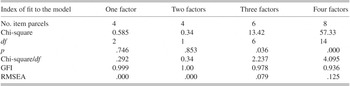
For each of the models tested, we obtained four indices of goodness of fit. The first was chi-square. Here, we sought a low nonsignificant value, which would indicate a close fit between the data and the model. As this index can be misleading with large samples, Ullman (Reference Ullman, Tabachnick and Fidell2001) has recommended that a chi-square-to-degrees of freedom ratio (chi-square/df) of less than 2.00 may be deemed to reflect a good fit to the model. This ratio was therefore used as our second index. For our third index, we used the goodness-of-fit index (GFI) where a high value, approaching 1.00 and preferably >.95, indicates a good fit to the model. Finally, for our fourth index, we used the root mean square of approximation (RMSEA), which may be thought of as a measure of badness of fit. We therefore sought a very low value, approaching .00 and preferably <.05, to indicate a good fit. Statistical comparisons of the one-, two-, three-, and four-factor solutions were undertaken using the chi-square difference test. We also investigated whether BDI-II total and subscale scores (derived from the best factor solution) correlated with impairment [the Functional Independence Measure (FIM)].
RESULTS
Exploratory Factor Analyses
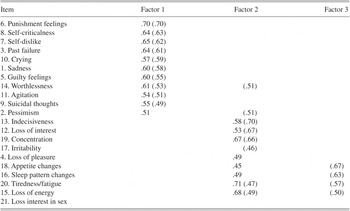
The principal component analysis suggested the presence of a large general factor of depression. Item loadings on the first principal component ranged from .35 to .69 with a mean of .56. A two-factor Varimax rotation resulted in two clear interpretable factors—a cognitive/affective and a somatic factor. These data are presented in Table 2 and show that a two-factor solution is sound in terms of the simple structure criterion. Results of a three-factor Varimax solution are also presented in Table 2. They suggest three reasonably clear factors although simple structure is not achieved as well with three items showing high loadings on two factors. The first factor represents self-worth, the second cognitive symptoms, and the third somatic symptoms. A four-factor solution produced four interpretable factors, but there were five items that failed to load high on a single factor, reflecting a loss of simple structure. The five-factor structure was relatively good in terms of the simple structure criterion. However, the somatic factor split into two new factors each comprising only two items, suggesting overfactoring.
Item factor loadings from two and three factor Varimax rotation of 21 items of the BDI-II in a sample of neurorehabilitation inpatients (N = 353)

Note.
Loadings for three-factor solution in parentheses. All item-factor loadings rounded to two decimal places and loadings <.45 removed for clarity. Adding scores for items 6, 8, 7, 3, 10, 1, 5, 14, 11, 12, and 2 will provide a cognitive/affective symptoms score out of 0–33. Items 13, 12, 19, 17, 4, 18, 16, 20, and 15 can be added to provide the somatic symptoms score.
The cognitive/affective and somatic subscale scores, based on the items identified in the two-factor solution above, showed modest significant correlations with scores on the FIM. Because almost 60% of the sample were not depressed (i.e., scored below 10), thus significantly constraining the variance, we calculated this correlation using the 166 participants who scored above 10. For these depressed patients, the cognitive/affective score showed a correlation of −.19 (p < .05) with admission FIM and a correlation of −.36 (p < .001) with discharge FIM. For the somatic scale, these correlations were −.25 and −.25, respectively (both p < .01). These were the only correlations with the subscale scores we examined.
Confirmatory Factor Analyses
The summary statistics for the four CFAs are displayed in Table 3, which suggests that the single- and two-factor models are the better models as reflected by small and nonsignificant values for chi-square and chi-square/df ratios of less than 2.0. The GFI and RMSEA figures confirm this picture and suggest an excellent fit for both one- and two-factor models. Chi-square difference tests were undertaken to provide a systematic comparison between the four models and can be summarized as follows: The two-factor solution is the best-fitting model but not significantly better than the single-factor model [chi-square difference (1) = 0.551, p > .25]. The three-factor model is quite good, but the two-factor model is significantly better [chi-square difference (5) = 13.386, p < .025]. The four-factor solution is not nearly as good as the three [chi-square difference (8) = 43.91, p < .001]. Reliability coefficients for the full BDI-II and the cognitive/affective and somatic subscales were as follows: full scale (21 items) alpha = .89, cognitive/affective subscale (11 items) alpha = .85, and somatic subscale (8 items) alpha = .77.
Results of the CFAs (N = 200) number of factors in the model

DISCUSSION
In this study, we conducted a range of EFAs based on previous research with TBI samples and compared two-, three-, four-, and five-factor rotated solutions. As more than one of these solutions seemed acceptable in terms of simple structure, we then used CFA on a subsample of 200 randomly selected participants to determine which solution provided the best-fitting model. Our results suggested that there is a large general depression factor that underpins the BDI-II. This was clear from both the principal component analysis in the EFA and also the unidimensional model tested in the CFA.
The EFAs also suggested that specific factors could be identified for the BDI-II. A two-factor solution, comprising a cognitive/affective and a somatic factor, was particularly clear with respect to simple structure, with 19 items loading highly on either one or the other factor. While items that loaded on the first factor were almost entirely psychological in nature, the second somatic factor was slightly less clear and included some items that were cognitive/motivational (e.g., concentration difficulties, indecisiveness, loss of interest). Overall, this structure is quite similar to that reported for Beck et al.’s (Reference Beck, Steer and Brown1996) student group, by Munoz et al. (Reference Munoz, Chen, Fischer, Roehrig, Sanchez-Johnson, Alverdy, Dymeck-Valentine and le Grange2007) for a large sample of patients prior to obesity surgery, and it is not markedly different from two of the three previous studies with TBI samples that both found a somatic factor and two additional factors comprised of essentially psychological symptoms (Green et al., Reference Green, Felmingham, Baguley, Slewa-Younan and Simpson2001; Rowland et al., Reference Rowland, Lam and Leahy2005).
In practical terms, this means that a total score on the BDI-II is an acceptable means of measuring severity of depression in a neurorehabilitation setting. It also suggests, however, that the BDI-II has two distinct dimensions of depression in this patient group—the cognitive/affective and the somatic. Hence, the BDI-II can also provide two subscores for cognitive/affective and somatic symptoms of depression. These can easily be obtained by summing the items loading on these two separate factors (Table 2) as the reliability coefficients showed these scales to have high internal consistency. On the basis of these findings, we would therefore recommend that each patient should receive a total BDI-II score using all 21 items and separate scores for cognitive/affective (11 items) and somatic symptoms (8 items—scoring details are provided in Table 2). Interestingly in the present study, both these subscales only showed modest correlations with disability as measure by the FIM.
The authors recognize some limitations in this study. First, the sample was drawn from a single centre providing tertiary specialist rehabilitation. It is not clear how these results might generalize to less severely affected individuals. Second, the use of both EFA and CFA on the same data set could also be criticized. Ideally, CFA would be performed on a separate and independent sample. The random selection of this subsample meant that it was not entirely the same. However, further confirmatory analyses with other acquired brain injury samples would be desirable.
CONCLUSION
The BDI-II is a suitable measure for using in the evaluation of depression in patients undergoing neurorehabilitation. It provides a meaningful total score of overall depression and can also yield two subscores, one measuring somatic symptoms and the other measuring psychological or cognitive/affective symptoms. This factor structure is not unlike that previously reported among both healthy and medically ill samples. To avoid confusing the common symptoms of neurological disability with the symptoms of depression in neurorehabilitation settings, clinicians and researchers need to carefully consider all three scores and not just a total score in isolation.
ACKNOWLEDGMENTS
We are grateful to all the patients on the Regional Rehabilitation Unit, Northwick Park Hospital, who allowed their data to be used and staff who performed the assessments. We are especially grateful to Dr. Frances Clegg for initiating the data set and to Margot Kalmus, Jo Clark, and Heather Williams for assistance with collation and validation of the data set. Financial support for the preparation of this manuscript was provided by the Dunhill Medical Trust and the Luff Foundation. Three anonymous reviewers made suggestions that assisted the authors to substantially improve the original manuscript.