Introduction
This study focuses on a contact phenomenon found in many clan-based societies: clan contact between in-marrying women and non-mobile local residents of villages. The indigenous Sui people of rural Guizhou Province in southwestern China have customs requiring that spouses originate in different clans. At the time of marriage, the wife permanently in-migrates to the husband’s clan, in a system known as patrilocal clan exogamy. Since many clans have subtle dialect differences, it is commonly the case that certain features of an in-marrying woman’s speech differ significantly from those of her husband and other locals. The dialects in this study are mutually intelligible, and the distinction is usually a relatively limited set of lexical and phonetic features. For example, a married woman may use a different 1st singular pronoun or different lexical tone and diphthong variants than her husband and grown children. Sui speakers report long-term maintenance of such group distinctiveness regardless of close, daily clan contact within the village and within the family.
Given that Sui dialect distinctiveness persists despite such long-term contact within villages, speakers may be viewed as performing and constructing identity through the use of linguistic features that index their home communities, a village-wide process that involves both the non-mobile local residents and the in-marrying women. In turn, such linguistic acts of identity (Le Page & Tabouret-Keller Reference Le Page and Tabouret-Keller1985) continuously construct and maintain a local notion of clan/regional dialects, regardless of contact and mobility. In short, the situation can be modeled as a practice-based dialectic of linguistic structure and agency (e.g., Giddens Reference Giddens1979:24, Reference Giddens1991; Bucholtz Reference Bucholtz1999:209).
Such an approach makes significant progress in understanding linguistic contact, but it misses the fine-grained local particulars of this non-Western, clan-based society. Building on classic dialectical models of language in practice, this study uses ethnographic interviews and observations to explore indigenous Sui language ideology. The interviews uncover a complex interplay of dialect stereotypes, place, clan lineage, and surname, as well as a deep sense of the importance and collective stability of descent-group loyalties and their linguistic expressions: acts of loyalty. Unlike most current, practice-based models of language and identity, which tend to involve highly flexible, dynamic behavior and a focus on the individual, this study finds a considerably more stable and collective sense of loyalty to descent groups (communities of descent), which are constructed and maintained by the stable use of linguistic features. The study also illustrates the crucial importance of using indigenous categories (Sui toponyms and notions of place and descent groups) in sociolinguistic analysis, rather than the non-indigenous categories also found in the Sui region (governmental administrative boundaries and Chinese-based surnames).
Background
Prior work on Sui clans and dialects
Previous studies of Sui (Stanford Reference Stanford2007, Reference Stanford2008a, Reference Stanford2008b) report on quantitative investigations of the speech features of in-marrying women, their children, and non-mobile men and teenagers in their original home clans. The results show that most in-marrying women maintain the dialect features of their original clans to a very high degree in all known variables, despite spending a decade or more in the husband’s region. Moreover, these results were not dependent on direction of exogamous mobility (migration from any one particular clan to another). Very young children were observed to have considerable mixing between the local variety and the matrilect (mother’s dialect). Older children also mix the matrilect and patrilect to some extent but appear to move steadily through a transition to the patrilect, becoming fully patrilectal by adulthood. In this way, dialect contrasts are closely maintained across the community as a whole.
The present study, having the goal of more deeply probing why these patterns of behavior occur, reports on fieldwork focused on Sui language ideology in ethnographic interviews conducted with in-marrying women and other village residents.
The Sui language and people
One of the 55 official ethnic minorities of mainland China, the Sui people are an indigenous minority group living in rural regions of southern Guizhou Province. The Sui language is usually classified as Tai-Kadai or Kadai (Edmondson & Solnit Reference Edmondson and Solnit1988); despite being located primarily in China, the Sui language is genetically more closely related to Thai and Lao. The Sui cultural and linguistic heartland is considered to be Sandu Autonomous Sui County (e.g., Zhang Reference Zhang1980), and this study was conducted in the central part of that county.
The overall area discussed in this article is approximately 20 miles (12 km) wide (east–west) by 30 miles (18 km) long (north–south) and contains roughly a dozen different surnames, each of which is shared by several thousand or more people.Footnote 1 The relationship between surname and clan is discussed below. Villages consist of clusters of houses situated near the rice paddy fields used by the families of that village. As for size, one village of typical size had 33 households.
Patrilects
Sui clans are patrilineal, and they are defined according to local understanding of the lineage of each village. Sui people keep the father’s surname for life, regardless of marriage. In the local understanding, a village has a homogeneous dialect that is spoken by every person born into that village. The women who have in-married into any given village are said to maintain their original dialects (henceforth patrilects, following Smith & Johnson Reference Smith and Johnson1986) and do not acquire the husband’s dialect (henceforth, exolect, i.e., the dialect of the place that the in-migrant has entered). Sui respondents report that the non-mobile adults, teenagers, and children of a given village speak a single variety, while the married women speak the varieties of their original homes. In some cases a woman’s patrilect does not differ significantly from the exolect, but in many cases there are notable differences. Such divergent features exist side by side in a village (and in a family) with no observed evidence of accommodation among adults. For example, a researcher visiting a Sui community is quickly exposed to consistent contrasts in 1st singular and other variables in face-to-face communication between speakers with different origins.
Context for Sui exogamy
Unlike the well-known case of “linguistic exogamy” in the Vaupes region of the Amazon (e.g., Jackson Reference Jackson, Bauman and Sherzer1974, Reference Jackson1983; Sorenson Reference Sorenson1967; Gomez-Imbert Reference Gomez-Imbert1986; Aikhenvald Reference Aikhenvald2002) where spouses are required to have different native languages, the exogamy in Sui culture depends on clan, not language. Sui spouses must originate in different clans, but there is no requirement that their languages or dialects be different. Instead, the linguistic effects discussed here are an epiphenomenon of clan exogamy. Although many Sui spouses have significant dialect contrasts, in other households the spouses originated in clans whose dialects are not significantly different. Furthermore, the linguistic exogamy in the Vaupes region is described as a difference in language, not dialectFootnote 2 (Aikhenvald Reference Aikhenvald2002:17, Reference Aikhenvald2003:2), while the Sui varieties described here have a very high degree of mutually intelligibility.
Smith & Johnson (Reference Smith and Johnson1986) describe a situation in northern Australia that more closely resembles the Sui exogamous system. The Nganhcara people of Cape York Peninsula are a clan-based society with mutually intelligible “clanlects” that are often in contact owing to exogamy. Like Sui, Nganhcara society lacks any clear socioeconomic stratification, but significant clan-level dialect differences are observed. Yan-nhaŋu speakers in Eastern Arnhem Land, Australia also have clan exogamy with linguistic effects (Bowern Reference Bowern2008), and evidence suggests that a Kuki-Chin language of Bangladesh has similar clan-level distinctions (David A. Peterson, p.c.).
Finally, considering the well-known instance of multilingual contact in the village of Kupwar, India (Gumperz & Wilson Reference Gumperz, Wilson and Hymes1971), both the Sui community and Kupwar village share the characteristic of having linguistic stability in a contact situation. However, Sui clan-level dialects differ in only a few mutually intelligible lexical and phonetic differences, unlike the widespread lexical differences found among the languages in contact in Kupwar. In addition, the Sui regions discussed here do not have the religious and cultural contrasts found in the Kupwar contact situation. As for dialect leveling, simplification, convergence, or koineization, while such processes may have played a role at some point in Sui history and may continue to play a role now, no such processes are currently observed or reported by the community (cf. Bortoni-Ricardo Reference Bortoni-Ricardo1985, Kerswill Reference Kerswill1994, Kerswill & Williams Reference Kerswill and Williams2000).
Women’s networks: The patrilect and the exolect
After her in-migrating to her husband’s village, and especially after children are born, a rural Sui married woman’s life primarily centers on the husband’s village. Many of the women interviewed were living 10 or more miles (6+ km) away from their home villages, with limited access to transportation. Studying the Kam people, a similar minority group in a neighboring part of the province, Jerold Edmondson (p.c.) also reports that married women’s outside interactions are limited owing to responsibilities in the husband’s village.
Furthermore, there is no evidence that networks (cf. Milroy Reference Milroy and Romaine1982, Reference Milroy1987) organized by clan of origin are formed by women in their husbands’ villages or that there are other dense networks or communities of practice (cf. Eckert & McConnell-Ginet Reference Eckert and McConnell-Ginet1992, Eckert Reference Eckert1988) in the husband’s village that use a woman’s own patrilect exclusively. Respondents report that exogamous marriages are based on the particulars of personal and family relationships, rather than any regular pattern where two clans have an agreed marriage exchange program. Women in a given village represent a wide range of different patrilects. For example, in one Lu clan village of approximately 150 people, 19 different regions were currently or recently represented by women who had in-married into the village. (The relationship between region, clan, surname, and patrilect is discussed below.)
Therefore, while a woman is likely to have some village interactions that include women who happen to share her patrilect, the local village dialect (husband’s dialect) is always the dominant variety – in terms of both social influence and numerical majority. A married woman is immersed in that variety on a daily basis.
In Their Own Words
Lexical stereotypes
In the Sui region studied, dialect variation is observed in a set of lexical items and phonetic variables (two diphthongs and two lexical tones). However, as seen in many of the excerpts below, respondents’ discussions of language variation usually focus on a few salient lexical items such as 1st singular (e.g., ju vs. ɛj). For example, a common means for describing the variety used by the Pan-surnamed people in the Tɔŋ regionFootnote 3 is the set phrase jɑ-ju, which is a discourse marker placed adjacent to 1st singular: ‘so I …’ or ‘like this, I …’ In such cases, this phrase has no referential meaning. 1st singular ju, the discourse marker jɑ, and a particular high toneFootnote 4 found in jɑ are all salient attributes of that variety, so this set phrase seems to serve as a convenient shorthand indexing that variety. Speakers of all varieties invoked jɑ-ju when they performed that Pan variety. This phrase may be compared to “It’s high tide on the sound side” as used by the “hoi toiders” of Ocracoke, North Carolina to perform their dialect (Schilling-Estes Reference Schilling-Estes1998). The various Sui 1st singular forms and the discourse marker jɑ may therefore be viewed as “third-order” indexicals, following Johnstone, Andrus & Danielson’s (2006:82–84) application of Silverstein’s (Reference Silverstein2003) orders of indexicality. The presence of such high-level indexicals suggests that these Sui varieties have become well-defined, “enregistered” (Agha Reference Agha2003; cf. Johnstone et al. Reference Johnstone, Andrus and Danielson2006:79; Silverstein Reference Silverstein1998) constructs.
Regardless of their own clans of origin, most Sui people have the ability to perform the salient variables associated with surrounding communities. Sui speakers have an impressive knowledge of the variation from clan to clan and village to village, especially in 1st singular. In fact, using an even simpler shorthand than jɑ-ju, speakers often refer to dialect regions by their 1st singular variants alone, such as, ‘I say ɛj [1st Sg]. You say ju [1st Sg].’
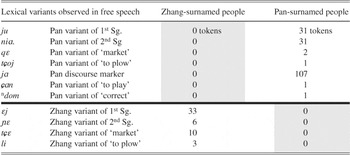
Table 1 shows the distribution of lexical variants in free speech samples from 20 non-mobile village residents and 11 in-migrant women (i.e., married women living in the husband’s village among speakers of the opposite variety, Zhang or Pan). Free speech recordings included discussions of festivals, customs, childhood stories, agriculture, and language attitudes. Note the prevalence of pronouns and the Pan discourse marker jɑ, and also note that speakers categorically used their own patrilects. Recordings were conducted in Zhang and Pan villages.
Lexical variants in free speech recordings.

Language ideology: Evidence from interviews
Recognizing the importance of “local knowledge that motivates and explains the behavior of a particular group” (Johnstone Reference Johnstone and Fought2004:76), the present study emphasizes Sui speakers’ own descriptions of local language ideology. The interviews were conducted in Sui and occasionally Chinese, so the texts given here have been translated into English. Ethnographic responses are presented both in terms of generalizations (to ensure that one doesn’t miss seeing the forest for the trees) and in terms of specific individuals’ experiences (to ensure that one doesn’t miss seeing the trees for the forest). With the latter in mind, this section begins by presenting a detailed excerpt from an especially informative individual, S6, a woman who had been married for about 35 years (excerpt 1). She was raised in a Pan-surnamed village in a southern region with the Sui toponym Tɔŋ, and she then married into a Zhang-surnamed village about 10 miles (6 km) away in a northern region with the Sui toponym Ljoŋ, where the interview took place. This speaker primarily uses the word hen ‘place, region, country’ to refer to dialect variation; she also cites dialects by means of 1st singular.
(1) a S6: Ljoŋ speaks Ljoŋ. People speak like their own place. I speak like my place. I wouldn’t be able to speak another place. I was grown up when I came here from my place, so I always speak my place.
b Interviewer: What if someone with the Pan surname [same surname as S6] came to Ljoŋ and spoke like Ljoŋ, what would people say?
c S6: Oh, if someone with the Pan surname came to the Ljoŋ place and spoke like Ljoŋ, everyone would laugh. She’d feel embarrassed. She wouldn’t speak that way anymore. [Trans. note: 3rd sg. is gender-neutral in Sui]
d Interviewer: Why “embarrassed”?
e S6: She would know she had done something wrong – done something inappropriate. So everyone would criticize her – make her feel embarrassed.
… In the Sui place, we always say this: “You are from your own home/family.Footnote 5 Your mother raised you. If you go to another home/family and speak like them, you’ll feel embarrassed.” People will talk about you like that and make you embarrassed.
f Interviewer: If she married into another place but spoke like that place, would that be “doing wrong” to her mother?
g S6: Yes, then the mother would say, “<sigh>You grew up in our home/family. Now you’re grown up, and you speak like others. Aren’t embarrassed? Are you giving respect to them [rather than to us]?” People in the Sui place say things like this.
h Interviewer: So if she speaks like the other place [her husband’s place], her parents would “criticize” her sometimes?
i S6: They would criticize! Yes! They would really criticize a lot!
j Interviewer: Have you heard this happen?
k S6: Yes, I’ve heard of it …. They say it like this: “You grew up in our home/family, but now you’ve married someone, married into another home/family. [And now] you speak like their place. …You must like to give respect to them! You’re so proud. You’re not afraid of what the place will say about you!”
l Interviewer: You’ve heard parents say that?
m S6: Yes.
n Interviewer: Not to you …
o S6: <laughs> I’ve been taught about it, so I haven’t done it [spoken like Ljoŋ]. When older people said such things, I learned. I haven’t been criticized. I learned about it myself when older people said it.
p … Ljoŋ says ɛj [1st sg.], but my home says ju [1st sg.] …
q Interviewer: What if a child here spoke like Tɔŋ …?
r S6: Everyone would laugh. Sui people would say, “Oh, you always speak like Tɔŋ. You’re a Tɔŋ person!” Then that child would feel embarrassed and wouldn’t do it again. She’d speak like the father [instead]. Otherwise, people in the village would laugh. She’d be laughed at; she’d feel embarrassed. She wouldn’t speak that way again.
Excerpt (1) suggests the following insights about local language ideology:
• A married woman will continue to speak her patrilect even after she marries into another village (lines a, o).
• Adults and children are all expected to identify themselves linguistically with their father’s place (lines e, g, k, r).
• This linguistic behavior is enforced by community and family pressure, especially ridicule and criticism (lines c, e, g, i, r). The speaker’s description of the community’s negative responses also shows that it is possible for people to use other places’ dialect features (e.g., line k), despite the earlier statement that she ‘wouldn’t be able to speak like another place’ (line a).
• These attitudes are transmitted verbally from older generations to younger generations (line o).
• When referring to dialect differences, the Sui speaker frequently uses the word ‘place’ hen, as well as specific Sui toponyms (Ljoŋ and Tɔŋ). She also occasionally refers to ‘home/family’ (e.g., line g), and in line p she uses specific dialect features.
Excerpt (1) typifies the attitudes found in many interviews. Respondents stressed that a person is considered a member of the father’s clan, not a member of the mother’s clan. Membership in the father’s clan is considered permanent. In this way, a married woman maintains her own patrilectal features out of loyalty to her father’s household. If a woman doesn’t maintain the dialect features of her father’s clan in her speech, this is viewed as inappropriate behavior.
Respondents viewed such linguistic features in categorical terms. For example, one married woman said, ‘People who say ɛj [1st sg.] always say ɛj. People who say ju [1st sg.] always say ju [1st sg.]’. Another woman reported, ‘We always speak like our home’, and a man said, ‘If you say ku [‘head’, Ljoŋ variant] here in Tɔŋ, people will say, “You aren’t from around here.” They’ll laugh at you’.
Some respondents drew a parallel with surname traditions, suggesting that the tradition of keeping the father’s surname for life is a natural parallel to the tradition that a person maintain the patrilect for life. In the sense that Sui patrilects and surnames are both social institutions – longstanding indicators of family relationships and loyalty – this viewpoint holds valuable insight. In addition, one respondent went so far as to suggest that the existence of differences in 1st singular among clans might be historically related to the taboo on marrying within one’s own clan. He speculated that perhaps this pronoun variation was specifically developed in the past as a check against intra-clan marriage. Regardless of the historical merit of that folk etymology, it shows a specific awareness of linguistic issues related to exogamy, as well as clear folk understanding of salient features between clans.
Most married women considered themselves to be closely maintaining their respective patrilects, usually giving an unequivocal response as in excerpts (2) and (3). In addition, note the three ways that these two speakers reference patrilect: place (by toponym or the words ‘place’ and ‘home/family’), linguistic features (1st singular), and surname (e.g., Zhang and Pan).
(2) Interviewer: You came from Tɔŋ, and now you’ve spent all these years in Ljoŋ. Has your speech changed?
S7: [A woman from Tɔŋ, married 12 years]: No, I haven’t changed.
Interviewer: Not even a little?
S7: No. I always say ju [1st sg.], like my home. I speak like Tɔŋ completely.
(3) Interviewer: Now that you’ve been in Ljoŋ a long time, have you changed [your speaking]?
S5: [A woman from Tɔŋ, married 20 years]: No.
Interviewer: Not even a little?
S5: No. …Not even a single word… People who are surnamed Zhang don’t speak like people surnamed Pan. If a mother is surnamed Pan, she won’t speak the same [as her husband and children].
Another woman from Tɔŋ who had married into a region called Liaj said, ‘I speak like my parents, not like my husband’, and she said her speech had not changed at all during her nine years in Liaj. A woman from a region called Tu, who had been living in Liaj for 10 years, also reported that she had not changed her dialect. One woman from Tɔŋ living in Ljoŋ for 10 years had noticed ‘a tiny bit’ of Ljoŋ features in her own speech. Another woman said, ‘I speak like my home, not like here… I don’t speak like that. [My speech] isn’t even a little like theirs’. I then asked one of that woman’s acquaintances about her, and the acquaintance agreed that the woman’s speech was ‘not even a little like [here]’. Likewise, S24, a woman who had been married for 10 years, said she hadn’t adjusted her dialect to the speech of the local Lu clan. In excerpt (4), note how S24 uses all three devices to describe patrilects: surname, 1st singular, and place.
(4) S24: They are surnamed Lu, so they say ɛj [1st sg]. We are surnamed Pan, so we say ju [1st Sg]. Each speaks their own way… People surnamed Lu speak like the Lu place. We people surnamed Pan speak like people surnamed Pan.
Sui respondents’ descriptions like excerpt (4) suggest processes of erasure and essentializing (Gal & Irvine Reference Gal and Irvine1995:973–75; Irvine & Gal Reference Irvine, Gal and Kroskrity2000; Arvaniti Reference Arvaniti2006; Eckert Reference Eckert and Fought2004:113). There is of course no inherent quality of a Pan-surnamed person that should necessarily link him or her to the ju variant of 1st singular. Pan-surnamed people produce and reproduce their Pan-ness by choosing to use ju rather than the other possible variants of 1st singular around them.
Related perspectives are observed in discussions of place. Note another phrase from excerpt (4), ‘People surnamed Lu speak like the Lu place’. This viewpoint is generally accurate, but at least one Lu village uses a Pan-like 1st singular ju (discussed below). Similarly, a Yang-surnamed woman said, ‘Ljoŋ doesn’t have any people surnamed Yang. There aren’t any people surnamed Yang until you get to Tu [another region]’. Actually, however, there are many Yang-surnamed people living in the Ljoŋ region: women with the Yang surname who in-married to Ljoŋ from their home region of Tu.
“Eating their food”
A 67-year-old man surnamed Lu illustrates the use of the phrase ‘to eat their food’, a very common idiom indicating community identity and loyalty (excerpt 5). The community where one was raised – the community that was originally responsible to nourish one as a child – is expected to receive permanent loyalty.
(5) The women are afraid of being embarrassed. [If a woman changes her speech, then] when she comes back, her clan will criticize her, saying, “Now you’ve gone and eaten the food of others; [you’ve] become like others. You don’t speak like us anymore.”
… [So] even after a long time, she still won’t talk like [her husband’s] place. [Otherwise] when she comes back, [they’d say] “Wherever you eat, you just become like that place!” So she would be embarrassed and would always speak like [her original place].
Very few married women reported any significant changes in their speech since marriage. Two exceptional cases, S15 and S13, are described in the following.
The case of S15
S15 was a 59-year-old Pan-surnamed woman who had been married in Ljoŋ for 40 years. Another community member commented that S15 had acquired some exolectal features. S15 self-reported (excerpt 6) that her speech had been influenced by interaction with local children.
(6) S15: …When I’m talking to children – grandchildren – sometimes I forget some words because I’m following the children. I don’t know. I always remember how to talk like my home, but when I’m with children, I forget some words.
Interaction with local children, perhaps coupled with her comparatively long time in Ljoŋ, had led to some initial changes in S15’s dialect. Such a result is predicted by other respondents’ suggestions that, even though it is rare for a married woman to acquire exolectal features, it may sometimes happen among older women. It is reasonable to suppose that clan loyalties sometimes gradually dissipate with ageing, especially if one’s parents or other close family members in the original village have passed away.
The case of S13
What happens when clan identity, loyalty, and dialect are not well established during childhood? S13 was a 34-year-old married woman living in Ljoŋ who had a mixed clan childhood. She was born to a Pan-surnamed family in Tɔŋ, but was raised in Ljoŋ for most of her childhood (until 12 years old), then lived in Tɔŋ until marriage, and then in-migrated back to Ljoŋ upon marriage at the age of 18. Unlike most people who had stable childhoods with clearly defined home villages and patrilects, S13 did not have one clearly defined original home community. In a striking contrast to the other married women, she had an obvious mix of both varieties in her speech (including a mix of 1st singular variants). She was not grounded in either community in terms of her personal history, so she clashed with others’ linguistic expectations. Note below (excerpt 7) her reactions to criticism about her lack of fully patrilectal speech. S13 was the only respondent who showed willingness to confront metalinguistic criticism. Remarkably, she manipulates the ‘eat the food’ idiom by reversing it into a justification of her own linguistic changes.
(7) Interviewer: So you’ve changed to [speak] like Ljoŋ?
S13: Yes.
Interviewer: Do people laugh?
S13: Yes! They laugh a lot! <laughs> I’ve changed to [speak] like Ljoŋ, so they laugh. <laughs> People laugh at me …
[People say,] “Now you’re like Ljoŋ. You don’t speak like before. Now you’ve eaten their food and become like them. You’re not like before.” <laughs>
[But I say], “Now I’m eating their food, so I’m like them.” …You go ahead [and move along in life]. You just become like [people around you]. You don’t act like before… They say I’ve changed to be like Ljoŋ. They always scold me! “You don’t speak like before!” [But] I say, “I’ve come here. I’m always with them [Ljoŋ people], so I speak like the here-and-now, not the past.” I say it like that to them.
Interviewer: You don’t care that they talk about you?
S13: When they talk, I don’t care. I say,“My memory is bad… I can’t remember – I can’t remember!”
The example of S13 shows that there is a significant social cost when an individual doesn’t identify with the patrilect: a clash with the community-wide system of linguistically marked loyalties. Note, however, that among 19 in-marrying women who were interviewed for this study, S13 is the only one who had this type of mixed clan identity and extensively mixed dialect features.
Metalinguistic criticism is also found in an interview with S5, a 41-year-old Pan-surnamed woman who had been married in Ljoŋ for 20 years (excerpt 8). Note also her use of both place (Ljoŋ) and linguistic features (1st sg.).
(8) S5: If [someone like me] were to speak like they do here, people would laugh a lot – laugh a lot! They would always laugh … If you speak like Ljoŋ, people will laugh. If you say ɛj [1st sg.], they’ll laugh – they’ll laugh.
In excerpt (9), another woman describes laughter as a consequence for straying from the patrilect. Notice that such consequences are not limited to the husband’s village but include the woman’s home village as well. She also illustrates the use of the phrase ‘eat the food’.
(9) S15: They would always laugh. So [that person] wouldn’t talk like that anymore. People would laugh, “You don’t speak like your own place anymore! You ate the food of our place, so you should be like our place.” They would say, “You are of our place. You ate the food of our place. You should be like our place.”
Two main points
The examples presented so far illustrate two main points. First, a strong sociolinguistic awareness of community loyalty and social order pervades daily life, as speakers express permanent loyalty to their home communities. Such behavior is a natural reflection of the key functions of such communities in local social order. After all, in addition to marriage, these descent-group affiliations also affect land use and most aspects of personal relationships, rights, and responsibilities. In daily life, as well as disasters or other times of need, a village depends heavily on kinship and mutual assistance. Villages outside one’s own clan have a lower sense of intimacy and duty. For example, I experienced this contrast when a Sui person brought me from his clan, where we moved freely and casually among homes and among villages, to a village a few miles away in another clan, where we experienced a sudden sense of obligatory formality and required etiquette. He explained, ‘This isn’t our clan. I don’t have close relatives here, so it’s difficult to freely visit. If you visit any village in our clan, it’s much easier’. The social order of clan organization and the corresponding loyalties to community are clearly crucial elements of daily life.
Second, the interviews show how respondents use three devices when discussing the linguistic correlates of their home communities: (1) place, (2) surname/clan descent, and (3) linguistic stereotypes. The next section models those interacting notions.
Sui Notions of Place
Respondents frequently invoke the word hen ‘place, region, country’Footnote 6 when identifying different varieties, despite the fact that many people in any given hen are speakers of other varieties (i.e., in-married women). As in other cultures (e.g., Johnstone Reference Johnstone and Fought2004, Johnstone et al. Reference Johnstone, Andrus and Danielson2006, Meyerhoff Reference Meyerhoff, Holmes and Meyerhoff2003, Philipsen Reference Philipsen and Philipsen1992), the Sui notions of place and language are socially constructed. In Thornton’s analysis of Alaskan Tlingit culture, for example, he defines place as “a framed space that is meaningful to a person or group over time” (2008:10). Similarly, Johnstone (Reference Johnstone and Fought2004:66–69) emphasizes “place as meaning,” and Meyerhoff describes the subtleties of the indigenous meaning of ples ‘place’ in Vanuatu (2003:306ff.; cf. Bolton Reference Bolton1999, cited in Meyerhoff).
In the Sui interviews, hen is closely associated with surname and patrilectal features, reflecting a socially meaningful sense of place that goes beyond physical location. Orientation to hen is maintained through linguistic loyalty to the home community, even decades after a person’s physical location has changed due to patrilocal marriage.
Linguistic distance, geographic distance, and social distance
There is no simple correspondence between physical location, surname, clan, and dialect. Patrilocal marriage causes pervasive dialect contact, and villages of a given clan may overlap or be very close to another clan’s overall region. At the same time, however, respondents view each place as having a single set of dialect features. For example, the non-mobile speakers of villages in large northern stretches of the Sui region are associated with the [iə] variant of the (iɑ) diphthong variable, while similarly large southern stretches are associated with the [iɑ] variant. From this viewpoint, respondents sense a general distinction along a north–south line, that is, an isogloss bundle related to the following variables: the diphthongs (ia) and (ua), a distinctive high tone, and lexical variables such as ‘frog’ and ‘socks’ (cf. Stanford Reference Stanford2007, Reference Stanford2008a, Reference Stanford2008b).
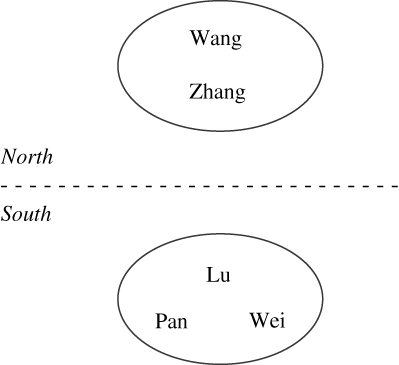
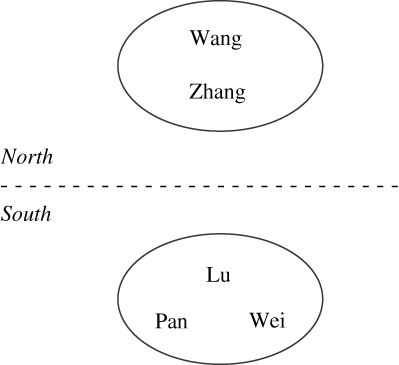
Surnames and places (Part 1). Ellipses represent two loci of linguistic features: Speakers who share the same variants of the diphthongs (ia), (ua) and many lexical variables such as ‘frog’, ‘socks’
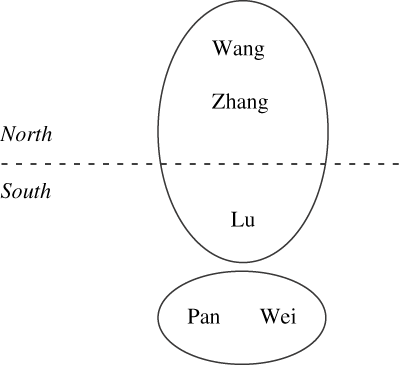
Surnames and places (Part 2). Ellipses represent two loci of linguistic features: speakers who share the same pronunciation of a distinctive high tone
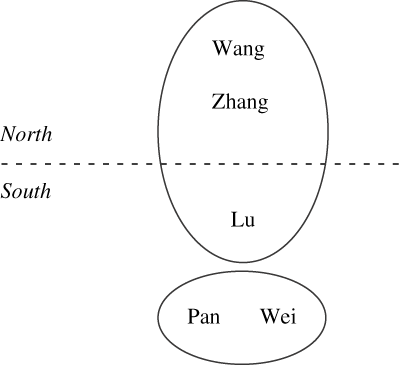
Figure 1 shows several of the major communities in the central part of Sandu County. People with surnames Lu, Pan, and Wei are all said to produce [iɑ] for (ia), [wɑ] for (ua), as well as sharing the same forms of most lexical variables. Meanwhile, 5 to 10 miles (3–6 km) to the north, the Wang and Zhang people are all said to produce [iə] for (ia) and [uə] for (ua), and use the same variants of most lexical variables.
On the other hand, as seen in Figure 2, the Pan and Wei people both have the distinctive high tone, but the Lu people lack that high tone. In this way, Lu clusters with the northern communities. Dialectologists recognize that isoglosses often do not bundle neatly together (e.g., Chambers & Trudgill Reference Chambers and Trudgill1998:89–103), so the variability in the linguistic associations of the Lu clan is not surprising. What Figures 1 and 2 show is a model of that variability at a socially meaningful level (clan constructs), rather than simply geography. Finally, at an even finer level of distinction, the Pan and Wei groups are divisible as well: Pan and Wei have different 1st singular forms, and Pan uses the discourse marker ja.
However, the sociolinguistic situation is more complex than this discussion suggests. There is also evidence of variability among villages with a single surname:
(a) Villages that are members of the same clan may have dialect differences. Lu clan speakers report that one of their villages, which is close to the Pan people, uses the ju variant for 1st singular like Pan, although they differ in other features. Despite this shared pronoun and their close geographic proximity, that Lu village may intermarry with Pan people since they are considered to be different clans.
(b) Conversely, villages in the same local region may have the same surname and linguistic features but not be members of the same clan. In the heart of the Lu clan region, a respondent once pointed toward a nearby village across a few rice paddy fields and explained, ‘That village is also surnamed Lu like us, but they are another clan. We can intermarry with them’. In such instances, same-surname marriages are fully in accord with clan exogamy, not subject to the “severe punishment” (Tang & Wei Reference Tang, Wei and Biao Wu2001:93) imposed on anyone who violates clan exogamy.
A crucial distinction: Indigenous categories versus non-indigenous categories
The Sui notion of one’s home community is a socially meaningful interaction of place, clan, dialect, and surname, but this interaction is clear only when indigenous categories are used. The key is to distinguish indigenous Sui notions from the Chinese categories that have been applied to the Sui area. I originally assumed that surnames were equivalent to clans. After all, surname is a reliable predictor of clan among Hmong communities in the United States (e.g., Yang Reference Yang, Tapp, Michaud, Culas and Yia Lee2004:183). But surnames are only rough guides to Sui clan identity. For example, the “Pan” label in Figures 1 and 2 is actually a simplification. There are two adjacent subsets of Pan-surnamed groups, living in subregions called ʔNiaŋ and Qəŋ, which are separate clans (the litmus test for clanhood is whether or not the two groups can intermarry). Likewise, the Wei people in Figures 1 and 2 can intermarry with Wei-surnamed people in other nearby regions since local knowledge maintains that they are different clans. But that same group of Wei people cannot intermarry with yet another group of Wei people about 20 miles (12 km) to the north. Those two Wei groups share clan membership, and they are reported to have similar dialect features, despite their geographic distance.Footnote 7
Clearly, then, clan distinctions are supported by local knowledge of the lineage of each village, and are just generalized with surnames. The lack of consistent correspondence between clan and surname is understandable when one considers the origin of contemporary surnames. The Chinese surname system was applied to Sui society long ago as part of the Chinese administration process, and, while contemporary surnames approximate some indigenous patrilineal Sui clan distinctions, there are many exceptions. Nonetheless, lacking any contemporary Sui-origin surnames or other clan-specific nomenclature, Sui people often refer to Chinese-origin surnames (Pan, Zhang, etc.) when citing their home communities, as seen in the excerpts above. In addition to surname, speakers may also cite a region or subregion that helps to define their specific clan. However, at that level of regional detail, Sui people from several miles away may not be familiar enough with those local clan boundaries to determine marriage eligibility between two particular villages; they would have to depend on locals’ fine-grained knowledge of each village’s lineage.
Second, contemporary Chinese-named administrative toponyms are only rough guides to Sui notions of dialect and boundaries. When speaking Chinese, Sui respondents mention Chinese toponyms (such as Sandong, Zhonghe, and Zhouqin) as dialect boundaries. For example, I once had the impression that people of Sandong all used the discourse marker ja. But as I learned to speak Sui, respondents began to provide more detailed, indigenous perspectives. It turns out that in the indigenous perspective, there are two separate regions in Sandong: nDɔŋ, a Wei surname region, and Tɔŋ, a Pan surname region. Tɔŋ is where people are said to use the discourse marker ja. Moreover, indigenous notions of region are not conterminous with Chinese-named administrative boundaries: nDɔŋ crosses over the Chinese-named administrative boundaries of Sandong and Zhouqin. Other such contrasts between indigenous notions and Chinese-named toponyms are found throughout the area.
It is clear that Sui people depend on their own oral tradition, not contemporary administrative categories, as they participate in many local social interactions, especially marriage. Naturally, such indigenous notions deeply affect linguistic behavior as well. Only from the viewpoint of socially meaningful, indigenous notions can local sociolinguistics be fully understood (cf. Johnstone Reference Johnstone and Fought2004, Schneider Reference Schneider1984, Hercus & Simpson Reference Hercus, Simpson, Hercus, Hodges and Simpson2002).
Communities of Descent and Acts of Loyalty
In George Herbert Mead’s framework (e.g., 1974), individuals are developed on the basis of interaction with others; in turn, the individuals themselves maintain and produce the society. Such a perspective has a proven record in social theory: a practice-based, dialectical approach (e.g., Berger & Luckmann Reference Berger and Luckmann1967[1966]:61, 189; Goffman Reference Goffman1959 inter alia; Giddens Reference Giddens1979:24, Reference Giddens1991; Ricoeur Reference Ricoeur, Reagan and Stewart1978:116; Street Reference Street, Graddol, Thompson and Byram1993; Fairclough Reference Fairclough2001[1989]:14) that has been invaluable for sociolinguistics (Eckert Reference Eckert2005:16; Johnstone Reference Johnstone and Fought2004; Coupland Reference Coupland, Eckert and Rickford2001:198–99; Mendoza-Denton Reference Mendoza-Denton, Chambers, Trudgill and Schilling-Estes2002; and many others). As Bucholtz expresses it, “Identities emerge in practice, through the combined effects of structure and agency” (1999:209).
However, when encountering diverse cultures, it is important to be sensitive to local subtleties that could be “erased” if theories are applied without accounting for indigenous perspectives: “Facts that are inconsistent with the ideological scheme either go unnoticed or get explained away” (Irvine & Gal Reference Irvine, Gal and Kroskrity2000:38). In Sui culture, local experiences point to a deep sense of collective “kinship selfhood” in addition to individual selfhood. An effective sociolinguistic model should include a natural way to account for the stable and crucial kinship loyalties found in many rural indigenous societies, especially non-Western, clan-based societies. Kinship plays important roles in almost every human society, but a daily, face-to-face, pervasive sense of collective, lineage-based loyalty and commitment is a fundamental part of the sociolinguistics of Sui. Most models of self and other/society that are used in sociolinguistics (e.g., Goffman Reference Goffman1959, Reference Goffman1963, Reference Goffman1971, cited in Schiffrin Reference Schiffrin, De Fina, Schiffrin and Bamberg2006:105–11; Mead Reference Mead and Blount1974) do not seem to naturally express such a sense of kinship collective-self. Instead, Sui culture suggests the following set of meaningful sociolinguistic objects: self, Self, and Other/Society, where lower/uppercase “self” and “Self” indicate individual-self and kinship collective-self, respectively. After all, among diverse cultures, it’s not surprising to find different experiences of self, society, and kinship (Schneider Reference Schneider1984).
As for sociolinguistic applications of communities of practice (CofP) (cf. Eckert & McConnell-Ginet Reference Eckert and McConnell-Ginet1992, Eckert Reference Eckert1988), such an approach accurately captures the practice-based construction of many localized communities and shows the importance of fine-grained degrees of locality of community. But for clan-based societies, one also needs a distinction in degrees of locality of self – that is, an accounting of speakers’ permanent, collective loyalty to home community: a “community of descent.” Further, in the CofP approach there is an overall sense of individualistic choices and malleability. By contrast, in clan-based communities of descent, one finds a significantly more permanent element of lifelong stability and loyalty.
In fact, Sui respondents liken the stability of this descent-group loyalty to the stability of surnames. In many societies, social and administrative barriers make countercultural surnaming practices difficult. Moreover, throughout mainland China, surnames are usually permanent regardless of marriage. Sui respondents therefore draw a comparison (excerpt 10) between the permanence of surnames and their own expectations of permanence in dialect and descent-group loyalty. Respondents suggested that the surname custom is outward evidence of deeply held traditional values: Keeping the father’s surname reflects that a person is always a member of the father’s clan/place.
(10) P6: Even though she is married to that place, she is still a member of this place… People of this place ought to speak this place’s speech. She feels she should persist in speaking this way. No matter what, her surname never changes. Even though she got married, she is still surnamed Lu.
[Likewise] she is always considered to be a member of her [father’s] village. She really isn’t a member of [her husband’s] village… [If she changed her dialect] she would feel like she was “forgetting herself”…
Our clan ideology is strong. Even though she marries into another place, she is still a member of [her father’s] place. Because people [in her father’s place] speak this kind of dialect, she continues on.
In contrast, Schiffrin writes about the much more variable, gradient situations where “identity is neither categorical nor fixed: we may act more or less middle-class, more or less female, and so on, depending on what we are doing and with whom” (1996:199, quoted in Coulmas Reference Coulmas2005:178). For Sui communities of descent, such an approach seems to be “too powerful,” a theory that predicts too much: It would predict a high degree of variability and individualistic shifting that does not reflect the sociolinguistic experience of communities of descent. Speakers sometimes use others’ dialect features in playful imitations, but such performances are clearly understood to be quoted speech (in fact, such performances serve to emphasize and maintain the sharp group distinctions). More importantly, a single token of ja or 1st singular ju, 2nd singular nia, etc., is already a categorical “sore thumb” stereotype, thus limiting the possibility of gradient effects. As earlier illustrated in Table 1, such categorical distinctions are carefully maintained. Excerpt (11) gives an example of the role of such linguistic stereotypes.
(11) When I talk with someone, I know, “Oh, you’re from that place over there.” …When they pronounce just one word, I know—like if they say ɛj [1st sg.], niɛ [2nd sg.], and don’t say niɑ [2nd sg.].
Just as Sui society as a whole monitors marriage (clan exogamy), appropriate surnaming of each infant, and the continued use of the original surname throughout a person’s life, so the society also establishes (socially constructs) an infant’s membership in a community of descent and then collectively monitors the person’s appropriate use of patrilect features throughout life (excerpt 12).
(12) If [a child] speaks like her mother, the people in our village will laugh at her [or him]. They’d say that the child isn’t a member of this village. Then the child would feel very broken-hearted.
Similar stability in descent-group membership and identity is observed in Nganhcara of Australia (Smith & Johnson Reference Smith and Johnson1986), the Vaupes region of the Amazon (e.g., Jackson Reference Jackson1983:165, Aikhenvald Reference Aikhenvald2003), the Tlingit people of Alaska (Thornton Reference Thornton2008:47–48), and the Tolngu people of Australia (Tamisari Reference Tamisari, Hercus, Hodges and Simpson2002). Among the Tolngu, for example, every person “is said to ‘follow the father’ … and is born and is a member of his or her father’s group” (Tamisari Reference Tamisari, Hercus, Hodges and Simpson2002:89). The Sui people use a similar term, tsop pu ‘be like the father’.
Acts of loyalty
The Acts of Identity model (Le Page & Tabouret-Keller Reference Le Page and Tabouret-Keller1985) and practice-based dialectical models naturally suit cases of individualistic, dynamic, gradient style-shifting and code-switching: Speakers modify their language features “to resemble those of the groups with which from time to time they wish to identify” (Le Page Reference Le Page1986:23, emphasis mine, quoted in Coulmas Reference Coulmas2005:182). Sui undoubtedly has a wide variety of stylistic features that would be appropriately analyzed with such tools. However, for the descent-group linguistic features discussed here, Sui speakers do not freely and individualistically make shifts on the scale suggested by such models. Loyalties to a community of descent are not transient and able to be changed “from time to time.” Rather than individual-centric Acts of Identity, the use and construction of descent-group features would be better described as “acts of loyalty”: sets of particular linguistic events that stably resonate with patrilect features, continually (re)constructing collective loyalties to the community of descent. Acts of loyalty are primarily mediated by Self rather than self.
Conclusion
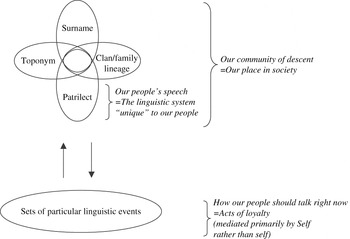
Figure 3 provides a summary of the model suggested here. First, the community of descent – people’s sense of having their proper place in a clan/descent-based society – is modeled as a flower with four mutually interactive petals: surname, indigenous Sui toponym, patrilect, and clan/family lineage. The patrilect establishes itself in the flower by means of third-order indexicals (Silverstein Reference Silverstein2003), such as the performance phrase ja-ju and many well-known prononimal stereotypes.Footnote 8 The community of descent itself is in a mutually constitutive relationship with ongoing linguistic acts of loyalty. Through erasure and essentializing (Gal & Irvine Reference Gal and Irvine1995:973–75; Irvine & Gal Reference Irvine, Gal and Kroskrity2000), the community minimizes awareness of the possible existence of dialect accommodation, contact effects, and other possible instabilities or inconsistencies, while maximizing similarities within their own community.
Summary

Note that, in keeping with the sense of group loyalty experienced and reported in this society, Figure 3 emphasizes collective (plural) aspects of community rights and responsibilities, rather than individuals’ acts. Also note that hen ‘place’ has two overlapping senses: (i) indigenous places and boundaries (such as the indigenous toponym Ljoŋ) and (ii) proper place in society as loyal members of a specific community of descent.
Finally, note that agency is not removed in this approach; norms can be creatively violated (e.g., excerpt 7). But the frequency of such violations of descent-group features in the society as a whole is very low and is rarely considered a possibility in respondents’ discussions of language ideology. Similarly, the model given here does not turn away from the view of culture as a continually evolving process (Street Reference Street, Graddol, Thompson and Byram1993; cf. Holmes & Meyerhoff Reference Holmes and Meyerhoff2003:8–9) where change is always possible.Footnote 9 Like prior models, this approach depends on practice-based constructions, rather than essentialist assumptions about inherent speaker qualities and fixed categories (see Talbot Reference Talbot, Holmes and Meyerhoff2003, Freed Reference Freed, Holmes and Meyerhoff2003). After all, beyond the clan-based linguistic features in question here, Sui society surely has countless sociolinguistic patterns that are produced and reproduced by means of subtle, gradient variability as an individual (the self) constructs and style-shifts through fine-grained layers of identity (e.g., construction of gender identity). Instead, what this study of descent-group features suggests is that the dynamism, flexibility, and individuality assumed in many current practice-based identity models should be tempered and remodeled in cases where language features interact with strong, stable, lineage-related group loyalties, especially in non-Western, clan-based settings. We all use language to mark our places in a social world of “organized diversity” (Gumperz Reference Gumperz1982:24), and the Sui example of descent-group loyalty shows yet another aspect of this experience.