Introduction
Traumatic brain injury (TBI) is the major cause of morbidity and mortality worldwide. Recent studies reveal that in the US only, severe TBI (sTBI) is responsible for more than 1 million hospital admissions annually. Despite the considerable resources invested in acute medical care and rehabilitation of victims of head injury, 50,000 of these patients eventually will die and 90,000 will suffer permanent neurologic disability.Reference Andiressen, Horn and Franschman 1
Outcomes in sTBI patients are related closely to the severity of the initial insult and to the secondary insults. Following the primary insult, secondary brain injury may result from hypotension, hypoxia, or a combination of these events. Hypoxia in severe TBI has been associated with increased morbidity, mortality, and poor neurological recovery. 2 - Reference Hellewell, Yan, Agyapomaa, Bye and Morganti Kossman 5
In order to prevent hypoxic events in these instances, prehospital endotracheal intubation (ETI) and mechanical ventilation (MV) is a common practice.Reference Chesnut, Marshall and Klauber 6 - Reference Stocchetti, Furlan and Volta 8 The objective of this investigation was to examine the effects of prehospital ETI on in-hospital outcomes in patients sustaining isolated traumatic brain injury.
Methods
This was a retrospective propensity-matched analysis of all patients with isolated severe traumatic brain injury [head Abbreviated Injury Scale (AIS) ≥ 3 and/or Glasgow Coma Scale (GCS) score ≤ 8] admitted to Los Angeles County + University of Southern California Medical Center (LAC + USC) from January 1, 2003 through October 31, 2011. Patients were excluded if they had any of the following: extracranial AIS ≥ 3, cardiac arrest in the field, or lack of immediate arterial blood gases (ABGs) obtained on admission. The LAC + USC is an American College of Surgeons verified Level 1 Trauma Center which manages an average of 5,000 trauma admissions annually.
Patients variables extracted were age, gender, mechanism of injury (blunt or penetrating), vital signs in field and on admission, Injury Severity Score, type of intracranial lesion, ABGs on admission, and major surgical intervention (laparotomy, thoracotomy, craniectomy, craniotomy and ICP monitoring placement). Primary outcome was mortality and secondary outcomes included arterial blood profile on admission, in-hospital morbidity, ICU length of stay (ICU LOS) and hospital length of stay (HLOS).
Continuous variables were dichotomized using the following clinically relevant cut points: age (> 55 years vs ≤ 55 years), systolic blood pressure (< 90 vs ≥ 90 mmHg), heart rate (< 120 vs ≥ 120 bpm), Injury Severity Score (ISS ≤ 15, ISS = 16-25, ISS ≥ 25).
The patients were stratified into two cohorts: patients who had a prehospital endotracheal intubation and those who did not. These two cohorts were compared for differences in demographics and clinical characteristics using bivariate analysis. Chi-square or Fisher's exact tests were used to compare proportions and unpaired Student's t-test or Mann-Whitney U test were used to compare means.
Propensity score matching was deployed to minimize the effect of variability in the clinical presentation on the study outcomes. Propensity scores were generated using the binary logistic regression. Included in the model were all demographic and clinical variables that differed significantly (at the P < .05 level) between the prehospital ETI and non-ETI groups. Cases were matched in a one to three ratio to their respective controls within a narrow caliper (0.003) of propensity without replacement. The caliper was equal to one-quarter of the standard deviation of the generated propensity scores (caliper was 0.012/4).
Comparing the demographics and clinical characteristics tested the suitability of the match. McNemar's chi-square test was utilized to compare proportions and the Wilcoxon signed rank test was used to compare means. Outcomes between the matched populations were compared using McNemar's chi-square test and Wilcoxon test for paired sample means.
Results
During the 8-year study period, 1,105 patients with isolated severe TBI were admitted. A total of 847 patients met the inclusion criteria and were available for analysis. The study population was predominantly male (77.8%) with an age of 39.8 years (SD = 20.9). Blunt mechanism of injury accounted for 82.5% of the cases while 8.1% and 5.4% were hypertensive in field and on admission, respectively.
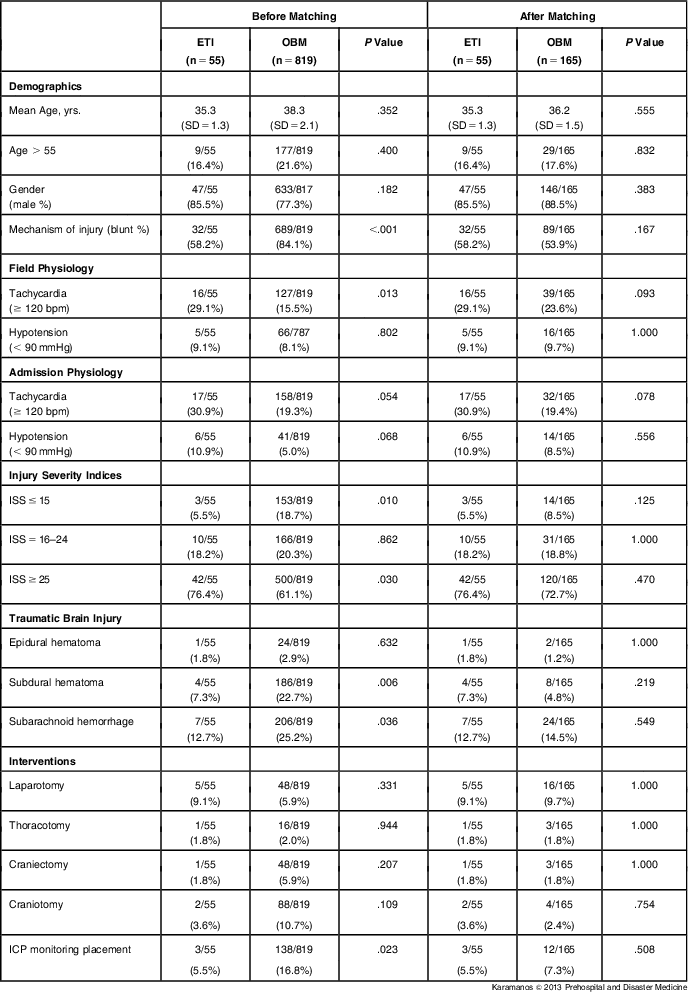
Patients undergoing prehospital ETI were more likely to have a penetrating mechanism of injury (41.8% vs 15.9%, P < .001), to be tachycardic in the field (29.1% vs 15.5%, P < .013) and to have a higher ISS (ISS ≥ 25:76.4% vs 61.1%, P < .030). Patients with prehospital ETI had a significantly lower incidence of subdural and subarachnoid hemorrhage (7.3% vs 22.7% and 12.7% vs 25.2%, respectively).
Following the propensity score matching, 55 cases were matched successfully with 165 controls. The demographics of the study population as well as the matched data are depicted in Table 1.
Demographic and Clinical Characteristics of the Study Population

Abbreviations: ETI, Endotracheal Intubation; OBM, Oxygen by Mask; ICP, intracranial pressure monitoring; ISS, Injury Severity Score
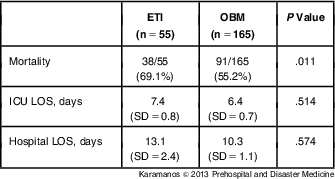
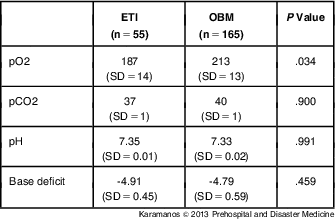
Mortality was significantly higher for the ETI cases (69.1% vs 55.2%, P = .011, Table 2). There was no difference in pH, base deficit and pCO2 on admission blood gases; however ETI cases had significantly lower pO2 (187 (SD = 14) vs 213 (SD = 13), P = .034). The time to obtain the ABGs was 15.3 (SD = 2.1) minutes after admission to the emergency department and did not differ significantly between the cases and their controls (12.7 (SD = 3.6) for the ETI cases vs 13.1(SD = 2.9) for the controls, Table 3).
Mortality and Hospital and Intensive Care Unit Lengths of Stay in sTBI Patients Subjected to Prehospital Endotracheal Intubation Administration and Control Patients

Abbreviations: ETI, Endotracheal Intubation; LOS, Length of Stay; OBM, Oxygen by Mask; sTBI, Severe Traumatic Brain Injury
Blood Gas Profile in Isolated sTBI Patients Subjected to Prehospital Endotracheal Intubation Administration and Control Patients

Abbreviations: ETI, Endotracheal Intubation; OBM, Oxygen by Mask; sTBI, Severe Traumatic Brain Injury
ETI cases also had longer HLOS and ICU LOS, but this finding did not reach statistical significance (Table 2).
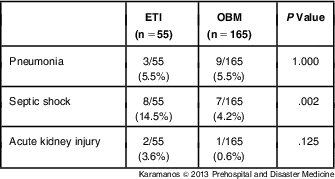
ETI cases had a higher incidence of septic shock (14.5% vs 4.2%, P = .002). There was no difference in the incidence of pneumonia and acute kidney injury (5.5% vs 5.5%, P = 1.000 and 3.6% vs .6%, P = .125 respectively, Table 4).
Complications in sTBI Patients Subjected to Prehospital Endotracheal Intubation Administration and Control Patients

Abbreviations: ETI, Endotracheal Intubation; OBM, Oxygen by Mask; sTBI, Severe Traumatic Brain Injury
Discussion
Over the recent decades, prehospital endotracheal intubation in metropolitan settings for patients suffering severe head injury has been a matter of debate.Reference Davis, Koprowicz and Newgard 9 - Reference Bauer 11 Several retrospective studies have failed to demonstrate convincingly any outcome benefit in patients selected for prehospital intubation following severe head injury.Reference Von Elm, Schoettker and Henzi 12 None of the included studies, however, used a proper randomization and therefore they were subject to inherent bias.
Among others, Murray et al evaluated the outcomes of prehospital ETI after stratifying sTBI patients into three groups by type of airway management: intubation, attempted intubation, and non-intubated groups. After matching the patients for field GSC, age, mechanism of injury, head AIS, ISS, associated injury and mechanism of injury, these investigators demonstrated no difference in mortality between the intubated and non-intubated groups (mortality ratio 1.20, P = .07 vs 1.13, P = .37). However, when the mortality was adjusted for attempted intubation, the risk of mortality was elevated (OR = 1.53, 95% CI, 1.31-5.34, P = .008).Reference Murray, Demetriades and Berne 13
Helm et al prospectively investigated the quality of oxygenation and ventilation in patients with severe TBI who were intubated in the field. Theses authors noted that optimal oxygenation, defined as PaO2 > 100 mmHg was achieved in 85% of patients and adequate ventilation (PaCO2 35-45 mmHg) was achieved in 43% of patients upon hospital admission. These investigators concluded that ETI and controlled ventilation in the prehospital setting does not guarantee optimal oxygenation and ventilation. This study, however, was limited by the lack of a control group.Reference Helm, Hauke and Lampl 14
Likewise, Wang et al compared a group of severe TBI patients who were intubated out-of-hospital to a group of sTBI patients that were intubated in the emergency department (ED). Using multivariate logistic regression these investigators observed that out-of-hospital ETI was associated with higher adjusted odds of death (OR = 3.99; 95% CI, 3.21-4.93), poorer neurologic outcomes (OR = 1.61; 95% CI, 1.15-2.26), and more severe functional impairment (Functional Impairment Score 11-15; OR = 1.80; 95% CI, 1.29-2.52).Reference Wang, Peitzman and Cassidy 15
Von Elm and co-investigators conducted a systematic review of the literature on prehospital tracheal intubation in patients with traumatic brain injury including 15,335 patients from 17 studies. They concluded that the available evidence did not support prehospital intubation and mechanical ventilation following severe head injury in metropolitan settings.Reference Von Elm, Schoettker and Henzi 12
Similar to previous studies, the findings of the current study suggest that in isolated TBI, prehospital endotracheal intubation is associated with significantly poorer admission oxygenation and higher case fatality rate while controlling for confounding variables. A matching of cases and controls was performed using a total of 19 variables; the sole discrepancy between the groups was prehospital intubation. The higher incidence in mortality and lower admission PaO2 noted in isolated TBI patients subjected to prehospital ETI may be attributed to the period of hypoxia during the airway protection attempts in the field. When performed in uncontrolled settings, ETI can do more harm than good if a short transportation time to a trauma care facility is expected. Intubation on scene may increase the risk of aspiration or misplacement of artificial airway resulting in further hypoxia. In addition, excessive hyperventilation during transport may aggravate cerebral ischemia, due to vasoconstriction, and secondary brain injury.Reference Bochicchio and Scalea 16 - Reference Davis 19
Limitations
To the best of the authors’ knowledge this study is the first to investigate the outcomes after field intubation in isolated TBI patients while examining the first arterial blood gases reflecting the level of oxygenation upon admission. Furthermore, it is the first study to match the cases with their controls for an extensive number of confounding factors. There are, however limitations to this study, with the most important being the retrospective nature of the data collection. The patients were not randomized to prehospital ETI; this was at the discretion of the emergency service providers. The authors attempted to compensate for this lack of randomization by matching the cases with controls as closely as possible by using a one to three ratio.
Conclusion
In isolated severe traumatic brain injury, prehospital intubation is associated with significantly worsened admission oxygenation and higher adjusted mortality rate. Further prospective validation of these findings is warranted.