Risk stratification of patients with Wolff–Parkinson–White syndrome can be a complex endeavour with imperfect evidence to guide management. It is well known that patients with Wolff–Parkinson–White are at risk for atrial fibrillation with rapid conduction through an accessory pathway, potentiating the risk for ventricular fibrillation.Reference Cohen, Triedman and Cannon 1 In their 2012 expert consensus statement, the Pediatric and Congenital Electrophysiology Society and the Heart Rhythm Society stated that patients aged 8–21 years with Wolff–Parkinson–White syndrome who are asymptomatic and have clear and abrupt loss of pre-excitation on exercise stress test are considered to have a lower risk of sudden death, and that invasive risk stratification is reasonable to assess a patient who does not demonstrate that clear and abrupt loss of pre-excitation; however, there are no recommendations, nor evidence, addressing repeat exercise stress tests to determine changes in risk stratification over time in these patients.Reference Cohen, Triedman and Cannon 1
We report a case that re-addresses the risk stratification criteria previously set forth regarding the management and non-invasive testing of asymptomatic young patients with Wolff–Parkinson–White syndrome.
Case report
We present the case of an 18-year-old man with a history of asymptomatic Wolff–Parkinson–White syndrome diagnosed by a screening electrocardiogram. His medications included oral methylphenidate, as well as patch, and oral guanfacine for attention deficit-hyperactivity disorder. His family history was unremarkable.
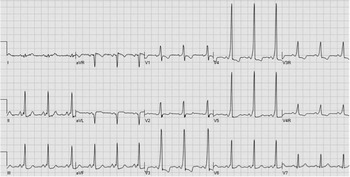
His electrocardiogram (Fig 1) was consistent with a sinus rhythm with evidence of pre-excitation, with a pattern suggestive of a left-sided accessory pathway. A 24-hour Holter monitor showed pre-excitation throughout the study with a maximum heart rate of 145 bpm. An echocardiogram showed normal cardiac anatomy and ventricular function.
Baseline electrocardiogram demonstrating pre-excitation with a qS pattern in aVL, suggesting a left-sided accessory pathway.

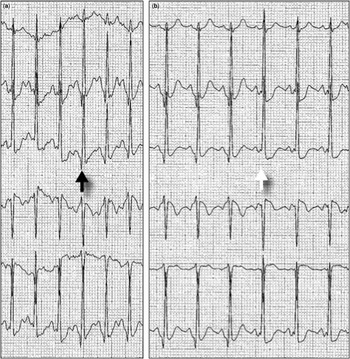
His first exercise stress test was performed 3.5 years ago according to the standard Bruce protocol. Pre-excitation was noted at rest, with beat-to-beat loss of pre-excitation at a heart rate of 176 bpm, and recurrence of pre-excitation during the recovery phase when the heart rate decreased to 128 bpm (Fig 2). The exercise stress test was repeated once more 3 months before his electrophysiology study to a maximum heart rate of 187 bpm, but with persistence of pre-excitation throughout the study. His home medications were consistent and were not held for either stress test or electrophysiology study.
( a ) Beat-to-beat loss of pre-excitation during exercise at a heart rate of 176 bpm. ( b ) Return of pre-excitation in recovery at a heart rate of 128 bpm.

Electrophysiologic testing
During his electrophysiology study, his baseline rhythm was consistent with persistent pre-excitation. Intracardiac intervals demonstrated an HV interval of 0 ms with the earliest ventricular activation in the mid-coronary sinus catheter. Rapid atrial pacing demonstrated 1:1 conduction via the accessory pathway at a cycle length of 290 ms from coronary sinus pacing. The accessory pathway effective refractory period was 500/270 ms. Testing was repeated on isoproterenol 0.02 mcg/kg/minute, with 1:1 conduction, via the accessory pathway at a cycle length of 220 ms with coronary sinus pacing. Atrial fibrillation could not be induced. He had inducible orthodromic re-entrant tachycardia with a left lateral accessory pathway, which was successfully ablated using radiofrequency energy via a trans-septal approach.
Discussion
Asymptomatic children with Wolff–Parkinson–White syndrome pose a challenging dilemma for the paediatric cardiologist. Given the risk for atrial fibrillation with rapid conduction through the accessory pathway leading to ventricular fibrillation and risk of sudden cardiac death, risk stratification of these patients is paramount; however, evidence has shown that, although we have certain non-invasive tools to risk stratify these patients, these tools are imperfect and without clear answers as to when invasive electrophysiological and repeat non-invasive testing are truly indicated.
For patients with evidence of persistent ventricular pre-excitation on baseline electrocardiogram and 24-hour Holter monitor, an exercise stress test has been shown to have diagnostic utility for determining risk of rapid accessory pathway conduction.Reference Cohen, Triedman and Cannon 1 – Reference Spar, Silver, Hordof and Liberman 5 Sudden loss of pre-excitation with exercise represents anterograde block in the accessory pathway. Several studies have shown that this sudden, beat-to-beat loss of pre-excitation is associated with both a greater accessory pathway effective refractory period and a greater shortest pre-excited R-to-R interval while in atrial fibrillation or rapid atrial pacing during electrophysiological testing. This beat-to-beat loss of pre-excitation lends to a lower risk of sudden death and, therefore, does not prompt the requirement of an electrophysiology study in the asymptomatic patient.Reference Cohen, Triedman and Cannon 1 – Reference Spar, Silver, Hordof and Liberman 5
Gaita et al performed a study in mainly symptomatic adult patients with Wolff–Parkinson–White syndrome, and found that an exercise stress test with persistent pre-excitation had a sensitivity of 96% and specificity of only 17% for predicting a shortest pre-excited R-to-R interval in atrial fibrillation of ⩽250 ms or accessory pathway effective refractory period ⩽250 ms.Reference Gaita, Giustetto, Riccardi, Mangiardi and Brusca 6 Wackel et al and Spar et al each investigated a similar concept in small groups of patients ⩽21 years of age with Wolff–Parkinson–White syndrome, in which a “low risk” exercise stress test had 100% specificity in identifying patients with subsequent non-rapid conduction during electrophysiological testing.Reference Spar, Silver, Hordof and Liberman 5 , Reference Wackel, Irving, Webber, Beerman and Arora 7
Studies over several decades have emphasised the limitations of the exercise stress test, and have shown that, despite a low risk status inferred by sudden loss of pre-excitation, an asymptomatic patient with Wolff–Parkinson–White syndrome can still have a high-risk accessory pathway shown on electrophysiological testing.Reference Daubert, Ollitrault, Descaves, Mabo, Ritter and Gouffault 2 In addition, there are neither current recommendations nor data regarding the utility of repeat exercise stress test to determine either change in risk of sudden cardiac death over time or an expected level of variability in risk stratification between subsequent exercise stress tests. Although consensus agreements argue that an electrophysiology study is not necessary in patients with clear and abrupt loss of pre-excitation, many electrophysiologists previously disagreed with this philosophy, with surveys by both Campbell et alReference Campbell, Strieper, Frias, Collins, Van Hare and Dubin 8 and Pappone et alReference Pappone, Radinovic and Santinelli 9 showing that 70–84% of electrophysiologists perform invasive electrophysiology studies on their asymptomatic patients with Wolff–Parkinson–White syndrome in order to risk stratify them and perform prophylactic ablations as indicated in those with high-risk pathways.
Our case presents a gap in the current guidelines and re-emphasises the work that still remains to be done to better establish risk stratification in asymptomatic young patients with Wolff–Parkinson–White syndrome. The potential risk of lethal cardiac arrhythmias secondary to an accessory pathway appears to be a dynamic process. Although an initial exercise stress test meeting low-risk criteria set forth by the Pediatric and Congenital Electrophysiology Society and the Heart Rhythm Society expert consensus recommendations may be re-assuring, our case suggests that serial stress tests may be warranted in patients with Wolff–Parkinson–White syndrome despite an initial test meeting low-risk criteria.
Acknowledgements
None.
Financial Support
This research received no specific grant from any funding agency, commercial, or not-for-profit sectors.
Conflicts of Interest
None.