


1 Introduction
A long-standing connection between logic and topology has been very fruitful in both directions. On the one hand, topology provides spatial semantics for many logical systems and gives insight into the fine-structure of logical reasoning. On the other hand, a logical approach gives rise to an entirely new set of problems in topology. For example, recent work on topological modal logic led to a novel concept of modal dimension for topological spaces [Reference Bezhanishvili, Bezhanishvili, Lucero-Bryan and van Mill4] and also established some new connections between topological completeness of modal logics and large cardinal axioms of set theory [Reference Bezhanishvili, Bezhanishvili, Lucero-Bryan and van Mill8].
The connection between logic and topology has also been exploited in computer science and philosophy. As noticed by Vickers [Reference Vickers29] and Abramsky [Reference Abramsky1], the notion of observability is best modeled using topology. More recently, developments in formal learning theory [Reference Baltag, Gierasimczuk and Smets3, Reference Brecht and Yamamoto12], distributed computing [Reference Herlihy, Kozlov and Rajsbaum18], and epistemic logic in multi-agent systems [Reference Baltag, Bezhanishvili, Özgün, Smets, Väänänen, Hirvonen and de Queiroz2, Reference Goubault, Ledent and Rajsbaum17, Reference Özgün25] have been based on topological semantics. In particular, topological methods have been employed in epistemic studies of modeling and reasoning about evidence and knowability [Reference Baltag, Bezhanishvili, Özgün, Smets, Väänänen, Hirvonen and de Queiroz2, Reference Özgün25].
We recall that in topological semantics of modal logic
 $\Box $
is interpreted as topological interior and hence
 $\Diamond $
as topological closure. The famous McKinsey–Tarski theorem [Reference McKinsey and Tarski24] states that under such an interpretation the modal logic of an arbitrary crowded (that is, dense-in-itself) metrizable space is Lewis’s well-known modal system
 $\textsf {S4}$
. The original McKinsey–Tarski theorem had an additional assumption of separability, which was shown to be redundant by Rasiowa and Sikorski [Reference Rasiowa and Sikorski26]. On the other hand, if a metric space is not crowded, it can give rise to other modal logics. A full characterization of such logics was given in [Reference Bezhanishvili, Gabelaia and Lucero-Bryan9]. To describe this result, for a topological space X, let
 $\textsf {L}(X)$
be the modal logic of X; that is,
 $\textsf {L}(X)$
is the set of modal formulas valid in X. Let also
 $\textsf {iso}X$
be the set of isolated points of X. We then have the following result, where all the undefined notions can be found in Section 2.
Theorem 1.1 [Reference Bezhanishvili, Gabelaia and Lucero-Bryan9, Theorem 3.8]
Let X be a nonempty metrizable space.
-
(1) If
 $\textsf {iso}X$
is not dense in X, then
$\textsf {L}(X)=\textsf {S4}$
.
-
(2) If
$\textsf {iso}X$
is dense in X but X is not scattered, then
$\textsf { L}(X)=\textsf {S4.1}$
. -
(3) If X is scattered and the Cantor–Bendixson rank of X is infinite, then
$\textsf {L}(X)=\textsf {S4.Grz}$
. -
(4) If X is scattered and of Cantor–Bendixson rank
$n\ge 1$
, then
$\textsf {L}(X)=\textsf {S4.Grz}_n$
.


It is unclear whether the McKinsey–Tarski theorem holds for a larger class of spaces. For example, a natural generalization of the class of metrizable spaces is that of paracompact spaces. But the McKinsey–Tarski theorem does not hold for crowded paracompact spaces as it already fails for crowded compact Hausdorff spaces. Indeed, the modal logic of an arbitrary infinite crowded extremally disconnected compact Hausdorff space is
 $\textsf {S4.2}$
[Reference Bezhanishvili and Harding11, Proposition 4.3].
Our aim is to obtain a version of the McKinsey–Tarski theorem for a different class of spaces, which also plays an important role in topology, and has numerous applications. One could think of metrizable spaces as a natural generalization of the topology of the real line
 $\mathbb R$
, which is induced by the metric
 $d(x,y)=|x-y|$
. But this topology is also induced by the ordering
 $\le $
of
 $\mathbb R$
. Thus, the concept of a linearly ordered topological space (or LOTS for short) is another natural generalization of
 $\mathbb R$
(see, e.g., [Reference Engelking16, p. 56]). Unlike the class of metrizable spaces, the class of LOTS is not closed under subspaces. Closing the class of LOTS under subspaces leads to the notion of a generalized ordered space (or GO-space for short); see, e.g., [Reference Lutzer23].
The classes of metrizable spaces and GO-spaces are incomparable. Each Euclidean space of dimension
 $\ge {2}$
is an example of a metrizable space that is not a GO-space. The circle is an example of a one-dimensional metrizable space that is not a GO-space. Examples of GO-spaces that are not metrizable include
 $\omega _1$
, the Sorgenfrey line, and the long line (see, e.g., [Reference Engelking16, p. 237]). More generally, typical examples of non-metrizable GO-spaces are topologies of “long” lexicographic orders. In spite of the differences, our main result mirrors Theorem 1.1 for metric spaces, indicating that these two classes of spaces have the same logical invariants. To obtain our main result, we first establish the McKinsey–Tarski theorem for an arbitrary crowded locally compact GO-space. If the real line is the guiding example in proving the McKinsey–Tarski theorem, the guiding example for our version of the McKinsey–Tarski theorem is the long line.
Our strategy is based on the modern proof of the McKinsey–Tarski theorem presented in [Reference Bezhanishvili, Bezhanishvili, Lucero-Bryan and van Mill5], which is based on the partition and mapping lemmas. Starting from a closed nowhere dense set N, the partition lemma builds a partition of a space consisting of N and finitely many open sets such that N is in the closure of each. Utilizing such partitions, the mapping lemma delivers a refutation for each non-theorem of S4 via an interior map onto an arbitrary finite rooted S4-frame. We develop these results for crowded locally compact GO-spaces.
As a brief survey aimed at providing intuition, we sketch how the partition lemma works for
 $\mathbb R$
, then for an arbitrary crowded metrizable space, and finally for a crowded locally compact GO-space. Rather than working directly with
 $\mathbb R$
, consider the real open unit interval
 $(0,1)$
. Start with N equal to the Cantor set (excluding 0 and 1) constructed through the well-known recursion of deleting open middle thirds. Then the open sets of the partition are obtained by taking appropriate unions of the deleted open thirds. Since an arbitrary crowded metrizable space need not have an immediate analogue of the Cantor set, Bing’s metrization theorem is utilized in a nontrivial way to prove a much more elaborate version of the partition lemma in [Reference Bezhanishvili, Bezhanishvili, Lucero-Bryan and van Mill5]. The situation for a crowded locally compact GO-space is simpler because it contains a nowhere dense preimage N of the Cantor set. This yields a starting point, which relies nontrivially on local compactness (see Section 3), that is analogous to the above construction for
 $\mathbb R$
. Moreover, the complement of N contains enough open sets to realize the desired partition. It remains an interesting open problem whether we can drop local compactness from our assumptions.
Our main result axiomatizes the modal logics arising as
 $\textsf {L}(X)$
for some locally compact GO-space X. In particular, we obtain an analogue of Theorem 1.1 for locally compact GO-spaces. While our proof technique is similar to that of [Reference Bezhanishvili, Gabelaia and Lucero-Bryan9], there is one important difference. Namely, the proof of [Reference Bezhanishvili, Gabelaia and Lucero-Bryan9] requires that each scattered metrizable space is strongly zero-dimensional, which is achieved by utilizing Telgársky’s theorem [Reference Telgársky28]. However, Telgársky’s theorem is not applicable to every locally compact GO-space. Instead we use Herrlich’s theorem [Reference Herrlich19] that a hereditarily disconnected LOTS is strongly zero-dimensional, and generalize it to the setting of GO-spaces. This yields that each scattered GO-space is strongly zero-dimensional.
The paper is organized as follows. In Section 2 we recall some basic definitions and facts about modal logic and its topological semantics. We also provide the necessary background on LOTS and GO-spaces. Section 3 is dedicated to proving the McKinsey–Tarski theorem for crowded locally compact GO-spaces. In Section 4 we generalize Herrlich’s result on hereditarily disconnected LOTS to hereditarily disconnected GO-spaces. Finally, in Section 5 we prove an analogue of Theorem 1.1 for locally compact GO-spaces.
2 Background
In this section we recall basic definitions and facts about modal logic and topology that play a key role in the paper. As basic references we use [Reference Chagrov and Zakharyaschev14] for modal logic, [Reference Engelking16] for topology, and [Reference Lutzer23] for GO-spaces.
2.1 Modal logic
Lewis’s modal system
 $\textsf {S4}$
is the least set of modal formulas containing
-
• the classical tautologies,
-
•
$\Box (p\to q)\to (\Box p \to \Box q)$
, -
•
$\Box p \to p$
, -
•
$\Box p\to \Box \Box p$
,


and closed under the inference rules
-
• modus ponens
$\frac {\varphi ,\ \varphi \to \psi }{\psi }$
, -
• substitution
$\frac {\varphi (p_0,\dots ,p_n)}{\varphi (\psi _0,\dots ,\psi _n)}$
, -
• necessitation
$\frac {\varphi }{\Box \varphi }$
.


As is common, we use
 $\Diamond \varphi $
as an abbreviation for
 $\lnot \Box \lnot \varphi $
.
We call a set
 $\textsf {L}$
of modal formulas a normal extension of
 $\textsf {S4}$
if
 $\textsf {S4}\subseteq \textsf {L}$
and
 $\textsf {L}$
is closed under the above three inference rules. The following well-known normal extensions of
 $\textsf {S4}$
play a key role in the paper:
 $$ \begin{align*} \begin{array}{l@{\,\,}c@{\,\,}l} \textsf{S4.1} & = & \textsf{S4} + \Box\Diamond p \to \Diamond \Box p, \\ \textsf{S4.Grz} & = & \textsf{S4} + \Box(\Box(p\to\Box p)\to p)\to p,\\ \textsf{S4.Grz}_n & = & \textsf{S4.Grz} + \textsf{bd}_n \ (n\ge1), \end{array} \end{align*} $$
where
 $$ \begin{align*} \begin{array}{l@{\,\,}c@{\,\,}l} \textsf{bd}_1 & = & \Diamond\Box p_1 \to p_1,\\ \textsf{bd}_{n+1} & = & \Diamond(\Box p_{n+1}\wedge\lnot\textsf{bd}_n)\to p_{n+1}\ (n\ge1). \end{array} \end{align*} $$
In relational semantics of modal logic, an S4-frame is a pair
 $\mathfrak F = (W,R)$
consisting of a nonempty set W and a reflexive and transitive binary relation R on W. Let
 $\mathfrak F=(W,R)$
be an S4-frame. Then
 $\mathfrak F$
is a partially ordered
 $\textsf {S4}$
-frame if R is additionally antisymmetric. For
 $A\subseteq W$
, define
 $$ \begin{align*} R(A) &= \{ w\in W \mid \exists a\in A \mbox{ with } a\mathbin{R}w\} \mbox{ and } \\ R^{-1}(A) &= \{ w\in W \mid \exists a\in A \mbox{ with } w\mathbin{R}a\}. \end{align*} $$
If
 $A=\{w\}$
, then we simply write
 $R(w)$
and
 $R^{-1}(w)$
. Call
 $\mathfrak F$
rooted if there is an
 $r\in W$
, called a root of
 $\mathfrak F$
, such that
 $R(r)=W$
. A cluster of
 $\mathfrak F$
is an equivalence class of the equivalence relation
 $\equiv $
on W defined by
 $w\equiv v$
iff
 $w\mathbin{R}v$
and
 $v\mathbin{R}w$
. The skeleton
 $\rho \mathfrak F$
of
 $\mathfrak F$
is the quotient of
 $\mathfrak F$
by
 $\equiv $
. Then
 $\rho \mathfrak F$
is a partially ordered
 $\textsf {S4}$
-frame whose order is induced by R in the natural way.
Let
 $\mathfrak F=(W,R)$
be a partially ordered
 $\textsf {S4}$
-frame. A subset C of W is a chain in
 $\mathfrak F$
if
 $w\mathbin{R}v$
or
 $v\mathbin{R}w$
for all
 $w,v\in C$
. The depth of
 $\mathfrak F$
is
 $n\ge 1$
provided there is a chain in
 $\mathfrak F$
consisting of n elements but no chain in
 $\mathfrak F$
has
 $n+1$
elements. Call
 $\mathfrak F$
a tree if
 $\mathfrak F$
is rooted and
 $R^{-1}(w)$
is a finite chain for each
 $w\in W$
. Let
 $\mathfrak F=(W,R)$
be a tree and
 $w,v\in W$
. Call
 $v$
a child of
 $w$
and
 $w$
the parent of
 $v$
provided
 $v$
covers
 $w$
; that is,
 $w\mathbin{R}v$
,
 $w\neq v$
, and
 $w\mathbin{R}u\mathbin{R}v$
implies
 $u=w$
or
 $u=v$
for each
 $u\in W$
.
Let
 $\mathfrak F=(W,R)$
be an S4-frame. The depth of
 $\mathfrak F$
is n provided the depth of
 $\rho \mathfrak F$
is n. Let
 $A\subseteq W$
. We call
 $w\in A$
quasi-maximal (resp. maximal) in A if
 $w\mathbin{R}v$
implies
 $v\mathbin{R}w$
(resp.
 $w=v$
) for each
 $v\in A$
. The concept of quasi-minimal (resp. minimal) is defined dually. Let
 $\mathrm {qmax}A$
(resp.
 $\max A$
) be the set of quasi-maximal (resp. maximal) points in A. Call
 $\mathfrak F$
a quasi-tree whenever
 $\rho \mathfrak F$
is a tree. Let
 $\mathfrak F=(W,R)$
be a quasi-tree. Then
 $\mathfrak F$
is a top-thin-quasi-tree provided that
 $\mathrm {qmax}W=\max W$
and each maximal cluster is the unique child of its parent cluster in
 $\rho \mathfrak F$
; see Figure 1.
A top-thin-quasi-tree.

The modal language is interpreted in an S4-frame
 $\mathfrak F=(W,R)$
by associating to each propositional letter a subset of W. This extends to all modal formulas by interpreting the classical connectives as Boolean operations and the modal box by setting
 $$ \begin{align*} w\vDash\Box\varphi \mbox{ iff } (\forall v\in W)(w\mathbin{R}v\text{ implies }v\vDash\varphi), \end{align*} $$
and hence
 $$ \begin{align*} w\vDash\Diamond\varphi \mbox{ iff } (\exists v\in W)(w\mathbin{R}v\text{ and }v\vDash\varphi). \end{align*} $$
A formula
 $\varphi $
is valid in
 $\mathfrak F$
, written
 $\mathfrak F\vDash \varphi $
, provided under every valuation of the propositional letters we have
 $w\vDash \varphi $
for each
 $w\in W$
. Let
 $\textsf {L}(\mathfrak F)$
be the set of modal formulas valid in
 $\mathfrak F$
, and for a class
 $\mathcal K$
of
 $\textsf {S4}$
-frames, let
 $\textsf {L}(\mathcal K)=\bigcap \{\textsf { L}(\mathfrak F)\mid \mathfrak F\in \mathcal K\}$
. It is well known that
 $\textsf {L}(\mathfrak F)$
and hence
 $\textsf {L}(\mathcal K)$
are normal extensions of S4. We call
 $\textsf {L}(\mathfrak F)$
the modal logic of
 $\mathfrak F$
and
 $\textsf {L}(\mathcal K)$
the modal logic of
 $\mathcal K$
. The following result is well known; see, e.g., [Reference Chagrov and Zakharyaschev14] (or [Reference Bezhanishvili and Harding11, Proposition 2.5]).
-
(1) S4 is the logic of the class of all finite quasi-trees.
-
(2) S4.1 is the logic of the class of all finite top-thin-quasi-trees.
-
(3) S4.Grz is the logic of the class of all finite trees.
-
(4)
$\textsf {S4.Grz}_n$
is the logic of the class of all finite trees of depth
$\le {n}$
.


2.2 Topological semantics
Let X be a nonempty topological space. We interpret propositional letters as subsets of X, classical connectives as the corresponding Boolean operations,
 $\Box $
as interior, and hence
 $\Diamond $
as closure. Therefore, for
 $x\in X$
, we have
 $$ \begin{align*} & x\vDash\Box\varphi \mbox{ iff there is an open neighborhood}\ U\ \mbox{of}\ x\\ & \qquad\ \ \qquad \mbox{such that } y\vDash\varphi\text{ for all }y\in U, \end{align*} $$
and hence
 $$ \begin{align*} & x\vDash\Diamond\varphi \mbox{ iff for every open neighborhood}\ U\ \mbox{of}\ x\\ & \qquad\ \ \qquad \mbox{there is}\ y\in U\ \mbox{such that } y\vDash\varphi. \end{align*} $$
A modal formula
 $\varphi $
is valid in X, written
 $X\vDash \varphi $
, provided under all valuations we have
 $x\vDash \varphi $
for each
 $x\in X$
. The modal logic
 $\textsf {L}(X)$
of X is the set of formulas valid in X, and the modal logic
 $\textsf {L}(\mathcal K)$
of a class of spaces is
 $\bigcap \{\textsf {L}(X)\mid X\in \mathcal K\}$
. It is well known that
 $\textsf {L}(X)$
and hence
 $\textsf {L}(\mathcal K)$
are normal extensions of S4.
Topological semantics generalizes relational semantics of
 $\textsf {S4}$
since each S4-frame can be viewed as a special topological space, in which an arbitrary intersection of open sets is open. Such spaces are known as Alexandroff spaces. For an S4-frame
 $\mathfrak F=(W,R)$
, call
 $U\subseteq W$
an R-upset if
 $R(U)=U$
. An R-downset is defined dually, and for a partially ordered set we simply say an upset or downset. The collection
 $\tau _R$
of all R-upsets of
 $\mathfrak F$
is an Alexandroff topology on W such that
 $R^{-1}$
is the closure operator,
 $\{R(w)\mid w\in W\}$
is a basis for
 $\tau _R$
, and
 $\mathfrak F\vDash \varphi $
iff
 $(W,\tau _R)\vDash \varphi $
for each modal formula
 $\varphi $
. Consequently, if a normal extension of
 $\textsf {S4}$
is complete with respect to its relational semantics, then it is also complete with respect to its topological semantics.
For a topological space X, we denote the closure and derivative operators by
 $\textsf {c}$
and
 $\textsf {d}$
, respectively. We recall that a point
 $x\in X$
is isolated if
 $\{x\}$
is open. Let
 $\mathsf {iso} X$
be the set of isolated points of X. Then X is crowded (or dense-in-itself) if
 $\mathsf {iso} X=\varnothing $
, and X is scattered if every nonempty subspace of X has an isolated point (in the relative topology).
Following a suggestion of Archangel’skii (see [Reference Bezhanishvili, Bezhanishvili, Lucero-Bryan and van Mill7, Definition 2.1]), we call X densely discrete provided
 $\mathsf {iso} X$
is dense in X (that is,
 $\textsf {c}(\mathsf {iso} X)=X$
). It is easy to see that every scattered space is densely discrete, but that the converse is not true in general.
By the famous Cantor–Bendixson theorem (see, e.g., [Reference Semadeni27, Theorem 8.5.2]), each space is decomposed into the disjoint union of a closed crowded subspace D and an open scattered subspace S. For
 $A\subseteq X$
and ordinal
 $\alpha $
, define recursively
 $\textsf {d}^\alpha A$
by setting
 $$ \begin{align*} \begin{array}{l@{\,\,}c@{\,\,}l} \textsf{d}^0A &=& A,\\ \textsf{d}^{\alpha+1}A &=& \textsf{d}\left(\textsf{d}^\alpha A\right),\\ \textsf{d}^\alpha A &=& \bigcap\nolimits_{\beta<\alpha}\textsf{d}^\beta A \text{ if } \alpha \text{ is a limit ordinal}. \end{array} \end{align*} $$
There is a least ordinal
 $\varrho $
, called the Cantor–Bendixson rank of X, such that
 $\textsf {d}^\varrho X=\textsf {d}^{\varrho +1}X$
. The Cantor–Bendixson decomposition
 $X=D\cup S$
is then realized by
 $D=\textsf {d}^\varrho X$
and
 $S=X\backslash D$
. It is well known that X is scattered iff
 $D=\varnothing $
, and that X is crowded iff
 $S=\varnothing $
. For scattered spaces, the Cantor–Bendixson rank is the topological analogue of the depth of an
 $\textsf {S4}$
-frame. It is well known that an S4-frame
 $\mathfrak F$
is of depth
 $\le {n}$
iff
 $\mathfrak F\vDash \textsf {bd}_n$
(see, e.g., [Reference Chagrov and Zakharyaschev14, Proposition 3.44]). Likewise, it follows from [Reference Bezhanishvili, Gabelaia and Lucero-Bryan9, Lemma 3.6] that a nonempty scattered space X is of Cantor–Bendixson rank
 $\le {n}$
iff
 $X\vDash \textsf {bd}_n$
. The following topological analogue of Lemma 2.1 is well known (see, for example, [Reference Bezhanishvili and Harding11, Proposition 2.2]).
-
(1) S4 is the logic of the class of all topological spaces.
-
(2) S4.1 is the logic of the class of all densely discrete spaces.
-
(3) S4.Grz is the logic of the class of all scattered spaces.
-
(4)
$\textsf {S4.Grz}_n$
is the logic of the class of all scattered spaces of Cantor–Bendixson rank
$\le {n}$
.


Let
 $f:X\to Y$
be a map between topological spaces. We recall that f is
-
• continuous if
$f^{-1}(V)$
is open in X for each open
$V\subseteq Y$
, -
• open if
$f(U)$
is open in Y for each open
$U\subseteq X$
, -
• interior if it is both continuous and open.


It is well known that f is interior iff
 $f^{-1}$
commutes with closure. We will use this in Section 5. If f is an onto interior map, then we call Y an interior image of X. Because an S4-frame is equivalently an Alexandroff space, these definitions make sense if either X or Y is an S4-frame. Indeed, an interior map is the topological analogue of a p-morphism. As such, onto interior maps preserve validity; that is, if Y is an interior image of X, then
 $\textsf {L}(X)\subseteq \textsf {L}(Y)$
.
Let Y be an open subspace of X. Then the inclusion
 $Y\to X$
is an interior map. As with interior images, we have that open subspaces preserve validity; that is, if Y is an open subspace of X, then
 $\textsf {L}(X)\subseteq \textsf {L}(Y)$
.
2.3 LOTS and GO-spaces
We recall that a partially ordered set
 $(X,\le )$
is linearly ordered if
 $x\le y$
or
 $y\le x$
for each
 $x,y\in X$
(that is,
 $(X,\le )$
is a chain). We write
 $x<y$
provided
 $x\le y$
and
 $x\neq y$
. The intervals
 $$ \begin{align*} (x,y),[x,y],[x,y),(y,x] \end{align*} $$
are defined as usual, and so are the intervals
 $$ \begin{align*} (x,\rightarrow),[x,\rightarrow),(\leftarrow,y),(\leftarrow,y]. \end{align*} $$
Therefore,
 $$ \begin{align*} (x,y) = \{z\in X\mid x<z<y\}, \ \ (x,\rightarrow) = \{z\in X\mid x<z\}, \ \ \mbox{etc}. \end{align*} $$
We say that
 $C\subseteq X$
is convex provided
 $x,y\in C$
and
 $x\le y$
imply
 $[x,y]\subseteq C$
. Clearly each interval is convex. Let
 $\varnothing \ne Y\subseteq X$
. A convex component C of Y is a maximal convex subset of Y. Each convex component of Y is an interval (possibly a singleton). For each
 $x\in Y$
, there is a unique convex component
 $C_x$
of Y containing x; namely
 $$ \begin{align*} C_x=\bigcup\{C\subseteq Y\mid x\in C\text{ and }C\text{ is convex}\}, \end{align*} $$
and the convex components of Y yield a partition of Y. The next definition is well known (see, e.g., [Reference Engelking16, pp. 56–57]).
Definition 2.3. A topological space
 $(X,\tau )$
is called a linearly ordered topological space or simply a LOTS provided there is a linear order
 $\le $
on X such that the family
 $$ \begin{align*} \mathscr{B}_\le:=\left\{(x,\rightarrow),(x,y),(\leftarrow,y)\mid x,y\in X\right\} \end{align*} $$
is a basis for
 $\tau $
. We call
 $\tau $
the interval topology, and say that
 $\le $
induces
 $\tau $
.
Typical examples of LOTS include the real numbers
 $\mathbb R$
, rationals
 $\mathbb Q$
, the Cantor space
 $\textsf {C}$
, etc. On the other hand, the subspace
 $X:=(0,1)\cup \{2\}$
of
 $\mathbb R$
is not a LOTS (see, e.g., [Reference Lutzer23, Remark 6.2]). This shows that the class of LOTS is not closed under taking subspaces.
Definition 2.4. A topological space X is called a generalized ordered space or simply a GO-space provided it is homeomorphic to a subspace of some LOTS.
The next theorem is well known (see, e.g., [Reference Lutzer23, Section 2]).
Theorem 2.5. A topological space
 $(X,\tau )$
is a GO-space iff there is a linear ordering
 $\le $
of X such that
 $\mathscr{B}_\le \subseteq \tau $
and each
 $x\in X$
has a local basis consisting of intervals in X.
We conclude this section with a lemma in which we collect together some well-known facts about GO-spaces that will be useful in the rest of the paper. Where we were unable to find an exact reference, we briefly sketch a proof. We recall that a subset of a topological space is clopen if it is simultaneously closed and open, and that a property is hereditary if every subspace has it. We also recall that the concept of a collectionwise normal space is a strengthening of the concept of a normal space; see [Reference Engelking16, p. 305] for details.
Lemma 2.6. Let X be a GO-space.
-
(1) The convex components of an open subset U of X are open, and hence U is uniquely represented as a disjoint union of open convex sets in X.
-
(2) If X is compact, then X is a LOTS.
-
(3) If
$K\subseteq X$
is compact and nonempty, then
$\max K$
and
$\min K$
exist. -
(4) If X is separable, then X is first-countable.
-
(5) X is separable iff X is hereditarily separable.
-
(6) X is hereditarily collectionwise normal.


Proof (1) Let C be a convex component of U and
 $x\in C$
. Since
 $x\in U$
, Theorem 2.5 implies that there is an open convex subset V of X such that
 $x\in V$
and
 $V\subseteq U$
. By the maximality of C we see that
 $V\subseteq C$
. Therefore, C is open in X.
(2) See, e.g., [Reference Lutzer23, Lemma 6.1].
(3) If
 $\max K$
does not exist, then
 $\{(\leftarrow ,x)\mid x\in K\}$
is an open covering of K with no finite subcover. That
 $\min K$
exists is proved similarly.
(4) Let D be a countable dense subset of X and
 $x\in X$
. If x is isolated in X then
 $\{\{x\}\}$
is a countable local basis at x. Suppose that x is not isolated. Then
 $$ \begin{align*} x\in\textsf{c}\left(X\backslash\{x\}\right)=\textsf{c}(\leftarrow,x)\cup\textsf{c}(x,\rightarrow). \end{align*} $$
If
 $x\in \textsf {c}(\leftarrow ,x)\cap \textsf {c}(x,\rightarrow )$
, then
 $$ \begin{align*} \left\{(d,e)\mid d,e\in D\text{ and }d<x<e\right\} \end{align*} $$
is a countable local basis at x. Suppose that
 $x\in \textsf {c}(\leftarrow ,x)\backslash \textsf {c}(x,\rightarrow )$
. Then
 $\textsf {c}(\leftarrow ,x)=(\leftarrow ,x]$
and
 $\textsf {c}(x,\rightarrow )=(x,\rightarrow )$
. Therefore,
 $(\leftarrow ,x]$
is a clopen downset, implying that
 $\{(a,x]\mid a<x\}$
is a local basis at x. Thus,
 $$ \begin{align*} \{(d,x]\mid d\in D\cap(\leftarrow,x)\} \end{align*} $$
is a countable local basis at x. Similarly, if
 $x\in \textsf {c}(x,\rightarrow )\backslash \textsf {c}(\leftarrow ,x)$
, then
 $\{[x,d)\mid d\in D\cap (x,\rightarrow )\}$
is a countable local basis at x.
(5) See, e.g., [Reference Lutzer23, Proposition 2.10(a)].
(6) By [Reference Lutzer23, Proposition 4.1], each GO-space is collectionwise normal. Since a subspace of a GO-space is a GO-space, each GO-space is hereditarily collectionwise normal.⊣
3 The McKinsey–Tarski theorem for crowded locally compact GO-spaces
In this section we prove our first main result, that the McKinsey–Tarski Theorem holds for an arbitrary (nonempty) crowded locally compact GO-space. The section is divided into three subsections. The first subsection consists of several auxiliary lemmas, and the second subsection proves the Partition Lemma, the key tool in proving the Mapping Lemma, which is done in the third subsection. The Mapping Lemma then easily delivers the main result of the section, that
 $\textsf {S4}$
is the logic of an arbitrary (nonempty) crowded locally compact GO-space.
3.1 Auxiliary lemmas
We recall that a space X is locally compact provided for each
 $x\in X$
there is an open neighborhood U of x such that
 $\textsf {c} U$
is a compact Hausdorff subspace of X. By [Reference Engelking16, Theorem 3.3.1], each locally compact space is Tychonoff. We also recall that a continuous onto map between compact Hausdorff spaces is irreducible provided the image of a closed proper subset is proper. The following fact is well known. Since we were unable to find a reference, we give a short proof.
Lemma 3.1 Folklore
Let X be a nonempty crowded locally compact space. Then there is a compact subspace Y of X and an irreducible map f from Y onto the Cantor space
 $\textsf {C}$
.
Proof Since X is nonempty locally compact, there is a nonempty open subset U of X such that
 $\textsf {c} U$
is compact. Because X is crowded,
 $\textsf {c} U$
is not scattered. Therefore, [Reference Semadeni27, Theorem 8.5.4] yields a continuous onto map
 $f:\textsf {c} U\to [0,1]$
. Thus,
 $f^{-1}(\textsf {C})$
is a closed, hence compact subspace of
 $\textsf {c} U$
, and the restriction of f to
 $f^{-1}(\textsf {C})$
is a continuous map onto
 $\textsf {C}$
. Finally, apply [Reference Johnstone22, p. 102] to deliver a closed, hence compact subspace Y of
 $f^{-1}(\textsf {C})$
such that the restriction of f to Y is an irreducible map onto
 $\textsf {C}$
.⊣
Lemma 3.2. For X, Y, and
 $f:Y\to \textsf {C}$
as in Lemma 3.1, there is a compact nowhere dense
 $Z\subseteq X$
and an irreducible map
 $g:Z\to \textsf {C}$
.
Proof Let
 $\textsf {C}_0$
be a nowhere dense closed subspace of
 $\textsf {C}$
that is homeomorphic to
 $\textsf {C}$
. Since f is irreducible,
 $f^{-1}(\textsf {C}_0)$
is closed and nowhere dense in Y, hence closed and nowhere dense in X. There is a closed subspace Z of
 $f^{-1}(\textsf {C}_0)$
such that
 $f|_Z:Z\to \textsf {C}_0$
is an irreducible map (see, e.g., [Reference Johnstone22, p. 102]). As Y is compact and Z is closed in Y, we have that Z is compact. Moreover, Z is nowhere dense in X since Z is nowhere dense in
 $f^{-1}(\textsf {C}_0)$
, which is nowhere dense in X. The desired irreducible map
 $g:Z\to \textsf {C}$
is then the composition of
 $f|_Z$
and a homeomorphism of
 $\textsf {C}_0$
onto
 $\textsf {C}$
.⊣
Lemma 3.3. If X, Z, and
 $g:Z\to \textsf {C}$
are as in Lemma 3.2, then Z is separable and crowded.
Proof Let D be a countable dense subset of
 $\textsf {C}$
. Because g is onto, we may choose
 $z_x\in g^{-1}(x)$
for each
 $x\in D$
. Let
 $E=\{z_x\mid x\in D\}$
. Then E is dense in Z since g is irreducible. Therefore, Z is separable. If x is an isolated point of Z, then
 $Z\backslash \{x\}$
is a proper closed subset of Z, and hence
 $g(Z\backslash \{x\})$
is a proper closed subset of
 $\textsf {C}$
. This is a contradiction since
 $g(Z\backslash \{x\})=\textsf {C}\backslash \{g(x)\}$
. Thus, Z is crowded.⊣
Lemma 3.4. Let X be a crowded locally compact GO-space and C a nonempty convex open subset of X. Then there is a nonempty crowded compact separable nowhere dense subspace of C.
Proof Since C is a nonempty convex open subset of a crowded Hausdorff space, there are
 $x,y\in C$
such that
 $\varnothing \neq (x,y)\subseteq C$
. Because
 $(x,y)$
is open in X, which is crowded and locally compact, we have that
 $(x,y)$
is a crowded locally compact subspace of X. Lemmas 3.2 and 3.3 then yield a nonempty crowded compact separable nowhere dense subspace Z of
 $(x,y)$
. Since Z is nowhere dense in
 $(x,y)$
, it is nowhere dense in C.⊣
The nonempty crowded compact separable nowhere dense subspaces play the same role in our construction as the Cantor space plays in the construction of [Reference Bezhanishvili and Gehrke10, Section 3].
Lemma 3.5. Let X be a crowded compact separable GO-space and
 $$ \begin{align*} L=\{x\in X\mid x\in\textsf{c}(\leftarrow,x)\}. \end{align*} $$
-
(1) L is dense in X.
-
(2) There is a countable dense subset D of X such that
$D\subseteq L$
and each
$x\in D$
is the supremum of a strictly increasing sequence in D.


Proof (1) If L is not dense, then there is a nonempty open subset G of X such that
 $G\cap L=\varnothing $
. Since
 $G\neq \varnothing $
and X is normal (see Lemma 2.6(6)), there is a nonempty open subset U of X such that
 $\textsf {c} U\subseteq G$
. Because U is a nonempty open subspace of a crowded space, U is crowded, so
 $\textsf {c} U$
is also crowded. Moreover,
 $\textsf {c} U$
is compact and
 $\textsf {c} U\cap L=\varnothing $
. Let
 $x=\max \textsf {c} U$
(see Lemma 2.6(3)). As
 $x\not \in L$
, we have that
 $x\not \in \textsf {c}(\leftarrow ,x)$
. Therefore, there is an open neighborhood V of x such that
 $V\cap (\leftarrow ,x)=\varnothing $
. Thus,
 $V\cap \textsf {c} U=\{x\}$
, implying that x is an isolated point of
 $\textsf {c} U$
. The obtained contradiction proves that L is dense in X.
(2) By Lemma 2.6(5), L is separable. Let D be a countable dense subset of L. Then D is dense in X since L is dense in X by (1). Let
 $x\in D$
. It follows from Lemma 2.6(4) that there is a countable local basis
 $\{U_n\mid n\in \omega \}$
at x. Without loss of generality we may assume
 $U_{n+1}\subset U_n$
for each
 $n\in \omega $
. We recursively define a sequence
 $\{x_n\}_{n\in \omega }$
utilizing both that
 $x\in \textsf {c}(\leftarrow ,x)$
(since
 $x\in L$
) and that D is dense in X. As
 $U_0$
is an open neighborhood of x, we have that
 $U_0\cap (\leftarrow ,x)\neq \varnothing $
. Because
 $U_0\cap (\leftarrow ,x)$
is open in X, we may choose
 $x_0\in U_0\cap (\leftarrow ,x)\cap D$
. For
 $n\in \omega $
, assume that
 $x_n\in U_n\cap D$
has been chosen so that
 $x_n<x$
. Noting that
 $(x_n,\rightarrow )\cap U_{n+1}$
is an open neighborhood of x, we have that
 $(x_n,\rightarrow )\cap U_{n+1}\cap (\leftarrow ,x)$
is a nonempty open subset of X. Thus, we may choose
 $x_{n+1}\in (x_n,\rightarrow )\cap U_{n+1}\cap (\leftarrow ,x)\cap D$
.
By construction, we have that
 $\{x_n\}_{n\in \omega }$
is a strictly increasing sequence in D bounded above by x. Let
 $y\in X$
be such that
 $y<x$
. Then
 $(y,\rightarrow )$
is an open neighborhood of x. So there is
 $n\in \omega $
such that
 $U_n\subseteq (y,\rightarrow )$
. Since
 $x_n\in U_n$
, we have that
 $y<x_n$
. Therefore, y is not an upper bound of
 $\{x_n\}_{n\in \omega }$
, and hence x is the supremum of
 $\{x_n\}_{n\in \omega }$
.⊣
3.2 The Partition Lemma
Let
 $\kappa \ge 1$
be a cardinal. We recall that a space Y is
 $\kappa $
-resolvable if there is a partition of Y into
 $\kappa $
subsets that are each dense in Y. Clearly being
 $1$
-resolvable merely means that the space is nonempty. Nevertheless, this notion is useful for inductive arguments. The following lemma on resolvability is a straightforward consequence of the work of Hewitt, Ceder, Illanes, and Eckertson.
Lemma 3.6. Let Y be a nonempty crowded Hausdorff space and
 $1\le \kappa \le \omega $
.
-
(1) If Y is first-countable, then Y is
$\kappa $
-resolvable. -
(2) If Y is locally compact, then Y is
$\kappa $
-resolvable.


Proof (1) Since Y is a nonempty crowded first-countable space, Y is
 $2$
-resolvable by [Reference Hewitt20, p. 331]. Because the property of being first-countable and crowded is preserved by dense subsets of Y, a straightforward induction yields that Y is n-resolvable for each
 $n\ge 2$
. By [Reference Illanes21, Theorem 5], Y is also
 $\omega $
-resolvable.
(2) Recall that the dispersion character of Y is
 $$ \begin{align*} \Delta(Y):=\min\{|U|\mid U\text{ is nonempty open in }Y\}. \end{align*} $$
Since Y is a nonempty crowded Hausdorff space,
 $\Delta (Y)\ge \omega $
. Because Y is also locally compact, Y is
 $\Delta (Y)$
-resolvable by [Reference Ceder13, Theorem 7]. Now apply [Reference Eckertson15, Proposition 1.1(b)].⊣
Lemma 3.7 Partition Lemma
Let X be a crowded locally compact GO-space, F a nonempty crowded compact separable nowhere dense subset of X, and
 $k\in \omega $
. Then there is a partition
 $\{F,U_0,\dots ,U_k\}$
of X such that each
 $U_i$
is open in X and
 $\textsf {c} U_i=U_i\cup F$
.
Proof Since F satisfies the conditions of Lemma 3.5, there is a countable dense subset D of F as in Lemma 3.5(2). Being a compact subspace of a GO-space, F is closed in X. Let
 $\mathscr{C}$
be the collection of all convex components of
 $X\backslash F$
. By Lemma 2.6(1), each element of
 $\mathscr{C}$
is open in X. For each
 $y\in X\backslash F$
let
 $C_y$
be the unique element of
 $\mathscr{C}$
such that
 $y\in C_y$
.
For each
 $x\in D$
, we build a countably infinite pairwise disjoint subcollection
 $\mathscr{C}^{\prime }_x$
of
 $\mathscr{C}$
. Let
 $x\in D$
. By Lemma 3.5(2), there is a strictly increasing sequence
 $\{x_n\}_{n\in \omega }$
in D whose supremum is x. Let
 $n\in \omega $
and consider the open interval
 $(x_n,x_{n+1})$
, which is nonempty by Lemma 3.5(2) because
 $x_{n+1}\in D$
. Since F is nowhere dense,
 $(x_n,x_{n+1})\not \subseteq F$
. Choose
 $y_n\in (x_n,x_{n+1})\backslash F$
and consider
 $C_{y_n}\in \mathscr{C}$
. Since
 $x_n,x_{n+1}\in F$
, it must be the case that
 $C_{y_n}\subseteq (x_n,x_{n+1})$
. Set
 $\mathscr{C}^{\prime }_x=\{C_{y_n}\mid n\in \omega \}$
.
Let
 $x,y\in D$
be such that
 $y<x$
. As x is the supremum of the strictly increasing sequence
 $\{x_n\}_{n\in \omega }$
, there is
 $N\in \omega $
such that
 $y<x_n$
for all
 $n\ge N$
. Thus, all but finitely many members of
 $\mathscr{C}^{\prime }_x$
are contained in
 $(y,\rightarrow )$
. This implies that
 $\mathscr{C}^{\prime }_x\cap \mathscr{C}^{\prime }_y$
is finite since
 $\bigcup \mathscr{C}_y'\subseteq (\leftarrow ,y)$
. Let
 $\{x_m\mid m\in \omega \}$
be an enumeration of D. For each
 $m\in \omega $
put
 $$ \begin{align*} \mathscr{C}_{x_m} = \mathscr{C}_{x_m}'\backslash\bigcup\limits_{i<m}\mathscr{C}_{x_i}'. \end{align*} $$
Then
 $\{\mathscr{C}_x\mid x\in D\}$
is a pairwise disjoint family of countably infinite subcollections of
 $\mathscr{C}$
.
Since F is a crowded separable GO-space and D is a dense subspace of F, we have that D is crowded and separable (see Lemma 2.6(5)). By Lemma 2.6(4), D is first-countable. By Lemma 3.6(1), there is a partition
 $\{D_0,\dots ,D_k\}$
of D consisting of dense subsets of D. For
 $0\le i\le k$
, set
 $U_i=\bigcup \mathscr{C}_i$
where
 $$ \begin{align*} \mathscr{C}_i = \left\{ \begin{array}{@{}ll} \bigcup\{\mathscr{C}_x \mid x\in D_i\} & \text{if }i<k,\\ \mathscr{C}\backslash\bigcup\{\mathscr{C}_x \mid x\in D\backslash D_k\} & \text{if } i=k. \end{array} \right. \end{align*} $$
Since
 $\mathscr{C}$
consists of open convex sets in X, for each
 $0\le i\le k$
, we have that
 $U_i$
is open in X and its set of convex components is
 $\mathscr{C}_i$
. Moreover,
 $\{\mathscr{C}_0,\dots ,\mathscr{C}_k\}$
is a partition of
 $\mathscr{C}$
. Therefore,
 $\{U_0,\dots ,U_k\}$
is pairwise disjoint and
 $$ \begin{align*} X\backslash F = \bigcup\mathscr{C} = \bigcup\nolimits_{i=0}^k\bigcup\mathscr{C}_i = \bigcup\nolimits_{i=0}^kU_i. \end{align*} $$
Thus,
 $\{F,U_0,\dots ,U_k\}$
is a partition of X.
Let
 $0\le i\le k$
. To see that
 $\textsf {c} U_i=U_i\cup F$
, we first observe that
 $U_i\cup F$
is closed since
 $$ \begin{align*} X\backslash\left(U_i\cup F\right) = U_0\cup\cdots\cup U_{i-1}\cup U_{i+1}\cup\cdots\cup U_k \end{align*} $$
is open. Thus,
 $\textsf {c} U_i\subseteq U_i\cup F$
and it is sufficient to show that
 $F\subseteq \textsf {c} U_i$
. Let
 $y\in F$
and U be an open neighborhood of y. Since open convex sets form a basis of X, without loss of generality we may assume that U is convex. Because
 $D_i$
is dense in F, there is
 $x\in D_i\cap U$
. Since
 $x\in D$
, we have that
 $x\in \textsf {c}(\leftarrow ,x)$
. Thus,
 $U\cap (\leftarrow ,x)$
is a nonempty open convex set, and so by Lemma 3.5(2), there is
 $N\in \omega $
such that
 $x_n \in U \cap (\leftarrow,x)$
for
 $n\ge N$
. Therefore,
 $C_{y_n}\subseteq (x_n,x_{n+1})\subseteq (x_N,x)\subseteq U$
for
 $n\ge N$
. Since
 $\mathscr{C}^{\prime }_x\backslash \mathscr{C}_x$
is finite, there is
 $n\in \omega $
with
 $n\ge N$
and
 $C_{y_n}\in \mathscr{C}_x\subseteq \bigcup \nolimits _{z\in D_i}\mathscr{C}_z = \mathscr{C}_i$
. Thus,
 $C_{y_n}\subseteq \bigcup \mathscr{C}_i=U_i$
, which yields that
 $\varnothing \neq C_{y_n}\subseteq U_i\cap U$
. Consequently,
 $F\subseteq \textsf {c} U_i$
.⊣
Remark 3.8. The last paragraph of the proof of the Partition Lemma shows that for each open neighborhood U of
 $y\in F$
and
 $0\le i\le k$
, there is a convex component
 $C_i$
of
 $U_i$
such that
 $C_i\subseteq U$
.
3.3 The Mapping Lemma
As we pointed out in Section 2.2, we view
 $\textsf {S4}$
-frames as Alexandroff spaces.
Lemma 3.9 Mapping Lemma
Let X be a nonempty crowded locally compact GO-space and let
 $\mathfrak T=(W,R)$
be a finite quasi-tree. Then
 $\mathfrak T$
is an interior image of X.
Proof Our proof is by strong induction on the depth
 $n\ge 1$
of
 $\mathfrak T$
. Let the root cluster of
 $\mathfrak T$
be
 $C=\{r_j\mid 0\le j\le m\}$
for some
 $m\in \omega $
.
Base case: Suppose
 $n=1$
. By Lemma 3.6(2), X is
 $(m+1)$
-resolvable. Therefore,
 $\mathfrak T$
is an interior image of X by [Reference Bezhanishvili, Bezhanishvili, Lucero-Bryan and van Mill4, Lemma 5.9].
Inductive step: Suppose
 $n\ge 1$
, the depth of
 $\mathfrak T$
is
 $n+1$
, and each finite quasi-tree of depth
 $\le {n}$
is an interior image of any nonempty crowded locally compact GO-space.
Let
 $w_0,\dots ,w_k$
be representatives of the children clusters of the root cluster C of
 $\mathfrak T$
. For each
 $i\le k$
put
 $W_i=R(w_i)$
and
 $\mathfrak T_i=(W_i,R_i)$
, where
 $R_i$
is the restriction of R to
 $W_i$
. Then each
 $\mathfrak T_i$
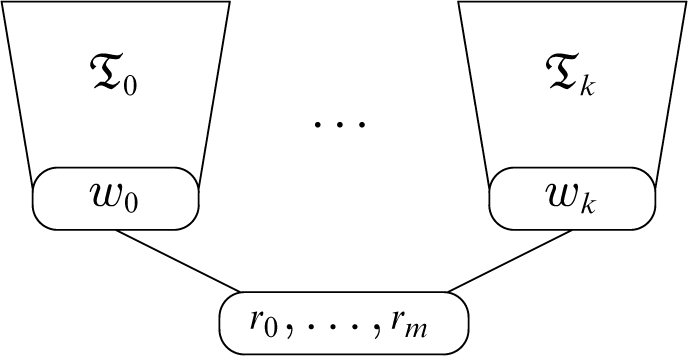
is a quasi-tree of depth
 $\le n$
; see Figure 2.
The quasi-trees
 $\mathfrak T$
and
 $\mathfrak T_0,\dots ,\mathfrak T_k$
.

Because X is nonempty, by Lemma 3.4, there is a nonempty crowded compact separable nowhere dense subspace F of X. In particular, F is locally compact, so Lemma 3.6(2) delivers a partition
 $\{F_j\mid 0\le j\le m\}$
of F such that each
 $F_j$
is dense in F.
Let
 $\{F,U_0,\dots ,U_k\}$
be as in the Partition Lemma and
 $0\le i\le k$
. Adopting the notation in the proof of the Partition Lemma, we have
 $U_i=\bigcup \mathscr{C}_i$
where
 $\mathscr{C}_i$
is the set of convex components of
 $U_i$
. Let
 $C\in \mathscr{C}_i$
. Then C is a convex component of
 $X\backslash F$
. Because F is closed, C is open by Lemma 2.6(1). Thus, the subspace C is a nonempty crowded locally compact GO-space. By the inductive hypothesis, there is an onto interior map
 $f_{C,i}:C\to \mathfrak T_i$
.
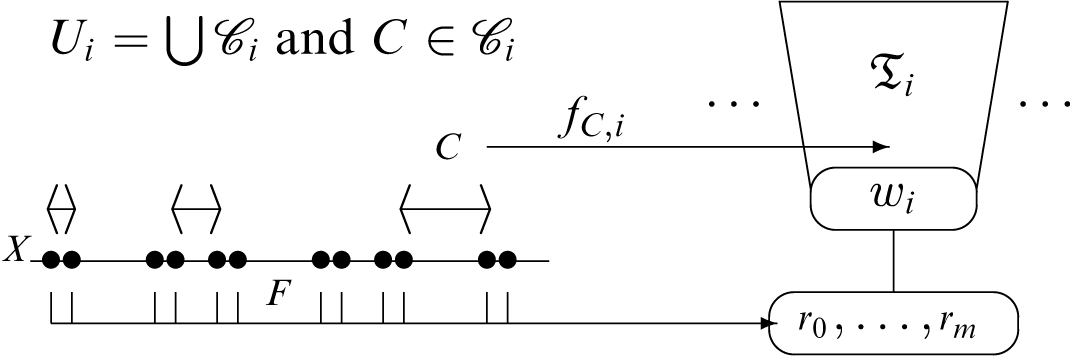
Define
 $f:X\to \mathfrak T$
by
 $$ \begin{align*} f(x) = \left\{ \begin{array}{@{}ll} f_{C,i}(x) & \text{if } x\in C \text{ for } 0\le i\le k\text{ and } C\in\mathscr{C}_i, \\ r_j &\text{if } x\in F_j \text{ for }0\le j\le m. \end{array} \right. \end{align*} $$
Then f is a well-defined onto map since
 $\{F,U_0,\dots ,U_k\}$
is a partition of X,
 $\{F_0,\dots ,F_m\}$
is a partition of F,
 $\mathscr{C}_i$
is a partition of
 $U_i$
for each
 $0\le i\le k$
, and each mapping
 $f_{C,i}$
is onto. Figure 3 depicts the mapping f where the set F is represented by bullets, the convex components of some
 $U_i$
are depicted with angled brackets, and C is a convex component of
 $U_i$
.
The mapping
 $f:X\to \mathfrak T$
.

Claim 3.10. f is continuous.
Proof Let
 $w\in W$
. If
 $w$
is a root of
 $\mathfrak T$
, then
 $f^{-1}(R(w))=f^{-1}(W)=X$
is open in X. Suppose that
 $w$
is not a root of
 $\mathfrak T$
. Since
 $\mathfrak T$
is a quasi-tree, there is a unique
 $0\le i\le k$
such that
 $w_i\mathbin{R}w$
. Let
 $C\in \mathscr{C}_i$
. Since
 $f_{C,i}$
is continuous,
 $f_{C,i}^{-1}(R(w))$
is open in C, and hence open in X (because C is open in X). Thus,
 $f^{-1}(R(w))=\bigcup \nolimits _{C\in \mathscr{C}_i}f_{C,i}^{-1}(R(w))$
is open in X. Because
 $\{R(w)\mid w\in W\}$
is a basis for the Alexandroff topology on
 $\mathfrak T$
, it follows that f is continuous.
Claim 3.11. f is open.
Proof Let U be a nonempty open subset of X. Since convex open subsets form a basis for X and the direct image of a function commutes with arbitrary unions, without loss of generality we may assume that U is convex. For each
 $0\le i\le k$
and
 $C\in \mathscr{C}_i$
, the set
 $U\cap C$
is open in C. As
 $f_{C,i}$
is open, it follows that
 $f_{C,i}(U\cap C)$
is open in
 $\mathfrak T_i$
, and hence open in
 $\mathfrak T$
. We have
 $$ \begin{align*} X = F\cup\bigcup\nolimits_{i=0}^kU_i= \bigg(\bigcup\nolimits_{j=0}^{m}F_j\bigg)\cup\left(\bigcup\nolimits_{i=0}^k\bigcup\mathscr{C}_i\right). \end{align*} $$
Therefore,
 $$ \begin{align*} U = U\cap X = \bigg(\bigcup\nolimits_{j=0}^{m}(U\cap F_j)\bigg) \cup\left(\bigcup\nolimits_{i=0}^k\bigcup\nolimits_{C\in\mathscr{C}_i}(U\cap C)\right). \end{align*} $$
Thus,
 $$ \begin{align*} f(U) &= \bigg(\bigcup\nolimits_{j=0}^{m}f\left(U\cap F_j\right)\bigg) \cup \left(\bigcup\nolimits_{i=0}^k \bigcup\nolimits_{C\in\mathscr{C}_i} f\left(U\cap C\right)\right) \\ &= \bigg(\bigcup\nolimits_{j=0}^{m}f\left(U\cap F_j\right)\bigg) \cup\left(\bigcup\nolimits_{i=0}^k\bigcup\nolimits_{C\in\mathscr{C}_i}f_{C,i}\left(U\cap C\right)\right). \end{align*} $$
If
 $U\cap F=\varnothing $
, then
 $U\cap F_j=\varnothing $
for all
 $0\le j\le m$
, which yields that
 $$ \begin{align*} f(U)=\bigcup\nolimits_{i=0}^k\bigcup\nolimits_{C\in\mathscr{C}_i}f_{C,i}\left(U\cap C\right) \end{align*} $$
is open in
 $\mathfrak T$
since each
 $f_{C,i}\left (U\cap C\right )$
is open in
 $\mathfrak T$
.
Suppose that
 $U\cap F\neq \varnothing $
. This yields that
 $U\cap F_j\neq \varnothing $
for all
 $0\le j\le m$
since each
 $F_j$
is dense in F and
 $U\cap F$
is a nonempty open subset of F. Therefore,
 $f(U\cap F_j)=\{r_j\}$
for all
 $0\le j\le m$
. Let
 $0\le i\le k$
. Because
 $U\cap F\neq \varnothing $
, Remark 3.8 implies that there is a convex component
 $C_i$
of
 $U_i$
contained in U. Since
 $f_{C_{i},i}(C_{i})=\mathfrak T_i$
, we have
 $$ \begin{align*} f(U) &= \left(\bigcup\nolimits_{j=0}^{m}f\left(U\cap F_j\right)\right) \cup\bigcup\nolimits_{i=0}^k\bigcup\nolimits_{C\in\mathscr{C}_i}f_{C,i}\left(U\cap C\right)\\ &\supseteq \left(\bigcup\nolimits_{j=0}^{m}\{r_j\}\right) \cup\bigcup\nolimits_{i=0}^kf_{C_{i},i}\left(U\cap C_{i}\right)\\ &= \{r_0,\dots,r_m\} \cup\bigcup\nolimits_{i=0}^kf_{C_{i},i}\left(C_{i}\right) \\ &= \{r_0,\dots,r_m\} \cup\bigcup\nolimits_{i=0}^k\mathfrak T_i = \mathfrak T. \end{align*} $$
Thus, f is open.⊣
Consequently,
 $\mathfrak T$
is an interior image of X.⊣
We are ready to prove an analogue of the McKinsey–Tarski Theorem for crowded locally compact GO-spaces.
Theorem 3.12. If X is a nonempty crowded locally compact GO-space, then
 $\textsf {L}(X)=\textsf {S4}$
.
Proof Since
 $\textsf {S4}\subseteq \textsf {L}(X)$
, it is sufficient to prove that if
 $\textsf { S4}\not \vdash \varphi $
, then
 $\varphi $
is refuted on X. By Lemma 2.1(1),
 $\varphi $
is refuted on some finite quasi-tree
 $\mathfrak T$
. By the Mapping Lemma,
 $\mathfrak T$
is an interior image of X. As interior images preserve validity,
 $X\not \vDash \varphi $
. Thus,
 $\textsf {L}(X)=\textsf {S4}$
.⊣
Since a LOTS is a GO-space, we immediately obtain the following corollary.
Corollary 3.13. If X is a nonempty crowded locally compact LOTS, then
 $\textsf {L}(X)=\textsf {S4}$
.
-
(1) Since
$\mathbb R$
and
$\textsf {C}$
are crowded locally compact LOTS, it follows from Corollary 3.13 that
$\textsf {S4}$
is the logic of both
$\mathbb R$
and
$\textsf {C}$
. -
(2) The Euclidean spaces
$\mathbb R^n$
for
$n\ge 2$
are not GO-spaces. Nevertheless, it is an easy consequence of Corollary 3.13 that
$\textsf { L}(\mathbb R^n)=\textsf {S4}$
. Indeed, since the projection map from
$\mathbb R^n$
onto
$\mathbb R$
is an onto interior map, every formula
$\varphi $
refuted on
$\mathbb R$
is also refuted on
$\mathbb R^n$
. This implies that
$\textsf {L}(\mathbb R^n)=\textsf {S4}$
. -
(3) More generally, if X and Y are nonempty spaces, where X is a crowded GO-space, then since the projection of
$X\times Y$
onto X is an interior map, Theorem 3.12 yields that
$\textsf {L}(X\times Y)=\textsf {S4}$
because each refutation on X can be lifted to
$X\times Y$
. -
(4) On the other hand, while the McKinsey–Tarski theorem implies that
$\textsf {L}(\mathbb Q)=\textsf {S4}$
, since
$\mathbb Q$
is not locally compact, this result does not follow from Theorem 3.12. -
(5) Local compactness is essential for our proof as it produces our basic building block for the recursive step in the Mapping Lemma. Without the locally compact assumption it is unclear how to construct such a building block.


Open Problem: Is S4 the logic of an arbitrary nonempty crowded GO-space?
4 Zero-dimensional GO-spaces
In this section we recall Herrlich’s result about hereditarily disconnected LOTS, and then utilize a result of Čech to generalize Herrlich’s result to GO-spaces. We start with the following well-known definition (see, e.g., [Reference Engelking16, Section 6.2]).
Definition 4.1. Let X be a topological space.
-
(1) X is hereditarily disconnected if the only nonempty connected subsets of X are singletons.
-
(2) X is zero-dimensional if X is
$T_1$
and has a basis of clopen sets. -
(3) X is strongly zero-dimensional if X is Tychonoff and the Čech–Stone compactification
$\beta X$
of X is zero-dimensional.


Every strongly zero-dimensional space is zero-dimensional (see, e.g., [Reference Engelking16, Theorem 6.2.6]), and every zero-dimensional space is hereditarily disconnected (see, e.g., [Reference Engelking16, Theorem 6.2.1]).
Theorem 4.2 Herrlich [Reference Herrlich19, Lemma 1]
A LOTS is strongly zero-dimensional iff it is hereditarily disconnected.
To generalize Herrlich’s result to GO-spaces, we use Lutzer’s modification of Čech’s construction.
Definition 4.3 Lutzer [Reference Lutzer23, Definition 2.5]
Let X be a GO-space with order
 $\le $
and topology
 $\tau $
, and let
 $\sigma $
be the interval topology induced by
 $\le $
. Define
 $X^*\subseteq X\times \mathbb Z$
by
 $$ \begin{align*} X^*=\left(X\times\{0\}\right) & \cup \left\{(x,n)\mid[x,\rightarrow)\in\tau\backslash\sigma \text{ and }n\le0\right\} \\ & \cup \left\{(x,m)\mid(\leftarrow,x]\in\tau\backslash\sigma \text{ and }m\ge0\right\}. \end{align*} $$
We view
 $X^*$
as a LOTS whose interval topology is induced by the restriction of the lexicographic order on
 $X\times \mathbb Z$
.
Remark 4.4. We can think of
 $X^*$
as being obtained from X by inserting a decreasing sequence of isolated points below each
 $x\in X$
satisfying
 $[x,\rightarrow) \in \tau \backslash \sigma $
, and an increasing sequence of isolated points above each
 $x\in X$
satisfying
 $(\leftarrow ,x]\in \tau \backslash \sigma $
. Each such sequence does not have a limit in
 $X^*$
. For the subspace
 $X:=\{-1\}\cup (0,1)\cup \{2\}$
of the LOTS
 $\mathbb R$
, we have that
 $X^*$
is homeomorphic to
 $$ \begin{align*}\left\{-\frac1{m+1}\mid m\ge0\right\}\cup(0,1)\cup\left\{\frac{2-n}{1-n}\mid n\le0\right\}.\end{align*} $$
The next theorem is attributed to Čech in [Reference Lutzer23, Proposition 2.7].
Theorem 4.5. Let X be a GO-space and let
 $X^*$
be as in Definition 4.3. The mapping
 $f:X\to X^*$
given by
 $f(x)=(x,0)$
is an order-isomorphism and homeomorphism of X and the subspace
 $X\times \{0\}$
of
 $X^*$
.
From now on we identify X with the subspace
 $X\times \{0\}$
of
 $X^*$
. It follows from the proof of [Reference Lutzer23, Theorem 2.9] that
 $X^*\backslash X$
consists of isolated points of
 $X^*$
, which yields that X is a closed subspace of
 $X^*$
.
Lemma 4.6. If X is a hereditarily disconnected GO-space, then
 $X^*$
is a hereditarily disconnected LOTS.
Proof Let A be a nonempty connected subspace of
 $X^*$
. If
 $A\subseteq X$
, then A is a singleton since X is hereditarily disconnected. Suppose
 $A\not \subseteq X$
. Then
 $A\cap \left (X^*\backslash X\right )\neq \varnothing $
. Therefore, A contains an isolated point x of
 $X^*$
. Because
 $\{x\}$
is clopen and A is connected, we conclude that
 $A=\{x\}$
. Thus,
 $X^*$
is hereditarily disconnected.⊣
We are ready to generalize Herrlich’s result to GO-spaces.
Theorem 4.7. A GO-space is strongly zero-dimensional iff it is hereditarily disconnected.
Proof It is sufficient to show that every hereditarily disconnected GO-space is strongly zero-dimensional. Let X be a hereditarily disconnected GO-space and let
 $X^*$
be as in Definition 4.3. By Lemma 4.6,
 $X^*$
is hereditarily disconnected. Therefore, by Theorem 4.2,
 $X^*$
is strongly zero-dimensional. By [Reference Engelking16, Theorem 6.2.11], strong zero-dimensionality is a hereditary property for closed subspaces of a normal space. Thus, X is strongly zero-dimensional because X is a closed subspace of the strongly zero-dimensional normal space
 $X^*$
.⊣
Corollary 4.8. Let X be a GO-space.
-
(1) X is zero-dimensional iff X is strongly zero-dimensional.
-
(2) If X is scattered, then X is strongly zero-dimensional.
Proof (1) This is immediate from Theorem 4.7.
(2) We show that X is hereditarily disconnected. Let A be a nonempty connected subspace of X. Since X is scattered, A has an isolated point, so
 $\{x\}$
is a clopen subset of A. Because A is connected,
 $A=\{x\}$
. Thus, X is hereditarily disconnected, and applying Theorem 4.7 finishes the proof.⊣
5 Logics arising from locally compact GO-spaces
In this final section we axiomatize all logics arising as
 $\textsf {L}(X)$
for some nonempty locally compact GO-space. The main result is that
 $$ \begin{align*} \textsf{S4} \subset \textsf{S4.1} \subset \textsf{S4.Grz} \subset \cdots \subset \textsf{ S4.Grz}_3 \subset \textsf{S4.Grz}_2 \subset \textsf{S4.Grz}_1 \end{align*} $$
are exactly the logics obtained this way, thus yielding an analogue of Theorem 1.1 for locally compact GO-spaces.
Let X be a nonempty locally compact GO-space. If X is not densely discrete, then Theorem 3.12 yields that
 $\textsf {L}(X)=\textsf {S4}$
, as we next show.
Theorem 5.1. If X is a locally compact GO-space that is not densely discrete, then
 $\textsf {L}(X)=\textsf {S4}$
.
Proof We only need to show
 $\textsf {L}(X)\subseteq \textsf {S4}$
since the other inclusion always holds. Suppose
 $\textsf {S4}\not \vdash \varphi $
. Because X is not densely discrete,
 $U:=X\backslash \textsf {c}(\mathsf {iso} X)$
is a nonempty open subset of X. Let
 $X=D\cup S$
be the Cantor–Bendixson decomposition of X. Since
 $S\subseteq \textsf {c} (\mathsf {iso} X)$
, we have
 $U\subseteq D$
. Therefore, U is a nonempty crowded locally compact GO-space. By Theorem 3.12, U refutes
 $\varphi $
. As open subspaces preserve validity, X also refutes
 $\varphi $
. Thus,
 $\textsf {L}(X)=\textsf {S4}$
.⊣
Next suppose that X is densely discrete. To determine
 $\textsf {L}(X)$
we need one more mapping lemma (Lemma 5.3) for which we recall the following two results about normal spaces. The first one follows from a straightforward inductive argument from the well-known fact that if
 $F_1,F_2$
are disjoint closed subsets of a normal space, then there exist open subsets
 $U_1,U_2$
such that
 $F_1\subseteq U_1$
,
 $F_2\subseteq U_2$
, and
 $\textsf {c} U_1,\textsf {c} U_2$
are disjoint. The second one can, for example, be found in [Reference Bezhanishvili, Gabelaia and Lucero-Bryan9, Lemma 3.2].
Lemma 5.2. Let X be a normal space,
 $n\ge 1$
, and
 $\{F_i\mid i<n\}$
a pairwise disjoint family of nonempty closed subsets of X.
-
(1) There is a family
$\{U_i\mid i<n\}$
of open subsets of X such that
$F_i\subseteq U_i$
for each
$i<n$
and
$\{\textsf {c} U_i\mid i<n\}$
is pairwise disjoint. -
(2) If in addition X is strongly zero-dimensional, then
$\{U_i\mid i<n\}$
can be chosen to be a partition of X.


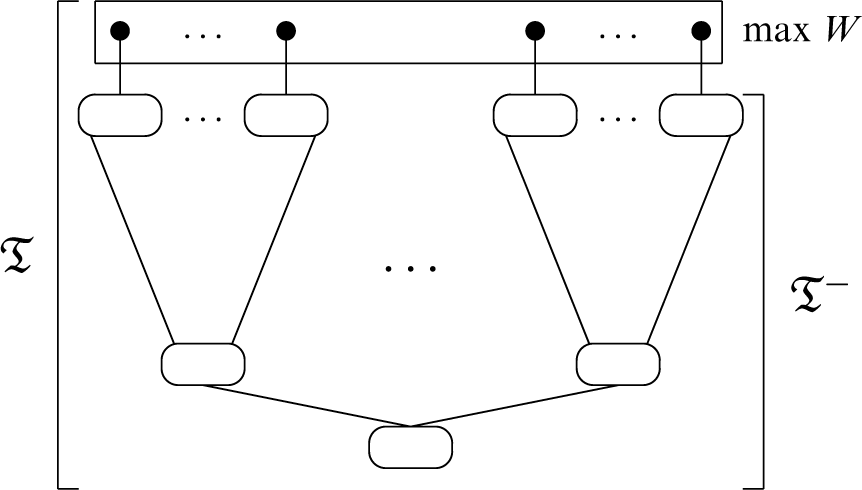
For a finite top-thin-quasi-tree
 $\mathfrak T=(W,R)$
let
 $\mathfrak T^-$
be the quasi-tree obtained from
 $\mathfrak T$
by deleting
 $\max W$
; see Figure 4.
The quasi-trees
 $\mathfrak T$
and
 $\mathfrak T^-$
.

Lemma 5.3. Let X be a non-scattered densely discrete locally compact GO-space. Then every finite top-thin-quasi-tree
 $\mathfrak T=(W,R)$
is an interior image of X.
Proof Let
 $X=D\cup S$
be the Cantor–Bendixson decomposition of X. Because X is nonempty and densely discrete,
 $S\supseteq \mathsf {iso} X\neq \varnothing $
. Also since X is not scattered, D is nonempty, and so D is a crowded locally compact GO-space. By the Mapping Lemma (Lemma 3.9), there is an onto interior map
 $g:D\to \mathfrak T^-$
. We show by strong induction on the depth n of
 $\mathfrak T$
that each such map g can be extended to an onto interior map
 $f:X\to \mathfrak T$
so that
 $f(S)=\max W$
. It follows from the definition of a top-thin-quasi-tree that each maximal element has a parent cluster, and hence the depth of
 $\mathfrak T$
is
 $\ge {2}$
. Therefore, the base case for induction is
 $n=2$
. Let
 $C_r$
be the root cluster of
 $\mathfrak T$
.
Base case: Suppose that
 $n=2$
. Then
 $W=C_r\cup \{m\}$
where m is the maximum element of
 $\mathfrak T$
; see Figure 5.
A top-thin-quasi-tree of depth 2.

Let
 $g:D\to \mathfrak T^-$
be an onto interior map. Define
 $f:X\to \mathfrak T$
by
 $$ \begin{align*} f(x) = \left\{ \begin{array}{@{}ll} g(x) & \text{if }x\in D,\\ m & \text{if }x\in S. \end{array} \right. \end{align*} $$
Because
 $\{D,S\}$
is a partition of X and g is onto, it follows that f is a well-defined onto map that extends g. Clearly
 $f(S)=\{m\}=\max W$
.
Since
 $\{m\}$
is the only nonempty proper open subset of
 $\mathfrak T$
and
 $f^{-1}(m)=S$
is open in X, we have that f is continuous. Let U be a nonempty open subset of X. As X is densely discrete,
 $\varnothing \neq U\cap \mathsf {iso} X\subseteq U\cap S$
. If
 $U\subseteq S$
, then
 $f(U)=\{m\}$
is open in
 $\mathfrak T$
. Suppose
 $U\not \subseteq S$
. Then
 $U\cap D$
is a nonempty open subset of D. Because g is interior and
 $\mathfrak T^-$
consists of a single cluster, namely
 $C_r$
, we have
 $$ \begin{align*} f(U) = f(U\cap S)\cup f(U\cap D) = \{m\}\cup g(U\cap D) = \{m\}\cup C_r = W. \end{align*} $$
Thus, f is open, and hence
 $\mathfrak T$
is an interior image of X.
Inductive step: Suppose that the depth of
 $\mathfrak T$
is
 $n+1$
, where
 $n\ge 2$
. By inductive hypothesis, for each top-thin-quasi-tree
 $\mathfrak F =(V,S)$
of depth
 $\le {n}$
, a non-scattered densely discrete locally compact GO-space Y whose Cantor–Bendixson decomposition is
 $Y=D'\cup S'$
, and
 $G:D'\to \mathfrak F^-$
an onto interior map, there is an onto interior map
 $F:Y\to \mathfrak F$
extending G such that
 $F(S')=\max V$
.
Let
 $g:D\to \mathfrak T^-$
be an onto interior map. We must extend g to an onto interior map
 $f:X\to \mathfrak T$
so that
 $f(S)=\max W$
. Let
 $C_0,\dots ,C_k$
be the children clusters of the root cluster
 $C_r$
of
 $\mathfrak T$
. For
 $i=0,\dots ,k$
, let
 $\mathfrak T_i=(R(C_i),R_i)$
where
 $R_i$
is the restriction of R to
 $R(C_i)$
. Because
 $\mathfrak T$
is a finite top-thin-quasi-tree of depth
 $n+1$
, each
 $\mathfrak T_i$
is a finite top-thin-quasi-tree of depth
 $\le {n}$
. Therefore,
 $\mathfrak T_i^-=(W_i,Q_i)$
where
 $W_i=R(C_i)\backslash \max W$
and
 $Q_i$
is the restriction of R to
 $W_i$
. Observe that
 $\{C_r,R(C_0),\dots ,R(C_k)\}$
is a partition of W and
 $\{C_r,W_0,\dots ,W_k\}$
is a partition of
 $W\backslash \max W$
. Set
 $F=g^{-1}(C_r)$
,
 $D_i=g^{-1}(W_i)$
, and
 $Y=X\backslash F$
. Then
 $\{D_0,\dots ,D_k\}$
is a partition of
 $D\backslash F$
and
 $Y=S\cup (D\backslash F)$
; see Figure 6.
The mapping g and the partition of D it induces.

Because g is interior, each
 $D_i$
is open in D and F is closed in D. As D is closed in X, we have that F is closed in X, which yields that Y is open in X. In addition, the closure of
 $A\subseteq D$
relative to D is
 $\textsf {c} A$
. Thus,
 $D_i$
is closed in Y since
 $$ \begin{align*} \textsf{c} D_i = \textsf{c} g^{-1}(W_i) &= g^{-1}(R^{-1} W_i) = g^{-1}(W_i\cup C_r) \\ &= g^{-1}(W_i)\cup g^{-1}(C_r) = D_i\cup F \end{align*} $$
implies that
 $\textsf {c}(D_i)\cap Y = (D_i\cup F)\cap Y = D_i$
. Being a GO-space, Y is normal. Therefore, we may apply Lemma 5.2(1) to
 $\{D_0,\dots ,D_k\}$
to obtain a family
 $\{U_0,\dots ,U_k\}$
of open subsets of Y, and hence of X, such that
 $D_i\subseteq U_i$
and
 $\{\textsf {c}(U_i)\cap Y\mid i=0,\dots ,k\}$
is pairwise disjoint. Then
 $\{U_0,\dots ,U_k\}$
is pairwise disjoint since
 $U_i\subseteq \textsf {c}(U_i)\cap Y$
.
We clearly have that each
 $D_i\subseteq U_i\cap D$
. For the converse, let
 $x\in U_i\cap D$
. Then
 $x\not \in S$
and
 $x\in U_i\subseteq Y = X\backslash F$
. So there is j such that
 $x\in D_j$
. Therefore,
 $x\in U_j$
, which implies
 $U_i\cap U_j\neq \varnothing $
. Thus,
 $j=i$
, so
 $x\in D_i$
and hence
 $D_i=U_i\cap D$
.
The family
 $\{\textsf {c}(U_i)\cap S\mid i=0,\dots ,k\}$
is pairwise disjoint and consists of closed subsets of S. Since
 $\mathsf {iso} X\subseteq S$
and X is densely discrete, S is dense in X. Because each
 $U_i$
is a nonempty open subset of X, we have that
 $U_i\cap S\neq \varnothing $
. Therefore, each
 $\textsf {c}(U_i)\cap S$
is nonempty. Since S is a scattered GO-space, Corollary 4.8(2) implies that S is a strongly zero-dimensional normal space. By Lemma 5.2(2), there is a partition
 $\{S_0,\dots ,S_k\}$
of S consisting of open subsets of S (which are also open in X) such that
 $\textsf {c}(U_i)\cap S\subseteq S_i$
.
The subspace
 $Y_i=D_i\cup S_i$
.

For each i put
 $Y_i=D_i\cup S_i$
; see Figure 7. Because
 $D_i=U_i\cap D$
and
 $U_i\cap S \subseteq \textsf {c}(U_i)\cap S\subseteq S_i$
, we have
 $$ \begin{align*} Y_i =D_i\cup S_i &= (U_i\cap D) \cup (U_i\cap S)\cup S_i = (U_i\cap (D\cup S))\cup S_i \\ &= (U_i\cap X)\cup S_i = U_i\cup S_i. \end{align*} $$
Therefore,
 $Y_i$
is open in X since
 $U_i$
and
 $S_i$
are open in X. Thus, being an open subspace of a densely discrete space,
 $Y_i$
is densely discrete. It is obvious that
 $\{Y_0,\dots ,Y_k\}$
is a partition of Y.
We have that
 $D_i$
is crowded since it is an open subspace of the crowded space D. Recalling that
 $\textsf {c} D_i = D_i\cup F$
, it follows that
 $\textsf {d} D_i=D_i\cup F$
, which implies that
 $\textsf {d}^\alpha D_i = D_i\cup F$
for each nonzero ordinal
 $\alpha $
. Let
 $\varrho $
be the Cantor–Bendixson rank of X. Then
 $\varrho \neq 0$
and
 $\textsf {d}^\varrho S_i\subseteq \textsf {d}^\varrho S\subseteq \textsf {d}^\varrho X=D$
. Because
 $U:=\bigcup \left \{Y_j\mid j\neq i \right \}$
is open in X, we have that
 $Y_i\cup F=X\backslash U$
is closed in X. Therefore,
 $\textsf {d}^\varrho S_i \subseteq \textsf {d} S_i\subseteq \textsf {c} S_i\subseteq Y_i\cup F$
, yielding that
 $$ \begin{align*} \textsf{d}^\varrho S_i\subseteq (Y_i\cup F)\cap D &= (D_i\cup S_i \cup F)\cap D \\ &= (D_i\cap D)\cup(S_i\cap D)\cup(F\cap D) =D_i\cup F. \end{align*} $$
Thus,
 $$ \begin{align*} \textsf{d}^\varrho Y_i = \textsf{d}^\varrho(D_i\cup S_i) = \textsf{d}^\varrho D_i \cup \textsf{d}^\varrho S_i = D_i\cup F \cup \textsf{d}^\varrho S_i = D_i\cup F, \end{align*} $$
which implies
 $\textsf {d}^\varrho Y_i\cap Y_i = D_i$
. Therefore, the Cantor–Bendixson decomposition of
 $Y_i$
is
 $D_i\cup S_i$
. Because
 $D_i\ne \varnothing $
, it follows that
 $Y_i$
is a non-scattered densely discrete locally compact GO-space.
Let
 $g_i$
be the restriction of
 $g:D\to \mathfrak T^-$
to
 $D_i$
. Since g is an onto interior map and
 $D_i$
is open in D, we have that
 $g_i$
is an interior mapping of
 $D_i=g^{-1}(W_i)$
onto
 $\mathfrak T_i^-=(W_i,Q_i)$
. By the inductive hypothesis, there is an interior mapping
 $f_{i}$
of
 $Y_i$
onto
 $\mathfrak T_i=(R(C_i),R_i)$
extending
 $g_i$
such that
 $f_{i}(S_i)=\max R(C_i)$
; see Figure 8.
Extending
 $g_i$
to
 $f_{i}$
.

Define
 $f:X\to \mathfrak T$
by
 $$ \begin{align*} f(x) = \left\{ \begin{array}{@{}rl} g(x) & \text{if }x\in F,\\ f_{i}(x) & \text{if }x\in Y_i. \end{array} \right. \end{align*} $$
Note that f is a well-defined map since
 $\{F,Y_0,\dots ,Y_k\}$
is a partition of X. It is clear that f extends g.
Claim 5.4. f is onto.
Proof
 $$ \begin{align*} f(X) &= f\left(F\cup Y_0\cup\dots\cup Y_k\right) = f(F)\cup f(Y_0)\cup\dots\cup f(Y_k) \\ &= g(F)\cup f_{0}(Y_0)\cup\dots\cup f_{k}(Y_k) = C_r \cup R(C_0)\cup\dots\cup R(C_k) =W. \end{align*} $$
⊣
Claim 5.5.
 $f(S)=\max W$
.
Proof
 $$ \begin{align*} f(S) &= f\left(S_0\cup\dots\cup S_k\right) = f(S_0)\cup\dots\cup f(S_k) \\ &= f_{0}(S_0)\cup\dots\cup f_{k}(S_k) = \max R(C_0)\cup\dots\cup \max R(C_k) = \max W. \end{align*} $$
⊣
Claim 5.6. f is continuous.
Proof Let
 $w\in W$
. If
 $w\in C_r$
then
 $f^{-1}(R(w))=f^{-1}(W)=X$
is open in X. Suppose that
 $w\not \in C_r$
. Then there is a unique i such that
 $w\in R(C_i)$
. Therefore,
 $f^{-1}(R(w))=f_{i}^{-1}(R_i(w))$
, so is open in
 $Y_i$
. As
 $Y_i$
is open in X, it follows that
 $f^{-1}(R(w))$
is open in X. Thus, f is continuous.⊣
Claim 5.7. f is open.
Proof Let U be a nonempty open subset of X. Then
 $$ \begin{align*} f(U) = f(U\cap X) &= f\left(U\cap \left( F\cup Y_0\cup\dots\cup Y_k\right)\right) \\&= f\left((U\cap F)\cup(U\cap Y_0)\cup\dots\cup(U\cap Y_k)\right) \\ &= f(U\cap F)\cup f(U\cap Y_0)\cup\dots\cup f(U\cap Y_k) \\&= g(U\cap F)\cup f_{0}(U\cap Y_0)\cup\dots\cup f_{k}(U\cap Y_k). \end{align*} $$
Because each
 $f_{i}$
is interior,
 $f_{i}(U\cap Y_i)$
is open in
 $\mathfrak T_i$
, and hence open in
 $\mathfrak T$
. If
 $U\cap F=\varnothing $
, then
 $f(U)=\bigcup \nolimits _{i=0}^kf_{i}(U\cap Y_i)$
is a union of open subsets of
 $\mathfrak T$
, and so is open in
 $\mathfrak T$
. Suppose that
 $U\cap F\ne \varnothing $
. Let
 $x\in U\cap F$
. Then
 $g(x)\in C_r$
is a root of both
 $\mathfrak T$
and
 $\mathfrak T^-$
. Since g is an open map and
 $U\cap D$
is open in D, we have that
 $g(U\cap D)$
is an open subset of
 $\mathfrak T^-$
containing a root. Therefore,
 $g(U\cap D)=W\backslash \max W$
, and hence
 $g(U\cap F)=C_r$
. For each i we have that
 $x\in g^{-1}(R^{-1} (C_i))=\textsf {c} g^{-1}(C_i)$
, which implies that there is
 $y_i\in U\cap g^{-1}(C_i)$
. Note that
 $f_{i}(y_i)=f(y_i)=g(y_i)\in C_i$
is a root of
 $\mathfrak T_i$
. Being an open subset of
 $\mathfrak T_i$
containing a root, we have that
 $f_{i}(U\cap Y_i)=R_i(C_i)=R(C_i)$
. Thus,
 $$ \begin{align*} f(U) &= g(U\cap F)\cup f_{0}(U\cap Y_0) \cup \dots \cup f_{k}(U\cap Y_k)\\ &= C_r\cup R(C_0)\cup\dots\cup R(C_k) = W, \end{align*} $$
and hence f is open.⊣
Consequently,
 $\mathfrak T$
is an interior image of X.⊣
Theorem 5.8. If X is a non-scattered densely discrete locally compact GO-space, then
 $\textsf { L}(X)=\textsf {S4.1}$
.
Proof Since X is densely discrete,
 $\textsf {S4.1}\subseteq \textsf {L}(X)$
by Lemma 2.2(2). Suppose that
 $\textsf {S4.1}\not \vdash \varphi $
. By Lemma 2.1(2), there is a finite top-thin-quasi-tree
 $\mathfrak T$
refuting
 $\varphi $
. By Lemma 5.3,
 $\mathfrak T$
is an interior image of X. Because interior images preserve validity,
 $\varphi $
is refuted on X. Thus,
 $\textsf {L}(X)=\textsf {S4.1}$
.⊣
Theorem 5.9. Let X be a nonempty scattered locally compact GO-space and
 $n\ge 1$
.
-
(1) If the Cantor–Bendixson rank of X is n, then
$\textsf {L}(X)=\textsf {S4.Grz}_n$
. -
(2) If the Cantor–Bendixson rank of X is infinite, then
$\textsf {L}(X)=\textsf { S4.Grz}$
.


Proof Lemma 2.6(6) implies that every open subspace of X is collectionwise normal. Since each subspace of a scattered space is scattered, Corollary 4.8(2) yields that every open subspace of X is strongly zero-dimensional. Thus, it follows from [Reference Bezhanishvili, Bezhanishvili, Lucero-Bryan and van Mill6, Theorem 4.9] that we may apply [Reference Bezhanishvili, Bezhanishvili, Lucero-Bryan and van Mill6, Theorem 7.3] to obtain the result.⊣
Putting together Theorems 5.1, 5.8, and 5.9, we arrive at the following axiomatization of
 $\textsf {L}(X)$
for each nonempty locally compact GO-space.
Theorem 5.10. Let X be a nonempty locally compact GO-space.
-
(1) If X is not densely discrete, then
$\textsf {L}(X)=\textsf {S4}$
. -
(2) If X is densely discrete but not scattered, then
$\textsf {L}(X)=\textsf {S4.1}$
. -
(3) If X is scattered and has infinite Cantor–Bendixson rank, then
$\textsf { L}(X)=\textsf {S4.Grz}$
. -
(4) If X is scattered and has Cantor–Bendixson rank
$n\ge 1$
, then
$\textsf {L}(X)=\textsf {S4.Grz}_n$
.


Remark 5.11. Utilizing the well-known Gödel translation (see, e.g., [Reference Chagrov and Zakharyaschev14, Section 3.9]), Theorem 5.10 yields a characterization of the superintuitionistic logics (si-logics for short) arising from nonempty locally compact GO-spaces. Let
 $\textsf {IPC}$
be the intuitionistic propositional calculus and
 $\textsf {IPC}_n:=\textsf {IPC}+\textsf {ibd}_n$
where
 $$ \begin{align*} \begin{array}{l@{\,\,}c@{\,\,}l} \textsf{ibd}_1 &=& p_1\vee\lnot p_1,\\ \textsf{ibd}_{n+1} &=& p_{n+1}\vee(p_{n+1}\to\textsf{ibd}_n). \end{array} \end{align*} $$
The formulas
 $\textsf {ibd}_n$
are the intuitionistic version of the modal formulas
 $\textsf {bd}_n$
.
We recall (see, e.g., [Reference Chagrov and Zakharyaschev14, Section 9.6]) that via the Gödel translation each si-logic
 $\textsf {L}$
gives rise to an interval (with respect to
 $\subseteq $
) of normal extensions of S4 consisting of modal companions of
 $\textsf {L}$
. It is well known that the modal companions of IPC form the interval
 $[\textsf {S4},\textsf {S4.Grz}]$
. Thus, each of S4, S4.1, and S4.Grz is a modal companion of IPC. Moreover,
 $\textsf {S4.Grz}_n$
is a modal companion of
 $\textsf {IPC}_n$
. This together with Theorem 5.10 yields that the si-logic of a nonempty locally compact GO-space X is:
-
(1)
$\textsf {IPC}_n$
if X is scattered and has Cantor–Bendixson rank
$n\ge 1$
, and -
(2) IPC otherwise.


Thus, the si-logics
 $$ \begin{align*} \textsf{IPC}\subset \dots \subset\ \textsf{IPC}_3\subset \textsf{IPC}_2\subset \textsf{ IPC}_1 \end{align*} $$
are exactly those that arise as the si-logic of a nonempty locally compact GO-space.
Acknowledgements
We thank Klaas Pieter Hart for kindly providing a copy of [Reference Lutzer23]. We also thank the referee for useful comments that have improved the presentation of the paper.