Implications
β-Adrenergic agonist (β-AA) and immunocastration have been associated with changes in carcass composition affecting production efficiency. They have been used as tools to increase the lean meat production to supply the growing animal protein demand. However, information about their effects in Bos indicus cattle and possible interactions are still scarce. In this study, it was observed that β-AA increase production efficiency by improving muscle deposition and carcass yield, whereas immunocastration reduces feed efficiency and muscle deposition and increase carcass fat. There was no interaction between factors so they can be used as independent technologies to manipulate growing process and carcass composition.
Introduction
In recent years, a number of technologies have been developed and used to improve beef cattle performance as well as the meat yield and quality. Among these technologies, the β-AA have been used as growth promoters for feedlot finished cattle because they improve feedlot performance and carcass yield (Avendaño-Reyes et al., Reference Avendaño-Reyes, Torres-Rodríguez, Meraz-Murillo, Pérez-Linares, Figueroa-Saavedra and Robinson2006; Hilton et al., 2008; Boler et al., Reference Boler, Shreck, Faulkner, Killefer, McKeith, Homm and Scanga2012; Howard et al., Reference Howard, Woerner, Vote, Scanga, Acheson, Chapman, Bryant, Tatum and Belk2014). β-Adrenergic agonists are non-hormonal growth promoters that bind to β1-AA and β2-AA receptors, which promote muscle hypertrophy in supplemented animals, as a results of increases in synthesis and/or decreases in muscle protein breakdown and decreases in carcass fat because of lower lipogenesis and higher lipolysis (Dunshea et al., Reference Dunshea, D’Souza, Pethick, Harper and Warner2005).
Raymond (Reference Raymond2013) stated that the use of β-AA as feed ingredient increase around 13.6 kg of lean meat/cow, which can exert a huge impact in meat production, contributing for world food secure. The use of β-AA in livestock finishing animals is approved in more than 20 countries (Food and Agriculture Organization of the United Nations, 2012). On the other hand, its use is forbidden in many other countries (e.g. European countries) due to food safety reasons. In Brazil, β-AA were approved for use in cattle in 2011, but it was temporarily suspended in 2012 (Ministério Da Agricultura, Pecuária E Abastecimento, 2013) due to the difficulty of segregating meat destined for export. In spite of this, studies concerning the effects of these additives in a more specific production conditions must be carried out to help increasing world meat production.
Another practice that is still the subject of much discussion is the castration of animals. This technique has been used as an alternative tool to increase carcass fat deposition and reduce aggressive behavior, and it consequently results in a meat with a better eating quality due to higher levels subcutaneous and intramuscular fat than non-castrated (NC) males (Dunshea et al., Reference Dunshea, D’Souza, Pethick, Harper and Warner2005). Recently, a technique of immunocastration for cattle by immunization of the animals with an analogous of the gonadotropin releasing hormone (GnRH) has been developed.
Several studies have been conducted to evaluate the effects of β-AA in cattle. However, most of them were conducted under conditions differing from those typically found in Brazil, including the breed and sex of the animals, degree of finishing at harvest and time on feed, among others. In addition, the availability of information on the immunocastrated (IC) cattle performance is still scarce in the literature. Thus, a study of how these factors can affect the performance of feedlot cattle is essential for producers and the industry. Therefore, this work was developed to evaluate the effect of β-AAs and immunocastration on the performance and carcass traits of feedlot finished Nellore cattle.
Material and methods
All procedures used for these experiments involving animal care were conducted in accordance with the Institutional Animal Care and Use Committee Guidelines, approved by the College of Animal Science and Food Engineering by protocol number 13.1.541.74.0.
Experimental design and treatments
In total, 96 Nellore (Bos indicus) intact males (409±50 kg BW; 20 months old) were weighed, tagged and divided into two groups, according to BW (heavy and light), so that each group had similar distribution of weights. Half of each group received two doses of immunocastration vaccine within 30 days of the interval (IC) whereas the other half was not immunized (NC). Afterward, the animals were transferred to the feedlot facilities at the Animal Science Department of the College of Animal Science and Food Engineering at the University of Sao Paulo, Pirassununga, SP, and housed in two feedlot facilities.
The first group (n=48), composed by 24 IC and 24 NC, was housed in four pens (12 animals/pen) equipped with electronic gates (American Calan Inc., Northwood, NH, USA) which allowed individual control of feed intake. To avoid problems of aggressive behavior between IC and NC groups in the same pen, they were divided by sex condition. Therefore, there were two pens with IC (12 animals each) and other two pens with NC (12 animals each) animals. The second group (n=48) was housed in individuals pens. Both facilities had covered feed bunks, concrete floors and automatic waterers.
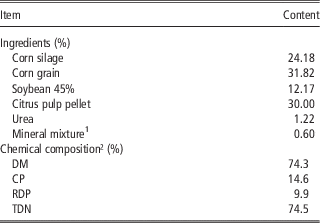
Initially, all animals were submitted to a 21-day adaptation period, when the concentrate levels were gradually increased and the animals were trained to use the electronic gates. At the end of the adaptation period, the animals were fed a total mixed common diet offered daily at 0800 and 1600 h containing 76% concentrate and 24% roughage (Table 1). Every 2 days the orts were taken, weighed and sampled for determination of the dry matter. The feed supply was adjusted every 2 days based on the amount of orts from the previous days, to ensure 5% to 10% refusals.
Dietary ingredients and chemical composition (dry matter (DM) basis) of the basal finishing diet

RDP=rumen digestible protein; TDN=total digestible nutrient.
1 The trace mineral mixture contained (per kg): zinc, 1715 mg; iron, 420 mg; calcium, 160 g; selenium, 6 mg; phosphorus, 17 g; manganese, 720 mg; magnesium, 14.3 g; copper, 360 mg; cobalt, 21.6 mg; iodine, 21.6 mg; sodium, 57 g; sulfur, 22.9 g; Non-nitrogen protein (NNP) – equivalent protein, 395 g; monensin sodium, 714.3 mg; vitamin A, 71 500 IU; vitamin D3, 8940 IU; vitamin E, 208 IU.
2 Diets were formulated to meet or exceed all nutrient requirement of finishing steers (National Research Council, 2000).
All animals received the same diet during the first 70 days (phase 1). Afterward (phase 2), they were split into three groups (n=32; 16 of each feedlot facility), according to the BW and fed 30 more days with the same basal diets added with the following additives: a control diet without β-AA (CON), a diet containing 80 mg/day of zilpaterol hydrochloride (ZH; Zilmax®, Merck Animal Health, Summit, NJ, USA) and a diet containing 300 mg/day of ractopamine hydrochloride (RH; Optaflexx®, Elanco Animal Health, Greenfield, IN, USA). β-Adrenergic agonists were added to the mineral supplement and added to the diets. The ZH diet was removed 3 days before harvest according to the withdrawal period required by law for this product, whereas RH diet was removed 1 day before harvest according to the required fasting period. Thus, ZH and RH diets were offered for 30 and 33 days, respectively.
Serum testosterone concentration
Blood samples to determine the serum testosterone concentration of the animals were taken by jugular venipuncture of 2 ml of blood in vacutainer tubes with ethylenediaminetetraacetic acid on days 0, 84 and 100 of feeding. Shortly after the collection, the samples were centrifuged at 2000×g for 20 min at 4°C to separate the serum, which was frozen at −20°C. Thereafter, the testosterone concentration was quantified by ELISA.
Performance and ultrasound carcass traits
The animals were weighed and ultrasound measurements were taken after 14 h feed fasting at baseline (day 0) and after 28, 70, 84 and 100 days of feeding. The dry matter intake (DMI), average daily gain (ADG) and gain to feed (G : F) were calculated from the feed intake data and BW measurements. The ADG weight during the feedlot was calculated by regression using the data from all weights.
Ultrasound measurements were taken using Aloka® equipment, model SSD 500 Micrus (Aloka Co. Ltd., Zug, Switzerland), with a linear probe 3.5 mHz and 172 mm in length. Ultrasound measurements between the 12th and 13th ribs were taken to determine the longissimus muscle area (LMA), backfat thickness (BFT) and the rump fat thickness (RFT) on the m. biceps femoris muscle between the ilium and ischium. Images were recorded and then interpreted using Lince® software (M&S Consultoria Agropecuária, Pirassununga, SP, Brazil) by an experienced ultrasound technician.
Carcass data collection
At the end of feeding phase, the animals were harvested at a commercial slaughterhouse (Dom Glutão, Ibitinga, Brazil) according to humane harvest procedures as required by Brazilian law. The hot carcass weight (HCW) and dressing per cent (DP) were determined immediately after evisceration. After that the carcasses were chilled and the following measurements were obtained by qualified personnel: pH and temperature 1 and 24 h after harvest, were taken between the 12th and 13th ribs and obtained by digital pH meter (Hanna Instruments model HI99163; Hanna Instruments, São Paulo, Brazil), and kidney, pelvic and heart (KPH) fat as a percentage of HCW.
Statistical analysis
The measured data of performance and carcass traits at harvest were evaluated as a randomized complete block design in a 2×3 factorial arrangement (sex condition v. treatments) using the Mixed procedure of SAS 9.3 software (SAS Institute Inc., Cary, NC, USA). The sex condition, treatments and the sex condition×treatments interaction were considered as the fixed effects. The block (initial BW) and pen (individual or collective) were considered as random effects, and the animal was the experimental unit.
The carcass traits measured by ultrasonography were analyzed as repeated measurements over time using the Mixed procedure of SAS. Means were compared by Student’s t test, and differences were considered statistically significant when P⩽0.05. The results are reported according to sex condition and treatment effects if no interactions were significant.
Results and discussion
No interaction was observed between sex condition and treatment for any trait evaluated. Thus, the main factors are presented individually.
Sexual condition
Serum testosterone concentration
There was no difference in the testosterone concentration between NC and IC animals at the moment of application of the second dose of immunocastration vaccine (day 0; Figure 1), which was expected because it is after this point that animals start to reduce testosterone production. After 84 and 100 days of feeding, testosterone levels were greater for NC than for IC (P<0.0001), suggesting that the immunocastration vaccine was effective in reducing testosterone levels. According to Amatayakul-Chantler et al. (Reference Andreo, Bridi, Tarsitano, Peres, Barbon, Andrade and Prohmann2013), the serum testosterone concentration to effectively castrate an animal is ~5 ng/ml.
Serum testosterone concentration.

After 100 days, the application of the second dose, the testosterone levels increased up to 8.4 ng/ml (Figure 1), indicating a reduction of the immunocastration effect. This was expected because this period was greater than that recommended for the product (90 days) when the second dosis is applied 30 days after the first one. Even with this increase, the testosterone levels of IC animals were smaller than NC (P<0.0001).
Similar results were reported by Jannet et al. (Reference Jannet, Gerig, Tschuor, Amatayakul-Chantler, Walker, Howard, Bollwein and Thun2012), that found lower testosterone levels in the IC than in NC animals from 42 (0.2 v. 14 ng/ml, respectively) to 168 days (7 v. 12 ng/ml, respectively) of study. Different results were described by Amatayakul-Chantler et al. (Reference Amatayakul-Chantler, Jackson, Stegner, King, Rubio, Howard, Lopez and Walker2012) who found that IC Bos indicus Zebu×Brown Swiss, had markedly suppressed testosterone concentrations within 14 day after the second dose and remained suppressed for the duration of study (~100 day; mean 1.3 ng/ml).
This longer effect of lowering testosterone level observed by Amatayakul-Chantler et al. (Reference Amatayakul-Chantler, Jackson, Stegner, King, Rubio, Howard, Lopez and Walker2012), when compared with our and Jannet et al. (Reference Jannet, Gerig, Tschuor, Amatayakul-Chantler, Walker, Howard, Bollwein and Thun2012) studies, was probably be due the greater interval between the first and second dosis of immunocastration vaccine used in Chantler’s study (42 days) compared with our and Jannet’s studies (30 days). According to the manufacturer’s recommendations, the longer the interval between the first and second doses, the longer the immunization period.
Performance
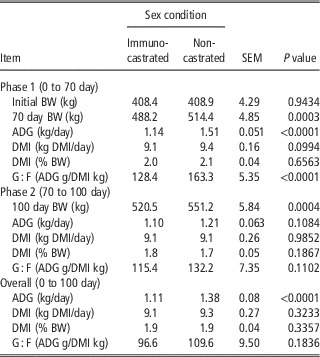
In phase 1, the NC animals showed greater ADG (P<0.0001), 70 days BW (P=0.0003) and G : F (P<0.0001) than IC. In addition, the NC tended to have lower DMI (P=0.0994) than the IC when expressed in kg dry matter/day, but it did not differ when DMI was expressed as percentage of BW (Table 2). In phase 2, the NC animals also had a higher final BW (P=0.0004) than the IC and tended to have greater ADG (P=0.1084) and G : F (P=0.1102). The DMI expressed in kg or percentage of BW did not differ.
Means, SEM and probabilities (P value) of the performance traits according to sex condition and phase

ADG=average daily gain; DMI=dry matter intake; G : F=gain to feed.
The different patterns of performance observed between the sexual conditions in phases 1 and 2 occurred mainly due to the decrease in weight gain of NC animals. This may have been due to the fact that these animals already reached the stage of the growth curve where muscle growth decelerates and fat deposition rate increases, which would explain the maintenance of DMI with a reduction in ADG and G : F.
Higher ADG between NC and IC animals were also reported by Amatayakul-Chantler et al. (Reference Amatayakul-Chantler, Jackson, Stegner, King, Rubio, Howard, Lopez and Walker2012) and Adams et al. (Reference Adams, Daley, Adams and Sakurai1993). On the other hand, these same authors did not observe differences in DMI and BW between NC and IC animals. Amatayakul-Chantler et al. (Reference Andreo, Bridi, Tarsitano, Peres, Barbon, Andrade and Prohmann2013) stated that IC animals were more efficient than surgically castrated animals due to the non-traumatic postoperation proportioned by immunocastration; therefore, IC animals had higher values for ADG, final BW, HCW and DP than surgically castrated animals. Ribeiro et al. (Reference Ribeiro, Hernandez, Zanella, Shimokomaki, Prudêncio-Ferreira, Youssef, Ribeiro, Bogden and Reeves2004) noted that immunocastration in grazing animals has the same effects found in feedlot animals, with lower ADG, G : F and LMA and greater BFT than IC animals.
Ultrasound carcass traits
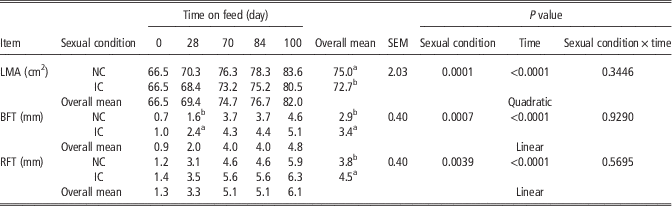
There was no interaction between sex condition and time on feed on LMA, BFT and RFT. The LMA was greater for NC than IC males (P=0.0001; Table 3) and showed a quadratic effect over time on feed (y=66.7757+0.04026x+0.001074x 2; P=0.0007).
Means, SEM and probabilities (P value) of the ultrasound carcass traits according to sex condition and time on feed before (0 to 70 days) and after (70 to 100) β-agonist adrenergic supplementation

LMA=longissimus muscle area; NC=non-castrated; IC=immunocastrated; BFT=backfat thickness; RFT=rump fat thickness.
a,bValues within a column with different superscript letters differ significantly at P<0.05.
Both ADG and LMA were higher in the NC animals, indicating the essential action of testosterone for muscle development, mainly until the animal reaches maturity. Cook et al. (Reference Cook, Popp, Kastelic, Robbins and Harland2000) found no difference in LMA and BFT between NC and IC animals; however, they related LMA with titers of anti-GnRH antibodies and observed a negative linear regression indicating that the greater the response to the vaccine the lower the LMA.
Non-castrated animals showed smaller BFT (P=0.0007) and RFT (P=0.0039) with a linear effect in both traits (y=0.9014+0.03985x, P<0.0001 and y=1.6112+0.04528x, P<0.0001, respectively). Similar results were reported by Amatayakul-Chantler et al. (Reference Amatayakul-Chantler, Jackson, Stegner, King, Rubio, Howard, Lopez and Walker2012) and Andreo et al. (Reference Amatayakul-Chantler, Hoe, Jackson, Roça, Stegner, King, Howard, Lopez and Walker2013) who found that NC animals had lower BFT and higher LMA, which might be explained by the NC animals depositing fat later than the IC animals due to the higher muscle development through the action of testosterone during animal growth.
Adams et al. (Reference Adams, Daley, Adams and Sakurai1993) stated that testosterone has great economic importance because carcasses with a low finishing rate are less marketable than carcasses with a high finishing rate. Ribeiro et al. (Reference Ribeiro, Hernandez, Zanella, Shimokomaki, Prudêncio-Ferreira, Youssef, Ribeiro, Bogden and Reeves2004) reported that NC animals failed to reach the minimal BFT required by Brazilian slaughterhouses (3.0 mm), which was not observed in this present study (4.6 mm); however, in both studies the IC animals reached a higher BFT than the requirement (5.2 and 5.1 mm, respectively).
Carcass data
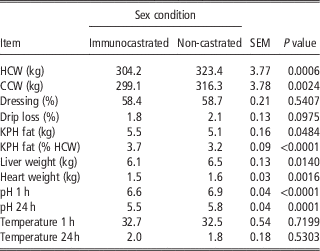
Non-castrated animals had higher HCW (P=0.0006) than the IC animals, but no difference in DP (Table 4) was observed. These results are similar to those of Andreo et al. (Reference Amatayakul-Chantler, Hoe, Jackson, Roça, Stegner, King, Howard, Lopez and Walker2013), who reported an increase for both HCW (7%) and DP (3%) in NC animals compared with IC animals. On the other hand, Cook et al. (Reference Cook, Popp, Kastelic, Robbins and Harland2000) and Ribeiro et al. (Reference Ribeiro, Hernandez, Zanella, Shimokomaki, Prudêncio-Ferreira, Youssef, Ribeiro, Bogden and Reeves2004) found higher HCW in NC animals but with no difference in DP, whereas Adams and Adams (Reference Adams and Adams1992) found no difference in HCW and DP.
Means, SEM and probabilities (P value) of the carcass traits, according to sex condition

HCW=hot carcass weight; CCW=cold carcass weight; KPH=kidney, pelvic and heart.
Immunocastrated animals had a higher weight and per cent of KPH (P=0.0484, P<0.0001, respectively) and a lower liver and heart weight (P=0.0140, P=0.0016, respectively) than the NC animals (Table 4). The greater KPH fat observed for IC is in agreement with greater BFT also observed in these animals, indicating that they had a greater overall body fat deposition. Its well known that castrated animals deposit more fat compared with NC (Dunshea et al., Reference Dunshea, D’Souza, Pethick, Harper and Warner2005). Higher KPH for IC than NC was also reported by Ribeiro et al. (Reference Ribeiro, Hernandez, Zanella, Shimokomaki, Prudêncio-Ferreira, Youssef, Ribeiro, Bogden and Reeves2004) and Amatayakul-Chantler et al. (Reference Amatayakul-Chantler, Jackson, Stegner, King, Rubio, Howard, Lopez and Walker2012).
Non-castrated animals exhibited higher carcass pH 1 and 24 h postmortem (P⩽0.0001) than the IC animals. Despite of these differences, pH values were within the range considered ideal to keep meat quality properties (i.e. pH between 5.6 and 5.8; Page et al., Reference Page, Wulf and Schwotzer2001; Muchenje et al., Reference Muchenje, Dzama, Chimonyo, Strydom, Hugo and Raats2009). These results were similar to those observed by Andreo et al. (Reference Amatayakul-Chantler, Hoe, Jackson, Roça, Stegner, King, Howard, Lopez and Walker2013), who found a final pH of 5.68 and 5.52 in NC and IC animals, respectively. Amatayakul-Chantler et al. (Reference Amatayakul-Chantler, Jackson, Stegner, King, Rubio, Howard, Lopez and Walker2012) found no difference in final pH between NC and IC animals.
Pacheco et al. (Reference Pacheco, Silva, Restle, Arboitte, Brondani, Alves Filho and Freitas2005) stated that the BFT has an average negative correlation with drip loss. The same authors reported higher BFT in IC animals than in NC animals. However, there was no difference in drip loss. Those results are similar to those found in this study, which showed greater BFT in IC animals than NC animals (5.1 v. 4.6 mm, respectively) and found that the NC animals had higher drip loss than the IC animals (P=0.0975; 1.8% v. 2.1%, respectively).
In general, it is possible to conclude that results observed for IC animals were similar to those observed for surgically castrated animals, which means smaller ADG, BW and HCW and higher fat deposition when compared with NC animals. Thus, immunocastration can be a viable tool to promote the deposition of a minimum BFT, that avoids problems in the meat quality due to the shortening of muscle fibers by the cold, without the disadvantages associated with the surgical castration of the animals.
β-Adrenergic agonists
Performance
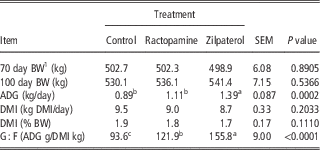
There was no effect of β-AA in final BW and DMI expressed in kg or % of BW; however, animals fed ZH diet showed greater ADG (P=0.0002) and G : F (P<0.0001) than those fed RH and CON diets (Table 5). According to Moody et al. (Reference Moody, Hancock and Anderson2000), increased ADG and G : F are usually expected when β-AAs are included in the animal diet, however, variations in responses to β-AA administration are common in the literature. This statement is in agreement with results reported by Arp et al. (Reference Arp, Howard, Woerner, Scanga, McKenna, Kolath, Chapman, Tatum and Belk2014), in which the ZH diet increased ADG by 38% and 13% and G : F by 35% and 14% compared with CON and RH diets, respectively. Increased ADG and G : F were also reported in cattle fed ZH (Beckett et al., Reference Beckett, Delmore, Duff, Yates, Allen, Lawrence and Elam2009; Montgomery et al., Reference Montgomery, Krehbiel, Cranston, Yates, Hutcheson, Nichols, Streeter, Bechtol, Johnson, Terhune and Montgomery2009; McEvers et al., Reference McEvers, Walter, DeFoor, Swingle, Hutcheson and Lawrence2014) and RH (Abney et al., Reference Abney, Vasconcelos, McMeniman, Keyser, Wilson, Vogel and Galyean2007; Winterholler et al., Reference Winterholler, Parsons, Walker, Quinn, Drouillard and Johnson2008; Strydom et al., Reference Strydom, Frylinck, Montgomery and Smith2009; Boler et al., Reference Boler, Shreck, Faulkner, Killefer, McKeith, Homm and Scanga2012; Arp et al., Reference Arp, Howard, Woerner, Scanga, McKenna, Kolath, Chapman, Tatum and Belk2014) diets compared with CON diet. On the other hand, no effects of RH (Quinn et al., Reference Quinn, Reinhardt, Loe, Depenbusch, Corrigan, May and Drouillard2008) and ZH (Strydom et al., Reference Strydom, Frylinck, Montgomery and Smith2009) diets were observed on ADG.
Means, SEM and probabilities (P value) of the performance traits, according to treatment

ADG=average daily gain; DMI=dry matter intake; G : F=gain to feed.
a,b,cValues within a row with different superscript letters differ significantly at P<0.05.
1 Corresponds to the beginning of β-agonist adrenergic supplementation.
Avendaño-Reyes et al. (Reference Avendaño-Reyes, Torres-Rodríguez, Meraz-Murillo, Pérez-Linares, Figueroa-Saavedra and Robinson2006) observed higher BW in animals supplemented ZH when compared with CON and RH. In the same way Beckett et al. (Reference Beckett, Delmore, Duff, Yates, Allen, Lawrence and Elam2009), Boler et al. (Reference Boler, Shreck, Faulkner, Killefer, McKeith, Homm and Scanga2012) and McEvers et al. (Reference McEvers, Walter, DeFoor, Swingle, Hutcheson and Lawrence2014) reported higher BW in animals fed β-AA than those fed CON diets. In addition, results regarding the effects of β-AA on DMI are contrasting in the literature. Similarly to our study, Quinn et al. (Reference Quinn, Reinhardt, Loe, Depenbusch, Corrigan, May and Drouillard2008), Vasconcelos et al. (Reference Vasconcelos, Hathmann, Reuter, Leibovich, McMeniman, Hales, Covey, Miller, Nichols and Galyean2008) and Boler et al. (Reference Boler, Shreck, Faulkner, Killefer, McKeith, Homm and Scanga2012) did not observed effect of β-AA on DMI, whereas others reported decrease (Avendaño-Reyes et al., Reference Avendaño-Reyes, Torres-Rodríguez, Meraz-Murillo, Pérez-Linares, Figueroa-Saavedra and Robinson2006; Beckett et al., Reference Beckett, Delmore, Duff, Yates, Allen, Lawrence and Elam2009; Strydom et al., Reference Strydom, Frylinck, Montgomery and Smith2009; McEvers et al., Reference McEvers, Walter, DeFoor, Swingle, Hutcheson and Lawrence2014) or increase (Abney et al., Reference Abney, Vasconcelos, McMeniman, Keyser, Wilson, Vogel and Galyean2007; Montgomery et al., Reference Montgomery, Krehbiel, Cranston, Yates, Hutcheson, Nichols, Streeter, Bechtol, Johnson, Terhune and Montgomery2009) DMI when supplementing β-AA.
Most of the results showed higher animal performance in the ZH diets in relation to the RH and CON diets, as well as in our study. It can be explained by the greater specificity of ZH to act on β2-AA receptors whereas RH acts predominantly on β1-AA receptors and minimally on β2-AA receptors, which are more abundant in muscle and have higher cellular action (Moody et al., Reference Moody, Hancock and Anderson2000).
Ultrasound carcass traits
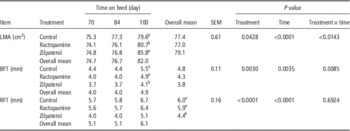
There was an interaction between treatment and days on feed (DOF) on LMA and BFT (P<0.0001, P=0.0085, respectively, Table 6). No difference in LMA was observed in on days 70 and 84, which could be expected due to the short time available to respond to the β-receptors at day 84. In contrast, at day 100, the animals fed ZH diet showed higher LMA (P<0.0001) and smaller BFT (P=0.0030) and RFT (P<0.0001) than the animals fed CON and RH diets. CON and RH diets did not differ for any ultrasound carcass trait.
Means, SEM and probabilities (P value) of the ultrasound carcass traits according to treatment in phase 2 (70 to 100 days) supplementation

LMA=longissimus muscle area; BFT=backfat thickness; RFT=rump fat thickness.
a,bValues within a column with different superscript letters differ significantly at P<0.05.
These results are similar to the studies of Avendaño-Reyes et al. (Reference Avendaño-Reyes, Torres-Rodríguez, Meraz-Murillo, Pérez-Linares, Figueroa-Saavedra and Robinson2006), Hilton et al. (Reference Hilton, Montgomery, Krehbiel, Yates, Hutcheson, Nichols, Streeter, Blanton and Miller2008) and McEvers et al. (Reference McEvers, Walter, DeFoor, Swingle, Hutcheson and Lawrence2014), which found higher LMA and smaller BFT for the ZH diet compared with CON diet. Winterholler et al. (Reference Winterholler, Parsons, Walker, Quinn, Drouillard and Johnson2008) found similar results using RH diet. Arp et al. (Reference Arp, Howard, Woerner, Scanga, McKenna, Kolath, Chapman, Tatum and Belk2014) observed an increased LMA for the ZH group compared with the CON and RH groups; however, the BFT was similar between all treatments. When comparing the two β-AAs for those characteristics, the ZH animals had greater LMA (P<0.01), lower BFT (P<0.01) and RFT (P<0.01) than the RH animals.
Carcass data
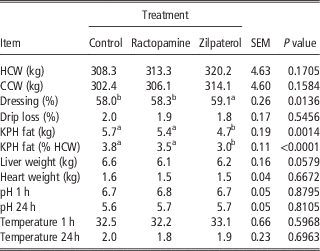
There was no treatment effect on carcass pH and the temperature evaluated 1 or 24 h postmortem as well as in HCW and drip loss. However, the animals fed ZH diet had higher DP (P=0.0136) than the animals fed RH and CON diets (Table 7).
Means, SEM and probabilities (P value) of the carcass traits, according to treatment.

HCW=hot carcass weight; CCW=cold carcass weight; KPH=kidney, pelvic and heart.
a,bValues within a row with different superscript letters differ significantly at P<0.05.
These results are similar to those found by Beckett et al. (Reference Beckett, Delmore, Duff, Yates, Allen, Lawrence and Elam2009), Montgomery et al. (Reference Montgomery, Krehbiel, Cranston, Yates, Hutcheson, Nichols, Streeter, Bechtol, Johnson, Terhune and Montgomery2009), Strydom et al. (Reference Strydom, Frylinck, Montgomery and Smith2009) and McEvers et al. (Reference McEvers, Walter, DeFoor, Swingle, Hutcheson and Lawrence2014), who noted that animals fed ZH diets had higher DP than non-supplemented β-AA animals. Likewise, Boler et al. (2012) and Quinn et al. (Reference Quinn, Reinhardt, Loe, Depenbusch, Corrigan, May and Drouillard2008) reported the same results for animals fed RH v. non-supplemented β-AA animals. However, Winterholler et al. (Reference Winterholler, Parsons, Walker, Quinn, Drouillard and Johnson2008) found no difference in that trait in animals fed RH diet. In contrast to these results, Avendaño-Reyes et al. (Reference Avendaño-Reyes, Torres-Rodríguez, Meraz-Murillo, Pérez-Linares, Figueroa-Saavedra and Robinson2006) stated that animals fed ZH and RH diet had higher HCW than non-supplemented β-AA animals. Those results are similar to those of Arp et al. (Reference Arp, Howard, Woerner, Scanga, McKenna, Kolath, Chapman, Tatum and Belk2014); however, these authors found no difference between animals fed RH diets and non-supplemented β-AA animals.
The animals fed ZH diet had a lower weight and percentage of KPH fat (P=0.0014, P<0.0001, respectively) than the animals fed RH and CON diet (Table 7), which were not different among themselves. These results associated with lower subcutaneous fat deposition in animals fed ZH diet are in agreement with the reported action of β-AAs, which act in the reduction of lipogenesis and increase of lipolysis (Dunshea et al., Reference Dunshea, D’Souza, Pethick, Harper and Warner2005), resulting in leaner carcasses.
These results are similar to those found by Hilton et al. (Reference Hilton, Montgomery, Krehbiel, Yates, Hutcheson, Nichols, Streeter, Blanton and Miller2008) and Howard et al. (Reference Howard, Woerner, Vote, Scanga, Acheson, Chapman, Bryant, Tatum and Belk2014), who reported a lower KPH fat in animals fed ZH compared with animals fed CON diet. However, no differences were observed in those traits for animals fed ZH (Beckett et al., Reference Beckett, Delmore, Duff, Yates, Allen, Lawrence and Elam2009 and Montgomery et al., Reference Montgomery, Krehbiel, Cranston, Yates, Hutcheson, Nichols, Streeter, Bechtol, Johnson, Terhune and Montgomery2009), RH (Abney et al., Reference Abney, Vasconcelos, McMeniman, Keyser, Wilson, Vogel and Galyean2007) or both β-AAs (Strydom et al., Reference Strydom, Frylinck, Montgomery and Smith2009).
The animals fed β-AA trended to have a lower liver weight (P=0.0579) than the animals fed CON diet (Table 7). In addition, there was no difference in heart weight between the treatments. According to Ramos and Silveira (Reference Ramos and Silveira2002), the protein breakdown promoted by β-AA occurs mostly in skeletal muscle. Thus, striated and smooth muscle, such as heart and liver, experienced reduction in protein, which might reduce the weight of these viscera compared with the non-supplemented animals. That statement explains in part the tendency of the animals fed β-AA diet to show a lower liver weight than the animals fed CON diet.
In summary, immunocastration decreases muscle development and increases fat deposition on the carcass when compared with intact animals. Thus, immunocastration could be used as a tool for improving the carcass fat uniformity at slaughter in spite of decreasing the animal performance when compared with intact animals. This may be of particular interest under production conditions where animals are fed for short periods – such as those observed in Brazil – where lack of carcass fat is one of the main problems for the meat industry.
In contrast, β-AA increases muscle proportion and decreases fat proportion, which can directly affect (increase) the carcass yield. The ZH diet has a higher action on the muscle metabolism, promoting higher animal performance when compared with the animals fed RH diet. However, RH diet achieves a better balance because it has an intermediary performance between non-supplemented and ZH animals, and does not decrease the carcass fat, which is important in conditions such as those observed in Brazil.
Acknowledgments
The authors gratefully thank the (grant no. 2013/07985-2) Sao Paulo Research Foundation (FAPESP), which provided financial support for this study, and Coordination of Improvement of Higher Education Personnel (CAPES) that offered a scholarship to the first author.