

In 1542 a new church ordinance appeared from an Erfurt press formally introducing Luther’s reformation in the principality of Calenberg-Göttingen, a small part of the duchy of Braunschweig-Lüneburg. Like many other Lutheran church ordinances of the time, it provided for the retention of the litany, a form of petitionary prayer arranged in a call-and-response format that had long been in common use. Typically Lutherans called for the praying of the litany on Wednesdays and Fridays, and this church ordinance is no exception. But unlike the others it goes on to caution the reader about the potential abuse of the litany:
That we Christians should pray at all times for the pressing need of the emperor, kings, lords, princes and all men is shown by Scripture . . . And therefore it is our grave and merciful wish that you, our pastors, hold general prayers and, on designated days, namely on Wednesdays and Fridays, have the litany sung with all devotion . . . It happens that the ancients introduced such prayers during Rogation Days, but soon the Devil came and corrupted this good intention, with notable abuses. Namely, that people went hither and thither with banners and saints’ [images] and forgot entirely their proper prayers. We wish, therefore, that such monkey-business [Affenspiel] with processions be entirely abolished; but nevertheless you should hold such Rogation Days, with sermons, sacraments and the litany, honourably in the early morning, [and] not so that we for a time oblige those who are weak in faith. But the litany should be held in the manner in which it was printed and issued from Wittenberg, and not as it was in earlier times, when people sang ‘Saint Peter, pray for us.’Footnote 1
A tension is apparent here between the ongoing value of the litany as a petitionary prayer and its traditional, late medieval role as an appeal to the saints’ intercession in heaven. It may have been for this reason that the litany would play a relatively minor role in Lutheran culture, musical and otherwise; but its assertion of sanctoral intercession helped to guarantee it a prominent place in the devotional culture of the Catholic Counter-Reformation. Whether spoken, chanted, or sung, the litany would become an aural linchpin of Catholic culture by the end of the sixteenth century, a sound that produced and shaped distinctively Catholic soundscapes through its characteristic ebb and flow of titles and petitions. In the contested religious geography of the Holy Roman Empire, the litany was perhaps the most insistently ‘confessional’ form of sounding prayer and music, one that traced the boundaries of faith communities and reinforced the confessional identities of performers and listeners, whether they embraced it as a devotional expression or rejected it as idolatry.
Despite the ubiquity of the litany within early modern Catholic liturgical and devotional culture, we still know relatively little about its aural character. Dominated by a lengthy series of titles referring to the attributes of God, Christ, the Virgin Mary, the Saints, or other holy objects, each answered with brief choral or congregational petitions, the litany is a highly formulaic and repetitive prayer. The most famous of early modern litanies, the Litany of Loreto, is as follows:

In the field of musicology the litany has largely been neglected, except for two lengthier studies on the polyphonic litany by Joachim Roth and David Blazey, and several shorter, recent essays by Robert Kendrick and Magda Marx-Weber.Footnote 2 Otherwise discussion of litany settings, even by prominent composers like Orlando di Lasso, Giovanni Pierluigi da Palestrina and Wolfgang Amadeus Mozart, remains scattered at best. The litany’s relentless repetition of titles and petitions may have discouraged closer attention, but its neglect may also follow from its position on a fluid boundary between oral and written traditions. The litany could be prayed silently; it could be spoken, intoned, sung to simple melodic formulae, or set polyphonically in myriad forms. In its usual performance in supplicatory processions and pilgrimages the litany demanded musical simplicity above all. Since monophonic litanies were sung to repeated melodic formulae, they were seldom notated in medieval and early modern sources. Furthermore, the litany posed considerable challenges for composers of polyphonic settings, who aimed at musically satisfying solutions that would balance the need for sonic variety with the form’s inherent repetitiveness.
One of the most venerable forms of prayer in the Christian church, with origins by the late fourth century at the latest, the litany inspired polyphonic musical treatment particularly in Catholic contexts from the late sixteenth century onward. The present essay focuses on the litany in a time and place that saw an explosion of musical interest in the genre: Catholic Germany in the age of the Counter-Reformation, and especially the duchy of Bavaria, which from the mid-sixteenth century emerged as a militant bulwark of the traditional Church in the confessionally fragmented landscape of the Holy Roman Empire. The litany is examined here in three facets. First, the litany represented the traditional Church’s dogma of sanctoral intercession in its purest form and became a provocative aural symbol of confessional controversy. Catholics entreating the saints to intercede with God on their behalf, or worse, to perform miracles directly – a belief not endorsed by the Council of Trent, incidentallyFootnote 3 – would be a thorn in the side of Protestant commentators, who railed against a form of idolatrous prayer not exclusively directed to God alone. Second, the litany was intimately connected to collective motion of Catholic devotees, expressed in the urban processions and rural pilgrimages that traced and defined sacred space. When sounded at the holy sites reached by these processions, the litany could effect miraculous occurrences. Finally, the prominent position of the litany as a ritual expression led to a remarkable flowering of polyphonic settings in the late sixteenth and early seventeenth centuries, especially in Bavaria, the epicentre of the Counter-Reformation in the north. By far the grandest collection of polyphonic litanies ever published was the Thesaurus litaniarum (Treasury of Litanies), issued in 1596 by the music director of the Jesuit college in Munich, Georg Victorinus. An examination of this rich anthology demonstrates not only its intimate connection with Catholic reform in German-speaking lands, but also the varied and creative ways in which composers responded to the litany’s distinctive structure, either foregrounding its functional and spatial distinction between title and petition, or effacing this structure by assimilating the form to prevailing forms of late Renaissance polyphony.
THE LITANY IN HISTORY AND THEOLOGY
Prayers or acclamations resembling litanies are probably quite ancient, as scattered examples from Judaic and Babylonian-Assyrian practices attest.Footnote 4 Clear evidence for the use of prayers resembling later litanies in medieval Christian worship is firmly attested by the end of the fourth century at Antioch, and by Egeria in her Itinerarium (c. 381–4) for the Holy Land, in which she describes collective responses of Kyrie eleison to a lector’s recitation of holy names.Footnote 5 The so-called Byzantine Ektenie seems to have formed the most direct precedent for litanies in the West: after the fourth century similar prayers are known in Ambrosian, Celtic, Gallican and Mozarabic practice. A Gallican usage, attributed to St Mamertus, Bishop of Vienne (d. c. 475), of processional litanies on the three days before the feast of the Ascension is of particular note, as this practice would eventually be adopted as the Minor Litanies or Rogations by Pope Leo III (d. 816). In the Roman liturgy it is thought that Pope Gelasius I (492–6) introduced a litanic ‘Deprecatio Gelasii’ after the Gospel,Footnote 6 which may have been the form adapted by Gregory the Great to produce the ninefold Kyrie. The Agnus Dei, too, seems to have originated as a litany, introduced by Sergius I (687–701). Before adopting the Gallican Minor Litanies, Rome introduced its own Rogation feast on 25 April – later known as the ‘Major Litanies’ – attested no later than the time of Gregory the Great. It is unclear whether this processional litany is the same as the sevenfold penitential procession (with congregational Kyrie eleison responses) called by Gregory in 590, beginning at the seven separate Roman churches and culminating at S. Maria Maggiore. Litanies were also called for in the Rule of St Benedict and became common in the monastic hours.Footnote 7 By the high Middle Ages litanies of the Saints became a dominant form, occupying a fixed role in the Paschal vigil and in the form of the Greater Litanies for the feast of St Mark and the Lesser Litanies for Rogation Days.Footnote 8
Critiques of sanctoral invocation led to a much-reduced role for the litany in the Protestant churches of the sixteenth century, although Martin Luther issued a vernacular version in response to the Ottoman military advances towards Vienna in 1529. Luther stripped the litany of all sanctoral invocations and prescribed an antiphonal style of performance between the choir and congregation. This ‘German litany’ soon became standard fare in early Lutheran hymnals, such as that of Joseph Klug (Wittenberg, 1529), Valentin Babst (Leipzig, 1545) and Lucas Lossius (Nuremberg, 1553), and it would occasionally be set polyphonically by composers in the Lutheran orbit – Michael Praetorius, Hans Leo Hassler and Heinrich Schütz, to name a few. It did not, however, enjoy a tradition as vibrant as within Catholicism.Footnote 9Certainly Protestant theological challenges to the traditional litany’s content played some role in this, especially its seeming lack of direct invocations to Jesus Christ. ‘Christ’s intercession is no less profaned’, Jean Calvin writes in his Institutes of the Christian Religion, ‘when mingled with prayers and merits of the dead than if it were completely omitted and dead men alone were mentioned. Then, in all their litanies, hymns and proses, where they leave no honor unapplied to dead saints, Christ goes unmentioned.’Footnote 10 Likewise the Lutheran theologian Martin Chemnitz railed against the non-Christocentric nature of the Catholic litany in his lengthy critique of the Tridentine decrees, the Examen Conciliis Tridentini, noting that the prayer of the litany at the opening of the Council represented a bad omen of what was to come:
Then at the very opening of the Council [they prayed] the litany, in which there is not a single solitary mention of the intercession of Christ; instead of Christ, our only mediator, they substituted all of the angels and Saints as mediators, patrons and intercessors. Then followed Ambrosius Catharinus, who in his prayer for the opening of the Council petitioned the mother of Christ as His helper, who is seated next to His throne, to obtain grace for us. Another in his speech took the words of the Evangelist, which refer only to God, and in a godless manner turned them towards the Roman Pope: ‘The Pope, the light that came into the world’ . . . From these beginnings one can see what to expect, for it is impossible, as the saying goes, that something begun poorly can have a good result.Footnote 11
The question of who is to be properly invoked in the litany also pervades the comments of Michael Praetorius, who published three polyphonic litany settings in his Kleine und Grosse Letaney (1613). Praetorius defined the litany ‘as a public collective prayer, in which the holy Christian Church expresses the general need of all Christendom to God the Almighty, and requests his Godly aid and deliverance with united, faithful hearts and mouths’.Footnote 12 Critical is his insistence that the earliest litanies were directed to God alone, and that the introduction of sanctoral invocations was a corruption from the time of Gregory the Great:
Pelagius, the successor of Gregory the First, or the Great, ordained to be prayed the Great Litany, in which he mixed in the idolatrous invocation of the saints, against the horror of pestilence. This was called the ‘Major Litany’ [Litaniam Majorem], also the ‘Gregorian and Roman’ [Litany]. After this pestilence [abated] the practice continued of an annual procession at this time [of year], with crosses and banners going from one church to the next, and around the churches and the flowers of the field, with the singing of Gregory’s litany. Due to this the Sunday Vocem jucunditatis [the Fifth Sunday after Easter] together with the following week was called Rogation Sunday and Rogation Week [Betsontag und Betwoche], and also the Cross-Week [Creutzwoche]. And in this way the papist invocation of the saints in the litany was first invented by Gregory the Great, and added to the earlier, proper form of the litany. However, when the ancient fathers consider the litany, they say explicitly that in it only God alone was prayed to and called upon.Footnote 13
For other reformers, litanic invocations to the Saints could easily be linked to other ‘idolatrous’ Catholic practices. Calvin’s co-religionist Rudolphus Hospinianus (1547–1626), a pastor at Zurich and an active polemicist, wrote extensively on the history of ‘litanies, rogations and supplications’ in his De templis: hoc est, de origine, progressu, usu et abusu templorum (1587).Footnote 14 Hospinianus offered a history of supplications and rogations in the early Church, including the institution of the Major Litanies on the feast of St Mark and the Minor Litanies for Rogation Days, but his principal aim was to attack the sanctoral invocations, which, he argued, were not a part of the most ancient litanies, which were appropriately directed to God alone (Praetorius, as we have seen, would echo this viewpoint). Simple commemorations of the Saints, moreover, became direct invocations under Gregory the Great and his successors.Footnote 15 Hospinianus took care to associate supplicatory prayer to the Saints with superstitious ceremonies that, he said, the Church adopted from pagan practices; among these were the ringing of bells during processions, done ‘so that the demons in the air should flee in terror and desist from their molestation of men . . . and refrain from stirring up storms’.Footnote 16 For Hospinianus, litanies, processions and the apotropaic power of bell-ringing were all of a piece, an expression of the magical thinking that had been superseded by Calvin’s reformation.
The Catholic defence of sanctoral veneration, and in turn of the litany, proceeded from the Council of Trent’s decree on the intercession of the Saints, issued during the twenty-fifth session in December 1563. Pastors were to teach their flocks that ‘the saints who reign together with Christ offer up their prayers to God for men, that it is good and beneficial suppliantly to invoke them and to have recourse to their prayers, assistance and support in order to obtain favors from God through His Son, Jesus Christ our Lord’.Footnote 17 The Tridentine decrees assured that appeals to the saints, such as those projected by litanies, could be efficacious in heaven, thus laying a foundation for the litany’s close identification with Catholic belief and ritual. But the Tridentine dogma of sanctoral intercession also countered still-popular beliefs that the saints could directly work miracles on earth, without any necessary appeal to the Godhead. Catholic apologists, like their Protestant opposites, distinguished worship from veneration in a manner that was very likely lost on the common devotee.Footnote 18 Whether they invoked the saints for their powers of intercession, or for their purported ability to exert power on earth, Catholics participated in a sacred economy in which they offered vows, prayers, visits and tangible gifts in exchange for miraculous healings and other good favours.Footnote 19
Insisting that the litany’s invocations to the saints did not amount to worship was a key strategy on the part of Catholic writers close to the confessional frontiers of the north. We see this, for example, in the treatise Lutherana veteris Catholicaeque litaniae correctio (Würzburg, 1589), penned by a certain magister Remigius Dithmar, about whom otherwise little is known.Footnote 20 Dithmar attacked the Lutheran revision of the litany and offered a robust defence of its Catholic counterpart in the face of criticism by Calvin, Martin Chemnitz and other Protestant writers. Much of his treatise is given over to a refutation of Protestant ‘lies’ on the origin and early history of litanies, but of greater interest here is his insistence in the face of Protestant criticism that the litany’s invocations are ultimately addressed to God and not to the persons of the saints. In a chapter on the utility of the litany, Dithmar gives a succinct account of its nature, its proper object and its speakers:
First, concerning those things that pertain to this prayer, the first consideration is to whom is prayed. Truly in litanies it is God alone, the highest and truest author and giver of all graces. Next are the Saints, who pray, and together with us appeal to our and their Highest and Greatest God on our behalf. The second [consideration] is, who prays. In our litanies they are men and Angels, the wretched and the blessed, the Church militant and triumphant. The third [consideration] is what is to be prayed for. In litanies this is variable. Appeals are made for good things of all kinds, divine and human: spiritual and bodily, public and private. The fourth [consideration] is on whose behalf it is to be prayed. Prayers are made for the living and the dead, for religious and secular [clergy], for princes and their subjects, for the well and the sick, for those here and absent, for friends and enemies. The fifth [consideration] is the manner of prayer. In litanies many methods are used by those who would succeed in their appeals. God is prayed to as God absolute, and in His distinct persons; or to each singular person individually; or to all of them together at once, but indicating the distinction in persons, and the unity of their essence.Footnote 21
Later in his treatise Dithmar returns to the proper object of litanic prayer, refuting specific ‘lies’ by Luther, Calvin, Chemnitz and the Magdeburg Centuries – the great church history penned by a group of Lutheran theologians led by Mathias Flacius – by pleading ‘we say to God: Miserere nobis, and to the Saints: Orate pro nobis. How can this be idolatry? Surely it is not permitted to say to God: sancte Deus, ora pro nobis?’Footnote 22
With its careful distinction between worship and invocation, Dithmar’s treatise proved to be influential: in fact it was reprinted in its entirety as an appendix to the Ingolstadt Jesuit Caspar Keller’s Litaniae Catholicae: ad Christum, Beatam Virginem, et Sanctos (Ingolstadt, 1589), a compendium of various litany texts, and as the first part of the Jesuit theologian Nicolaus Serarius’s Litaneutici, seu de litaniis libelli duo (Cologne, 1609).Footnote 23 In turn, Dithmar’s arguments favouring prayer to the saints as mediators were explored in broader south-German treatises on sanctoral invocation, such as De sanctorum invocatione by the Jesuit Petrus Thyraeus and the Scottish Benedictine Francis Hamilton (Würzburg, 1596), and the Quaestiones de sanctis, eorumque invocatione, ac litaniis, variae by Serarius and the Dominican friar Johannes Zittard (Mainz, 1608), a tract that would become the second part of Serarius’s Litaneutici one year later.Footnote 24 We need not be detained here further by these authors who, like Dithmar, argue for the efficacy of the saints’ intercession without attributing divinity to them. Whether such fine theological distinctions had any purchase with common devotees who recited and sang litanies in Catholic rituals is debatable, and indeed it was their tendency to conflate invocation with worship that motivated Protestant critiques in the first place.
Published Catholic defences of the litany went hand in hand with a profusion of different litany texts, ranging from the more traditional sanctoral litanies to those honouring the Virgin Mary, the Eucharist and the Name of Jesus. The most notable trend is the emergence of Marian litanies as the dominant form, related in part to Mary’s seeming intercession in the European wars against the Turks, notably at the Battle of Lepanto in 1571.Footnote 25 The principal object of devotion was, of course, the Holy House of Loreto on Italy’s Adriatic coast. According to legend, the house of Mary’s birth at Nazareth, threatened by advancing Turkish armies, had been miraculously transported by angels first to Dalmatia in 1291 and then to its present spot in 1294. In subsequent centuries an active pilgrimage emerged at this site, which received bulls in its favour by Sixtus IV in 1484 and by Julius II, whose In sublimia of 1507 officially sanctioned the legend of the Holy House’s translation.Footnote 26 The arrival of the Jesuits in 1554 to assume the duties of pastoral care at Loreto led to an upsurge in devotional culture there, and it is no accident that the Jesuits would be primarily responsible for the subsequent spread of the Loreto cult. Within a few decades of Lepanto, architectural copies of the Holy House soon sprang up in many cities and rural areas – particularly in the Catholic lands of southern Germany, Austria and Bohemia – and became active pilgrimage centres in their own right. Early copies were constructed by Anton Fugger, scion of the wealthy Augsburg banking dynasty, at Hainhof in 1572, and by Ferdinand II of Tyrol in the Haller Au in 1589, but their rapid profusion began only after the turn of the century, and especially from the 1630s to 1675, a period that coincided with the dissemination of the Jesuit Wilhelm von Gumppenberg’s influential Atlas Marianus, a comprehensive catalogue and description of Marian cultic sites throughout the world.Footnote 27 By the early seventeenth century there was little question in this region of the prestige and dominance of the Marian cult, which now overshadowed sanctoral and Eucharistic shrines of an older vintage.
At the same time the so-called Litany of Loreto became the most widespread litany used in Catholic Europe.Footnote 28 It was associated with the Loreto shrine by 1558, the year that the Jesuit father and writer Peter Canisius had it printed in Dillingen for circulation in the south German orbit; by 1560, again at Canisius’s insistence, it was in use at the Jesuit college in Prague.Footnote 29 By the end of the century its text had far outstripped other types in popularity, and it was one of only three litanies – the Litany of Loreto, the Litany of All Saints and the Litany of the Name of Jesus – that were officially retained for use by Clement VIII in his 1601 constitution Sanctissimus.Footnote 30 As we shall see, the Litany of Loreto gained further ground in southern Germany through its promotion not only by the Jesuits, but also by the Bavarian dukes, who emerged as the principal state supporters of the Catholic cause north of the Alps in the years leading up to the Thirty Years War. Despite the triumph of the Litany of Loreto, there is considerable evidence that a variety of litany forms were and remained popular, particularly in the northern Catholic lands.Footnote 31 Three years before Sanctissimus, for example, we find a Thesaurus litaniarum ac orationum sacer, cum suis adversus Sectarios Apologijs (Brussels, 1598) by the Jesuit priest Thomas Sailly, dedicated to Don Francisco de Mendoza, the commander of cavalry forces in the Spanish Netherlands. An explicitly confessional document, Sailly’s Thesaurus contains a wide variety of better- and lesser-known litany texts, which are distributed through a succession of daily meditations through the week.Footnote 32 In the German Catholic heartland, we also find a published collection of litany texts issued in 1600 by none other than Duke Wilhelm V of Bavaria, who had recently abdicated his position in favour of his son Maximilian I and now retired to a life of pious devotion and charity. Wilhelm’s Fasciculus sacrarum litaniarum ex sanctis scripturis et patribus, a volume that would be reprinted at least five times before 1620, does indeed contain the Litany of Loreto and the Marian litany ex sacra scriptura (with Marian titles based strictly on biblical verses), but these are embedded in a lengthy series of thirty-two litanies directed also to God the Father, Christ, the Holy Spirit, the Trinity, St Michael, the Holy Angels and various categories of saints and martyrs; notably we find also a ‘Litany for Germany, to the German Saints’ and a ‘Litany to the Saints Militant in Time of War’, echoing the overt militancy of Sailly’s Thesaurus. Footnote 33 Wilhelm’s gesture of publicising a litany collection was certainly intended as a conspicuous symbol of Wittelsbach piety, but like Victorinus’s Thesaurus litaniarum it also promoted the utility of the litany as a devotional and confessional tool.
THE LITANY AND ITS FUNCTIONS IN COUNTER-REFORMATION GERMANY
The specific aural forms taken by the litany in Catholic devotion and ritual show a remarkable diversity, ranging along an aural spectrum from the spoken word to heightened recitation, to chant, to rudimentary polyphony and to elaborate polyphonic compositions for trained choirs. This wide range of expressions implies a range of practices as well. Apart from standard liturgical prescriptions for the feast of St Mark and Rogation Days – and, beginning in 1615, for Compline on the feast of the Immaculate Conception – the litany was often performed in churches on Saturday evenings, at least on the vigils of Marian feasts; at public and confraternal devotions; during Sacramental devotions; during the course of private spiritual exercises; and in public processions, to name a few contexts.Footnote 34 Much of the initial impetus for the expansion of litanic practice was due to the Jesuits, whose introduction of litanies on Saturday evenings in Lent at the German College in Rome in 1583 was soon imitated at other Jesuit colleges and sympathetic courts.Footnote 35 North of the Alps, the prestige of the litany was enhanced by a miraculous occurrence at the Jesuit college in Ingolstadt in April 1604. It was during the Saturday devotions of the Marian Colloquy (Colloquium Marianum), led by Father Jakob Rem, that the following episode took place:
It was the 6th of April when, as the Marian Colloquists were gathered together as customary, the musicians sang passages from the Litany of Loreto. Father Jakob occupied his customary place in a corner of the oratory, meditating on the titles of the great Queen of Heaven, seeking to understand which of these would be most pleasing to the Divine Mother. And behold! As the musicians enunciated those words: Mater admirabilis [Wondrous Mother], the Virgin appeared in a vision surrounded by celestial light, instructing [him] that she was best pleased by that praise. His most ardent spirit could not contain his joy at Mary’s glory. Suddenly he sprang up from his corner into the middle [of the chapel], exclaiming to the rest – who wondered at such insolence – that they should all redouble their voices [and sing] Mater admirablis three times, seeing how pleasing this appellation was to the Mother. Without delay they obeyed: thrice did they repeat this phrase, and from that time forward it was always said three times in the litany by the Colloquists, and the name Mater ter admirabilis was attached to the whole assembly.Footnote 36
Litanies soon became common at public Jesuit celebrations as well, such as the final consecration of the Jesuit church of St Michael in Munich in 1597, for which sanctoral litanies in both Latin and German were printed for public consumption.Footnote 37 By the middle of the following century, the Munich Jesuits embedded litany recitations into an elaborate ritual practice: when litanies were to be performed on Saturdays, two burning candles flanked the priest at the altar, whose introductory prayers were followed by the Litany of Loreto and an antiphon (probably one of the seasonal Marian antiphons); on other days of the week, a motet would follow the recitation of the Litany of the Saints. The Litany of the Name of Jesus, on the other hand, was prescribed for sacramental expositions during the Octave of Corpus Christi.Footnote 38
A close association between litanies and processions may be found in numerous Catholic mandates for public supplications, which were often performed on occasions of external threats. The imperial wars against the Turks, which reached a critical stage by the mid-1590s, were especially invoked as a justification for these ceremonies. Indeed Bishop Neidhart von Thüngen of Bamberg took the step of publishing a separate Ritus cantandi et legendi Litanias in Ciuitate et Dioecesi Bambergen[sis] in August 1594 ‘for the expedition against the Turks’, a booklet that contained additions to the Litany of all Saints calling on God to confound the Turks and to provide assistance to the emperor, the bishop and those under his authority.Footnote 39 In Bavaria, Duke Wilhelm V and his brother, Bishop Ernst of Freising, issued mandates around the same time that deployed litanies together with processions and other prayers to counter the Turkish threat.Footnote 40 The rising hazard of confessional military conflict within the empire itself after 1610 also compelled such mandates, where we find varied combinations of processions, litanies and extended Sacramental devotions like the Ten- or Forty-Hour Prayer.Footnote 41
The link between the performance of Marian litanies and Catholic military fortunes remained firm in the German-speaking areas affected by the Thirty Years War. In 1638, the Swedish armies having withdrawn from the southern German theatre, Maximilian I of Bavaria erected a massive column in the main square, crowned by a statue of the Virgin Mary with child. Throngs of Catholics soon were processing to this so-called Mariensäule to offer their prayers to the Virgin, often taking the form of Marian litanies. In May 1639 the local bishop felt compelled to write to the dean of the church of Unsere Liebe Frau to complain that too many litanies were being sung at once on Saturdays, often extending well into the night. From now on, he instructs, only a single litany should be performed on Saturday evenings, presumably by the trained musicians Unsere Liebe Frau.Footnote 42 By August of that year we know that singers and musicians from that church, from the parish of St Peter and from the electoral court were being paid annually for performing polyphonic litanies before the column.Footnote 43 Finally, the principal obligation of the so-called ‘Marianische Compagnie U. L. Frauen Säulen auf dem Platz allhier zu München’, founded by lay devotees in 1680, was to sing the Litany of Loreto before the column every Thursday, accompanied by paid singers and instrumentalists.Footnote 44 At least for the next hundred years, polyphonic litanies to the Virgin would provide a regular sonic backdrop to the commanding presence of this golden statue in the centre of the capital, the symbolic centre of the duchy as a whole.
The litany was most fundamentally connected, however, with the motion and the definition of space. Litanies were among the most characteristic sound of processions, whether circumnavigating an urban environment or projecting through the rural landscapes of pilgrimage. Their repetitive, rhythmic profile, coordinated with the rhythms of breathing and walking, not simply expressed motion but induced it as well: they articulated lengthy journeys, helping to pace the procession and impel bodies through space. The litany had dogmatic textual elements, but its lengthy repetitions also evoke what the anthropologist Stanley J. Tambiah has described as the ‘redundant’ character of ritual speech that can lead to altered states of consciousness, opening the door to a sense of not only communal harmony but also divine presence.Footnote 45 Consequently, the most common forms of litanies were relatively simple in musical dress, limiting luxurious counterpoint in favour of a sharply honed rhythmic profile. Litanies traced sacred space with sound, but they also expressed social hierarchies by exploiting spatial distinctions. As post-Tridentine processions were increasingly subject to clerical and official control, they were gradually more organised to reflect hierarchies of social standing and gender: this meant a clear physical separation of clergy from laity and men from women; confraternities, too, marked by special dress and accessories like banners and pilgrims’ staves, marched separately from the general laity. The ebb and flow between the litany’s clerical invocations and lay responses not only underlined these distinctions in authority, but also dramatised the different physical positions of these actors in space. As we shall see, during the peak of the genre’s prominence in the late sixteenth and seventeenth centuries, composers would resort to various means to represent these spatial qualities of the litany.
The provocative quality of processional litanies is especially evident in northern regions of mixed confession, where Catholic apologists foregrounded the role of litanies in processions and deployed a panoply of historical examples, extending back to the early centuries of the Christian church, to defend them against Protestant critiques; we see this clearly, for example, in De Catholicae Ecclesiae processionibus seu supplicationibus (Ingolstadt, 1606) by the Ingolstadt Jesuit theologian Jakob Gretser (1562–1625), as well as in the Sacri peripatetici, sive de sacris ecclesiae Catholicae processionibus (Cologne, 1607), by the aforementioned Nicolaus Serarius.Footnote 46 By this time litanies were probably a common sound in the Catholic processions that began to wind their way through cities of mixed confession like Augsburg, Regensburg and Donauwörth. Augmented by songs, trumpeting, drumming and even gunfire, these processions projected a militant Catholicism designed to reinforce the identity of Catholics and strike apprehension into the hearts of Protestants, even those not directly viewing the spectacle.Footnote 47 Processions themselves had already been the target of Protestant critics beginning with Luther himself, who railed against the frivolity and misconduct of Rogationtide processions as early as 1519;Footnote 48 but the aural projection of intercessory prayer in the form of litanies added a new and theologically troubling dimension. Litanies were surely among the sights and sounds that led members of the Lutheran majority in the city of Donauwörth to physically attack a St Mark’s day procession in the year 1606, an infamous episode later dubbed the Fahnenschlacht (‘Battle of the Banners’) that ultimately led to Bavarian occupation and the city’s loss of its free imperial status.Footnote 49 We are not precisely informed of the sounds and music in this procession, but litanies figure more prominently in a Lutheran account from Augsburg in 1598, when the Catholic party used the occasion of the imperial reconquest of the Hungarian city of Györ [Raab] from the Ottoman Turks as a pretext to extend their processions into Protestant areas of the city. Writing to his co-religionist Georg Cuno, Stadtschreiber of Donauwörth, the Protestant councillor Werner Seutter complained bitterly of the litanies that sounded in the streets of Augsburg:
Our [Catholic] clergy here introduce one novelty after another. Last Sunday, between our sermons in the morning, they held a very long procession from the cathedral to St Ulrich’s cloister, against tradition, with their idolatrous song ora pro nobis, and created much bad will and annoyance. The fault lies with the emperor, the Catholic city councillors and even the princes [of the empire]. Patience. For such idolatrous praise for the taking of the fortress and city of Raab will not scatter the Turks, but rather awaken God’s great wrath against us.Footnote 50
For Seutter and other Protestant auditors in this divided city the litany, invoking sanctoral intercession in its distinctive interplay of titles and petitions, must have seemed a provocative gesture.
Processional litanies in public spaces lent a distinctively Catholic sonic profile to urban areas, but they traced the sonic geography of rural areas as well. Pilgrimage was a venerable popular phenomenon that was successfully appropriated by religious elites in the service of a confessionalist programme, and by the early eighteenth century hundreds of thousands of pilgrims were making their way annually to prominent shrines in the southern German and Austrian orbit. The Bavarian and Swabian regions were particularly rich in Marian pilgrimage shrines, including the ‘Black Madonna’ of Altötting – an object of especial devotion by the Bavarian Wittelsbachs – and, as we have seen, a series of copies of the Holy House of Loreto. The litany was a common sonic component of pilgrimage to these holy places: its impressive length, simplicity and rhythmic ebb and flow lent it especially well to coordinate with breath and step over long distances.Footnote 51 As a form of oral culture above all, litanies proved to be remarkably useful in a context of mixed literacy: while a cleric or singing-leader (Vorsänger) sang the constantly changing titles of the divine object, commoners could participate in the collective responses (ora pro nobis, Bitt für uns) without the aid of written texts or notation. More profoundly, the litany’s traditional association with processional motion meant that its sounds both pushed bodies through space and projected Catholic ideas of sanctoral intercession, as pilgrims in their collective responses of ‘pray for us’ requested the same aid that they hoped to enjoy at the shrine itself. In this way the litany became an aural medium that traced a Catholic spiritual geography such as that evoked in Gumppenberg’s Atlas Marianus.
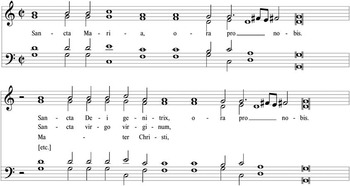
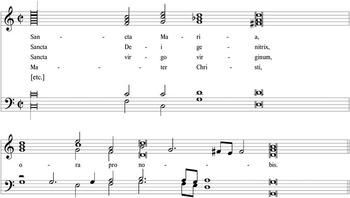
Monophonic recitation or singing was certainly the most common mode of performance for litanies in pilgrimage, but simple polyphonic litanies could have been negotiated under way by more musically adept amateurs. One index to this is the Litaniae textus triplex, a 1582 print by the Augsburg cathedral vicar Johann Haym von Themar, who offered a series of litanies ‘for the use of sodalities and fraternities going here and there to holy places: and indeed first [for the use] of the Fraternity of the Holy Mountain (known commonly as Andechs) in Bavaria, at the Cathedral of the Blessed Virgin Mary in Augsburg’.Footnote 52 Haym sets the long series of titles in what is essentially falsobordone, mimicking an increasingly common performance practice for Office psalmody at the close of the sixteenth century.Footnote 53 These are followed by short cadential figures for the responses (Example 1). In order to sing these litanies, confreres marching to Andechs or other shrines would only have had to memorise a short, formulaic phrase in their preferred vocal register, which could be repeated for as many titles and petitions as one wished. The collection presumes, naturally, that the singers would have been capable of singing rudimentary polyphony, which suggests that more than a few members of post-Tridentine confraternities possessed such skills.Footnote 54 Schematic litanies such as these are perhaps the most vivid demonstration that the genre of the litany, to use Kendrick’s formulation, ‘democratised’ the honour accorded to God and His saints by allowing the widest variety of voices, both skilled and unskilled, to participate in their invocation.Footnote 55
Johannes Haym, Litany of the Blessed Virgin Mary, from Litaniae textus triplex (Augsburg, 1582)

Given the litany’s formulaic character and liminal position between oral and written culture, monophonic versions were seldom transmitted in contemporary Catholic songbooks. These, however, otherwise contain large numbers of pilgrimage songs that often depend on the litany for their refrain structures and subject matter. A number of suitable examples can be found, for instance, in Ein new Rueff-Büchlein, Von Etlichen sonderbaren Catholischen Wahlfahrten-Gesängen, published at Straubing by Andre Sommer in 1607.Footnote 56 The Rueff-Büchlein contains no litanies per se; but songs like the following, in honour of St Benno, whose remains were venerated at the parish church of Unsere Liebe Frau in Munich, show a clearly litanic structure:
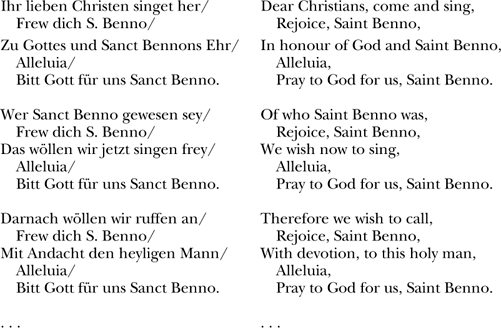
Ihr lieben Christen singet her extends in this source to eighty-nine stanzas, typifying the manner in which pilgrimage songs narrated the histories and salvific properties of pilgrimage shrines in luxurious detail. Regular collective responses such as ‘pray for us’ or ‘Lord, have mercy’ suggest that clerics or singing-leaders presented the varied lines of the poems in the manner of a litanic invocation, while the laity responded in a regular fashion that required only that they memorise a short melodic and textual phrase. Sommer’s Rüeff-Büchlein was but one example of many contemporary Catholic books that offered vernacular pilgrimage songs with strong litanic associations.Footnote 57
Stories of the litany’s power to effect miracles, many of which were reported by the Jesuits, may have enhanced the form’s popularity in pilgrimages and in devotional contexts more broadly. In his pilgrimage manual for the Marian shrine of Altötting, Unser liebe Fraw zu Alten Oetting (Ingolstadt, 1571), Martin Eisengrein relates a fascinating tale involving the litany. Early in 1571 members of the noble Fugger family of Augsburg departed for Altötting with one of their ladies-in-waiting, one Anna von Bernhausen, who was thought to have been possessed by demons. The famous Jesuit priest Peter Canisius was to conduct the exorcism in the presence of the famed ‘Black Madonna’. Upon arrival the first order of business was the performance of a polyphonic litany in the pilgrimage chapel before retiring for the evening: ‘As soon as they had dismounted from the carriage’, Eisengrein writes, ‘and in order to make a good beginning in God’s name, they immediately entered the holy chapel of Our Lady, where the wondrous Litany of the Blessed Virgin of Loreto was piously sung in polyphony; and then, after it was finished, they returned to their quarters.’Footnote 58
In the actual exorcism of Anna von Bernhausen that began the following day, the litany demonstrated its thaumaturgical power:
Then Herr Canisius in a loud voice proclaimed the confession, the Our Father, Ave Maria and other fine prayers, and all who were there answered him. But when they began to piously pray the litany of Our Lady all together, the demon soon began to quiver and could not bear hearing the words ‘Holy Virgin Mary, Mother of God, pray to God for us’. And the maid, too, said these words clearly. [The demon] wished it not and thereupon cast the poor person down to the floor. Then Herr Fugger took the maid in his arms and placed her in his lap before the altar. On his right side was Herr Canisius and on the left Frau Fugger with another priest, and they all held her tight.Footnote 59
Upon conclusion of the litany Canisius commanded the demon to leave her, but the exorcism could not be completed until the second day. On that day, too, the litany proved its power to torment the demons possessing the poor maid’s body:
Then all who attended this action responded to Herr Canisius in several Christian prayers and the litany. But the wretched demon again could not tolerate them saying ‘Holy Virgin Mary, pray to God for us’, and since they persisted in saying this despite [the demon’s] anger, he grew wrathful and with a great cry tossed the maid backward, who had been kneeling next to Frau Fugger.Footnote 60
Eisengrein’s remarkable account of this successful exorcism encouraged reactions from both sides of the confessional divide. His focus on the Marian intercession projected by the litany drew fire, for example, from the Strasbourg theologian Johannes Marbach, who responded that that repetitious prayers by pilgrims like the rosary or the litany must be a sign of demon worship, for only a demon could inspire such an outpouring of idolatrous prayer. Attacking the veneration of the Virgin Mary at Altötting, for example, Marbach writes:
Since, in the true faith, the Holy Virgin Mary can neither be to prayed to nor called upon without obvious idolatry, and it is in itself a sin to pray to her without [true] faith, it follows on undeniable grounds that to pray to the Virgin Mary in the old chapel of Ötting, and to praise her with the Litany of Loreto, is nothing else in God’s sight than repellent idolatry . . . And so the great praises by Eisengrein the Jesuit and all Papists for this fine, wondrous and venerable service, accompanied by many wonders and signs, which is daily celebrated in praise and honour of the Holy Virgin Mary in her chapel at Altötting, with singing and praying of the Litany of Loreto, the reading of the Mass, etc., is nothing more than a horrid and revolting insult to and idolatry before God.Footnote 61
By contrast, Remigius Dithmar, whom we have seen previously defending the litany from Protestant criticism, cited Eisengrein approvingly in his discussion of litanies in exorcisms, adding the following anecdote from the travels of Francis Xavier in Japan:
In our memory and that of our fathers, successful exorcisms of demons from human bodies have been perfected by means of litanies, through divine grace. And indeed the Apostle of Japan, [Francis] Xavier, upon leaving the fortified citadel of a certain prince Hexandonus, left with the new Christians [there] a little book of litanies which, when placed upon the bodies of the sick – of whom Hexandonus despaired – healed many of them. So great is the aid given to Catholics, that this true devotion to such a saving and beneficial supplication, which the sound of the litany requires, merits our attention.Footnote 62
Contemporary rites of exorcism, in fact, affirmed the opinions of Eisengrein and Dithmar. A sanctoral litany is embedded in the opening stages of the first exorcism outlined in Girolamo Menghi’s much-reprinted Flagellum Daemonum of 1574, where it follows the recitation of passages from the Gospel of John and of Psalm 69, and precedes a further series of prayers and scriptural passages that lead to the exorcism proper. Menghi concludes his manual with a somewhat longer sanctoral litany ‘to be said against storms excited by demons’.Footnote 63 By the early seventeenth century the sanctoral litany was prescribed at the opening of the exorcism rite in the new Rituale Romanum (1614) and in the widely circulated Manuale Exorcismorum (1619) by Maximilian von Eynatten, cathedral canon at Antwerp; the prayer was to be recited by the genuflecting exorcist, with responses provided by others present. Von Eynatten, moreover, adds supplementary Litanies of Loreto and of All Saints for those exorcists who choose to use them, and, like Menghi, calls for the sanctoral litany in a special rite against storms caused by demonic forces.Footnote 64 Although a litany does not form a part of the actual prayer that effects the exorcism itself (‘Exorcizo te, immundissime spiritus . . .’), its persistent place in the ritual points to its thaumaturgical potential, whether spoken, chanted or sung.
This apotropaic function of the litany is balanced by other accounts of litanies seeming to spark miraculous occurrences at pilgrimage shrines. The Capuchin preacher Prokop von Templin reported, for example, that a crippled pilgrim at the Passau shrine of Mariahilf regained his health as the litany of the Virgin was being sung:
On this same day, the 31st of August 1652, on a Saturday afternoon around three o’clock, as the litany of Our Dear Lady was being sung in the holy chapel at Mariahilf, and at which many common men and women were present, a poor, young beggar came into the said chapel on two crutches and went through the middle of the church to the side altar of the Deposition of Christ from the Cross, and stayed there until the end of the litany. Suddenly after its completion, a local Passau woman led him by the hand through the middle of the church and out, without the crutches, which were left at the iron gate at the said altar.Footnote 65
Another much-recounted episode occurred in January 1690 at Munich’s Herzogspitalkirche, when a young girl experienced the following during the singing of the Litany of Loreto in front of the sculpture of the so-called ‘Schmerzhafte Mutter’ or ‘Dolorous Mother’:
During the usual [services] on Saturday evening, that is, on the 21st of January of last year, 1690, the Litany of Loreto was being sung in the presence of many people, including a young maiden of ten years named Maria Franziska Juliana Schott. She evidently noticed that during the Litany, the image of the Dolorous Mother standing under the Cross turned her eyes very gracefully and tearfully towards the crucified Christ, and then down to the ground, and then to each side, and then to [Christ’s] cradle standing nearby. Because she thought that others among those present had also seen this, she said nothing, but as soon as she came home she told her parents; this gave occasion to her mother and other persons, who had heard about the matter, to visit the image the next day and to go there frequently, so they might see the turning of her eyes.Footnote 66
Confirmed as authentic by the bishop of Freising in 1691, the miracle at the Herzogspitalkirche touched off the most active pilgrimage in eighteenth-century Munich and confirmed the status of the litany not simply as a form of intercessory prayer, but also as an expression that could potentially trigger miraculous interventions.Footnote 67
THE POLYPHONIC LITANY AND GEORG VICTORINUS’S THESAURUS LITANIARUM (1596)
Despite the increasing prestige of the litany as a devotional and ritual form in post-Tridentine Germany, its success as a polyphonic form was hardly assured. Its repetitive character and liminal position between oral and written tradition may help to explain why composers seem to have avoided the form through the mid-sixteenth century. In fact the first published setting of a polyphonic litany would not appear until 1575, the year that Costanzo Porta, the new music director at Loreto, issued his Litaniae deiparae Virginis Mariae ex Sacra Scriptura depromptae, a Marian scriptural litany for double choir that, according to its title page, was sung on Saturdays, vigils and Marian feasts at the Holy House.Footnote 68 It was the rapidly expanding cult of Loreto, as we shall see, that helped to inject new energy into the litany as a polyphonic genre in Italy and in transalpine Catholic regions by the end of the century. Litanies performed by trained choirs, Loretan and otherwise, were increasingly prescribed for contexts of paraliturgy and devotion, such as the Saturday evening observances spearheaded by the Society of Jesus, endowed services by wealthy patrons, confraternal gatherings and Catholic court chapels.
The epicentre for litany composition in the north was doubtless the Bavarian capital of Munich, where Duke Wilhelm V and his immediate family cultivated the litany with enthusiasm. Munich had already seen a notable foundation at its principal parish church of Unsere Liebe Frau in 1570, when Simon Thaddäus Eck, a stepbrother of Luther’s opponent Johannes Eck, donated a Litany of Loreto on the eves of all seven Marian feasts as well as on other occasions, ‘to be sung devoutly and slowly in four-part polyphony with two boys intoning and the choir responding’.Footnote 69 Five years later, Wilhelm’s consort Renate of Lorraine founded a Sunday evening Salve service at the same church, including the performance of polyphonic litanies of the Virgin.Footnote 70 As for the duke himself, Wilhelm appears to have heard polyphonic Marian litanies at his Landshut residence well before his accession in 1579, for his sister Maria Anna, recently married to Archduke Karl of Austria, wrote to him from Graz in 1572 requesting a copy of a ‘Ledaney von unser Frauen’ for four voices that had been sung at Landshut and also at Altötting. Having received this, she thanked her brother in writing in February 1573 and again in July 1576, stating on that occasion that she was ‘happy in her heart about the litany’.Footnote 71 By the mid-1570s Wilhelm was evidently commissioning polyphonic litany settings from his father’s chapelmaster Orlando di Lasso, for the latter wrote to the duke in mid-1575 that he was ‘doing everything Your Excellency commanded . . . with the litanies’; over the next two decades no fewer than sixteen polyphonic settings by Lasso would appear in court chapel manuscripts and, after his death, in print.Footnote 72 Of these, twelve set the Litany of Loreto, a reflection of the Wittelsbach enthusiasm for this text. Furthermore, the ten litanies that are extant in four different choirbooks from the ducal court set the Loretan text exclusively: the most significant source is Mus. ms. 14 of the Bayerische Staatsbibliothek in Munich, a collection of Office music copied around 1590 that transmits seven settings of the Loretan text, five by Lasso and five by his deputy Johannes à Fossa.Footnote 73 Lasso’s preference for the Litany of Loreto might be also explained in part by his own pilgrimage to the Italian shrine in 1585, on which occasion he donated an ex-voto image of himself as a supplicant to the Virgin, a picture still extant today in the Loreto museum.Footnote 74
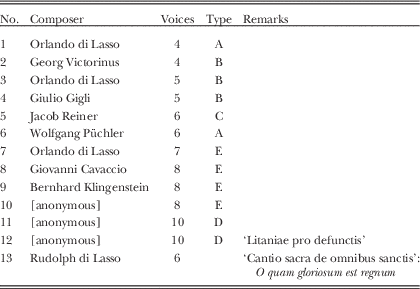
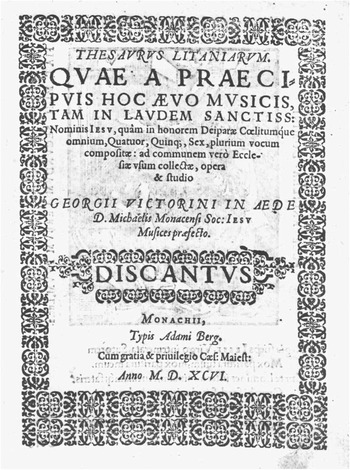
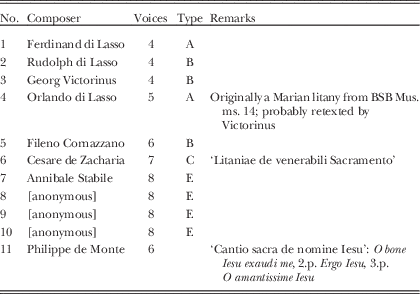
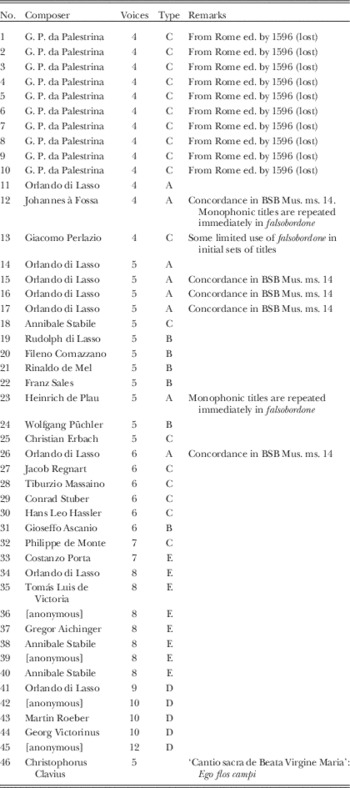
As we shall see, the Litany of Loreto is strongly represented in the greatest contemporary anthology of polyphonic litanies published in this period, the Thesaurus litaniarum or ‘Treasury of Litanies’ (1596) edited by Georg Victorinus, music director at the Jesuit church of St Michael in Munich (see Figure 1). Victorinus, a native of Silesia, had occupied the music director’s post at St Michael since around 1591; in 1616 he also identified himself as ‘musicæ præfectus’ of Wilhelm V’s private chapel of St Nicholas, and by 1618 he was schoolmaster at the parish of St Peter’s in Munich, a position he would occupy until his death in 1632.Footnote 75 Victorinus’s greatest achievement was as editor and anthologist, manifested in the Thesaurus litaniarum and later in his two anthologies of sacred concerti by contemporary Italian and German composers, the Siren coelestis of 1616 and the Philomela coelestis of 1624.Footnote 76 The Thesaurus was the largest contemporary anthology of polyphonic litanies published in Europe: it contains fifty-nine settings of litanies for Christ, the Virgin Mary, the Saints and the Dead, together with three motets, by thirty different named composers; ten settings are anonymous and identified by the editor as incertus.Footnote 77 The volume, whose contents are listed in the Appendix, is divided into three books: first a set of ten litanies on the Name of Jesus and the Sacrament,Footnote 78 concluded by Philippe de Monte’s six-voice motet O bone Jesu exaudi me; then thirty-seven Marian litanies (of which twenty-eight set the Loretan text), followed by Christophorus Clavius’s five-voice motet Ego flos campi; and finally eleven sanctoral litanies, one anonymous Litaniæ pro defunctis and a concluding six-voice motet by Rudolph di Lasso, O quam gloriosum est regnum. Each book is prefaced by a poem praising its object and by a small woodcut illustration. Not surprisingly, the best-represented composer in the volume is Orlando di Lasso with twelve settings, including eight Litanies of Loreto, three sanctoral litanies and one Name of Jesus litany. Victorinus also includes Palestrina’s two imposing Marian litanies for four voices, in five partes each, settings that would be published together in 1600 but were certainly available in a printed edition – no longer extant – by 1596.Footnote 79 The bulk of the remainder are by composers in Munich and the southern Catholic German orbit, including Victorinus himself, Lasso’s sons Ferdinand and Rudolph, musicians from nearby Augsburg (Gregor Aichinger, Christian Erbach, Hans Leo Hassler, Bernhard Klingenstein), Prague (Philippe de Monte, Tiburzio Massaino), Innsbruck (Jakob Regnart) and Weingarten (Jakob Reiner), as well as Italians whose published litanies managed to cross the Alps. Roman Jesuit connections in particular are suggested by the four litanies of Annibale Stabile, probably drawn from his Letaniae Beatae Mariae Virginis et nominis Jesu (Rome, 1583), a collection closely connected to the Collegium Germanicum where Stabile had served as maestro.Footnote 80
Georg Victorinus, Thesaurus litaniarum (Munich, 1596), title page. Courtesy of Bayerische Staatsbibliothek München, 4 Mus. pr. 59

We have seen previously the central role of the Jesuits in promoting the litany as a devotional form. In the Thesaurus litaniarum Jesuit connections are likewise explicit, in both the set of Name of Jesus litanies with which it begins and in its paratexts.Footnote 81 The reverse of the title page is graced by a woodcut image of the Annunication, entitled ‘Ad insignia Sodalitatis Partheniæ’ or ‘to the emblems of the Marian Sodality’, a reference to the Marian Congregations of the Jesuits, the organisations of students, clerics and laymen devoted to the Marian cult that the Jesuits established in great numbers in German Catholic cities beginning in the 1580s. The Annunciation image is flanked by verses from Luke 1:38 (‘Behold the servant of the Lord: let it be with me according to Your Word’) and followed by a six-line epigram in praise of the Virgin and her followers. Victorinus in fact directs the dedication to the Marian Congregations of the Jesuits’ Upper German Province, in Munich, Ingolstadt, Dillingen, Augsburg, Innsbruck, Hall in Tyrol, Regensburg, Luzern, Fribourg (Switzerland) and Porrentruy. Counting himself as a member of the sodality, Victorinus begins by praising Gregory the Great’s role in reviving litanic prayer in the Christian church, and by noting the efforts of composers to provide litanies with ‘sweetest modulations’ [modulis quám suauißimis], with which mortals should be stirred to avert God’s wrath. Victorinus expresses his surprise, however, that a volume such as the Thesaurus has not appeared previously, for these polyphonic litanies ‘would be of the greatest use for pilgrimages undertaken to holy places; and now because it is in the nature of these times, more than ever, that it seems fitting to flee to such arms’.Footnote 82 Victorinus not only situates the Thesaurus firmly within the activites of the Marian Congregations, then, but also links its contents directly with the processions and pilgrimages that projected Catholic space in the contested lands north of the Alps. The Munich Congregation, at least, seems to have welcomed Victorinus’s effort, for it provided a poem addressed to their fellow sodalist, printed immediately after the dedication:
The Congregation of Munich to sodalist Georg Victorinus
As much as it pleases others to grow rich with foreign treasures,
And to accumulate the weight of a thousand silver bars:
You, Victorinus, now labour with your art to excavate
A treasure-chest of works from its hiding place.
In a moment all things pass, but that treasure-chest
Shall grow in riches from day to day:
It shall suffer no sign of old age; as it is used,
It shall grow more beloved, more splendid.
Why shall the Mother not prepare, for your viligant pursuit and care,
A great treasure-chest for you in God’s citadel?
To her this work is welcome, welcome is your industry,
Welcome is your labour, Victorinus, this no one can doubt.
The praying and singing of litanies was probably common in the gatherings of these sodalities, whose statutes and devotional books routinely transmit litany texts. Moreover, as early as 1583 the Marian litany ex sacra scriptura for double choir by Costanzo Porta, mentioned above in connection with the German College in Rome, was published at Munich, a setting which was ‘habitually sung in the chapel of the Marian sodality in the ducal Gymnasium of the Society of Jesus’.Footnote 83 While this litany and other more elaborate settings in the Thesaurus suggest performances in fixed locations by trained choirs, it is nonetheless notable that Victorinus singles out pilgrimage as a principal context for his collection, drawing at least a symbolic connection between these invocatory prayers and the spiritual geography of contemporary Bavaria.
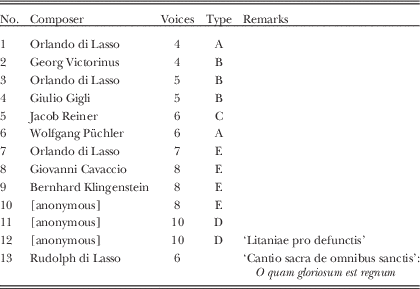
The fifty-nine settings of the Thesaurus can be divided stylistically into two broad groups: thirty-five litanies for a single choir of up to seven voices (types A, B, C in the Appendix) and twenty-four litanies for seven to twelve voices organised clearly in a double-choir or polychoral format (types D and E in the Appendix). Although these works can be examined from a number of different perspectives, our main interest here is the extent to which composers preserve the litany’s traditional call-and-response structure, and hence its suggestion of liturgical/devotional function. While the larger-scale polychoral litanies offer obvious opportunities to do so, those settings for a single, smaller ensemble pose inherent challenges; as we shall see, some composers strove to maintain some distinction between title and petition by using plainchant or falsobordone, while others effaced this distinction by assimilating the litany to prevailing modes of continuous polyphony. As the Appendix shows, both single-choir and double-choir/polychoral litanies could either be through-composed – i.e., with titles rendered in mensural polyphony (types C and E) – or have titles rendered in monophonic chant or falsobordone, with petitions in mensural polyphony (types A, B and D). Victorinus was certainly aware that the history of printed polyphonic litanies was a short one. In order to adapt chant tones or falsobordone to titles of different lengths, he notated these formulae with white or black maximae, providing a note to the reader explaining what may have been a seldom-encountered notational practice. Furthermore, Victorinus only provides full litany texts in appendices to each of the three books of the Thesaurus, encouraging the singer ‘to seek out this [text] from the end of this book, or from this or that book of prayers’.Footnote 84
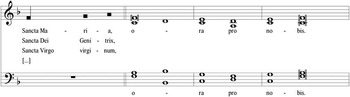
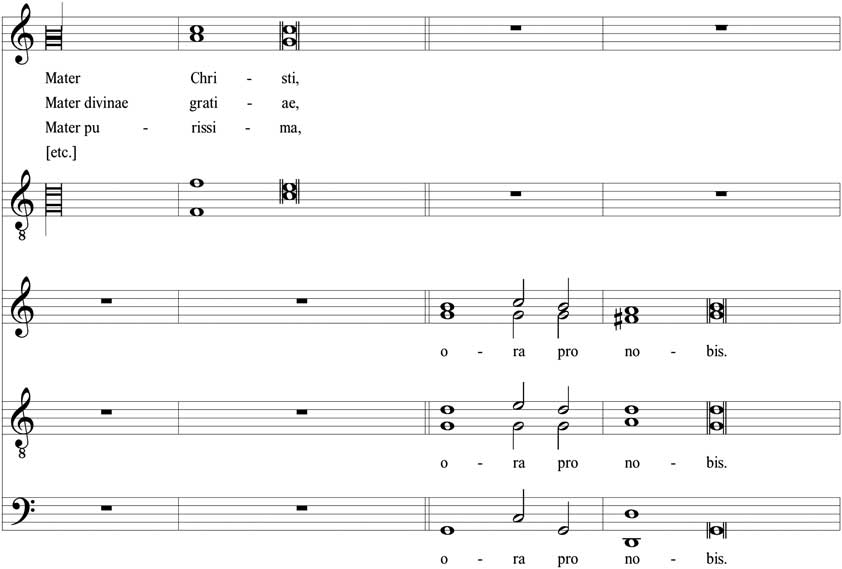
One notices immediately that in the smaller-scale litanies, Orlando di Lasso almost always presents his intonations monophonically in the discantus in unmeasured chant notation, followed by short homophonic or lightly contrapuntal choral responses – generally around three breves or less – leading to a cadence and fermata (Example 2).Footnote 85 Victorinus seems to have drawn the majority of these simple settings from a single court chapel manuscript containing Litany of Loreto settings, BSB Mus. ms. 14 (c. 1590), adapting one of the four-voice Marian litanies as a Name of Jesus litany (I/4) for the first volume of the Thesaurus.Footnote 86 Lasso also prefers chant intonations in his sanctoral litanies for smaller ensembles (III/1, III/3), as well as in some of his larger double-choir settings for seven, eight and nine voices (II/34, II/41, III/7). The other litanies in the Thesaurus featuring chant intonations were composed exclusively by musicians connected with the Munich court chapel: Lasso’s elder son Ferdinand, his deputy Johannes à Fossa and Heinrich de Plau [Blau], a chapel singer; nothing is known of Wolfgang Püchler (the composer of nos. II/24 and III/6), although several men bearing his surname were engaged by the chapel in this period.Footnote 87 The consistent and simple format of these works suggests that they may have been quotidian fare in Wilhelm V’s court chapel and may represent a characteristic practice for that institution, for monophonic chant intonations are entirely absent from the other litanies in the collection. In many respects their sonic profile approaches most closely the prayer’s format of individual invocation answered by collective response and suggests that for this Munich group preservation of the litany’s liturgical/devotional function was of paramount concern.
Orlando di Lasso, Litany of Loreto (Thesaurus I/4), bb. 17–20

Far more common in the Thesaurus are litanies that present the variable-length titles in falsobordone, not unlike Johannes Haym’s Litaniae textus triplex cited previously. In this group of litanies the opening Kyrie and closing Agnus Dei acclamations are invariably composed polyphonically (unlike Lasso’s small-ensemble settings, which responsorially alternate chant with polyphony), but the main body of titles is now rendered in falsobordone formulae with brief, fully composed petitions in mensural notation (see Example 3). As in the case of Haym’s Litaniae, the falsobordone approach bridged between oral expressions and more elaborate composed products for trained choirs; with its use, however, we are now a step removed from the fundamental character of the litany as a collective response to an individual cleric or Vorsänger. Particularly in litanies scored for lesser numbers, the music is performed not by physically separated individuals or groups: the same ensemble must negotiate both titles and petitions. Nevertheless the distinction of static falsobordone versus counterpoint is enough to invoke the litany’s traditional differentiation of roles and space. Composers in the Thesaurus adopting this approach are largely from Munich or its orbit, suggesting that here, again, we may be observing a local or regional practice: apart from Orlando di Lasso’s sanctoral litany for five voices, we find in this group works by his younger son and court organist Rudolph; by court instrumentalists Fileno Cornazzano, Gioseffo Ascanio and Giulio Gigli; and by the aforementioned Wolfgang Püchler. Outside the court proper, Victorinus himself offers two falsobordone litanies, while we also find works in this style by Rinaldo del Mel and Franz Sales, both of whom enjoyed direct or indirect connections with members of the Wittelsbach dynasty.Footnote 88
Rudolph di Lasso, Litany of Loreto (Thesaurus II/19), bb. 8–9

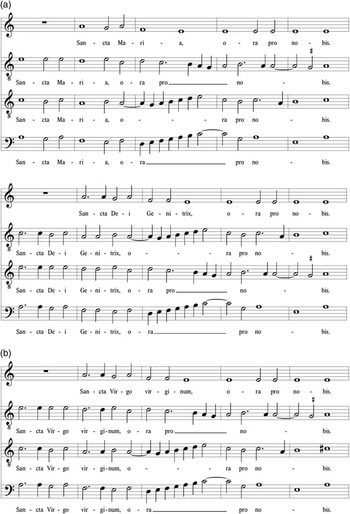
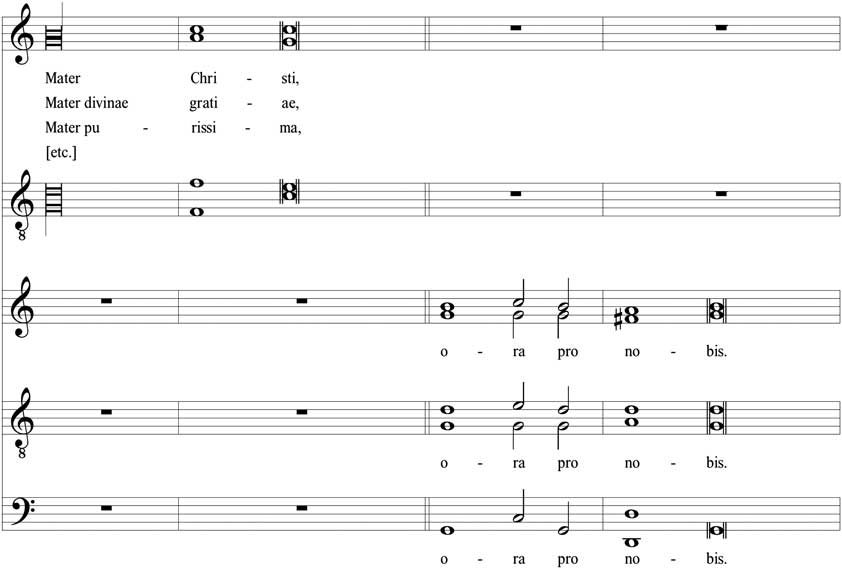
We have seen that composers in the Munich orbit preferred to distinguish title from petition in a manner reminiscent of the litany’s traditional call-and-response format, but as we move farther afield we find that composers chosen by Victorinus adapted the litany to prevailing styles of late Renaissance polyphony. Within the single-choir settings it is instructive to consider Palestrina’s two large-scale Marian litanies for four voices that Victorinus placed at the head of Volume II (II/1–5, II/6–10).Footnote 89 The most obvious difference, of course, is the expansiveness of Palestrina’s settings, as each of the two litanies is divided into five partes, each of which surpasses in length a complete setting by Lasso. Instead of the Loretan text that prevails in Lasso’s litanies, Palestrina uses a lengthy, non-standard catalogue of praise for Mary; unorthodox, as well, is the appearance of the standard Kyrie acclamations at the beginning of each individual pars – thus interrupting the succession of Marian titles – and the complete omission of the concluding Agnus Dei. Instead of distinguishing intonation and response through contrasts of chant or falsobordone with polyphony, moreover, Palestrina carefully integrates the responses fully within the polyphonic texture, thus ‘flattening’ the distinctive call-and-response format of the litany text (see Example 4). As Peter Bergquist has observed, Lasso’s litanies, far more than those of Palestrina, succeed in projecting the fundamental ebb and flow of intonation and response that is the chief hallmark of the litany, even at the risk of repetitiveness for the listener.Footnote 90 This is not to say that ‘motet’-style litanies lack any sort of internal differentation. The transitions between intonation and response may be signalled, for example, by continuous changes in vocal groupings (Hassler’s six-voice litany, no. II/30, is a fine example), or by regular alternations of smaller and larger ensembles: note Philippe de Monte’s consistent assignment of titles to a higher group of two discantus, altus and bassus primus (in the c4) clef, while the responses of ‘ora pro nobis’ are sung by the full choir of seven (no. II/32). Nevertheless, these settings only weakly reflect the fundamental spatial qualities of the traditional litany.
Giovanni Pierluigi da Palestrina, Litany of the Virgin (Thesaurus II/6), bb. 28–32

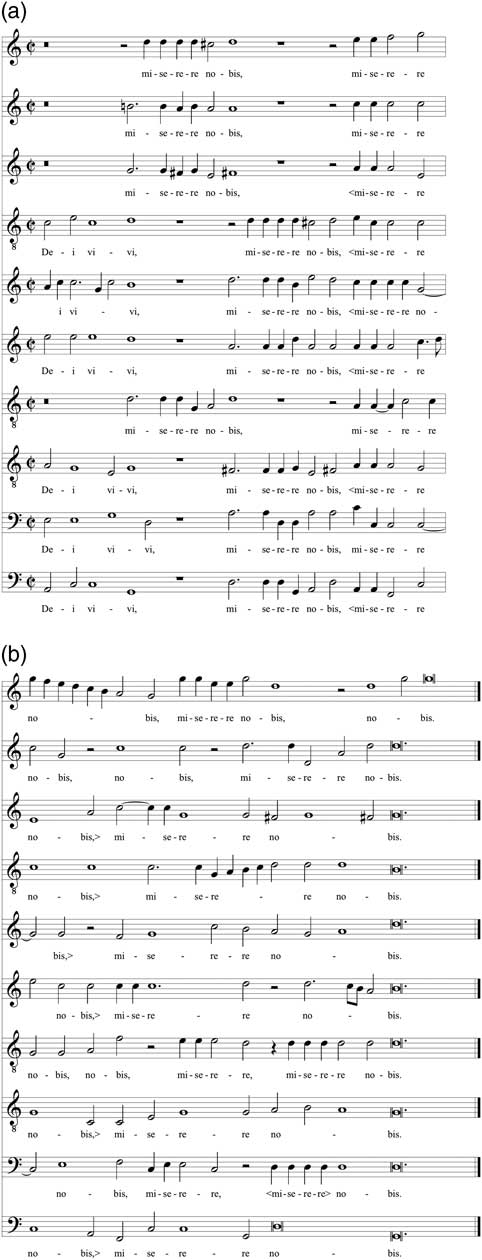
In litanies scored for larger ensembles, double-choir or polychoral textures provide ample opportunities for the exploration of spatial contrasts. This often takes the expected form of dividing the titles and petitions between the two choirs, faithfully preserving the prayer’s regular ebb and flow. In a small number of litanies, again apparently connected with the Munich orbit, falsobordone is deployed for the titles, while petitions are set to a static, repeated formula in measured notation.Footnote 91 Orlando di Lasso follows this schematic approach in his nine-voice litany, no. II/41, and indeed in his large-scale litanies without falsobordone (nos. II/34 for nine voices and III/7 for seven voices) he prefers a rather rigid, formulaic approach that emphasises brevity and consistent alternation, arguably at the expense of purely musical interest (Example 5).
Orlando di Lasso, Litany of Loreto (Thesaurus II/41), bb. 33–6
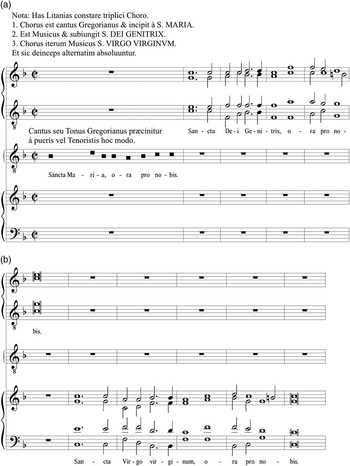
Lasso and his compatriots in the Thesaurus, however, could be far more bold. Victorinus appears not to have had access to Lasso’s most expansive litany setting, a Litany of Loreto for nine voices, extending to no fewer than 370 breves in Bergquist’s edition, preserved in a chapel manuscript copied around 1585 that mainly features imitation Magnificats.Footnote 92 While this litany was evidently unavailable to Victorinus, he did include a group of fully through-composed litanies for multiple choirs, some of which are also of impressive length – note Gregor Aichinger’s eight-voice Litany of Loreto (II/37) at 247 breves and Bernhard Klingenstein’s sanctoral litany (III/9) at 242 breves. Naturally, the divided-choir principle allows composers to separate title and petition, but in practice they avoid rigidity: at times both the title and its accompanying petition will be sung by the same choir, while these might be separated elsewhere; nor is it the case that titles or petitions are consistently assigned to one choir or another. The full ensemble may be joined, furthermore, not only for the concluding acclamations – as is customary – but also for individual titles at the composer’s discretion. Particularly creative approaches may be seen in several larger-scored works, not the least of which is Annibale Stabile’s Litany of Loreto for eight voices (II/40), a work whose titles and petitions alternate between three distinct groups of singers: a choir of boys or tenors singing plainchant and two four-voice choirs singing mostly chordal settings (Example 6). This litany, probably composed for the German College while Stabile was its maestro, closely resembles the ‘litanie della Madonna con doi chori di Musica, et uno in falsobordone’ mentioned by the college’s rector Michele Loretano in a diary entry of 1583, and thus may represent a particularly Jesuitical practice of litany singing.Footnote 93
Annibale Stabile, Litany of Loreto (Thesaurus II/40), bb. 44–54

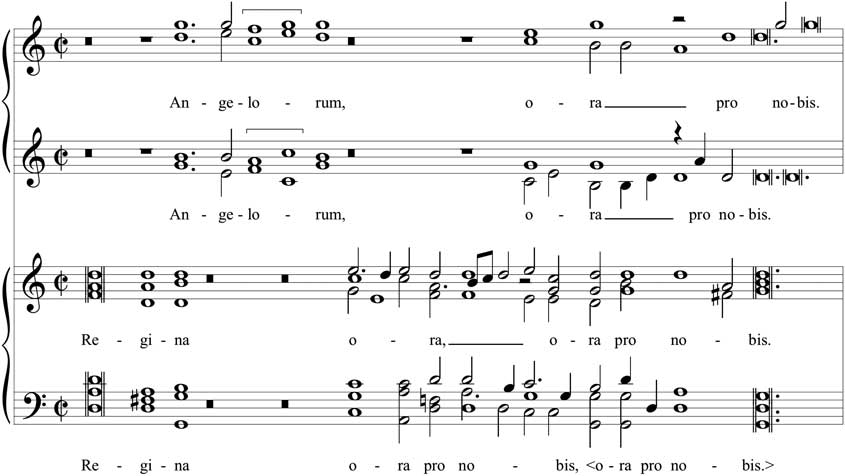
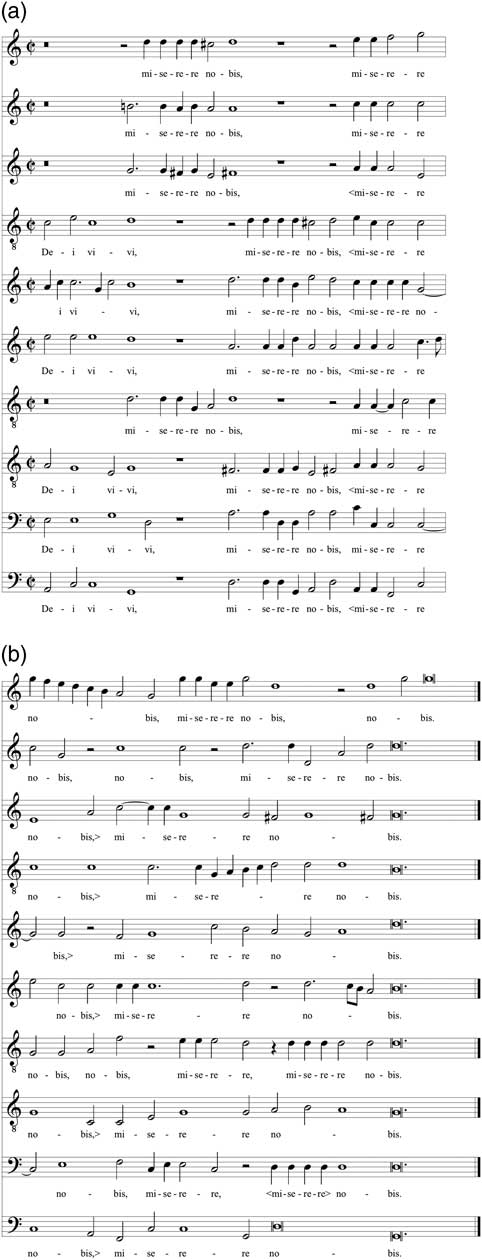
Also ambitious is a ten-voice Marian litany composed by Victorinus himself (II/44), featuring a registral contrast between a high quartet (g2–c1–c2–c3) and a low sextet (c1–c1–c3–c4–c4–f4). Following the thoroughly contrapuntal Kyrie, Victorinus begins the lengthy series of titles with high falsobordone in the first choir answered by low homophonic refrains in the second. Beginning with ‘Regina Angelorum’, however, Victorinus unveils a quicker, more playful alternation between the two groups (Example 7). They divide the words of the titles themselves, ‘Regina’ versus ‘Angelorum’ for example, joining together for grand proclamations of ‘ora pro nobis’.Footnote 94 Victorinus’s setting concludes with a kaleidoscopic ‘miserere nobis’ for full ensemble that rivals any other setting in the Thesaurus for its opulence (Example 8). In settings such as these, fashionable double-choir writing conveniently suggests the traditional alternation of the litanic prayer, without slavishly mirroring its static exchanges between individual titles and collective petitions.
Georg Victorinus, Litany of Loreto (Thesaurus II/44), b. 17
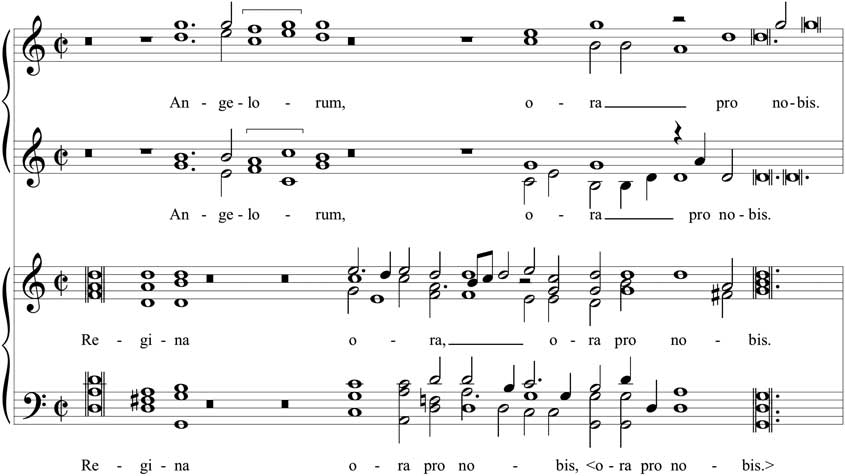
Georg Victorinus, Litany of Loreto (Thesaurus II/44), bb. 28–9
Brief mention is due of the three motets that conclude each portion of the volume, providing a capstone to the sets of Christological, Marian, and sanctoral litanies in turn. Philippe de Monte’s O bone Jesu exaudi me, a large Christological motet in three partes, is based on prayer texts from the Officium Beatae Mariae Virginis, a version of which was evidently printed in Rome as early as 1571.Footnote 95 Scored for six voices and featuring frequent passages of homophonic declamation, the motet is first extant here in the Thesaurus and may have been solicited by the editor himself.Footnote 96 It could have been through his Jesuit connections that Victorinus obtained the five-voice motet Ego flos campi by Christophorus Clavius (c. 1538–1612), a native of Bamberg who had joined the Jesuit order and taught mathematics at the Roman College between 1565 and around 1580.Footnote 97 His motet, divided into two partes, sets a pastiche of Canticles texts (2:1 with 4:15; 5:1 with 6:1) on the allurements of the sponsa allegorised as Mary, set to Netherlandish counterpoint in a predominantly syllabic format. Victorinus surely commissioned the concluding six-voice O quam gloriosum est regnum directly from Rudolph di Lasso (c. 1563–1625), Orlando’s younger son who served as ducal court organist at the time of the anthology’s publication. Setting a Matins Responsory for the feast of All Saints, Lasso begins by deploying the chant melody as a cantus firmus in even semibreves in the discantus and then tenor primus, following with free counterpoint and mostly syllabic declamation. It is not impossible that Victorinus intended the three motets to be performed in connection with the litanies of the Thesaurus, but they serve no obvious functional purpose apart from exegesis on the volume’s main devotional objects.
The wide range of musical approaches seen in the Thesaurus does not allow for a reductive view of the volume’s function. The more ambitious, larger-scale litanies certainly suggest stationary ensembles, as complex counterpoint, overlapping entries and irregular alternations of antiphonal choirs (such as we have seen above in Victorinus’s litany no. II/44) would likely have posed difficulties for walking singers. The most rudimentary litanies, such as those for smaller ensembles by Orlando di Lasso and his companions in the Munich court chapel, are perhaps best suited for processional performance – including the ‘pilgrimages undertaken to holy places’ indicated by Victorinus in his preface – but even here we must be cautious. Litanies of extreme simplicity like Lasso’s Litany of Loreto, no. II/11 could certainly be negotiated by a processing four-voice choir, the regular semibreve and breve rhythms coordinating more or less with the singers’ footfalls. On the other hand, note that the source for five of Lasso’s simpler settings, BSB Mus. ms. 14, is in fact a folio-size choirbook (52.5 × 37.5 cm) that also contains masses, canticles, and other Office music that certainly would have been performed by a stationary choir; the same is true for his four-voice Marian litany ex sacra scriptura (not in the Thesaurus) that is transmitted in BSB Mus. ms. 2748, a folio-size choirbook copied between 1576 and 1581 that is otherwise dominated by Magnificat settings.Footnote 98 Rudimentary polyphonic litanies such as these by Lasso, or those of Johann Haym’s Litaniae textus triplex – again, ‘for the use of sodalities and fraternities going here and there to holy places’ – were practical for singing while under way, but performance by stationary choirs is equally plausible. More relevant here is the fact that most of the litanies in the volume, whether for smaller or larger forces, project the litany’s alternation of title and petition, and thus its aural sense of spatial distinction and the implication of motion.
As the paratexts of these collections strongly suggest, the post-Tridentine confraternities and sodalities that processed ever more frequently in the cities and the countryside were key audiences for polyphonic litanies, whether or not they hired professional singers or deployed their own members who were capable of reading mensural notation.Footnote 99 But the more complex and ambitious settings must have proved attractive to court chapels, monastic churches, larger urban parishes, and, naturally, the growing network of Jesuit colleges and churches that Victorinus praised in his dedication. We have seen that monophonic or polyphonic litanies were prescribed at the Jesuit church of St Michael in Munich as part of a distinct and elaborate ceremony by the mid-seventeenth century, and the nearby parish church of Unsere Liebe Frau also featured polyphonic litanies as part of endowed services. Not far away at the Bavarian ducal court of Maximilian I, where a number of the composers represented in the Thesaurus had been active (the Lasso family, Johannes à Fossa, Heinrich de Plau, Fileno Cornazzano, Giulio Gigli, Giacomo Perlazio), the new court chapel of the Immaculate Conception (built between 1601 and 1603) would have been a congenial home for polyphonic litanies. It is significant that the decorative scheme of the new chapel included on the surface of its barrel vault an elaborate cycle of stucco emblems and captions, probably designed by Hans Krumper and executed in part by Michele Castelli around 1615, that were drawn from the Marian titles of the Litany of Loreto and the Marian litany ex sacra scriptura.Footnote 100 Beyond their reflection of Maximilian’s intense Marian piety, they would have provided a rich visual counterpoint to the sound of litanies performed in that space.
CONCLUSION
Having attracted only limited scholarly attention, the litany was a genre of remarkable flexibility that remained poised on the boundaries of oral and written performance, ranging in its expressions from silent or private prayer to speech, recitation, and finally to polyphonic composition. It was in the Catholic German orbit that the litany, both as prayer and as music, saw an explosion of interest in the decades immediately preceding the Thirty Years War. As Kendrick has argued, musical settings of litanies linked the spiritual power of their invocatory titles to the principles of sounding number; they increased the honour accorded to their divine object; and by incorporating traditional recitation tones and structures they remained intelligible and accessible to a broad audience.Footnote 101 This accessibility, a product of the litany’s liminal position on the oral–written spectrum, afforded lay participation in a manner uncharacteristic of more ‘sophisticated’ types of sacred polyphony. The Mariensäule devotions in seventeenth-century Munich, for example, suggest that the genre found a degree of popular success.
If the litany was an key vector for lay participation, it was simultaneously a strongly programmatic genre that projected official notions of sanctoral intercession and reinforced hierarchies of clerical and lay, of social class and gender. Unlike the Latin Mass, the motet, the Magnificat, and sacred song, all of which crossed confessional boundaries with relative ease, the litany marked a clearer sense of Catholic space in a religiously contested geography. Its characteristic call-and-response format lent a distinctive sonic profile to processions in cities (sometimes with mixed confessional populations) and to the pilgrimages that traced the spiritual landscape of Catholic Germany. Stories of its power to banish evil spirits and move the saints to miraculous intercession only increased its identification with Catholic spirituality. Whether miraculously effective or merely idolatrous, the litany was perhaps the most insistently confessionalist genre of music produced in the age of Catholic reform and Counter-Reformation.
APPENDIX
Inventory of Georg Victorinus, Thesaurus litaniarum (Munich, 1596)
Types:
A = Single choir, monophonic titles followed by short polyphonic petitions
B =Single choir, falsobordone titles followed by short polyphonic petitions
C = Single choir, through-composed (‘motet’-style) settings
D = Double-choir or polychoral settings with falsobordone titles
E = Double-choir or polychoral settings, through-composed
Litanies for the Name of Christ
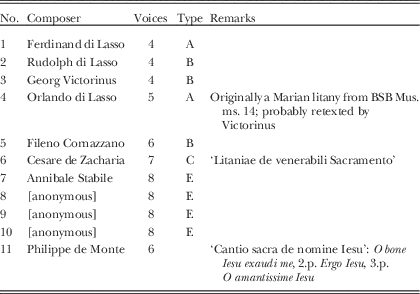
Litanies for the Blessed Virgin Mary

Litanies for the Saints