The goal of this article is to explore aspects of mortuary ritual as strategies of alliance employed by ancient Maya elites in the Early Classic period. Ancient Maya political organization has proven difficult to characterize (A. Chase and D. Chase Reference Chase and Chase1996; Demarest Reference Demarest, Demarest and Conrad1992, Reference Demarest1996; Fox and Cook Reference Fox and Cook1996; Iannone Reference Iannone2002; Marcus Reference Marcus, Sabloff and Henderson1993), but the ancient Maya can be described as archaic states (Iannone Reference Iannone2002:68). Infrastructure such as roads, water-management features, monumental architecture, and intensive agriculture imply central governance, but the archaeological record of many ancient Maya sites reveals varying degrees of centralization. The degree to which the larger Maya kingdoms held authority over smaller regions remains poorly understood and likely varied across the Maya landscape and through time. Joyce Marcus (Reference Marcus, Sabloff and Henderson1993) proposed a dynamic model that incorporated cycles of centralization and decentralization over long periods of time. Demarest (Reference Demarest, Demarest and Conrad1992:155–157) argued that centralization was achieved by individual, charismatic leaders who were adept at manipulating ideology but lacked the economic or military foundations that one expects of archaic states. Political authority based in ideology gave the ancient Maya kings a tenuous grasp on their power.
Governing authority was held by the k'uhul ajaw, the divine lord who inherited the position through birth, and who was perceived as endowed with greater capacity than other people to communicate with nonhuman forces such as deceased ancestors (Astor-Aguilera Reference Astor-Aguilera2010; Demarest Reference Demarest, Demarest and Conrad1992; Houston and Stuart Reference Houston and Stuart1996). Subordinate ajawob from minor polities drew their legitimacy from their association with the k'uhul ajaw from major centers (Sharer and Golden Reference Sharer, Golden, Golden and Borgstede2004). Lords attempted to integrate their subordinates, building patron-client relationships, forming alliances, or directly controlling territory through military force (LeCount and Yaegar Reference LeCount, Yaeger, LeCount and Yaeger2010:31–36). Hieroglyphic texts and iconography depict the k'uhul ajaw collecting tribute from subordinates, but also participating with them in rituals and intermarrying (Martin and Grube Reference Martin and Grube2008:20). Iconography and hieroglyphs give a top-down perspective, and we rely on archaeology to inform us on the strategies and interactions of Maya elite with their overlords. Recent assessment of ancient Maya political organization calls for a multiscalar approach, and agents acting at every level of the social hierarchy are considered (LeCount and Yaegar Reference LeCount, Yaeger, LeCount and Yaeger2010:43).
Bourdieu (Reference Bourdieu and Nice1984, Reference Bourdieu1989) proposed that elements of both material culture and behaviors (“properties”) function to create social groups by indicating social difference (Bourdieu Reference Bourdieu1989:20). The ancient Maya elite are recognized by their access to exotic material culture, elaborate residential architecture, funerary treatment, and hieroglyphic texts (Chase and Chase Reference Chase, Chase, Chase and Chase1992; Haviland and Moholy-Nagy Reference Haviland, Moholy-Nagy, Chase and Chase1992). We propose that the position and head orientation of the deceased, along with other aspects of mortuary treatment associated with the ancient Maya elite, were, as described by Bourdieu, aspects of behavior considered “elite” because they were restricted, and elites recognized each other in them (see also Jackson Reference Jackson2009). Bourdieu emphasizes that the manner in which any property is used is constantly negotiated and changing. Inherent instability provides room for the non-k'uhul ajawob of minor centers to employ them strategically.
The data presented herein is from Burial 7, an elite interment at Cahal Pech, Belize. The location of Burial 7 in a large structure in the site center with opulent grave goods, including artifacts with hieroglyphic inscriptions, indicates that the occupants of the tomb were members of the ruling elite of the site. We argue that elites at Cahal Pech used body position and orientation to set themselves apart from other inhabitants in the broader Belize River Valley and they were possibly emulating elites in more powerful regions. The period of time in which these individuals were interred, the Early Classic and early Late Classic (AD 250–600) was sociopolitically tumultuous in the eastern Maya lowlands, and the Cahal Pech elite may have turned to ritual emulation as a means to enhance their sociopolitical connections.
The Maya Elite and Their Burial Practices
Classic period Maya burial practices were variable in body deposition and number, body position, grave type and location, and grave goods. Although the vast majority of burials were single individual, primary inhumations (Ruz Lhuillier Reference Ruz Lhuillier1968; Scherer Reference Scherer2015; Welsh Reference Welsh1988), variability by region and site is so extensive that it is difficult to summarize. The interaction of the living with the remains of the deceased further complicates the mortuary record (McAnany Reference McAnany2013; Weiss-Krejci Reference Weiss-Krejci2001, Reference Weiss-Krejci, Ciudad-Ruiz, Sosa and Ponce de Leon2003). Fitzsimmons's synthesis of pan-lowland Maya burial practices demonstrates a predilection for interring the dead within structures, often on the eastern side of architectural courtyards but also under plazas, within temples, under household floors, and under other architectural features (Reference Fitzsimmons2009:65, after Ruz Lhuillier Reference Ruz Lhuillier1968 and Welsh Reference Welsh1988). Royal burials were typically placed in their own temples or ceremonial platforms, in many cases marked overhead by an altar or staircase. The skull received particular attention by the living, in some cases covered with a shell or ceramic vessel, in others removed from an inhumation entirely.
Body deposition also defies simple categorization. Body positions, flexed or extended, seem to be site specific, as were preferences for head orientation, although this varies considerably (Fitzsimmons Reference Fitzsimmons2009:65). Skeletal elements were placed in secondary locations, either in a grave with primary inhumations or in a dedicatory space such as a cache (Tiesler Reference Tiesler, Tiesler and Cucina2007). Skulls are found in large deposits suggesting trophies from battle or sacrificial victims (Duncan Reference Duncan2011). Graves were also reused for sequential interments, often disturbing the original occupant (D. Chase and A. Chase Reference Chase and Chase1996; Healy et al. Reference Healy, Awe and Helmuth1998). Interacting with the bones of the deceased is known from the archaeological and iconographic records at Tikal, Piedras Negras, Cahal Pech, and elsewhere (Awe Reference Awe, Moyes, Christenson and Sachse2018; Eberl Reference Eberl2005; Fitzsimmons Reference Fitzsimmons2009; Tiesler et al. Reference Tiesler, Cucina, Kam Manahan, Douglas Price, Ardren and Burton2010).
The inclusion of large quantities of ceramics, red pigment, earflares, stingray spines, and jade within a tomb defines many interments that are likely royal, although there is distinct regional and site-specific variation (Fitzsimmons Reference Fitzsimmons2009:11; Krejci and Culbert Reference Krejci, Patrick Culbert and Grube1995; Welsh Reference Welsh1988). For example, at Palenque, royal interments have few ceramic vessels (Scherer Reference Scherer2015:188), and the royal tombs at Piedras Negras are lacking in jade artifacts (Fitzsimmons et al. Reference Fitzsimmons, Andrew Scherer and Escobedo2003:458). Recent studies in other areas of the Maya lowlands have also noted growing evidence for regional patterns in ancient Maya burial practices (D. Chase and A. Chase Reference Chase and Chase1996; Pereira Reference Pereira2013; Scherer Reference Scherer2015; Scherer et al. Reference Scherer, Golden, Arroyave, Robles and Wrobel2014; Schwake Reference Schwake2008).
In the Belize River Valley during the Classic period, 54% (n = 151) of the burials were in a prone position, 23% (n = 65) were in a supine position, and 85% are oriented with head to the south (n = 353; Novotny Reference Novotny2015). The interment of bodies in this position is consistent across age and sex categories (Novotny Reference Novotny2015). During the Classic period, the relationship between body position and status, as approximated by site placement in the Belize Valley settlement hierarchy (Novotny Reference Novotny2015 after Iannone Reference Iannone1996, Reference Iannone and Garber2004), is statistically significant (χ 2 = 50.05; df = 10; p < .05). Among elites, head orientation is consistently to the south, with 82% (n = 146) of burials having this orientation; 6% (n = 12) were oriented with head toward the north. Burials containing multiple individuals were uncommon (Schwake Reference Schwake2008). Freiwald (Reference Freiwald2011) found that individuals interred in a prone, extended position with south-oriented head were more likely to exhibit radiogenic strontium isotope values consistent with early childhood residence in the Belize River Valley, possibly signifying community identity. Furthermore, research at nearby Xunantunich demonstrated that nearly all individuals buried in an atypical pattern had nonlocal radiogenic strontium values (Freiwald et al. Reference Freiwald, Yaeger, Awe, Piehl and Wroble2014).
The Belize River Valley and Cahal Pech
The 15 major centers of the Belize River Valley, of which Cahal Pech is one, are characterized by epicenters with pyramidal temples, eastern triadic groups (versions of the “E-Group”), royal palace architectural complexes, ball courts, stone monuments (occasionally carved), causeways, causeway terminus groups, and, in some cases, royal tombs (Helmke and Awe Reference Helmke and Awe2012:62–64). Their large sizes and defensible locations suggest low political integration (Chase Reference Chase and Garber2004:332), a characteristic that led Helmke and Awe (Reference Helmke and Awe2012:74) to describe the sociopolitical organization of the region as “balkanized.” Chase (Reference Chase and Garber2004; see also LeCount and Yaeger Reference LeCount, Yaeger, LeCount and Yaeger2010) suggests that access to trade routes and agricultural productivity likely made the valley the focus of competition between more powerful centers.
Until recently, few hieroglyphic texts were from the Belize Valley, making it difficult to determine the political hierarchy of geographically proximate major centers and their relationship to the greater Maya region. Emblem glyphs are useful texts for reconstructing such relationships (Marcus Reference Marcus, Feinman and Marcus1998; Stuart and Houston Reference Stuart and Houston1994). Helmke and Awe (Reference Helmke and Awe2012) argue that there were likely emblem glyphs at the major Belize Valley centers of Buenavista del Cayo, Baking Pot, Xunantunich, and Pacbitun, which suggests that other major sites in the area potentially had them too (Helmke and Awe Reference Helmke and Awe2012:75). Helmke and Awe (Reference Helmke and Awe2012) further note that a glyphic text painted on the wall of a “throne room” in Structure A-1 at Cahal Pech may have included the emblem glyph of the site, and Awe and Zender (Reference Awe and Zender2016:163) suggest that the inscriptions on the rings and turtle shell from Burials B1-7 and B1-2 at Cahal Pech likely refer to a local royal title.
Although emblem glyphs suggest the sites in the Belize Valley considered themselves independent in some regard, we know from texts at other lowland sites describing principal/vassal relationships that they likely were not (Helmke and Awe Reference Helmke and Awe2012:75). The Belize Valley was a fertile farming zone, and it provided access for the landlocked Central Petén sites to Caribbean trade routes. Geography may have lent Belize Valley sites some leverage, but it seems likely that these major centers, including Cahal Pech, were the vassals of larger sites at points in their history. Hieroglyphic texts at other sites suggest the Belize Valley was pulled between the competing city-states of Naranjo and Caracol throughout the Classic period (Chase Reference Chase and Garber2004; Helmke and Awe Reference Helmke and Awe2012; Lecount and Yaeger Reference LeCount, Yaeger, LeCount and Yaeger2010).
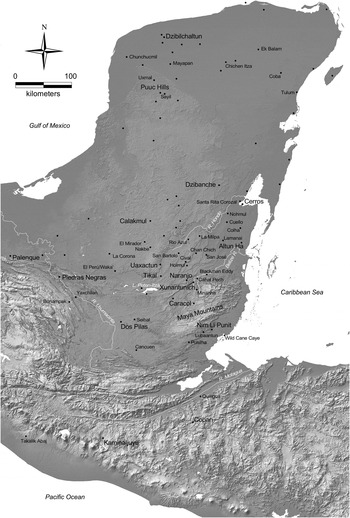
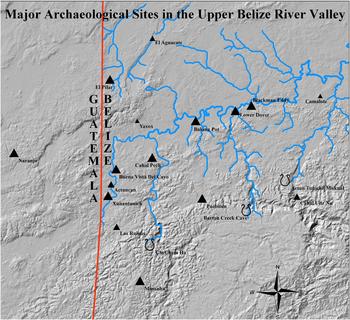
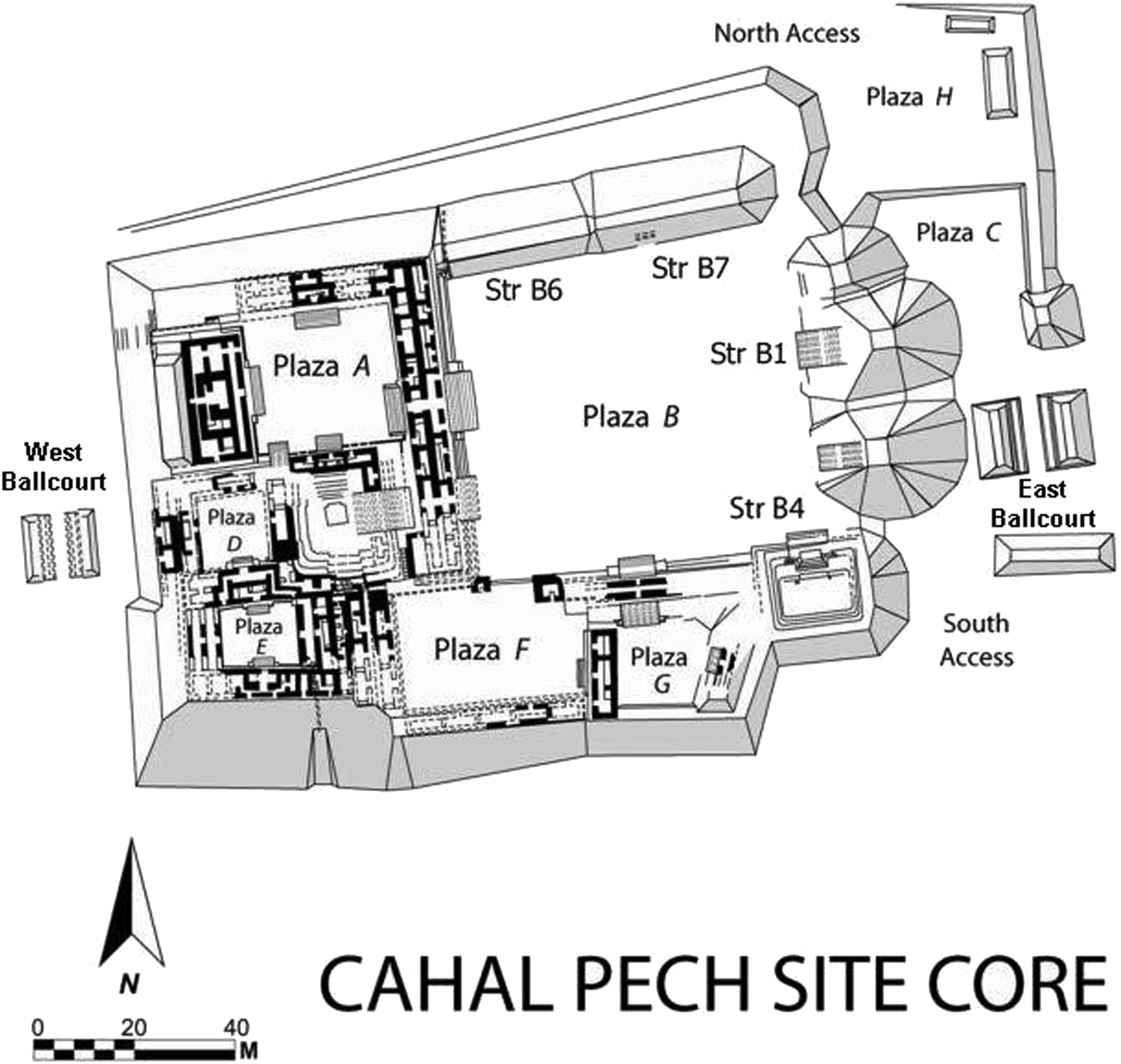
Cahal Pech is located in western Belize in the upper Belize River Valley on a hilltop above the west bank of the Macal River (Figures 1, 2). The central precinct consists of at least 38 structures, including two ballcourts, several temples, and range structures that enclose eight plazas of which the largest is Plaza B (Awe Reference Awe1992). Initial settlement at Cahal Pech dates to the terminal Early Preclassic period (1200–900 BC) and the site continued into the Terminal Classic period (AD 750–850). Structure B1 is the central, eastern structure within the triadic group on the eastern edge of Plaza B (Figure 3; Awe et al. Reference Awe, Hoggarth, Aimers, Freidel, Chase, Dowd and Murdock2017) and is a 12 m high pyramid with two smaller structures, B-2 and B-3, appended to its north and south sides respectively.
Map of sites in the Maya region with sites mentioned in the text emphasized (Houk Reference Houk2015:Figure 1.1).

Belize River Valley sites mentioned in the text (map courtesy of Belize Valley Archaeological Reconnaissance Project). (Color online)

Cahal Pech site core (map courtesy of Jaime J. Awe).

Structure B1 Excavations
Excavations within Structure B1 revealed 15 individuals within 13 graves (Supplemental Figure 1; Awe Reference Awe1992; Reference Awe2013; Awe and Zender Reference Awe and Zender2016; Ishihara-Brito et al. Reference Ishihara-Brito, Can, Awe, Hoggarth, Ishihara-Brito and Awe2013; Mitchell Reference Mitchell2006; Novotny Reference Novotny, Hoggarth, Guerra and Awe2012a; Santasilia Reference Santasilia2013a, Reference Santasilia, Hoggarth, Ishihara-Brito and Awe2013b). The majority were uncovered by Awe during excavation of Structures B1, B2, and B3 in the 2012 to 2014 field seasons of the Belize Valley Archaeological Reconnaissance Project. The primary purposes of these investigations were to construct a detailed record of the morphology and stratigraphy of this eastern triadic shrine and to recover additional primary deposits like burials and caches to aid in the chronological reconstruction of the site.
Burial 7 is a crypt, a stone-lined space with capstones (Welsh Reference Welsh1988), initially constructed at the onset of the Early Classic period. After the initial interment, the crypt was reentered at least two more times by the ancient Maya during the latter part of the Early Classic and early Late Classic periods. The crypt is 2.2 m below the summit platform of Str. B1, along the east–west axis of the structure. Below a poorly preserved plaster floor, our excavations encountered a thick layer of chert flakes on top of the capstones of the Burial 7 crypt. These flakes were likely deposited following the final entry into the crypt (Santasilia Reference Santasilia2013a).
Beneath the capstones, five ceramic vessels were recovered stacked against the north wall of the chamber. One of the vessels was decorated with iconography associated with ancestors (Zender Reference Zender, Hoggarth and Awe2013). The vessels contained several artifacts, including three jade celts (Figure 3), deer antlers, and human skeletal remains. The disarticulated skeletal elements were from the cranium, axial, and appendicular skeleton, although the thoracic region and the hands were not well represented, a pattern consistent with secondary or disturbed burials (Duday et al. Reference Duday, Courtaud, Crubezy, Sellier, Tillier, Crubezy, Duday, Sellier and Tillier1990).
Skeletal Remains
The body of Individual 1 was found at a slightly lower depth than the vessels at the north end of the crypt. The remains were poorly preserved but represented the primary interment of an adult female who was laid in an extended, supine position with head to the north, departing from the typical Belize River Valley practice described above (Supplemental Figure 2). Age was estimated based on skeletal morphology and dental wear (Buikstra and Ubelaker Reference Buikstra and Ubelaker1994). Sex was estimated using a discriminant function analysis of carpal measurements (Mastrangelo et al. Reference Mastrangelo, De Luca and Sanchez-Mejorada2011). No pathologies, evidence of trauma, or culturally motivated body modification were observed on the remains of Individual 1 (Novotny Reference Novotny, Hoggarth, Guerra and Awe2012a).
Individual 2 was the primary interment of an adult male. Age was estimated using skeletal development and dental wear (Buikstra and Ubelaker Reference Buikstra and Ubelaker1994). Sex was estimated using morphological characteristics of the cranium (Buikstra and Ubelaker Reference Buikstra and Ubelaker1994) in addition to a discriminant function analysis of carpal measurements (Mastrangelo et al. Reference Mastrangelo, De Luca and Sanchez-Mejorada2011). Individual 2 was placed in an extended, supine position with head oriented to the north, a departure from the Belize Valley norm (Supplemental Figure 3). Several parts of the body were disturbed after its initial interment. The lower bones of the left leg were found disarticulated and lying parallel to where the left femur should have been. In addition to tibia fragments, the location of the missing left femur was marked by the carved and painted femur of a jaguar (Panthera onca). The right leg was rotated laterally out of anatomical position. The cranium was also disturbed and had been placed above the left shoulder with orbits toward the feet. Cranial fragments showed residue consistent with red pigment (Novotny Reference Novotny, Hoggarth, Guerra and Awe2012a).
Individual 3 was represented by bones of the feet and one tooth. The bones of the feet were beneath the cranium of Individual 2 at the north end of the crypt, and the tooth was at the south end. No other evidence of this body was found. It is possible that the bones discovered within the vessels stacked at the north end of the crypt belonged to this individual, but it is not possible to say for certain (Novotny Reference Novotny, Hoggarth, Guerra and Awe2012a). The location of the tooth with relation to the feet, which were poorly preserved but articulated, suggests interment in an extended position with head oriented to the south. Nevertheless, the lack of other bones, particularly cranial bones, makes this conclusion tenuous.
Artifacts
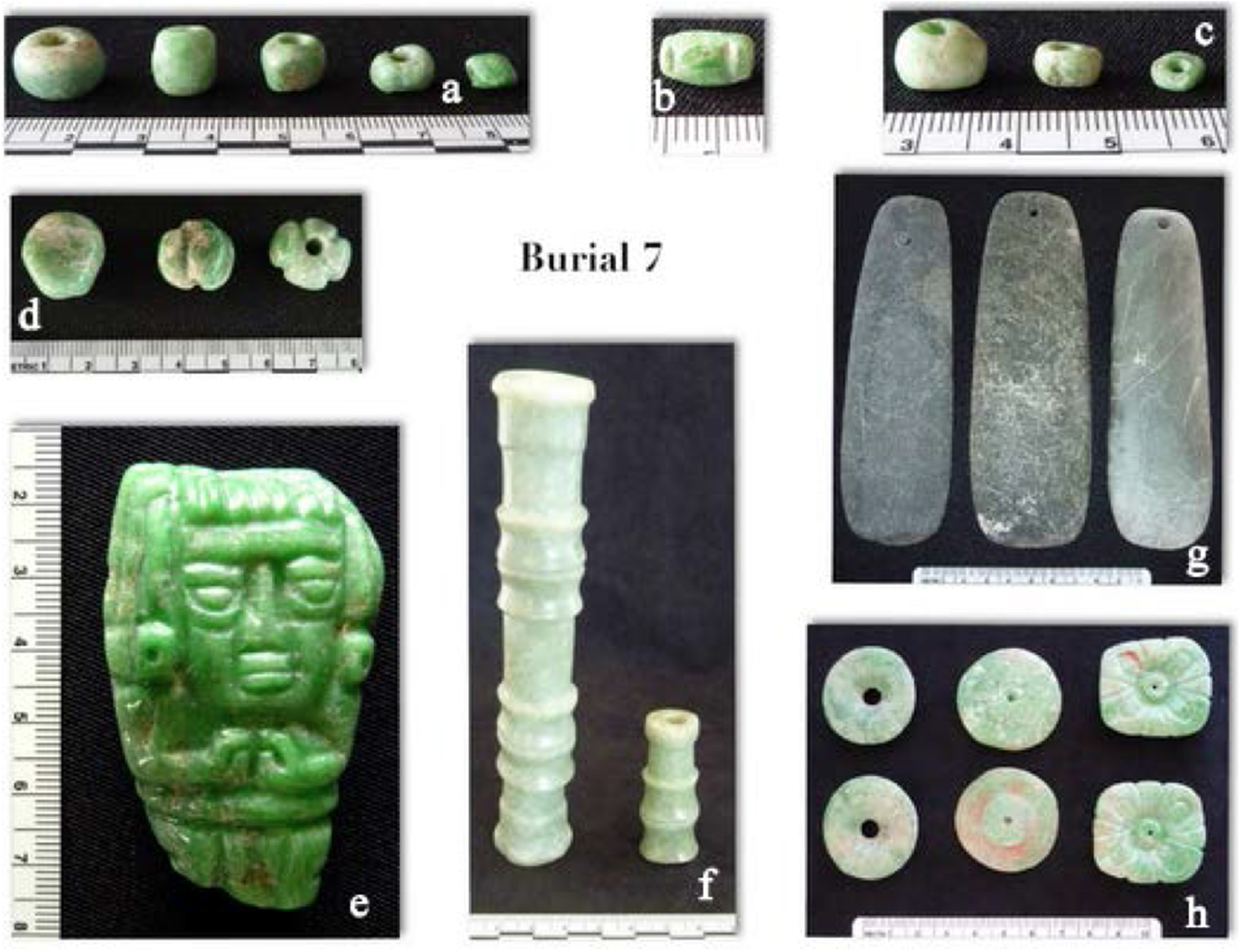
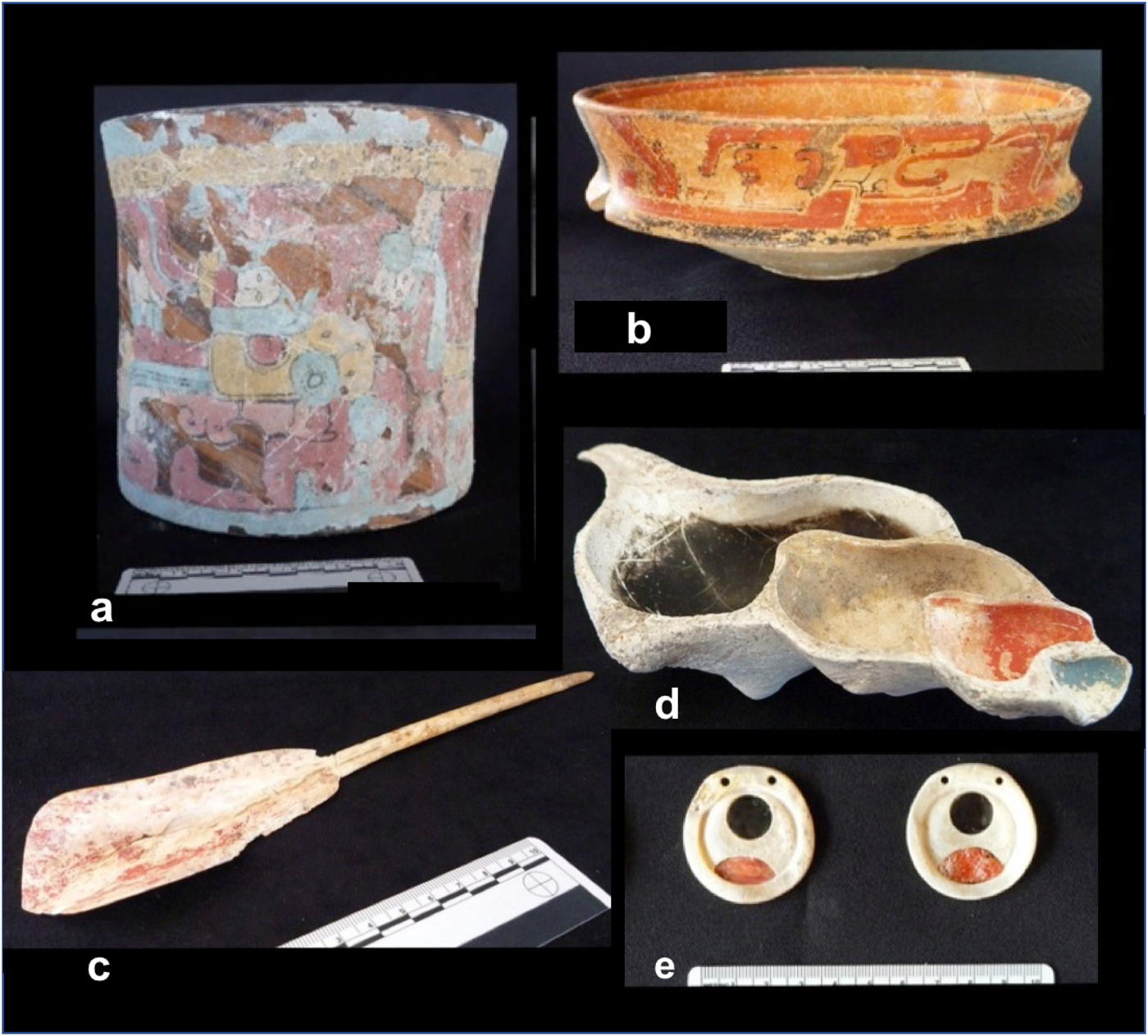
Ceramic vessels within the crypt date its occupation to the Early Classic and early facet of the Late Classic period. Two basal flanged Dos Arroyos Orange Polychrome bowls were discovered, along with a stuccoed vase depicting an earth monster and iconography consistent with that seen at the central Mexican site of Teotihuacan (Figure 5a) and in royal tombs at Kaminaljuyu in Guatemala (Wetherington Reference Wetherington1978), Copan in Honduras (Bell et al. Reference Bell, Sharer, Traxler, Sedat, Carrelli, Grant, Bell, Canuto and Sharer2004), and in a cache at Altun Ha (Braswell Reference Braswell2003). These vessels are known from only two burials in the Belize Valley, both at Baking Pot (Audet Reference Audet2006; Bullard and Bullard Reference Bullard and Bullard1965). Also present was an early Late Classic Silkgrass fluted vase, a bichrome bowl, and three monochrome red dishes (Awe and Zender Reference Awe and Zender2016:259–260). Jadeite artifacts included several beads, six ear flares, a pendant depicting the maize god, three large celts, and two carved pectorals (Figure 4a–h; Santasilia Reference Santasilia2013a). Bloodletting implements include two stingray spines and several obsidian blades, one with red pigment (Santasilia Reference Santasilia2013a).
Jadeite artifacts recovered from Burial 7: (a, b, c) beads; (d) adornos; (e) pendant; (f) pectorals; (g) celts; (h) ear flares (Catharina Santasilia, photographer). (Color online)

Ceramic, shell, and bone artifacts from Burial 7: (a) Vessel 1, stuccoed vessel; (b) Vessel 4, Dos Arroyos Orange Polychrome with ancestral figure; (c) bone stylus; (d) shell inkpot; (e) shell pendants with obsidian and Spondylus sp. inlays. (Catharina Santasilia, photographer). (Color online)

A perforated jaguar (Panthera onca) humerus was placed near the chest of Individual 2. Additional faunal remains included a grey fox (Urocyon cinereoargenteus) mandible, carved jaguar canine, over 3,000 dog incisors and canines (Canis sp.), and white-tailed deer (Odocoileus virginianus) teeth, all perforated (Stanchly and Awe Reference Stanchly and Awe2015). The animal teeth may have adorned a headdress or been worn as a necklace (Santasilia Reference Santasilia2013a). There were several large shells (Spondylus sp.), as well as adornos (Spondylus sp.), and four shell plaques with inlays of obsidian and shell (Spondylus sp.), which may have decorated a shroud (Figure 5e). Shell and jadeite fragments in various shapes possibly comprised a funerary mask. A conch shell ink pot was recovered from the chest area of Individual 2 with remnants of paint in red, black, yellow, and blue (Figure 5d). A bundle of bone styli, several painted red, may show association between one of the deceased and the scribal arts (Figure 5c). Bone pins and spindle whorls speak to further crafting activities, likely weaving.
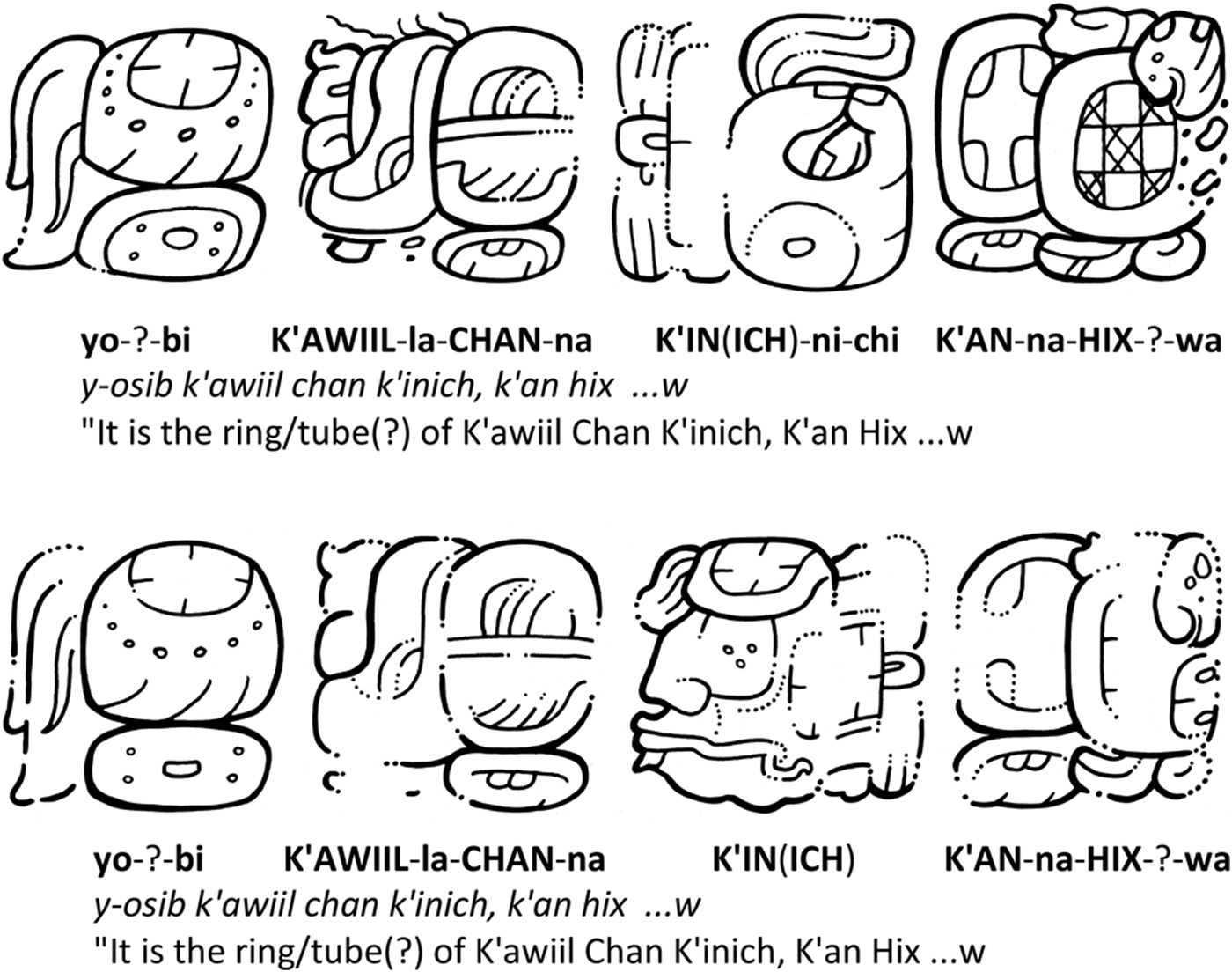
Two delicate bone rings were recovered finely inscribed with hieroglyphs (Figure 6). The rings have four glyph blocks, each with nearly parallel inscriptions; a common glyphic substitution exists in the K'IN(ICH) logogram of one ring (Awe and Zender Reference Awe and Zender2016). The first glyph block consists of a possessive noun loosely translated as “the ring of….” (Awe and Zender Reference Awe and Zender2016:160–163). The next two blocks are a name: K'awiil Chan K'inich, which means roughly “the Sun God like Lightning in the Sky.” K'awiil Chan K'inich was also the name of an eighth-century King of Dos Pilas (Awe and Zender Reference Awe and Zender2016:160–163; Martin and Grube Reference Martin and Grube2008:60–63). The final block consists of two elements that read “Yellow (or Tawny) Jaguar” and an undeciphered element that reads K'AN-na-HIX…-wa (Awe and Zender Reference Awe and Zender2016). Its location following a name suggests that it is a title. The possible title has not been found in enough contexts to permit an accurate reading; it has appeared at several other sites, but it occurs most frequently at Cahal Pech (Awe and Zender Reference Awe and Zender2016).
Hieroglyphic inscriptions on bone rings from Burial 7 (Marc Zender, illustrator).

A jadeite plaque recently discovered at the southern Belizean site of Nim Li Punit bears an example of the title from the bone rings, K'AN-na-HIX…-wa (Prager and Braswell Reference Prager and Braswell2016; Awe and Zender Reference Awe and Zender2016), leading Prager and Braswell (Reference Prager and Braswell2016:10) to suggest that the royal woman who bore the jadeite plaque may have been from Cahal Pech (see also Awe and Zender Reference Awe and Zender2016:164). Interestingly, the title was also found inscribed on a turtle carapace recovered from Burial 2 at Cahal Pech. As Awe and Zender (Reference Awe and Zender2016) emphasize, there are now four examples of this title, three appearing at Cahal Pech. The repeated association with Cahal Pech thus suggests that the K'AN-na-HIX…-wa title was specific to the ruling family of the site.
We follow Joyce Marcus (Reference Marcus, Sabloff and Henderson1993) in identifying the ancient Maya elite as a minority group with a specific and exclusive lifestyle and use of material culture. The exotic nature, quality, and quantity of artifacts, as well as the hieroglyphic inscriptions naming a possible noble title, suggest an elite status for the individuals in Burial 7, if not a royal one. Many items found in Burial 7 are consistently found within tombs in the Belize Valley and in those of known Maya rulers in other regions. Baking Pot Tombs 1 and 2, Buenavista del Cayo Burial 11, and Pacbitun Burial 9 have layers of chert or obsidian debitage, numerous ceramic vessels, bloodletting implements, large quantities of jade and shell, and mosaic masks (Audet Reference Audet2006; Healy Reference Healy1990). Although Burial 7 does not have the quantity of ceramic vessels that Krejci and Culbert (Reference Krejci, Patrick Culbert and Grube1995) associate with royal interments, the eight vessels, which include a number of polychromes, are the most from any grave at Cahal Pech (Awe and Zender Reference Awe and Zender2016). A thorough discussion of the definition of royal vs. elite is beyond the scope of this paper. Furthermore, the relationship between grave inclusions and social status during life is actively debated (Fitzsimmons Reference Fitzsimmons2009).
Dating
To determine when the three individuals in Burial 7 were interred, we selected human teeth for radiocarbon dating. Because preservation of human bone is generally poor in the Maya region, we anticipated that teeth would yield enough well-preserved collagen. The samples were prepared and analyzed at the Accelerator Mass Spectrometry Laboratory at the University of Arizona. The teeth were cleaned mechanically prior to chemical cleaning and sample preparation. Collagen extraction and filtration followed the process outlined in Law and Hedges (Reference Law and Hedges1989), with minor modifications. The first modification was that subsequent to demineralization, the samples were gelatinized at 70 °C for <12 hours to aid in removal of contaminating humic material. The second modification was filtering the collagen using 0.45 µm glass microfiber autovials prior to being lyophilized. Samples were then analyzed by AMS. Radiocarbon dates and correction for contamination were calculated after Donahue and colleagues (Reference Donahue, Linick and Timothy Jull1990).
The data were calibrated using the OxCal v. 4 calibration curve (Bronk Ramsey Reference Bronk Ramsey2008). Results are given in Table 1 and place the use of the crypt throughout the Early Classic period (AD 250–600). The ceramic mortuary assemblage coincides well with the radiocarbon dates. Vessels 1, 4, and 7 date to the Early Classic period (AD 250–600), while the remaining five vessels date to the early part of the Late Classic (AD 600–700).
Radiocarbon Data from Cahal Pech Burial 7.

Radiogenic Strontium Isotope Analysis
Previous research has identified a relationship between residence within the Belize River Valley and body position (Freiwald Reference Freiwald2011). We also used radiogenic strontium isotopes to assess the residential history of the individuals interred in Burial 7. Radiogenic strontium values (87Sr/86Sr) vary geologically based on the mineral composition and age of bedrock (Faure Reference Faure1986). Assuming local food and water consumption, radiogenic strontium values are good indicators of residence during formation of osseous and dental tissues because the dietary strontium is incorporated into hydroxyapatite, where it substitutes for calcium (e.g., Comar Reference Comar and Wasserman1963; Dolphin and Eve Reference Dolphin and Eve1963). Radiogenic strontium isotope values are broadly known throughout Mesoamerica, and baseline data are used to establish the variation of major, minor, and trace elements in flora, fauna, water, and soil (Hodell et al. Reference Hodell, Quinn, Brenner and Kamenov2004; Price et al. Reference Price, Burton, Fullagar, Wright, Buikstra and Tiesler2008). The range of 87Sr/86Sr values for the Belize River region is 87Sr/86Sr = 0.70821 to 87Sr/86Sr = 0.70908 (Freiwald Reference Freiwald2011).
Use of radiogenic strontium isotopes to reconstruct paleomobility assumes that individuals consumed food and water from that geographic location (Bentley Reference Bentley2006). There is no archaeological evidence that people in the Belize River Valley were consuming large amounts of food or water from different geologic zones (Freiwald Reference Freiwald2011; Thornton Reference Thornton2011; Yaeger and Freiwald Reference Yaeger and Freiwald2009). Consumption of animals such as deer from the nearby Vaca Plateau and Maya Mountains, which have different radiogenic strontium values, cannot be ruled out. Deer meat is low in calcium, suggesting meat consumption likely did not contribute nonlocal radiogenic strontium values.
Researchers typically identify individuals local to a geologic region by radiogenic strontium values that fall within two standard deviations of the mean value of local fauna (Price et al. Reference Price, Burton and Bentley2002). There are two geologically distinct strontium zones in the Belize Valley region (Freiwald Reference Freiwald2011:102–105). We follow Freiwald (Reference Freiwald2011) in identifying local individuals as those that fall within two standard deviations of the faunal mean for the strontium zone within which the site is located (i.e., the Belize River strontium zone). Modern fauna range from 87Sr/86Sr = 0.70829 to 0.70853 (average 87Sr/86Sr = .70838 ± .0001; Freiwald Reference Freiwald2011:172).
All archaeological samples are at risk for contamination. Naturally occurring radiogenic strontium in soils may be taken up by bone; teeth are less porous and, thus, less susceptible to diagenetic processes. Diagenesis and contamination are addressed by cleaning the bone surface mechanically and chemically and by comparing the ratio of calcium and phosphorus (Ca/P) in archaeological bone samples to that in living bone. The ratio of uranium to calcium (U/Ca) is also assessed, as uranium is commonly found in soils (e.g., Burton Reference Burton, Anne Katzenberg and Saunders2008; Lambert et al. Reference Lambert, Weydert, Williams and Buikstra1990; Price et al. Reference Price, Blitz, Burton and Ezzo1992).
Radiogenic strontium isotope values were collected from bone and teeth samples from Individuals 1 and 2 (Table 2). The redeposited bone was not sampled due to poor preservation, which made it difficult to distinguish redundant skeletal elements. There were no teeth associated with these remains. All bone and teeth samples were processed in the Archaeological Chemistry Laboratory in the Center for Bioarchaeological Research. Sample preparation and strontium collection procedures are described in detail elsewhere (Novotny Reference Novotny2015).
Radiogenic Strontium Isotope Results from Cahal Pech Burial 7.

Radiogenic strontium isotope sample preparation and analysis were performed by the first author under the direction of Drs. Kelly J. Knudson and Gwyneth Gordon. The enamel samples were analyzed using the Thermo-Finnigan Neptune multicollector inductively coupled plasma mass spectrometer (MC-ICP-MS) in the W.M. Keck Foundation Laboratory for Environmental Biogeochemistry at Arizona State University. Recent 87Sr/86Sr analyses of strontium carbonate standard SRM-987 yield a value of 87Sr/86Sr = 0.710261 ± 0.000020 (2σ), which is in agreement with analyses of SRM-987 using a thermal ionization mass spectrometer (TIMS), where 87Sr/86Sr = 0.710263 ± 0.000016 (2σ; Stein et al. Reference Stein, Starinsky, Katz and Schramm1997), and analyses of SRM- 987 using an identical MC-ICP-MS, where 87Sr/86Sr = 0.710251 ± 0.000006 (2σ; Balcaen et al. Reference Balcaen, De Schrijver, Moens and Vanhaecke2005). On April 9–10, 2013, analyses of SRM-987 yielded a value of 87Sr/86Sr = 0.710241 ± 0.000020 (2σ, n = 58).
The mean Ca/P values from the bones and teeth of the individuals from Burial 7 range from 2.11–2.13 with a mean of 2.16 ± 0.05 (n = 4, 1σ). All bone and tooth samples were within an acceptable range of the living ratio of Ca/P = 2.1, so we determined that little diagenesis occurred. The average U/Ca ratio was 1.88 × 10−07 ± 2.63 (n = 4, 1σ). The ratios were judged sufficiently small that diagenetic contamination is unlikely for all samples.
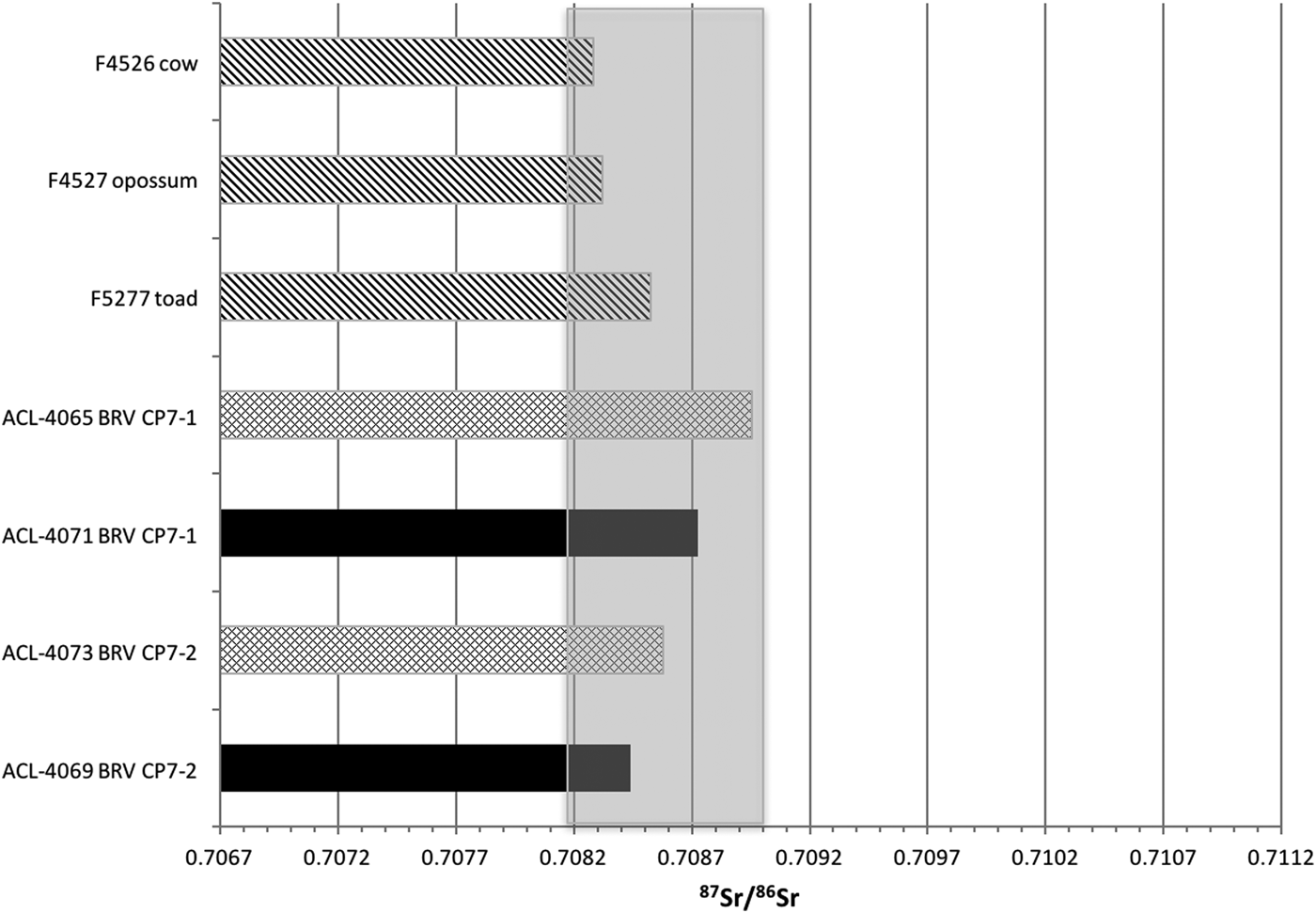
Radiogenic strontium values for Individuals 1 and 2 are given in Table 2 and are compared to baseline values in Figure 7. Both fall very near to the Belize River Valley mean 87Sr/86Sr = 0.70852 (Freiwald Reference Freiwald2011). Comparison of samples from teeth and bone indicates that Individuals 1 and 2 were present in the Belize River Valley as juveniles and as adults. The bone sample value from Individual 1 (Table 2), the last individual placed in the crypt, was slightly higher than the other values, although it was still consistent with residence in the Belize River Valley.
Hashed bars, top, represent radiogenic strontium faunal baseline values from Freiwald (Reference Freiwald2011). Shaded bars represent radiogenic strontium isotope values for teeth and latticed bars represent radiogenic strontium values for bone.

Discussion
Grand funerary displays, including re-entry rituals, were likely an important aspect of the theater necessary to maintain stable political power in ancient Maya society (Demarest Reference Demarest, Demarest and Conrad1992). Given the high number of major centers in the Belize Valley region, maintaining relationships with powerful extraregional centers was one way rulers could elevate themselves. Links, real or perceived, to powerful centers may have been increasingly important in times of sociopolitical turmoil. Centers such as Cahal Pech in economically rich regions may have changed their allegiances with powerful neighbors as the latter rose and fell. Practicing mortuary traditions departing from the Belize Valley norm may have been a strategy used by the Cahal Pech rulers to associate themselves with elites in other regions (Bourdieu Reference Bourdieu and Nice1984). We also argue that it is significant that an elite burial with local occupants departs from typical Cahal Pech and greater Belize Valley body treatment. Burial 7 seems to have more in common with interments at sites south of the Belize Valley, including Caracol, although there is also overlap with the western lowlands, particularly in terms of head orientation.
Emerging Mortuary Patterns
Recent research suggests that mortuary features such as body position and head orientation may represent regional identity at Maya sites (Peirera Reference Pereira2013; Scherer Reference Scherer2015). During the Classic period, a northerly head orientation is common in the western lowlands at Piedras Negras, and Palenque, and in the central lowlands at Tikal and Uaxactun (Scherer Reference Scherer2015; Welsh Reference Welsh1988). At Tikal, the elaborate tombs from the Mundo Perdido complex dating to the Early Classic period predominantly featured burials with their heads to the east (LaPorte Molina Reference LaPorte Molina, Arroyo, LaPorte and Mejía2005). During the mid-fifth century, major changes to mortuary practices are seen at Tikal and throughout the central Peten. Royal burials became even more elaborate starting in the mid-fifth century. Animal skeletons become more common during this time period as did vessels painted in stucco (Krejci and Culbert Reference Krejci, Patrick Culbert and Grube1995:109). The ruling dynasty at Tikal shifted the location at which they interred their leaders from the Mundo Perdido complex to the North Acropolis during the Early Classic (LaPorte Molina Reference LaPorte Molina, Ruiz, Sosa and Ponce de León2003:62–63).
At Caracol, the head orientation varies considerably. Although head to the north is relatively common, it does not predominate (Arlen Chase, personal communication to Awe 2017). The phenomenon of numerous graves and caches in eastern structures is a practice seen in 80% of residential groups at Caracol. At Tikal, it occurs only 14% of the time (Chase and Chase Reference Chase and Chase2004).
In addition to head orientation, we propose that the number of individuals interred in a grave may also indicate regional community identity. Although interments containing multiple individuals have been found in limited numbers at the sites of Chan, Zubin, and Chaa Creek (Connell Reference Connell2000; Iannone Reference Iannone1996; Novotny Reference Novotny and Robin2012b) to the south of Cahal Pech, Burial 7 is the only one at Cahal Pech. Multiple individual interments occur in other lowland Maya subregions and are particularly common south of the Belize Valley in the Macal River Valley, the Vaca Plateau and Chiquibul regions of western Belize, and at Caracol (Awe Reference Awe1985; Awe et al. Reference Awe, Weinberg, Guerra and Schwanke2005; D. Chase and A. Chase Reference Chase and Chase1996, Reference Chase and Chase2017; Healy et al. Reference Healy, Awe and Helmuth1998; Schwake Reference Schwake2008). Schwake (Reference Schwake2008:267–268) observed that Vaca Plateau sites had a much higher frequency of multiple individual interments (40%, n = 213) than the Belize Valley (14%, n = 228) or sites in the southeast Petén (10%, n = 237) in the Late and Terminal Classic periods. The infrequent occurrence of multiple individual interments in the Belize River Valley underscores that Burial 7 sits apart from other burials in this region. Multiple burials are a burial tradition at Caracol (D. Chase and A. Chase Reference Chase and Chase1996, Reference Chase and Chase2017), suggesting that the atypical Burial 7 at Cahal Pech likely reflects influences from Caracol because the latter extended its sphere of influence in the valley following its defeat of Tikal in AD 562 (Chase and Chase Reference Chase and Chase2017).
Sociopolitical Context of Burial 7
Radiocarbon dating of Burial 7 corroborates the relative ceramic dates and allows us to discuss the implications of the interments in terms of the broader sociopolitical lowland Maya landscape. Individual 3, the first individual placed in Burial 7, was interred between Terminal Preclassic and Early Classic times (AD 250 ± 58), in Belize Valley fashion, with a head-south orientation. During this time, material culture at Cahal Pech, such as obsidian, demonstrate economic and ideological links to the greater Maya region (Awe Reference Awe1992:139, 356–357). Plaza B was easily accessible, suggesting that it functioned as a place for public gatherings such as funeral rites (Awe et al. Reference Awe, Campbell and Conlon1991:5). In addition to Individual 3 in Burial 7, one other individual was interred in Structure B1 during the Terminal Preclassic—a young female individual within a stair block of Structure B1, with head possibly to the south (Mitchell Reference Mitchell2006). At least two other burials had already been placed in Structure B1 during the Late Preclassic (Mitchell Reference Mitchell2006; Santasilia Reference Santasilia2013a, Reference Santasilia, Hoggarth, Ishihara-Brito and Awe2013b). We see the beginnings of McAnany's (Reference McAnany2013) “genealogy of place”—successive interments in a structure associated with the east that establishes a ruling lineage and legitimizes their power.
Individual 2, an adult male, was placed in Burial 7 during the latter part of the Early Classic (AD 525 ± 59), with Individual 1 following not long after in the early Late Classic (AD 607 ± 31). Settlement and construction data suggest that population increased at Cahal Pech, and throughout the valley, around this time (Awe and Helmke Reference Awe and Helmke2005:47). A transition in architecture is also seen, with the “formalization of in-line triadic structures which appear to have functioned as eastern family shrines in the central precincts of site cores,” (Awe and Helmke Reference Awe and Helmke2005:48). Four burials have been recovered from Structure B1 that date to the Early Classic, all single individual interments with head oriented south. We argue that the inclusion of Individuals 1 and 2 together was purposeful, because there were other graves and other grave locations that could have been used in Structure B1.
The time during which Individuals 1 and 2 were buried was tumultuous in the eastern Maya lowlands. Two of the most powerful dynasties of the Classic period, the Kaanul, or Snake, dynasty, based at Dzibanche in the Early Classic and later at Calakmul, and the royal dynasty at Tikal, presided over the coronation of kings at the eastern lowland sites of Naranjo and Caracol in AD 546 and AD 553, respectively (Helmke and Awe Reference Helmke and Awe2016a; Martin and Grube Reference Martin and Grube2008; Martin and Velásquez García Reference Martin and García2016). Their interest in the eastern lowlands was partly economic. The aggressive expansion of Tikal was motivated by its interest to secure and maintain trade routes for exotic items such as jade and obsidian (Woodfill and Andrieu Reference Woodfill and Andrieu2012). Although the vassal of the Kaanul dynasty at Naranjo, Aj Wosal Chan K'inich, would be long-lived and cooperative, his successor, K'uxaj, attempted to stop Kaanul domination, ending in Naranjo's defeat (Martin and Grube Reference Martin and Grube2008:72). Likewise, Caracol rebelled against Tikal in AD 562, joining forces with the Kaanul dynasty (Martin and Grube Reference Martin and Grube2008). Following the defeat of Tikal, Caracol became the dominant force in west central Belize, apparently extending its control over Belize Valley sites. Two hieroglyphic panels recently found at Xunantunich describe a possible civil war between half-brothers of the Kaanul dynasty (Helmke and Awe Reference Helmke and Awe2016a, Reference Helmke and Awe2016b). The panels underscore the complexity and bellicosity of the political landscape during the early Late Classic in this region. Mortuary ritual was a way to negotiate and possibly transform sociopolitical relationships and may have been used by the elite at Cahal Pech to stabilize their position and power in a region with a number of other major population centers. The removal of the femur from Burial 7 suggests that the Cahal Pech rulers may have been curating these remains as objects for ritual communication with the deceased, a ritual with religious and political undertones.
Conclusion
Careful consideration of Burial 7 can provide better understanding of the relationship between ancient Maya institutions—ancestor veneration through mortuary practices and elite control of this tradition. Archaeological and epigraphic data attest to the existence of individuals that did not have esteemed titles such as k'uhul ajaw but who were royals (ajawob) in their own right (Helmke and Awe Reference Helmke and Awe2012) and who populated ancient Maya courts (Jackson Reference Jackson2013). We emphasize the strategies and processes by which elites manipulated royal culture as an attempt to bolster their own social position and set themselves apart from their contemporaries (Marcus Reference Marcus, Chase and Chase1992). Those responsible for the interment of the individuals in Burial 7 may have used mortuary ritual as a tool of communication about their eliteness to create or enhance their social position (Bourdieu Reference Bourdieu and Nice1984).
The data suggest that the creation of the Burial 7 context was done to demonstrate relationships with sites or regions outside of the Belize Valley. In the early part of the Late Classic, perhaps in response to the decline of Tikal and turmoil at Naranjo, Cahal Pech was likely attempting to maintain its power by affiliating with stronger sites or regions. The few hieroglyphic inscriptions recorded for the Belize Valley suggest that the sites in this lowland Maya subregion were subordinate to larger primary sites throughout their history, such as Naranjo and Caracol (Helmke and Awe Reference Helmke and Awe2012). In the case of Burial 7 at Cahal Pech, the ritual practices observed in this context suggest that Caracol may have been the subject of their emulation at the end of the Early Classic period.
Acknowledgements
We would like to thank the Institute of Archaeology in Belize for permission to excavate at Cahal Pech and to analyze Burial 7. Biogeochemical analyses were funded by NSF award number BCS-1329506. We are also grateful for the laboratory assistance and access from Drs. Ariel Anbar and Gwyneth Gordon of the W.M. Keck Foundation Laboratory for Environmental Biogeochemistry at Arizona State University. The archaeological investigations were made possible by the financial support from the Tilden Family Foundation and the Belize Valley Archaeological Reconnaissance (BVAR) Project. We are grateful to the many BVAR members who participated in the excavations of Str. B1, especially Doug Tilden, Ashley McKeown, Marc Zender, Rosie Bongiovanni, Mat Saunders, Jorge Can, Alfredo (Jim) Puc Sr., Alfredo Puc Jr., Antonio Itza, Eduardo Cunil, and Merle Alfaro. We also extend gratitude to our BVAR colleagues Julie Hoggarth, Myka Schwanke, Christophe Helmke, Claire Ebert, and Rafael Guerra for their constructive comments on our research. Thank you to Tomás Gallareta Cervera for translating the abstract and to the reviewers for their helpful comments and suggestions.
Data Availability Statement
All data discussed in this manuscript are available to the public for research purposes by contacting the authors.
Supplemental Materials
Supplementary material for this article is available at http://dx.doi.org/10.1017/laq.2018.41
Supplemental Figure 1. Structure B1 with all graves indicated (Catharina Santasilia and Reiko Ishihara-Brito, illustrators).
Supplemental Figure 2. Burial 7, Individual 1 (Catharina Santasilia, Marc Zender, and Anna Novotny, illustrators).
Supplemental Figure 3. Burial 7, Individual 2 (Catharina Santasilia, Marc Zender, and Anna Novotny, illustrators).